
Episode 406 ·
Network Monitoring in the Remote World with Tanya Blinova, VP Engineering of AppNeta
Today we’re talking to Tanya Blinova, the VP Engineering at AppNeta. And we discuss why companies of all sizes can benefit from network monitoring. What makes a great VP of Engineering, and tips for conducting interviews when hiring for the first time.
All of this, right here, right now, on the Modern CTO Podcast!
To learn more about AppNeta, check them out at https://www.appneta.com
In case you missed it: check out our episode with Mike Hustler, the CTO of AppNeta
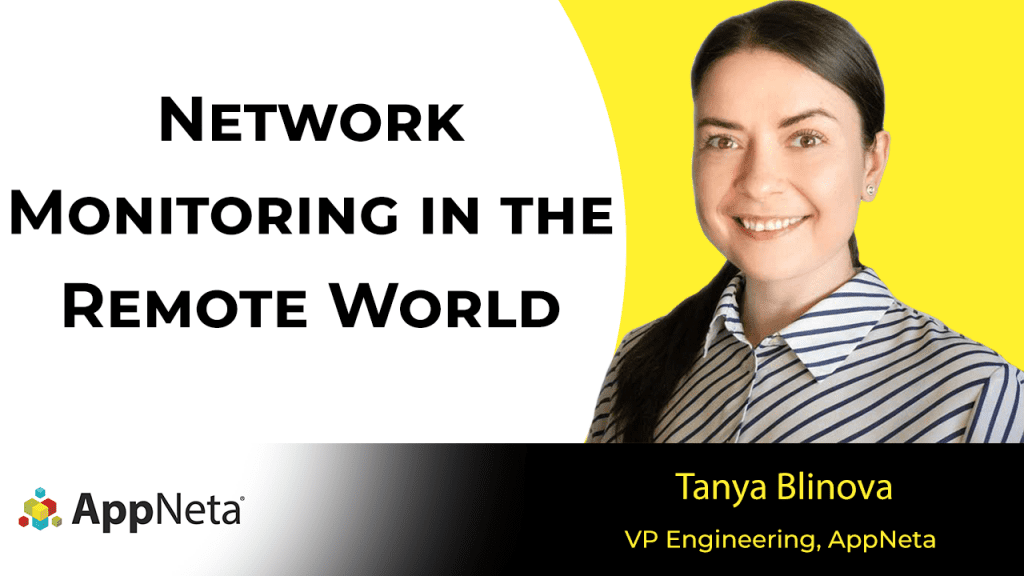
About Tanya Blinova:
Tanya Blinova is AppNeta’s VP of Engineering, having played a pivotal role in our R&D efforts since joining AppNeta in June 2012. In this time, Tanya has helped steer the development and quality assurance of myriad new product features, taking new services from ideation through execution and to production, ensuring greater value is delivered to customers. Prior to AppNeta, Tanya was part of the OSS/BSS team that built Parallels Business Automation platform, a comprehensive business support system for Cloud services including ordering, provisioning, billing and invoicing of reseller management solutions. Tanya received her Masters with Honors from the Moscow Institute of Physics and Technology, Department of Radio Engineering and Cybernetics, in Russia.
About AppNeta:
AppNeta is the only network performance monitoring solution that delivers deep, actionable, end-to-end network performance data from the end-user perspective. With AppNeta’s SaaS-based solution, IT and Network Ops teams at large, distributed enterprises can quickly pinpoint issues that affect network and business-critical cloud application performance, regardless of where they occur. AppNeta is trusted by some of the biggest Fortune 1000 companies, including 3 out of the 5 largest corporations in the world, as well as 4 out of the 5 largest cloud providers.
Transcript
(Joel Beasley at 00:00:03)
Hello, my friends. Today we're talking to Tanya, the VP of Engineering at AppNeta, and we discuss why companies of all sizes can benefit from network monitoring, what makes a great VP of engineering, and tips for conducting interviews when hiring for the first time. All of this right here, right now on the Modern CTO Podcast.
(Tanya at 00:00:29)
Here we go.
(Joel Beasley at 00:00:30)
This is the Modern CTO Podcast.
(Joel Beasley at 00:00:41)
Do you do music?
(Tanya at 00:00:42)
I spent eleven years playing violin. A little bit of piano, but violin was my primary instrument, eleven years of school. But then I moved to Canada and the violin stayed back in Russia where I originally... That's awesome. Yeah. I love the industry. Definitely some beautiful pieces out there.
(Joel Beasley at 00:01:07)
So how did you get started in tech? Were you doing tech and music at the same time, or was there some transitionary period?
(Tanya at 00:01:14)
No, nothing like that. So the music was primarily for, you know, just a side interest or, I guess, parents more insisting we really finish the musical element. The technology, I always loved math, you know, the numbers, the math, the puzzles. There's this analytical element of how things work behind the scene. Like, you put something in—what actually happens? So that was always kind of an area of interest for me.
So then I went to school. I actually started in physics and radio engineering. And in there, I got my first job within Parallels. And again, around automation, business automation. I then joined bigger companies, telecoms, where they had massive, really interesting systems integrating with each other, you know, operational support systems, business support systems, multiple different third parties coming together, talking to one messaging bus. So that was my area of focus back then.
And then I moved to Canada, and AppNeta was actually the first company—first and actually only company for me within Canada. You know, when you move to a new country, it's a new language, it's a new culture, it's pretty much everything new. So I figured I've got to get a job and try to find my way through this community.
(Tanya at 00:03:01)
So when I joined AppNeta, the team was smaller, and I wasn't even in a leadership role then. I joined as a test engineer. Shortly after, because again, I'm always curious how things work deeper inside, not just what you see on the surface, but really what's happening behind the scenes, how the gears are turning or what process is running in the background. So that got me to—you know, my curiosity and interest got me into the team lead position. From there, very shortly, I took a quality management role. I didn't stay too long there as one of our full stack teams was left without a leader, and I was offered to take on an engineering manager role.
So I joined the team and I led a team of really smart engineers. That was probably the biggest responsible change in my career—when you're going from doing things yourself into doing the same things, but not yourself, but through a team of, you know, running a team and leading the team through all the challenges. So after taking over the team, very shortly, we started getting, you know, the most challenging issues or projects or business impactful POCs or, again, features. And in a couple of years, I was promoted to a senior management role. And early this year, I took on a new chapter in my career and a bigger role so far as VP of Engineering with AppNeta.
(Joel Beasley at 00:04:53)
That's awesome. Congratulations.
(Tanya at 00:04:55)
Thank you.
(Joel Beasley at 00:04:56)
So what was one of the biggest challenges you experienced that first time going from individual contributor to manager?
(Tanya at 00:05:05)
Right. As I was saying, you go from, "I can do things very fast"—you know, there is a saying, if you want to do something good, you do it yourself. And the biggest change is you're not doing it yourself anymore. You're doing it through means of others.
So this is where it comes in—a big element of leading a team, being clear of what the goal is about, how the journey looks like, when is it, how do we even know that we reached the destination, and how much time is it okay to take to go through from point zero all the way until the finish. So that was the biggest change, again, from doing it myself into ensuring everyone is clear what needs to be done, how it needs to be done while keeping the bar high, the quality bar high, of course, and ensuring that the roadblocks are removed or identifying when people need help or, you know, someone's really struggling and helping them through one way or another. There is never one answer that fits all the people. We're all different and teams are extremely different. There are different backgrounds, there are different skills, there are different interests. And finding what works for this particular person in this particular case was another challenge to solve.
(Joel Beasley at 00:06:44)
So what are some strategies you have for keeping up to date with how your team is feeling and doing and making sure you're on the same page with them and you know when they're struggling and how you can help?
(Tanya at 00:06:59)
Yeah, that's a good question. As the pandemic hit, the reality just changed. And what worked for us back when we all were in the office—you can see each other in real life, have this, "Hey, how was your weekend?" even a small chat, you know, while you're grabbing a coffee—it disappeared, right? So we needed to adjust and find new ways of exactly figuring out how the team's feeling, how is that person on the other connection doing.
So what we—and of course, some of it, like it or not, reaches through constant communication, whether it's a Zoom meeting or a quick Slack, or what we introduced for our teams, what are called "water cooler conversations." There is a team Slack that we call "Small Talk Channel" which just drops a picture of kids or how I spent my weekend, and the conversation would just get going.
As you know, we in AppNeta, within engineering, we adopt agile frameworks and agile principles. So every day, we effectively start with a stand-up. So what we did very soon was, among all the teams, you know, whether it's leadership team or engineering team, a scrum or full stack team, we would start first Monday as we all come from weekends: "So how about your weekend?" You know, before jumping into doing business problems or day-to-day things, we just pause and just chat.
There are also some hobby-focused channels. There is "We Bake." There are dogs. There are cats. So anything that can really help connect people outside of, you know, individual projects, we tried to unveil it and bring it to the teams.
(Joel Beasley at 00:09:04)
That's awesome. Speaking of pets, one of our salespeople on our team, she has like ten dogs or something, and she just got a pig, like a little baby pig. And so she'll hold that on the Zoom team calls. And it's so great to see the pig in, every couple weeks, see him again.
(Tanya at 00:09:24)
That is so awesome. Yeah, the most unique pet I've heard of.
(Joel Beasley at 00:09:30)
And he seems cute. He plays with the other dogs.
(Tanya at 00:09:33)
Very nice.
(Joel Beasley at 00:09:35)
But so I already know about AppNeta because I had the privilege of speaking with your colleague, Mike. But for the audience, can you talk a little bit about AppNeta? What's the product about?
(Tanya at 00:09:47)
Yeah. AppNeta is the leading network performance monitoring solution for distributed enterprises. We deliver visibility into the end user experience of any application from any location at any time. So with our AppNeta Performance Manager SaaS-based solution, IT and network operations teams can quickly pinpoint issues that affect network or business-critical applications for their end users or maybe remote offices.
(Joel Beasley at 00:10:25)
Very cool. So I know you said that AppNeta was your first job after you moved to Canada. What's kept you there the whole time? What do you like about it?
(Tanya at 00:10:36)
Yeah, that's a good question. So AppNeta is not a big company, and this is a question that I'm being asked the most during the interviews that I conduct. And everyone is curious, like, "So why do you stay at AppNeta?" So again, we're not a big team. Engineering is around forty people, but we have big ambitions, you know. And among those who are on the team, my team or my colleagues' teams, every single person is extremely smart, curious, and dedicated. They all work hard and they solve extremely interesting and challenging problems. And it is great pleasure to work among people who challenge you, who enable you to grow and learn, such smart people, such smart engineers.
We have an interesting domain and serve a very unique market. So again, as I was saying, it's always been interesting and challenging, so it never gets boring after all. And last but not least, AppNeta puts people first. And in any position that I've held, you know, whether it's a direct contributor, individual contributor, or first leadership roles, every decision that our executive team makes, we can feel it. And for me, from every rung, I can feel it as well, whether it's a life balance or fantastic programs that the leadership team introduced as we moved to navigate through the pandemic. So that makes it really rewarding to stay at a place where we're valued as human beings.
(Joel Beasley at 00:12:37)
That's awesome. And I remember when I was talking to Mike, he mentioned that you guys had a hackathon coming up. Did that happen? Or can you talk about it a little bit?
(Tanya at 00:12:47)
Yeah. The hackathon—we had it happen. It happened late September, and that was our second annual hackathon. So hackathon, AppNeta style, is an event that's held within primarily the engineering team, although this time, because again, we're all remote and there are not a lot of opportunities to work together outside of, you know, a focused team environment, so we really asked people, like engineers, to reach outside, reach out to customer-facing teams, to sales teams, to marketing teams, any function outside of engineering, to assemble a team and come up with an idea and try to actually make it, make it real.
So the teams, we asked for teams to stay within four to five people because going beyond, it becomes a tiny crowd. And even, from a time management perspective, it's a little bit tricky to manage. This time, we had thirty-six hours for folks to go through ideation, POC creation, execution, and then presentation cycle. So teams—and we had a really fantastic time and a really fun time joining the demos.
So at the end of a hackathon, teams are asked to present, you know, what they came up with. And the end result is very simple. It's got to be either a functional prototype or a front-end facade with some mock back end. So we still want the code to compile at least and be a little bit interactive as possible. And then there is showtime. At the end of this thirty-six hours, the whole company joins Zoom, and we have presenters show up, what they came up with, and we're able to create the awards at the end.
And we usually employ our executive leaders to help select the team for a particular award. This year, we had three different awards. So hackathons are themed events. We have one theme, different, of course, for different events. And then one of the awards is exploring how well the teams connected their projects or their ideas to the theme, to the problem, effectively, of the event, and how well they were able to kind of unpack it and uncover.
The second award, as you might guess, is technology exploration, right? We don't just want to give people the ability to get curious to create, but also explore the technologies because there are so many new technologies out there. And this is also a great opportunity to roll up your sleeves and give it a try, actually, and put it into practical use.
And the final award we had this year was People's Choice Award. So we asked everyone who attended which team's product or which team they most liked. And that became a sort of award.
(Joel Beasley at 00:16:32)
That's awesome. What were some of the cool projects that came out of it?
(Tanya at 00:16:36)
So some of them are looking at all the data that we have. AppNeta collects a lot of data and we analyze and we allow end users to pinpoint where the problem is. So some of the projects look at the data and try to present it through different lenses. You know, either it's a new dashboard or an interactive way to monitor one of your targets or pinpoint your application and identify what is important for you specifically at a given time and how you can get alerts or maybe look at it from a different lens, something that you're not necessarily able to do within Performance Manager at this point.
Some teams explored it from a different angle and approached the data and the solution through the operations team's perspective. "Hey, I have a maintenance window, for example. Why don't I, you know, put some rules around what alerts I would like to see or what I don't like to see?" Because if I know there is a maintenance happening, well, I do expect some systems to be, you know, maybe showing poor performance or being unavailable. So other teams explored a little bit in this direction, and some took a very deep, really deep look at the core engine, the monitoring engine, and explored ways of, you know, introducing maybe a different angle of monitoring that end users can benefit from.
So all of these were fantastic projects done in just thirty-six hours. You can't believe how much people can actually do in thirty-six hours. But we all were inspired by what is possible ahead of us. And maybe down the road, we might see some of these projects coming to light as part of the Performance Manager offerings.
(Joel Beasley at 00:18:53)
That's really cool. And I'm sure it's really rewarding for the teams if their projects do end up making it into the official offerings, like, "Hey, I started that in thirty-six hours," you know?
(Tanya at 00:19:06)
Yeah, absolutely.
(Joel Beasley at 00:19:08)
So was this the first hackathon you guys did remotely, or did you do that... Oh, I'm sure we're over a year into the pandemic now. It's easy to forget that. So probably the second one, right?
(Tanya at 00:19:20)
Yeah. So this was the second one, and the first one they also did all remote. Actually, we've never done a hackathon in real life. So when the office is on, life is somewhat after normal, that will definitely be something for us to explore. And I'm sure it will look absolutely different from the last ones.
(Joel Beasley at 00:19:43)
Yeah. I'm sure it'll be really interesting to evaluate how it's different in real life and see what's better, what's not better in that sense. But I do want to talk a little bit about work from home, work from anywhere in general, because I'm sure as your business is network monitoring, I'm sure it affects it a lot. But how is work from anywhere impacting the day-to-day for people in VP Engineering roles at various companies like yourself?
(Tanya at 00:20:15)
Yeah. Well, good question. As I mentioned before, when the pandemic hit, we all realized that what used to work for us, all our habits, all things that we would do without thinking, didn't work. And we needed to find a new normal. And from the engineering perspective, you know, as I was saying, communication needed to look different. Some team-run processes needed to look a little bit different.
There are some rules that we follow, like when you are on Zoom, turn on your video. And we also learned, as a company of our size, we experience problems as our customers as well. So problems like when we are all in the office, we can guarantee a nice connection, a stable Internet connection, good coverage, good speed, and reachability of business-critical applications. When we moved home, you know, as I'm working in the basement or in my bedroom or a Starbucks around the corner whenever possible, the connection of my network to business-critical applications can be unpredictable.
So what teams worked on, and we learned that it's going to be useful for our customers. We shortly introduced, you know, host metrics monitoring—the Wi-Fi. Am I on VPN? Am I not on VPN? How is my Wi-Fi doing?
(Tanya at 00:22:06) Am I better to join on a wired connection? So details like this, visibility, we ourselves learned a huge—got a big benefit out of it as we were navigating day to day, and our IT team was able to solve users' problems really fast, but also to learn that our customers are going through the same problems. And that became AppNeta's, you know, and we enabled IT teams to dramatically speed up mean time to resolution by enabling these user or device specific metrics. How is your CPU doing? What's that process that's chewing up on the memory and, you know, maybe interfering with your Zoom application when you most need it?
(Tanya at 00:22:55) So visibility like this has definitely helped ourselves, but also our customers as we moved through the pandemic times and adjusted through it.
(Joel Beasley at 00:23:13) Oh, yeah. I was just curious because I heard you mentioned VPNs in there. And when people are using a VPN on their private home office, does that interfere with your monitoring of their network? Because I know the whole—I mean, at least my understanding of VPNs, the whole point is to keep things more private for you.
(Tanya at 00:23:32) Yeah. So we can monitor whether the connection is going through the VPN or not. And what it gives IT is an area where to look for if there is a problem. So what we tell in a single point of time, was a user connected through public network or one of their local network? How is their quality of Wi-Fi performing?
(Tanya at 00:24:01) Are they in one room or maybe as you move around, does it change? As user connects through the VPN or stays on a non-VPN connection? So visibility like this, we were able to provide and give even a historical view of how users' journey throughout the day or throughout time has changed.
(Joel Beasley at 00:24:25) Okay. That makes sense. So I saw on your website something called CPE 4.0. Can you explain to me what that is?
(Tanya at 00:24:33) Yes. So it's not necessarily the same angle as we're talking about the WFA metrics. WFA, working from anywhere, as we say, you are in the home or you are in the Starbucks. But it does introduce a way for IT teams to easily gain visibility into other areas. So CPE 4.0 is what we call customer premises equipment. It's effectively our enterprise grade monitoring point that is container-based.
(Tanya at 00:25:07) So within, you know, under just 60 seconds, they again grab the container, deploy into one of the switches within remote offices, and gain the visibility they were lacking before. So with this new offering, what AppNeta does is, again, it's all about making IT lives easier. And you just drop a monitoring point and start monitoring. And now you have all the data, all the metrics to troubleshoot, to learn about the system first and then troubleshoot it timely without undertaking a lot of time or architecting or remodeling maybe your network. So that's our newest addition to the offering. And again, it's all about making IT life easier and about faster or a very speedy resolution of the problem.
(Joel Beasley at 00:26:07) That's cool. And so since it's container-based, it's pretty easy for the IT team to just flip it on and it's out there doing its job?
(Tanya at 00:26:15) Yeah. Pretty much. You got it.
(Joel Beasley at 00:26:17) That's cool. So what's generally the size of the companies that are customers of AppNeta?
(Tanya at 00:26:24) So we primarily work—where we're targeting enterprise size customers. So maybe user base around thousands, beyond thousands. So that's our focus.
(Joel Beasley at 00:26:38) Okay. Because I was just curious because I was recently interviewing this guy named Matt, who's head of engineering at a security company called Vanta. And he's passionate about helping to get startups into security as early as possible, because obviously that's—you want to have security on the ground floor of everything you're doing. And I was just curious to get your perspective as someone who spends your time thinking about network monitoring.
(Joel Beasley at 00:27:11) At what point should a company start thinking about deploying a network monitoring solution? Like at what size is generally when they start thinking about that?
(Tanya at 00:27:24) You know what? I think, look at us. The size of our company, we aren't big, and we already can see the benefits of having the monitoring. So I would say you don't have to wait until you grow to enterprise level, you know, like employees, like thousands plus employees. Smaller companies like us can already benefit from having the visibility because we all have business critical applications.
(Tanya at 00:27:52) We all have employees, whether it's a 10-person group, a 50-person group, I don't know, like a 300 group. Any size of the company or a team, having the visibility of how that last mile for employee is looking is gonna be beneficial, right? Because, you know, businesses are different, problems are different, but at the end of the day, ability to be connected and have access, good access, matters at any size.
(Joel Beasley at 00:28:27) Yeah. I mean, that makes sense. It's totally mission critical.
(Tanya at 00:28:31) Pretty much.
(Joel Beasley at 00:28:32) With a lot of startups, um, there's—and I'm sorry, I'm asking you about startups. You know, you just told me most of your customers are enterprise-based. But I—our company is a startup, so I tend to think about that a lot. And so we don't have an IT person. It's just our founder, if something's wrong. He's a software engineer of 17 years, so he'll fix it himself.
(Joel Beasley at 00:28:56) And so I'm curious, I know IT people are generally the users of your product, but does it have to be used by an IT professional, or can it be utilized by whoever's doing the IT job at a company?
(Tanya at 00:29:16) That's a good question. So I believe that right now, it does need to be IT professionals because there is a lot of data we provide. There are different monitorings we provide, and being able to identify what matters or what is applicable is important. So at the point where we are right now, it's mostly targeting the dedicated teams. So yeah.
(Joel Beasley at 00:29:53) That makes sense. So I actually, I wanna get into some leadership topics with you. Is that okay?
(Tanya at 00:29:59) Yeah. For sure.
(Joel Beasley at 00:30:00) Cool. So I know you're in your VP of Engineering role, and you've probably had to put a lot of thought into how to be successful there. And I'm curious, what are some traits that make a great VP of Engineering?
(Tanya at 00:30:19) Yeah. So that's a great question you ask. You know, at each level within the company, within our company at least, we wanna ensure that we embrace company values. And for AppNeta, we have them as TPT—transparency, performance, and trust. And these are our primary values that drive most of our decisions or steps, right?
(Tanya at 00:30:52) As we're talking about trust, again, company of our size that serves enterprise customers, we have to trust each other and we have to be transparent with each other. What is happening within the teams? What is happening within the company? Among all customers, we wanna support each other's decisions and maybe sometimes give a benefit of doubt to those we work with, but also keeping efficiency top of mind.
(Tanya at 00:31:28) So from there comes performance. I like to see every project as a journey. And as leaders, our job is to ensure that our teams are set for success, that we have the right people with the right skills at the right problem. We set the goals and define the timelines. Details are so much important. And we ensure that we do our best to achieve and sometimes maybe even overachieve while keeping the quality bar high at all times.
(Tanya at 00:32:11) And also, you know, I was talking about the traits, one of the goals for VP is able to solve problems of getting the project done. Right? We wanna be able to get the projects efficiently and communicate clearly along the way. And what's also important—not just communicate as we're talking to teams, for example—ensure that information has been heard. It's one thing to say it out loud, but it's another to ensure that every person in a room or on a Zoom call has heard and understood what we're trying to do and what we need to do and how success is gonna look like.
(Tanya at 00:32:58) And then as we go to transparency, you know, we all work, we all learn, and unavoidably, we all make mistakes. And we admit that we made a mistake, and we learn from it. That's an important element. We wanna learn from our mistakes and just move on. Or sometimes we just try again, apply what you've learned, and hope for a different outcome.
(Tanya at 00:33:27) So that's a spirit of transparency as well. Don't be afraid to admit your mistake, but make sure that you learn from it. Don't just make it and move along, for example. And another final element is I'm a true believer in teamwork. You know, I believe it takes a village, as they say, and the same is applicable to our teams.
(Tanya at 00:33:58) It's the reason we have teams, and so many things we can do when teams come together. And ensuring that there is a great team culture, you know, that people can speak up and people really embrace the challenge and not be afraid to roll up the sleeves and really try and move along is important. And that's one of the traits of a good leader—to ensure that there is a great team environment, whether some call it a safe space or it's just pleasant to come back to work to join that Zoom meeting as we don't necessarily come into work these days. But it's all about the team, you know. So that would probably sum it up as a start.
(Joel Beasley at 00:34:49) So as a VP of Engineering, what are some things that—because we have a lot of CTOs that listen to the podcast—and so what are some things that the CTO can do to make your job easier?
(Tanya at 00:35:02) Yeah. So there is a saying going, hire smart people and get out of their way, but support them when they ask for help. So that's pretty much what worked for me throughout all my previous journeys and, you know, all the different challenges. So ensuring that there is a problem that needs to be solved, that the problem is interesting, maybe challenging, that is also impactful to the customers or the business or even maybe industry.
(Tanya at 00:35:37) Ensure there is trust between us and open communication. Candid feedback, as I said before, we all make mistakes, and we all want to learn from them. And how will you learn from feedback to some extent? Right? So having feedback is a very, very important ingredient in a successful relationship between, you know, CTO and VP or maybe one mentor and another mentee.
(Tanya at 00:36:10) And at times, I also needed a soundboard, as simple as that. You know, either to bounce ideas off or just simply talk through the process in detail, whether we were designing and applying a big migration or a data center migration, or whether we were working on some other project where there are so many moving parts and we all wanna make sure that we just kind of saw all of them. So being a good listener. Right? So whether any kind of a mentor, being a good listener and just listening and being able to hear and ask the right question is what's been extremely, extremely useful for me. And still actually is very useful for me.
(Joel Beasley at 00:37:08) That's awesome. So what's some really good advice that you've had from a mentor that has stuck with you to today that's really helped you in your career?
(Tanya at 00:37:18) You got it. So that's all it. It's probably more motivational, but I think ensuring that we don't lose hope or don't drill into self-doubt is the most recent that pops to my mind right now. And especially if you can think when I was taken on the VP journey, that was a very big step and a lot of unknowns. So a little bit of support and motivation went a long way.
(Joel Beasley at 00:37:58) Yeah. I totally agree there because I was actually just kind of reflecting today on how when I first started here, my job was very much I had these tasks that I was told I need to get these tasks done, and I would do them. And that was my job. And very slowly, in a way that I didn't really notice it happening, my job transformed into figure out what needs to get done for the company and get it done. And something that really helped me along that journey was sometimes when I would ask my CEO, Joel, for some feedback on something, I'd be like, hey, I got this email from a client. What do you want me to reply to them? He'd be like, I don't know. Why are you asking me? Like, what do you think you should reply to them?
(Joel Beasley at 00:38:50) And, you know, figure it out. And that kind of logic just kind of made its way into the rest of my day to day. And yeah. So I think "you got it" is absolutely some of the best advice you can get because, I mean, not only is it helping you have the confidence to do what you need to do, but a reminder that it's up to you to figure out what needs to get done and excel.
(Tanya at 00:39:20) Yeah. Because, you know, we got where we got for reasons. And but at times, we might forget all the fantastic achievements, even for yourself. People trust—again, I was saying before, people trust in you and really want you to succeed.
(Tanya at 00:39:39) So sometimes it just takes it to step back and let you figure out, or let me figure out, us to figure it out, and then do it again, and do it again, and again, right?
(Joel Beasley at 00:39:55) So I made a mental note earlier in the interview when you mentioned something about hiring. It was when I asked you why you stay there and you said people ask you that in interviews. And that reminded me of something that I've had some struggles with in my career that I wanted to ask you about. So when I first had to hire someone, I didn't really know what to do. And my boss was like, yeah, just start interviewing people.
(Joel Beasley at 00:40:22) And I tried to look online for some resources. And when you try to look up resources for interviewing, obviously, all the results are gonna be for interviewing as a candidate because there's a lot more people that do that and need help there. And it was hard to find resources for what to do as the hiring manager. And I'm just curious, do you have any advice for people that are just starting to have to hire people for the first time?
(Tanya at 00:40:54) Yeah, that's a good question. And even right now, it's like these questions come to my mind. You need to understand what are you looking for, right? Because we don't just go, oh, we're hiring for without a reason. So we're either expanding the teams. That means there are certain skills that we're looking for, or maybe there is a replacement that we're looking for. In that case, understanding who are you looking for is probably the first step. And then from there, figuring out what is absolutely important for you and what are the areas where maybe, you know, candidates can learn? There are certain skills or traits that aren't teachable.
(Tanya at 00:41:47) Attitude, cultural fit. Uh, those are, desire to learn, for example, or even a motivation to, you know, join and really work along with people. So those are things we usually look for in people and trying to assess as they wanna join us and really help us to succeed. And then it depends on the situation, whether the skills need to be there or the skills can be learned. And if there are certain skills that are must-haves, like you know that in order to join the team and get going, you have to have this set of skills. So you look for them, and you look for them by asking questions.
(Tanya at 00:42:31) What we find is always reflecting on what you've done before versus what in theory you would do if you were in that position is a good start. You know, we might maybe ask if it's a problem solving question. So just give us an example how you solved a problem before, whether it was a technical issue, problem, or more a soft skill type of problem. So we always try and reflect on the previous experiences because that shows that you aren't just dreaming how you would behave in certain situations, but you really lived through the situation. And again, you just talk to people.
(Tanya at 00:43:18) It's interesting how some interviews—for some interviews I had, conversation just flows. You just go there and it's a conversation. So those interviews are fantastic interviews. And the people we've hired with whom we had a conversation turned out to be fantastic people. And then there's a different type of an interview.
(Tanya at 00:43:44) I ask you a question, you give me a brief answer. So those are a little bit tricky, but it also tells you that it just doesn't flow. You know? And then you start seeing, well, maybe you're not on the same page or they don't quite get what you're asking. It depends, like different reasons.
(Tanya at 00:44:06) But those types of interviews aren't usually as successful as, you know, where you're having conversation. And again, it just comes down to what is must-have, what is nice-to-have, as simple as that. And you just try to figure out how can you probe or find out whether a person has this particular must-have. It always really gets you to see whether people are able to learn. Again, it can be drawn from previous examples or by how many hobbies they have or are they really interested in a certain topic, for example.
(Tanya at 00:44:47) Again, different people might require different—the different interviews might require a little bit different approach. But once you know who you're looking for, what is must-have for you, what can be taught later, usually you can find the person really quick.
(Joel Beasley at 00:45:06) That's awesome advice. Thank you so much. As you were talking, I was trying to formulate follow-up questions, and you just kept answering them as you were going. So, but anyway, before we wrap up, I want to make sure to give AppNeta a good clear shout-out here. So what is the problem that IT teams are encountering that makes them want to come to AppNeta?
(Tanya at 00:45:34) Good question. So what we do—a little again—we give visibility into end user experience of applications or business-critical application performance. So what we help teams is identify a problem and solve it fast. So effectively, this is what IT teams would come for us for, come with for our solution. You know, get eyes and get visibility into end user laptops, workstations, maybe remote offices, have data and continuous data, monitoring data.
(Tanya at 00:46:20) We collect the data every minute and we store it in, you know, all fantastic data stores. And we identify the problem and actually can give the insight to where you need to look in order to resolve it quickly.
(Joel Beasley at 00:46:41) Thank you so much for listening. And if you found this episode useful, please share it with a friend or colleague who you think would get value from it. And if you have topics that you'd like to hear discussed on the podcast, either add me on LinkedIn or send me an email, [email protected]. Every time I get an email or LinkedIn message, it absolutely makes my day and inspires me to keep going.