
Episode 367 ·
Mike Hustler - Network Monitoring Solutions for the Modern Workplace
Today we’re talking to Mike Hustler, the CTO of AppNeta. And we discuss how to create a culture of trust, performance, and transparency. AppNeta’s advanced network monitoring solutions, and how AppNeta has been able to give employees every other Friday off with no loss in productivity.
All of this, right here, right now, on the Modern CTO Podcast!
To learn more about AppNeta, you can check them out at https://www.appneta.com
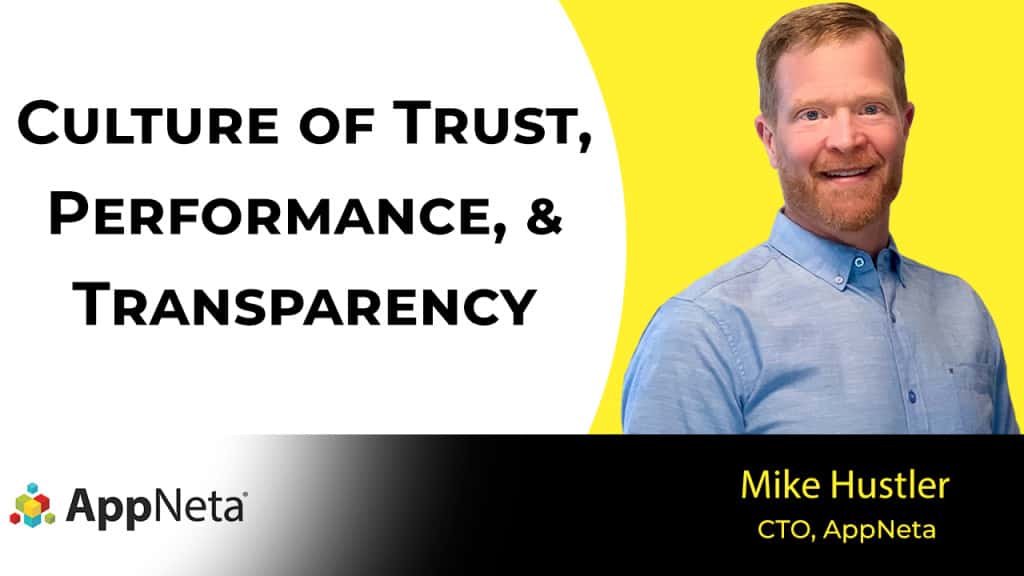
About Mike Hustler:
Mike Hustler is AppNeta's CTO, having led our R&D team since the company's inception. Through his leadership, AppNeta has grown to encompass six teams with more than 50 engineers, practicing agile software development to release product updates at a rapid pace. Prior to AppNeta, Mike was part of the software development team that built the Cray XD1, a modular and highly interconnected supercomputer, along with other extensive experience within the networking space. Mike received his Computer Engineering degree from the University of Victoria, British Columbia, and has been part of the Vancouver area tech community since.
About AppNeta:
AppNeta is the only network performance monitoring solution that delivers deep, actionable, end-to-end network performance data from the end-user perspective. With AppNeta’s SaaS-based solution, IT and Network Ops teams at large, distributed enterprises can quickly pinpoint issues that affect network and business-critical cloud application performance, regardless of where they occur. AppNeta is trusted by some of the biggest Fortune 1000 companies, including 3 out of the 5 largest corporations in the world, as well as 4 out of the 5 largest cloud providers.
Transcript
(Joel Beasley at 00:00:02) Hello, my friends. Today we're talking to Mike, the CTO of AppNeta, and we discuss how to create a culture of trust, performance, and transparency, AppNeta's advanced network monitoring solutions, and how AppNeta has been able to give employees every other Friday off with no loss in productivity. All of this right here, right now on the Modern CTO podcast.
(Joel Beasley at 00:00:32) Here we go. This is the Modern CTO podcast.
(Mike at 00:00:45) I did computer engineering in university and came out of that basically directly into the telecom space or into the network space. So all of my enterprise software development work, from when I was a software developer through various leadership roles, have been uniquely in the network space despite being software focused. So in the early days, it was folks at telecom managing large telecom networks, connecting to—I mean, this is stone age—but connecting to big class five switches and helping out large telcos. I did a brief switch into the HPC space, the high performance computing space.
(Joel Beasley at 00:01:38) Oh, cool.
(Mike at 00:01:38) In there, it was a small startup, and the team that we worked with were all very network focused. So we took that network knowledge and experience and put it into HPC by having high-speed networks around SMPs and connecting them together. So even in that HPC space, it was still around networks and managing partitions of computers, essentially, and managing those networks.
(Mike at 00:02:07) And then out of there, that kind of transitioned me more into what we're working at now in the modern space—in IP networks and analyzing WAN, LAN performance, supporting critical apps, and really looking at networks from an application perspective. Nice. Yeah, that's kind of the whole story. So it's always been about software and always been about networks as well.
(Joel Beasley at 00:02:35) That's cool. The first time I had to get a baseline understanding of networks was actually from working in audio because in the past ten years, it's been a bit of a revolution, just realizing that you can run audio over networks through Cat 6 cables and stuff. And I mean, especially just with advances in the quality of digital over analog, it's not that much of a difference as it used to be. But anyway, it's still all the same baseline technology—running the network for a business and networking the computers together versus networking different pieces of audio equipment together. It's the same underlying tech that's there.
(Mike at 00:03:23) Yeah. No, I mean, it feeds in quite well to how we think about networks. The network is there to support the application, so whether it's a voice over IP or video backup systems, SaaS applications, or whatever it is, that's the reason the networks exist. And that's the most important piece for the customer—how they're using their work and the quality they're getting with their applications.
(Joel Beasley at 00:03:55) So how did you meet the team at AppNeta and get involved there?
(Mike at 00:04:00) Yeah, that just kind of grew into that role. I knew some people that were working there at the time, and it seemed like a really good team to work with and good group of people to work with. And that has proved true over many, many years as we've evolved the company, the product, and kind of changed where in the market that we're targeting.
(Joel Beasley at 00:04:26) Awesome. Yeah. Well, so one thing that I'm super interested to talk to you about—actually, we've kind of covered this topic with a couple of guests on the podcast. Recently we had on this guy, Brett, from a company called Sunrise Banks, and they're actually a really cool bank because they put social responsibility at the forefront of their business, and they also are working really hard to try and help underbanked and unbanked people. But he was talking about how when COVID hit, they had to pivot super quickly to get PPP loans out to small businesses and streamline their mobile banking. And so at AppNeta, you guys were monitoring office networks, and I just got to know, what do you do when people aren't going into the office anymore?
(Mike at 00:05:15) Yeah, I mean, that's definitely jumping right into it. So to step back a little bit, just tailing onto your story about quickly adjusting in the pandemic—so we had, as we saw this happening around North America and around the world, we're like, "We better have a couple of trial days where we'll just shut the offices down, everyone will be at home, and just make sure our tooling is good and in place that we can be productive." And that was a plan with not a lot of notice, but it was planned. And that turned out to actually be the start of the office shutdown.
(Joel Beasley at 00:05:57) And it just timed up perfectly?
(Mike at 00:05:59) Planned experiment—it just landed, and we were actually not going back. So the team did—I mean, thinking about the engineering team, we had a lot of the tools in place to work remotely. We're using SaaS for pretty much everything, including all of our code repository and such. And being bicoastal in our offices, we had a lot of our communication systems kind of set up that way. So everyone was able to be pretty effective immediately. There's a bit of a culture shift and some stresses as everyone experienced, but I'm certainly proud of the team and the way that they transitioned into that.
We also made some pivots—not pivots, but adjustments—to the delivery of our product, which is helping enterprises and the IT teams in large enterprises and their connected offices. So as you said, now their environment or their scope of network goes from maybe tens of locations, hundreds of locations, to now everybody's got their own office. And IT is responsible for the productivity—from a technical perspective, the productivity of the employees—despite really not having visibility into those networks. So we were able to leverage the insight that we give customers for IT departments with their connected offices and just extend that into home offices so that we can help them. And that's something that we've put a ton of effort into over the past year and are continuing to run with as we see this being the normal going forward—not necessarily 100% work from home, but in the knowledge worker space, it's going to be pretty high percentage, two, three, four days a week.
(Joel Beasley at 00:08:07) Yeah, absolutely. I mean, yeah, I have an office here. I'm in Orlando, Florida, in my office, and I pretty much only come in to host the podcast. And then I'm working the rest of my—which is three to five hours out of the week, right? Pretty much the rest of it, I'm at home working on all the other things that are involved with running this podcast. But what are some of the tools that you guys offer for enabling workers to be productive? I just—I want to hear about how it's practically used, you know, so I can get a better vision of it.
(Mike at 00:08:45) I think a good place to start might be thinking about enterprises and their offices and their data centers and some of the motivations for leaning into AppNeta and looking at the solutions that we provide. So if you think of larger enterprises and they've got, you know, even your biggest hotel chains—you don't think of a hotel as owning a data center, but they absolutely have a data center. And their hotels are connecting back to the data center. The hotels are connecting to each other. And when you go to check in at a hotel and things are slow or the person you're working with says, "Sorry, my computer is a little slow," it's really talking about the network and the connection to, you know, probably to their data center and to their apps.
So there's kind of three, maybe four, motivations that customers have to lean into AppNeta. One is just ensuring that the end user experience is good. So the end user could be the employees themselves. It could be the customer, the person that's checking into the hotel, and making sure that their experience is top notch and understanding what it is. IT is managing a large surface area of locations, equipment, connections, dealing with multiple ISPs, and we need to help make them more efficient in their time and quicker to get their job done. And then companies are making big transformations. We saw this a lot during the pandemic—moving stuff out of their on-premise and into SaaS and doing some sort of transformation of infrastructure or application. So those three.
And then the fourth is around remote office visibility. So think of insurance companies that have thousands of locations, and they're all connected somehow back to a data center or a head office—making, you know, giving visibility into that remote office, which might not have top-of-the-line network equipment or high-capacity network equipment, so being able to provide some visibility into the network performance there. And if you think of that remote office visibility component, and now your remote office is maybe, you know, like where I am here in my basement is now a remote office, giving IT visibility into that office and the network performance there. And so it's not a big stretch to think of how network performance and performance visibility, observability into the network, extends to work from home, work from anywhere.
(Joel Beasley at 00:11:46) So—
(Mike at 00:11:47) We provide monitoring points—what we call monitoring points—which is essentially the application and network instrumentation, so the thing that does the measuring and gives you your key performance indicators, gives you the latencies and total capacities and this kind of information. We provide all different form factors of that so that they can be applicable for massive networks in data centers or small Wi-Fi networks in remote offices, for example. And then also an agent that can run within a remote worker's workstation to give visibility into the home office. So it's really just another type of monitoring point that's providing very similar metrics and information, if that makes sense.
(Joel Beasley at 00:12:40) Yeah. Yeah. So you're basically giving the company all the information they need to know the health of their employees' home networks so that if something needs to be improved, they can improve it, or if someone's network goes down, they can try and help them out with that. Is that correct?
(Mike at 00:12:59) That's right. The difference in home is that the equipment, the infrastructure in your home office, is not something that IT has set up or decided on.
(Joel Beasley at 00:13:12) Yeah.
(Mike at 00:13:12) So you're dealing with consumer-grade infrastructure—access points, routers, modems, your ISP. All of that is, you know, possibly substandard from what IT would be investing in for their actual offices.
(Joel Beasley at 00:13:32) Yes. So what do you do about it when you have some employees that just have a super slow connection that's hindering them from getting their stuff done? Is that up to the company to decide, or do you make a recommendation?
(Mike at 00:13:44) We basically enable the IT teams. So we're giving the IT teams the visibility they need. And we're not running their network. We're not—
(Joel Beasley at 00:13:53) Got it. Got it.
(Mike at 00:13:57) We're providing the solution to give them—and then they can—and we've seen all sorts of different approaches there. In some cases, companies have been monitoring connections and seen where the connection is just too slow—your ISP service is just too slow—and possibly compensated the employee to get a better network connection. We've also seen policies put in place where Wi-Fi is just not allowed because of issues that IT has seen. So they're requiring a wired connection. And so the solution will also identify if the workstation is on a wired or wireless connection and help give—if it's wireless, help give some visibility into the wireless metrics and the quality of the wireless. Maybe they need to move closer to their AP.
(Joel Beasley at 00:14:53) Nice. So this is kind of bringing up something that's been on my mind since I interviewed Matt Mobley, the CTO at a company called Merkle. So they're a high-tech marketing tech company, and they help with personalizing customer experiences. And obviously that takes a lot of data, and some people are hesitant about sharing the data. So he was talking about how they work really hard to be extremely transparent about what they do with the data so that everyone knows it's safe. And I imagine that there's probably kind of a similar hesitancy around people having their home networks monitored. And I'm just curious, how do you make people feel better about that? How do you make people feel like they're not being spied on?
(Mike at 00:15:46) That's valid. I mean, that's valid across network monitoring in general. So we definitely treat—you know, the data that we're acquiring is for the customer, and it's for the customer's consumption. So the data is stored within the application, but it's the customer that has control and can own or view that data. Security is super important across our apps, so making sure that infrastructure patches and updates are kept up to date, making sure that we're using the strongest ciphers and encryption is key, and then getting accreditation from third-party audits and that sort of thing is all part of the solution.
As for the data at the workstation, that's up to the employee's IT department as to whether the agent is turned on or turned off and when it's collecting information. The data that we're collecting is really performance metrics. So it's not about where are you surfing or what are you using your workstation for. It's really about what's the performance of the network that you're running on. And that's the data that gets sent back—things like loss, latency, jitter, total capacity, and that type of information.
(Joel Beasley at 00:17:29) That makes sense.
(Mike at 00:17:31) And location might play a role in as well. That's something that can be controlled as to whether that's on or off.
(Joel Beasley at 00:17:40) Very cool. So what would you say is a ballpark estimate of the number of networks that you manage?
(Mike at 00:17:49) Right. So you think of it as customers, and each customer, with offices, you're talking about hundreds of locations. So that's the number of monitoring points that you'd have if it was—in some verticals, like I mentioned, insurance and hotel, there you've got thousands of physical locations, right?
(Mike at 00:18:18) So each one of those represents an endpoint that's doing monitoring. And each of those locations is probably testing and monitoring 10 to 100 networks at that location. So you kind of multiply that out, and it's significant per customer. And when you go to work from anywhere or from home, and your office is now your workstation, then we have accounts that, you know, get to 5,000, 7,000, 10,000 or higher number of monitoring points that are measuring to different networks. So, yeah, and that was, you know, one of the—it certainly kind of goes along with this motivation to support the work from anywhere use case. Now scale has jumped up for us.
(Mike at 00:19:17) So our back-end engineers are busy working and making sure that the infrastructure will continue to keep up with the scale demands that this multiple locations kind of pushes out.
(Joel Beasley at 00:19:32) Absolutely. So how did you have to kind of change your strategy overall as a company as the scale just exploded?
(Mike at 00:19:41) So as a company, we focused a bit more on looking for where we can help with the work from anywhere, work from home type of use cases and working with customers there as well as all of the brick and mortar and physical locations. This is a SaaS product, so we're running, you know, hosted in the cloud. And as far as the technical side of things, it's just been a lot of fun building up a lab that can kind of mimic this type of scale and then just continuing to work, which has always been an area of focus, but really kind of doubling down on making sure that the infrastructure's there to support the growth.
(Joel Beasley at 00:20:33) So can you tell me a little bit about the culture at AppNeta?
(Mike at 00:20:36) Sure. I don't know, maybe there's a loose connection of observability there and providing some sort of transparency into networks and giving some visibility into the performance there. But we've really leaned into something we call TPT, which is trust, performance, and transparency. And that kind of goes across all of our teams.
(Mike at 00:21:02) And during that pandemic, some ways that that has manifested is, we had a bit of a policy around remote work and work outside the office. It was, you know, one or two days a week, and people could kind of work from home and have some flexibility in their workday. Of course, with the pandemic, that's gone out the window, and now it's 100%. And we've doubled down in our recruiting to look outside of our core campuses in Boston and Vancouver to grow our team. And now, you know, across North America, we have people that have joined AppNeta.
(Mike at 00:21:45) So, obviously, they're not going back to the office when our office does open up. And, in fact, our policy has shifted that way completely, so there's no kind of requirement to go back into the office. And, really, that does feed into the trust and not, you know, it's not about kind of bums in the seat and working. It's, you know, we just trust you to get your job done and work with the people that you need to to get your job done. Yeah, there's a bunch of things that we monitor as far as how well the team's working together, the stresses and the team.
(Mike at 00:22:32) And I'm thinking particularly of engineering. But through this kind of work from home, the performance, we keep track of that. We're running sprints, so we look at our sprint productivity and measure that. And, in fact, through the pandemic, when everybody was working from home, the productivity actually increased, and the quality of software went up as well. So as our customer base grew, the number of people using the product, the number of field issues kind of coming in has gone down, which is fantastic.
(Mike at 00:23:10) And I think that just reaffirms that we can trust our teams, that they will perform.
(Joel Beasley at 00:23:19) That's awesome. So as you've expanded to hiring kind of all over the place, one thing that I've been hearing and reading a lot about recently is how wages have kind of flattened across the industry as a result of you can get a job from anywhere. And so there's a lot of engineers from San Francisco that are still expecting to get paid the same when they get hired by a company in Kansas. And so I've been hearing a lot of people talking about how it's hard to attract top talent now because of that. So what do you guys do to attract the best engineers?
(Mike at 00:23:57) Yeah. I mean, as far as compensation goes, you know, we keep close to the market for sure. So there's giants, especially, you know, in Vancouver, there's certainly some giant names that we're up against. But there's also, you know, a lot of smaller names as well that are like us having to really kind of lean in. You know, we support our employees with a pretty decent benefits package from, you know, looking after families and everything that goes there with babies and a really good maternity, paternity leave program.
(Mike at 00:24:40) But one of the big things that kind of came through this last year was something we call ten and nine. And, again, this is kind of in that trust realm, and that's that every second Friday, the company, AppNeta, is taking that off. And just ensuring that people continue to get their job done. And it's been working well. And, again, as we look at the performance of our teams, we haven't seen an impact at all in doing that.
(Mike at 00:25:17) And some of it is, you know, the stress around the pandemic and that adjustment, just people needed that extra day for mental health. Not necessarily to take off for a long weekend, every second weekend, but just to have a day to get some other things done and think about some other things. People are using it in different ways personally to help them or to get outside and enjoy the outdoors and different ways to kind of deal with the busyness. But, yeah, it's super—yeah, that's awesome.
(Mike at 00:25:54) Whatever happens with going back to the office, we're going to keep the ten and nine, and we've actually rolled that into our handbook.
(Joel Beasley at 00:26:06) Really cool. Hey, let me know if you're trying to start a podcast or something. I'm pretty good at that. But, um, yeah, that totally makes sense because when three day weekends are a more rare occurrence, it's almost like there's pressure to do something special with that time. Whereas like when it's more normalized, you can actually relax on that day off.
(Mike at 00:26:31) Yeah, put it towards professional development or put it towards just a mental kind of mental health, mental break.
(Joel Beasley at 00:26:39) For sure. Yeah. I mean, I feel like everyone wants to have a day off where they can actually just do nothing and not feel guilty that they didn't—that they squandered it. You know? One thing I'm curious about is, uh, monitoring all these networks.
(Joel Beasley at 00:26:56) Do you guys utilize any kind of AI machine learning for anomaly detection or anything like that?
(Mike at 00:27:03) We have some AI analysis in our diagnostics. So as we're identifying issues with the network and being able to pinpoint kind of not just that there is an issue and kind of what that issue, what the symptom of that issue is, like data loss. We're able to narrow down and tell you where in the network path that that is happening and where it starts happening and what likely the cause of it is, whether it's, you know, in case of data loss, is it due to media errors or something like that? So there's some analysis and AI that goes into that. As for anomaly detection, there's a ton that we have that we're working on and that, you know, we're going to continue to invest on.
(Mike at 00:28:01) And it's particularly interesting as the scale goes up and as you're dealing with thousands of monitoring points, you can't have individual configurations of those paths and those monitoring points. So it's certainly something that we're looking at and working at. Another area related to scale and being able is the consumption of data at scale. And there's a ton that we've invested in over this past year in making it easier to find the issues in your network. So if you have a sea of thousands of monitoring points and each one is monitoring, you know, tens or 100 paths, you can't be looking at each of those network paths individually, and you want to be able to see broadly where issues are happening or if there's a correlation that issues are happening in a particular region or to a particular app and be able to have those call out.
(Mike at 00:29:04) And we think of that in the consumption of the data. And one improvement that we've done over this past year is a bunch of different dashboards to help give that view and help you kind of slice and dice the data according to, say, a tagging model that you've overlaid onto your model and be able to identify, you know, look at a tree map of your data to identify hotspots due to location or due to application or type of network. And there's almost unlimited number of ways that you can kind of slice and dice that up to look at it. And we think of that as taking your business model and using some of the capabilities to apply your internal model to your monitoring to make sure that the monitoring is fitting kind of the way you look at your network.
(Joel Beasley at 00:30:09) That's really cool. So what is the visualization or consumption side of things?
(Mike at 00:30:14) So, yeah, I think working on the visualization components and the data consumption components from the engineering team has really given the engineering team—it's really easy as engineers to be focused on, you know, product management has given you requirements, and you build the software according to those requirements. And it's, you know, it's easy to kind of lose touch with why you're building those and who you're building those for. And I think the visualization component and, really, the discussions that we're having around why we're building those and how they're going to be used have brought the engineers a bit closer to the customers that we're delivering the solution for. So I think that's, yeah, that's been a help in kind of bringing them closer to the reason that they're building the software they're building.
(Joel Beasley at 00:31:15) Yeah. That's awesome. That's a trend I've been seeing a lot is companies working really hard to get their engineers closer to the customer and closer to the end product. I've, like, heard about companies that, like, have their engineers sit down with salespeople or, like, sit in on a sales call once a week or something.
(Mike at 00:31:33) You know, there's one—we're due for another one, but not so long ago, we had a hackathon. And it was—oh, cool. It was at the start of the pandemic, and it was, we picked a theme of work from home and just had the engineers think about what they could do in a couple days to either as a standalone or adding onto the product to support the work from home use case and help our customers that are working from home. And it was phenomenal to see the ideas that came out of that. I think product management in looking at our roadmap definitely took a step back and was like, I want to do all these things. How can we do all these things? Because some great ideas came out from the engineers and just playing around with that concept of work from home. So that, again, is putting our engineers in our customer shoes and trying to think of the problem space from their perspective.
(Joel Beasley at 00:32:38) That's awesome. That's such a fun way to come up with ideas to improve the company.
(Mike at 00:32:44) Yeah. It's hard to—it's definitely hard to schedule and make time for. But we're due for it again. And the engineers have been reminding us that it's time to—so everyone had a lot of fun.
(Joel Beasley at 00:32:56) Oh, that's so cool.
(Mike at 00:32:57) We will do it again.
(Joel Beasley at 00:32:59) That's awesome. You guys should, like, do kind of a write-up of it because that sounds like just super entertaining to read about the results of the hackathon and how that impacted the company.
(Mike at 00:33:11) Yeah. Yeah. We should make sure we fold that into a blog of some sort.
(Joel Beasley at 00:33:15) Absolutely. Uh, before we wrap up, I want to ask you a couple, like, leadership questions. So, like, as CTO, how would you describe your personal approach to leadership?
(Mike at 00:33:27) So I think we're really, really leaning in on trust, transparency, relationships. There's a lot of lead by example, I think, that is that I try to embrace, compassion to our team to understand kind of their professional and personal needs and really supporting our team because that's what definitely keeps me coming back to the office every day is the folks that I get to work with.
(Joel Beasley at 00:34:08) That's so awesome to hear, man. It is at the end of the day, it's all about the people. Like, that's 100% what makes it. And, also, yeah, you hit on leading by example, and I forget who it was, but someone told me a story recently on the podcast about how—that was one of his largest leadership tenets because when he was working for a company years ago, they had a boss that had preached work hard, play hard, you know, and he had like a picture of him on a surfboard on the wall and thought it was—he wanted to create that culture at his company. And so the guy, the employee, had just closed like a big deal and was feeling really good and accomplished. It was like 4:30 on a Friday. So him and one of his coworkers, these buddies, pick up the ping pong paddles, start playing a game of ping pong. You know, they're playing hard. They just worked hard.
(Joel Beasley at 00:35:05) And he said he got like a really dirty look from his boss as he was playing ping pong on work time. And that was like the moment where he lost that boss as a leader because the example was kind of broken at that point. And that just kind of stuck with me because it was a really powerful story. And it was Ryan Westwood, the founder of a company called Simplus. That was the guy, but yeah, that's just so true. And it makes me feel so inspired to really do my job better when I think about that. When I'm waking up in the morning for work, I'm like, well, my green bubble on Slack better be on before everyone else's because they need to know I'm here just like them.
(Mike at 00:35:58) Right. Right. Yeah. I think that's—I think a big part of—well, the biggest part of not being in the office these days is those lunches that we had. We had, the engineers would quite often have a bunch of board games that they'd pull out at lunchtime and really kind of lean into that. That's cool. Crazy kind of foosball tournaments, of course, that you have to have in every tech company. Yeah. I think that getting together with each other and people is the biggest miss of not having the office. And, you know, we're trying to—trying to, I think doing a reasonable job of accommodating that in other ways.
(Mike at 00:36:45) Most teams or broad kind of collections of teams within engineering have an end-of-day water cooler Zoom link. And 4:30, 5:00, people just kind of drop in, drop out, and they may keep working and just have kind of Zoom running over here, and it's just an open kind of water cooler drop-in session. So those are fun to drop into as well. And sometimes they're, hey, I got some technical questions, and sometimes it's, what are you doing this weekend or casual.
(Mike at 00:37:21) But I think that, I don't know, it's one way that helps people keep connected without being, you know, a scrum-based meeting of some sort that we're jumping into.
(Joel Beasley at 00:37:36) Yeah. I mean, when those interactions aren't happening serendipitously, you have to plan them, and it's really fun to be able to do that. Like just this morning, we had a team meeting. The whole thing just kind of turned into small talk, and it was great. It was awesome.
(Joel Beasley at 00:37:53) I love getting to see my coworkers because we don't really see each other. So, I guess before we wrap up, is there anything else that we didn't get out there that we want to make sure we get out for AppNeta? I mean, I know you guys are handling a lot of work with managing all those remote offices. Are you hiring? What can we plug?
(Mike at 00:38:14) Yeah. We're hiring across a bunch of different roles. We're in engineering. I think likely all the different roles from engineering manager and to various individual contributor roles—we're on the lookout for those. And then across the organization as well, in sales and other functions as well. We're absolutely hiring.
(Mike at 00:38:42) So check us out there. And I think that we're capturing a landing page of this chat somehow under appneta.com/moderncto as well.
(Joel Beasley at 00:38:58) Thank you so much for listening. And if you found this episode useful, please share it with a friend or colleague who you think would get value from it. And if you have topics that you'd like to hear discussed on the podcast, either add me on LinkedIn or send me an email: [email protected]. Every time I get an email or LinkedIn message, it absolutely makes my day and inspires me to keep going.