
Episode 439 ·
Customer Experience Transformation with Rupesh Mithani, SVP at Hexaware
Today we’re talking to Rupesh Mithani, SVP at Hexaware. And we discuss how Customer Experience Transformation requires reevaluating every part of the organization. How to plan as a leader when technology is evolving so rapidly, and why it’s important to give your direct reports the freedom to fail in order to build a strong foundation.
All of this right here, right now, on the ModernCTO Podcast!
To learn more about Hexaware CXT, check them out at https://hexaware.com/transform-customer-experiences/
In case you missed it: check out our previous episodes with Hexaware:
- Biju Shoolapani, Global Leader of Digital Core Transformation
- Arun "Rak" Ramchandran, CVP Global Market Leader
- Tony Schettino, VP
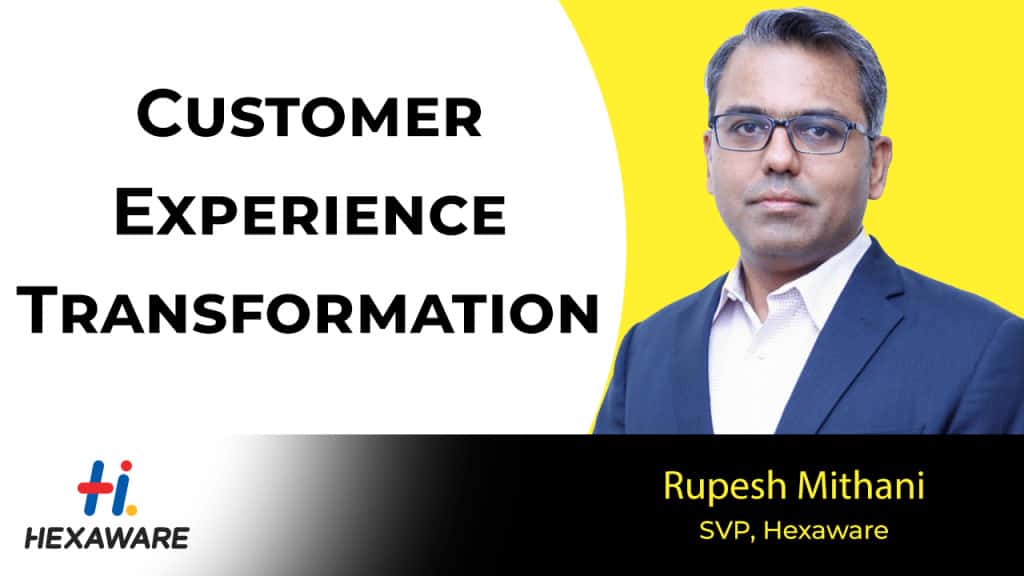
About Rupesh Mithani:
25 years experience working with consulting organizations providing services to their end-clients.Led teams focused on developing IT strategies and roadmaps, high-level solution approaches, package software selection implementations for various ERP/CRM and cloud-based solutions. Have extensive experience with ERP packages such as PeopleSoft (CRM, Supply Chain, Financials and HR), SalesForce.com (CRM), Oracle (Financials and Customer Data Hub) and Workday (HR, Payroll & Benefit Admin). Managed large teams for implementation work including using BearingPoint's offshore delivery center and working with Hexaware and TCS resources to provide overall solution to the client.
About Hexaware:
Hexaware is a fast-growing automation-led next-generation service provider delivering excellence in IT, BPO and Consulting services. We are driven by a combination of robust strategies, passionate teams and a global culture rooted in innovation and automation. Hexaware’s Digital offerings have helped clients achieve operational excellence and customer delight. Our focus lies on taking a leadership position in helping clients attain customer intimacy as their competitive advantage. We are now on a journey of metamorphosing the experiences of the customer’s customers by leveraging our industry-leading delivery and execution model, built around the strategy— ‘Automate Everything™, Cloudify Everything™, Transform Customer Experiences™”. Powering Hexaware’s complex technology solutions and services, is the Bottom-Up Disruption, a disruptive crowdsourcing initiative that brings about innovation and improvement, to everyday complexities and, ultimately, growing the clients’ business. The digitally empowered workforce of Hexaware represents various nationalities, comprising 19,833 employees, lives the company’s philosophy of ‘customer success, first and always’. The company reported 2020 global revenue of USD $845.04 Mn.
Transcript
(Joel Beasley at 00:00:03) Hello, my friends. Today, we're talking to Rupesh, senior vice president at Hexaware. And we discuss how customer experience transformation requires reevaluating every part of the organization, how to plan as a leader when technology is evolving so rapidly, and why it's important to give your direct reports the freedom to fail in order to build a strong foundation. All of this right here, right now, on the Modern CTO Podcast.
(Joel Beasley at 00:00:37) Here we go. This is the Modern CTO Podcast.
(Joel Beasley at 00:00:49) So how did you first get into technology, man? What was your start?
(Rupesh at 00:00:54) So, you know, I've been in the technology field for a little over twenty-five years. And back then, there were really only three options, right, when you got out of college. Obviously, the world's evolved dramatically. But back then, it was either you are in the engineering field, or you are in the medical field, or you are in some sort of accounting consulting field. And, you know, growing up, I was always excited about building stuff because back then, you know, computers didn't exist.
(Rupesh at 00:01:28) And so building is what got me into engineering. And then since, you know, since then, it's just been one thing after the other. It was exciting to be in the field of consulting. It was exciting to work with customers, understand their business problems. You know, we basically call it customer transformation today, but, you know, it was always about using technology to solve problems, make things faster.
(Rupesh at 00:01:53) And so that is sort of how, you know, the journey got started and, as well, here I am.
(Joel Beasley at 00:01:59) That's cool. So how did you meet the team at Hexaware and join where you're at today?
(Rupesh at 00:02:06) So the Hexaware journey also has been quite exciting. They, Hexaware as an organization, was trying to build out and focus on customer experience using digital technologies. Again, five years back, it was all about digitization and digital transformation. It has now been named as experience transformation. And so, you know, our paths crossed because of a joint customer pursuit.
(Rupesh at 00:02:38) You know, I sort of met the team. They liked what I could offer. I was excited about the leadership journey, ability to sort of, you know, run P&L for the company, contribute to the bottom line, contribute to the shareholders. And so that is sort of, you know, how that happened and I switched gears and joined Hexaware.
(Joel Beasley at 00:03:01) That's cool. So I've actually had the privilege of interviewing a couple other people at Hexaware before, but I know that you work in the customer experience transformation business unit, which is a completely separate, like, it's a whole business unit dedicated to customer experience. Right? So how does that fit into, like, the rest of Hexaware as a whole?
(Rupesh at 00:03:24) So, you know, in today's world, right, there are some very complex organizations out there who have a variety of products, you know, that they offer to their clients. What we as an organization have done is really sort of simplified our landscape. Right? We basically go to market for our clients, right, in three broad categories. Right?
(Rupesh at 00:03:45) One of them is experience transformation. Right? Which means we want to basically enable digital experiences, you know, for our clients and customers or end partners or end employees such that they truly sort of want to engage and do business or even interact, right, on a daily basis with them. The two other areas which are very sort of cohesive to that story but help in ultimately bringing value to the shareholders is around automation. So you really cannot do experience transformation, you know, without really sort of automating a lot of things.
(Rupesh at 00:04:23) Today's generation, you know, requires things very quickly. You know, they are not willing to wait for hours or minutes, days or weeks. Alternatively, they also want to be able to interact with their businesses on their own time. Right? Somebody wants to wake up in the middle of the night and book an airline ticket.
(Rupesh at 00:04:41) Right? They don't want to have to call between a nine to nine type of slot. And all of this, you know, some of this cannot be done without automation. So that's the second unit that sort of, you know, cohesively works with experience transformation. In order to enable experience, you need to do automation.
(Rupesh at 00:04:56) You need to sort of improve the underlying processes to deliver value. And then the third element is, as your business scales, you want agility and the flexibility. And more and more organizations are, you know, moving to the cloud. And so we have a whole branding story around how do we help migrate, you know, our clients from their on-premise solutions to cloud. And so these three things sort of work together, you know, for an end client to generate value.
(Rupesh at 00:05:24) So this is sort of where experience transformation as a pillar fits the other two pillars, but these are the three simple pillars in terms of, you know, how we want our customers or even some of our prospective employees to look at our site. Right? If you like something that you're excited in one of these pillars, this is a great place to work because we have a very simple offering, right, to offer to our customers and generate value.
(Joel Beasley at 00:05:49) So customer experience transformation sounds like a pretty broad term. What does that actually mean in practice? Like, are you building out a contact center for a company for direct interaction with the customers, or is it more of, like, a holistic approach to, like, kind of being a consultancy around improving their product and experience as a whole with the customer in mind? Like, what do your engagements look like?
(Rupesh at 00:06:23) So if you think about experience customer experience transformation, right, we look at any organization. An organization, whether it's a manufacturing company, whether it is a telecommunication company, whether it's the airline industry, take any industry. Right? At the end of the day, each of these industries is serving an end customer. The customer can be in the form of a consumer, like you and I. The customer can be in a form of a business, right, that they are serving because maybe they're manufacturing for them and providing goods.
(Rupesh at 00:07:01) Or it could be an employee or a partner also. Right? With whom they engage and collaborate to ultimately, you know, generate revenue. For us, each of these personas has a journey that they engage with from start to finish. So if you look at a consumer, you know, there is elements of advertising about your product or services, you know, being able to educate your consumer about your products and services, help them sort of answer questions through any of the channels, whether it is phone, email, social. There are many ways customers, you know, reach out to these industries. And so there's a buying journey that goes after that.
(Rupesh at 00:07:40) There is a service journey that sort of can follow it based on what you're selling. There's, you know, customer surveys that you may want to take to ensure that, you know, you can effectively gauge the service that you provided the client so that if there are any things that you can improve, you know, you can work on it internally. So there are so many interaction and touch points that happen in our day-to-day lives. Right? And each of these interactions, you know, has to be painless, has to be frictionless.
(Rupesh at 00:08:10) In today's world, it also needs to be contactless now. Right? Because people are uncomfortable to have face-to-face conversations or are even, you know, uncomfortable to use your digital devices to give you feedback. So we can look at something which could be as small as a single journey and, you know, make it better, or we can look at the entire life cycle of each of these personas, you know, evaluate the touch points, and then sort of figure out better ways to deliver that same experience. I mean, that is what a lot of the startups are doing, and a lot of the traditional brick-and-mortar organizations are now trying to keep up, evaluate, you know, sort of copy from that approach, and, you know, become better.
(Rupesh at 00:08:51) Because otherwise, you know, they'll not survive. The Amazons of the world are, you know, overtaking the world, and so some of the competitors have to invest time and effort in these areas to truly make this frictionless. Otherwise, they'll be irrelevant. So that is sort of what we offer to our customers. The problem statement could be as simple as booking a ticket.
(Rupesh at 00:09:11) The problem statement could be as complex as, you know, looking at the total customer value, you know, to that organization.
(Joel Beasley at 00:09:19) Okay. Thanks for providing that context there. So I know earlier you said that you also provide, like, cloud migration services and, like, lots of automation for your clients. And that kind of steps into the realm of general digital transformation, which I know is another place where Hexaware as an organization does a lot of work. So when providing, like, the cloud migration services, do you reach across the organization and work with some of the digital core transformation parts of Hexaware, or does it still stay within the CXT?
(Rupesh at 00:10:02) So at the end of the day, you know, Hexaware has a philosophy of a single throat to choke. Right? You can, a customer can start a journey with us by, you know, improving their record, or a customer can start the journey with us when they want to solve an experience problem, which then, you know, will entail also, you know, sort of making improvements, you know, to the core. So as an organization, we will bring the right team together for the customer scenario and internally collaborate and sort of solve the problem. If you need to migrate to the cloud, you want to go to a public cloud, you need to do some engineering work.
(Rupesh at 00:10:44) To an end customer, it doesn't matter. Right? Like, today, if you have to buy something, if you are to buy a cup of coffee from Starbucks, it doesn't matter to you how that cup of coffee is delivered to you. Right? You want to make sure that the person you are interacting with, with whom you've placed your order and you've paid the money, you get the right cup of coffee.
(Rupesh at 00:11:04) There may be a lot of operational activities that happen behind the scenes to ensure that the coffee is stocked, you know, they have the cups, the methods are standardized so that your experience is, you know, the same. So from that perspective, right, the customer journey, even at Hexaware, could start in one particular area, and it could continue to evolve over a period of time. But your point of contact always remains the same, and he or she will enable you, you know, to your success metrics.
(Joel Beasley at 00:11:32) That's really cool. Yeah. That's great that you're able to have, I know Hexaware isn't like a huge, huge organization, but, I mean, what do you have? Almost 20,000 employees now total. Right?
(Joel Beasley at 00:11:49) So that's, like, pretty large. And so it's impressive that you're able to keep from being siloed and keep open communication across the organization so it is that kind of seamless experience.
(Rupesh at 00:12:02) While we are 20,000, we still think of ourselves, you know, come with a mindset of an entrepreneurial philosophy, right, or a startup philosophy. And we like to be agile and nimble. Right? And that's, I think, the need of the hour. If you put something out, if you try to think of building a road map which could be, you know, three, five years down the line, I mean, nobody knows what that three, five years look like.
(Rupesh at 00:12:26) You really need to kind of think in three-month installments because in three months, the world can change. Right? And I think we all have sort of experienced it and observed it based on what has sort of transpired in the last two years. Right? Nobody can predict, and so it's best to invest in three-month chunks.
(Rupesh at 00:12:44) Right? It's how I at least tend to advise our customers. Right? And then kind of build up on that as you kind of move along.
(Joel Beasley at 00:12:51) That's smart. So you're talking about you advise your customers just to plan ahead in three months at a time.
(Rupesh at 00:13:00) Right.
(Joel Beasley at 00:13:01) And so why three months? Why not, like, a year at a time?
(Rupesh at 00:13:07) So I have a pretty interesting sort of, you know, observation slash philosophy about it. Right? If you were to look at 2000, the era of 2000, back in those days, technology used to evolve every two years. So if you actually really go back in time and you look at, you know, how you had mainframes. From mainframes came client server.
(Rupesh at 00:13:30) From client server, you, you know, kind of went into distributed architecture. You then went into Internet. Then you went into cloud. So back in those days, every two years, something would change. And if you set out a road map at the beginning of that two-year journey, you would know that you would finish the work in six months here, and then you would realize the benefits of it before you would have to think again differently.
(Rupesh at 00:13:57) Today, if you look at a lot of the cloud providers, you know, be it Google, be it Salesforce, be it Microsoft, they are launching products every three to four months. They are making improvements in their products every three, four months. And so for a customer to say that, hey, I'm going to put out a five-year road map and sort of continue to work on it. It just does not make sense. Yes.
(Rupesh at 00:14:21) There can be a vision. There can be an objective. But the technology road map or the implementation road map or the approach has to be adaptive, has to be agile, has to sort of refactor the changes that have happened around you every three to four months. Because that's how fast, you know, the world is changing, and what you may decide today may just not be as relevant, you know, three to four months down the line.
(Joel Beasley at 00:14:46) That makes a lot of sense. It is moving a lot faster today, and it's going to continue moving faster. Maybe in a couple years, you'll be advising your clients to think in one-month chunks. But, anyway, since I'm on the phone with or on a Zoom call with you, like, someone that is, like, an expert in CX, I want to hear about, like, CX in general. What are some new CX trends that you see happening in the industry today?
(Rupesh at 00:15:19) So what has, I think in the space of consumer world, there has been a lot of evolution. Right? Each one of us has a very good understanding of what is it that we want from our lives on a day-to-day basis. Right? Right from your ability to shop groceries, to getting your cup of coffee, to getting a meal.
(Rupesh at 00:15:44) We all sort of expect, anticipate delivery. Right? We all expect a particular level of service today and an experience today. But when we come to work, we sometimes don't have the same level of experience, you know, serving our clients or even for organizations to serve other organizations. So a lot of the end platforms have improved dramatically.
(Rupesh at 00:16:10) But as we do a lot of business-to-business service, there's still, you know, a lot more to be done. So what I perceive, right, in the coming years is going to happen is that there's going to be an immense amount of transformation dollars being spent on businesses that, you know, serve each other. And today, some of those are still not as modern and as digital as they were in the past. And knowing that the workforce today is very digital savvy, they will pick and choose partners, you know, as they are part of the organization with the other organizations who are digitally savvy or who have the level of experience. Like, look at yourself.
(Rupesh at 00:16:53) Right? You guys are, and like you said, you are among organizations. You spoke a little bit about your growth. Imagine you have to work with a company who would not be able to pay your invoice, you know, digitally, or who would ask you for a paper invoice, or, you know, that experience could be you have to fill in a, you know, 50-page form to just get onboarded as a vendor. It's just not going to work.
(Rupesh at 00:17:17) You will just, as an organization, say I'm willing to let go. Because of the amount of time I will spend in interacting with Hexaware as a company, I can probably do three of these interviews, which will bring in three times the more revenue. So that's the new trend. It's a trend that is evolving. Organizations are really looking at how they serve other organizations, and they're bringing that consumer grade experience within themselves as they're interacting with the other companies.
(Rupesh at 00:17:48) So that's the big trend in my mind which is going to change the way we operate going forward.
(Joel Beasley at 00:17:55) Yeah. And that makes sense. I mean, you have to be pleasant to work with in order to get, like, a one or really great partners with your company. And yeah, that all trickles down to the end user at the end of the day too. Like, your employee experience directly impacts your customer experience.
(Joel Beasley at 00:18:17) So you gotta make sure your employees and your partners are all having a great experience at work so that they can pass that along.
(Rupesh at 00:18:26) And that's also how people then sort of word-of-mouth improve your references to other organizations. Right? And that's how you grow business. It is super hard now to market to some other traditional means of LinkedIn and email where you can generate business. Business gets generated because you've truly delivered value, and that sort of helps you get more business.
(Joel Beasley at 00:18:50) So why do you think this trend of companies actually paying a lot more attention to their customer experience at work—why do you think that's happening now? Like, what's different today?
(Rupesh at 00:19:05) I think organizations have just realized—so there's a few factors there. Right? If you look at it, unemployment is at our lowest levels right now. It's really hard to find talented workforce. So in my mind, the workforce has become very selective in terms of deciding who they wanna work with.
(Rupesh at 00:19:25) Right? People have multiple job options at times, and they are wanting to align with an organization who is pleasant to work with, like you said. Who there is ease of work. Something as simple as how do I do benefits? You know, if an organization is doing benefits the old way where you're still filling a piece of paper or you're filling a PDF form, it just does not work.
(Rupesh at 00:19:49) So in my mind, a lot of these organizations have to focus on these EX activities because, A, they are not going to be able to attract talent or retain talent if a lot of what they do today is not similar to what it means to that end employee to be able to deliver food at home. The same thing is true with trade partners or with dealers or your partner ecosystem. If there is no ease to work with you, there is no transparency to work with you, there is no ability to interact with you at all times of the day, self-service, then those partners are going to select and choose to work with organizations who are fast forward. So in my mind, you know, the last two years where there have been supply chain issues, there are talent issues, there is high inflation, each and every part of the ecosystem is gonna pick and choose who they wanna work with. Right?
(Rupesh at 00:20:49) If they have a choice, they're probably gonna work with somebody who is a lot easier to operate with. And because of ease—the less time you spend on their interaction, the more revenue you can make as an individual or as a company or you can serve other people. And so that is what is—efficiency is the name of the game now. If you are not efficient to work with, they are gonna pick somebody else who is, and you will become the last choice, right, in the pecking order. And so that is why I think companies have to put a lot more focus on making sure that they truly have delightful experience to work with on a day to day basis.
(Rupesh at 00:21:29) And that's where the attention is coming from in my mind. Also, costs are going up, so enabling a lot more self-service helps the underlying organization from a bottom line perspective. So you do gain experience through doing what you're doing, but you do also get cost efficiencies over a period of time.
(Joel Beasley at 00:21:46) Yeah. That makes sense. So what are some things that you guys do at Hexaware to make your employee experience nice for the people that work there?
(Rupesh at 00:21:56) So we have also been on a long journey for the last two years. We have been in the process of evolving how we sort of work with our employees. So the pandemic has forced us to do digital onboarding of employees. Right? People no longer are coming to offices to get onboarded.
(Rupesh at 00:22:16) So we have a complete digital onboarding capability where employees are onboarded without having to come to work. Their machines and things like that are dispatched to their home addresses. The welcome kit is done. So their entire workflow is completely automated right from the point of an employee accepting an offer all the way to their joining day. The post joining activities are also workflowed in a way where it's completely digitally enabled.
(Rupesh at 00:22:48) And then a lot of our collaborations, right—we are a big user of Microsoft Teams. The world has sort of adopted Teams in a big way. And so Teams is our digital collaboration tool. Everything that we do is through Teams, whether it is customer calls, internal calls, document collaboration. So we've done a lot of those things.
(Rupesh at 00:23:09) The same thing has been extended to our partner ecosystem where, as we are working with partner organizations, you know, their onboarding, their sort of the ability to do the paperwork to be able to generate invoices to us, their payments, digital payments—some of these things have evolved over time, expenses that evolved over time where, um, we have, again, digital toolkits to be able to pretty much do everything with the assistance of a mobile device. And most importantly, what we have done is we've looked at a lot of these processes, and we streamline them, minimize them as we go. And again, our journey is still not completely done, but we are sort of continuing to evolve that just like any other organization out there.
(Joel Beasley at 00:23:56) Recently, we had on this company called Voximplant, which they do a cloud based communication platform as a service. And from what I understand, it's like a similar offering to Twilio, but it's better for building complex solutions. It makes the complex use cases for that a lot easier on the engineers and easier to implement. But their CTO, Andre, gave one piece of advice in his leadership section that individual contributors should think twice before moving into management because they won't get to spend as much time hands-on engineering. And so that's just kinda been in the back of my mind.
(Joel Beasley at 00:24:43) And I'm curious to ask you, did you find it challenging to start being more hands off when you made the transition from individual contributor to manager?
(Rupesh at 00:24:54) So it's a very good question. Right? And if I were to look back, it is hard. It is a journey. It is a journey of trust. So what happens in a typical scenario like that is you are an accomplished individual contributor and you get promoted to leading a team or leading an initiative or whatever the case may be.
(Rupesh at 00:25:19) Your natural tendency, if somebody is not measuring up to how you are used to operating as an individual, you have a tendency to step in and just solve the problem. And so that is a typical mindset of a first year, second year leader where they want to—you know, ultimately, they wanna look good in front of whoever it is that they need to deliver. Because of that nature, they tend to step in the weaker situations. But hindsight, twenty-twenty. Right?
(Rupesh at 00:25:58) If there was this one advice suggestion, as you mentioned, I would give is you have to groom the team. You know, you have to mentor the team. It is very easy to step in and solve the problem, but it is 10 times harder to build that foundation. Right? And to me, once you build the foundation, you are gonna reap the benefits of that foundation for many, many months to come.
(Rupesh at 00:26:26) Versus each time there is a problem and you step in, you are not getting to do what you are supposed to do, and you have suddenly taken somebody else's problem on your plate. And that other person has just not had a chance to learn. So, you know, management 101 or leadership 101 is allow your team to make mistakes. You know, we all have made mistakes when we have been in those positions, and it's really because of our managers at that time who allowed us to sort of learn from their experience and improve next time onwards is how we came out to be who we came out to be. We have to extend that same facility, flexibility to those folks.
(Rupesh at 00:27:07) We have to let them fail because out of failure comes success. And so that's the one thing I would tell to anybody who's gonna become a new manager.
(Joel Beasley at 00:27:18) That's awesome advice. Thanks, man.
(Rupesh at 00:27:21) And on the other side, you mentioned about the technical aspects. Right? So there is a way to stay technically active as you sort of grow in the ecosystem. If some of the people or some of your listeners were to look at my LinkedIn, right, they would see that, you know, I have done certification exams and I've done technical certifications as late as just 12 to 18 months back. But I think the way you learn, you sort of evolve.
(Rupesh at 00:27:46) You may not do a lot of things more hands on, but as you are working with multiple teams, you're working with multiple customer situations, each of those interactions is a learning opportunity. It's up to you on how much in-depth you wanna go with that interaction or how much surface level you wanna be. Each person is very different. I, for one, am still very active in the technical space. And so I use those interactions as a way to learn.
(Rupesh at 00:28:18) The advantage here is I may have 20 certain interactions in a week, and I would learn 10 things out of those 20 interactions. Whereas in an individual contributor capacity, I would probably only learn one or two things in the whole week because that's sort of my world. Right? So your ways of learning improve as you grow up the ladder. It's completely up to you—you know, we're all learning. Right?
(Rupesh at 00:28:42) I feel I'm learning even today.
(Joel Beasley at 00:28:44) Absolutely. So, on the topic of like, passing that learning on to the next generation of leaders. I'm curious if you have any advice for how you run one-on-ones with your direct reports to make sure that they are getting the most out of every success and every failure. Like, so what do your one-on-ones look like, and what advice do you have for conducting successful one-on-ones?
(Rupesh at 00:29:16) So I think three very simple ideas around one-on-ones with your direct reports. Right? One is keep the frequency high. You want to basically interact them with them on a regular basis. Plan small.
(Rupesh at 00:29:34) Right? One of the new things that I'm implementing, and again, new learning for me in 2022, is plan one month at a time. You know, take some small goals, work on the goals. You will either knock all of the goals or you will knock 90% of those goals. But, you know, take small initiatives, build small successes, and then, you know, the buildup leads up to something bigger over a period of time.
(Rupesh at 00:30:02) And then the third thing on the call is, you know, be very objective on the feedback. I, for one, have this philosophy that I don't wanna give feedback to somebody when and only it's time to do a review. Think of each of those one-on-one calls as the ability to give feedback to the person you are working with. Right? Because if you give them feedback in the right time, you know, they are going to course correct and they're all gonna meet our objectives.
(Rupesh at 00:30:29) There's no point in telling somebody six months down the line that you didn't do something well, and now I'm gonna ding you on the review. Because guess what? Your business objectives are not met. And by giving them, you know, B minus or C minus on the review grade is not gonna help you meet your objective. So to me, those reviews—the old methodology of saying I'm gonna do reviews six months or twice in a year, four times in a year—just does not make sense.
(Rupesh at 00:30:56) You know, be very transparent. Be very candid. And, again, like I said, you know, build small objectives and goals and then continue to deliver on them successfully. And that to me—the one-on-one works totally well with that philosophy.
(Joel Beasley at 00:31:10) Yeah. I mean, it's basically like having a review every week or maybe twice a week depending on how often you do them.
(Rupesh at 00:31:18) Yeah. It's not about review per se, but I think it's having that open candid conversation on what is it we are trying to do. Okay. You know, you need help here. Let's figure out how to help you. Let's course correct.
(Rupesh at 00:31:31) You know? You wanna be agile. Like, how we today—we are doing our customer delivery in an agile format. So why can't our interaction with our team be agile and be adaptive? The whole methods, you know, in my mind, like I said, everything is fast now.
(Rupesh at 00:31:48) Nobody wants to wait for an infinite amount of time to kind of know where are they going wrong. And so I think that's—you know, we ought to bring agility in everything that we do today, which means every interaction is an experience interaction in my mind. Right? Even a one-on-one with my teammate is an experience interaction, and I wanna make sure that they love that. Right?
(Rupesh at 00:32:09) And that's what's gonna make them stay here.
(Joel Beasley at 00:32:11) What is a piece of advice that you wish you got early on in your career or maybe a really good piece of advice that you actually got early on in your career that has served you really well?
(Rupesh at 00:32:24) I would say that I have gotten all the right advices. I don't think I missed out on anything. But to that effect, I have contributed my career to three really good mentors during the course of my career. The very first mentor sort of told me that it's extremely important to be open and vocal. Right?
(Rupesh at 00:32:45) I was not a very outspoken person when I was working as an individual contributor. And then this first mentor showcased to me the value of being outspoken or the value of being at least heard. And that sort of helped me. So, my advice to a lot of new people who are getting into the industry or even folks who've spent couple of years back in the industry. Right?
(Rupesh at 00:33:11) There is no stupid question out there. You just have to ask your questions. You should not wait for an infinite amount of time to ask a question, or you should not have to wait on a leader to ask that question on your behalf. You have a doubt in mind, open up, ask the question, you will get an answer. Everybody is out there to help you.
(Rupesh at 00:33:36) And when we are working our consulting assignments, the customer is not out there to take any revenge when they're telling you. Right? Or they are not gonna think of you as a stupid person if you're going to ask a question. People are sometimes very worried, but I think that advice very early on in my career sort of helped me. The second sort of big movement point for me was the coaching that I received on becoming a true business consultant or to really sort of apply common sense to business problems.
(Rupesh at 00:34:11) Again, I can't thank that second mentor because that is the person that sort of enabled me to sort of start my leadership journey within my career. You know, she again groomed me and mentored me for almost a year. I used to be very frustrated on a daily basis. Right? I'd put out a deliverable to her and, you know, by the time it would come back to me, it would be completely red, right, because of the change management that you would use in Word or Excel.
(Rupesh at 00:34:38) And I would get super frustrated and annoyed at the end of the day. But today, and I can't thank her enough, because when we put out a deliverable to our customer, you know, it could be any kind of deliverable, right? The quality actually matters. The way I sort of tell my team is if you were to go to a high-end restaurant, or even if you were to go to a restaurant, and if somebody were to serve you the food sloppily, would you eat it or would your appetite get killed?
(Rupesh at 00:35:06) The answer is your appetite would get killed. You would no longer be interested to eat it. The same goes through with any interaction that we have with our customer. If that interaction is not up to the mark, they are not going to want to work with you or they're not going to want to talk to you. So to me, being at the front end of your conversation is very important, whether it is oral, written, or these days even social or any other channels.
(Rupesh at 00:35:32) Right? So that was the second big change that, you know, brought about a dramatic change in who I am today. And then the third thing was a very recent thing where as individual contributors, we are extremely anxious and we tend to jump around a lot, right, in the early to up to a 10 mark. I think you have to sit back, be a little bit patient, you know, reap the benefits of the hard work that you put in. I have been, I have to say that I have made the same mistakes, except for this one last time when this mentor kind of gave me this piece of advice.
(Rupesh at 00:36:13) And I have no regrets about, you know, not doing something right to the point where I have not reaped the benefits. And I'm actually, you know, really enjoying sort of what I'm doing today. So being patient is something that is sometimes very important in today's day and age. But three core leadership advices, which is sort of my DNA of, you know, who I am and what I do.
(Joel Beasley at 00:36:37) That's beautiful, man. That's a great way to wrap it up. Thank you so much. But before we wrap up, is there anything that we want to make sure we get out to the world that we didn't get to touch on today? Any extra plugs you want to make for Hexaware or anything else?
(Rupesh at 00:36:54) Yeah. So what I would tell out there to your listeners that are going to listen to these pods, right? It is not organizations that, you know, basically deliver success. It's actually the people that we work with who sort of help you deliver the success.
(Rupesh at 00:37:10) They could be part of any brand, any organization. It doesn't matter. Right? At the end of the day, it's the people that make you successful. So we at Hexaware are really trying to build that sort of culture and team, which sort of, you know, brings successes to the customer.
(Rupesh at 00:37:26) In my mind, if any of our employees, you know, go anywhere else, to me, they'll, you know, deliver the same value as they have delivered as part of being with us. But that's the talent that we are building here at our company. And that is the talent that, you know, we want to serve you as an end client. And in my mind, I know that, you know, the work that we do today, the people that we work with, it's a journey. It's not that I may be at Hexaware for the rest of my life, or any of the people that work with me, you know, will be at Hexaware for the end of their life.
(Rupesh at 00:38:00) But as long as we are able to learn from each other, as long as we are able to mutually respect each other, and we are able to generate value for our clients, we are dependable, reliable, we are all going to be successful wherever we end up being. And so if you, as a listener, you know, want to sort of experience that culture, you know, Hexaware is the place to be.
(Joel Beasley at 00:38:20) Very cool. Yeah. So check it, like, hexaware.com/careers?
(Rupesh at 00:38:25) Absolutely. So we do have a website, and I'm sure we have tremendous amount of openings around the globe in this current market situation.
(Joel Beasley at 00:38:35) Thank you so much for listening. And if you found this episode useful, please share it with a friend or colleague who you think would get value from it. And if you have topics that you'd like to hear discussed on the podcast, either add me on LinkedIn or send me an email, [email protected]. Every time I get an email or LinkedIn message, it absolutely makes my day and inspires me to keep going.