
Episode 621 ·
Driving Innovation in the Data Cloud Space with Prasanna Krishnan, Senior Director of Product Management for Snowflake
Today we’re talking to Prasanna Krishnan, Senior Director of Product Management for Snowflake. We discuss Prasanna’s journey as a technology leader and founder; Snowflake’s vision for the data cloud of the future; and why being truly customer-driven is key.
All of this right here, right now, on the Modern CTO Podcast!
For more about Snowflake, check out their website: https://www.snowflake.com/en/
In case you missed it, check out our episode with Publicis Sapient.
Produced by ProSeries Media.
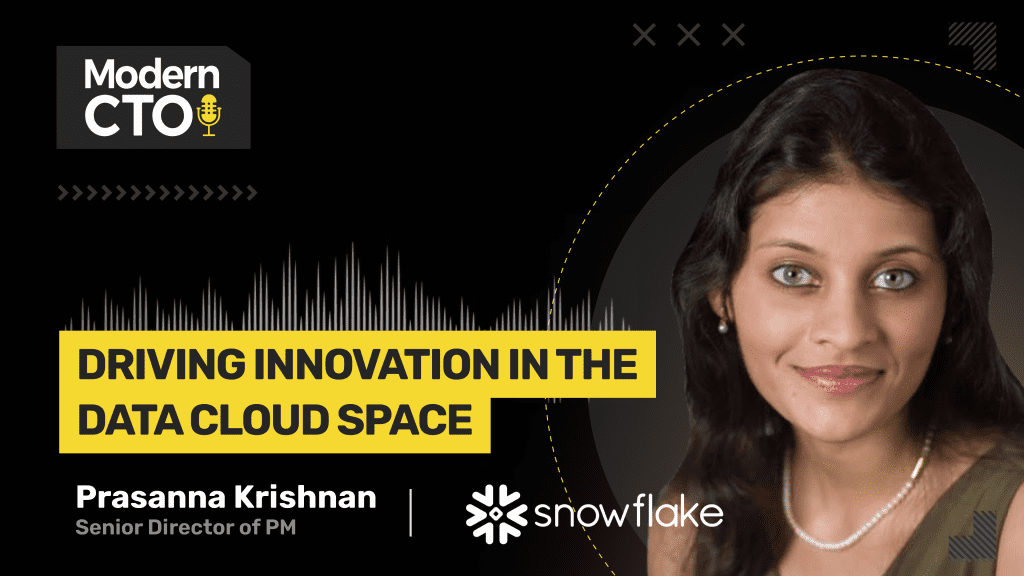
About Prasanna Krishnan:
Snowflake delivers the Data Cloud — a global network where thousands of organizations mobilize data with near-unlimited scale, concurrency, and performance. Inside the Data Cloud, organizations unite their siloed data, easily discover and securely share governed data, and execute diverse analytic workloads. Wherever data or users live, Snowflake delivers a single and seamless experience across multiple public clouds. Snowflake’s platform is the engine that powers and provides access to the Data Cloud, creating a solution for data warehousing, data lakes, data engineering, data science, data application development, and data sharing. Join Snowflake customers, partners, and data providers already taking their businesses to new frontiers in the Data Cloud.
About Snowflake:
Snowflake delivers the Data Cloud — a global network where thousands of organizations mobilize data with near-unlimited scale, concurrency, and performance. Inside the Data Cloud, organizations unite their siloed data, easily discover and securely share governed data, and execute diverse analytic workloads. Wherever data or users live, Snowflake delivers a single and seamless experience across multiple public clouds. Snowflake’s platform is the engine that powers and provides access to the Data Cloud, creating a solution for data warehousing, data lakes, data engineering, data science, data application development, and data sharing. Join Snowflake customers, partners, and data providers already taking their businesses to new frontiers in the Data Cloud.
Transcript
(Intro Narrator at 00:00:00) Today, we're talking to Prasanna from Snowflake about Snowflake's vision for the data cloud. You're listening to Joel Beasley, Modern CTO.
(Joel Beasley at 00:00:13) So when I heard I was going to get to talk to somebody from Snowflake, I was super excited because my background is software engineering, and all of a sudden Snowflake popped up. It came out of seemingly nowhere, and then everybody was talking about it. It was really popular in the financial space as well, as far as people making investments. It grew what I consider super fast, and it's become this huge thing. And I was hoping that you could explain to me the evolution of Snowflake.
(Prasanna at 00:00:41) So Snowflake, let's go back to the beginning, was started as a database or a data platform that was built ground up for the cloud. Right? And one of the fundamental benefits of our architecture was the separation of storage and compute, which was counter to what the database industry had believed for decades, that you cannot separate storage and compute. And Snowflake built that as a fundamental benefit of our architecture, which meant that you could scale both storage and compute independently, which was something that the cloud enabled you to do. And so that enabled us to be really successful with capturing data workloads as they moved to the cloud because of that near unlimited scale and concurrency.
(Prasanna at 00:01:26) You could spin up a new virtual warehouse when you needed more compute power without having to duplicate data or copy data. Then building on that core platform and that core architecture, our data cloud, which is our mission to really break down silos between data and enable our customers to do more with their data in terms of running diverse workloads and driving more insights from their data, but also being able to monetize and drive new revenue streams from their data and from building applications on the Snowflake data cloud. And so that's the big vision and mission that we are working towards.
(Joel Beasley at 00:02:05) That is pretty cool because when I would scale a Postgres database in the past, you scale them together. You scale the storage and the compute for the database. So I love that. I wish I would have learned that sooner.
(Prasanna at 00:02:19) Well, hopefully now you get to play around with Snowflake and then get to do that.
(Joel Beasley at 00:02:23) Yes. Yeah. That's why it's good we have these conversations. I'm sure there's a bunch of people out there that were like, "Whoa, that's new information."
(Joel Beasley at 00:02:29) Ray from Publicis Sapient. Now I know that's how we got introduced, but I don't know, do you actually, do you know Ray? Have you worked with him at all?
(Prasanna at 00:02:36) I haven't worked with Ray directly, but we know Publicis. They're a services partner of Snowflake. And together with Publicis' know-how and knowledge and Snowflake's data cloud platform together, we're helping customers do more with data on the cloud.
(Joel Beasley at 00:02:50) So Ray is awesome for future. If you need somebody there, Ray is the guy. Yeah. But tell me a little bit about what the partnership or the, what does that look like?
(Prasanna at 00:02:59) Yeah, absolutely. So the partnership, as I was mentioning, is Publicis is a services partner of Snowflake. And this means that they bring in their know-how, their consulting services to help customers leverage the Snowflake data cloud, both our technology capabilities as well as the participants of the data cloud who bring the content on the data cloud. So there are many different dimensions on which we are working with Publicis, and really excited.
(Joel Beasley at 00:03:27) So I want to talk a little bit about you too. You seem like an absolute rock star climbing up corporate stuff, doing huge jobs. And one of the things that I was really interested in is your interest in physical activities, hiking, things like that. I'm assuming you're a pretty healthy person. You take care of yourself.
(Joel Beasley at 00:03:46) I was curious, have you always been like that, or did you learn a lesson and learn to take time for yourself? How has your journey with health and work gone over your career?
(Prasanna at 00:03:55) That's a really interesting question. Thank you, first of all. Yeah, I've always been an active person. I just have a lot of energy, and I find that being active and fit just helps me do my work better.
(Prasanna at 00:04:10) So that's always been a big part, whether it's outdoor stuff, hiking. I also do a form of Indian classical dance that I've done for many decades, and I continue to perform that, which is another way to stay active and creative at the same time.
(Joel Beasley at 00:04:25) Nice. That sounds fun. So do you do it like an extracurricular activity, or you have a group that you guys meet up with once a month or something like that?
(Prasanna at 00:04:34) Yeah, we have a group and then a teacher who I've been working with. And so, yeah, we meet once a week, but then we also do performances.
(Joel Beasley at 00:04:42) That is so cool. I love that. I've found that throughout all the interviews I've done, some of the top performers have a really good understanding of doing physical activities, whether it's working out or dancing or whatever it may be. And I find that, you know, I get to talk to so many people, and I would say that a lot of them are successful, you know, you want to say that.
(Joel Beasley at 00:05:05) A lot of them tend to be good leaders, but the ones that I see that are happiest and successful good leaders have figured out that physical component.
(Prasanna at 00:05:12) Yeah, that's definitely true. I actually think of dance as a form of active meditation. I can't, you know, some people like to meditate sitting and doing breathing. For me, this is my form of meditating while being active.
(Joel Beasley at 00:05:23) And you do some hiking too. I saw that. It says you have hiked every continent. Is that correct?
(Prasanna at 00:05:30) Yes.
(Joel Beasley at 00:05:31) Wow. Like, is that Antarctica too? Is Antarctica a continent?
(Prasanna at 00:05:34) Yes, Antarctica too. I did that when I was actually in business school, and we spent a week, eight days in Antarctica camping and hiking, and that was definitely an incredible experience. It was like being on the moon. It was just so different.
(Joel Beasley at 00:05:47) Wow. That sounds like, I have not gotten to do anything close to that. I have been to the States, and then I've been to Copenhagen and Sweden. So just a little bit over there, and that's pretty much it, like Belize. So only three or four other countries outside the US. But what I have found is that we are largely the same.
(Prasanna at 00:06:08) Yes.
(Joel Beasley at 00:06:09) We are mostly the same. We're all humans.
(Prasanna at 00:06:12) That is so true. That is so true.
(Joel Beasley at 00:06:13) Yeah. And can you just walk me through your working career? Because I know you've done a lot of things. You founded companies. You've worked on Teams early, I think, at Microsoft.
(Joel Beasley at 00:06:22) Can you walk me through your progress?
(Prasanna at 00:06:25) Yeah, absolutely. So my background before I got to Snowflake falls into three camps. From an educational perspective, I grew up doing computer science. So much like you, I was programming.
(Prasanna at 00:06:36) And so I did a bachelor's and then a master's in computer science. My master's was here at the University of Illinois in Urbana-Champaign. And then I worked in sort of three buckets of things. The first bucket was large tech companies, including Microsoft and briefly at Comcast. The second bucket was venture-backed startups, including one that I started and ran, which actually was in education and using technology to improve education and reading.
(Prasanna at 00:07:03) And so I know that's an area that you are passionate about as well. And then the third bucket was I used to be a VC, and one of the areas I invested in was cloud back in the very early days of cloud. So those are my sort of three buckets of things, and I did roles that were technology roles, product roles, business roles, and then that all led me to Snowflake.
(Joel Beasley at 00:07:25) Was it in that order too? Was it large tech companies and VC-backed startups and then some VC investing?
(Prasanna at 00:07:30) Oh, actually, that's a good question. No, the order was mixed. So I started at Microsoft, then I went to business school at Wharton, did my MBA, and then I worked in venture right after that. And then I really wanted to be back on the side building things, which is what I really enjoyed.
(Prasanna at 00:07:47) And so I then went into the venture-backed startup world with MongoDB and Jetsetter, where I ran a marketplace, very different type of marketplace, B2C. And then I started my company really with the goal of leveraging technology to improve education.
(Joel Beasley at 00:08:03) Why did you, I mean, after you'd worked in these tech companies, you went to Wharton, why did you decide to get into VC? Did you know somebody there? Were you recruited? How did you get involved in that world?
(Prasanna at 00:08:13) It's a great question. So I was always drawn to working on new ideas and technology, and so the startup VC world was really interesting to me from that sense because it was leveraging technology to disrupt large industries that could really benefit from new innovation. And VC and startups, I kind of saw as two sides of the coin. Obviously, as a venture capitalist, you're investing in startups. And as a founder, you're building startups.
(Prasanna at 00:08:46) But that was kind of what drew me to VC, and it was an interesting industry to work in because it's sort of like learning from 2,000 different case studies because you're working with all these different startups and you see them going through different journeys. And so it was a great learning experience. But for me, I'm a builder at heart. And for me, in VC, at the end of the day, you are investing in companies and supporting them, but you are not actively building them. And I really love the building part, and so I went back into the operating side.
(Joel Beasley at 00:09:15) I love that. And did you go right from that into Snowflake, or did you do some other things along the way?
(Prasanna at 00:09:20) And so after VC, I actually worked at the other places that I mentioned, like Jetsetter and MongoDB and my startup. And it was after that that I got reconnected with folks at Snowflake. Christian, my manager, and I overlapped at Microsoft many years ago, and that was kind of the reconnection back here, just as I was thinking about my next adventure.
(Joel Beasley at 00:09:42) So Christian knew you could deliver, and that's one of the ways you got into Snowflake?
(Prasanna at 00:09:48) Well, I hope that was why I was brought in. No, I'm kidding. Yeah.
(Joel Beasley at 00:09:53) Well, that's what, I was doing some research on people getting jobs through recruiters or relationships and then how those relationships worked. And I found that some of the, like, let's say like a JPMorgan Chase, if you're going to be the director of technology there, typically in my experience, those types of positions come in through relationships because when you have a position that's so important, being able to look at your network and know someone's right for it and know they can deliver on it, that is one of the benefits you have as a professional is your network and the people you've worked with.
(Prasanna at 00:10:29) Yes, absolutely. Yeah. And I think your network is really important both to help you find the next set of people that you want to work with, right, and for you to find your next adventure. And I think that's a large part of that is because I personally believe that in an interview, there is only so much that you can know about a person.
(Prasanna at 00:10:47) And I think being able to really see how they are to work with, what they've accomplished, and what others who work with them have to say, I think is really important as well.
(Joel Beasley at 00:10:59) I have a question for you about interviewing because I was doing one today. We were looking for another producer today to expand the team. So we make our show, but we also make like fifteen, twenty other shows for other companies. So that's one of the ways that we're expanding and growing. That's awesome.
(Joel Beasley at 00:11:15) That's awesome. But for interviewing, I have found that I can't really tell the difference in whether it works out better when I just hire quickly or I spend more time with them. It seems that my ratios are about the same. Have you found something different, or do you have any tips for me there?
(Prasanna at 00:11:35) Yeah, it's a great question. You know, I think having an interview loop is one thing that helps. So you have more than one person interviewing a particular candidate, and that's something at Snowflake we put a lot of effort into making sure that you have the right interview loop that's interviewing a person and can focus on different dimensions of assessing what you need for this role. Maybe someone's focusing more on the technology side, someone's focusing more on collaboration and so on.
(Prasanna at 00:12:00) But I think the other piece, so the loop helps you get to evaluate different dimensions. And then the other part that I always go back to is, what do folks who worked with this person have to say? And oftentimes, that is, I think, also an important measure. And of course, it's not always the case that you know someone they've worked with, but I think their references are also very helpful.
(Joel Beasley at 00:12:23) Yes. That is actually one of the few things that has stuck with us. We always ask for two references because if you don't have two people in your life that are willing to discuss your character or what it's like to work with you, even if you're a college student, you have professors and things like that.
(Prasanna at 00:12:38) Yep.
(Joel Beasley at 00:12:38) Well, you've got a team. Can you describe to me what you're doing on an everyday basis at Snowflake?
(Prasanna at 00:12:44) Yeah, absolutely. So at Snowflake, I focus on our collaboration set of things as well as the Snowflake marketplace. So going back to what we talked about with the vision for the data cloud, which is to eliminate silos and help you drive more value from your data and build applications on the data cloud, a big part of this vision is enabling customers to be able to collaborate. And so when you think about collaboration, if you think about business, business is inherently collaborative.
(Prasanna at 00:13:15) You don't do business within your own four walls. And so what we do with the collaboration workload at Snowflake is really enable customers to be able to collaborate for all of the different use cases that they have for collaboration, which we think of as spanning a continuum. Right? On the one end of that continuum is finding and using third-party data, maybe to improve your ML models, or to enrich data that you have, or even finding and using third-party applications against your data. Right?
(Prasanna at 00:13:46) And so this is kind of the commerce use case, buying and selling. Further down the continuum is you might want to use free open data out there, for example, economic indicators. Further down the continuum, you want to collaborate with your suppliers, your vendors, or you might want to get access to your own data that is being captured within an application that you use. Right? Maybe it's your CRM system, maybe it's your email marketing system.
(Prasanna at 00:14:11) And then you also have business units within your company and you want to enable people to collaborate across these business units. And so being able to collaborate across this entire continuum of use cases is one of the big value props that we want to enable with the data cloud and making that really easy. And that includes being able to give access to the data without creating copies of it. That's a big central premise. It also includes being able to discover and monetize data and applications on the data cloud, as well as being able to do all of this collaboration in a privacy-compliant way.
(Prasanna Krishnan at 00:14:46) And, you know, security and governance is central to everything that we do. And especially when it comes to collaboration, you have to sort of—privacy becomes really important. And so with our clean room capabilities, we enable multiple parties to be able to collaborate on data and do so in a privacy-compliant way. So think of it as sharing data, but saying what kind of questions the other parties are allowed to ask on this data without giving access to the underlying data. And so we have customers like Disney and Roku who established clean rooms on Snowflake to enable their advertisers to better target and measure and activate their ad campaigns.
(Prasanna Krishnan at 00:15:23) And so this is going to continue. And so our day-to-day is around how do we build the right product capabilities to support all of these use cases of collaboration, as well as an important part of the data cloud is also the content that is available on the data cloud. I like to think of it as the data cloud is valuable to you because of the underlying technology, but also because of all of the other participants on the data cloud that are available. And so a big part of what we also do is bringing on the leading sellers of data and software in every industry to participate on the data cloud. And so we have a dedicated marketplace business development team and operations team that's focused on bringing on the other supply on the data cloud.
(Joel Beasley at 00:16:04) That's a lot. You do a lot of stuff there.
(Prasanna Krishnan at 00:16:06) It's fun. I focus on all of the collaboration and Snowflake Marketplace. Yep.
(Joel Beasley at 00:16:12) Oh, okay. Cool. Can you describe to me, like, is the marketplace where I'm buying data or where I'm installing apps or both?
(Prasanna Krishnan at 00:16:19) It's a great question, and it is both. You know, we think of the marketplace as really the conduit to enable customers to discover the right data or applications that they need, be able to evaluate it, and then be able to immediately get access to it. Right? Whether it's buying it through our usage-based monetization approach and then being able to access it immediately through our underlying data sharing mechanism, which enables you to get access to this data or this application built on the data cloud. And so the marketplace has listings, and the listings can be targeted to be discovered by everybody or only by specific people depending upon what your use case is.
(Prasanna Krishnan at 00:16:59) Right? And so if you wanna publish this data or this native application on Snowflake and make it discoverable broadly so that you can monetize it, you might wanna make it discoverable by everybody. But if you wanna collaborate with your suppliers, maybe the clean room example where you want to do a collaborative clean room with a specific set of parties, then you only wanna make that listing discoverable to those parties. And so we support varying ways in which you can target who can discover your listing. And then the marketplace then becomes really the layer that solves this discovery problem, connecting parties, as well as enables you to then be able to try and buy this data that is being monetized. Yep.
(Joel Beasley at 00:17:41) How does GPT play into this? Is it an app on your marketplace that you can install and have it look at your data sources? Are you using GPT at all at Snowflake? How does that work?
(Prasanna Krishnan at 00:17:51) Yeah. So GPT is, of course, a very exciting development for all of us, right, in the industry. And, you know, at Snowflake, we actually think that this is a big part of where Snowflake also brings value in terms of having the data. So data and ML kind of go hand in hand. It's like peas and carrots.
(Prasanna Krishnan at 00:18:07) And so, you know, one of the big benefits of the data cloud which enables you to break down silos between data is really to now be able to use all of this data, bring together all of this data, right, within your own four walls and outside, to use that to train models, deploy models, and so on. So that's one piece. The other part that we're actively thinking through is also leveraging some of these capabilities to make it easier to build those connections and discover the right content that we talked about with the marketplace.
(Joel Beasley at 00:18:41) I was playing with it last night. I found a YouTube video that was showing you how you can ask GPT questions about your data, and it spits out the SQL or whatever you would need to query the data. So you could say, "Hey, in the summer, what product's the most popular?" And then boom, outputs the SQL.
(Joel Beasley at 00:19:00) You paste it in your SQL, and it gives you the answers. And when I saw that, I thought to myself, "Wow. We have come a long way from Active Record in Ruby and some basic things to make it slightly easier to—" just you can ask the question. And my brain started thinking about...
(Prasanna Krishnan at 00:19:18) Yep.
(Joel Beasley at 00:19:18) How that's going to change the structure of our engineering teams. It's definitely gonna make it more accessible. It's going to allow people that have an interest in tech, but aren't necessarily of the engineering mindset on a super detailed level, that they can get involved. So have you thought about how it's going to change the structure of our organizations?
(Prasanna Krishnan at 00:19:39) Yeah. I mean, I think there is definitely, you know, impact that it has in many different kinds of fields. And I think with engineering, some of the examples that you gave, right, are super interesting—making it easier for you to write queries, to be able to... And those are all things we think about. At the end of the day, I think it's—I think of it as really humans plus algorithms. You know, it's making it easier for humans to do some of the things that you might have otherwise spent, you know, hours doing.
(Prasanna Krishnan at 00:20:11) And so, yeah, I think it enables—opens up—lots of new frontiers.
(Joel Beasley at 00:20:15) Have you seen the GitHub Copilot text or code completion? Have you seen the software yet?
(Prasanna Krishnan at 00:20:22) I've seen code completion examples. I—yeah. Definitely. Those are—that's another great example, right, where normally, you know, you would have to go dig up maybe documentation to look this up, and this is just giving you that information at your fingertips. So again, making you much more efficient as a developer.
(Joel Beasley at 00:20:40) Yes. So okay. You were a founder. You had VC connections. You knew how to run a business.
(Joel Beasley at 00:20:46) You know how to deal with the P&L, all of that stuff. And then you go work for another company? Like, Snowflake. Tell me, what was going on? Like, what were your thoughts? Was it to focus on family, or was it because Snowflake was such an opportunity?
(Joel Beasley at 00:20:58) Are you, like, working with Christian? Like, what were you thinking about when you took this role?
(Prasanna Krishnan at 00:21:03) Yeah. I mean, it was really a little bit of all of the above. Right? And, you know, one of the things that drew me... Just a little late, and I'll actually go back to something that I often share when folks ask me how I thought about my career progression or advice on, you know, the next adventure. The beginning of my career, I kind of made decisions based on what's the most interesting technology or product to work on.
(Prasanna Krishnan at 00:21:22) Then, after having been in VC, I said, you know, let's look at how big this business can be, and that was kind of how I made my decisions. Right? But then I came to realize with all of my gray hair that while those two are necessary, they're not sufficient. The third key ingredient is the people and the culture. And I think that is something that is absolutely essential for you to really enjoy your day-to-day.
(Prasanna Krishnan at 00:21:46) So what drew me to Snowflake was really the combination of all of these three. It was, you know, obviously a really unique technology as we talked about, and it was really a unique opportunity to shape, you know, a key part of this vision from the product and business side. But it was equally an amazing group of people and a great collaborative culture.
(Joel Beasley at 00:22:07) So I know you described the specific area that you're in within Snowflake, but so Snowflake exploded. It became something everybody's aware of. My parents know what Snowflake is, and,
(Prasanna Krishnan at 00:22:19) You know,
(Joel Beasley at 00:22:20) they're doctors and stuff. So people know Snowflake, and it just became this massive thing. How do you keep going forward after, like, everybody knows you? You're a thing in the industry. Like, how do you look at taking the next step as Snowflake when you're already so well known?
(Prasanna Krishnan at 00:22:39) You know, I honestly think there's so much to do. We're honestly really just getting started. And one of the big, big areas we're really excited about is really disrupting application development. Right? And so making it easy for you to build, deploy, and monetize applications on top of the data cloud is something we're super excited about.
(Prasanna Krishnan at 00:23:01) And on this note, I wanted to touch on actually a couple of things that we're doing that are really key to this. So the first part is enabling you to build applications in the language of your choice, right, whether it is programming in SQL, Java, Python, Scala—enabling you to build, deploy, train models. And so what we are doing with Streamlit, which was an acquisition Snowflake did a little while ago, is really central to this. Streamlit, you know, enables you to build visual experiences on top of your data through Python. Right?
(Prasanna Krishnan at 00:23:34) And it's really easy to use. You know, there's tons of applications you can play around with on the Streamlit cloud. That's all a big part of making it really simple for you to build in your language of choice and really build extensible applications. The second big piece is being able to deploy and run these applications that are, you know, able to scale and can really be performant. And so a lot of the things that we're doing with the data cloud and enabling you to execute these applications as what we call native applications is a big piece of that.
(Prasanna Krishnan at 00:24:03) And so a native application is—think of it as a contained set of the application logic as well as logic that can leverage data. And that data could be sitting in the account of the provider who's building the application or in the account of the consumer. And through the marketplace, the consumer can discover this native application. They can try it, they can buy it, paying for it on a usage basis, and they can then run this application in a secure sandboxed way within their Snowflake account and really have full controls over what this application is doing within their account. And so that's another big part of being able to deploy or run your applications.
(Prasanna Krishnan at 00:24:43) And the third part is being able to distribute, being able to reach new customers, and being able to monetize these applications through the marketplace and what we're building there. So I think all of this is, you know, the next big thing, but it's—and there's so much more to do. So, yeah, we think there is a lot that we're gonna continue really pioneering for the industry.
(Joel Beasley at 00:25:04) It is so cool to think of your database as being connected to a marketplace. Right? Because you always wanna do all these things to your data. Typically, the data is isolated, and you would bring the tools in locally and all of that. And the idea that I can have a database, and then I can open up a marketplace, and I could do things like install a GPT-type technology, and then I could just talk to my database.
(Joel Beasley at 00:25:32) That sounds really, really cool. Or that I could put a charting program on it for a visualization without having to pipe the data around in a million places. And I'm assuming there's—a lot of these softwares are smart enough to understand some basics about the data structure. So out of the box, when you turn it on, there's at least something cool to look at, and then you can sort of configure it.
(Prasanna Krishnan at 00:25:54) Yeah. No. You hit the nail on the head. A big part of this is having one single source of truth for the data instead of piping the data around, as you said, or creating copies that are floating around, which, you know, we repeatedly hear from customers that becomes a nightmare—if you have a governance nightmare, if you have, you know, data being copied around. And so our whole premise is to have a single copy of the data, a single source of the truth, and be able to bring the applications and the logic to the data and enable them to run in a secure sandboxed way.
(Prasanna Krishnan at 00:26:23) And that is a big, big benefit both for the consumer because now they can have a single source of truth of the data. And then for the provider, it gives them that distribution and scale.
(Joel Beasley at 00:26:33) I was reading an article from your chief data officer, and he was talking about how data science is starting to permeate every department
(Prasanna Krishnan at 00:26:43) in
(Joel Beasley at 00:26:44) every organization. Right? Are you seeing this happening as far as the users who are doing things with the datasets?
(Prasanna Krishnan at 00:26:52) Yeah. Absolutely. I mean, every line of business is becoming data driven, and that means that there are, you know, insights that can help whether it's the chief information security officer or the chief financial officer or the chief marketing officer, right, enabling everyone to do their work better. And so one of the things we see a ton of is both data being used for these different use cases in these different lines of business, as well as applications that are, you know, being built for these different lines of business. So we talked about, you know, clean rooms and the marketing use case.
(Prasanna Krishnan at 00:27:27) As a CMO, I wanna be able to better, you know, target and activate customers that we wanna advertise to. I also wanna see how these are performing. Right? That measurement piece and being able to do all of this, that's a big use case. I'm just using CMO as an example.
(Prasanna Krishnan at 00:27:44) But there you have the data from different parties. So we talked about Disney as a publisher using a clean room with their advertisers and being able to bring together data from all these parties and then being able to ask questions of this overlapping data, the joining—joining this data together—in a privacy-compliant way. Right? That's one example. If you look at the information security space, you know, using Snowflake as your security data lake to be able to do analytics on events happening on your network.
(Prasanna Krishnan at 00:28:14) That's another big use case. Again, driven by data, again, driven by applications that are specific for that business use case.
(Joel Beasley at 00:28:20) That is so cool. So I'm just gonna say it again to make sure that I understand this correctly. If there's two entities and they both have data that they wanna remain private, but they wanna answer questions on those being laid over each other, connected...
(Prasanna Krishnan at 00:28:36) Yep.
(Joel Beasley at 00:28:36) Do you have this clean room and we both bring our datasets in there or give access to them? We can't see the underlying datasets. But we can ask questions, and these questions can return results. And you have systems on there, so I'm not just asking, "What does row one say? What does row two say?"
(Prasanna Krishnan at 00:28:52) Exactly. Yeah. Yeah. Exactly.
(Joel Beasley at 00:28:54) That is so cool.
(Prasanna Krishnan at 00:28:55) Yeah. That is incredibly powerful. You can ask questions of the overlapping set, right, without revealing any underlying PII.
(Joel Beasley at 00:29:01) How do you spend time with customers? What does that look like for you on a day-to-day basis?
(Prasanna Krishnan at 00:29:06) Yeah. That's a great question. We are a very, very customer-driven company, and we definitely work closely with customers. So we work with customers all through, you know, that product development life cycle, right, from the discovery phase where we are, you know, understanding the need, the problem, to then come back with sort of a really creative way to solve that problem. Then when we go out and kind of solve that problem, we also work with customers who join in the preview of that feature, right, to get their feedback, to make it better.
(Prasanna Krishnan at 00:29:38) And then, of course, finally, when we launch a feature in GA, we work with customers to really adopt it and scale it, and we also work across industries. So talking to customers in different industries to see how the same feature can really solve problems for them in their industry.
(Joel Beasley at 00:29:54) So we have a rule here, and it's when you say an acronym, you have to explain it.
(Prasanna Krishnan at 00:29:58) Oh, yes.
(Joel Beasley at 00:29:59) Yes. You said GA.
(Prasanna Krishnan at 00:30:01) Oh, I'm sorry. I didn't even realize I said that. Yeah. No. GA is just generally available.
(Prasanna Krishnan at 00:30:05) So the feature has been previewed, and then we've incorporated the feedback from the preview and then made the feature generally available.
(Joel Beasley at 00:30:12) I love that. You know, I actually asked for feedback from somebody the other day that was on the show. I said, if you could change anything about the show, what would it be? He said, well, your guests often use acronyms, and I don't understand them. And I used to ask more often, but then I learned so much that I just thought everybody knew it, and now I'm back on the train.
(Joel Beasley at 00:30:32) So if everybody has been listening for a while, I am back on. If somebody says acronyms, we're going to have them explain it.
(Prasanna Krishnan at 00:30:38) That was great feedback from your guest, and it's great that you called me out on that.
(Joel Beasley at 00:30:43) So as we start to wrap up here, you're hiring. Our show is good for a couple things, right? Brand awareness, getting your word out about what you do, hiring and attracting talent, because the people who want to become better are the people that listen to these episodes because they want to learn and grow. And I saw that you have a principal technical program manager. You have some jobs opening. You're hiring. Can you tell me a little bit about any of those roles or what you look for in potential employees?
(Prasanna Krishnan at 00:31:11) Yes. No, thank you for bringing that up. Yeah, we are hiring, which, you know, Snowflake has always been very careful about hiring. So the good news of that is we didn't overhire, and so we're in the opposite situation of many companies that are trying to correct that overhiring. We didn't have that problem. We are hiring in many roles. One role that I shared about on LinkedIn is we are looking to hire a technical program manager for this collaboration area that I talked about, really to help us operationalize and execute the programs that we're working on in this space. But we have several other roles. Our careers site has roles across the company in product and engineering, in product management, in engineering, in design, in all of the different functional areas as well.
(Joel Beasley at 00:31:58) There it is. Oh, I forgot a question for you. Do you know about the origin of the name? Like, why is it called Snowflake?
(Prasanna Krishnan at 00:32:07) Yes. What I've heard from Benoit, our founder, I think it had something to do with, well, one, all of the founders were really passionate about snow and winter sports, being, and that was one of the things that brought them together. And then the other part of it is really sort of the cloud and the reference to, you know, snow comes from the cloud, and we were building this data cloud. And so I think that was another nice reference as well.
(Joel Beasley at 00:32:33) Oh, it's a good object. I mean, snowflakes, at least from a physics and nerdy standpoint, they're beautiful things with their fractal nature and all of that. But yeah. We made a podcast. How do you feel?
(Prasanna Krishnan at 00:32:44) Oh, this is so fun.
(Joel Beasley at 00:32:46) Thank you so much for listening. And if you found this episode useful, please share it with a friend or colleague who you think would get value from it. And if you have topics that you would like to hear discussed on the podcast, either add me on LinkedIn or send me an email, [email protected]. Every time I get an email or LinkedIn message, it absolutely makes my day and inspires me to keep going.