
Episode 580 ·
Finding Success in a Remote World with Raymond Velez, Global Chief Technology Officer at Publicis Sapient
Today we’re talking to Raymond Velez, Global Chief Technology Officer at Publicis Sapient; and we discuss why finding balance as a technology leader is crucial; the reason customers expect personalization and how to deliver on it; and the trend of remote teams that’s allowing them to grow most effectively.
All of this right here, right now, on the Modern CTO Podcast!
Check out more of Raymond and Publicis Sapient at https://www.publicissapient.com/!
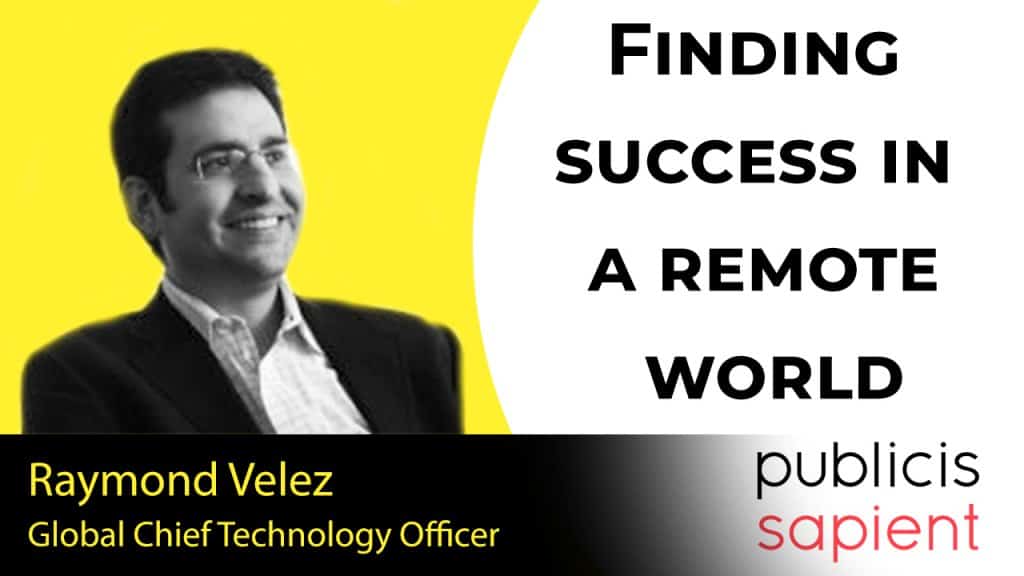
About Raymond Velez:
I have spent my career in application technology architecture and development. Starting off in the client server industry and moving into web application development I've worked with a wide spectrum of technologies helping implement business and user driven solutions to meet our clients needs.
Specialties: web technology and architecture, digital and web application development, technology community collaboration
About Publicis Sapient:
Publicis Sapient is a digital transformation partner helping established organizations get to their future, digitally-enabled state, both in the way they work and the way they serve their customers. We help unlock value through a start-up mindset and modern methods, fusing strategy, consulting and customer experience with agile engineering and problem-solving creativity. As digital pioneers with 20,000 people and 53 offices around the globe, our experience spanning technology, data sciences, consulting and customer obsession – combined with our culture of curiosity and relentlessness – enables us to accelerate our clients’ businesses through designing the products and services their customers truly value. Publicis Sapient is the digital business transformation hub of Publicis Groupe. For more information, visit publicissapient.com.
Transcript
(Intro Narrator at 00:00:01) Today, we're talking to Ray from Publicis Sapient all about personalizing data and optimizing work-life ratios. You're listening to Joel Beasley, Modern CTO.
(Joel Beasley at 00:00:16) Yeah, so what's your background? Like, how did you get in? Did your dad take you around to different technology places?
(Ray at 00:00:22) Well, you know, there's probably some influence there. My dad was actually a diesel truck mechanic. But when I was, I guess I was about 10, I went to computer camp, and I remember loving it so much. I saved up from my paper route and bought an Atari 800. Right? And I always remember that. It's one of my more obscure bio points. But I remember it came with, you know, BASIC and a little book where you type in a program and then you just tweak a couple of things and it would change it. And I remember, wow, this is great.
(Ray at 00:00:56) And then in high school, I advocated to bring back an advanced placement class for computer science. Back then, I think it was, well, it was definitely Pascal. And then I studied computer science at Boston University. So I just fell into something that I really enjoyed. And, you know, still to this day I love, I don't do the programming side of things as much anymore, but just putting together the components to help computing reach its potential.
(Ray at 00:01:25) So at BU, I studied computer science and philosophy, so a lot on that intersection between kind of the known and the unknown. Everybody thought it was crazy back then because I graduated in '92, but now I see it's, you know, regular offerings now. But we had to do it as two separate majors, and so I had to do some night school to fit that in. But I loved it, and, you know, I don't think I would have been able to put the extra time in if I didn't like that kind of intersection of philosophy of science and computer science.
(Ray at 00:01:58) Then started off, I probably spent, kind of pre-internet, spent a lot of my time with client-server technologies. So that's where I got started. It was a place called Cambridge Technology Partners, which turned out to be, you know, basically across the river in Cambridge from Boston University. And it was a great place, and it spawned a lot of interesting startups, which then we all kind of moved on during the dotcom days to the dotcom consultancies. And that's kind of still where I am now, twenty-odd years later. But it was a consultancy called Scient, and then we merged and became Razorfish, and then we were sold to Microsoft as part of a bigger acquisition. Then Microsoft sold us to Publicis. So I've been, you know, just all throughout the industry. If you look at my LinkedIn, it's like, why, you've been at the same place for a long time. Well, it's been a pretty different place every four or five years.
(Ray at 00:02:48) Now I'm the CTO, and I focus on customer engagement solutions at Publicis Sapient is my current role.
(Joel Beasley at 00:02:56) All right, I've got lots of questions for you now. BU, you study computer science, philosophy, my type of person. Right? And I'm curious to know, how you went from being a computer science nerd to developing those skills to lead an organization. How did you do that?
(Ray at 00:03:13) Yeah, yeah. It's interesting. I think it kind of fell in naturally. Like, I didn't necessarily have in my mind that, you know, I wanted to be a leader, and I'm really fortunate to have worked at just some great organizations that supported us and mentored us and helped us really grow.
(Ray at 00:03:30) And that Cambridge Technology Partners, they had this great track from developer through, I think, yeah, it was technology team leader. Right? And I, you know, I moved pretty quickly into the TTL role. Now I think back, this is such a long time ago, but it fell natural. And the structure of the organization was to bring in lots of young undergrads and then grow them into leaders pretty quickly.
(Ray at 00:03:56) So like, it was, you had no choice. But I also felt like it came naturally. I was talking to some colleagues about this in the past, too. I think the other thing in the computer science space, and even in the development space, there's just a ton of diversity. Right? And it's kind of, that's my heritage is pretty diverse. I was born in Brooklyn. My mom was Irish and English ethnicity. My father's from Puerto Rico, and I always joke our holidays were, you know, me trying to translate the Irish side so they could speak to the Puerto Rican side in Spanish. And I would always say, well, if you speak louder, it doesn't mean they understand your English any better. Right? Let's see if we can translate. So I grew up with, you know, a variety of opinions and feedback and, you know, loudness and quietness. And I felt that, you know, working with diverse teams, you know, charting towards a goal is, you know, kind of in my DNA, I guess.
(Joel Beasley at 00:04:54) Did you pick up your technical and social skills from your parents? Tell me about that.
(Ray at 00:04:59) Well, probably a little bit of both. So my mom passed away a couple years ago, and we did, you know, an online service for her. And it, I, you know, my mom was the Irish and English side, even though she spoke perfect Spanish, too, you know, till the day she passed. Her network of friends and colleagues was just amazing. Like, I don't know many people, you know, made it to her stage in life. And they went to, sad things about pandemic, it was hard to get together. But one of the nice things was we had a virtual remembrance, and it was all over the world. And the number of people who showed up was like, wow, you know, like, I was so lucky to be in that family and my mom who really just knew how to bring together people. Right? And she was just superb with that. And then maybe the technical side a little bit from my dad. I grew up sitting alongside and helping him fix our family vehicles. And it wasn't just our family. Since he was the only mechanic in the family, it was everybody in the family. And so he really had a comfort with, you know, kind of taking things apart and putting them back together.
(Ray at 00:06:09) He forbid me from going into auto mechanics, and I never learned as much as I should have because he was my dad, but sitting along there certainly had an influence.
(Joel Beasley at 00:06:19) I love that. I'm always interested how we're influenced by our parents. It took me over thirty years to realize the reason why I get excited about technology is because my mom was a cheerleader and my dad was an engineer.
(Ray at 00:06:30) Right. Exactly. So it's simpler. Yeah, yeah. It comes together.
(Joel Beasley at 00:06:33) Yeah. I lost my mom about five years ago, and it had a fairly, like, profound impact on my life because, you know, you hear people all the time say how life is short and it's finite and it's precious, but then losing a parent is like a very specific thing. And that was one of the things I had, or events that had caused me to, I guess, wake up and try harder. And I got into, like, personal development, and I kind of went crazy with trying to become a better person. What type of experience did that have, like, on you?
(Ray at 00:07:00) Yeah, yeah. So, well, I think it definitely, and I was talking to some colleagues about this the other day as well, is just how do you make sure you're driving that balance in priorities in life. Right? And that was a big piece for me. I think a lot of times I, you know, and I got married and started a family. We have two kids. You know, I'm in my fifties and we have an eleven-year-old and a thirteen-year-old. And I started a family a little later, and I think I really always worked too much. You know, it was just, you know, part of my nature. I think I enjoyed it, so it came easy. But, you know, losing my mom really helped me to understand, make sure you're trying to find that balance. And then I always remember, I had a cousin graduated from med school and we went to her graduation, and my mom and my aunts, her sisters were there. And one of the things I really took away from it was the story—I love graduations and I love listening to the speakers at graduations—but the story of how when she was graduating medical school, the speaker at the graduation talked about she was juggling her newborn child in one hand, getting ready for some aspect of her post-graduate medical work, and talking to her mom at the same time because somebody was coming over the house. And her mom's like, well, did you clean the bathroom?
(Ray at 00:08:20) You know, and she said in her head, it's like, you know, I'm trying to get some balance here, and she felt completely out of balance. Right? And her takeaway, which kind of resonated with me, too, is, you know, that's the way balance works. It's not always steady state. And so it's trying to find that index that, you know, works for all these different constituents. Right? And we've debated that a lot with, you know, different colleagues over the years. But I think that made me kind of rethink that and make sure that, you know, I just know that it is a pendulum. Right, is that the right word? But just finding that is, well, when is this piece out of balance and this one more in balance? And I think that really kind of came to a head for me.
(Joel Beasley at 00:09:05) Yeah. When that conversation became really popular, right, about work-life balance a few years ago, I started thinking about it and talking about it on the show. And then at some point, I stole this from somebody, but they talked about, like, work-life ratio. Right? So, for example, I just had my third child. Right?
(Ray at 00:09:21) Okay.
(Joel Beasley at 00:09:22) And so those two or three, thank you. Those two or three weeks, about, you know, three months ago, I was definitely focused more on my family. The ratio was different. I was focused more on my family than work at that time. But I think it's more about understanding where you're at and being aware of where you're at and making sure that this ratio isn't changing and sneaking up on you and having skills to change that ratio. I think that's super important.
(Ray at 00:09:49) Yeah, I totally agree. And, you know, and I think starting a family later in life, it took me time to learn that. Right? And, you know, but knowing that it was some hard learnings, I hope it sticks with me for the rest of my life. Because, you know, I'm lucky. I still really enjoy what I do. I love, you know, solving challenges for clients. And I think that's the kind of the nice part of services, too. Like, I've always wondered, do I want to spend more time building product that kind of, you know, from the outside in, in the little experience I have building product, it feels like, you know, that's a better business model. Right? You know, it's more sustainable, more margin upside. Whereas, you know, services, it's all about, you know, kind of helping to solve a client's problem and, you know, managing your teams into, you know, profitable client relationships. And so they're different. The services model is obviously much, much, much older, but the product model, you know, seems to be, you know, much, much more successful.
(Ray at 00:10:46) So how do you find that balance between the two? And it's a big piece of, you know, we all deal with things like that on a daily basis.
(Joel Beasley at 00:10:54) Do you currently have any products that you develop within the company?
(Ray at 00:10:57) Yeah. So I've been part of incubating a couple of different products, and Publicis has made some really interesting strategic moves into digital transformation. And it's been, you know, a long journey. But the two acquisitions that Publicis Group has made, you know, one was what is now Publicis Sapient. So a large-scale digital transformation services company. Right? So how do we help our clients move from the old world of marketing and advertising to be, you know, digitally native in the way they go to business?
(Ray at 00:11:31) So that was, and Publicis, like I said, it's been around about ninety years. So that was the largest acquisition to that day. And then the second, or then it was an even larger acquisition of a company called Epsilon, too, which brings together a lot of products. And so in between there, I was incubating a couple of different products that now have moved into what Epsilon takes to market, just helping to, you know, build what this industry brings, which is a lot of data. How do we take that data and use that to activate on advancing and growing our clients' businesses?
(Ray at 00:12:06) So you think about personalization, enterprise optimization, all finding new data monetization models. All of that kind of comes together under some of the products I've spent time on. My role now is very focused on, you know, bringing all those products together, both internal and with partners, to help solve client problems.
(Joel Beasley at 00:12:25) So it looks like you guys do a whole lot of things. You have tens of thousands of employees. And I want to zero in on maybe two things that you said. The first one is you do some digital marketing, digital native type stuff. You do some marketing with brands?
(Ray at 00:12:40) Yeah. And so, well, two seconds on Publicis as a whole, and I think that that'll help bring it together. So Publicis Sapient's been around for about thirty years, was acquired by Publicis a couple of years back, probably probably four or five years at this point. But the long, the ninety-year heritage is, you know, kind of our two sister hubs. So there's Publicis Media, which has been a media buying agency, so helping clients take their advertising budgets and take those budgets and allocate those across different media buying platforms, both traditional things like television, et cetera, as well as digital platforms like Facebook, Amazon, and Google.
(Ray at 00:13:20) And Publicis Communications leads the creative side of things. So they'll help brands create that visual identity and the communications of how those brands go to market. So when you bring all of that together, it comes underneath an umbrella we call the Growth Loop. And so on one side of that Growth Loop is activating all of your owned and operated. So this could be your website, it could be your physical presence, the coming together of those two things, and all of the omnichannel capabilities that are needed to interact and reach both your customers and ideally grow the business with prospects.
(Ray at 00:13:59) And then on the other side of the Growth Loop are things that the legacy Publicis Media and Communications teams do. So how do we activate your brand with partnerships and within paid or rented mechanisms? Right? So that could be advertising buying and the experiences that go into there. You're starting to see clearly whole new universes like Metaverse and NFT and Web3 as well, which we're talking about with our clients. But at the end of the day, it's that Growth Loop. How do we bring those two together, have the technology and data to support that?
(Joel Beasley at 00:14:31) What do you think the future is in the next three to five years with Web3?
(Ray at 00:14:35) Yeah. No, it's a great question, and I work a lot with our lead in the Web3 teams, Ajay Dalal, who's been spending a lot of time there. I think, you know, it feels a little bit like what we're seeing with cryptocurrency and, you know, some of the impacts there. So and if I, you know, hadn't been in the industry long enough, I probably wouldn't have been able to recognize patterns back in ninety-nine, two thousand, when we hit the first dotcom boom and bust.
(Ray at 00:15:01) And, you know, it feels a little bit like, I don't know if folks would disagree. There's certainly boom and bust with cryptocurrency and some of the things that have been happening on FTX and others. But the principles behind the blockchain and Hyperledger principles, as well as the advancement of, you know, Metaverse experiences, those will continue to progress forward. Right? You can't really predict when it'll be, you know, feasible and easy to put on a pair of glasses or not and enter the Metaverse, which obviously is going to be a limiter on adoption.
(Ray at 00:15:35) But there's enough, you know, brilliant people and amazing funding to move that forward. So if you look over the next couple of years, what are the practical applications of a brilliant innovation like distributed identity or distributed transactions? Like, what's behind the Hyperledger? Well, you're going to see great positive results there. I have a friend at a startup, they're building, called drop.io, and they leverage the low cost and trustworthy capabilities of the Hyperledger to enable micro-transactions.
(Ray at 00:16:10) Right? Which is something we've been talking about since '99 and 2000 as well. So how does that in a trustworthy way still, you know, and a currency-backed way, still support all new business models? So we'll see more and more of that. We've seen things like the Hyperledger, even going back a couple of years, be used to create private networks to improve a procurement project with smart documents.
(Ray at 00:16:35) Right? So, okay, this procurement process is big and diverse. How do I enable that through a Hyperledger technology connected to smart documents to reduce the time that a large, complicated enterprise typically takes to go through an RFP process? How do I reduce that? I reduce that with trust and distributed trust.
(Ray at 00:16:54) Right? So I think those things will continue to grow, right? They have clear business value, but clearly we're seeing peaks and valleys with more of that consumer end of things.
(Joel Beasley at 00:17:03) And then your role, you mentioned that you're using data to find, like, create interesting findings, but also monetization. Is it findings of monetization? Are they two separate things?
(Ray at 00:17:13) Yeah. So I think it kind of parallels to the growth loop too. So if you think about one of the challenges with regulatory and deprecation of third-party cookies and even the, you know, deprecation of first-party cookies in many respects—and Apple's done this going back to 2017—it's harder and harder to recognize a repeat visitor to your digital properties, you know, whether they're recognizing the logged-in state or you're working with a third-party cookie and partner to drive a remarketing campaign for products that somebody who visited your properties might be interested in.
(Ray at 00:17:50) And so what we call that is solving for an identity or, if you think about how that translates to a physical presence, an identity graph. Right? So how do I—and of course, always lots of caveats, legal and regulatory privacy consent way, and I'll talk about kind of consent management. I think it's an important piece to talk about that. But clients need to solve for their identity graph, right?
(Ray at 00:18:12) Customers expect personalization at least at the same level when they walk into the store. Right? You know, I used to live in New York City, and my favorite thing was if I went to the same deli I went to every day, they'd be like, "Ray, you want the usual?" And I'd say yes, and I'd get the usual, right? And so that's personalization.
(Ray at 00:18:30) Right? And so for customers who have consented in and you've crossed the T's and dotted the I's on legal and regulatory, you need to enable that. The heightened expectations of consumers is you have an identity graph, bring together off-site and on-site data to recognize individuals, personalize, provide offers, et cetera. The other side of that is an enterprise graph. And so if you think about that as well, when I solve for an identity graph and I have the ability to build new models around a propensity to buy with both prospects and customers, how can I use that to improve supply chain?
(Ray at 00:19:07) So now you're taking two things together. And so what we've done for some organizations, like in the auto industry as well, is: okay, how do I align your inventory levels with your offers, your marketing, your experience? How do I bring all of those together? And it's everything, right? And so that means, okay, our data science teams are building sophisticated propensity to buy models based on visits to dealerships, websites, et cetera, that identify popularity of a certain vehicle by regions potentially, right? And I don't necessarily need PII to solve that. I just need to stitch together, you know, legal and regulatory datasets to prove that. And then I can use that.
(Ray at 00:19:48) Well, maybe you want to change the way you're presenting these offers because of excess or not enough inventory, right? And so certainly the pandemic has shown that. We've been working on this for quite a while. But I think it's those two graphs: solve for the identity graph, solve for, for lack of a better term, that enterprise graph.
(Ray at 00:20:05) And the reason why we emphasize graph a little is because it's a propensity score, right? And so if I could build some of that into, you know, physical constructs like graph-based technologies, then I could more rapidly build the analysis and the outcomes against that. And you're not just building, you know—I grew up in the old days, I was a DBA—you know, traditional relational database model that only connects two things when you've complied with the rules of your database structure. Right now, you're connecting things based on propensity and other models that give you the ability to do things you couldn't do in the past.
(Joel Beasley at 00:20:40) That's pretty cool. So how is your team structured then?
(Ray at 00:20:44) Yeah. Yeah. So my focus is really, how do I assemble this with all of our partners? Right? And as you can imagine, three of the biggest partners I work with are cloud compute partners, right?
(Ray at 00:20:56) And so they're a huge amplifier for us being able to do things that wasn't feasible a couple of years ago. And it wasn't feasible because the startup cost or the technologies to do this would take a lot more time. And that's really cloud computing at its heart—is it's enabling new things. I always used to say when Amazon first came out, I remember being amazed that I could spin up a hundred instances, you know, on AWS in less time than it took to reboot a laptop. You know, like, wow, all I need is a credit card and an account, and I just put up a hundred instances.
(Ray at 00:21:33) It takes me longer to restart my laptop. Right. And so it was just mind-boggling. And so now, you know, that assembling those partnerships and those teams is critical. And then at Sapient, I work with our capability leadership teams to build the solutions that bring all of this together.
(Ray at 00:21:51) Right? And there's a lot of domain expertise as well. When you're solving for identity and identity graph data, right? You know, if you look at this, this is what Facebook, Amazon, and Google have done really well, but this is something that's been a challenge for traditional enterprises.
(Ray at 00:22:05) Right? They've maybe captured customer data, but they're still at the point where many enterprises are combining a point-of-sale individual with an online individual. Right? You know, so even in a consent environment, they're not doing the things that customers expect. So it's building that domain expertise.
(Ray at 00:22:21) And then where it comes together to deliver, from a transformational perspective, are my partners I work with in our enterprise capability. So we use an acronym called SPEED: strategy, product, experience, engineering, and data. So all of those are across, you know, basically all of Sapient and all of the groups. So how do we make sure I'm aligning the data science capabilities with the engineering capabilities?
(Ray at 00:22:48) Right? Especially since, as we all know, a lot of data science is—what—60, 70, 80% is data wrangling and data engineering. So bringing all that together is part of my role.
(Joel Beasley at 00:22:58) That's pretty cool. You enjoy what you do a lot?
(Ray at 00:23:01) Yeah. You know, I'm really lucky. I think when you look at the promise and, you know, a lot of what we've been talking about for—you know, I'd say it really ratcheted up when the feasibility became possible. Right? When cloud computing really made a lot of this possible.
(Ray at 00:23:17) I'll go back to kind of an inspiration from a Google white paper, which became a Yahoo project, which became a service on Amazon. But it feels like we're still at the beginning of that. Right? So I've been talking about it for quite a while. And this goes back a long time. A book we launched—I had a couple chapters on this intersection of how to solve for identity—and that goes back eight, nine, ten years.
(Ray at 00:23:41) And I still feel like the opportunity is large. There's still plenty of white space to help large enterprises do this. And every year, the technology gets stronger and stronger. Right? So back to that story around, kind of, there's a technology that sits on Google Cloud called BigQuery.
(Ray at 00:23:59) And there was a white paper that years ago, I think, was called Bigtable. And I remember when Google came out with it, but it was, you know, the infinitely scalable infrastructure they built to enable them to really ingest data at scale without any, you know, row-level locking or any limitations on a server-by-server basis. Right? So Google invented this while we were trying to get, you know, clusters of traditional relational databases to work together to supply Internet scale, and it wasn't working. But so Google wrote this white paper, published it to the world.
(Ray at 00:24:37) Then Doug Cutting, a developer at Yahoo, took that white paper and implemented Hadoop. Right. And then Amazon said, "Hey, this Hadoop thing's really cool. Why don't I offer it as a service?" And Amazon created Elastic MapReduce.
(Ray at 00:24:50) Right. So then—and this was maybe, you know, ten-odd years ago—all of a sudden, I had the infrastructure strength of what Google was using to index the whole Internet, and I could rent it for, you know, pennies on the hour. Right? So that really just unlocked capabilities because people couldn't do what Google did until it was, you know, something that you can rent and feasibly approach.
(Joel Beasley at 00:25:14) Now I want to talk a little bit about this. You said there's a lot of opportunity, there's a lot of white space. I'm going to agree with you. So I've done interviews this year with Fingerprint.js. They do something like fingerprinting the browsers to help you identify, like, repeat logins and things like that. I also got to meet with Beyond Identity. One of the interesting things they do is they use this special chip that was originally designed in the computer for, like, DRM licensing, like for media.
(Ray at 00:25:39) Right. Yeah.
(Joel Beasley at 00:25:40) And they use that to hold some keys or something. And basically, they have, like, a passwordless offering. So I've seen a lot of this, like, passwordless stuff where they're using all the attributes of who the person is and where they should be and everything. Are you working with any of these companies? Not necessarily those two brands, but do you partner with these companies or do you roll your own stuff in-house?
(Ray at 00:25:59) Yeah. So a little bit of both. And I think decentralized identity, back to your earlier question, like, you know, where do we think Web3, metaverse, Hyperledger is headed? That feels like a great opportunity. Right?
(Ray at 00:26:13) Because if you roll this back to what started this regulatory environment, it goes back to a case in Europe. I don't know if you remember, but a citizen of Spain wanted to be delisted from Google search index. There were some public records that talked about their bankruptcy that they were unhappy with. And, you know, initially everyone looked at it, it's like, "But this is public records. You know, Google's just creating a pointer to it." And so then the question became, "Well, but this is still my data. I own this." Right? And I think there's been some legislation recently too around the search index companies and publications and newspapers, et cetera.
(Ray at 00:26:57) And so if you think about that, that's kind of the heart and spirit for all of these identity questions. And so how do we respect that right to be forgotten and empower customers in a way that allows them to control where their identity can be shared or not in exchange for, you know, better services or whatever the thing might be? And so interestingly enough, there's lots of public data that's been around to help identity. Right? And so one of our sister companies, Epsilon, has a long, long heritage—I think going back 50 years—using public data to help organizations improve their traditional mail campaigns.
(Ray at 00:27:35) You know, their understanding of customer data, and some of the companies in that traditional industry actually were the first to digitize the old phone book. I don't know that kids remember phone books much nowadays.
(Joel Beasley at 00:27:49) Oh, exactly. They don't chop down the trees and leave them on your doorstep every year now.
(Ray at 00:27:53) Yeah. Well, and I always remember, I think it was in the Terminator 2. So we were going back east to be with our family for Thanksgiving, and in the airport, we were in Roanoke, Virginia. There's a payphone, and I was kind of excited. I was hoping it had a phone book, but it didn't have a phone book, but it had a payphone. But, you know, took some pictures with my son. We're like, "This, you know, kind of interesting artifact of years past." But again, the point is that was all public data. Right? You know, the Terminator was able to find Sarah Connor by going in the phone book.
(Ray at 00:28:25) Right? So that public data still provides a pretty strong anchor for, you know, quality customer data identity, et cetera. And, you know, I assume, you know, if you're really going to look at consent, you know, at some point they might have to go there, but that is important. And so working with established legal and regulatory compliant approaches is key. Right?
(Ray at 00:28:46) Obviously, large enterprise companies need to do this. There continues to be flux too. Right? So in the regulatory requirements, the California Consumer Privacy Act was number one. They've already iterated on that. And then different states had different regulatory needs. So I think they—
(Joel Beasley at 00:29:03) They sued Facebook. Right? And didn't they—
(Ray at 00:29:05) Yeah. Yeah. Yeah. I always tell the story. One of our colleagues has a bit of a side hustle collecting on the class action lawsuits where people are not complying with these. And so, for example, you know, Snap violated the Illinois biometric law somehow, and there's a class action lawsuit they lost.
(Ray at 00:29:23) If you're a Snap customer in Illinois, you can fill out this form and you can get a check. Right? And so, and it seems like it's going to continue to go. So I think that to your question on, you know, companies like Fingerprint and Beyond Identity, I think they're going to have an interesting opportunity as we move forward. And I would hope that it becomes easy for people to give and take back consent.
(Ray at 00:29:45) And right now, there's a lot of complexity. And I think you've got to stick with, again, right—I don't work in the legal field, but, you know, whatever your organization's interpretation of legal privacy regulation as it applies to your go-forward, that's going to be important. But I think some of these other technologies are going to have an interesting approach, especially the decentralized ID ones. Because I think in some ways, right, like, Apple deprecated cookies in 2017, third-party cookies on a browser, and they delete first-party cookies after seven days. Right?
(Ray at 00:30:17) So all of these things actually make it harder for customers in some ways to deal with their data. Right? In the past, you could turn off cookies. Now how do I turn off, you know, somebody that might be using my data for another purpose? Right?
(Ray at 00:30:30) And there's so many companies out there doing it—individual companies, third-party companies. How do you bring that all together? So there's a lot that needs to happen in the industry to, you know, both stay compliant with legal and regulatory, but also with the spirit of the right to be forgotten.
(Joel Beasley at 00:30:45) Yeah. I have a hard time with it because I straddle the fence between I'm a consumer and I want my privacy option, and I own a business and I love marketing.
(Ray at 00:30:54) Right. Exactly.
(Joel Beasley at 00:30:56) Yeah. Yeah. And I don't want to show marketing to people who don't want to see it, but, right, you know? What happened with that person who wanted the bankruptcy removed? Did they get it, or did you not follow it?
(Ray at 00:31:06) No. They did get it. You know, I might be missing it a little bit, but I believe they won the lawsuit, which eventually became the General Data Privacy Regulations in the EU. Right? And so it started off with, "Hey, I'm going to put a cookie on your laptop for this experience." Right? You remember any EU website had to comply with that. And then GDPR made it—this was an interesting twist to GDPR—you needed to provide the ability to interact with an individual's records. They need to be able to claim and get their records deleted. You could do that on Google. You could do that on Facebook. All of that.
(Ray at 00:31:40) Right? So I think that lawsuit became the inspiration for what was kind of already feasible, but now it's much more feasible. And interestingly enough, you're seeing this—we're talking a lot about this and, you know, this is commerce and marketing experiences. All of these experiences are impacted. And now what we're seeing in the U.S. is there's a regulation around patient records.
(Ray at 00:32:01) Right? Because as a life sciences provider, you weren't legally obligated to make your records available digitally. And so now in 2023, every business in that industry needs to make a record available digitally, right, which is great because now I can start to think about doing things like, hey, how do I combine my cardiologist data with my—I'm a WHOOP band person. I love the WHOOP band.
(Ray at 00:32:29) How do I bring those two datasets together to better inform, you know, my heart and cardiac health? Right? Things of that nature.
(Joel Beasley at 00:32:38) What does that WHOOP band tell you?
(Ray at 00:32:40) So the WHOOP band, yeah, I'm totally nerd about this. So I turned 50 a couple years ago, and I was like, okay, you know, I'm closer to heart attack territory. More interestingly, there's a great podcast the founder of WHOOP does, and it's a couple of leaders on his team from the data science team.
(Ray at 00:32:57) And what it does differently than, like, an Apple Watch or others is it measures heart rate variability, which took a lot of time for me to try to understand, which is what's the distance of time between your beats? And it turns out the current thinking is, right, and this might help, is that the greater variability between your heartbeats, the healthier you are. And you could use this to measure standing in front of a computer all day, stress on your body, or, you know, I went for a hard mountain bike ride or something else the day before. And so then in between that, you're like, okay, what are the levers I can pull to improve my recovery?
(Ray at 00:33:37) And it measures a bunch of other things too. But to measure it well, you have to wear it all the time. So it's got this charger that allows you to charge it while it's on, and that's what makes it different. I think it's a little more comfortable than a big bulky watch. And so heart rate variability is kind of the anchor for this analysis, but it's also things like respiratory rate, a little bit of your galvanic skin response.
(Ray at 00:33:58) So, you know, whether you're cold or hot. There are a bunch of these metrics it measures, and then it brings them all together, gives you a recovery score. And so what was fun about it was it allows you to keep a journal. So if you got your vaccine the day before, it had collected and built a report on everybody who reported getting the vaccine and the impact it had on recovery rate. So now, you know, again, so it kind of grew out of the fitness industry, but you can see applicability everywhere. So it's really, really fun stuff.
(Joel Beasley at 00:34:27) I want to head in the direction of wrapping up. So I've got a couple last questions for you. The first one is, what's the call to action here? What do we want people listening to this show to do? Do they need to go to Publicis and sign up for something? Is there an email list? What are we driving them towards?
(Ray at 00:34:42) Yeah. Well, I think at the end of the day, we want to expand our client influence and support. So we want clients to come to us to help them solve for their identity and enterprise graph. Right? And so they can go to publicissapient.com, sign up for all our thought leadership, which we continue to expand and, you know, start to build a relationship.
(Ray at 00:35:03) We're growing too. So for people interested in data engineering, data science, cloud computing, we love talking to candidates.
(Joel Beasley at 00:35:11) And what's the best piece of leadership advice that you've ever received and then put into practice and it's stuck with you?
(Ray at 00:35:20) Yeah. And so, you know, it's interesting. I think there's a lot of really strong momentum around a modern approach to working with teams and helping our teams find balance. Right? And so, again, this probably goes back to my upbringing to some degree—is helping to build an environment that gives everyone the comfort to contribute to your end goals.
(Ray at 00:35:46) Right? And so I touched a little bit, you know, since I started my career so long ago on the more traditional leadership styles, which were very top down. And then you were looking at companies like some of my inspirational leaders were companies like the Basecamp guys, and they came out, you know, quite a long time ago. Now they came out with a book called—DHH? Yes.
(Ray at 00:36:07) Yes. Right. And they wrote a book called—I never met with them, but I was inspired by Rework as this is a new way of bringing together teams and empowering individuals. And so I think we're seeing that, and I don't want to get too philosophical, but as a societal change. Right?
(Ray at 00:36:25) So empowering our teams with the tools and remote work is pushing this to enable and encourage that diverse set of viewpoints and leadership and knowing there is a positive contribution. Right? So moving away from the legacy top-down styles. And certainly, the pandemic has accelerated this to a massive extent. Right?
(Ray at 00:36:48) You know, to a large—and I love seeing the debate, you know, currently. Everybody's got to come back to the office. People can stay remote working. Right? And that's why I recognize the Rework book and the Basecamp team because they pioneered this, right, when nobody thought it was possible.
(Ray at 00:37:05) Right? Now coming out of the pandemic, everybody's saying come back to the office. And I think we need a responsibility to really support our teams. Right? Like, let's recognize that the daily commutes were statistically killing people.
(Ray at 00:37:17) Higher divorce rates, higher heart attacks, ruining people's lives. Right? So forcing—if we know we have this model that works, is there some healthy in between? And how does that contribute to really, you know, positive leadership that empowers the entire team? Right?
(Ray at 00:37:34) And so I don't know if that's a single piece of advice. I think I took, you know, obviously, bits and pieces from lots and inspiration from the early innovators in the space, but I'm hoping we take those lessons to heart and, you know, build team structures that really enable that.
(Joel Beasley at 00:37:49) Have you checked out Ryan Singer's new book, Shape Up?
(Ray at 00:37:52) No, I haven't.
(Joel Beasley at 00:37:53) No. So you've got DHH, right, and then his cofounder, and then basically Ryan's right there.
(Ray at 00:37:58) Okay.
(Joel Beasley at 00:37:58) One of the two. He's grown a lot. He was actually episode number seven.
(Ray at 00:38:03) Okay.
(Joel Beasley at 00:38:03) On this show. Right? And he just released a book, but it's what you would expect coming out of that company. Right? Okay.
(Joel Beasley at 00:38:10) Interesting ideas, talking about shaping up and ideology around building software and things of that nature.
(Ray at 00:38:15) Yeah. You know, I'd pick on them, but I think the pandemic really kind of proved them right to some degree, but also there's limitations to staring at a screen and not getting people together.
(Joel Beasley at 00:38:26) Just—what type of dogs do you have?
(Ray at 00:38:28) Yeah. Apologize. Sorry about that. Yeah. We've got, well, basically, two mutts, but one that looks a little bit more like a lab. Another one looks a little bit more like a Belgian Malinois right there. Sometimes a little too loud.
(Joel Beasley at 00:38:41) Nice. Oh, we've got dogs, German shepherd, and then, yeah. Every time people—we hear barking in the background, I always—people will come up to me at conferences and stuff. They'll be like, when they have dogs, ask what type of dog it is. Like, okay. I work for the people.
(Ray at 00:38:57) Yeah. So, yeah.
(Joel Beasley at 00:38:58) No, that's fun. Awesome, man. We made a podcast. How do you feel?
(Ray at 00:39:01) Yeah. Great.
(Joel Beasley at 00:39:03) Thank you so much for listening. And if you found this episode useful, please share it with a friend or colleague that you think would get value from it. And if you have topics that you'd like to hear discussed on the podcast, either add me on LinkedIn or send me an email, [email protected]. Every time I get an email or LinkedIn message, it absolutely makes my day and inspires me to keep going.