
Episode 443 ·
Smooth International Hiring with Yaron Lavi, CTO of Deel
Today we’re talking to Yaron Lavi, the CTO of Deel. And we discuss how Deel simplifies hiring remote workers internationally. Tips for managing hyperscale, and how to properly align incentives with your employees’ motivations.
All of this right here, right now, on the ModernCTO Podcast!
To learn more about Deel, check them out at https://www.letsdeel.com
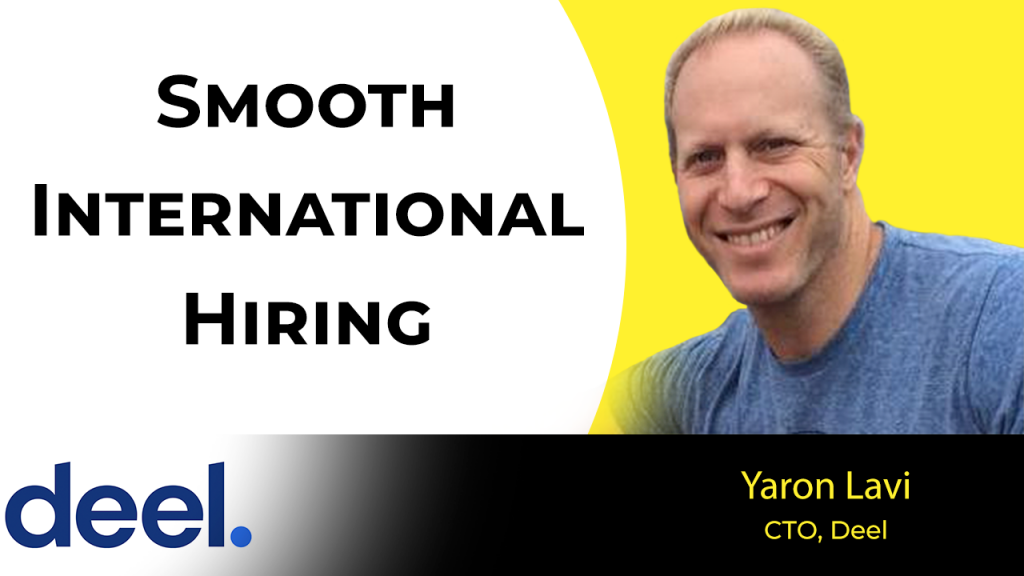
About Yaron Lavi:
Yaron Lavi is CTO of Deel, a company helping anyone anywhere in the world find a job. The startup makes it easier for businesses to hire, onboard, pay, and comply with local laws using a powerful online platform. Before Deel, Yaron was at Zira, heading up R&D. He has deep experience in building and managing software products and architecture, designing aspects of infra, data, backend, and frontend systems.
About Deel:
How we work has changed. In real-time, we can collaborate on Zoom, design new products, and attend (virtual) events from anywhere in the world.
The one big issue? Tools to hire and pay international teams haven't kept up. International hiring can be messy. With confusing local laws, complicated taxes, and even hefty fines (if you don't get it right).
Why does hiring an employee in another country still take months? How do you hire contractors without unintentionally breaking local laws? And why wasn't there a great tool for all this?
At Deel, we envision a worldwide workforce that isn’t limited by boundaries, but we needed to change some things to make this a reality. So we went back to the drawing board (our laptops) to tackle these problems and create a tool to enable remote teams to grow.
By solving these issues, we quickly realized we could open thousands of virtual doors around the world. Meaning more companies from more places could hire fantastic talent. And people from more regions could get the jobs they wanted. Anyone in the world could finally work everywhere.
Now, we’ve raised our Series D led by Coatue of $425 million, bringing Deel’s valuation to $5.5 billion. With our Series D we’ll be focusing on some exciting things to shape the future of work. Starting with launching Deel Premium to further protect companies against misclassification risks, bringing Global Payroll to every business in the world, releasing our Open API, and opening a total of 80 live Deel-owned entities (with 60 live already) to make employee hiring a breeze.
Transcript
(Intro Narrator at 00:00:04) Hello, my friends. Today, Joel is talking to Yaron, the CTO of Deel, and they discuss how Deel simplifies hiring remote workers internationally, tips for managing hyperscale, and how to properly align incentives with your employees' motivations. All of this right here, right now, on the Modern CTO Podcast.
(Joel Beasley at 00:00:34) This is the Modern CTO Podcast. Where are you calling in from today?
(Yaron at 00:00:47) So I'm nearby Tel Aviv in Israel.
(Joel Beasley at 00:00:50) Oh, very cool. Emerging tech. Well, I wouldn't say it's emerging anymore. It's like a massive technology scene now, right?
(Yaron at 00:00:58) Yeah, it's amazing. It's all over the place. You see startups and corporates, and everybody's doing something or developing something. Startup Nation, isn't it?
(Joel Beasley at 00:01:07) Absolutely. And is this where Deel was founded?
(Yaron at 00:01:12) I don't think so. I think they started in the States, actually, almost three years ago, even before COVID.
(Joel Beasley at 00:01:21) Oh, very cool.
(Yaron at 00:01:23) Yeah. But for sure, COVID showed the world that you can hire amazing talent everywhere and have amazing teams and, you know, exactly prove the things that we're doing here.
(Joel Beasley at 00:01:36) Yeah. Well, then now that you can hire talent everywhere, you need companies like Deel, right?
(Yaron at 00:01:41) Yeah, that's the—yeah. But Deel by itself, you know, we are practicing what we preach. Everybody in Deel is working remotely from home, like me. Everybody in Deel is, by the way, getting paid through Deel, which is using your own product. It's kind of awesome. You must be.
(Joel Beasley at 00:01:59) Oh, awesome.
(Yaron at 00:02:00) Yeah. And I have, at least in engineering, I have people from at least 15 different states all over the world, and it's amazing.
(Joel Beasley at 00:02:10) Yeah. One of the first things I was interested in at first, when the production team pitched all of this and I saw the episode, I was like, oh, okay. This is a payroll system. I know Eddie over at Gusto, right? And they're a payroll company, and so I was pretty familiar with some of the modern payroll companies. But then I was, you know, diving deep into your company, and you're not just a payroll provider. You're specifically a payroll provider for people who want to hire in other countries, which is incredibly a difficult thing to do. I'm an entrepreneur. This is my fourth business, and it's always—you know, luckily, my businesses have been small enough to where I'm kind of, you know, doing it on the edge of compliance, right? But if you want to actually scale something legitimately, it's a huge pain in the butt to hire people overseas, and you guys have solved that. Is that correct?
(Yaron at 00:03:04) This is exactly correct, and you should come to Deel. Yeah. To take it in short, okay, I have experienced myself. You know, Deel for me is like my fourth startup already. And at the beginning, I had to recruit only people in Israel and then only people in San Francisco. And it's an amazing challenge, but there is so much talent all over the place, all over the planet. And each time I'm meeting new people, it's amazing to see all the amazing people and talent there is out there. Why not use it? You can form amazing companies all over the world. And I really believe Deel is the future of work. We are the enabler for that. So we'll take all the burden of, okay, how do I contract someone who is not in my country? How do I onboard him? How do I pay him? How do I invoice? All that stuff. I think that we can offer an amazing user experience around that and really offer you to focus on your stuff, focus on your business, and not on all the plumbing around.
(Joel Beasley at 00:04:11) And so do you support international contractors and international full-time employees? Can you help me understand what's the difference?
(Yaron at 00:04:20) So yeah. So there are exactly two main lines of business. One of them is more a classic client-contract. For example, let's say that I have a small company in Israel, and I want to hire the amazing Adam in the States, okay? So I have two main challenges. One of them is, how do I pay you like you want in terms of which currency, which payment method, right? So it could be, of course, bank transfer, but also cool stuff like Stripe, PayPal, Payoneer, Revolut, even Coinbase, like crypto, okay? The second is how to do it compliantly, because a contract from someone from the States is very different from someone in Spain or Russia or Israel and so on. So indeed, we have automated all this. We have a large legal department, and we have fully automated the contract creation. I can really, within a couple of minutes, create a fully binding contract for us too. I input the rates. I input the start dates. I sign it online. I then invite you to co-sign. Click the link there. You hop on Deel this time as a contractor or freelancer, we call it, okay? You look at the contract, and if everything is cool over there, you go ahead and sign it. On payday, the only thing that I have to do as a client is click one button—pay. Then Deel automatically takes funds from my payment method, which I've defined when I set up my account, according to our contract. We put it on your account on Deel. We notify you, hey, Adam, you've been paid. You hop on Deel, this time as the contractor, and you click one button—withdraw—and funds are moved to wherever you want them. Now this is quite simple, and it's one-to-one, right? But what if I have 20 contractors or 50 or 500 contractors in different countries, currencies, payment methods, and you pay them all with one "pay now" button? This is an amazing time saver and makes the experience seamless. So this is one, very classic e-commerce-like line of business—client and contractor. If I want to hire an FTE, a full-time employee, sometimes I may face another challenge. Like, in that country, I must have a local subsidiary in order to hire the guy, okay? Now this for many companies is already a showstopper. How do I set up a subsidiary? Everything is too complicated. I don't know how to do it. I don't have time for this. So Deel is doing it for you. We are actually creating Deel subsidiaries in any country that we are interested in expanding on. And we simply say to you, hey, you want to hire a full-time employee, hire it through Deel. Deel is the employer on record, or in short, EOR, okay? But and then all the experience is seamlessly between the clients and the full-time employee. We, of course, take some commission on there. This is how we make our money. But for the hiring company, it's completely seamless, and they can simply expand to whichever country we support. And it's over 60 countries today. So again, everything you need to make remote hiring as easy as hiring your neighbor next door.
(Joel Beasley at 00:07:46) That's pretty cool. That's exciting for me. And—
(Yaron at 00:07:50) It is. It is.
(Joel Beasley at 00:07:50) I'm fresh. I'm actually a little angry at you because where were you ten years ago, man?
(Yaron at 00:07:56) I don't know. I really believe this is the future of work. Come on. It's—I don't know. It's, I'm talking to you and then I'm explaining it, and I'm getting excited myself. You should really try. It's amazing. It's so smooth, so straightforward. So I really think that we are doing something good. I really think that we are connecting people, connecting talent, enabling companies to scale out fast across places. And, you know, each time we have a whole all-hands and I see small rectangles of people all over the world—this is one team, and it's amazing, man. It's amazing.
(Joel Beasley at 00:08:36) Are you growing fast?
(Yaron at 00:08:38) Even as we speak, I recruited two more. Yeah. I'm joking. I'm joking. I'm joking, but am I joking? I'm not so sure. So growing amazingly fast. I don't know. It's like 20% a month, every month for the past two years. And Deel itself, I think when I started—it's not even two years—Deel was 15 people. Now it's over 600, and we'll get to 1,000 soon. Engineering team, it was three people. Now it's over 80. So yes, I mean, one of the main challenges is, of course, serving the needs, doing the scale both on the technology side, people side, culture side. But this is where all the fun kicks in, at least for me.
(Joel Beasley at 00:09:22) Now can you give me a little bit of your background? Are you the founder? You said—I think you were—were you a part of other startups, or did you found them? Tell me about your history.
(Yaron at 00:09:32) So it's quite interesting. I've been in the high-tech industry about 30 years already. I have quite a few years of experience in big American corporates like Amdocs or Applied Materials, but actually I'm much more of a startup guy, and Deel is my fourth startup already. And I've been doing startups in all kinds of different technologies. I was never a founder. I was always joining as the first engineer or number three or four, which is interesting. But I had the good fortune to see at least two startups from day one, when you buy pencils, until they were either acquired or merged. Just a quick talk. The first one was called Sync Value. It did real-time billing for several carriers. I've been joining there—I think I was employee number three or two. I was there until seven years later, it was acquired by Amdocs. This is how I got into Amdocs, huge American corporate. And I told them, look, guys. I have to be here one year because this is so I can get my stock options and so on. But you won't see me here after one year and one day. Turns out I've been there eight years. I can explain that. You know, first of all, they did it smart. So we still were kind of a startup within a bigger corporate, and they gave us resources. We grew. Business grew. You are growing also as an engineer. So you start managing teams, then teams of teams, then director. I think it was an amazing ride, at least for me. And eventually I said, okay, I need to leave it. I must go back to the startup mentality. I really like doing stuff now and seeing it live, okay? So much more of a startup guy. After that, I went into a startup called Jethro, jethro.io. We did BI optimizations over Hadoop. Hadoop was the next big thing at that time, which proved to be untrue. As the cloud went in, I then went to Zer01.us, which we're doing optimizations for manufacturing, mostly in San Francisco, by the way. So I've been there in all those companies. I was building things from scratch and usually products from scratch, which I love to do. And I've been there around two years, and then some recruiter told me, hey, you need to speak with Alex Bouaziz. And I told him, no, I'm not interested. I'm perfectly fine where I am. And a week later, he said, hey, you need to really speak with that Alex from Deel. And I told him, I'm not going to speak with him. I build a product from scratch. I had the team from scratch. And a week later, I was in Deel. It's a true story. I think that it was a combination of things. First of all, after two years, I already saw that the product, it was already forming up. It was already stable, but also quite stagnating. I didn't see business booming as we thought. But to be honest, the moment I had a talk with Alex and it took me 30 seconds to understand the ideas, and it was like a lightning struck. And I gave him a hard time to convince me, but he had me within five minutes already.
(Joel Beasley at 00:13:00) I love it. It's so exciting. I'm just like, for me, when I think about your company, I mean, I think it'll be a cool day when you have your first employees from Mars. You know? Like people that are from—then you'll be an interplanetary payroll system. That would be pretty cool.
(Yaron at 00:13:18) Let me start by taking amazing talent from all over the world. Yeah. You know, people in engineering—I kid you not, okay? Now those 80 people are from—are you ready? So let me give you a gist. It's like now. So there are people from Israel, Ukraine, Brazil, Mexico, Russia, UK, Colombia, Germany, Turkey, Argentina, Belarus, Bosnia, Hungary, India, Nigeria, Paraguay, Peru, Poland, Spain. One team. Works beautiful.
(Joel Beasley at 00:13:52) It's slightly stressful to hear all of those because—
(Yaron at 00:13:56) Why?
(Joel Beasley at 00:13:56) Because for me, as a business owner, I just am imagining all the compliance, because I'm getting used to—not to love on your product too much, but I'm having to learn how to think about the fact that you can just do it without a bunch of difficulty, because otherwise you would have to open up, you know, subsidiaries in a lot of those countries. You would have to have a legal team and an HR team that would understand the specific laws and taxes. And it's a difficult thing to do. And so, you know, I think, I think Jeff Bezos says that he invests in products that change people's lives. And I'd say this is one of those interesting products that will actually change the life of an entrepreneur. So, you know, I don't see these all the time. I see a lot of small, tiny improvements, but I think this is a massive improvement—opening up the entire global workforce. So good job. And I also want to talk a little bit about your past too. So, you know, I see a lot of entrepreneurs. I see a lot of long-term engineering executives, but your path is one of my favorite paths.
(Yaron at 00:14:50) Oh, really?
(Joel Beasley at 00:14:51) Yeah. Yeah. It's kind of rare, but looking back on it, I had the opportunity to take a path like that. But what I see is that, you know, joining as an early employee, being two or three, you have slightly less—you have less risk than being an entrepreneur and founding the company, but you have enormous upside. So I was reading this study of how people become wealthy, and you could take all the wealthy people and you can divide them into three groups. The people who save, have normal jobs and they save and invest long term, entrepreneurs, and then executives at companies that, you know, get in early or grow with the organization. And so I think that's under-discussed. It's not talked about as much. And it's a super intelligent strategy to just be early, because you're having to understand the landscape and make investments deciding where you're going to work. And that's a skill of itself. You deciding where you're going to spend your time affects, you know, your career. So you've had good vision as far as, you know, that goes, with pairing with companies that are going places. So I think that's pretty cool.
(Yaron at 00:16:15) Thanks. Thanks a lot. I can tell about this. I think it's something—it's more of a personal thing. So I've always been more of a people person. I've always, as an engineer, been more front-end oriented, more working with people and experience and less on the backend side in architecture. But also this means that I have less patience. I want—I want to code something, and I want to see it now, okay? So I have no patience to do, let's have a big version, release it once a quarter. Let's see how it goes. This will kill me, okay? I want to code something now and test it. If it's cool, let's ship it. And tomorrow again and again and again. I'm a real believer, you know, of sending small chunks of value to customers, very small ones, but all the time. So very rapid evolution, but no revolution, okay? So release every day. Release three times a day.
(Yaron at 00:17:15) So this was a bug fix, and then we had a button and a lever over here. We do it all the time. So I think that this is both giving amazing experience to our customers because they see all the new stuff coming. The response time for them is amazingly quick. We invest a lot in our customer support.
(Yaron at 00:17:35) And also, even if you have an issue, how much has changed from yesterday or a few hours ago? It's very easy to fix course and move ahead. We almost never had to roll back anything. So this is something that really helped me a lot on that course. Usually when I hear something, a meal or some entrepreneur comes with an idea, I already start building it in my mind.
(Yaron at 00:18:00) And I can say, hey, let's take some database and some serverless and fold it in React on that, and we could build something very fast. So why not?
(Joel Beasley at 00:18:11) Yes. I wanted—I consider you to have a lot of experience in scaling based off of your history, and so I'm curious, you know, if you were to mentor a startup that, let's say, they had 50 people and they were growing relatively quickly, what sort of advice would you give them?
(Yaron at 00:18:34) Well, that's the million dollar question. Yeah, I know. I can tell you that I think that I have personally recruited at least 250 people myself during the years. I can tell you if someone is a good fit for a position in, like, five minutes, to be honest. I'm quite good with that. I think that when, you know, when you hire people, there are, at least my three golden rules. It's you need to hire smart people who care and can deliver. Let me expand on that, okay?
(Yaron at 00:19:08) If the people that you hire are not smart, they won't be able to produce the value that you want. Okay? If you have a smart guy, super smart engineer, but he doesn't care about customer satisfaction, doesn't care about quality, doesn't care to see stuff out, it won't work. And eventually, I had guys that have that but didn't strive to see the thing being shipped. Many times, the devil is in the details, so you need to have both the back end and the database and the deployment and the front end all tied together and delivered.
(Yaron at 00:19:41) So it takes a certain kind of engineer, the guy that can really push and take all the pieces together and balance. So that's about the principles. If you need to scale from five to 100 or to 500, it's a different story. Eventually, I think that, you know, every one of us is working with between five to six people a day, every day. So this is normal.
(Yaron at 00:20:08) So if you have 25 people, you're working with five, each of them should work with their five, and so on. So you need to grow the teams and then scale them, to split the teams or take them to another level and so on. Always the secret sauce is balance. Okay? Not to get too many back ends or front ends, have enough managers, but not too many managers because the team eventually needs to work and deploy.
(Yaron at 00:20:37) It is also, as you grow and hire more and more people, the next hire becomes much more difficult because you're not only thinking about his technical skills or soft skills or human skills. You already know which team he's going to join. Right? So you need to think about, will he have good chemistry with the people in the team? Eventually, we are all people.
(Yaron at 00:20:58) And it's even more so when the people themselves are from different countries with different mentalities. That's amazing stuff. Even different time zones. So these are all kinds of new challenges that you have when the team is fully remote, fully scattered across the world. So this is one of the things that I like to do the most—not just finding a good candidate to join the team, but which team? What will be a good place to put the newcomer?
(Yaron at 00:21:31) Will he evolve as an engineer, as a manager, as a team lead? What career path do I see for him a year from now, two years from now? It's one thing to hire. It's much more difficult to keep your team happy and growing and evolving.
(Joel Beasley at 00:21:47) All right. I want to dig into that a little bit. So you're experienced. You know, this is your fourth company. You've done this a lot. You've hired, recruited over 250 people. And right now, we're working on a book, a technology management leadership book. And one of the questions—I'm working with a ghostwriter. He's really great, but we meet every week and we talk about different topics. And last week, we were talking about hiring and recruiting people.
(Joel Beasley at 00:22:17) And of course, if you're talking about hiring, you're talking about firing as well. Right? And in order to get that experience, you have to—like a child, you're learning how to walk, you fall down, you make mistakes. You hire the wrong person, you have to let them go. And at first, I've never met anybody who said, oh, yeah, the first 10 people I fired was super easy. I loved it. I could do it again. Right? It's a difficult thing to do. And so I was curious if you had to go back to your past self and those first five or 10 people you had to let go, what sort of advice would you give yourself?
(Yaron at 00:22:54) To do it earlier. You know, especially in those days, I was the one recruiting them, so I eventually signed off on each and every one. By the way, till this day, no matter who we're recruiting, I'm always seeing them last. I always want to see, at least the scale we are—I'm not sure what will happen next year—I always want to meet and have a good talk with the candidate before he joins. But, you know, looking at the younger me, you see quite fast that it is not working as expected. The guy is not performing well. He's in the team, everybody there is doing great, but you try to do some betterment. It's not working. I think it's quite natural, or it was for me, to try again and again. We did better one-on-ones. We defined KPIs and so on. But eventually, I noticed most of the work was on me.
(Yaron at 00:23:48) I was monitoring if that person was getting better or not. And I had a lot of talks on that, and eventually, I had to cut it off much earlier. Okay? Because especially in a high-growth company, if someone is not helping you, he's dragging you down. It's as simple as that. Okay? It's not a big corporate where you can chill and do something else. When you're in a high-growth company, you're running, and sometimes you're running fast. Okay? It's like the joke.
(Yaron at 00:24:18) But in teams, and especially in high-growth companies, the teams are relatively small. So the team will feel very fast if someone is not performing well. And not only that, it will also impact the team. My advice to the younger me—okay, don't be afraid to admit that you were wrong, that the hiring was bad. Try to do some betterment because sometimes it does work. The guy understands what the expectations are and so on. But if it's not working, it's better to part ways, as painful as it is, and recruit another member to the team.
(Joel Beasley at 00:24:54) And after, for me, after about the first 20 or 25 times of having to go through this process. Right? And realizing—I like what you're saying because I'm agreeing with it. I'm like, yep, yep, I've experienced this. But I'm curious to know if you've had this situation. Have you ever—you know, you've taken the perspective that it's just not the fit for them. You almost feel bad because you failed to identify it. Right?
(Joel Beasley at 00:25:21) You're like, I let you down because I didn't correctly match you with this, and now I have to let you go. And of course, you get better and better at that. But have you ever, you know, let someone go for some reason, like maybe they're too chill, too many bugs, bad performance, and then they come back and thank you later because it was like a wake-up call? Have you ever had that happen?
(Yaron at 00:25:44) I had. I had in a previous company, I was bringing a team lead to form a team. We had worked before. He's an amazing guy, amazing attitude. All that was there, and we started growing. We recruited people to the team, and the team started delivering, but the quality wasn't—the pace was really slow. Okay? And it was all because of the team lead. Okay? He wasn't putting the right priorities. He wasn't pushing the team where it was needed.
(Yaron at 00:26:19) And where he pushed, they were already too stressed out and so on. And, you know, I had such a good relationship with him, I really didn't want to see it. But eventually, I had a wake-up call from upper management as well, and I had to go ahead and let him go. It was quite a difficult talk, by the way, because it was a key position in the company. But I think that I learned a lot from it. Also, who am I hiring? What am I looking for? But still, having said that, it may very well be that when you have a company of five people, the ones that you hire from the beginning will not be good candidates when you're growing from small startup to medium-size to large company. Okay? That engineer, that team lead has to grow as well—as a manager, as an engineer, as a person. Not everyone can do that, although you try hard and think hard.
(Yaron at 00:27:17) So this is something that as a manager, I have to every day inspect that this is happening. I give praises when it's done correctly. And when I see things that are not okay, I need to roll my sleeves and dive in. And it's never easy. It's never easy.
(Joel Beasley at 00:27:34) No, it's not. No, it's not at all. How—once you get great people and you have them on board, right, and let's say they do have the mindset that they want to grow, because one of the mistakes that I made many times before I figured it out was I assumed people were like me. You know, it's something we do as humans. Our default state is we assume people are like us. And I want to grow. I want to get to the top. I want to do great things and push the limits and all of that. And some people don't.
(Joel Beasley at 00:28:06) And so I found that I was pushing people who just wanted to do routine work and just have their life—I was trying to excite them with, you know, when the company grows, you're gonna have a team and all of this. And I found out it was really stressing them out. So then I learned how to understand who the person is and what drives them in life, and then make sure I build something around them that's also beneficial to the company. And that's how you can tell alignment. Right?
(Joel Beasley at 00:28:37) Here's what I need. Here's what you want. If they align, it's magic. If they don't, it just doesn't work. But once you have great people and those great people are growing and the company is growing, everybody loves—I found great people love to work with great people. So that's one way that you keep people around. But great people also love money. So I'm curious, how do you do incentive structures to keep these high-performance people around?
(Yaron at 00:29:02) So it's a combination of two things. First of all, I strongly believe in stock options because, first of all, they bind the employee to the success of the company. Right? So it's a long-term benefit. And second, of course, if the company is doing great, the value of those stock options can be really life-changing for many of the employees. So they are essentially getting a part of the company, even if it's with options. And I find it to be a great incentive. Second of all, there is no way around it. Okay? You need to keep all the time a look at what is happening on the market, what people are making, and have a look at what your people in the team are doing.
(Yaron at 00:29:47) And you need to do, at least every six months or once a year, you must have one-on-one meetings with the guys and reviews, and if needed, doing a raise. I also try a lot to give good words and good feedback on stuff we're doing. Usually, when we work a lot, it's very easy to point out what went wrong. You didn't catch that bug. That was not good quality and so on. But we sometimes neglect to do the other way around. Give good words or some bonuses for really complex projects being made. So I'm also doing stuff like that—one-time bonuses and so on.
(Yaron at 00:30:31) I found that we need to have at least two times a year one-on-one reviews with anyone in the team. At least once a year, this will also include a salary review. And if you have good performance, it will usually go up. But this way, usually, the team knows that it's coming. It's coming. They know when to expect it and so on because, again, it's a culture thing. I had, for example, a location where one of the programmers—out of the blue. Okay, I don't want to say from which country, but out of the blue—said, I got another offer. I'm leaving. It's not even that he came and said, look, I think that I should be getting more. Is there anything that we can do? And he was amazing.
(Yaron at 00:31:17) And I told him, hey, why didn't you come to me earlier and so on? He said, okay, I didn't know that I was able to do so. I didn't think that this is how things are being done. Okay? And it's very different from different companies. So we made peace. I explained it. He was amazing, and he stayed with us till this day. No problem, brother. But it taught me a lot. Okay? So usually, I'm the one doing that more proactively, even before the time and so on. But also, you need to feel the pulse of what is going on in the industry.
(Yaron at 00:31:50) And it's also different for different countries. I think the challenge in Deel is greater in that aspect because guys with the same experience in Ukraine—it's very different from the guy in the UK or the States or in Spain. Okay? And they work together on the same team sometimes. Even though there are differences in cost of living in different countries, you still want to have the team salaries more or less in the same regions. I find it extremely important. And I'm stepping out, so I will always try to—if someone is from a country where the cost of living is lower, I will try to raise him so the team will be more or less balanced, more or less on the same level, and so on.
(Joel Beasley at 00:32:35) Yes. I liked when you were talking about the variances or the differences in work culture across countries.
(Yaron at 00:32:46) It's so different. It's amazing. It's amazing.
(Joel Beasley at 00:32:48) Oh, exactly. Yeah. I've worked on teams that will—I've been a part of projects where, you know, companies are merging, multiple different companies are merging together, an acquisition-style company, and they're pulling people from Israel, Spain, India, and now all of these people have to work together. And it's not that they don't like each other. It's just they all have very different routines of how they work, and now you have to get these people to work together.
(Joel Beasley at 00:33:16) And it's just so fascinating to me because I don't think anything's good or bad necessarily. It's just different. And understanding how to work with the differences and figuring out how to create situations where people can come together and bond, that's a hard thing to do, but it's fun when you get it.
(Yaron at 00:33:35) I can tell you, at least for me, when I'm first talking with a candidate, I'm looking for energy. I'm looking for optimism. I'm looking for a sense of humor. I won't hire someone without a sense of humor. Actually, I didn't do it in Deel, but in previous companies, my first sentence to a candidate is, hi, please tell me a joke. First sentence. And you see, some of them really burst into laughter or stuff like that. Some of them were stuck. What does this crazy guy want from me and so on.
(Yaron at 00:34:09) So that's about it. But again, if you have the energy and you have the optimism, sense of humor, and your height, you must be hyped on the company. You can't come to a place like Deel if you're not like, "Wow, that idea is amazing. Let's change it."
(Yaron at 00:34:26) Okay? It makes things so much easier because eventually you all want the same goal for the company. You all want the same goals as engineers. Indeed, you can be super impactful. Okay?
(Yaron at 00:34:38) We had to talk technology, but it is really a place. I mean, you can write something in the morning and QA verify it at noon, and by the evening it's live for thousands of thousands of people. For most engineers, this is something amazing. I always wanted to work in companies like that, and I will always try to keep it coming. And technology today allows it to do it quite easily.
(Yaron at 00:35:02) So—
(Joel Beasley at 00:35:03) I wanna tell you my favorite joke.
(Yaron at 00:35:07) Go ahead. Let's see if you're fit.
(Joel Beasley at 00:35:09) Alright. Why was the baby strawberry—from your own joke.
(Yaron at 00:35:14) I do. I'm that person. Alright, here we go. Why was the baby strawberry sad?
(Yaron at 00:35:23) Okay. Why?
(Joel Beasley at 00:35:24) Its mom was in a jam.
(Yaron at 00:35:26) Oh, that's a dad joke. That's a dad joke.
(Joel Beasley at 00:35:28) Oh, I'm a dad. Yeah. That's a dad joke. I have to have jokes that are okay with the kids.
(Yaron at 00:35:34) Okay. You can go, "Hey, Dad. Hi, Dad. I'm hungry." And you can go, "Hi, Hungry. I'm Dad."
(Joel Beasley at 00:35:42) I like that one.
(Yaron at 00:35:42) That's an equally bad joke.
(Joel Beasley at 00:35:46) I love it. I love it. Are you a dad, by the way?
(Yaron at 00:35:49) Yeah. I'm a dad. I have three kids. Not so much of kids. So I have two boys, 24, 21, and I have a girl. She's 17. My smallest kid is already driving.
(Joel Beasley at 00:36:04) Not me. I have a daughter who's four, a son who's turning three this week, and then another one on the way. We don't know. We're gonna wait. On the first two, we found out what the gender was and everything before they were born, but the third one, we're like, yeah, let's just wait. We'll be surprised.
(Yaron at 00:36:22) I envy you. I envy you. I would love to have another toddler running around the house.
(Joel Beasley at 00:36:28) If you were in my house last night, you'd be like, okay, just kidding.
(Yaron at 00:36:33) No, no. I'm sure I had it all before. It's cool. I'm already joking. I'm still telling my daughter, "Go ahead and sort out your room. What's that mess?" That one is already driving in the street with a car. Oh, boy.
(Joel Beasley at 00:36:48) Oh, man. Yeah. So I wanna know, how has being a father—have you been able to take lessons from raising your kids, and have those helped you at work?
(Yaron at 00:36:57) I think that's a difficult question. I think at the beginning I was much younger. I had my first one when I was 27, and yes, I was already in a startup. At the beginning, it was quite hard because my firstborn, he refused to sleep at nights. At least he hadn't slept a full night until he was one year old or something like this. So I remember I was holding him and coding, and my brother was falling asleep on the keyboard. So that was quite traumatic. The second one slept beautifully. I learned a lot. The first one taught us a lot as, you know, as parents and so on. But I always felt quite comfortable. I didn't see that, "Okay, if I bring kids, I can't work or it will be strapped." I always felt it quite natural. I have kids. I will do them as young as I can. If I had the power, I'd have the fourth one, as I told you already.
(Joel Beasley at 00:37:59) Yeah. For me, it was seeing—you know, because mine are still very young. But even as early as, you know, age one, age one and a half, the kids are—everything's exaggerated. Right? So the emotions are exaggerated. Everything's bigger, and it's like a computer. Right? If I could walk into the computers of the 1980s and everything was huge, I would see all the different parts of the computer. Now they're in these thin MacBooks, and you can't really see them too easily. But, you know, when they're bigger, they're easier to understand. And so watching these kids grow up and have these big emotions and these desires for these specific things, for me, I just picked up a lot, I guess, intangibly about how people work by watching them grow up.
(Yaron at 00:38:45) I think that for me it was very interesting because I have three kids. They are so different from one another. They look different. Okay? If I put a picture of them, you won't be able to tell that they are brothers. Okay? And their character is so different, and every one of them is like a whole complete person, and it's amazing. It's amazing for me to see how they are growing and how they are different and how each of them has its own human script expertise and so on. That thing was amazing for me.
(Joel Beasley at 00:39:20) I love it. Alright. I could talk about family all day, but I wanna make sure that we don't forget Deel. We talked a lot, several different topics, but I'm sure, you know, people are excited. They like your energy. They've been hearing about Deel. Can you tell us how you can find out more about a career at Deel?
(Yaron at 00:39:40) Oh, there's a zillion opportunities about that. So first of all, we have on the Deel career website, we have a zillion careers at Deel. Really, a lot of career openings, company's growing all over. And I think that this year it's going to be really, really big. You can hop on letsdeel.com/careers. Just go off for the website, and you can see really a lot of careers over there. I think that 2022 is going to be an amazing year within Deel. This is the year. Deel is—it's quite simple. We are going to be de facto the company, the default company to go to when you want to hire remotely. And Deel is big and going to be very big. So this is an amazing time to join. We have many positions open all over the place from engineering to marketing to customer success and so on. Just browse for the website.
(Joel Beasley at 00:40:32) And that's D-E-E-L, right? Letsdeel.com? Okay.
(Yaron at 00:40:37) Exactly.
(Joel Beasley at 00:40:38) Was there anything else that we wanted to make sure that we got out there today that we haven't already covered yet?
(Yaron at 00:40:44) I think so. So I would like to touch a bit on the technology side. If you want to know—let's say that you want to have a hypergrowth company. Okay? My advice—we talked a lot about hiring. Let's talk about technology. My 2 cents for all the entrepreneurs out there on the hypergrowth one is you should embrace any technology that allows you to focus on what you want to achieve in your business and not to deal with the plumbing and stuff going all under. That means, of course, go over to a cloud. Any managed service that you can take on, take it as a managed service. Do not try to operate it yourself because you need to place time and people around it. So you want to run a Kubernetes cluster, so take it from AWS or Azure. Don't try to run it yourself. You're running Jira, go to managed Jira on the cloud. Don't install your own Jira and stuff like that. So we did a lot of that on Deel. So whatever we took, any managed service that we can take on, we use that. This allowed us to really focus on the things that Deel wanted to achieve on the product itself, on growth, on scalability. And we were able to achieve it with a relatively small amount of people. So that's great about that. Second, I think that in order to be growing fast, you need to deliver fast. Have continuous integration and continuous deployments implemented in your company. I'm a huge DevOps fan. I've been doing DevOps even before it was called DevOps, because as I said, I always want to write something. I want to see it live. So DevOps is the key. Right? Automation and everything. So technologies like CI/CD, Kubernetes, everything that allows you to deploy right here, right now, anytime are critical for success of hypergrowth companies. Anything else eventually will stall you up. So this is in terms of technology. The first thing is what you select as the technology to write your stuff with. Should they use Ruby, Java, JavaScript, React, Angular? So it's not only a selection of technology, but it's also a selection of people. Okay? Every one of us has some sort of tendency or love this or that language. But you think about it when you're growing up, you need to recruit talents. And so we need to know people who know that language, who are very good at it. So where do I recruit them from? What is the expected salary for those? Is that language fully supported? For example, at Deel, we love JavaScript. So by definition, we use JavaScript both on the back end and on the front end because by definition, if someone wants to move from back end to front end or vice versa, be my guest. Usually, whatever is good for your team members is also good for you as a manager and as a leader. So this is why we really went with JavaScript, something that is easy to find great talent all over the world. You can easily move between domains like front and back end, and I see it every day.
(Joel Beasley at 00:44:07) Yeah. That's pretty cool because then it gives them the freedom to—before you were saying, you know, people not even knowing it was an option, like employees not even knowing, you know, if they get other offers to bring them and talk to you about them. Some people will get bored, and they will leave not knowing it's an option to even join an assignment on another team within the company to do something different.
(Yaron at 00:44:29) If you touch on that, another super important thing, super, when the company is fully remote is the culture, the culture for openness, the culture for transparency. Okay? You are not meeting guys next to the coffee shop. Right? Because they're in different countries. Okay? They must feel that they can talk with you about anything, and there is zero politics. If something is bothering them, like, "Okay, I need to move. I want to move to another team. I want to switch from back end to front end and so on," they feel that they can speak about it openly and so on. So this is a culture we fully encourage at Deel. I talk to people all the time, not just, "Okay, what's the status of this and that," but how do you feel? How are we progressing? Do you feel that you are progressing? Have you learned something new that month? Or what we should improve and so on? And I think that it's super important. And my fourth tip around that is, as your team continues growing, you still must work with relatively very small commando-like teams. So even if you have 100 people in engineering, you should have teams made of six to seven people at most that can plan together and execute together and delivering together. So go with microservices, which goes very nice with Kubernetes and all that stuff. Okay? But try not having huge teams because you will get stuck on syncing and doing status meetings all day. I hate meetings. And I think that are the really key innovation. Usually, we have an important meeting, we try to have a Notion page or a Wiki page about what are we offering, what we want to discuss. And the meeting itself is, let's just decide. Just discuss what is not good, what needs to be changed, decide, and that's it. So try to have small teams that can deliver by themselves, can move fast, and you can have dozens of those teams. That doesn't matter. It's much better than having huge teams.
(Joel Beasley at 00:46:38) Yes. I love it. Yeah. I was talking with this guy yesterday, actually, who—they make DNA. They store data inside of DNA. Right? Amazing. I know. And now they're making DNA-based computers, and it's just next level unbelievable stuff. And he was saying, you know, you could have some really large—he used to be the head of supercomputing at IBM. He said you could either have really large machines or—and he compared them to horses. He goes, you know, you can have five horses or you can have a billion mice because they're making these super tiny computers, but at this unbelievable scale. And I was like, wow. That's actually really, really interesting. But yeah, if you have a bunch of small teams that can produce results within your organization, it's like a decentralized approach, and it provides—it increases your level of stability by having these teams that can produce independently.
(Yaron at 00:47:34) So it increases your stability. It increases your cadence. It also increases your quality because you probably build your product in small chunks or microservices. So I can be able to deploy small stuff without affecting any other stuff. So everything is easier. The customer is happier because you ship much faster. The guys in the teams are happier because they see their stuff being used alive. It's a win-win-win situation.
(Joel Beasley at 00:48:04) Thank you so much for listening. And if you found this episode useful, please share it with a friend or colleague who you think would get value from it. And if you have topics that you'd like to hear discussed on the podcast, either add me on LinkedIn or send me an email, [email protected]. Every time I get an email or LinkedIn message, it absolutely makes my day and inspires me to keep going.