
Episode 757 ·
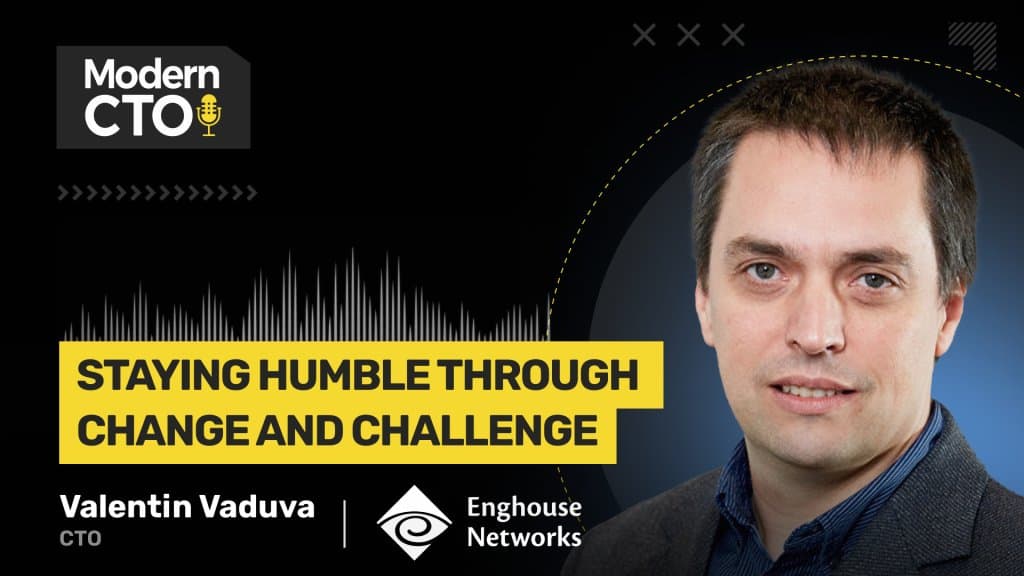
A Tech Leader’s Journey: Staying Humble Through Change and Challenge with Val Vaduva, CTO at Enghouse Networks
Today we’re talking to Valentin Vaduva, CTO at Enghouse Networks. We discuss Val’s challenge of starting a new life in Canada with ten thousand dollars in debt, how he rose up to become a technology leader, and what it really means to be a CTO in 2024.
All of this right here, right now, on the Modern CTO Podcast!
To learn more about Enghouse Networks, visit their website here.
Have feedback about the show? Let us know here.
Produced by ProSeries Media.
For booking inquiries, email [email protected]
About Valentin Vaduva
Technical leader and entrepreneur in mission critical enterprise software. Digital Transformation, M&A, Product Management, Operations, R&D Management, international Customers, Sales. Software Engineering background: Architecture, Databases, Analytics. Efficient and effective delivery, P&L ownership, legal and contractual responsibility. Expertise in Business Strategy, Large technical team leadership and organizational change. Modernization for enterprise customers. Product vision, strategy and execution.
About Enghouse Networks
Enghouse Networks technology portfolio spans Business Support Systems (BSS), Operations Support Systems (OSS), Mobile Value Added Services (VAS), Network Security, Control & Routing Automation, all of which are designed to deliver strategic value for next generation communication service providers and telecommunications businesses around the globe. Enghouse Networks is a member of GSMA and the TMForum.
Enghouse Networks is a subsidiary of Enghouse Systems Limited, a publicly traded Canadian-based software and services company founded in 1984. Enghouse shares are traded on the Toronto Stock Exchange (TSX) under the symbol ENGH. Enghouse Systems serves a number of distinct vertical markets through its three divisions, each developing and selling enterprise-oriented applications software.
Transcript
(Intro Narrator at 00:00:00) Today, we're talking to Val, the CTO at Enghouse Networks, about how he started a new life in Canada and what it truly means to be a CTO in 2024. You're listening to Joel Beasley, Modern CTO.
(Joel Beasley at 00:00:20) I want to talk a little bit about the story Josh told me. He said that you arrived in Canada with two suitcases and $10,000 in debt. I want to talk about how you overcame that. But before I do, let's just briefly tell the audience, you know, what's the biggest problem that your company solves for customers or your product set specifically?
(Val at 00:00:44) It's a suite of problems. We are a commercial off-the-shelf provider of telecom systems. So what we provide to our customers is a lot of value in the core value propositions of our products. And the telco stack is standardized and it is very complex. Us being a vendor with a lot of products in the portfolio that cover a lot of this stack and through the work that we have done over the last couple of years to integrate between all of these systems.
(Val at 00:01:29) One major problem we are solving and a differentiator for us as a provider is that we can come in and provide a suite and eliminate the need for a customer to work with multiple providers and get them to integrate these products point to point. Something that is difficult to maintain when you have multiple providers having to integrate, you as a customer having to coordinate that type of work, and then those integrations having to be maintained. So we provide as a company, Enghouse was created based on a telecom product that is still in our portfolio and has been around for various incarnations and evolutions and multiple modernizations, but has been with us since the late eighties. The product still exists. So we have excellent know-how of the telco stack and the telco systems in our domains.
(Val at 00:02:43) And we have this approach where we can deliver across a number of products and domains, things that are pre-integrated out of the box that we maintain. And we then maintain those integrations as part of our roadmaps.
(Joel Beasley at 00:03:02) Well, that's easy to understand. And it makes complete sense because putting together the systems, it's just easier when there's an all-in-one solution, right, that's already integrated?
(Joel Beasley at 00:03:12) I get that 100%. So you arrived in Canada, two suitcases and $10,000 of debt. How did you overcome that?
(Val at 00:03:22) Yeah. So, well, overcoming and overcoming. I'm not that good at self-promotion, I must say, to qualify all of this. So I think there are other examples of people that have had bigger challenges than I did. And I think to your question about leadership, learning to be humble is important.
(Val at 00:03:51) Always. My particular journey. Yes, I did arrive in Canada as an immigrant back in year 2000. And it wasn't a particularly easy period for software engineers in Canada.
(Val at 00:04:10) You had to, Canada, throughout Canada, U.S., I guess, the West, because of the dot-com crash and all of the other macro impacts that followed. So in my first year in Canada, I navigated between a number of jobs. I think I had four positions at four different companies that were running out of steam. So what can I say? I was good at interviewing, got better through that journey, but I had my craft.
(Val at 00:04:46) So when you are a young engineer, you're always someone that can find a niche as long as you can adapt and you have your skills sharp. So that's what got me through that period, right? My craft, and that being software engineering. It wasn't particularly easy to navigate all of that.
(Val at 00:05:18) The $10,000 I mentioned in debt, there was a requirement. I don't know if it's still, but when you arrive in Canada as a skilled immigrant, then you need to have enough financial means to sustain yourself for six months. It was $10,000 that was required at that time. So I had to borrow from my friends and family because I used to work for a Dutch company before, but salaries that we had were not very high. So I saved enough for the flight tickets and the processing fees and all of that.
(Val at 00:05:57) So there's $10,000 I needed to have with me. And then my journey from that, so the initial period, the first two years were just about saving everything you have, paying your expenses and making sure that I can sustain myself. As another anecdote into that, I used to withdraw cash from the machine and at that time came with a certain fee. So I would have that optimized so I could withdraw cash, pre-calculated as much as I needed for the two-week period between the salary. So I could save on the fee to be able to save a little bit of money.
(Val at 00:06:54) Everything was calculated to that level. So, you know, it was a lot of work. I used to work pretty much every weekend in that period to make my value, so to say, stand out and spend a lot of time keeping my skills up to the market and to the latest tech. And that's what allowed me to cross over the initial very lean couple of years. From that, I can continue, but my journey evolved into entrepreneurship, founded the company together with three other co-founders.
(Val at 00:07:47) We built it up over thirteen years to about 50 people. And then Enghouse acquired that company. Started in Enghouse about nine years ago. And I had two promotions. I did an MBA and now here I am.
(Joel Beasley at 00:08:13) Did you build a family along the way?
(Val at 00:08:15) I did, yes. I did, yes. That wasn't easy, but it is important. That's what keeps you going and keeps you motivated and focused because you have to, right? Having a young family and having children and all of that, having to buy a house when things are, especially when you're an entrepreneur, it's a bit precarious. You never know. You depend on the next contract and the next customer and you have to make pay for the team that you have and all of that. It's, every owner of a small business will tell you the same type of journey.
(Joel Beasley at 00:08:58) Yep. I'm living it. I've got a wife. I've got three kids that are between 16 and almost seven years old. And so they're young.
(Joel Beasley at 00:09:08) Yeah. And we own a small business and it's been operating now for about seven years. So it's doing well and it's growing, so that's exciting. And yeah, when you're sitting here talking to me about this stuff and about your journey of the immigrant aspect that you went through and the difficulty, that's hard work, right? Like, I respect that a lot. That's a lot of hard work. I'm curious on how you raise your kids to have that, like, have a similar work ethic or how did you impart your values on your kids?
(Val at 00:09:44) For example, mostly, right? They've seen me working hard throughout the years. They grew up to experience that. They've seen me traveling quite a lot for work.
(Val at 00:10:01) And at times, you know, not being there for them. And we talk in the family and we talk about my journey. We talk about what gets you, what gets you ahead. And it's, my particular story is as well one of no network. Well, because you come to a country, the one thing you leave behind is your network, whatever connections, colleagues in university you've had, all of that.
(Val at 00:10:39) So what gets you ahead is effort, but as well, initiative and taking risk, in a way being good at managing a crisis, difficulty. When even if you don't have a network, if you have intrinsic value, if you know your craft and you have the right level of energy and the capability and personality to be resilient solving a crisis. It's something where, you know, others may shy from. They would rather use their other skills and assets and so on. And it depends on your station in life. But my children have seen me through multiple crises at work, while I was owning the company, mostly, but not only.
(Val at 00:11:50) Right? When you have to scramble, sometimes you have to, okay, kids, I'm sorry. We have planned a ski vacation since we were talking about winter before. But we have to cancel it. I have this emergency now, so I'm sorry. We will do that, right? So it's by that type of example that your kids will learn from. And I guess your case is similar, right?
(Val at 00:12:20) When you talk about owning a small company, it's not easy. Sometimes it's precarious and risky. But it pays out in the end, even if just as an experience and you have to do those things, ideally, I don't know, before you're 45. Afterwards, you should be somewhere in a stable place where you can use all of those experiences, right, to further your career.
(Joel Beasley at 00:12:58) Yeah. That's where I'm at right now is I seem to have the recurring thought of, oh, I mean, I learned that lesson because now I'm facing this battle. And it's like, I know how to do this battle now and then just so on and so forth. And hey, I started my first, you know, quote unquote company when I was like 13, right?
(Joel Beasley at 00:13:18) And I was just freelancing as a software engineer on websites like what you would now consider Upwork, right? Like Scriptlance and these other names that existed back in the day.
(Joel Beasley at 00:13:29) And then from there, I built some software and I learned some stuff in real estate and then I learned some stuff in the financial, the modeling part of software. And then I was the co-founder with a salesperson counterpart and I was just the technical co-founder. And then I saw how they were operating and then I said, okay. Well, on this next adventure which started seven years ago, I was like, I'm going to be like a solo founder and I'm going to learn the sales side of things. And once I learned the sales side of things and the communication that made me better at building product, that made me better at, you know, so many different things and understanding really, like, value and how do you connect what they paid for and their problem that they're spending money for to what you're actually building. And that really cleared up a lot of previous mistakes that I had made. I should have gotten the sales side sooner.
(Val at 00:14:22) You have to make your mistakes early but everything happens for a reason and that is an understanding that I have had earlier on with my own company, right? If there is, no matter how wonderful the engineering, and I'm an engineer. I understand that craft well. I have practiced it for many years.
(Val at 00:14:49) And it is crucial. Good engineering is crucial to the success of a company. But the business side of it is more important. Your timing is crucial to get into whatever niche you want to get into, whatever area. Timing is important and customer focus is essential to be able to succeed.
(Val at 00:15:19) If you don't have those two and you just have engineering, it's not going to get you far, right? If you're just a technology looking for a problem to solve or something that doesn't have traction or it doesn't solve a real problem, the most wonderful technology will not be sufficient.
(Joel Beasley at 00:15:44) Tell me about the lesson, like, the big lesson you learned the first time you were leading a team.
(Val at 00:15:51) That is a good question. And I'd say my first lesson was attitudes and personality trumps pure skill. So I've had to deal with very good performers in terms of technology, high performers, and very knowledgeable people that needed one of two things. The other needed a lot of attention and one-on-ones and adjustments to their type of attitude, feedback, inter-work, team interaction between these types of engineers. That was one aspect.
(Val at 00:16:42) Or in some cases, even if somebody is very skilled technically, but has the wrong philosophy, the wrong attitudes, can't work with them in a team and so on. Sometimes you just, if there is no fixing, then you just have to make the hard choice and let them go and hope that they learn from that experience on their own. That was my first lesson. That just being a high performer in terms of pure tech doesn't help a team succeed if you don't have all of the other attributes when it comes to how personable you are, how well you work with others. The fact that you can at times disagree with, let's say management, with the business and so on, and you can make your case, but you have to understand that after a certain point, you have to commit to what the company and the team overall wants to do, even if you're right.
(Val at 00:18:01) And allow for that process to happen and come at the other end and say, you know, like next time let's change this in our analysis and fix it. Not to say that it works, it works both ways. And I can give you an anecdote of that. I remember years ago, a very good engineer of mine had a certain idea for a design of a user interface framework.
(Val at 00:18:32) And I had a completely different idea on how that must work at the technical level. I was also the manager of that team. And we couldn't agree. And it wasn't, it was just a technical discussion and I'm not the person to impose a design or a technical solution just because I'm a manager. So I said, listen.
(Val at 00:18:56) I think that this is a mistake, but hear me out. I'll let you do all of this and go in that direction even if I think that it is a mistake. So I'm not going to argue with you anymore. I'll let you run out with a POC. We'll then implement it and then we'll see where you are and where you view it.
(Val at 00:19:20) And that eliminated, so to say, kind of ego between two engineers. Everybody has its own pride in trying to compete on technical designs. He proceeded to that solution, and he himself actually found something better than even I figured out, but that aligned with my intrinsic philosophy. So I wasn't necessarily wrong. And we came with a much better solution together in that particular instance. So you have to allow people to make mistakes when you know that they are valuable team members.
(Val at 00:19:59) They will learn from it and mistakes do happen and they are very rarely fatal, right? They will not, a mistake in engineering is not going to be the end of it all, but a bad team dynamic will be, right? If you don't, if you have a dysfunctional team or somebody that's just upset because you trampled over their engineering pride, they are not going to continue to work well with you. And that spreads around to the other members of the team.
(Val at 00:20:33) So that was, that team only became better after that exercise.
(Joel Beasley at 00:20:41) Who was a leader that you looked up to quite a bit when you saw them operating? You said, I like that they're doing that. You maybe stole some of their style. Like, who influenced you?
(Val at 00:20:54) Well, a lot of people did. I would start early and I would say one of my earliest inspirations in terms of how to formulate, this is completely out there, as my first, in grade school literature professor. He taught me how to structure my thinking and communicate effectively. And that's invaluable in what I'm doing, especially what I'm doing now.
(Val at 00:21:31) My second along the same line, I had an excellent professor in university for what we were studying back then, microprocessors. And he had the same skill. He knew how to make that subject so interesting. And I remember one of his books that we read started with, and he had a painting. The painting was, don't remember the author, one of the French painters.
(Val at 00:22:07) And it was reading in French, "This is not a pipe." And the drawing was that of a pipe. It was a drawing of a pipe. And if you find it, I don't remember the name. Anyhow, that made you realize that looking behind in that information, you would find the substrate, the actual information, because it's true.
(Val at 00:22:34) It was not the pipe. It was the drawing of a pipe, right? But the drawing was that of a pipe, actually. So it was that play with him. And he was an excellent communicator and made that very technical difficult stuff.
(Joel Beasley at 00:22:51) I think I found it.
(Val at 00:22:53) Is it? Yes. Yeah. Yes. Yeah.
(Val at 00:22:57) It continued from there with my co-founders in the business that I had, all of them older than me and with a very different perspective. Our CEO in that company—and I learned a lot from him in terms of how to communicate with customers, the sales side of things, and just communicate a lot in terms of technical designs by drawing effectively. Another very important skill. And I would say currently, I'm inspired by our executive suite in Enghouse. Our CEO is a man who's very rational, and I like that about him.
(Val at 00:23:53) He's capable of leading things a lot with rationality. I took his example, and he inspired me to do my MBA as well, in addition to my engineering degree. He's the same—an engineer and an MBA—and he built this company. What is it? Our market cap now is $2 billion. And then we do have people where you can take examples in our executive suite on energy. Our president is like that, extremely energetic and focused at the same time. So there is a lot to learn from every experience and every leader that you have if you know where to look.
(Joel Beasley at 00:24:50) The co-founders, did they join Enghouse too in the acquisition, or did they do other things?
(Val at 00:24:55) They did. And our business has grown internally in Enghouse substantially because Enghouse is a worldwide player with a lot of capability in terms of not only technology engineering and so on, but sales, marketing, all of that—way more capable than what we could do on our own in our own much smaller company.
(Val at 00:25:28) So they have joined, but they were at a certain station in their life. So they are now retired.
(Joel Beasley at 00:25:38) Okay. And what are you looking for in the next generation of leaders? A lot of technology leaders or people who aspire to grow as a technology leader, whether it's individual contributor to manager or manager to VP to CTO, that whole stack of the people who just know they want more, listen in on the show. So I always like to ask people like you, when you're working with your teams, what behaviors are you looking for? How are you figuring out and investing in the next generation of leaders?
(Val at 00:26:11) Right. So I'd give two perspectives on this answer. One of them being what made my journey to where it is now. Again, remember I'm humble. I don't like self-promotion. But as I mentioned before, resiliency and being good in a crisis—because I never had a network.
(Val at 00:26:38) If you have a network, that will get you far, but not everybody has that type of luxury. So for me, my personal journey, these two characteristics—being resilient and not being scared of difficulty, risk, and being a good crisis manager, being able to step in and do something, right? Put in some order, think of an approach, a philosophy, and go ahead with it. And you never have complete information in those instances, right? You are there with a customer, somewhere else. They experience difficulty. You may have competitors. You may have a bunch of unknown variables. Then you just have to make a bet, and it's never going to be a 100% safe bet. But it's better than not having a bet, not having an approach, and not taking that risk.
(Val at 00:27:44) Right? And what could happen? What's the worst that can happen? If you're at that stage in your career, you take that risk, you assume that responsibility, you try to do something. Things don't play out. You at least tried. Having a vacuum and hesitancy and just not doing anything—that is dangerous.
(Val at 00:28:13) So that's the first aspect of it. So what I look for in leaders today, people that try to become, let's say, move on from an engineer into a manager role—what you look for in them is the soft skills, right? Not necessarily that you have to be a good coach. You have to know how to listen to the rest of the team.
(Val at 00:28:49) You have to know how to communicate effectively with others, and you have to just have the right attitude and mindset, right? There is a place for complaining. There is a place for highlighting problems when there are problems. But there is also enthusiasm, energy that you have to apply to these roles to be able to make that initial move.
(Val at 00:29:23) You also have to be firm, concise, for the team to support you when being a manager and to be able
(Joel Beasley at 00:29:41) to move
(Val at 00:29:44) further into a more senior role. You have to make the team succeed. You will not get there by being alone. You have to succeed as a team, right? And you have to succeed with your other teams. That's often an ignored aspect, but it's never so that when you manage a team, a company, or anything else, that it is a sole person sport.
(Val at 00:30:21) It's sometimes making others succeed and others look better, doing always what is optimal, but also what is right in difficult contexts, and making sure that you have the personality traits to be able to select engineers. For example, you're a manager of an engineering team and you have to hire somebody. Ideally, you would want to hire somebody that's better than you as an engineer. That's what is going to make the team succeed.
(Val at 00:30:58) And that's what will gain the respect of your entire team and make them deliver for you, right? You see a lot of managers doing the opposite. Not good managers, but some managers do the opposite. They try to be the best at everything in that particular team, in their particular realm.
(Val at 00:31:28) And you don't scale well in that context.
(Joel Beasley at 00:31:35) I'm taking notes, man. This is good. This is good. I'm over here like, wow, does Val give talks about this regularly? He's just got so much inside of him.
(Val at 00:31:46) Well, you know, I'm old enough, and I've been through a lot of the fights, and I've done my mistakes as well. So, you know, you have a certain wisdom when you get to—I don't want to date myself. So let me formulate it differently.
(Joel Beasley at 00:32:04) I'm 36. How old are you?
(Val at 00:32:06) How old do you think I am? Let me ask you that.
(Joel Beasley at 00:32:10) Because of the kids and stuff and because you keep saying you're old, I'd say like 45.
(Val at 00:32:15) I'm 50. I'm 50.
(Joel Beasley at 00:32:17) Oh, you're 50?
(Val at 00:32:18) I just turned 50 last year. So going strong on 51.
(Joel Beasley at 00:32:25) And how old are your kids?
(Val at 00:32:28) My son, he's 16, and my daughter is 19, not far from 20. She's—so my son is in high school, and my daughter is at the University of Toronto studying.
(Joel Beasley at 00:32:46) Oh, what is she studying?
(Val at 00:32:52) Yeah. She's amazing with kids, like her mother. Doesn't take that from me. So she wants to become a professor of French.
(Joel Beasley at 00:33:01) Very cool. I thought you were gonna say child psychology.
(Val at 00:33:05) You never know where she's going to go from there. But her French is so good. She's sometimes mistaken for a native. So I guess we did well.
(Joel Beasley at 00:33:17) Yeah. It makes you proud.
(Val at 00:33:19) Mhmm.
(Joel Beasley at 00:33:20) Yeah.
(Val at 00:33:20) Very much so.
(Joel Beasley at 00:33:21) What is your son into technology-wise?
(Val at 00:33:24) Technology-wise, I think he's—also my earliest choice for a career, and that had to do with the educational system of the place I'm coming from. But he's mostly looking to become a dentist or orthodontist or something like that. So he's into biochem, life sciences, that type of an approach. And earlier on, I dreamt of becoming a physician myself.
(Val at 00:34:01) And then again, I'm being very open here. Memory, the ability to memorize things, was never my strong suit. So that kind of changed my perspective of things.
(Joel Beasley at 00:34:15) Yeah. I watched my brother become a doctor. We shared a room together. He's three years older than me. And he has the recall he has is—I didn't ship with that software.
(Val at 00:34:29) Yep. Yeah. Same for me. Yeah. Yeah.
(Val at 00:34:32) We need a reboot and a better internal memory, I guess. Maybe external one as well. Who knows?
(Joel Beasley at 00:34:41) Both. Yeah. You get a Neuralink chip in there with a nice solid-state drive or DNA storage. Well, I wanna make sure that we cover everything. Is there any topic that we didn't get to or any call to action that we didn't get to today that you wanna get out there to the world?
(Val at 00:34:59) I would end with this. Overall, CTO—CTO can be many things in many companies. So if you're in a smaller company, it's more hands-on, more technology-oriented, something else. If you are in a larger company such as my role is currently at Enghouse, I would summarize the role of a CTO is somebody that's technical and has business instincts. And what you are asked to do primarily is to align the strategy and the execution of your technology with the business objectives that you have.
(Val at 00:35:51) That's purely the role of a CTO. It's not that of, I don't know, having a vision for the product. That is there as well. I have my own vision for where my products need to go, but you need to have a vision that aligns with the business objectives of the company. So finally, my advice to engineers out there: make sure you get a good exposure, and you can do that through education or you can do that through the work you're doing to the business, sales, marketing, all of those aspects of operating a business. And work enough with customers to be able to empathize with their needs if a CTO role is what you desire to be in the future.
(Joel Beasley at 00:36:52) You nailed it. This was a great interview, man. We made a podcast. How do you feel?
(Val at 00:36:57) I feel good.
(Joel Beasley at 00:36:59) Thank you so much for listening. And if you found this episode useful, please share it with a friend or colleague who you think would get value from it. And if you have topics that you would like to hear discussed on the podcast, either add me on LinkedIn or send me an email: [email protected]. Every time I get an email or LinkedIn message, it absolutely makes my day and inspires me to keep going.