
Episode 388 ·
Trevor Hinesley, Co-Founder & CTO at Soundstripe - Enabling Musicians to Make a Steady Income Creating
Today we’re talking to Trevor Hinesley, the Co-Founder and CTO at Soundstripe. And we discuss his journey from touring musician to CTO. How Soundstripe enables musicians to make a steady income creating music, and how to know when to trust your gut for big decisions.
All of this, right here, right now, on the Modern CTO Podcast!
To learn more about Soundstripe, check them out at https://www.soundstripe.com
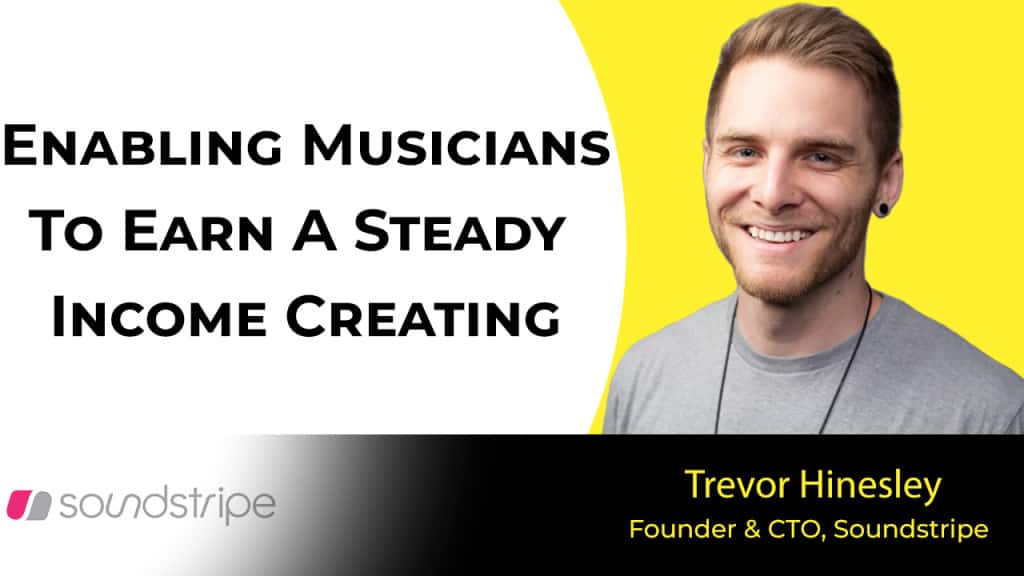
About Trevor Hinesley:
Trevor specializes in building scalable technology platforms by growing teams who desire to challenge the status quo. He is currently making creators' lives easier @Soundstripe.
About Soundstripe:
Founded and operated in the heart of music city, Nashville, TN. We are dedicated to making incredible music available to video content creatives. Emotional impact is the name of the game and we are passionate about the marriage between music and picture.
Transcript
(Intro Narrator at 00:00:03) Hello, my friends. Today, Joel is talking to Trevor, the co-founder and CTO at Soundstripe, and they discuss his journey from touring musician to CTO, how Soundstripe enables musicians to make a steady income from creating music, and how to know when to trust your gut for big decisions. All of this right here, right now, on the Modern CTO Podcast.
(Trevor at 00:00:30) Here we go.
(Trevor at 00:00:31) This is the Modern CTO Podcast.
(Trevor at 00:00:42) How did you wind up meeting Jonathan?
(Trevor at 00:00:47) So I looked up the different podcast people that were out there that had good podcasts, and Developer Tea was one of them.
(Trevor at 00:00:56) Oh, yeah.
(Trevor at 00:00:56) And so I reached out to him, and he was busy traveling at the time. And then a year went by and we tried to connect again. We basically disconnected for three years of just every once in a while, I'd be like, "Hey, I like what you're doing." I'd see a series he did, I'd be like, "Oh, that's cool."
(Trevor at 00:01:13) And we'd chat a little bit. But then finally, I was like, everything just came together well with COVID because we had more time.
(Trevor at 00:01:21) Right.
(Trevor at 00:01:21) And we got together and got to know each other on a couple different calls, and then we did a podcast together.
(Trevor at 00:01:26) That's awesome. Yeah. I've known him for—I mean, like I said, since we were teenagers. But, yeah, that dates back a while. I mean, both of us were in music prior to software. So, yeah, we go way back.
(Trevor at 00:01:42) Yeah. And you're still in music, though.
(Trevor at 00:01:44) Yes. Yeah. In a very different way than I was when we—you know, than I was years ago, which was in my early twenties. I was a touring musician.
(Trevor at 00:01:57) Oh, yeah. What were you playing?
(Trevor at 00:01:59) I played guitar. That's actually how me and Jonathan met. When I was 12, I picked up bass guitar, but then I decided I wanted to try electric. And I went and took a few lessons and Jonathan was my teacher. So he was 15, I was 13, I think, or 14. And we just stayed in touch over the years.
(Trevor at 00:02:23) Somehow both of us got into software. And, you know, I don't know if he talked to you about this, but he actually was in—I believe he was with a signed artist for some portion of time. And, you know, I wound up after I got my degree in computer science—when I got out of college, I toured full time for three or four years. And the whole time I was on the road, I worked remotely as a software engineer.
(Trevor at 00:02:53) So, yeah, both music and technology have had huge parts of my life and are both big passions of mine for sure.
(Trevor at 00:03:04) Oh, nice. Yeah. I play as well. I play guitar.
(Trevor at 00:03:07) Nice. It's—I think it's funny that you said that. So my parents, they had gotten my brother a guitar and then so for me, they got me a Carlo Robelli bass guitar.
(Trevor at 00:03:15) That's awesome.
(Trevor at 00:03:15) I didn't want to play bass guitar though, because I saw my brother. I wanted to play that. So eventually, I just got rid of the bass. But, yeah, it's pretty weird how I keep meeting people that have a similar background. They end up as technologists.
(Trevor at 00:03:30) They go from musicians, touring musicians, to technologists. I just talked to this guy—we had him on the podcast named Brian. He is the CTO of this thing called The Office Experience and they're not like Soundstripe, right? But they do this design and digital transformation and innovation.
(Trevor at 00:03:48) Right? So they're a really, really interesting company, but he did the whole touring thing, right? And did that for years and years and years.
(Trevor at 00:04:00) And then now he's the CTO. And then that's after this happened three or four times, I told my production team, I'm like, "There's this weird trend of this recurring."
(Trevor at 00:04:10) That's so crazy. Yeah. I mean, it's definitely—I feel like people have this thing in their mind too, where if you're a musician, it's just—I don't know. There's some dichotomy or polar opposite mindset from doing something technical. But the reality is that both—I think from the individual contributor level all the way to management, strategy, et cetera, all of those things are extremely creative in the software field.
(Trevor at 00:04:40) I mean, when you're building everything from architecture to, you know, decisions, even design decisions—which in our company, we actually contain within the engineering department, which is a little different than how other people do it—but all of that is super creative, and I get the same, I don't know, dopamine hit or whatever it is from building software and, you know, growing—really entrepreneurship, growing a business—that I do from playing music and creating on that side. They're different flavors of the same thing, for sure. When you're playing on stage to thousands of people, that's obviously a very different experience than very intimately managing people on a day-to-day basis. But both are extremely rewarding in their own ways, for sure.
(Trevor at 00:05:33) And so can you give me a little bit of background, the high-level overview of what Soundstripe is?
(Trevor at 00:05:38) Yeah. Yeah. So, you know, I mentioned that basically I became a touring musician out of college and my degree was in computer science. I double majored in audio engineering and computer science. And soon as I got out of college—if I'm remembering this story right, this might be one of those things where your stories get better the older you get, you know what I mean? But if I remember it right—I know this part's true—I auditioned for this band that was signing a record deal, and I got the call that I got in it. And I think I was actually in cap and gown doing my college graduation rehearsal when I got the call that I got in it. So either way, I knew that once I graduated, I was going headfirst into what had been my lifelong dream, you know, trying to tour and, quote unquote, "make it" as an artist.
(Trevor at 00:06:32) But I had this degree, I just spent all this time building. So once I got out of school, the band I was in, we also had a very unique kind of development situation. Um, because of that, for the first year or so, we weren't going to tour. So we were going to be in town doing development and doing the early stages of building the brand and the band itself. And because of that, you know, I felt like I had a good opportunity to try to still put my foot in the door of technology and really try to pursue that at the same time.
(Trevor at 00:07:09) I started interviewing for some jobs, I had a really hard time landing anything because I wanted to be ethical about it. I knew that in a year or so I was going to have to work remote or, you know, it just wasn't going to work. So I told everybody that. And of course, you know, we'd have a couple interviews, but as soon as the conversation came up around touring and the potential there, this was 2013 and remote work was definitely not the norm then. And I told—especially being on the business side now, I totally get it.
(Trevor at 00:07:39) But they're just—as a junior developer with very little to no prior experience, there weren't a lot of people out there willing to take a chance on the fact that I'd have enough time to get up to speed to really be effective remote. So I couldn't get an offer. But one of the guys, shout out to Dennis Monzowick, he was the senior—a senior engineer at my internship in college. He did an email intro with the CEO of a new startup in town.
(Trevor at 00:08:12) And that guy, also shout out to him, Rob Humphreys, great guy. We still get dinner a couple times a year, me and his family. I sat down at coffee with him a couple days after three job offers didn't manifest and told him my situation. I was like, "I want to tour, but I need someone to give me a shot. Like, you know, I'm a hard worker. I promise. I just need some resume under my belt." Didn't have it yet. So he said, you know, he loved that I was a creative, and he was looking for a kind of a specific working arrangement, as far as I was going to be contract. And he was just getting this company off the ground, and I was like, "I'm totally willing to work with that." And so he was like, "Great. I want to help you pursue both dreams." So I started—that was on a Thursday, the next Monday was my first day at work. And he honored that about a year in, we started touring, I got to work remote. I eventually—both me and him wound up moving to other opportunities. And over that time period, I worked for an app agency, I built websites for, you know, everything from startups to doing agency work for large enterprises and Fortune 500s and stuff like that.
(Trevor at 00:09:30) So I had developed a lot of experience in that time, I started doing some freelance work. And all of that led me to Soundstripe when one of my freelance clients—I was still touring full time at this point. And I had a 30-hour-a-week retainer with an app agency. But I was still doing—I was still dabbling in some things on the side. And one of my freelance clients, he was like, "Hey. I've got these two guys you need to meet. They have an app idea." I mean, of course, if you're in software, everyone's got an app idea, right? So I was like, "Man, I really appreciate that, but I'm just slammed."
(Trevor at 00:10:07) I also was trying to get a side hustle SaaS product off the ground with a different business partner. And I was touring full time, 30-hour-a-week retainer. I just had no time to do something else, but he was like, "Look, they're great people. Just meet them, you know, get dinner with them, whatever. I think they'd be good for you guys to know each other." And I was like, "Yeah, totally down for that." So that wound up being who are my now business partners at Soundstripe. So Micah, who's one of my co-founders, we went out to dinner, fell in love with him. He introduced me to Travis, our other co-founder, fell in love with him.
(Trevor at 00:10:42) And they're our co-CEOs. And we had just a very unique dynamic between the three of us. I don't know if you're an Enneagram fan, but I am an Enneagram 3. Travis is a 5. Micah is a 7. So we make this weird kind of triad. And we're very different people, but our values are very aligned. So from the get-go, we were, you know, gung-ho about working together, while I was still touring and I was working on all that other stuff. I was really amped. Honestly, we hadn't landed on what the business model was going to be yet. So I wasn't even super sold on that.
(Trevor at 00:11:20) I just knew if anybody was going to do this, it was going to be those guys and I wanted to be a part of it. So on the side, I wound up building an MVP. We launched it four months later. That was February 2016. And we were, you know, whenever I was home from tour, we were working out of Travis's bedroom. It was just a few of us. We were all kind of just, you know, working for free in the hope of some stock that might be worth something. And for the first year or so, we did that, and we grew faster than any of us anticipated. We bootstrapped. And about ten months into it, I quit touring to focus on it full time.
(Trevor at 00:11:59) And then about two years in, we crossed the million ARR mark and decided we wanted to go out and raise some venture capital. So, yeah, we just grew it from there. In 2018, we raised a $500,000 seed round. We quadrupled the business that year. And then in 2019, we went out and raised another $6 million in a Series A. And today, we're about 80—right around 80 full-time employees.
(Trevor at 00:12:28) Nice. Nice. So what does the Soundstripe product actually do?
(Trevor at 00:12:32) Yeah. Yeah. So we were trying to solve a couple problems. One was it's really difficult to make a living in music. All of us are the poster children of that. Micah, Travis, both were touring and session musicians as well. Travis, I mean, he filled in for George Strait, Willie Nelson. We always joked he's the real musician of us three because he plays fiddle and he's a prodigy. But, um, and then Micah was a touring rock guitarist like I was. And all of us had—you know, we'd had history in the business, but we also had, you know, intimate familiarity with the difficulty of making a living doing it because I would not have been able to tour had it not been for software.
(Trevor at 00:13:17) I mean, I vividly remember, matter of fact, it was the largest show of my career. We played at the Georgia Dome. There were 38,000 people there, and my paycheck was $50. So I played that show and then got back on the bus and was building software for about that per hour. You know? It was like, "This is bizarre. Where is the disconnect?" So, um, again, Micah and Travis have similar stories where they both stopped playing and moved to the tour bus driving seat. So they basically got their CDLs and started driving buses for artists because your day rate was much more than it was as the musician. So in Micah's case, he actually was in the same band, but he just stopped playing guitar and started driving the bus and made more money. So, yeah, we were trying to solve that.
(Trevor at 00:14:12) It's difficult to make a living as a musician, even supplemental income, right? We weren't trying to make the next Katy Perry. We just, you know, a part of our business model was centered around trying to provide a stable or, you know, side source of income creating music. Because a lot of the people I toured with, when they would get home, in order to make ends meet, you'd still be working two or three other jobs. You'd be a waiter or, you know, have DoorDash, some side hustle, something to pay the bills when you're not on the road or in between. And but the idea for this was like, "Wait a second." We found this interesting niche where we could create a structure that was a win on the business side, but also allowed people to own their craft and create music as that source of supplemental income. So that was the one pain point we were trying to solve, and that's on the artist side. The other was, as a creator, it's really tough to find great music.
(Trevor at 00:15:14) And around the time we were starting, it was almost impossible to find something that was—stock music was synonymous with elevator music, or you had to pay every time you used it for every project, or the licensing was really complicated. So there was no really streamlined way for a high-output content creator to get a lot of music for a lot of projects that they had no idea where they were going to go, right? Somebody who's starting out on YouTube doesn't know if a video is going to go viral, and they don't want to have to worry about, you know, if it takes off overnight going back to renegotiate or buy an enhanced license or something. We just didn't want—that was a pain point we had seen and we didn't want creators to have to deal with that.
(Trevor at 00:16:03) So those are the two sides we were trying to solve. We wanted to, you know, create high-quality music at an affordable cost for high-output content creators. And we wanted to do it in a way that it was a win-win-win for the company, the artist and the consumer.
(Trevor at 00:16:19) That's pretty neat. So, I mean, from my perspective, we needed some background music and a couple sounds for the videos that we were doing. So we searched around and the easiest one to use was you guys because it was like, "Here's a subscription. Everything's unlimited. You can access the whole deal." And it was just really easy.
(Trevor at 00:16:38) That's awesome.
(Trevor at 00:16:40) Is it still like that? Is it still all like that?
(Trevor at 00:16:43) Very much so. That's great to hear because that has really been a core focus for us, is trying to simplify that. And, you know, we're not an enterprise product, so we don't deal with a lot of feature creep in the same way a lot of enterprise products do. And part of it's because we're really intentional about that. But what we do try to do is our product roadmap is much more similar to a company like Netflix, where they're doing constant 1% improvements and really dialing in the engine under the hood.
(Trevor at 00:17:14) So, you know, our website has definitely gotten a lot prettier over the last five years since when we launched. But usability—it's only gotten easier to use and less cluttered over time because we've done a ton of really intense, even R&D projects on everything from the terms that people can use to search, you know, like our filters in our sidebar. Surprisingly, that was essentially—and it's still to some degree, but it was definitely an unsolved problem in the space—because you would go to a site and you would see like, the terms like, you know, you'd look at a list of moods that you're trying to search by. And in your head, you're like, oh, I want—I need a dreamy song, right?
(Trevor at 00:18:06) And you'd see the dreamy tag or whatever that you could filter by right next to an ambient or an ethereal. And you're like, well, what's the difference? So that was actually something we spent a lot of time on, is making sure that every part of our application is extremely intuitive. But, you know, you can still drill really far down and get really specific. And so to your point, yes, it's still very much a simple product, and we've actually made it more simple over time. Now, we used to—we asked that if you were working on multiple projects, that you would just record it in your account, and that would act as your license.
(Trevor at 00:18:46) So if you did, you know, I don't know, if you were working on a client project and used the same song in two different ones, you could come back and license it again. We got rid of that whole flow. And now we integrate with YouTube so that if you're uploading something to YouTube, basically, now you just download the music, use it whenever you want, as long as you're actively subscribed. All of the content ID, you know, copyright claims and stuff—all of that's done automatically. So you don't have to deal with any of that. So yes, it's only gotten more simple over time for sure.
(Trevor at 00:19:21) That's pretty neat. And so why did you guys want to raise capital? I mean, it sounds like it's a pretty cash flow positive business.
(Trevor at 00:19:29) Yeah. It was. We were definitely growing quickly, but we also saw that the market just continued to—well, really, it was blossoming, but it was also, you know, there were new competitors popping up daily. At that point, we had actually had one or two competitors that popped up. We had one in particular who still exists, so I won't name them, but they literally ripped off our—I mean, they literally stole creative we were using, like our images, our slogans, our all this stuff on their site. And it's not one of the bigger names in our space.
(Trevor at 00:20:05) They were just a smaller company that popped up. But we started seeing that kind of stuff. And we were like, okay, there's enough of these popping up. It started to feel like what happened with stock photos about five years prior, where there was a million of these mom-and-pop kind of boutique licensing things, right? And then they all started getting gobbled up by the two or three big competitors in the space, the Shutterstock, Getty Images, Adobe's.
(Trevor at 00:20:31) And they all kind of blur into become one. And then they start pushing these ancillary brands, and you're like, I think that's iStock, but it's a different logo. And then you click on it and you finally end up getting back to iStock. Yeah. It's crazy.
(Trevor at 00:20:44) That's exactly right. So we started seeing that same thing in music. And the reality was, we didn't want to get left behind. We didn't want to be one of the little shops that got gobbled up or, you know, pushed off the map or whatever. We wanted to be one of the two or three big players.
(Trevor at 00:21:00) And we felt like there was a time horizon on that. The only way to do that was to raise capital and really, you know, put some fuel to the rocket. Nice.
(Trevor at 00:21:07) So with that ARR, you probably got really good terms too. So that's good. It's way easier than starting with $0 and raising $500,000.
(Trevor at 00:21:15) Exactly. Well, and that's actually, you know, before we had any revenue, when we had landed on the idea and stuff, we had tossed the idea to a couple investors and no one really bought, or, you know, part of it was probably we didn't have a pitch nailed. I mean, we made a deck and stuff, but we also didn't know what we were doing. And so that may have been part of it. But the other side is that, you know, they're also—there was an element of the, you know, the classic startup story where no one gets it until they get it. That was definitely a thing where we would have conversations with, like, publishers, like music publishers, and borderline get laughed out of the room.
(Trevor at 00:21:58) Like, no one's going to pay for this, like a $15 a month subscription. There's no way. There's not enough demand, blah, blah, blah. So some of it was like, okay, well, we'll just—maybe they're right, but let's try to prove it and see what happens. So that was, you know, I think we were trying to prove it to the people who had said no, but also to ourselves. And so once we got there and realized how big the market was, how fast it was growing, that's when we decided to put some capital in it.
(Trevor at 00:22:26) That energy of proving people wrong, it's a powerful thing, my friend. It's driven me many places in life.
(Trevor at 00:22:33) That is so true. And honestly, I don't know—I feel like every founder is so different. I feel like everyone's got their own story and such. But for me, that's part of the exciting part too, is trying to—because it doesn't always work. I mean, my first business, the one I was talking about that was a side hustle before Soundstripe, we wound up putting that thing to bed a year in because we couldn't sell it. It was like we had built this product, and frankly, no one wanted it. So it was, you know, it was exciting at first, but we also knew when to quit. And, you know, that—to me, it's not always successful, but that excitement to find and fill a need and then people start paying for it. That was hard to beat.
(Trevor at 00:23:20) For me, that's a big motivator because it was a lot of fun to, you know, hear user feedback of like, oh my gosh, I've been looking for something like this. And again, people putting their hard-earned money into something you've built. That was a really rewarding experience to me.
(Trevor at 00:23:36) How did you get content? Day one, you put this up. You need a lot of stuff. How did you get the original content?
(Trevor at 00:23:42) Yeah. We started as more of a marketplace model, right? So we did it as a rev share. Couple reasons. One, because we had no money. And two, because that would, you know, in our eyes at the time, it seemed like a really reasonable way to do it. And plenty of marketplaces operate that way. But as we grew, you know, we had friends—we were from the industry, like I said, so we had friends who had hard drives full of songs that were just unused. Either you, you know, you tried to pitch it for a commercial and it didn't get picked. And that could be for a slew of, honestly, minute reasons.
(Trevor at 00:24:23) You could have a great song, but they didn't like one word in the lyric. And instead of asking you to revise it, they're just going to pick one of the other 500 submissions they got that fits perfectly, you know? So you'd have a hard drive of great songs that have no value outside of a video. A lot of our producer friends had that. So that was our early catalog, was a lot of them. But as we grew, we started experiencing pain points from it. One, having a rev share like that, artists' paychecks fluctuated. Even if it was slightly, it still fluctuated with the business. So if we had down months in the winter when there's not a lot of wedding videos happening or not a lot of content being made, so if acquisition is lower in those months, so is the rev share. So that wasn't a huge effect, but it was something we started to notice.
(Trevor at 00:25:15) People would start to rely on it, and it didn't matter how much notice we gave of like, hey, it's a slow month for us. Be prepared or whatever. People, you know, it's still a thing. So that was one piece. The other is that we curated all the content that came in. So we were basically picking and signing, essentially. Not really, because it's not like a record deal or something. But when we would sign artists, yes, we would still curate and pick the music, but there was also a beggars can't be choosers thing where we weren't buying this stuff outright. So we didn't have a whole lot of say. We didn't have a whole lot of control of the content, which also meant we couldn't be as selective as we wanted because we just needed content.
(Trevor at 00:26:01) And we also felt like we could really, you know, we could be a marketplace and have a bajillion artists and the top 0.1% make some money while everybody else is living off scraps, or we could slim that down a bit and try to create a different acquisition model that was a little more upfront, a little less risk on both sides, et cetera. So what we did is we moved to buying music, and we acquire all the rights upfront. So we own all sides of the copyright—master and publishing. But this gets complicated. Music—again, licensing and music rights are insane and very antiquated due to copyright law.
(Trevor at 00:26:45) But on the publishing side, there's a federally regulated royalty called performance royalty, and broadcast TV has to deal with this, and any kind of public performances like movie theaters, stuff like that. So that royalty—the writer share, it's split two ways. There's a publisher share and a writer share. The writer share goes back to the original author of it. We felt like that made sense. They're the ones who wrote the actual composition. But we still own and control all those rights. So what we do is we pay upfront to buy the music, and then that gives us a lot of leeway to—we can commission exactly what we want. We can go out and find artists who specialize in it and work with them. We can do structures that are still stable and recurring, like recurring contracts. If they do a—if we really like their music and it fits in a particular need that we have a lot of, they can—we can do a recurring contract where they're submitting music monthly, so it's more of a stable thing for them.
(Trevor at 00:27:53) And we also have—we actually have W-2 staffed artists. So we have a section of our artist pool that's actually on staff with us, as well as our mixing engineers, mastering engineers, et cetera. We have a whole post-production team in-house too. So we moved to more of an acquisition model. It gave us more control over the music and how we could use it and allowed us to simplify licensing like I was talking about. But it also gave us the ability to really find the content we wanted, and it gave us the ability to make it as good as we could with that kind of in-house post-production team I was talking about.
(Trevor at 00:28:30) It sounds like you're a record label.
(Trevor at 00:28:33) We are. Yes. On paper, one way to look at it is we are—because we are a tech business. A quarter of our company is product and engineering. But we have—we're basically a record label and a publishing company as far as legal entity goes. But we own our distribution, which is soundstripe.com. So we're not beholden to making money from the Spotifys of the world and stuff like that. We do, because we own the rights. We make money from all sorts of different revenue streams, including traditional listening like that. But our main distribution is where we recoup most of the benefit of the copyrights we buy. Yeah.
(Trevor at 00:29:15) That's pretty neat. I totally get the concept that these producers have these large hard drives, which are a bunch of songs that—because my brother-in-law is a producer, and yeah, he will share songs with me, and I'll be like, that song's great. And he'll explain to me how the industry works. There's political aspects to it. You can have a great song, but the person doesn't have the right story and they don't have a huge social credential at that point in time, or it's a great thing, but it's going up against something that's slightly hotter. If it came at a different time, it would have worked.
(Trevor at 00:29:47) So true. And they
(Trevor at 00:29:48) end up having all of this stuff, like these songs that these producers sit there with the artists and make and that never really do anything.
(Trevor at 00:29:56) That is so true. And it's, you know, the way we saw it is like, look, there are—because we buy the rights, we're not shy about that. You know? But there's a lot of—this is kind of soapbox, but I also feel like there's a lot of—I hate to use the word misinformation, but the reality is that there's just a lot of rhetoric, I would say, around don't sell your rights. Don't sell your rights. By all means, if you're not comfortable with that, don't do it. Or if you don't know what you're doing, don't do it. But at the same time, if you tell everybody that, you have a whole—I mean, the majority of the industry, you've got all sorts of people who are holding on to 100% of nothing. Because unless you're in the top 0.1%—I know this intimately.
(Trevor at 00:30:42) I was an artist, right? Unless you're in the top 0.1%, you know, you're in Katy Perry's band or you are Katy Perry or something. That's a hard living. And again, going back to that rhetoric, there's this whole thing about people feeling really—sometimes people feel really weird about selling their rights.
(Trevor at 00:31:03) But we all—look, from the time we started, we have artists that were literally there day one when we launched our company that are still with us today, that have seen us, you know, we went through that change from marketplace to acquiring copyrights and stuff. And some of those are even on staff with us. And the reality is, there is a large portion of musicians who have a mortgage, a family. They don't want to tour all the time, but they're really good at music. So they need a nine to five or a contract job in music because that's what they're good at.
(Trevor at 00:31:39) So really, all we did is—there is a route to become the next Katy Perry or to go out and gig for big artists like that or try to make it, right? That exists. But just like in every other industry, you could be a graphic designer working for an agency, or you can start your own graphic design agency and be the business, right? You trade stability for the upside of potential reward later if you start your own business. In music, the latter is the only thing that exists. There was no "go work for a company." You have to be your own brand, marketing, you know, all this stuff. So all we were trying to do was provide an option there. If you're trying to be the next Katy Perry, we are not right for you. Don't sell your stuff to us, or make some stuff on the side and sell that to us and do your Katy Perry stuff, you know, as your dream thing, just like people would do with a side hustle or something. So yeah, I mean, the industry is tricky.
(Trevor at 00:32:37) And I think a lot of it is because it's built on an old foundation that has a lot of storytelling built around it that I think can be detrimental to some people, for sure.
(Trevor at 00:32:51) Yeah. That's so interesting. I'm learning so much right now.
(Trevor at 00:32:56) Well, I'm glad. It's—like I said, it's a very—a lot of the industry is, you know, it evolves very rapidly, especially as mediums change. CD after cassette and then now streaming, et cetera. So this stuff is changing always, but it's super interesting.
(Trevor at 00:33:11) Tell me a little bit about—I think you said you have around 80 people, quarter of those are engineers. That size company I'm pretty familiar with, but I'm curious to know, like, what are you experiencing today? What are the challenges you're facing today as a CTO?
(Trevor at 00:33:26) Yeah. Honestly, I feel like my job is different every three months, and that speeds up the bigger we get. So now it's different every month or so. But the stage we're at, I'm very fortunate to have an incredible vice president of engineering who has grown with our organization. He came on board a couple years ago as a contributor and just worked his way up. And he is unbelievable and definitely my right-hand man. I mean, he handles a lot of the day-to-day as far as operational excellence and, you know, shoring up everything from security to best practices and stuff like that. And I oversee a lot of that just in general, but I'm not doing the day-to-day execution of a lot of that. And at the stage we're at now, we're at this strange in-between where my focus is sort of on the R&D side.
(Trevor at 00:34:24) And so he's handling a lot of the, again, day-to-day operational execution of the product roadmap from the engineering standpoint. But there's a lot of projects we have. Because we own all of our music, we can do a lot of really interesting things with it in our core business, in ancillary markets. There's a lot of ways we can leverage the copyrights we built. And the other thing, and the reason we're different from a typical record label is even the majors—the Universal Musics of the world and stuff—they're not set up to be a technology-first company. They'll buy tech companies, but they're not, you know, in the same way that the Procter & Gambles of the world go out and buy the Dollar Shave Clubs of the world and do that as their R&D. That's kind of how the majors work. So we're a little different because we are the company doing the R&D, and we have an awesome product and engineering department.
(Trevor at 00:35:01) So I'm in this kind of limbo stage where I've been able to delegate a lot of the day-to-day so that I can focus on what I see as some of the more 10,000-foot view, further-out R&D stuff. Where are we going in 12 to 36 months? But also, we're not big enough to where I have enough resources for that. So I am dabbling in a lot of these R&D things myself or having to bring in people to kind of flank me on some of them. And, like, there's some AI stuff we've been looking at, and we do have some AI talent on staff, some really good AI talent, but they're in other projects. So I can't pull them off really high-priority stuff.
(Trevor at 00:35:46) But I myself don't have a ton of actual—like, I haven't built a production-level AI model where I've written a journal about it or done some kind of true research on that. So I'm in this stage where I know my strengths, I know my weaknesses, and my strength is in the R&D side, but I've also got to figure out how to be most effective with my time for the sake of the business and my team and everything else. And so I'm basically an R&D department of one, and that's probably the most recent biggest challenge I've been facing is how to make sure I'm leveling up our organization on that side until I get enough resources to do that. And again, even that looks different as we continue to grow. But right now I've been pruning the tree of potential R&D projects and figuring out, 80/20 principle, what are our biggest bang for the buck that I can have an impact on and maybe bring in one or two people? And then what is the stuff that can wait?
(Trevor at 00:37:19) Or, especially because we're in a competitive industry, what's the stuff that is going to, from a technology standpoint, put us ahead to leapfrog some of our bigger, more well-funded competitors and things like that? So these are the kind of things that are in my head when I go to sleep every night, for sure.
(Trevor at 00:37:36) Are you—you have a large subscriber base, right, that wants you to be successful. Do you poll them at all? Bounce your ideas off of them?
(Trevor at 00:37:43) Yes. So we actually have a user focus group that's basically—it's like a VIP panel almost. It's basically our long-standing customers that have been with us a long time who are very responsive to surveys and stuff. We can pull them together and do all sorts of different focus groups or product testing or even—we've done one recently where we showed them some demos of things that, like, one was a project that I had built, and it was like a demo of something we were really excited about. And then two others were kind of more far-flung things, but we wanted to just do a litmus test, you know, see what the appetite was there for some of this stuff.
(Trevor at 00:38:08) So we got them together and showed them some of these ideas, but it wasn't even just a focus group. Half the time we spent just getting to know them and learning more about—not necessarily every in and out of how they work on a day-to-day basis, but the things they care about as customers. And it's different depending on the persona. That's a unique problem in our industry is that you need music for all sorts of different creative projects—podcasts, all the way to wedding videos, YouTube videos—and there's different pain points with each of those. So yes, we do do focus groups and we run a lot of these things by them. We'll show them demos, hopefully early enough to where we don't waste a bunch of cycles. But that's definitely a big focus of mine for sure.
(Trevor at 00:39:21) What's the startup scene like in Nashville? Pretty active?
(Trevor at 00:39:25) Yeah, it is. It's more active than it used to be, but I would say there's a lot of early-stage companies. There are some that are above the 20-employee mark, but most of them, I would say, are pretty early stage, and a lot of the startups around here are in the healthcare space. So there's a lot more popping up that are in music or even outside of that. I think Pilot has a headquarters here, which is the automated bookkeeping service. So there are definitely some larger startups coming out of Nashville now or moving here, et cetera. But historically, it's either been primarily healthcare or just smaller startups in general.
(Trevor at 00:40:15) Those automated bookkeeping services are crushing it. I just talked to the founder of, I think it was called Bot something, and he was like, yeah, we go in and we categorize these transactions, and we have AI. And I was like, you're the fourth company I've heard that does that. And you guys are all growing at insane amounts, and they all have—you know, they're plus 100 employees, and they're just crushing it.
(Trevor at 00:40:37) Yes. It's insane. Pilot, the company I was referring to, I think Stripe is a major investor of theirs. So there's a lot happening in the fintech space in that particular area right now.
(Trevor at 00:40:51) Man, I'm blown away every time I visit Stripe's homepage. There's 80 new products. They just—it was like it started with one, and then there was two or three, and now there's this menu and you go there and—I'm not exaggerating—I think there's 20 to 30 products in their dropdown on their homepage. They just do so many things now.
(Trevor at 00:41:09) Oh, it's bonkers. You can even—on their site—no, let's take this back. This was on an article I found, I think. But someone basically built out a timeline of Stripe product launches, and it was their core, their subscription stuff and all that. That was early on. And then as years went by, they added their billing products, which is some of the more advanced subscription features. But I mean, just their growth, their product launches hockey stick. In the last three or four years, they've launched the majority of those. It's crazy.
(Trevor at 00:41:45) I know. I'm excited, though, because right when they came out, I was dealing with—what was that horrible service? Authorize.net. Yes. Where they had the most convoluted API, and the application process was multiple days of sending paper back and forth and doing all—and then, all of a sudden, one of my buddies told me, he's like, hey, check this out. And he found a gem, a Ruby gem—I was programming in that language at the time. And he sent it to me. He's like, check out this Stripe API with this Ruby gem. I was like, all right, cool.
(Trevor at 00:42:17) And so I checked it out, and I was like, I just signed up for an account and charged my own credit card. He's like, yeah. I was like, I didn't have—I filled out one form and put in my Social Security number, checked the box, and that was it. He's like, yeah. He's like, this is what it's like. And from there on, every single project that I did, which is, you know, another 20 projects or so as a developer, I put on Stripe because it's like, look, put it on Stripe, don't worry about it, and it's great.
(Trevor at 00:42:41) Exactly. Yeah. And we started on Stripe. Eventually, we had to move to a subscription billing management tool, so we used Chargebee on top of Stripe. Oh, yeah. But part of that—there was a lot of reasons for that. One of those was we wanted to start offering PayPal, and we had already gotten to a point where we were building custom features on top of Stripe, many of which Chargebee offered. So yeah, eventually—we still use Stripe for our card payments, but they—I know Stripe has launched more of those features since, but we love Chargebee and have had a great experience with them. But it was definitely—we were nervous switching to anyone from Stripe early on because we had that same situation. I'd been developing on them for, I mean, now over a decade. But we had such a good experience.
(Trevor at 00:43:34) Crazy. Yeah. It's wild. It's crazy.
(Trevor at 00:43:36) It goes by so fast.
(Trevor at 00:43:37) I know. It's wild.
(Trevor at 00:43:39) When I saw those Chargebee-like services, you know, when they started to emerge, because we were doing it before they existed, and then they started to come out—and I was like, I don't get that. I was like, why would I give a percentage of revenue when I could just build this? And then I realized very quickly the section of the market that is the advancements in billing features moved so fast. Yes. That you need a team of engineers and billing to keep up with all the new things you can do in billing. And so those services all of a sudden became really interesting.
(Trevor at 00:44:14) Yeah. Oh, absolutely. I think Chargebee just became a unicorn. So I mean, if you think about it, they're another layer abstracted even from Stripe, and even that market is huge. It's crazy.
(Trevor at 00:44:29) Yeah. And then you can focus all your resources and not on figuring out what happened with the payment reminder emails and the interfaces for getting people to update their credit cards before it expires. And you can instead just work on your core product, like your search algorithms and just make it better. Exactly.
(Trevor at 00:44:46) Exactly. And that was—we've done a lot of that, of trying to—you know, anytime we start to build something, we'll go through kind of like a build versus buy analysis. But I really try to focus heavily on we should only build what's core to our business, and anything outside of that, let's outsource, whatever. And yeah, that's—we've, again, done that with Stripe being a great example, but there's a lot of things under the hood that if they aren't core to what problems we specifically are trying to solve for our customers, then I don't mind outsourcing all of that stuff if necessary.
(Trevor at 00:45:28) Have you ever done any team augmentation with an Andela or something?
(Trevor at 00:45:33) We had—actually, I've talked to Andela a couple different times. I actually love what they do, just from a mission standpoint. The only issue and the reason we hadn't gone with an Andela or any other kind of sourcing firm like that was purely because, you know, at the stage I was looking to potentially partner with them at, we were still looking for local talent. Now we're remote first. We've stayed that way even—you know, a lot of companies are going back to in-office and stuff. We're staying remote first. And at the time, we were still looking for remote talent, but even beyond that, you know, we had—me and some of my other engineering leadership had worked with outsourced teams in the past. And sometimes we had great experiences, sometimes not so much.
(Trevor at 00:46:06) But given the stage of company we were at, it was just one of those things that I didn't know—you know, in order to make the best decision for us at the time, it felt like we needed a little more control over, basically, some of those earlier hires. Where we could do—having some of the local talent for some of our early positions, I do think was beneficial for us in particular just because we had a really tight office culture early on. And, you know, we kept trying to figure out—because we had started to add remote employees, but we were like, how would we make this work? We could do different time zones and such. And, you know, within Andela in particular, there wasn't necessarily a language barrier, so we didn't have to deal with that. But it was purely, you know, we had enough of a network at that time where we thought we could source some of those early roles ourselves.
(Trevor at 00:47:11) And since then, you know, at the size company we're at, we could probably go back to that and look at it. But at the time, it was one of those risk versus reward. Again, I loved what they did as a mission, and I actually thought that there was a lot of value we would get out of talent from them because of how they train them and a lot of the education that people that come through Andela get. But the other thing was, two of the roles I was looking for at the time, they didn't have—they didn't have talent that was at the experience level. So I was looking for a senior engineer with a specific focus—I can't even remember at the time—but they didn't have anyone for that. So it was a combo of timing, potential risk. It was a new partner, even though I loved what they did. I'd never worked with them before, that kind of stuff.
(Trevor at 00:48:28) Yeah. Well, it's really important at the beginning of a code base or a project that you have some really magical, awesome people that understand the problem deeply because that sets the tone. Because nobody wants to work on a garbage platform. Right?
(Trevor at 00:48:44) Exactly.
(Trevor at 00:48:44) And so if you get a nice, well-groomed, best-practices, as much as you can, type-based software, then you'll attract people that want to work on that and expand it.
(Trevor at 00:48:56) 100%. Yeah. And that was—that's definitely—and again, not to say that that couldn't be done through Andela by any means. But—
(Trevor at 00:49:03) No, it's just different. Because, like, if I have 500 engineers and I need to boot up 20 or 30, I'd call up Andela and be like, this is how we roll. This is our—you have such a mass. Once your mass gets to a certain point, it becomes even easier. But, you know, that core, that solid foundation, me personally, I would hire full-time people for that solid foundation.
(Trevor at 00:49:25) Right. Yep. And that's how I felt at the time. The other thing was that I also felt like I didn't have any room to make a mistake because, let's say—let's say even the interview process with someone at Andela or whoever, I'm just using them as an example—but let's say it went well. If there was even a hint—because one of the things that companies like that offer you is that if the hire winds up not working out, you know, they'll figure it out for you or whatever.
(Trevor at 00:49:56) I didn't have that luxury. It was, you know, we were too small at the time. We were not capital intensive. We didn't have enough cash in the bank to potentially make a wrong hire. I didn't feel like I had that opportunity.
(Trevor at 00:50:15) I'm curious to ask you this. All right, so I was thinking the other day as I was scrolling through LinkedIn, I saw this article and it said, "Don't use your gut when making hiring decisions." And then you scroll a little bit farther and it's like Jeff Bezos, another article, Jeff Bezos has made every important decision not on data but with his gut. And I was like, this is the most perfect—if I could get these in a screenshot, it'd be awesome. This is the most perfect example of how the world works post-2020, right? A hundred percent. It's like, we're gonna tell you one extreme and then the other extreme, and we're gonna make it look like valid, credible sources and good insight and advice. So I've decided that, or have the thought, that the thing discerning between what you should do and how you should listen and how much you should listen is the art form that will make you successful. Because if you listen to everybody all the time, you're never really doing your own thing, and so you kinda have to block stuff out. So I'll go through periods where I'll consume a bunch of content, and I'll go through periods where I don't do anything and I just apply things and get my own experience. How have—have a lot of people been—I guess I'll ask a pointed question. Have a lot of people given you specific advice? And do you find that a lot of people are doing that and you're having to filter, or are people not talking to you about advice?
(Trevor at 00:51:29) That is a great question. One, I completely agree on all of that. And two, to answer your question, when we—especially as we were early starting out—we didn't go through a startup incubator or anything like that. Again, we were working out of a bedroom. I was touring full time until the business was almost a year old. And so we had our own dynamic. We were kind of living in a bubble. We have the Nashville Entrepreneur Center, who is awesome, and I actually, just like you were talking about giving back, I try to do that there now, which is basically me just going in there saying, "Hey, we screwed this up. Don't do the same thing." Here's where we messed up. This is what we did right, you know. And even though we didn't go through something like that, we had a lot of—matter of fact, another shout out, Scott Welch, incredible guy. He was my band's manager, and when we started Soundstripe and I quit the band, he was like—or I told him what we were doing. He's like, "What are you doing over there with that thing?" And so he came on as an adviser and is still a mentor to all three of us founders. We had people around us that were still pouring into us and giving us advice and things like that. Today, I mean, we still try to source feedback from our employees and such because we wanna make sure we have a good pulse on that. But I mean, we get more feedback than we can handle from everybody else, you know, whether it be advisors or partners or investors or whoever else. There's always someone giving feedback, and a lot of it is helpful. Not all of it is, right? And that filter is incredibly important. And again, I don't say this to be a polarizing statement, but one thing that my dad always told me—so he's a small business owner. He's a lawyer and he's owned his practice for 40 years, 40-something years. He has always told me that, like, just how underrated your gut actually is. So I don't base every decision on my gut by any means. I'm an engineer. I base lots of things on data. We're very agile-minded, data-first, et cetera. But there are definitely—to me, my gut is the litmus test that things have to pass through where, if we're stuck on a big decision or the data isn't giving a conclusive answer, almost always, I have some sort of gut feeling. And the tie—I mean, more times than not, when I don't go with my gut, I should have. And the times that I have, it's fine. You know, whether it was better the other way or not, my filter is a lot of things, data being one of them, et cetera. But at the end of it, my gut has to be comfortable with it because it's also, one, from an ethics standpoint, it's gotta be something I sleep with at night. But just from a practical standpoint, there's—and I'm about to quote something totally unsourced, so everyone feel free to look up how accurate this is. But to me, there has to be something to your gut. It comes from your subconscious. I mean, that's your—your subconscious is what controls your anxiety response, and all of that is tied to your gut. There is something there. So whether it's, you know, the wealth of knowledge you've accumulated over your life that's trying to tell you something or whatever it is, I do believe there's something to gut. And for me, a lot of times, that's the last hurdle anything has to get over is gut.
(Trevor at 00:55:11) Yeah. Yeah. And, you know, I read back in the day something like there's 100 to 500 million neurons in your gut, very similar. I think it's slightly less than what's in your brain. I could be—whoever knows this stuff, you're brilliant. And that means there's probably one person cringing. The one person that knows the answer to this is cringing.
(Trevor at 00:55:34) Love that.
(Trevor at 00:55:34) But there's a lot. The point is there's a lot. Some people call it the second brain, but I know what you mean there. That gut is the great filter.
(Trevor at 00:55:43) Yes.
(Trevor at 00:55:43) Yeah. All the data happens. Everything occurs. You do all your due diligence. But then if it doesn't feel right—
(Trevor at 00:55:50) I've never had something not feel right and be like, "This isn't gonna—" or, like, I don't know how to explain it because it's a nonverbal thing. It's a feeling, right? You get that feeling that it's not gonna be right, and then you do it anyway. And my ratio is, like, 99.9% of the time, I should have listened to my gut.
(Trevor at 00:56:08) Same. A hundred percent.
(Trevor at 00:56:10) Yeah.
(Trevor at 00:56:10) And there is something to that, you know. I don't—I also, and even, like, talking about the gut thing. This is a whole other subject, but the microbiome or whatever in your gut, the bacteria and how all that stuff is—that's part of what I think you're talking about. There's a lot of—there is a lot of science behind that and how it affects your brain and stuff. And I mean, even—so I say that about my gut, but there's also an element of you also literally have to keep your gut healthy because that stuff affects your brain, your decision making, any of that kind of stuff. And I actually make it a point—so even in normal decision making outside of that gut filter, et cetera, I think that's actually a super important thing, is just health in general, especially for decision making, because you can't make big decisions or important ones, or decisions that, like I was giving an example of a minute ago, that are on a seesaw, right? Ones that have—that you can't quite figure out what the right answer is. Mental, physical—all health ties back to that stuff. And I actually think that's a super important part of being an executive or a people manager or whatever, is keeping yourself healthy.
(Trevor at 00:57:34) Yes. First of all, you hit on a very passionate subject of mine because I used to be obese and now I'm really fit. But—
(Trevor at 00:57:42) That's awesome.
(Trevor at 00:57:43) Yeah. Yeah. When I got hit by that car, I got really depressed, you know, because I couldn't go out. And so I blew up and got really big in middle and the beginning of high school. And then I noticed that the girls in high school were attracted to the athletes, and I was like, I need to look like that to get the girls to happen, right? So that was my natural motivation to live a healthy lifestyle. But when I started doing my startup and I was having my first kid at the same time, I said, "I need to train like an athlete, right, to get everything right." Because the more I train, the clearer my thoughts are, the better I handle stress. And so about, I don't know, six months ago now, when people—I get people that write to me all the time from the podcast, right? They send me emails and ask me questions and stuff. And when people ask, like, what can I do to get an edge or what should I be doing as a CTO? And I will almost always respond with something like health, physical—like, go work out. Go understand macros—you know, fats, carbs, and proteins. Understand that. You don't have to change your diet. Just understand what you're doing to yourself. Like, you know, you put the right fuel in your car, right? You give your dog a measured amount of food so it doesn't get overweight. Like, it's just—when it comes to humans, we're so strange. And so it's my best advice: if you're not working out regularly and if you're not conscious of—not following a fad diet, but just understanding the core principles of nutrition to know that you're giving your body the nutrients it needs—understand those things and you will be in the top 1%. Well, understand them and do them, and you'll be in the top 1%. It's not that hard.
(Trevor at 00:59:29) Yeah. It's not. It's really not. That's the thing. It's like everyone has access to this with the internet now. So that—I mean, I actually, I love the physical benefits of working out. I go five days a week as well, and I have for years. But the mental benefits—people don't harp enough on this. It's like, there is—I mean, if you go to the—if you get up early one morning for anybody listening, if you're not active, just get up early one day, do something at the gym, you know, run for a bit or try to lift some weights, do something. I promise you, mentally you will be more stimulated that day than you have in weeks.
(Trevor at 01:00:12) And you feel so successful. Yeah. Yeah. You feel successful, and that's all you've done is gotten up early and worked out a little bit.
(Trevor at 01:00:19) Exactly. And all of that—I mean, there's science behind that too, like setting healthy habits. But what it—how that affects, you know, as you're going through your day and you're learning things and you're trying to collect new information and process all of that, working out actually helps your brain organize. And there's just so many benefits. I could go on for ages about that too, but totally agree. I think there's a massive component to that that aids in not just success or whatever you wanna call that, but feeling—there's a difference in being successful and feeling successful. You don't have to, you know, sell your company for a bajillion dollars to be or to feel successful. To me, I'm content and happy when I get up every day, and it's not that—but I have OCD. You know, I deal with anxiety heavily. Like, all those things are real, and I don't mean to detract or dismiss those by any means. But I know that when I'm in my routine and I'm doing things that actively benefit me, I feel—just like you were talking about—you feel accomplished, you feel successful, you feel like you're doing things that are setting you up for success. And there's a lot of benefit that you derive from that, for sure.
(Trevor at 01:01:44) And that structure helps a lot too. Like, the discipline—it bleeds over into every area of your life. Whether you like it or—discipline's not like—it's not like you can have a large amount of discipline in one specific area and it not affect other areas of your life. It just does. It always bleeds across.
(Trevor at 01:02:03) Well, and a lot of it is because you'll see the positive effects you get from that discipline, and it will naturally carry over into other things because you're like, "Oh, well, it helped me in this way over here. Why would I not do the same here?" You know, totally agree.
(Trevor at 01:02:16) Yep. Yeah. I felt like a religious person the first time I had these realizations. I wanted to go out and sell everyone on, like, just be healthy. Just wake up and go for a run and just understand nutrition. And people just look at you like, "What?"
(Trevor at 01:02:32) That's exactly right. I mean, it's—but it's also one of those that—I don't—you know, when you—I think what is the science now? It's like 250-something days to make a habit. It used to be like 30 days. I feel like it just gets longer every year.
(Trevor at 01:02:51) It gets longer. Yeah.
(Trevor at 01:02:54) But the reality is, once you have that habit and you see the positive benefits of it, it's natural. You want other people to thrive, you know, and that's where that comes from, is that feeling like you've found—not the thing, right, but something that helps. And some of that's healthy too. I know friends that the only reason they got started in a healthy habit was because someone pushed them into it. So if anything, I'd give you a pat on the back for that.
(Trevor at 01:03:25) There we go. Look at this. Do you have one of these? Have you—do you know Atomic Habits?
(Trevor at 01:03:30) I do know Atomic Habits. I don't have that journal.
(Trevor at 01:03:32) Yes. So this is by the guy James Clear. He partnered with Baron Fig, and they made a Clear Habit Journal. It's pretty cool.
(Trevor at 01:03:41) That is rad. I'll have to check that out.
(Trevor at 01:03:42) Yeah. I like it. It just helps me track tiny changes, remarkable results. I don't know. It's pretty useful.
(Trevor at 01:03:50) That's cool.
(Trevor at 01:03:50) But I got really into that. The moment I heard that guy's YouTube or whatever it was, where he gave a TED talk or something about habits, I just instantly was like, "Who is this dude? He is brilliant. He is speaking truth." And you just sometimes know things are true. You can hear them.
(Trevor at 01:04:06) Yep.
(Trevor at 01:04:06) But I wanted to step back a little bit and talk about mental health. And you mentioned OCD can be like a superpower or a curse. Can you explain that?
(Trevor at 01:04:16) Yeah. Totally. I got diagnosed with OCD when I was 26, and frankly, it was in a very—one of the darker periods in my life. It was—okay, we launched Soundstripe in February 2016, and this was in October 2016, I believe. In a 30-day period, I quit my band, got diagnosed with OCD, ended my engagement with someone, and got a dog, and lost that retainer job, which was my steady paycheck. So it was an insane amount of life change in 30 days. And Soundstripe was not big enough to pay us full-time salaries yet or, you know, at least nothing comparable to where we were at. So part of my OCD journey was understanding—and it's still a journey. I'm still learning things. But I'd had it my whole life. And a lot of people think of OCD in particular as—and these are true for sure, but people that open and close a door 50 times or, you know, you have to buckle your seatbelt 10 times to get out of the car or something like that. And those are very real symptoms of OCD, side effects that are basically, like, outwardly performed rituals to relieve anxiety. I didn't have many of those, so I never thought I had OCD like that. There were different points in my life that I remember thinking, "I wonder if I have OCD." Because in college, I was driving my car and noticed that it kind of bugged me if I had a window down and the other one wasn't at the same height, like that kind of stuff. But that was really all the thought I had given to it. And what I learned—I was on tour, I was dealing with what are called intrusive thoughts. And you don't have to have OCD to have intrusive thoughts. That's a very common thing that many people with and without—humans.
(Trevor at 01:06:26) Yeah, exactly. Humans—I was about to say with and without mental illness—deal with. But I was having intrusive thoughts on the road, and due to the nature of OCD, they were obsessive. I couldn't stop ruminating on them.
(Trevor at 01:06:38) It was driving me crazy. I was in our van at the time, and I Googled—I literally don't even remember what it was I was thinking, but I Googled whatever it was. And the first article that popped up was an article, I think, on psychologytoday.com or something, and it said "How OCD Minds Think." And I clicked it, and immediately I was like, I don't have OCD. My house isn't even clean, you know?
(Trevor at 01:07:06) I just didn't think that was the thing. So I went into it, though, and bullet point after bullet point, I started crying reading it because it was exactly how my brain has functioned since birth, basically. And I thought everyone was just like me, but it's just how my brain processed. I came to learn I basically had a broken fight or flight. That's really what OCD is, where it misappropriates thoughts or other unknowables—things that live in a gray area—as threats that you have to figure out and fix, and that's where the anxiety comes from. And again, it was a journey for me, but I learned how much it has affected relationships, whether it be friendships, romantic in nature, business relationships, etc. Less so friendships and business relationships, more so romantic for me. But I did learn about that, and I learned how, going to the superpower part, yes, it can definitely be a curse. But if I can channel it into my work—
(Trevor at 01:08:19) And honestly, it's a big part of who I am and why, you know, it's part of what makes me, I think, decent at my job. And it's part of—you can put a ten-page legal contract in front of me, and within seconds I can start pointing out grammatical and spelling errors and everything else. And a lot of that is due to my OCD finding imperfections and that kind of thing. So even though—and it also makes me obsessive about the things I care about. So if I'm like, with Soundstripe, I remember we had given ourselves a self-made deadline in June 2017 where I was on the technical side.
(Trevor at 01:09:08) We were a Rails app, but I was rebuilding it as a Rails API with a React front end, and I was the only dev still. And at this point, we had thousands of paying customers. We were closing in on a million ARR. So there was stuff at stake, you know, it had to work. And that week that we launched it, again, it was a self-imposed deadline, but I was at the office for 120 hours. I was basically there, in one stint. I was there from Thursday morning at 11 a.m. until Friday night at 6 p.m. with no breaks. And, you know, plenty of people without OCD have strong work ethics. That's not what I mean. But I do know that when I get on something, if I'm in it or focused on it or whatever, that's where that obsession is—it's all I think about naturally.
(Trevor at 01:10:08) So when I was building that first side product that wound up not working—it's another good example—I would come home from my nine-to-five. And if I wasn't doing something for my band, I would sit on my couch and program it. And I would do that—I'd go to work 8 a.m. to 5 p.m., I'd get home, and from 5 p.m. to midnight or later, every night of the week through the weekend for a year, I built that piece of software. And again, a lot of that is being able to take my OCD and channel it into something. I wouldn't necessarily say that was healthy, but channeling it into something productive. So that's what I mean by it. It can be a blessing and a curse. It's just a matter of—I have to—the more I've learned about it, the more I know about it and the more I can deal with it and direct it when useful. Yeah.
(Trevor at 01:10:59) So treatment for that, counseling or therapy or awareness of it? What's the treatment for that?
(Trevor at 01:11:05) All of the above. So there is a really effective form of therapy called ERP, Exposure Response Prevention. And I do that with a guy named Sam Greenblatt in New York. I do it virtually. I found him on a podcast, actually, and I reached out to him because I was like, oh, this guy's amazing. And he's awesome.
(Trevor at 01:11:27) And basically, what it is is you take something that is triggering you, and for anyone listening to this, don't do this on your own at first, because it sounds easy to do, but it can actually become an obsession itself if you have OCD. So, but basically the way it works is I'll sit down with Sam and will take something that is triggering me lately, whether it's something at work or some, I don't know, moral predicament or—because that's an area where my OCD thrives typically is gray areas and ethics or morals or whatever. That's a really common one for people with OCD. Like, am I a bad person? Do I think this way?
(Trevor at 01:12:13) Could I think this way? You know, all that kind of stuff. And so we'll take something that's triggering me. I'll explain it to him, and he'll dive in and say, "Okay. Why do you feel that way? What is—" because all of it centers around an uncertainty that you're trying to prove to yourself. "No, I'm not that way," or "No, yes, I am," or—you're trying to find some concreteness to put it to bed. So what ERP is is you get exposed to whatever it is that's triggering you and then you're trying to prevent how you were responding before. That's the Exposure Response Prevention. So I'll get triggered or whatever, and I'm sitting there thinking about it, and my anxiety's, you know, rolling over and triggering or whatever. But the idea is you just sit in it and you basically talk yourself through, "I will never have certainty on this, and that's okay. Maybe it is this way, but maybe it's not."
(Trevor at 01:13:07) Maybe it's this way. Maybe—you basically, what that does is it actually, and there's a ton of science on this, retrains your neural pathways to stop forcing you to find—basically, the reason it is an issue, normal people that have—I say normal. I mean, I don't know if any of us are normal, but you get my—any thought that's intrusive, if you don't have something like OCD that latches on to intrusive thoughts trying to remedy it, it would just pass through your head, right? Everyone has bizarre, uncomfortable, or whatever thoughts, but they just go in your brain and out.
(Trevor at 01:13:47) But with OCD, your fight or flight triggers and it's like, "Whoa, why did you think that? Are you that kind of person?" Or—that's where it then starts a cycle. So what you can train though, and the reason that happens, that fight or flight triggers and you feel extreme anxiety. So it's almost like the thought—you're feeling guilt as if you've done something or you're, you know? So it feels real and it feels like you've got to fix it. So what ERP does is it trains your brain, your subconscious, to stop triggering that response or at least to let you control it. And it works. It is crazy.
(Trevor at 01:14:24) You can experience extreme relief within just a few sessions. You will actively start to get better. You will stop—with proper treatment, you should stop experiencing obsessions for as long. That time window should start shrinking down to where you would have what's considered regular anxiety, which is like, okay, if you get a call that your brother's in the hospital, you're going to feel some anxiety. Every human would. That's not because it's from a mental illness or something. But with a normal situation like one I just gave, should I think about some random thought I had for the next 48 hours and try to prove to myself that I'll never think it again or whatever? Probably not.
(Trevor at 01:15:11) That's not healthy, and it's not changing anything. So you can actually—you can lessen everything after that five minutes, is the way Sam explains it. Everything after that first five minutes of anxiety, you can kind of collapse to nothing using ERP. So that's been really successful for me and something I'm still actively doing.
(Trevor at 01:15:31) Something you said reminded me. So my previous landlord for the commercial property for the business, where we were renting from, he owns co-buildings, but he's a trauma psychologist. Oh. Like a really cool one locally, you know, the personalities regionally. Yeah.
(Trevor at 01:15:49) And so when we were wrapping up, because we just did this move a month or two ago, we just hung out and talked about his book that he's writing and just in the office as we were, you know, as everyone was moving out. And he said something that really stuck with me as he was explaining to me what he does with trauma psychologists, with his patients and everything. He said the brain has no—a certain most of the brain has no understanding of time, like the animal part of your brain. It's like animals interact in real time. Right.
(Trevor at 01:16:19) Right?
(Trevor at 01:16:19) Yep.
(Trevor at 01:16:19) There's a threat, you deal with the threat, you move on. There's pleasure, you deal with the pleasure, you move on. You're dealing with everything now, in the now. But so that part of our brain exists of dealing with the now. I walk up to you and punch you in the face, you have to deal with the now. Right?
(Trevor at 01:16:33) Yep.
(Trevor at 01:16:34) But we also have a part of our brain that can think of the past or think of the future. But the other part that's not thinking of the past or future that's just observing it will have those emotions that it can't tell that you're thinking about the past or the future. Mhmm. It's just reacting to the thoughts you're processing through it.
(Trevor at 01:16:52) Interesting.
(Trevor at 01:16:53) Right? So that's why you can think about the past and be sad. That's why you could think about the future and be happy. That's why you can think of an awkward moment you had and ruminate on it and get crazy about it. Yep.
(Trevor at 01:17:05) Right? You can bring all of those things up. You can bring all that stress, all that emotion, all that anxiety simply by thinking, and it's because that part of your brain doesn't understand it's not actually happening right now.
(Trevor at 01:17:16) That is wild.
(Trevor at 01:17:17) Isn't that wild?
(Trevor at 01:17:18) That makes all the sense in the world. I mean, because, yeah, you're essentially—your brain is treating it as if—that part of it is treating it as if it is a real-time occurrence.
(Trevor at 01:17:27) Yeah. That's wild. Yeah. Yeah. People will relive breakups or whatever it may be. Sure. And it'll just be horrible. And so it's like, man, how many people are out there torturing themselves that don't realize this fact? And once you realize that this is how part of how the brain works, you can, you know, be more forgiving with yourself about—I have a great reason not to think those thoughts now.
(Trevor at 01:17:55) Totally. I mean, that's been a huge thing for me too is the more I learned about it, I was able to develop more grace for myself, honestly, because I was like, oh, whatever it may be this thought I'm having or whatever, it's okay. I'm not—you know, this isn't the end of the world. It isn't something I have to figure out right now. And taking all that weight off of it was a huge thing for me.
(Trevor at 01:18:18) And I did Prozac for about six months, just to kind of—it helped lessen that anxiety response for me. Or at least that's what I felt from it. So I felt, you know, okay, this is what less of this would feel like. And I got off meds because I felt like I had the tools to—I knew what it felt like to be on meds. And somewhere between where I was before and where I am on meds is where I'm at today. And I was like, if—for me personally, I felt if I can live off of meds and live in this kind of middle spot where I'm not—everything's not perfectly dandy, but I'm able to do it naturally, that worked for me. So I was like, I'm—this is where I'm at now, and so far so good.
(Trevor at 01:19:04) How did the Prozac feel?
(Trevor at 01:19:07) I mean, I didn't have any kind of crazy side effects or anything, but really what it did or—and maybe some of this was placebo, but for me, I would still have—I deal with the same type of thing, but I didn't have that crazy gut-wrenching response whenever I had a thought or felt—you know, I would still feel guilty over things like any human with a guilty conscience, but I didn't have this unnecessary crazy anxiety response to things. It helped dull that a bit so I could more clearly think through situations without all the added burden of, I already feel bad about it, and I don't even know what it is yet. I haven't even thought about it. You know? Yeah.
(Trevor at 01:19:53) So that's how it was for me.
(Trevor at 01:19:57) Yeah. So it kind of maybe helped with the physiological response.
(Trevor at 01:20:01) Yes. Right? Exactly.
(Trevor at 01:20:03) Because that will—they amplify each other. They create momentum. You have the psychological—the thought and then the physical response, and then that creates stress, and you can—it starts to manifest in the body, and that retriggers the thought, and it's just this vicious cycle.
(Trevor at 01:20:17) 100%. Yeah. That for me—that's kind of why it helped me think more clearly through any situations I was dealing with or whatever. And, yeah, a lot of it truly was just understanding it. Feeling like I had a—you know, more of a grasp on what it was and that it wasn't just some—I actually felt good that I could say, oh, this isn't normal or whatever because I felt like if it was normal, it was like an uncomfortable way to live and I had done it for 26 years, you know? I was still happy with myself and stuff like that.
(Trevor at 01:20:58) It didn't lead me—thankfully, I didn't deal with a ton of depression from it. But being able to put a name to it gave me—I felt empowered for sure.
(Trevor at 01:21:09) Yeah. Absolutely. And I like that you talk about it too because it helps other people. There's so many things in life that we experience and we think about that our brain just edits out. Right?
(Trevor at 01:21:20) And we don't end up talking because there's a stigma around it or something of that nature.
(Trevor at 01:21:24) Totally.
(Trevor at 01:21:25) So I've always tried, you know, from the day I started this podcast and just as a human being, I've always tried to just be as genuine as possible and put it out there. And even if it's awkward or whatnot. Sure. Just because—
(Trevor at 01:21:40) I mean, we've always said even from the time we started the company, EQ over IQ. You know? If I had to pick one, I would—EQ every day of the week.
(Trevor at 01:21:52) Dude, this is awesome. But before we wrap up, for—we like to do a leadership thing at the end of the podcast. Cool. So either some of the best leadership advice you've ever gotten or something you would tell your direct reports when they first become leaders, I'll leave it kind of open for you.
(Trevor at 01:22:10) Yeah. Actually, one of the best pieces of advice that I was given is a little maybe oxymoronic, but it's from one of my business partners that—there's a difference between quitting and giving up, and there's not shame in quitting. Sometimes that is the best decision you can make. And my life is an example of that. If I had not left my band, I would not be doing what I'm doing with Soundstripe right now.
(Trevor at 01:22:44) And that was a very scary decision. They were at the height of their career, they're still killing it and going strong. And I mean, there's been a handful of things in my life that have operated that way. To get into that band, I had to quit another band who was also—we had a bunch of opportunities that were presenting themselves. And it—but it was a risk, you know, but it also wasn't the same as giving up. I was intentionally quitting something and there were—I didn't feel shame at it at the time, but, you know, you read a lot about don't quit. Don't quit. Don't give up. That is—if that is another example of a rhetoric that could definitely be bad advice. There are some things you probably should quit.
(Trevor at 01:23:29) You know? I know. Yeah. Exactly. So that one, that one has rung true in my head for years since I've talked to my, or since my business partner talked about it.
(Trevor at 01:23:38) I love it. I love it. And it highlights how important context is to advice too.
(Trevor at 01:23:43) Totally agree. Yep. Just because if—
(Trevor at 01:23:45) Just because it's a must clip or a Jeff Bezos clip for thirty seconds on Instagram, everyone will instantly apply it to their current day, and I'm like, woah. I go back. I'll go back and watch the hour long talk it was extracted from so I can understand how he's using it.
(Trevor at 01:24:00) Exactly. Well, it's like the Bezos thing where you were talking about where he's like, oh, big decisions made from gut and stuff. That does not mean, you know, like, every decision I make today is gonna be purely gut. Like, there is so much more under the hood of that comment. You know?
(Trevor at 01:24:20) Thank you so much for listening. And if you found this episode useful, please share it with a friend or colleague who you think would get value from it. And if you have topics that you'd like to hear discussed on the podcast, either add me on LinkedIn or send me an email [email protected]. Every time I get an email or LinkedIn message, it absolutely makes my day and inspires me to keep going.