
Episode 744 ·
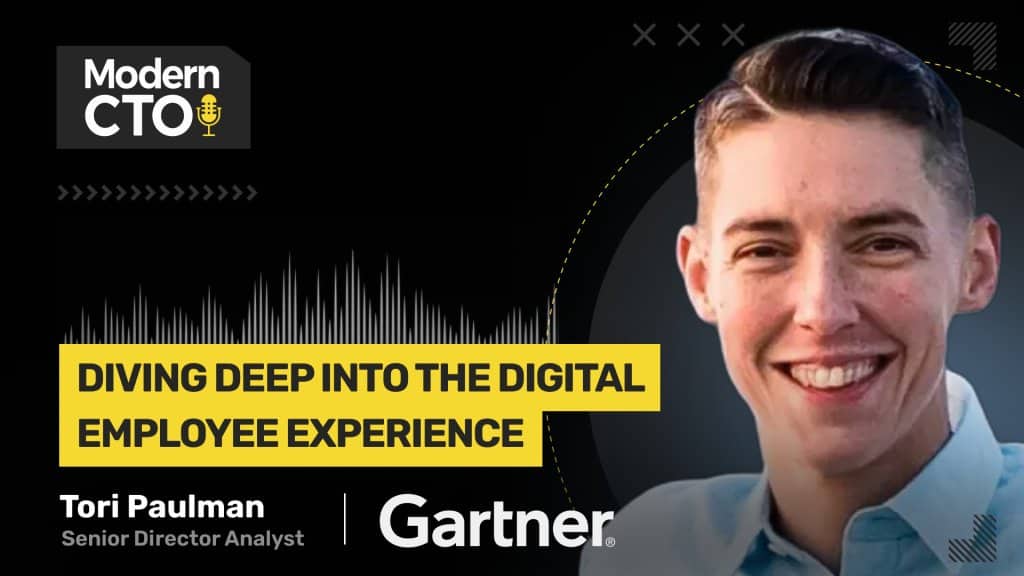
Diving Deep into the Digital Employee Experience with Tori Paulman, Senior Director Analyst at Gartner
Today we’re talking to Tori Paulman, Senior Director Analyst at Gartner. We discuss Tori’s idea of the Digital Employee Bill of Rights, the surprising survey question that 90% of respondents agreed on, and how their biggest research finding is shedding new light on traditional organizational hierarchy.
All of this right here, right now, on the Modern CTO Podcast!
For more about Gartner, check out their website here.
To learn more about & register for Gartner's Digital Workplace Summit, click here.
Have feedback about the show? Let us know here.
Produced by ProSeries Media.
For booking inquiries, email [email protected]
About Tori Paulman
My life's work is to ensure that humans have a validating, supportive, and engaging experience with technology. I do this by meeting them where they are today and seeking to understand their lived experiences, so that I can help them unlock experiences that allow them to achieve their goals.
I am a trusted advisor with extensive experience leading managers and contributors of superior client care as they support employee adoption and resilience in the ever-changing information technology environment. I have differentiated depth and breadth of knowledge in various industries including entertainment, education, non-profit, professional services consulting, financial services, and software development.
I have spent my career cultivating an empathetic IT methodology, which seeks to balance the narrative that so often focuses on the adoption of new tools by driving the conversation back to the most valuable asset of your digital workplace program, people. My work centers on the human experience, because I believe that fostering innovative performance requires that Digital Workplace programs must be focused on something deeper than user experience, they must be focused on the human experience.
I am passionate about the importance of inclusion and facilitating opportunities for people to have positive interactions with technology that makes their work, and lives, better. I have a proven history of leveraging the art of interactive storytelling to ensure that people of all backgrounds, technical aptitudes, and acumen can reap the benefits of the technological advances that have been made possible by the digital workplace.
If someone says, "That's Impossible!" You should understand it as: "According to my very limited experience and narrow understanding of reality, that's very unlikely."
About Gartner
We deliver actionable, objective insight to executives and their teams. Our expert guidance and tools enable faster, smarter decisions and stronger performance on an organization's mission-critical priorities.
Our unrivaled combination of expert-led, practitioner-sourced and data-driven research steers clients toward the right decisions on the issues that matter most. As a $5 billion company, with over 19,500 associates, and a member of the S&P 500, we are an objective partner with 15,000+ client enterprises in more than 100 countries — across all major functions, in every industry and enterprise size — and boast 40+ years of experience providing insights and expert guidance to client enterprises worldwide
Transcript
(Intro Narrator at 00:00:00) Today, we're talking to Tory Paulman, Senior Director Analyst at Gartner, about their intensive research on the modern challenges of digital employees. You're listening to Joel Beasley, Modern CTO.
(Joel Beasley at 00:00:17) I do take a public anti-cat platform, but that's strictly due to allergies.
(Tory Paulman at 00:00:23) Are you allergic to cats?
(Joel Beasley at 00:00:26) Yeah, yeah. Unfortunately, there are some cats that I'm not allergic to.
(Tory Paulman at 00:00:31) Yeah.
(Joel Beasley at 00:00:32) I don't know why. I don't care to find out. But like 80% of cats—my parents have three. They've had three over the course of their life.
(Tory Paulman at 00:00:41) Okay.
(Joel Beasley at 00:00:41) All while I was out of the house, right? And there is one that I wasn't allergic to. I think it was like calico. I think that's what it was called, but it didn't bother me.
(Tory Paulman at 00:00:51) Hairless cat, right? It wasn't like a specific hypoallergenic cat.
(Joel Beasley at 00:00:53) Oh, no, no.
(Tory Paulman at 00:00:53) I don't know. I'm making words up.
(Joel Beasley at 00:00:57) Calico sounds like a cat thing, but it was a cute cat and it was cuddly.
(Tory Paulman at 00:01:03) And you weren't allergic?
(Joel Beasley at 00:01:05) And I wasn't allergic, but the other cat that looked the same, I was. So I don't know.
(Tory Paulman at 00:01:12) That's so interesting. The problem with telling a research analyst that is that I now have to spend the rest of my afternoon understanding what makes calico cats different. I actually went down this crazy rabbit hole yesterday because apparently calico is a pattern and not a breed, right? So like there's calico orange, calico—anyway, this is the problem. This is the problem with being someone like me is that I will find one thing that I can be curious about for three days and then learn everything about it, and it's not useful.
(Joel Beasley at 00:01:43) Well, you're well-positioned to be an analyst.
(Tory Paulman at 00:01:47) That's true. That's true.
(Joel Beasley at 00:01:49) So I'm a curious person similar to you, right? I would likely be an analyst if I was not a consultant where I get to work on multiple different types of technology or an analyst where I get to research multiple types. But here's what got me interested about the email that you sent. Yeah. Digital Employee Bill of Rights. I have never heard this, and I'm like, what is that?
(Tory Paulman at 00:02:13) Yeah, yeah. Well, so I do a lot of flying because I do a lot of talking at conferences, and I was thinking about the Airline Bill of Rights. Remember when you're talking about like the right to a refund or the right to whatever, right? There was this Bill of Rights for airlines. And of course I'm sitting in a seat thinking, well, don't workers deserve a Bill of Rights? Don't workers deserve some sort of a promise, if you will? So if I unpack it a little bit, we have heard, I'm sure, of the employee value proposition. So that is typically implemented by HR, and it's all of the value and benefits and payroll and adjacent benefits that an organization offers—work-life balance, et cetera. But when I led the Digital Worker Survey this year, I found that there was a huge amount of friction, like huge numbers of workers who can't find the information to do their job, who don't know what the right application is, that admitted to us that they make mistakes, that they're constantly bogged down by distractions. And so again, sitting in an airplane seat, I was like, what if we had a Bill of Rights that the CIO was in charge of? And it was things like the right to develop digital skills, the right to have the right tool to do the job—not the enterprise tool, but the right tool to do the job—the right to be free of distraction, the right to find, to have access at your fingertips to the information, sort of thinking through like conversational user interfaces. So it's really still at this very Genesis kind of baby—it's my little baby and I'm trying to figure out if there's interest in it. But yeah, so that's the little gem of an idea right now. What do you think?
(Joel Beasley at 00:04:00) I think it's interesting. It reminds me of conversations that I've had previously about manager READMEs, I guess, was one of the things. And I know it's not exactly the same or comparatively, but the manager's basically issuing to their teams like, hey, this is how to interact with me, and this is how I operate, and this is how I think about things. And so that kind of helps with the interaction. But as far as uniqueness, that's what I'm connecting it to right now. But I get what you're saying, so give me an example so we can talk about a specific right that would be in this Bill of Rights.
(Tory Paulman at 00:04:38) Yeah, so in our survey we found that 45% of respondents—so this I should unpack. This is a survey that Gartner does every 18 months. This year we went out to 5,000 people worldwide, and we asked almost 30 questions about their digital experience. And one of them was, how frequently do these types of events occur? These types of issues occur. And one of them was, how frequently do you struggle with irrelevant notifications? 45%. Yeah, exactly. Yeah, and actually it's so funny because I've now done this presentation for five of our conferences, and when I talk about this one—I'm going to tell you what the finding was—but when I talk about this, I ask people, how many times has your phone buzzed in the first five minutes of this presentation? Right? How many notifications have you gotten? And it's mind-boggling what people say to me afterwards. But 45% of the respondents said that they often struggle with irrelevant notifications, just this humongous number, right? We also had 47% of workers who say they can't find the information to do their job and 36% saying that they're missing or failing to notice really important stuff because of the volume of information or the number of applications that they use. So not only is this an issue for, I would say, leaders, right, who have workers who are saying they can't find what they need to find, they're constantly being interrupted, and they're missing important information and important updates. So not only is it sort of a leadership issue and a business issue, it's also like a human rights issue, right? Like the ability to bring to bear your creative and innovative capabilities.
(Joel Beasley at 00:06:29) Yeah. The irrelevant notifications—you mentioned like three specific things. Irrelevant notification, finding what they're trying to find. But none of them were 100%, right? Were there any cross-sections of people that didn't have any of those issues? And were you able to study them about why they don't have any of these issues?
(Tory Paulman at 00:06:50) It's a good question. We didn't—we could. We didn't say, hey, of these 55% of people that didn't say that they have this irrelevant notification, what else is about them? We did find that—well, I don't even know if that's true. It's a great question. I don't think I dug into the negative space of it. Like if this person didn't have this issue with irrelevant notifications, did they also not have the trouble finding information? And maybe one way to spin that is to think about digital skills. So Gartner, my colleagues at Gartner—and there's sort of been a lot of, I think, research around the idea that there's a large number of what we would call business technologists in the workplace. So a business technologist is someone who works on, builds, develops, and delivers technology but doesn't sit in IT. So it could be someone in the marketing team that's doing quantitative analysis. It could be someone in investment team that's building macros, those kinds of things. And so Gartner's talked about there being 40% of the workforce being these business technologists. I don't have evidence to back that up, but I wanted evidence. I wanted some evidence that I could use that would come out of the survey that I could use and point to. And this is what I found. I asked workers, or we asked respondents, what did they feel their skill level was? Were they proficient? Were they developing their skills? Were they experts or novices, right? And then so that's where usually where the question stops, right? So Joel, if you say you're an expert at using technology, then I go check, you're an expert, right? But that's not real life, right? Your perception of your expertise doesn't necessarily result in business outcomes for me. So I wanted to go a step further. So then we looked for respondents—again, talking about your sort of cross-sections, right, or the intersections. We said, okay, well, if they're experts, then how do they answer this question? How frequently do you do things like create information containers to improve knowledge sharing? How frequently do you create data visualization to help make better decisions? How frequently do you create innovation places where people can collaborate in interesting ways? And so we tested. We said if you say you're an expert, then you probably should be doing one of these things, right? You should be engaging in these behaviors that potentially improve business outcomes. And so only then did we consider this respondent digitally dexterous. So rather than 40% of the workforce being business technologists, which again I don't have evidence to prove or disprove that that's true, I found that 12% of the workforce was able to be categorized as a digitally dexterous worker, meaning again they have expertise with the technologies for work and they're using it to combat some of these outcomes that we saw. Does that help?
(Joel Beasley at 00:09:55) Yeah, I just want—I would want like an export of like, all right, here's three big problems that 40% of people are experiencing. And then the first question would be, is there individuals in this dataset who don't have any of these problems? And then the question I would ask is, like, what is—is there a common—is there a lot of them? You know, maybe there's 40 of them, right? Maybe there's 40 of these humans. It's like, all right, well, what's different? Is there differences between those 40 people and then like compare it against the set of a grouping of 40 people that have all the problems? And I'm just—because where I think it would probably lead us to is something along the lines of workplace culture or personal choices. And so for me, like, one of the things that's interesting about me is I don't have notifications on my phone minus my wife—she can break through my Do Not Disturb and I get her text notifications. I will turn on—I've got two phones, a personal phone and a business phone. On my business phone, I do have notifications on for calendar events. So somebody's going to ask me the question, do you get relevant notifications? The answer is nope, nope. I only get them from my wife trying to break through Do Not Disturb or calendar events, which are things that I have scheduled and put on my calendar to run my organization, for my day. So I would—and then you might, if you were to research into me, you'd be like, oh, well, look, this person has notifications turned off, right, so they don't have a relevant notification process.
(Tory Paulman at 00:11:27) I will push back on that, Joel, because my guess is—I think you're talking about things that go bing, bong, blip, and buzz, right? But you—I mean, I don't know you. We've just met, right? But you probably ingest some sort of social media. You probably engage with, even if it's just LinkedIn, you probably—
(Joel Beasley at 00:11:48) Yeah.
(Tory Paulman at 00:11:49) Yeah, we're in podcasts. You probably engage with some sort of mainstream media. You probably engage with maybe Reddit. We seem like we both seem like Reddit people. And so, you know, the notifications are also coming from, I think, these other applications. Now not in our study. In our study, it was digital workplace apps. But I think that we're constantly bombarded by these attention thieves, right, that are trying to peel us off. And, you know, maybe one of the challenges that folks like you and I face, and you've got a really great boundaried way of dealing with it—you're like, no, no, none shall pass, right? And my way is like, well, I have no idea where I'm going today, right? And it's a different approach. I think we've both been probably successful, but I just wanted to push back that the irrelevant notifications is more than just the ones that are pushed to us. They're the ones that occur maybe within our world.
(Joel Beasley at 00:12:48) No, no, thanks for—yeah, yeah. I would say that there are absolutely irrelevant notifications that I get from business applications. When I go to certain softwares and things like that, I'm like, this is pointless, this is pointless, this is pointless. That happens quite a bit. I feel that if it's made such an impact on me and my—let's just call it my personal life. We'll just separate them easily. We'll just say in my personal life, if it's made such an impact on me and my business life to treat this device—now we're just talking about like the device as a whole. Like to treat this device as I own this device and I tell it when it's allowed to interrupt me, you know? And so treating it like that gives me—you know, it's allowed me to maintain more of my focus and attention when I'm trying to do things. And so, yeah, what—just curious. To bring it back to this specific thing, you guys did the research to find out irrelevant notifications were affecting 45% of people, which I think that number is pretty low. It feels low.
(Tory Paulman at 00:14:01) I would agree. I would agree.
(Joel Beasley at 00:14:02) What—was there any solutions, or was this just research to understand problem areas?
(Tory Paulman at 00:14:08) Yeah, I know. It's—so the research study itself, it's not longitudinal, right, because we don't go back to the same people, but we do go back to the same audience every 18 to two years. So the project is really to support—we have CIO research studies that go out. We have HR research studies. This one is the only one that focuses on the digital workers' experience. And I should say that this is very much, at least in years past and the one that I ran in this year, it's very much focused on what we call a location-agnostic worker or a desk worker, right? We wouldn't use the word knowledge worker, but a desk worker. So we're really not looking at frontline workers with this study. Now, we talked a lot about irrelevant notifications, but to me one of the bigger findings was all about—well, I guess there's two really big things. One, about the number of applications necessary to do your work. And you said something—I believe you said, I believe it's more than 45%. We found there's been nearly a 100% increase in the number of apps that people use just to do their job, right? And so we went from six in 2019 to 11 in 2022, 2023. And we found that 36% of workers say they use up to 25 apps just to do their job. So like that was a big finding, right? And we did then triangulate, to your point, when we double-click and we see, okay, well, if this, then that, right?
(Tori Paulman at 00:15:38) If this is true that they use more applications, well, guess what? All of those things I just said about the problems that they have go up by double digits. Right? So double digits more problems finding information, double digits more problems with irrelevant notifications. So really, when you say what is the recommendation, because that's what we try to be—insights and recommendations.
(Tori Paulman at 00:16:00) Right? The recommendation is to not only reduce your application count, but actually make the applications much more personalized to the person, right, and to the work that they're doing. So getting away from this idea that there's one tool to rule them all and really focusing on, well, what does this worker with their neurodivergence or their neuropathways and their ways of working and the teams they work with and the work they do, what's the little setup that they need to be successful? Now that can be a daunting task for CIOs because they're like, listen, I just buy the work hub.
(Tori Paulman at 00:16:41) I buy the Microsoft or the Google work hub, and I give it to everybody. And I hope that they're not, you know, putting data in unsanctioned areas. So it's a really, really big ask, but that's really the recommendation is to develop—not kind of, but to develop what we call how we work programs, right, that match the work that's being done with the set of tools that's available and the practices that we use. So a little package like that. Have you heard that before, how we work?
(Joel Beasley at 00:17:12) No. But I like it. It sounds like it's gonna end up being a new job title type thing. Like, have you seen this happening? Are there people that specifically go in and do this matching and try to make the applications more usable for the person doing their job?
(Tori Paulman at 00:17:28) I have seen an organization do this. They didn't call it a how we work program. We called it that, but they created a set, basically, a site that you could go to that would say, you know, Joel and Tori are doing a podcast. This is how we do podcasts here. Here's the tech package that you get.
(Tori Paulman at 00:17:48) Click this button to download it. And if you wanna use your own app, you can submit it here in sort of a user voice. I mean, you've seen user voices from software vendors. Right? You could submit it and people could upvote it or downvote it.
(Tori Paulman at 00:18:00) You can now offer a justification. And then the IT or security team, whoever's reviewing it, does so in a really transparent manner. So we were really inspired by this one client that we saw that did this, and I've been going around the world this last year just kind of putting that seed out there. In fact, I talked about it in one of my sessions in San Diego. And unbeknownst to me, the client that showed it to me was in the audience.
(Tori Paulman at 00:18:27) Right? And came up to me later and was like, oh my gosh. I can't believe. Right? So of course, the you know, our clients, we protect their identities, but it's been a really kind of eye-opening experience for people.
(Tori Paulman at 00:18:41) Now in this case, the leader, like, the person, the job description, it's this digital workplace leader. It's the person who, you know—and actually, often, they report up under, you know, kind of I&O and are sort of evolving their career up towards the CIO. But this is the person who's in charge of making sure that workers have the technology necessary to do their job. Often, they're in charge of the work hub package, like Google, Microsoft, or, you know, a collection of best in breed.
(Tori Paulman at 00:19:15) Now my position on it is that this skill set of a what I would call a DEX leader. Right? That the skill set of a DEX leader is far more than many IT leaders have, because it's sort of a combination of tech savvy, which I'd categorize as, you know, technical skills, like expertise with technology, but also understanding how technology solves business problems, like, you know, this idea. Right? I wanna do a podcast.
(Tori Paulman at 00:19:47) Okay. Well, here's the technology. Here's how you use it, and here's how we use it here. Here's the best practices for using it. That's above, I think, many IT leaders, you know, either their capabilities or maybe even their ambitions right now.
(Tori Paulman at 00:20:02) Actually, I'll give you a better example, or a more succinct example. I had a desktop engineer that worked for me once, and I was kind of testing out all my team. Are they DEX leaders or are they IT leaders? And that's fine. And I said, uh, what's the definition of done?
(Tori Paulman at 00:20:17) We're rolling out this new application. What's the definition of done? He said, when I get the icon on the desktop. And I said, no. That's the definition of beginning.
(Tori Paulman at 00:20:26) Right? And that, you know, analogy right there is exactly the pivot that we are going to need executive IT leaders and their teams to make in order to be successful. I made you laugh. So why did that make you laugh?
(Joel Beasley at 00:20:42) Well, because I'm a software engineer by trade, and the definition of done is, like, step one for a project, and everyone always has—you could tell someone's engineering maturity by what their answer is to done.
(Tori Paulman at 00:20:53) What would you have said? What would you have said?
(Joel Beasley at 00:20:54) Business value delivered probably would be a good starting point. Yeah. Yeah. Yeah. We could probably go from there.
(Joel Beasley at 00:21:00) What does I&O? You said something I didn't understand. You said I&O. Yeah.
(Tori Paulman at 00:21:05) Infrastructure and operations.
(Joel Beasley at 00:21:07) Oh, okay. Got it.
(Tori Paulman at 00:21:09) Yeah. Infrastructure. Yeah.
(Joel Beasley at 00:21:10) Operations. I always—that's one of the things we do on the show is anytime someone puts an acronym out there
(Tori Paulman at 00:21:17) Yeah.
(Joel Beasley at 00:21:18) I ask. And I stopped doing it for, like, a year or something, and I had a bunch of, like, hate mail. Why don't you do this anymore? You just let them slide. No.
(Joel Beasley at 00:21:27) They were just upset that I don't ask because we have all these technologists that listen, and they could either be, like, you know, working on, like, a mech leg for a robotics company, or they're working in, like, finance at Robinhood. There's such—and then all the different acronyms mean so many different things across different industries that when I don't ask, it's like, oh, okay. So I ask all the time now.
(Tori Paulman at 00:21:50) It's funny that you say that because I was just in Barcelona for our symposium and I was meeting with public sector clients there. And they wanted to know about digital workplace, and they specifically, this idea of skills. Like, how do you build digital skills? Because workers are telling leaders that they wanna build their digital skills. We see that across all of our surveys.
(Tori Paulman at 00:22:11) We also saw, by the way, that workers in our survey said that in exchange for—what their expectations were from building digital skills, more than 90% of them said, so here's your smoking gun. Right? More than 90% of them said that they believed that if they built their digital skills, they would advance their career, they would become more autonomous, and they would become more effective. So Joel, when was the last time 90% of people agreed literally on anything? Right?
(Tori Paulman at 00:22:42) It's almost unheard of to have this idea of people believing. We also just recently had a survey. So not my survey, but another Gartner survey that asked workers, if you had a job available to you that was nearly identical to your job, what would be appealing to you? And it was upskilling. Right?
(Tori Paulman at 00:23:04) Upskilling in the next role or career path, you know, as the second highest. By the way, four-day work week was the highest. Right? So again, and I don't know if that would be, like, nearly identical, but so we're out this—at symposium and out to dinner with these public sector clients, and they wanted to know all about digital workplace and digital skills. And so I said, okay.
(Tori Paulman at 00:23:26) Well, you know, what kind of things do your workers do? And I was completely shocked because they said, well, some of them are woodworkers, and some of them are textile engineers, and we have fashion designers, and we have, you know, steel manufacturers, and all, like, in the same organization. And I sat there, like, really, to be honest, completely at a loss for how to support an organization like that in an industry like that or various industries like that with digital skills. But I took it away as, like, this has to be research that we do. Right?
(Tori Paulman at 00:24:03) Like, the idea that only desk workers or only, you know, folks who are doing data and analytics wanna build their digital skills is clearly, you know, it's a bad idea. Right? We have to be focused on all workers. Does that surprise you at all?
(Joel Beasley at 00:24:20) That all types of people want to increase their digital skills? Uh, no. It doesn't because to live your everyday life as a general citizen, you're having to do that already. I mean, everything is moving towards that, whether it's your bill pay or interacting with your local government to get a permit or a license or something like that. And so I—and typically, people—I don't know.
(Joel Beasley at 00:24:46) Most people that I'm around wanna become better at the things that they need to live their life. I've surrounded myself pretty successfully with those types of people. So yeah. I mean, I just look at the classes that Apple holds. Right?
(Joel Beasley at 00:25:01) There's a lot of—like, if you walk into the Apple Store, there's, like, grandparents and all sorts
(Tori Paulman at 00:25:07) I saw that the other day.
(Joel Beasley at 00:25:09) Yeah. Yeah. All sorts of spectrum ages and everything. And it's because they wanna learn, and they wanna learn because using these tools has value to them. And when something has value to you, you wanna figure out how it works. Right?
(Tori Paulman at 00:25:21) Yeah. Well, actually, if you think about that, right, the values—career development was the lowest. It was actually 89% of workers say that they believe their career will, you know, advance if they build their digital skills. But 91% said they'd be more autonomous and 95% they'd be more effective. Right?
(Tori Paulman at 00:25:40) So again, it could—it tips to what you were just saying, which is that people wanna feel autonomy. They wanna feel mastery. They want to feel like they're able to handle their own business, if you will. We did create a prediction. We predicted that by 2027, so that's all the way through 2026, if organizations promote digital dexterity, they'll have stronger revenue.
(Tori Paulman at 00:26:07) Now when we make a prediction, we track it. So, you'll have to come back to me at the end of 2026 and ask me if we were right. But I think we will be. Right? That if, again, thinking about this public sector customer saying, I want—I wanna focus on how I can support the digital skills of every single one of my employees.
(Tori Paulman at 00:26:29) I think that, you know, the results will show that this kind of organization that's investing in employees will find themselves having better outcomes, whether that's revenue or, you know, protecting citizens or whatever it is that they do. But, yeah, I think that will prove itself to be true. I'm curious what your thoughts are on it.
(Joel Beasley at 00:26:49) Yeah. You'd be a fool to take a bet against that. It's like we're living in a digital world, and to say that you're—the people who are most flexible, things are changing. The curve of things changing is increasing. Like, it's not like things are just changing. They're, like, changing faster.
(Joel Beasley at 00:27:02) And I had a conversation this morning with an ex, like, Facebook or Redditor large language model guy. And, uh—I knew you were
(Tori Paulman at 00:27:14) a Redditor, by the way. Uh,
(Joel Beasley at 00:27:18) I'm not—no. No. No. No. But so this is, like, your former Reddit Facebook engineer who works on large language models.
(Joel Beasley at 00:27:25) And I was talking with him, and he's like, man, we were working on this idea. And he said the rate at which things are changing in the large language model with the vectors and the searching and the compressions and, like, all this nerdy stuff that I only understood 1% of. Right? All of this stuff, he said, it's changing on, like, six-week increments. He goes, things that are possible today—specifically, what we were talking about is running large language models offline on local devices and whether or not that's possible.
(Joel Beasley at 00:27:55) He's like, eight months ago, no. Today, yes. And I was like, okay. So things are changing really fast. He says—he says, yeah.
(Joel Beasley at 00:28:01) He goes, I have to keep up with things on a weekly basis. There's noticeable improvements and changes to ways people are doing things on, like, six-week increments. And I was like, wow. This is moving really fast. Because, you know, when I started—when or not when I started, but when I got into the business side of things in the web application space, like jQuery coming out was, like, one thing that happened in six months or a year that was, like, the biggest thing.
(Joel Beasley at 00:28:26) And now big, huge things are coming out, like, on a regular basis. So your ability to adapt and be, you know, to—I don't know. Is decks desk dexterous, like, be able to move, or is it digital employee experience, or is it kinda both?
(Tori Paulman at 00:28:42) Yeah. It is—it's digital employee experience. So that's what—that's how we define DEX. And we have two ways of talking about DEX. We have DEX tools, which are applications and technology that provide telemetry about applications, devices, endpoints, networks, those kinds of things.
(Tori Paulman at 00:28:59) Also provide employee sentiment through, you know, nudges and push notifications and micro surveys and stuff like that. So there's DEX tools, and then there's DEX, which is a business practice. Now what we've been talking about today is DEX as a strategy. But I just wanna—I wanna mirror what you just said. So, in 1981, my mom was a COBOL programmer at Aetna.
(Tori Paulman at 00:29:23) And, you know, she was able to write mainframe language to go into systems and pull out data insights, but by the time I was in my career in the nineties, you know, we were using graphical user interface. Right? Like, GUI to go in and kinda go into the ribbon. I was in my IT career when the ribbon got rolled out. I had to teach everybody how to use the ribbon, and then it continued to change.
(Tori Paulman at 00:29:46) But still, like, you needed to be able to know how to use functions and data sources. Again, still digital skills, a generation of people building ribbon and function skills. And now, you know, we're seeing with generative AI and what we refer to as a CUI or a conversational user interface, we're seeing people be able to make natural language queries. Like, hey. Go get the answers.
(Tori Paulman at 00:30:13) Ask in my car. Hey. Take me home. Right? So natural language inquiries.
(Tori Paulman at 00:30:19) But the skill set is not just, you know, how do you use it? Because that's a human skill set. I could say, hey, Joel. How do I get to my kid's school? Right?
(Tori Paulman at 00:30:29) And you could go on Google and give me the answer. Really, what we need is to develop a workforce, I guess, across all the generations that's able to be more descriptive about the ask, but also be able to say, tell me what's important. Hey, car. Tell me the best way to get there. Or, you know, hey, system.
(Tori Paulman at 00:30:54) Tell me what the most important insight out of this dataset from my survey is.
(Joel Beasley at 00:30:58) That one.
(Intro Narrator at 00:30:59) That one.
(Tori Paulman at 00:30:59) Do you know what I mean? Like, but that's
(Joel Beasley at 00:31:00) That's the one. That's the one I think is gonna be huge.
(Tori Paulman at 00:31:03) It's super important, and it's a totally different generation. Or it's—sorry. It's not a different generation. It's a totally different skill set to be able to say, write me—so I was writing something today, and Gartner has our own internal generative AI conversational user interface. And so I was saying, hey.
(Tori Paulman at 00:31:22) Take this thing that I wrote, which is the summary for our keynote for 2024, and make it more entertaining. Right? And so, you know, it spits it out. And it was ridiculous, but it was enough to be like, I could say it this way.
(Tori Paulman at 00:31:36) Or, hey, you know, system, make it sound like a hero's journey. Right? So kind of having the ability to have more of a mature conversation with the machine, that's the new skill.
(Tori Paulman at 00:31:51) It's not necessarily—but the other part of that around digital skills and maybe even just skills, analytical skills, is knowing when it's wrong. And that's a big risk. You know, you can't trust the system entirely.
(Joel Beasley at 00:32:04) Well, yes, 100%. And so that's one of the things that when I find people who are dismissive of the technology, they'll be dismissive from the perspective of, oh, I just want to be able to enter one line and have it write me the best book on this thing. And it's like, well, that's—I know that's the, I guess, mental image of perfection is to be able to read your mind and come up with the exact thing that you want. But today, it's massively powerful because I don't know if you're a superhuman, but I am not.
(Joel Beasley at 00:32:33) And so I have a limit to how much creativity I have per day. And so when I'm trying to do creative things and I'm burnt that day, before I would just stop. Now I can be like, alright, I can query the interface in a way that can give me a list of things, and I can sit back and pick out—or I can try different things. And I could say, hey, here's the situation. What's three interesting ways that this could be resolved? And then I'll be like, I want 30 now. And then I can take the top 10 and say, okay, I really enjoyed these, but make them sound a little funny or make them sound a little bit more like this. And to your point exactly, I think you said make it sound like a hero's journey.
(Joel Beasley at 00:33:12) Are you telling me a story? Yeah. Put it in story format. So it's really understanding, and I think that is where the creative people are going to excel with the tools. Right.
(Joel Beasley at 00:33:24) And where people who aren't creative but have that self-sufficiency drive and desire are going to excel even farther. Because I know brilliant people who admittedly are not creative, but now you put these tools in their hands and now they can harness creativity, and that's fantastic. Just like how we've been harnessing logicalness. Logicalness is the new word. Logicalness with calculators.
(Tori Paulman at 00:33:46) Please define logicalness for your studio audience.
(Joel Beasley at 00:33:49) Yeah, I'd like to hear that. It's ability to use calculators. There we go.
(Tori Paulman at 00:33:54) I think that's so interesting. Okay, so what we went back to here is that my mom needed—we need a flashy word for it. So she was querying large mainframes, and she was essentially kind of like knitting almost. Right? She was sewing the data together because it had no relation to each other. Right? So she's bringing it all together. She'd be totally thrilled by that analogy too because she was super into quilting. So she's sewing this data together.
(Tori Paulman at 00:34:25) And then our generation, or my generation, you know, is all about logicalness. Right? And calculating and taking the numbers and just being like, well, that's the number. And this next generation is having a conversation with the data. Right?
(Tori Paulman at 00:34:40) Having a conversation. So that's exactly what I did. I had written the summary for our keynote, and I just pumped it in. And I was like, make it sound funny. Make it sound heroic. You know, match it to the hero's journey model. Make it sound entertaining. Make it sound scary. Right?
(Tori Paulman at 00:34:56) I just wanted—I needed to have a relationship. I needed to have an ideation session with someone, and I didn't want to have it with a human. You know, and the outcome was really good. So I did want to share one other thing with you about, you know, one of the findings that we found because I think it hits into this idea of this worker that exists today who deserves to be able to do what I did or what you just described. So we asked people, you know, how satisfied they were with applications.
(Tori Paulman at 00:35:25) And we found that 88% of our respondents said, yeah, yeah, we're happy. We're satisfied with the applications. Now there's one little caveat, which is that satisfaction's gone down 4% since the last time we did the survey in 2020, but 4% isn't 20%, so I wasn't hugely concerned.
(Tori Paulman at 00:35:42) But then as I started going through the data, I also found that almost half of workers say that they're using personal applications, either to collaborate or to analyze data. And then as I continued to go down the rabbit hole, I found that more than half of workers are building their own personal tools either to collaborate or analyze data. So we've got these folks out there who are saying, yeah, yeah, yeah, the thing you gave me for spreadsheets, that's fine. But my thing that I'm using to actually do my job in a way that sets me apart, don't you dare take that away from me. Right?
(Tori Paulman at 00:36:07) The last piece of that is we asked folks if their IT department took the tool away, what would be the outcome? And nearly 30% or more said that they would have severe impact across all the things that they do—analyze data, collaborating with each other, collaborating with customers.
(Tori Paulman at 00:36:38) So there's this sort of brewing risk out there. And I know in IT, we call that shadow IT. Right? Mhmm. But we've got to bring it out of the shadows because—it's not empirical evidence that this is what's driving, you know, successful, digitally skilled employees.
(Tori Paulman at 00:36:56) But I think you could argue that those folks who are using these kinds of applications, perhaps they're using unsanctioned generative AI applications to do exactly what you and I just talked about. If those are in the shadows, first of all, it's a risk to you. And second of all, you know, people will run the risk of having these things taken away, and then you'll run the risk of not getting the outcomes that you were wanting to get. Do you hear that from other folks around this idea of shifting the conversation from shadow IT to—
(Joel Beasley at 00:37:28) I am the type of person that just—I just focus on the outcome and achieve it at all costs. And that's why I own my own business, and that's why—sure. So I'm probably not a good employee. And I mean, I'm definitely not a good—You
(Tori Paulman at 00:37:40) have that founder archetype. Yeah. Yep. Not a good employee.
(Joel Beasley at 00:37:44) That's true. I've never been. I've actually always had to make my own job because, inevitably, I'll walk into a situation like this makes no sense. And then there's all these guardrails for whoever's reason and people you have to work around people and legacy. It's just, ugh.
(Joel Beasley at 00:37:58) I'm like, oh, I just want to achieve things. I'm
(Tori Paulman at 00:38:00) just going to
(Joel Beasley at 00:38:00) go achieve things and I figured that out. So I—and our company is small. We're under 20 people. So we're at the point in a maturity curve where that's still the spirit amongst all employees. It's like, this is a requirement. You have to just be able to bust through things and figure things out.
(Joel Beasley at 00:38:12) Obviously, that goes away as you scale up more. But when you say—but I do get to have the conversation of shadow IT constantly. And what I—and I do go around, and I've gotten to speak to audiences and answered questions about shadow IT and things like that. It's a direct connection to the culture of the company.
(Joel Beasley at 00:38:35) Some companies handle it much, much better than others. Some are like, hey, when you have personal tools that are making you more effective, brilliant. Congratulations. Thank you.
(Joel Beasley at 00:38:44) Come talk with us so we can secure correct licensing or we can secure enterprise, whatever—sure—or so that we can do an evaluation on it. And I've even gone as far as—and to keep—I'll keep the names private. If they'll see it happening and there's something—they'll figure out a way to let it happen in a sandbox somewhere else that's going to protect the company data, but it's also not sanctioned, but it's also just kind of like it needs to happen in that area. Yeah.
(Joel Beasley at 00:39:08) So it really is the companies. I'd say the worst possible thing you could do is just be super rigid and shut the door on the entire thing. Now granted, I'm not in charge of running a 100,000 person IT department.
(Tori Paulman at 00:39:20) Sure. Sure.
(Joel Beasley at 00:39:21) I don't know what type of issues come up with that. But I do know—Yeah. Humans, and I know people with mindset. And I know people that have the mindset of we're all trying to get to this outcome together. Let's figure it out.
(Joel Beasley at 00:39:34) Right. Tend to be more successful long term in my personal, unresearched opinion.
(Tori Paulman at 00:39:40) I love how you said that though because there's obviously a spectrum of trust between workers and leaders. Right? Workers and organization leaders. You know, and at the lowest levels of trust, we see things like we want to know who's working and who's not. Right?
(Tori Paulman at 00:39:53) Productivity monitoring, badge reporting. We want to know who's coming in and who's not, or we've got to mandate people to come in because we've got to see them working or we don't think they're working. And then in sort of the middle range, which I would say, I would hope—I think in my experience, most folks are in this middle, sweet spot, where they're looking at, like, well, we want to know if the tools we give you and the place we give you is making you feel productive and satisfied and happy, and we have really no way to measure that, but that's what we want. Right?
(Tori Paulman at 00:40:23) Most of the people I talk to are in that sort of—it's almost like purgatory because there's not really a great way to measure it. It's just kind of like, do we kind of think that you're happy? Okay. And then at the highest level of trust, you know, we have organizations that want to establish and measure outcomes. And you can scientifically measure an outcome, but you've got to be able to define an outcome first. Right? And that's a big barrier for folks to understand the difference between output and outcome. So an example for maybe your listeners. Right? If you were migrating from, you know, from on-prem storage to SharePoint this year, an output would be the number of terabytes you migrated or the number of documents you migrated or the number of documents that are left. Right?
(Tori Paulman at 00:41:07) But an out—so that would be an output, but an outcome would be improved customer claims processing, first call resolution, you know, better RFP performance or wins. Right? Better wins with RFPs. So that sort of outcome, it requires an understanding of business processes.
(Tori Paulman at 00:41:29) And I think that's maybe where we—we double-click on who this DEX leader is. So if we're going to have a digital employee value proposition or a digital bill of rights as I'm sort of dreaming up, we've got to have—we've got to have established DEX leadership qualities either as a DEX leader. So you talked about who's this person that's doing the how-we-work program. Right? So it could be a person or it could be established leadership qualities that we start putting into every leader performance evaluation.
(Tori Paulman at 00:42:03) Right? So we talked about tech savvy, but the other things that are important are connections. Right? Broad connections in the business and also within an IT realm. So not just staying in your little siloed sandbox.
(Tori Paulman at 00:42:17) The ability to lead people who don't report to you. So matrix leadership or braided leadership, that's going to be really important to DEX leadership. Understanding. Right? Understanding business processes.
(Tori Paulman at 00:42:30) And what are we even trying to do? Are we trying to win more accounts? Okay. Well, let's think about what technologies go into that. Being able to tell a story, like getting up on stage or even, you know, in—some of the more successful clients I talk to say they have they have their own little TED Talks where people come and hear about technology and hear about, you know, their own teams.
(Tori Paulman at 00:42:53) And then finally, you've got to have the empathy. And I think I wonder what you think. I'm not sure that empathy is one of the things that IT folks have established over the years. Right? Where IT has been, like, let's really empathize with the business users, and let's really understand what makes them tick.
(Joel Beasley at 00:43:16) The smart ones do. The smart ones do.
(Tori Paulman at 00:43:18) Yeah. The smart ones do. Because they're probably DEX leaders. Right? They have these sort of qualities, but it's not been something I've found a ton of in my, you know, in my IT career prior to that.
(Joel Beasley at 00:43:29) On the maturity curve, it's just earlier on the curve. Because what happens is the people that get farther, they understand, like, I have to go understand what is—what is going on at the top of the company. I have to understand what's happening in sales. If let's say I'm a product—narrow the conversation to a product company. Alright? So just—Yeah. Okay. If we build a specific product, we build Slack or something, I need to under—I need to go sit with a salesperson, you know, every once in a while.
(Joel Beasley at 00:43:54) I need to jump in on a customer call. I need to listen—I need to talk to the support team and see what the largest support tickets are. And they might say, well, that's outside of your purview or you don't work on that part of the application. It's like, yeah, but if I'm going to be working here, I need to understand what's going on within the organization as a whole.
(Joel Beasley at 00:44:09) And I need to understand what did the CEO and the CXOs, what did they say is the most important thing? Because, yeah, there's fires burning. One of the most frustrating things to me is when someone comes in and everything's messy and they think, oh, I'm not going to do the job I was hired to do. I'm just going to start cleaning everything up. It's like, no.
(Intro Narrator at 00:44:25) No. No. No. No. No.
(Joel Beasley at 00:44:26) Focus on the outcome that you were hired to achieve.
(Tori Paulman at 00:44:29) Yeah.
(Joel Beasley at 00:44:29) So, yeah, I see the more successful people. They understand that they need to understand what's going on at the business. Yeah.
(Tori Paulman at 00:44:37) And—Yeah.
(Joel Beasley at 00:44:38) What the goals are and what the direction is, and then figure out a way—I call it business hops. How far away is the work that you're doing to value that the business is trying to achieve?
(Tori Paulman at 00:44:47) That's cool.
(Joel Beasley at 00:44:48) Yeah. Because if you're really hopped far away, like—because you could take a backup system. Let's say you're building a more efficient backup system. Well, that could sound like just a good thing to do because you're making it 238% more efficient.
(Tori Paulman at 00:45:00) Mhmm.
(Joel Beasley at 00:45:00) And it could sound like a completely useless thing to do. But if you know that—and you've communicated and you talk—but if you know that your top 10% of clients are having trouble with backup speeds and they're considering other vendors, all of a sudden now it has this context to it where it's really important work what you're doing.
(Tori Paulman at 00:45:17) I love what you're saying. So one of the—you're describing CX. Right? You're describing customer experience. And customer experience is a well-understood, well-worn path, and Gartner has a ton of really excellent research on it.
(Tori Paulman at 00:45:33) But EX is so—the EX part of DEX, right, is I would say about three to five years behind. Right? So we're publishing things about journey maps and publishing things about personas and publishing things about diagnostics. How do you do work-forward method in diagnostics? And clients, when they look at it, they're like, yeah.
(Tori Paulman at 00:45:52) I want to do that. But they've never connected that the same exact practices that they could use for their customers or even citizens—it doesn't have to be necessarily a product—it's exactly the same. You know, we could literally, when we first started writing this research, we would open a customer experience doc and find and replace the word customer with employee, and they go, what else do we have to change here? Right?
(Tori Paulman at 00:46:19) It was really, really, really easy to see how easily you could take that mindset that you're describing and apply it. Now I want to share one little anecdote that I think you might find interesting. I met the CIO of an airline company many years ago before I joined Gartner, and he was telling me all about joining the airline. And literally two weeks after he joined as a CIO, they went bankrupt. And he was like, what has happened?
(Tori Paulman at 00:46:47) So talk about joining a company and seeing a bunch of million, you know, little fires and saying, what am I going to do? I've got to fight all of these fires all at once. But he didn't. He went to the CEO and he said, what is the one thing that will get us out of bankruptcy? And the CEO says, well, our all of our data says that if we just improve on-time performance, we'll get out of bankruptcy in no time flat. Right?
(Tori Paulman at 00:47:12) And so that CIO went back to the department and said, every single project we do, you need to prove to me that—I mean, anything I spend money on, anything I choose not to spend money on—you need to show me how it relates to on-time performance. And it did. Right? So this particular airline made all kinds of investments in technologies, including employee assistive technologies, customer technologies, all to improve on-time departure.
(Tori Paulman at 00:47:41) And they are now the leader of on-time departure. Right? So this was many, many years ago, but it's easy to see that if you were to just have that conversation with whoever is one level above you, what's the one thing? If you could just do one thing this year, what would that be? And then you start taking apart, well, what are the applications we need? What are the things we've got to get rid of? What are the practices and leadership qualities we need? What are the skills that our workers need to have? You know, where are the barriers?
(Tori Paulman at 00:48:09) Like, are 80 percent of people unable to find the document that tells them how to do something? Like, those kinds of things. I think it's easier if you're willing to be brave enough to ask a question. I think it would have been very easy for that CIO to go, I can't see any way in which my work lends itself to on-time departure. But he didn't.
(Tori Paulman at 00:48:29) And it was a really big turning point for me when he told me that story many, many years ago.
(Joel Beasley at 00:48:34) Oh, 100 percent. Or he could have looked at one of the larger fires that, oh, that's database related and I know database efficiency, so I'm going to dump everything I have into that fire to put that out to get a win.
(Tori Paulman at 00:48:43) Because then I'll look good. Yeah.
(Intro Narrator at 00:48:45) Yeah.
(Joel Beasley at 00:48:45) Yeah. Yeah.
(Tori Paulman at 00:48:45) Yeah. Absolutely.
(Joel Beasley at 00:48:47) No, you're brilliant. Tori, I want to be respectful of your time because I did have in the notes that you have a hard stop.
(Tori Paulman at 00:48:53) Yeah. I have another meeting right now, but if there's one more question or, you know, if there's—I don't know if you got what you needed.
(Joel Beasley at 00:49:00) I did. Yeah. Yeah.
(Tori Paulman at 00:49:01) Cool. Well, one thing I'm going to do for you is I'm going to go into the data. I do have a BI dashboard that I can go in. So I'm going to go into the data and find, you know, maybe one or two things about these people who have no problems, and I'll come back to you on that.
(Tori Paulman at 00:49:15) What is that? Maybe I'll have it back to you in time for your episode. But it's a great prompt, you know, and I hadn't thought about the negative space. I think that's really interesting. It's so hard because when I was doing the analysis, there were 300 findings.
(Tori Paulman at 00:49:30) And I actually didn't share maybe the most important finding. It was our keystone finding. I got distracted by all the other things. We asked workers which top three company executives had the most positive influence on their overall employee experience, so their entire employee experience. And we definitely—our hypothesis was that the CHRO would be in the top three.
(Tori Paulman at 00:49:55) And we were completely shocked to find that the CIO was number three and the CHRO was number five. So here we are finding that the CEO, the COO, the CIO, CHRO, and number five. So that's been the biggest finding for me, and it's the reason why I feel like coming on podcasts like this and going into symposium and standing up in front of CIOs and saying, workers believe that you have more positive influence on their overall employee experience than the CHRO, but they're waiting for you to believe it too. Right? Like, CIOs, CTOs, executive IT leaders, I don't think they know how much impact they have on the whole experience of workers today.
(Tori Paulman at 00:50:45) And if they did know, I think they would be making more investments in their own persona on it even. Right? They have a huge opportunity to be the next employee experience leader. So that was the number one finding, and I wanted to make sure that you got that in front of you as well.
(Joel Beasley at 00:51:07) Awesome. Thank you so much for doing this. Very valuable.
(Tori Paulman at 00:51:11) I—oh, I'm supposed to say something about our conferences. So maybe I could say that in the end if you—when's your conferences?
(Joel Beasley at 00:51:18) When's your conferences?
(Tori Paulman at 00:51:19) So some of the stuff that we talked about today is really the foundation of the Digital Workplace Summit for 2024, which we're having in Texas in March, I think, and in London in June. But we're also bringing this content around DEX tools. So we talked about DEX tools. We're bringing that to IOCS in London next week, which is why my shirts are wrinkled, and in Las Vegas in December. So we've got a lot of really exciting content coming out that has to do with the survey and has to do with how CTOs, CIOs, and executive IT leaders can be leaning in to this employee experience remit that they have.
(Joel Beasley at 00:51:59) Well, I'm sure we can get Josh to put some links to the upcoming conferences in the show notes. That way people can go search for those and get their tickets to the Gartner event.
(Tori Paulman at 00:52:02) I'll send it to you.
(Joel Beasley at 00:52:03) And the show notes. That way people can go search for those and get their tickets to the Gartner event.
(Tori Paulman at 00:52:08) Cool. Thanks, guys.
(Joel Beasley at 00:52:10) Thank you so much for listening. And if you found this episode useful, please share it with a friend or colleague who you think would get value from it. And if you have topics that you'd like to hear discussed on the podcast, either add me on LinkedIn or send me an email, [email protected]. Every time I get an email or LinkedIn message, it absolutely makes my day and inspires me to keep going.