
Episode 530 ·
Life In Space with Tom Marshburn, Astronaut at NASA
Today we’re talking to Tom Marshburn, an astronaut for NASA; and we discuss leadership lessons learned in space; Tom’s toughest moments aboard the International Space Station; and the technology that will one day get humanity to Mars.
All of this right here, right now, on the Modern CTO Podcast!
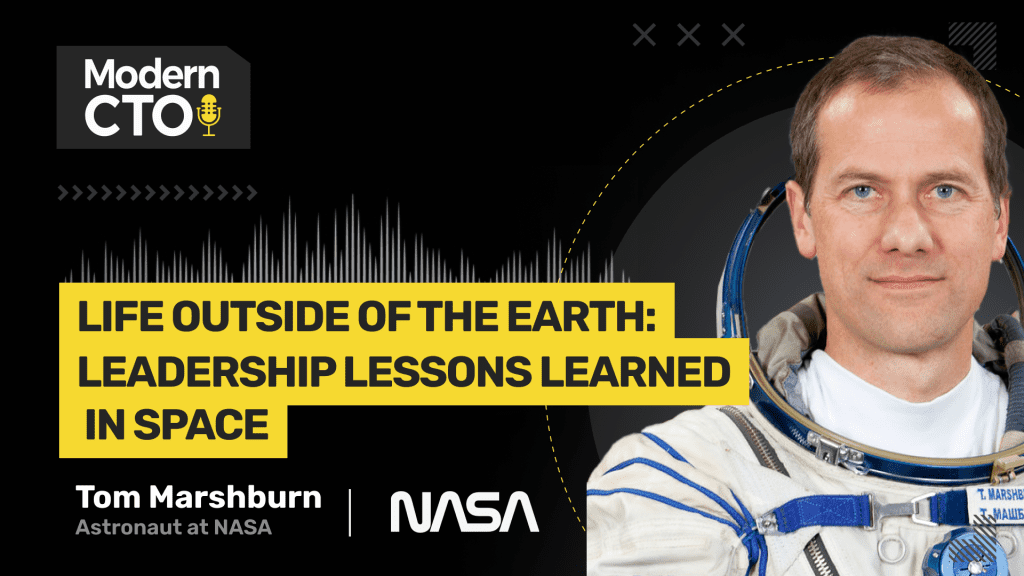
About Tom Marshburn:
Dr. Thomas H. Marshburn was selected by NASA in 2004. He holds a Bachelor of Science in Physics from Davidson College, North Carolina; a Masters in Engineering Physics from the University of Virginia; a Doctorate of Medicine from Wake Forest University; and a Masters in Medical Science from the University of Texas Medical Branch. The North Carolina native is a veteran of three spaceflights, STS-127, Expedition 34/35, and Expedition 66/67 as part of Crew-3. Prior to becoming an astronaut, Dr. Marshburn served as a Flight Surgeon, assigned to Space Shuttle Medical Operations and to the joint U.S./Russian Space Program and eventually became the Medical Operations Lead for the International Space Station. He served as pilot of the NASA SpaceX Crew-3 mission to the International Space Station, which launched on November 10, 2021. Marshburn served as a flight engineer on Expedition 66 and commander of Expedition 67 during that mission. NASA’s SpaceX Crew-3 astronauts safely splashed down Friday, May 6, 2022, aboard the Dragon Endurance spacecraft completing the agency’s third long-duration commercial crew mission to the International Space Station. The international crew of four spent 177 days in orbit.
About NASA:
For more than 60 years, NASA has been breaking barriers to achieve the seemingly impossible—from walking on the Moon to pushing the boundaries of human spaceflight farther than ever before. We work in space and around the world in laboratories and wind tunnels, on airfields and in control rooms to explore some of life’s fundamental mysteries: What’s out there in space? How do we get there? And what can we learn that will make life better here on Earth?
We are passionate professionals united by a common purpose: to pioneer the future in space exploration, scientific discovery and aeronautics research. Today, we continue NASA’s legacy of excellence and innovation through an unprecedented array of missions. We are developing the most advanced rockets and spacecraft ever designed, studying the Earth for answers to critical challenges facing our planet, improving the air transportation experience, and so much more.
Transcript
(Intro Narrator at 00:00:03) Hello, my friends. Today, we're talking to Tom Marshburn, an astronaut for NASA, and we discuss leadership lessons learned in space, Tom's toughest moments aboard the International Space Station, and the technology that will one day get humanity to Mars. All of this right here, right now, on the Modern CTO podcast.
(Joel Beasley at 00:00:31) This is the Modern CTO podcast. So I was just curious, how did you develop this sort of discipline and this ability to deal with difficult situations?
(Tom Marshburn at 00:00:50) So the role of the astronaut starts when you're selected, and they try to select people who have been through this before. So if I'm back even before I became an astronaut, I would say it really started, I wouldn't say it started in medical school, but that's very unique stresses. You know, they start you off getting you around a dead body in an anatomy lab. That for some people can be really stressful, but the real stress hits when you start taking care of patients. But even before then, there's an academic stress, you know, getting ready with exams, that sort of thing, pretty high-pressure stuff. So I think it's exposure, kind of inviting it, inviting the stressful situation, which you don't have a choice. If you want to go to med school, you're going to take those courses, and in med school, you're going to be under the gun. For me personally, when I came to a situation where I had to make decisions based on limited information that really had affected outcomes in people's lives, et cetera, again, you do the best. You prepare as best you can, but you just have to expose yourself to it. I don't think there's any way to prep for it other than academically. Certainly prep yourself for it, and then rely on that and do the best you can. It was interesting as an emergency resident, I trained in Ohio, and we had a Life Flight program. So we were one year out of med school. We just finished our internship, and we would be on call to fly in a helicopter. And we could land right in the middle of a car wreck scene where they couldn't extricate people out of the car, so we'd go by helicopter. So just this, you know, really kind of disaster, war zone kind of thing you just suddenly descend into. That was probably the hardest time, I think, for myself and my colleagues to kind of get over. And of course, you come in with a lot of hubris, and the next day, it's like, "Yeah, this happened. No big deal." But you lose a lot of sleep. Extremely challenging time to get through. Then being kind to yourself, knowing you did the best that you can, having people support you that are around you, your colleagues, your attendings. They all know what it's like to start out. There's all the protections they can possibly provide for the patient themselves, but still there's going to be some bad outcomes. It's inevitable. And so making sure your social structure around you can help protect you when the inevitable bad outcome happens. As you've heard it said that the pathway to success is paved with failures, and accepting that, you fail as fast as you can because it's going to happen and then learn from it. So the psychological protection around you when that happens, I think, is extremely important. And being good to yourself to take some time off as needed. Give yourself a break in between times. Still, enough pressure on yourself to really learn from the situation as you get ready for the next one. But it's tough. Yeah.
(Joel Beasley at 00:03:37) Now I got a lot of my discipline, like in hindsight, I look at it from a couple major events. So the first one was my dad was in the Air Force, so he raised us like that. So I got a little bit there. I got hit by a car. I had to learn how to walk again when I was like 12.
(Tom Marshburn at 00:03:52) Wow.
(Joel Beasley at 00:03:52) And so that was like a really difficult moment.
(Tom Marshburn at 00:03:54) Sure.
(Joel Beasley at 00:03:55) And then, you know, I got to hold my mom's hand as she passed away, and that was a difficult moment too. So whenever I look at like business things, I'm like, are you kidding me? Somebody not doing a deal or something not going right in the business world. That's nothing compared to this other stuff. Did you have any sort of big moments, or were your parents very disciplined people? Anything in your childhood?
(Tom Marshburn at 00:04:14) I had a gilded childhood, not from a money standpoint, but a very loving, close family. I'm the last of seven. Loving parents, wonderful memories, challenging growing up with six siblings, but I learned tons from them. And I am who I am today because of them, I would say, maybe even more than my parents. So I guess day by day living with them is what prepared me for life. Academics were a priority. They didn't put pressure on us, but the expectation is that you would work at your best. And that was the most important thing that you could do in your childhood. But just a wonderful time. But no, you know, I didn't have friends or family pass away. Now, when I was, just as a sideline, when I was in space in 2013, my mom died. That was quite challenging. My education in medicine and the knowledge that she had been ill ahead of time really helped with that a lot. But again, you know, my family kind of coming around and helping with that. But no, it was, I think for me, it was really kind of pressure on myself to achieve. That was the pressure that kind of formed me. And that can be both bad and good. That can go awry if you, like I said, if you don't stop and take care of yourself a little bit. Try to be well-rounded, especially. I was always involved in some kind of a sport, some kind of athletics, just something to blow off steam. I think it's extremely important to do that. I don't think I'm answering your question, but—
(Joel Beasley at 00:05:32) Oh, yes, you are. Yeah. I like people. You know? Yeah. I like different types of people and to figure out, like I will say it, I'm sure you're humble, but you're a great person. I mean, it's insane some of the things that you've done. You become a doctor, then you become an astronaut. And one of the things I do want to know that you sort of brought up a minute ago or a couple times is taking a break. How do you take a break when you're in space?
(Tom Marshburn at 00:05:53) Oh, when you're in space? Not as easy as on the ground. The advantage you have in space is that everyone is there for accomplishing the mission. You have a lot of people supporting you in space. You have Mission Control, hundreds of people on the ground monitoring everything you do. So that helps. But by the same token, at no moment are you really off. I found it kind of hard. I love to read a book. It's hard to read a book because, you know, you're in space. Maybe I shouldn't be reading a book. Maybe I should be cleaning something. And there's, you know, we have multiple caution warning messages. Emergencies or warnings come up. And so that can happen any moment, so you have to be ready to just jump. Even when you're asleep, you have to be ready to throw something on and get out right away to start taking care of something. So the real way I find to relax in space, there are some quiet moments. Yes, you can read a book, but it's to talk to my crewmates. This last mission was wonderful. I had the best crew I've ever flown with. All of them were people that were great to just bounce things off of and to kind of open up and say, "Hey, I don't think this went very well," or "I did great with this." And then they either come back and help you get through the tough time or, you know, double the joy if things have gone well. And it was just a wonderful, wonderful crew to work with, and it's the people. And really the thing you remember the most from a spaceflight is the people. I tried during a flight, it certainly is wonderful to look out a window. We don't have extended periods of time where we can do that, but you capture every moment you can. And I made it a point to look out the window with one of my crewmates for as long as we could, 30 minutes, 40 minutes, at least once during the mission with each crewmate. And that's what you remember because they're going, "Oh, wow. Look at that. Oh, I know about this. Really? What's going on over here on this part of the world? Why does it look like that?" But mostly just reflecting back on each other, what you're seeing, because it's just so remarkable. And that really doubles your joy, and that was a great way to spend time as well.
(Joel Beasley at 00:07:48) And you've been up a couple times, right?
(Tom Marshburn at 00:07:50) Yeah. I just finished my third flight. Yeah, two long duration, and my first flight was six months. And my first flight was 16 days on the shuttle.
(Joel Beasley at 00:07:57) And that was all to the International Space Station?
(Tom Marshburn at 00:08:00) Right, right. We were supplying the shuttle on that shuttle flight, did three spacewalks to kind of help build it, build it out. We were one of the last to add something to the space station. And then the other two flew, or flew on a Soyuz up there to conduct the experiments, live and work, and actually utilize the space station. And then my last flight was up on the SpaceX Dragon to do the same.
(Joel Beasley at 00:08:20) Were you comfortable with the SpaceX Dragon, it being like a newer rocket?
(Tom Marshburn at 00:08:24) Absolutely. Yep. Yep. I mean, there's nothing really ultimately or inherently safe than sticking yourself on top of an ICBM or the equivalent of one. But they've launched so many satellites into space. They haven't been around for a long time, but they've done so much of that, and it has such a good success rate. We have full confidence in that vehicle to get us up there and in our capsule to keep us alive. And we knew the engineers and their dedication to doing the right thing, having a successful mission, pulling it off, but still doing it as safely as possible, something inherently dangerous as safely as possible. The Soyuz has the best safety record because they've just been doing it since the '70s and early '80s. But yeah, felt the same with SpaceX as it did with Soyuz for sure in terms of safety. Yeah.
(Joel Beasley at 00:09:13) Yeah. We were talking about that over here, and I was like, well, I guess the more serious question would be, is there specific data or you have a team? But you kind of answered it. There's obviously teams at NASA. You're getting to meet these people. When you get to meet somebody in person and spend some time with them, you really get to understand who they are, and that can provide you a whole lot of safety. Yeah.
(Tom Marshburn at 00:09:33) And you know, the trainers are just a blessing. They share your enthusiasm for spaceflight. They don't all want to go into space, but they share the enthusiasm. And it just bleeds into their work. They're just totally dedicated, committed. They got PhD level, if not actual PhDs, but PhD level information, knowledge about the system that they train you on. And Russians as well are absolutely dedicated to making sure you're successful. That's a really wonderful experience.
(Joel Beasley at 00:10:02) And then of all the three missions that you've been on, what was the most difficult situation that you faced?
(Tom Marshburn at 00:10:09) The most difficult situation that I've faced, I think it's probably preparing for a spacewalk. And the reason why I say that is that's the biggest unknown. It's a question of whether the hardware is going to cooperate with what you want to do. It's one of the more dangerous things that we do. It's also an opportunity to mess up in a spectacular fashion in front of everyone. It's critical for continuing your career. You want it to be good. So that's leading up to that, and that's just kind of the expected mindset going into it. There have been some days when things don't go right, and maybe I made a mistake or hardware failed on me. And that's when you gather your crewmates around, and you just kind of recover and move on. So space is really complicated, so things are going to go wrong. As a veteran now space flyer, one of the most important lessons I had to learn was, fine, it happened. You learn from it. You got half a second to get back in the saddle and keep going because you have to keep going. And learning how to do that is quite a challenge, but absolutely necessary.
(Joel Beasley at 00:11:17) That has been one of the more interesting parts. I'm 34. I've got a wife. I've got a four-year-old, a three-year-old, and then one that'll be here like this week. And—
(Tom Marshburn at 00:11:26) Wow. So you know the ultimate stress. And the stress that comes with, I tell you, it's a real thing, you know, when, especially when the first one comes along, how are we going to do this? And you don't know, but you do. You do it.
(Joel Beasley at 00:11:39) Oh, yeah. How many do you have?
(Tom Marshburn at 00:11:41) Just one. Just the one.
(Joel Beasley at 00:11:43) Just one? Yeah. Yeah. It really is the ultimate life moment, right? You think you've been through it all and then you get married, and then you think you've been through it all, and then you have a child, and then you go, okay, no. Life, you know, adulthood starts now.
(Joel Beasley at 00:11:53) Yeah. You slowly start to look around and realize there's like no one to help. Like you've got to do it.
(Tom Marshburn at 00:11:58) Yep.
(Joel Beasley at 00:11:59) So the ISS, it's going to be retired in like 10 years. And what's going to replace it?
(Tom Marshburn at 00:12:06) Well, the goal is NASA's goal is to hand it over to commercial entities. That's been the goal for a while, to make use of low Earth orbit in a commercial sense so NASA can move into more of the exploration, Moon and Mars part of spaceflight. So that would be the goal, and we're taking steps in that direction. We had the first private astronaut mission come up on our, and they were up for about, I think 16 days it was, while we were on orbit. It was really fascinating having four more astronauts on board with us. We had a good time together, worked really hard, learned a lot. But now there's an explosion of other companies. Some will utilize the space station. Some will probably choose not to. They're going to build their own space station. I think that is the ultimate goal. It would be hard to deorbit that thing, but the infrastructure is still strong. There are some things that have to be upgraded like the solar panels and, you know, semiconductors on those will wear out over time. They get micro meteoroid hits on the solar array. So that's being upgraded. But overall, when I'm living up there, it's a beautiful space station. It's incredible capability for science and Earth observations, astronomy. So I really hope that it's successful and it doesn't go away even in 2030, which is what NASA's plan is for continuing to work and be involved with it.
(Joel Beasley at 00:13:25) And then many countries contributed to that, right?
(Tom Marshburn at 00:13:28) Oh, yeah. Yeah. Lots of international partners. The continual presence in space of humans from U.S. and Russia has been since the year 2000. We've had Canadian and Japanese, and then we're talking about our European partners, which is, you know, multiple European nations. I was up there with a German astronaut. A French one had just come home just prior to my roommate, Matthias Maurer, arriving from Germany. So we get all kinds of, yeah, all countries up there.
(Joel Beasley at 00:13:57) And who's deciding these experiments that you run? I looked at your list on the press release site of all the different things you were doing. They varied greatly. There wasn't a common theme, at least that I could pick up. Like, who decides what you do up there?
(Tom Marshburn at 00:14:10) Well, NASA and the partner agencies look at all commerce. There's a filter there. First of all, there's obviously, might be obvious that there's limitations in power. You can't draw too much power than the station can provide. There's weight, volume considerations. There's safety considerations. Don't want a lot of broken glass floating around, that sort of thing.
(Tom Marshburn at 00:14:31) And for astronauts or people from the ground to be able to run it. So all of that's looked at by boards that evaluate the experiments that are coming in. After that happens, I think the bandwidth is the capability or the bottleneck of getting that experiment up into space is the launch capability and the astronaut time to perform it. So I'm not aware of any other hierarchy that's used in order to get things done. There might be some really special interest things like the twin study.
(Tom Marshburn at 00:14:58) You know, Scott and Mark Kelly, a few other things. There are certainly the Alpha Magnetic Spectrometer, which is out there. That was a dedicated shuttle flight to bring that up and attach it to the outside of the space station. So there's a lot of big science things going on up there. But, boy, that's a lot of fun to be surrounded by all of that all the time.
(Joel Beasley at 00:15:19) How do you get selected for that?
(Tom Marshburn at 00:15:21) To do the science or to be an astronaut?
(Joel Beasley at 00:15:23) Both, I guess. Mostly the astronaut.
(Tom Marshburn at 00:15:26) Okay. To be an astronaut, I'm not quite sure because I've never been on a selection board. From what I can tell, they need somebody with a technical degree. An advanced technical degree helps, but they like people with a broad experience. They like people who are extremely curious, who have put themselves in risky situations with a calculated risk, not like, you know, drive dangerously or bungee jump, but to actually some of that requires some effort and real calculated risk.
(Tom Marshburn at 00:15:56) Flying is typical of a hobby or profession for astronauts, but not by any means is that exclusively for pilots.
(Joel Beasley at 00:16:04) There are a
(Tom Marshburn at 00:16:04) lot of non-pilots that become astronauts. And so when you first apply, you fill out a form. If you were going to work for the post office or the astronaut office, it's the same form. Now for the astronaut office, they had a quick health form. Did you have any major diseases?
(Tom Marshburn at 00:16:18) Is your eyesight going to pass the limits that they've got? That kind of thing. And then you send in references, and then they look at your references. So you've put in your application, and about a month or two later, you might hear from a college professor who says, "Hey, they just sent me this." I'm going to go, "That's great. That means I've gotten this far." And then you might get a call months after that that says, "We want to give you an interview." And so you come in. I think it's about a 45-minute interview.
(Tom Marshburn at 00:16:44) That's it. It's just one astronaut candidate that's interviewing with about 10 people. And they're usually constructed into a T—two tables into a T, and you're in the armpit of the T. So you're surrounded 270 degrees by people evaluating you. It's deliberate to do that just to see how do you handle yourself in public.
(Tom Marshburn at 00:17:02) So that's a big determinant. Are you somebody that's easy to talk to? And typically, the interview will start with, "So starting with high school, tell us about yourself." And it's completely open-ended. And you just start talking, and then it'll start picking off things.
(Tom Marshburn at 00:17:14) "Oh, you did what? You worked in Yosemite, you know, bagging grizzly bears
(Joel Beasley at 00:17:20) for a while there?"
(Tom Marshburn at 00:17:20) You know, there's kind of these interesting things to the sideline. They don't necessarily want to know about what your PhD was about, but they want to know about all the other stuff you've done because they can probably figure out what you did for your PhD. They could read your articles, for instance. And then if you've done well in that, past that, then you're called back again for about a week of medical tests. And that's when they poke and probe and look at every orifice and really put you through the ringer to see if you're medically qualified.
(Tom Marshburn at 00:17:46) And if you pass that, then they do a Defense Department background check. Sometimes you don't know they're doing it, but sometimes I got a call from a neighbor and then a childhood friend of mine said, "Somebody from the government was asking about you." And then that's really exciting because then you know you've gotten that far. And then finally, if you pass that, then you get the phone call that invites you to join the corps.
(Joel Beasley at 00:18:08) That is amazing. Did you have to relocate, move somewhere different?
(Tom Marshburn at 00:18:11) No. I started off as a NASA flight surgeon. I was an ER doc and then moved to Houston. I was a member of a new program where they're training outside doctors to become NASA flight surgeons to take care of astronauts and pilots. So I came here and had been here. I got to know a lot of astronauts through that. And I'd been a flight surgeon for 10 years before I finally—and four applications—before I got into the astronaut corps.
(Joel Beasley at 00:18:36) And when you say flight surgeon, is that like we call it in Florida, I think Bay Flight. Is that where you're doing surgery on the helicopter when you come down into the crash scene? Is that what that is?
(Tom Marshburn at 00:18:45) No. No. That's a different thing. Flight surgeon is more of a military term. Started in World War I when they realized they're losing more pilots due to illness than they were to actually aircraft getting shot down.
(Tom Marshburn at 00:18:55) So they had a specialty or physician that actually draws from sort of a family practice or emergency medicine background. Whatever's going on with the pilot, you help them fix it. And they're pretty or extremely healthy people anyway. But, you know, a stuffed-up nose could bring somebody down, so you have to know what the implications are for any illness. Part of the training is to fly with the pilots, and so flight surgeons typically have flight experience or they get experience in the cockpit in all kinds of airframes.
(Tom Marshburn at 00:19:25) So that's what a flight surgeon does. But, no, they do not typically do surgery in flight. But I did a little bit of that, more like anesthesia in flight. I did some surgery too in Life Flight, but that was part of being an ER doc.
(Joel Beasley at 00:19:39) Very cool. Very cool. As you're talking about this, it's bringing up memories. Like, on Friday nights, my stepmom would—she'd be on radio for the local ambulances and stuff and the stuff I would hear, and then she would spit it back. It just gave me a ton of respect for her because I was like, "Man, this person knows so much and is doing all these calculations."
(Joel Beasley at 00:19:57) And I thought it was such a cool experience. But those trauma situations, they're very specific things. I don't meet people too often because I'm not in the field that get to experience it just because I'm adjacent, you know, because of my brother and stepmom. So when I do get to meet people like that, I'm like, "Ah, I know how cool you are under pressure."
(Tom Marshburn at 00:20:15) Totally. Well, it's something in it because it's so emotionally—can be emotionally traumatic and chaotic with everything going on, not to mention what you're seeing. You know, blood and guts and that kind of thing. So they work really hard to provide a lot of structure. This is what you do in every trauma case no matter what.
(Tom Marshburn at 00:20:33) And since I've been in training and what they do today, they even have a little podium. Somebody behind the podium is probably not a physician. It's probably a nurse that's typically done this a lot. Who is the quarterback? Just calling, "You're doing that, you're doing that, don't forget that," and watching to make sure everything gets done.
(Tom Marshburn at 00:20:50) And that's really the way to run a trauma.
(Intro Narrator at 00:20:52) Oh, yeah.
(Tom Marshburn at 00:20:53) A trauma code, especially. Yeah. Yeah. It's tough.
(Joel Beasley at 00:20:56) It's definitely interesting. It's, uh, tells you a lot about yourself too. Like, if you're the one that when the chaos emerges, if your instinct is to be calm, I don't think you really train for that. I think some people just have that. I don't know.
(Joel Beasley at 00:21:07) You might be able to. But
(Tom Marshburn at 00:21:09) Yeah. There's some training of—a colleague of mine, Anne McClain. She said something I think is a wonderful little mantra to go by. And what I'm referring to is when you do a spacewalk. So kind of the same thing as visually chaotic in the sense that you come out the hatch and then suddenly you're in open space and you're 250 miles above the Earth and you've never experienced that.
(Tom Marshburn at 00:21:27) We can't train that at all. You can train a lot of the other aspects of spacewalks, but not that. And but I think it's true for your first trauma code or anything that is stressful to say keep your world small. Do the best you can to block out everything else. What is the one thing I've got to do right now?
(Tom Marshburn at 00:21:45) And on a spacewalk, what you've got to do is just all you've got to do is hold on. Make sure you've got your tether there so you're not going to go float off and just hold on. That's your job number one. Job number two is maybe start moving around a little bit, and that could take a couple minutes. And then, you know, you just slowly increase and before you know it, in a few minutes, you're going, "Okay.
(Tom Marshburn at 00:22:02) Now I'm doing the full suite of things I was trained to do out here." It's daunting, so keep your world small starting out.
(Joel Beasley at 00:22:09) Does it take you several months to get your muscle back after you get back to Earth?
(Tom Marshburn at 00:22:15) We actually—our muscle tone is pretty good when we get back because we train so hard in flight. Your listeners probably know that we would be like jellyfish if we did not do all of the resistive exercise up there and the cardiovascular exercise that we do. So we spend about two and a half hours every single day up there exercising in order to make sure that doesn't happen. Being in zero-G causes a lot of atrophy. It's even less exercise than, say, lying in bed in an ICU because there's no stress on your body at all.
(Tom Marshburn at 00:22:46) There's no gravity pulling on it. So we work out pretty hard. And so when we get back, I've both flights came back with more lean mass than I had when I left. Some people lose a little lean, but we've been able to keep it up. And that's important because our bones stay pretty strong.
(Tom Marshburn at 00:23:01) We might lose a little bone. If we didn't work out, we'd lose a lot of bone. Horrible osteoporosis if you did not do that exercise. But some muscles like neck muscles, small muscles, muscles in the lower back can get kind of weak. So we've got some specialists on the ground, and I've just come out of a six-week program of especially stretching and mobility and activation to get kind of everything balanced again.
(Tom Marshburn at 00:23:22) So we can get back to the exercise regimen that we were doing preflight. And I would say from a cardiovascular standpoint, it could take three months to get back to that point, maybe two months. From a strength standpoint, for me, mostly because of stretching and making sure I was limber, that took about six to eight weeks to get back to that.
(Joel Beasley at 00:23:40) So how do you think about going to Mars? Right? Like, as people, what type of considerations do we have for our physical bodies to make it on a trip to Mars?
(Tom Marshburn at 00:23:50) Well, one of the wonders of what we've done so far in space flight, especially on space station, is find out we can do that. We need to provide the exercise capability. That's absolutely paramount. And so the biggest challenge is going to be—some would say radiation is going to be a big problem. I got the equivalent of about three chest X-rays per day following up there.
(Tom Marshburn at 00:24:11) So we're constantly monitoring. We have a radiation badge. We have radiation workers. We get more in emission than terrestrial—no nuclear reactor workers get in an entire career. So they're watching us very closely to see what happens with that to our bodies.
(Tom Marshburn at 00:24:25) And so far, nothing's really stuck out as being a problem for us. I get people are thinking about cancer and that sort of thing. And as far as we know, that hasn't happened. But once you get out of the Earth's geomagnetosphere, you're going to be getting a lot more radiation. How much still to be determined?
(Tom Marshburn at 00:24:41) What effect on the body is still to be determined, but that's something to be thinking about. For me, I think the—I would suggest that the psychological aspects of being with three, I don't know, three, six, maybe 10 people going to Mars, being cut off from the rest of the Earth absolutely because you can't even talk to them real time. The light signal traveling back and forth is going to take too long for us to have a conversation, for anybody like we are right now to have a conversation. So it's really ultimate isolation. And once you get far enough from the Earth, it's a blue dot.
(Tom Marshburn at 00:25:11) You don't have the joy of looking at your home planet anymore. And for a long time, for months, you would just have a blue dot and a red dot, and you're traveling in between them. So all of those psychological benefits, uh, being in low Earth orbit, we're not going to have. So I think that could end up being the biggest challenge. But as far as bone and muscle goes and as far as we can tell for other medical problems, we've solved a lot of those or at least have a solution if we haven't solved them.
(Joel Beasley at 00:25:35) So the technology for blocking radiation while in low Earth orbit—they have some. It's medium good. It's obviously not perfect because you're getting tons of radiation. But, like, if we were to talk about no technology, like, just 100% exposure to radiation that's there. So I guess, like, full exposure and no exposure was the spectrum.
(Joel Beasley at 00:25:55) Right? Where are we currently at? Like, what type of technology is there helping us?
(Tom Marshburn at 00:25:59) The technology is such that you've got to have something kind of massive in the way. And probably the lightest of those massive things is water or polypropylene. I think it's polypropylene, but we do have these bricks that we've lined some of our sleep quarters with. The aluminum shielding goes away to doing that, but some of your heavier ions come in, will scatter and give you neutrons and secondary particles to then hit your body. We are constantly—we've got multiple sensors around the space station, sensors on our body.
(Tom Marshburn at 00:26:29) We're evaluated. The outside environment's being evaluated just to fully understand what the space radiation environment is like. So that's where we are right now. I think what will be interesting, I think the technology and the answer will be getting to Mars, if that's what we're talking about, as fast as possible to reduce the exposure. Having a part of the spacecraft have a lot of water or a slush, if you have a nuclear reactor, maybe you have a slush, so that we can live and work in space in this big cabin, but then if there's a solar flare that's directed right at us, that could maybe kill us right away.
(Tom Marshburn at 00:27:04) We could get inside that safe haven. We may have to spend a week or two in there until it passes. But that's kind of where we're headed with that. I don't know of any other—and that's been the technology for a while. I don't know if we've had any other great advancements from that.
(Joel Beasley at 00:27:20) Do we currently have any nuclear reactors operating in space?
(Tom Marshburn at 00:27:26) No. Okay. Well, we have the small pellets that are continued to make their Martian rovers go and some of our deep space probes. So, yes, those are pellets that are continuing to keep them warm, keep them operating, but not in any of the spacecraft that we are flying human beings in.
(Joel Beasley at 00:27:45) Are we using it for thrust at all or just that warmth?
(Tom Marshburn at 00:27:49) Well, it's just in those probes and no. That's not being used for thrust. The innovations in thrust, you know, typically, we've been using chemical propulsion, but the ion engines have been new. And those are relatively new, I mean, the last 20 years. They provide a low thrust over a long period of time and keep things going.
(Tom Marshburn at 00:28:09) So that's been innovative and really wonderful for making sure we can have smaller engines and still go far distances and maintain a probe for a long period of time. But for human beings, it remains chemical propulsion in across all the vehicles.
(Joel Beasley at 00:28:24) Of all the movies that you've seen that are related to space, which one do you think is the most accurate?
(Tom Marshburn at 00:28:30) I would, if I could, mix two of them—well, three maybe. Apollo 13, I think, is the most accurate in terms of the way NASA operates and the way astronauts operate. Even having said that, I suspect there's a little bit of Hollywood in terms of the interactions of the astronauts. You've got to have the big dramatic moment. I don't know that that ever happened.
(Tom Marshburn at 00:28:49) I suspect it did not, but who knows? As an indication of how much engineers at NASA, how much they respected the movie Apollo 13, they actually made a list of all the mistakes they made. They actually had a list, and it was not infinite. And there were little things in there. So that was kind of fascinating.
(Tom Marshburn at 00:29:04) But I love that movie. From an emotional standpoint, I would say Gravity is—from a physics standpoint, Gravity is kind of ridiculous. But from an emotional standpoint, I love the emotional arc that the main character goes through. And while I don't think astronauts act or react in that way at all, still the emotional arc is fairly true. And for me, in terms of the wonder of spaceflight, now this is through the eyes of an eight-year-old child, but the movie Kubrick's 2001, the wonder of it, and what I felt when I saw that movie, which kind of got me onto the whole idea of, "Wow, space is really amazing."
(Tom Marshburn at 00:29:41) I'm scared to death of it, but, boy, it's cool. And reading more about it, learning more about it, that movie got me started.
(Joel Beasley at 00:29:47) And then what's some of the coolest pieces of technology or the coolest piece of technology that you've got to encounter in your time as an astronaut?
(Tom Marshburn at 00:29:55) Oh, probably, I'd have to say the Dragon spacecraft is the coolest piece of technology. Right next to that is the Soyuz. They're both accomplishing amazing things in slightly different ways. And maybe because the Dragon was newer, I tend to gravitate towards that. Now the spacesuit itself is remarkable.
(Tom Marshburn at 00:30:17) It's old. We probably need to develop a new suite or fleet of spacesuits, but that entire life support system that's packed in the back of a backpack, that is a wonder of engineering. If the shuttle were still around, I think it'd be pretty clear as the space shuttle. That's still a remarkable engineering achievement with the payload capacity. How much it could lift has never been surpassed with those liquid oxygen and hydrogen engines.
(Tom Marshburn at 00:30:47) But the SpaceX Dragon was great. In particular, through the flight phases, just how smooth and exact each of the staging areas were. You know, it's only eight and a half minutes to get to station or to get to orbit from when you launch, but, boy, those were beautiful eight and a half minutes. And then on the way home from the time they burned to bring you home, that was the most exciting part of any dynamic phase of spaceflight, you know, launch or reentry, for any of the vehicles that I've had because it was an enormous amount of fun. It was violent exactly where it's supposed to be when the chutes open.
(Tom Marshburn at 00:31:18) You could hear yourself coming through the atmosphere. You'd not only see the plasma coming through these big windows. In fact, they could have pretty big windows, so you could see what's going on. It's remarkable. This pink glow as you're coming back through the atmosphere, but then the rush of the atmosphere, and you could hear it.
(Tom Marshburn at 00:31:32) You could just hear the screaming sound as you're coming back in like you're inside of a 747 engine or being encircled by one, as you're still coming down at high Mach speed through the atmosphere before your drogue chute's open. So the combination of what the Dragon allowed you to experience, but at the same time, the better technology on the inside of the cabin was really, really fantastic.
(Joel Beasley at 00:31:59) Did Elon come and shake your hand and talk to you guys before you went up?
(Tom Marshburn at 00:32:03) Nope. Nope. Nope. Did not. I met him before.
(Tom Marshburn at 00:32:06) He came and talked to the astronaut office. I think he did meet the first crew, maybe another crew, the first crew to fly in the Dragon. But busy guy.
(Joel Beasley at 00:32:15) Oh, yeah. Yeah. I like his design stuff. I think across all his brands, one of the things I'm the biggest fan of is design. Things usually look pretty cool coming out of there.
(Joel Beasley at 00:32:23) So I saw some mock-ups for a future space suit or something of that nature, and I was like, that looks cool.
(Tom Marshburn at 00:32:30) Yeah. Their space suits were cool.
(Joel Beasley at 00:32:32) As far as small portable electronics that you're using, what I'm getting at is I got to have on Douglas Terrier a few years ago, who was at the time the chief technical officer of NASA. And he shared with me that several of our inventions have come from trying to achieve greater competency in space. Right? Like power tools and some other things. And so since then, I haven't talked to anyone else from NASA.
(Joel Beasley at 00:32:58) I was just curious, like, any interesting tools that you're using that are small electronics inside of the space station?
(Tom Marshburn at 00:33:05) NASA has gone back to—I think you're right. It gave to the industry the acceleration and leap into the future really when it came to miniaturization. And so NASA uses some of those products back up on the space station again. So nothing specifically derived by NASA for that. You know, I can't help but just mention some of the other things that have come out of the space program since you mentioned it anyway. CT scans.
(Tom Marshburn at 00:33:28) That mathematics behind that came from the lunar mapping, radar mapping from the lunar module. AEDs, by the way, rechargeable batteries that started with NASA. NASA needed those. But up on the space station, we've been doing some virtual reality work up there, some holographic. And we're trying to expand our ability to not have to rely on mission control for AI to actually teach us while we're looking through a lens and or maybe even a screen while something is projected on the screen or on our retinas to help us do a lot of procedures.
(Tom Marshburn at 00:34:02) It's fairly complex. You have smart, curious people, but you don't have nearly enough time to train them to do everything they've got to do. So you've got to provide the right kind of procedure at the right time and in the right way to make them effective and pulling off some pretty aggressive and audacious experiments. So that kind of technology, I find very fascinating and an enormous amount of fun to work with. Still in its nascent stages, but still exciting.
(Tom Marshburn at 00:34:26) We had a couple of free-floating AIs with us, one from the European Space Agency, one from MIT. And so these free-floating modules that are just kind of, you know, using fans or little CO2 cartridges to move around and ultimately to be able to just float behind you and shine a light or a camera on your work, answer questions, go find something for you, provide a tool or something like that. That again is in its beginning stages, but that's a lot of fun to work with those as well.
(Joel Beasley at 00:34:53) Oh, man. I can imagine what that's going to be like in a few years when it gets really smooth.
(Tom Marshburn at 00:34:58) Yeah. Very. Yeah. It's funny because you go, well, this is not a humanoid. It's not like I've got a person with me.
(Tom Marshburn at 00:35:02) But inevitably, we start talking to them. And it's as a joke, but still, it's fun to actually talk to them.
(Joel Beasley at 00:35:09) As we wrap up, what would you say to kids or the next generation of people that are interested in becoming an astronaut?
(Tom Marshburn at 00:35:18) Oh, if you want to become an astronaut, start being one today. I don't care how old you are. You know, when I was in elementary school or high school, I was just like you. I wasn't quite sure what I wanted to do, but I love this idea of being an astronaut. And so I read the bios, the biographies of astronauts, and I tried to copy them.
(Tom Marshburn at 00:35:37) And you can start doing that right now because the training really does start wherever you are right now. Do the best you can in school. If you have problems with it, no problem. Just keep on learning from that and get better and better. NASA cares that you have learned how to learn.
(Tom Marshburn at 00:35:51) And so keep on working on it. Take care of your body because you've got to be healthy to fly in space, at least as a NASA astronaut. And stay curious. Put yourself in situations where your decisions matter. As we were talking about before, you've got to kind of stress yourself a little bit and kind of get out of your comfort zone a little bit every now and then to get better.
(Tom Marshburn at 00:36:15) And so if you can do all those things, you can start doing all those things, you know, start in elementary and high school. Even then, you are training to be an astronaut. You're doing exactly what you need to be. So, and be persistent. Nobody got to this job by taking the easy road or by saying, "I think I'll be an astronaut. I'll put in an application." Suddenly, they become one. Everybody's very persistent and works hard to get here. But it's an enormous amount of fun. It's worth it.
(Tom Marshburn at 00:36:40) Just the road to get here is worth it. It's not just about getting to fly in space. It's getting to work with people and the whole path to get here was wonderful. So highly recommend it.
(Joel Beasley at 00:36:51) Excellent. Man, that's all I've got for you, man. We made a podcast. How do you feel?
(Tom Marshburn at 00:36:56) Oh, I feel great. I'm glad.
(Joel Beasley at 00:36:58) Thank you so much for listening. And if you found this episode useful, please share it with a friend or colleague who you think would get value from it. And if you have topics that you'd like to hear discussed on the podcast, either add me on LinkedIn or send me an email [email protected]. Every time I get an email or LinkedIn message, it absolutely makes my day and inspires me to keep going.