
Episode 478 ·
The State of Nuclear Energy with Todd Allen, Professor of Nuclear Engineering at University of Michigan
Today we’re talking to Todd Allen, Professor of Nuclear Engineering at University of Michigan; and we discuss the state of nuclear energy in the world today, barriers to investing more in nuclear energy, and what it would take to have a personal nuclear reactor in your home.
All of this right here, right now, on the ModernCTO Podcast!
Check out UMich's Fastest Path to Zero Initiative, where Todd and other super bright people are working hard to get the world to net zero carbon emissions.
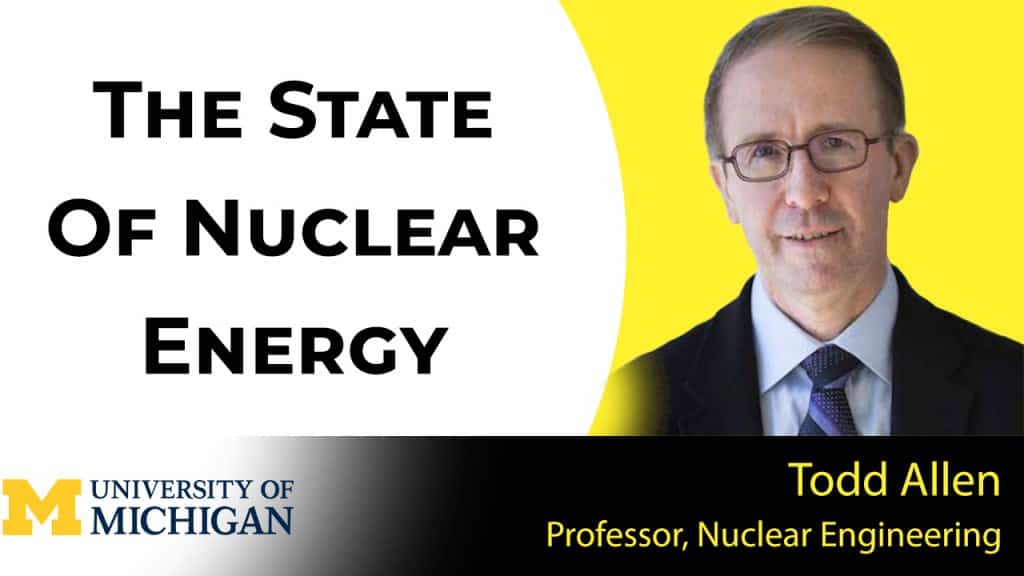
About Todd Allen:
An offer to skip history class in high school to listen to a Navy ROTC recruiter sent Todd Allen on a serendipitous journey that led to him becoming one of the top U.S. experts in nuclear energy, with focus on the material science of nuclear systems.
Todd began his professional career as a submarine officer in the U.S. Navy where he learned the practical applications of operating a nuclear power plant as well as how to take a submarine to periscope depth. Following active duty, he built on that practical Navy experience by earning a Ph.D. in nuclear engineering with specific focus on how radiation changes the physical properties of metals.
His first post-Ph.D. position was as a staff scientist at Argonne National Laboratory. While at Argonne, he joined the leadership team tasked with developing the Generation IV Roadmap, the document that framed the resurgence of the nuclear research programs early in the 21st Century.
Following Argonne, he joined the faculty at the University of Wisconsin. While there, he split his time between establishing a premier material science program at the university and supporting the Idaho National Laboratory. At INL, he led the transition of the Advanced Test Reactor into a national user facility, creating a unique distributed network of national research facilities working together to support novel research ideas brought by universities and private industry. He also ran a six-institution Energy Frontier Research Center focused on answering fundamental questions about heat transfer in nuclear fuel.
From 2013-2016, he helped lead the Idaho National Laboratory as the Deputy Laboratory Director for Science & Technology, including being an important contributor to the development of the Gateway for Accelerated Innovation in Nuclear (GAIN) initiative announced at the White House in November 2015.
He is the author of over 200 technical publications, many of which are readable.
Todd has degrees in nuclear engineering and management information systems. He is a native of Michigan and tries very hard to find ways to watch baseball. His best summer ever (2016) was 64 different stadiums across the U.S.
About the Fastest Path to Zero:
We are an interdisciplinary team of experts, including University of Michigan faculty, staff, and students, working to support communities as they plan and pursue ambitious climate goals. We offer a variety of assessment, siting, and reporting tools to help communities transform their energy systems while adapting to a changing climate. We use big data analytics combined with a passion for human-centered design and engagement.
There isn’t a one-size fits all solution for climate change. The fastest path to zero emissions will be unique for every community. That’s why we are creating technology-neutral tools to aid community-centered decision making. To get to zero, different places will adopt different energy and technology mixes based on their specific social, political, and economic needs. We want to make that process easier and more transparent so that more communities can successfully reach their climate goals as quickly as possible.
If it can help get us to zero, it’s on the table.
Transcript
(Intro Narrator at 00:00:03) Hello, my friends. Today, Joel is talking to Todd, professor of nuclear engineering at the University of Michigan, and they discuss the state of nuclear energy in the world today, barriers to investing more in nuclear energy, and what it would take to have a personal nuclear reactor in your home. All of this right here, right now, on the Modern CTO podcast.
(Todd (Professor of Nuclear Engineering at the University of Michigan) at 00:00:31) Here we go.
(Joel Beasley at 00:00:32) This is the Modern CTO podcast. What was happening is a few years ago, I interviewed someone who had previously been on a nuclear submarine in their service time here in the United States. And I was surprised to find out that these nuclear-powered subs could run for so long without having to refuel, right? And then a couple months later, I started researching different types of energy because I was buying this farm and looking at ethanol fuel and different—just getting a little nerdy with it, you know, in my spare time. And I was thinking to myself, okay, well, with the little I know about nuclear energy density, it seems like we should be using that. It seems like a really smart thing. And then I was curious. I was like, why aren't we using it? I did some research.
(Joel Beasley at 00:01:29) The best that I could come up with was that there were some issues with some nuclear power plants early on, and that sort of scared the public, and maybe that's why the technology didn't progress as far or as fast as it could have. So those are my very limited understanding and views. And so I want you to sort of tell me, is that a correct assumption? Am I wrong? And sort of help me understand this concept a little bit better.
(Todd (Professor of Nuclear Engineering at the University of Michigan) at 00:01:53) Yeah, sure. I think what you've learned is correct, but maybe part of the story, right? So the way I like to think about it is if you look at any product, right, somebody introduces a product. Usually if people like it, it starts to take off, right? But it usually plateaus at some level, right? And where it plateaus is usually a combination of what it does, right? Like, how many people need this thing? What's its cost? What is the social acceptance? Are there reasons that are non-economic that people may or may not want it? And then what's the policy environment around that? Because we can influence decisions through policy, right? Tax breaks or other things that may not strictly make sense from a pure economic or social acceptance status, right? So we've introduced one generation of commercial nuclear power, right? So think of it as like the Model T of these energy systems.
(Todd (Professor of Nuclear Engineering at the University of Michigan) at 00:02:52) And when we started introducing them back in the 1960s, '70s, '80s, the U.S. regulatory system—it was all regulated utilities, right? So you told the utility, build this thing and we'll give you a fixed rate of return, right? So you knew you were going to make money. You weren't going to get super rich off of it, but it was fixed. And under those conditions, the designers kept building bigger, bigger plants. You got incentivized to build very large plants. So right now, about 20% of the U.S. electricity—one out of every five electrons—comes from nuclear in the U.S., but that is from only slightly less than 100 plants, right? And part of it is nuclear has a huge energy density, meaning I get about a million times as much power out of a nuclear reaction as a single coal reaction. That, combined with the fact that we tried to build these very large plants, meant we've got roughly 100 or so, and we get a lot out of them.
(Todd (Professor of Nuclear Engineering at the University of Michigan) at 00:03:56) But their size actually caused some issues. So when you talked about early accidents that influenced the public, you know, one of these was at Three Mile Island, sort of the one in the U.S. that people talk about. The most recent was at the Fukushima plant in Japan. And I think part of the response to those accidents for people is to get nervous about the technology. I think the other way people got nervous about the technology was in the early days, you know, most people in the 1940s, '50s, '60s—the first time they heard of nuclear was World War II weapons testing, right? And so you just have this "nuclear is a dangerous thing" in your mind. And, you know, nuclear engineers will get into these big arguments about, well, a bomb and a power plant don't operate the same. You can't make a power plant, blah, blah. I don't think that matters to the general public, right? I think they've seen in a couple of cases that if you sort of lose control of the technology for whatever reason, then you can have these major assets. It doesn't happen very often, right? The safety record of these plants is great in general, but when something does happen, it is big and it's, I think, psychologically impactful.
(Todd (Professor of Nuclear Engineering at the University of Michigan) at 00:05:09) And so I think a couple of things limited us to that 20%. Part of it was the social response, right? Some people just didn't want more plants, but also from an economic standpoint, starting in the 1990s around the country, we started changing the way we reimburse for electricity. It's different all over the country, but in some places it's deregulated markets and they compete based on cost. And so with that new reimbursement system, with natural gas getting extremely cheap due to fracking, with renewables getting cheap and also subsidized in a lot of cases, in certain cases, the new plants just couldn't compete, right? So I think you've got this combination of the gigantic nuclear plants that we have are only good in certain economic situations. The demand growth in the U.S. isn't so much that we need a whole bunch more of these giant plants. And in a lot of places where you are building new electricity, it now just makes more sense to get something online really quickly.
(Todd (Professor of Nuclear Engineering at the University of Michigan) at 00:06:08) Right now, we've gotten very bad at building nuclear plants in the U.S., but the best case, the Koreans building the new plants in the United Arab Emirates, five years, right? Billions of dollars. Well, in a lot of cases, utilities don't want to do that, right? They just go get a natural gas plant. It's cheap. You can get it online faster. And so I think that's why I say it's part of what I think limits the new plants—sort of the societal acceptance. Part of it, though, is just the economics, right, and that this single product that we've got commercially doesn't always make sense. And if you look at overseas deployments, like a place like an African country whose demand growth is growing, one of these giant plants may be too much, right? If you imagine you put a gigantic plant online, right, and it's more than 20% of your total electricity in the country, you lose it—that's a big problem, right? You never want any single source to be such a big fraction.
(Todd (Professor of Nuclear Engineering at the University of Michigan) at 00:07:07) So I think what's exciting about nuclear now, we're at this phase where either all those old plants we built will get shut down and that'll be the end of it, or you've got lots of companies out there—Bill Gates' company is probably the most famous because Bill Gates is the most famous—who've got these different ideas for different sizes, different uses that might make sense in sort of modern energy markets. And we'll see, right? That's kind of, I think that's kind of a long answer to what you asked.
(Joel Beasley at 00:07:34) No, it's good, though. So for example, the submarine we were talking about earlier, that's a smaller nuclear—what would you call a nuclear-powered engine? Is that how you would refer to it?
(Todd (Professor of Nuclear Engineering at the University of Michigan) at 00:07:43) Yeah, essentially, right? That nuclear reactor on the submarine produces all the power you need to move the ship through the water, right, as well as all the electricity that you need for heat, power, lights, you know, equipment. Yep.
(Joel Beasley at 00:07:58) So why—and I'm just throwing stuff out here—that seems like a more decentralized way. Why don't I just have a nuclear reactor for my house instead of having a multibillion-dollar nuclear reactor in the city to supply all of this stuff? Are people going in that direction, or is that not economically feasible currently?
(Todd (Professor of Nuclear Engineering at the University of Michigan) at 00:08:19) Yeah. So with all these new plants I'm talking about, people are just getting to the point of building the first demonstration. So whether it's economically feasible, I think it's a question to be answered, right? I mean, they're competing with fairly cheap renewables and natural gas. But in some cases, you're absolutely right. They're looking at much, much smaller plants. So the term that nuclear engineers use is microreactors. But think of it as about one one-thousandth to one one-hundredth the size of a typical plant. Or if you've been fortunate enough to ever visit a university that's got a research reactor, that's about the size, right? And so where would you use something like that? Well, some of the places people think about are, look at remote northern communities—Canada, Alaska. In a lot of cases, the weather is such that you can only bring fuel in at certain times a year, right? And you have to have enough for the winter, and it's typically diesel, and it's expensive, much more expensive energy than here in the continental U.S.
(Todd (Professor of Nuclear Engineering at the University of Michigan) at 00:09:25) So it's dirty, it's expensive. Well, could you replace that with what looks like a very small nuclear reactor? Smaller communities, you don't need a ton, right? So that's one thing people are looking at. But then if you do build those and people start building them, then you start seeing other potential opportunities, right? So defense bases like to have secure power, right? They get power from the grid, but if that goes down, they want their own very secure backup. Well, maybe if you had a very small reactor, you could use it in that situation, right? Lots of people are talking about not wanting to rely on the grid, but having more of a microgrid, local distributed power. Typically, they talk about that in terms of wind, solar, right? So you build your own solar resources or wind, but you always have to have some backup, right? Might be batteries.
(Todd (Professor of Nuclear Engineering at the University of Michigan) at 00:10:14) We don't have batteries yet that are good enough to do season-to-season storage. So maybe a small reactor would make sense in that case. And in the U.S., we've always used the reactors for electricity. There are other countries that use them for electricity and district heating. So I take the heat from the reactor and just run it through pipes in people's houses to heat it up. So a lot of people are thinking about applications like that. And the reason they think about maybe Alaska and northern Canada first is, you know, whenever you build something, you get better at it over time, right? And that drives the cost curve down. That's what's happening with renewables.
(Todd (Professor of Nuclear Engineering at the University of Michigan) at 00:10:52) So the thought is, well, maybe if you can start building them in northern communities, but you build enough, they start to drive the costs down. Those northern communities right now are paying a lot more for power anyway. So you don't have to be as cheap, right, to get into the market there. I mean, I think that's some of the thinking.
(Joel Beasley at 00:11:09) What's the—so the cost, the submarine nuclear reactor, let's say that costs X, right? What is the comparison to how much the actual nuclear material costs? Is most of the cost in the machine, or is most of the cost in the material?
(Todd (Professor of Nuclear Engineering at the University of Michigan) at 00:11:27) Yep. So that's a good question. So first, I should differentiate. Probably don't look at submarine reactor costs, right, as a good comparison to civilian because they're very specialized machines and they need to do a lot more, right? So as an example, civilian machine, you really just want to get it up steady state, make power. You're on the submarine, right? You've got to do things like go from zero to as fast as you can because somebody's shooting torpedoes at you, right? It's like the high-performance Ferrari version of a reactor. So it costs more because—
(Joel Beasley at 00:12:00) I need that for my house, though, just so you know. I've got kids.
(Todd (Professor of Nuclear Engineering at the University of Michigan) at 00:12:04) Yeah, yeah. When the speakers come on and you need them loud, you don't want to have to wait. Yeah. I get it. Yeah. So, anyway, so the costs associated with once you've got the reactor running, right, the fuel is actually fairly cheap, right? So a lot of the costs traditionally, and, you know, thinking with the big traditional reactors, a lot of money to build them, a lot of money just in interest, right? As you take out the bank loans and you're building this thing, you don't make any money until you start selling electricity. If it takes you a decade to finish it, five to 10 years, you're just carrying those interest costs for a while. So there are interest costs. And with traditional reactors—and this is another reason why people are thinking the smaller ones may differentiate—is there's a lot of operators, right, and a lot of security personnel associated with the big reactors. So to be proven, if people can get these regulated and approved with smaller staff. But I think those are the things they're looking at.
(Todd (Professor of Nuclear Engineering at the University of Michigan) at 00:13:03) Build them in a manufacturing way so that for a fixed amount of material, you just get better at putting them together. Traditional reactors, you built them all on-site. It was a big, huge construction project. People are hoping build them in a factory the way you would a car, right, drive the cost. But once you get them going, the fuel is actually pretty inexpensive compared to the—
(Joel Beasley at 00:13:23) How do you get that fuel? How do you get that material? Well, first of all, it's called fuel, not material. I was just saying—
(Todd (Professor of Nuclear Engineering at the University of Michigan) at 00:13:29) Yeah, we call it fuel. So—
(Joel Beasley at 00:13:29) All right. So how do you actually mine that? Where does the nuclear fuel come from?
(Todd (Professor of Nuclear Engineering at the University of Michigan) at 00:13:34) Yep. So there's a few countries in the world that have big—just like any other thing that you mine, right? There are places in the world that have lots of uranium: Australia, Kazakhstan, Canada, Russia. The U.S. has a lot of uranium reserves in Wyoming. In the past, you know, near term, though, we've stopped doing a lot of our own mining and we've been importing.
(Todd (Professor of Nuclear Engineering at the University of Michigan) at 00:13:58) This is why, if you're reading in the news, the concerns with Russian fuel is that they provide a lot of the fuel into the international markets. And so people are suddenly saying, look, you can't trust the Russians for your energy security, or we don't want to buy their fuel because they're doing awful things and we don't want to support that. So we're in this big pivot right now, but there are other places in the world that you can mine uranium from.
(Joel Beasley at 00:14:25) And if I come across uranium in the wild, what does that look like?
(Todd (Professor of Nuclear Engineering at the University of Michigan) at 00:14:29) It just looks like a rock.
(Joel Beasley at 00:14:30) Just like a rock?
(Todd (Professor of Nuclear Engineering at the University of Michigan) at 00:14:31) Yeah. I mean, a geologist might know. You wouldn't know unless maybe you had a radiation detector you could hold up to it. Uranium in the wild is not really that radioactive, but you could measure it.
(Joel Beasley at 00:14:46) So then you sort of crush these rocks and somehow extract it from...
(Todd (Professor of Nuclear Engineering at the University of Michigan) at 00:14:50) Yeah, it's a bit of a complicated process. So you have to extract it. It turns out that within uranium—so the way you get power in a nuclear reactor is something called fission, right? And you split an atom and it just gives off a tremendous amount of energy. Not every uranium atom fissions very easily. The kind that do is only slightly less than 1% of natural uranium. So it's a little bit of a complicated process. You go in, you dig up a bunch of uranium, and you say, well, I want this specific part. So I need to find a way to concentrate that part. And this involves some chemical processing, some separations by mass. It's kind of a big industrial process to go from natural uranium into something that is the compositions that you want for the fuel. Then once you've got that, then it's just ceramic processing. You take things and you press them into little cylinders. And so after you go through all those processes, you've got little cylinders and you stack them up in a tube. And you've got a number of those tubes that you put together in an assembly, and a bunch of those assemblies you put into a plant. But basically it's rock, process the rock to get the right concentrations, press that into the fuel, and then you're good to go.
(Joel Beasley at 00:16:10) Do you think that nuclear would be useful for rocket ships or space or once you're in space to have nuclear plants floating around there, or is it not good for space?
(Todd (Professor of Nuclear Engineering at the University of Michigan) at 00:16:23) Yeah. Actually, it's probably necessary in a way that's counterintuitive to most people. So it turns out that the world is naturally radioactive. The sun is giving off a lot of radiation and some of it gets to us as humans. But the reason we don't get too much is the Earth's atmosphere blocks it. Well, if you're a rocket ship commander, as soon as you leave the Earth's atmosphere, then you're potentially subject to really high radiation fields, especially if there's a solar flare or something. So let's imagine you want to go from here to Mars. And you don't want to have to carry a lot of heavy materials on your rocket that would shield you from the sun's radiation because it would just take more fuel. So you want to get there as fast as possible. And so to get there as fast as possible, you need something that gives you a lot of power in a very short amount of time to give you a really strong impulse. So, you know, right now we go to the moon, which in space terms is not that far away, just using chemical rockets. But if you start to look at needing to get to Mars or further and wanting to do it in relatively short periods of time, you need something that really gives you a powerful push. And so you look at nuclear because, as I said, it's a million times more power per reaction than a chemical reaction. And then if you try to do it with deployable solar panels, the further and further you get from the sun, the less you're picking up. So that doesn't work very well. So there's lots of—if you look at all the literature about people who want to do Mars missions or even remote power stations if you were on Mars, it almost always defaults to nuclear. And you get into questions then about, do you want to launch from Earth using a nuclear rocket, or do you want to launch something using chemical rockets and then start the nuclear processes once you're clear of the Earth's orbit? Because if you had an accident, you don't want to have a nuclear rocket that's going to spread contaminated material. But yeah, so it's a long answer, but I think most people that think about long-term space missions, you almost have to get back to nuclear. Nothing else gives you enough power for the mass of the fuel that you're carrying.
(Joel Beasley at 00:18:41) Yeah. And you reminded me, I was watching some interviews with some astronauts, and they were saying that because they didn't have the magnetic field or the atmosphere from the Earth, at night when they're sleeping they'll get these bright flashes of light on the back of their eyelids because those are some sort of particles hitting their retinas that are normally blocked out by the atmosphere. But one thing you mentioned, and I've heard it a lot, like people will use chemical rockets and then they'll say nuclear. But what's the differentiation? I mean, isn't nuclear a chemical reaction and chemical rocket—can you help me understand the differences?
(Todd (Professor of Nuclear Engineering at the University of Michigan) at 00:19:19) Yeah. Yeah. I'm going to take you back to early chemistry and physics if you've taken that. So you remember the model of an atom. You've got neutrons and protons in a nucleus, then you've got electrons surrounding it. All right. So when somebody talks about a chemical reaction, it's electrons doing things with other electrons. So for instance, if I've got some pure sodium and I've got some pure chlorine and I get them close to each other, it turns out they want to share electrons. They're happier. And then you get salt. So sodium chloride is salt. That's a chemical reaction, but it's just those electrons. Nuclear, it's all happening in the nucleus. And the reactions, the way the reactions happen are different, but much more powerful. So when people differentiate a nuclear reaction and a chemical reaction, that's the difference. Are electrons doing things? Are you doing things with the nucleus? And then the ramifications of that are the amount of power you can get per reaction.
(Joel Beasley at 00:20:20) Excellent. So I wanted—since we're going back—we just kind of jumped into everything because I was so excited. Can you give me your brief experience in this nuclear field, what you did growing up and what you've been doing professionally and where you're at today?
(Todd (Professor of Nuclear Engineering at the University of Michigan) at 00:20:38) Yeah. So, I mean, growing up, that's not interesting. Typical Midwest high school kid, went to high school, watched Godzilla movies on TV. Nothing. But I got into nuclear actually because I lucked out. I got a Navy ROTC scholarship to go to college. I mean, it's a random event. Recruiter shows up at school and I don't know anything about the Navy, but I went and filled out the paperwork and then suddenly they're offering me enough money to go to Northwestern University. So I'm like, sure, I'll do it. But, you know, that scholarship, then they'll pay for your college, but then you owe them. I owe them five years active duty. And so then you get a discussion. Well, what do you do in the Navy? And they said, it's really easy. Either you're going to be an airplane pilot, you're going to be on a surface ship, you're going to be a Marine Corps officer, or you're going to be on a submarine. And I don't know why, but my teenage brain said, the submarine thing sounds fun compared to the others. And then I learned that the submarine is powered by a nuclear reactor. And I had actually applied to be a computer scientist, you know, when I did my college applications, but I switched my major to nuclear. So it's, you know, how did I get into nuclear? Typical serendipitous random things that happen to high school age kids. But then I got that degree and I spent seven years active duty in the Navy. So I went through Navy nuclear power training, spent three and a half years on a submarine. They sent me to teach physics for a couple of years at the Naval Academy. I then decided to leave active duty. I stayed in the reserves for another seventeen years. So I'm a retired Navy captain at this point. But I then left active duty and I went back here to Michigan where I am now, got my PhD studying nuclear engineering, specifically how materials react in nuclear systems. And then over the course of the years after I got my degree, I worked as a staff research scientist at Argonne National Lab. It's a big Department of Energy research lab. I then got a faculty position at the University of Wisconsin. I was there for about fifteen years, but in the middle, I took a leave of absence. So I went back to—I went out to Idaho as a senior—and I'm older now, so I'm senior executive, kind of number two person at the lab. It was called Deputy for Science and Technology. So imagine everything this lab does, science and technology things. I sort of coordinated that for the lab director, the boss. Did that for a few years. And then I had the opportunity to go spend time in Washington, DC at a think tank, learning about public policy approaches to nuclear. Then I went back to Wisconsin for a couple of years and then I got offered this position at Michigan. So now I'm the chair of the nuclear engineering department here at Michigan. And I'm kind of doing a combination of researchy things and administrative things and public policy things that all make sense if you look at my history. So a little bit of operating nuclear plants on a reactor, a little bit of research, a little bit of teaching, a little bit of policy.
(Joel Beasley at 00:23:27) That is so cool. You've got a wide breadth of experience. That's awesome. I'm curious. Where do I want to go with this? I definitely want to talk about nuclear weapons. So my questions are, what is the smallest nuclear weapon that you're aware of?
(Todd (Professor of Nuclear Engineering at the University of Michigan) at 00:23:45) So, yeah, I'm not a huge weapons expert. So, I mean, I think I've read that the Soviets have these tactical—so the size you could put on a missile. I mean, that's still—I think, yeah, I'm going to be somewhat ignorant here because I don't know. I mean, I can't—I don't know off the top of my head the number of kilotons. But even a small nuclear weapon is a lot. But I think that's the size that I've read about, sort of things that you could shoot on a missile, like a smaller missile.
(Joel Beasley at 00:24:19) What are you talking about with your peers right now? What are the hot topics amongst people of your expertise level in nuclear going on? What's going on?
(Todd (Professor of Nuclear Engineering at the University of Michigan) at 00:24:28) Yeah, I think it's these advanced reactors we started to talk about before. So for a lot of my career, the energy in looking at new reactors was pretty much a research function. We've got these big, really impressive national laboratories that the Department of Energy runs, but they're research facilities. They're not really sort of commercial companies. Well, starting about five, six years ago, maybe a little earlier, a large number of privately funded efforts, small companies, just started showing up. And as I said, they're thinking about nuclear in a much different way. As I said, first generation nuclear was very, very large electricity production plants. And now they're looking at varying sizes for electricity, but also varying functions. Do I supply heat? So an industry that uses lots of high-temperature heat, chemical industries, steel industries—they may burn a lot of natural gas to do that. But if you're concerned with climate change and release of carbon dioxide in the atmosphere, you wouldn't want to burn gas unless you can sequester all of the CO2 that comes off of that. So maybe you could build a reactor that just directs heat to a big industry. Now, never skip the electricity. So I think a lot of the excitement around nuclear in the past decade-ish, I'd say, is around those companies, those ideas, but then also in the public policy space, can you do things to help them succeed? So as an example, one of the first things that the US government did was started a program called GAIN, Gateway for Accelerated Innovation in Nuclear. But the general idea is these big research laboratories have a lot of really specialized capability. GAIN tried to make it accessible to all of these companies so they wouldn't have to rebuild the specialized equipment. So we did that. And now they've got a big private-public cost-share program to try to build first generation demos of some of these new ideas. So I think that's where all the interest is. And as I said, you know, I think Bill Gates' company, it's called TerraPower—he's been on 60 Minutes, it's in the news. He's not the only one, but he's certainly out there in front of a lot of the companies, but one of many.
(Joel Beasley at 00:26:53) So there are programs out there, both in the private and the public sector, that are helping spur innovation in the industry?
(Todd (Professor of Nuclear Engineering at the University of Michigan) at 00:26:59) Much more than we've seen for a long time.
(Joel Beasley at 00:27:04) Yeah. I tell them to hurry up. I want a nuclear watch, nuclear-powered iPhone. Never have to charge it.
(Todd (Professor of Nuclear Engineering at the University of Michigan) at 00:27:10) Yeah. There you go.
(Joel Beasley at 00:27:11) Yeah. So I'm curious. Maybe you might know this. So I just bought a farm about an hour outside of Nashville. And I was thinking the other day, I was like, oh, what would happen if a nuclear bomb went off in Nashville?
(Joel Beasley at 00:27:27) And how would that impact me being an hour away out in the sticks? And is there anything I could be doing, any sort of supplies I should have and put in my, we've got a bomb shelter, tornado shelter thing. Tablets for purifying water, anything? What would you do if your family lived one hour outside of a city that got a nuclear bomb dropped on it?
(Todd (Professor of Nuclear Engineering at the University of Michigan) at 00:27:53) I think, so first of all, if they drop a nuclear bomb on a city, it's going to be horrible no matter what, right? But I think the few things that you could do, one of the things, so our bodies tend to use chemicals in certain ways. So I'll use your thyroid as an example. Your thyroid needs iodine just to function, right?
(Todd (Professor of Nuclear Engineering at the University of Michigan) at 00:28:20) One of the things that happened, and it happened at Chernobyl, the Chernobyl accident in Russia where they released a lot of radioactivity. Some of the radioactivity that's released is radioactive iodine, right? So the people who were nearby who ingested it, right, that iodine tends to want to go to your thyroid. Your body can handle a certain amount of radiation, right? As I said, we're getting it from the sun.
(Todd (Professor of Nuclear Engineering at the University of Michigan) at 00:28:43) You purposely go to the dentist and let them irradiate your head because learning that you have a cavity is very important compared to the small risk that you get in x-raying your head. But if you get too much iodine, especially radioactive, it'll concentrate and it will attack and potentially damage and kill your thyroid, right? So one of the things people do to be prepared for that is you could have just iodine tablets, right? Because if you ingest the iodine before radioactive iodine gets to you, then your thyroid gets full.
(Todd (Professor of Nuclear Engineering at the University of Michigan) at 00:29:17) It only can use so much, then it won't ingest new, right? So that's something, right?
(Joel Beasley at 00:29:23) Okay.
(Todd (Professor of Nuclear Engineering at the University of Michigan) at 00:29:23) The other thing is when you try to protect yourself from excessive amounts of radiation, right, there's two things to worry about. One, some radiation cannot even penetrate your skin, but we don't want to inhale it because then it's inside, right? So little things like if you were in a situation and you had the ability to go underground or have a gas mask or something, it would. But honestly, I don't, you can do all this, right, but I actually think just the damage from a nuclear blast is so significant compared to this that I think the best thing you could do is try to convince your congressman to get the world to decrease the number of nuclear weapons, to be honest with you.
(Joel Beasley at 00:30:08) Yes. Right? No, it's an interesting question. I think about it.
(Joel Beasley at 00:30:12) You know, what, do you have kids?
(Todd (Professor of Nuclear Engineering at the University of Michigan) at 00:30:15) I do not have kids, no.
(Joel Beasley at 00:30:16) Yeah, bobbleheads. Yeah, bobbleheads. They're very similar.
(Todd (Professor of Nuclear Engineering at the University of Michigan) at 00:30:20) Yeah, yeah.
(Joel Beasley at 00:30:21) But no, when I started to have kids, I started to care about this stuff more. Yeah. And it's, you know, being a background with engineering, software engineering, and thinking about things objectively, it's like, okay, well, if a bomb did hit, well, first of all, all the fuel, all the supply chains, everything shuts down anyways. If the crops are contaminated from nuclear fallout, then you don't have this much food anyways. And then what's the quality of life going to be? And are you going to be able to get somewhere safe? There's all these questions. But when you're doing a podcast, you got to ask questions, what could you be doing? And I'm so glad that you explained the iodine thing to me because I don't have any iodine, but I've, you know, researched, and I've, by research I mean I searched on Amazon for fallout supplies type stuff.
(Joel Beasley at 00:31:09) And people are like, iodine, iodine, iodine. But I never understood how it actually works. So just, I'm going to regurgitate it. You tell me if I've got it right. Your thyroid needs iodine.
(Todd (Professor of Nuclear Engineering at the University of Michigan) at 00:31:20) Yep.
(Joel Beasley at 00:31:20) And you'll ingest sort of the nuclear contaminated iodine, and that'll kill you. But if you actually ingest the pure iodine that you have stored safely, that'll fill your need up for it, and then it's not going to process that other iodine.
(Todd (Professor of Nuclear Engineering at the University of Michigan) at 00:31:34) Yep. I'd only make one small clarification is that the thyroid cancer doesn't usually kill you. It's something that they do, remove your thyroid. It limits your functionality, right? But in most cases, that one doesn't kill you.
(Todd (Professor of Nuclear Engineering at the University of Michigan) at 00:31:48) It's not good in any way, right? But iodine radiation events in Chernobyl, lots of surgeries, people having their thyroids removed, but it's one of the, it's something that is curable.
(Joel Beasley at 00:31:59) What's the thing that kills you the most other than the blast itself?
(Todd (Professor of Nuclear Engineering at the University of Michigan) at 00:32:02) Yeah, well, it's definitely the blast. And then if you get a lot of just too much radiation, right, of any type, your body can't handle it. Right? So we know from studies of the World War II bomb victims in Japan, they did estimates of how much radiation people got. And while I said your body can recover from a certain amount, too much, and it just can't, it can't repair itself fast enough.
(Todd (Professor of Nuclear Engineering at the University of Michigan) at 00:32:28) Right? And that's, in working in nuclear systems, we've got all these radiation protection rules. So if you're a worker, right, you wear these little monitors and we keep track of how much radiation you get. And if you reach the limit in a year, you're just not allowed to do that job anymore. Now I say that, in the way we structure the work rules, people very rarely get to these limits, right?
(Todd (Professor of Nuclear Engineering at the University of Michigan) at 00:32:52) And there's the regular legal limits, then companies usually say, well, I'm only going to let you get to a tenth of that because we don't want you to even be close. But yeah, so we do know if you get too much radiation, it can, you can just overwhelm your body's ability to repair the cells.
(Joel Beasley at 00:33:09) I want to talk a little bit about career development and progression in the nuclear field. So we get a wide range of listeners from, you know, founders of large technology companies to people who want to become, from individual engineers to management or leadership all the way to the next generation who's just, you know, in high school, college type stuff looking for what they're going to be doing. Nuclear is a very exciting word. I never see that as a boring subject. What sort of advice would you give or thoughts do you have for people who are early on in their careers, maybe high school or college, and they think nuclear sounds exciting?
(Joel Beasley at 00:33:48) They also like technology, and they're figuring out if that's an area that they want to go spend some time in.
(Todd (Professor of Nuclear Engineering at the University of Michigan) at 00:33:54) Yeah. So I would say first recognize that nuclear is probably broader than you imagine, right? So we've been talking a lot about power, right? But a lot of medicine uses nuclear or radiological processes, right? Not only to diagnose you, but to treat you.
(Todd (Professor of Nuclear Engineering at the University of Michigan) at 00:34:12) Right? So as an example, I'll use the, go back to the thyroid again, right? If I can measure radiation, I can detect it. We've built detectors. We can do that.
(Todd (Professor of Nuclear Engineering at the University of Michigan) at 00:34:25) Right? And let's say I want to understand how your body's functioning, right? I can actually have you ingest a small amount of radiation, and then I can watch those signals coming off of your body to see how your body is reacting. Right? Your body, just like the iodine case, the body's reacting because it's a chemical that it wants.
(Todd (Professor of Nuclear Engineering at the University of Michigan) at 00:34:46) But if I give you a radioactive version of that chemical, I can follow it through your body. And then I can say, oh, I can image now and see what your problem is. And we do that all the time in nuclear medicine. Then in some cases, then if we know, for instance, you have a cancer and we want to try to kill it, we can try to put very close to that cancer a radioactive source, enough that we design it so it's doing a lot of damage locally to the tumor, hopefully minimizing the damage to the rest of your body. Right?
(Todd (Professor of Nuclear Engineering at the University of Michigan) at 00:35:18) But it's a way of killing cancerous cells. So one thing is, if you're interested in nuclear, you could say, well, I want to do something in power, but you could say I want to do something in medicine, in imaging. And then the imaging thing is also seen in national security, right? Let's say somebody is trying to smuggle radioactive material into a port, right? And you don't want to search every single container, but, you know, people have developed ways to shoot particles in, in a way that causes a nuclear reaction that we can measure.
(Todd (Professor of Nuclear Engineering at the University of Michigan) at 00:35:54) But it's only there if the thing they're trying to smuggle is in there, right? If it's not, then the container would seem empty, right? So there's all sorts of power, medicine, but also sort of national security type things that we do with nuclear. And then there's industrial uses. Say you're drilling a deep well and you want to know what it looks like down there.
(Todd (Professor of Nuclear Engineering at the University of Michigan) at 00:36:17) We can use little radiation signals and detection to see what's going on down there. So there's a ton of things that you can do in nuclear that people don't even realize. So that all said, then you have to decide, well, do you want to get into nuclear technology? Right? And there's lots of ways you could do that.
(Todd (Professor of Nuclear Engineering at the University of Michigan) at 00:36:34) It tends to be a very chemistry, physics, math heavy field. But you can get into nuclear all the way from the things I've done, research, right, down to plant operations, people that just run the plant, know how it operates. That includes people that are specialists in maintenance of nuclear systems, right? Nuclear systems, nuclear power plants have typically a lot of sort of high-paid tactical union jobs compared to other things. And I think even using the submarine as an example, right, you need people to understand the reactor, but you need people who understand how you use the power from the reactor to make electricity.
(Todd (Professor of Nuclear Engineering at the University of Michigan) at 00:37:20) Right? So it's all different fields of engineering get involved. And then you can be business, you can be communications. I think you can almost do anything. But the first thing would be figure out what it is about nuclear that intrigues you. And it's probably bigger than you know.
(Joel Beasley at 00:37:36) That is cool. Yeah, you just expanded my mind because I had heard about a number of this. My brother and stepmom are both physicians, so I remember they had told me something a couple years ago about it. But one question that I have is we're talking about all these different uses of nuclear, and so we're using this one word to describe all these uses.
(Joel Beasley at 00:37:56) Is it the same exact reaction that we're just doing at different levels of intensity or are there different types of nuclear reactions?
(Todd (Professor of Nuclear Engineering at the University of Michigan) at 00:38:05) Yep. Different types of nuclear reactions. So when we started out talking about power, right, and I mentioned it's a million times more energy, that's a very specific reaction called a fission. Right? A lot of the medical things we're talking about are different reactions.
(Todd (Professor of Nuclear Engineering at the University of Michigan) at 00:38:21) Right? Or the national security. Like, so if I, if I have an example where I want to measure, is there a certain set of chemicals here? Right. I can do that through nuclear reactions.
(Todd (Professor of Nuclear Engineering at the University of Michigan) at 00:38:36) Right. But those are very different than the fission that causes power. So some of the principles are the same, right? Like, how do I make a reaction happen? When I make the reaction happen, what comes off of it?
(Todd (Professor of Nuclear Engineering at the University of Michigan) at 00:38:47) Because you get, I talk about radioactive material as if it's a single thing, but there's lots of different types. And so, you know, you target your need with different reactions. So it's, yeah, it's much more, it's not a single thing. It's a sort of a range of different reactions that we use depending on is it a medical application? Is it a power application?
(Todd (Professor of Nuclear Engineering at the University of Michigan) at 00:39:07) Is it industrial application? So it's—
(Joel Beasley at 00:39:10) A range of different reactions and a range of different materials. There could be different types of uranium or different. Is there any nuclear material that's not uranium?
(Todd (Professor of Nuclear Engineering at the University of Michigan) at 00:39:20) Oh, yeah. Yep. So there's different kinds of uranium. Right? But then there are other materials like thorium, plutonium, and then sort of everything in the periodic, well, even if you talk about nuclear fusion, which you may have heard of, right?
(Todd (Professor of Nuclear Engineering at the University of Michigan) at 00:39:39) In nuclear fission, we're breaking apart really heavy things. Nuclear fusion, we're trying to put together very light things, but they're still nuclear reactions. It's things that are going on at the level of the nucleus. And so, you know, for anyone in your listeners who know what a periodic table of elements is, it lists every single material that there is. Right?
(Todd (Professor of Nuclear Engineering at the University of Michigan) at 00:39:59) Iron, chrome, everything. Right? You can do nuclear things across the entire table. Right? It just depends on what you're trying to do.
(Joel Beasley at 00:40:07) Okay. Alright. And so give me a couple of different examples. You mentioned fission, how you sort of, for lack of a better term, you incite them for the explosion. Right?
(Joel Beasley at 00:40:18) How would you, what type of process would it be for something lighter, like the, some medical version of it? Like, what are you actually doing to it?
(Todd (Professor of Nuclear Engineering at the University of Michigan) at 00:40:28) Yep. So I'll give you three examples. So fission is the first one we talked about. And what I do is I take something like uranium, and I can do a nuclear reaction that makes it split into two pieces and it just gives off a lot of energy. That's one. If I go all the way to the really light elements, it turns out I can take two really light things. So let's take a hydrogen atom and hydrogen atom, and I can fire them at each other. And if I get them going fast enough, I can get the nucleus to merge. And it turns out that also gives off a ton of energy for a different reason.
(Todd (Professor of Nuclear Engineering at the University of Michigan) at 00:41:01) Right? That's the second example. Those are both power related. For a medical example, there's something called boron neutron capture therapy. Sounds really fancy.
(Todd (Professor of Nuclear Engineering at the University of Michigan) at 00:41:16) But if I have a boron atom, I can have a reaction where it will absorb a neutron and then it will split into two pieces, right? And people use this for medical in the sense that if I can get the boron in your body where I want, right, let's say next to a tumor, then I can then shoot a radioactive, I can shoot a particle into you that hits the boron, the boron captures it, then it splits into two pieces. Those pieces have a lot of energy and they'll run into and damage whatever's nearby. Right? So if I put the boron near your tumor, right, what I'm doing is very locally through these reactions, concentrating a bunch of energy.
(Todd (Professor of Nuclear Engineering at the University of Michigan) at 00:42:01) And if I do it right, that energy kills the local cancer cell without damaging a lot of the good tissue around it. So it's three very different things. In each case, it's nuclear, right? Because I'm getting things to happen at the nucleus level. But for very different reasons.
(Todd (Professor of Nuclear Engineering at the University of Michigan) at 00:42:21) I'm releasing energy, but I'm trying to do very different things with it.
(Joel Beasley at 00:42:25) That's so cool. I gotta be honest. I feel like a kid in the candy shop learning about all of this stuff, and it's always so humbling to go into other fields and realize how deep they are. I mean, come on, the amount of research to figure out that you could do this boron concept where you're shooting things at it and it's splitting like that. That is just—it makes me happy.
(Joel Beasley at 00:42:46) And it gives me optimism and faith in humanity.
(Todd (Professor of Nuclear Engineering at the University of Michigan) at 00:42:50) Yeah. Well, I mean, that's what's cool about technology, right? You can do a lot of clever things. And, you know, at the same time, though, you have to realize the limits or the ethical implications of using it wrongly.
(Todd (Professor of Nuclear Engineering at the University of Michigan) at 00:43:02) Right? So I can talk about all these cool things you can do with nuclear power or nuclear reactions. On the other end of it, people have figured out how to make a very destructive weapon out of it, and we don't like that.
(Todd (Professor of Nuclear Engineering at the University of Michigan) at 00:43:13) We figured out how to pass information technology in amazing ways. Like when I was a kid, we had like three television channels and it came into my TV through the airway. There was no internet. We can do all this stuff and it's super cool.
(Todd (Professor of Nuclear Engineering at the University of Michigan) at 00:43:29) And we can control things in a super cool way. But at the same time, people can cyber attack that and cause a lot of damage and shut down our systems and take over our bank accounts. So part of being a technologist is figuring out how to do cool things. And I think the other part of it is figuring out how will people respond to it, right?
(Todd (Professor of Nuclear Engineering at the University of Michigan) at 00:43:48) What are the problematic parts of the technology and figuring out ways to get the most out of the good parts and minimize the bad parts from it. Being a scientist can be pretty cool.
(Joel Beasley at 00:44:01) Yes. I've absolutely chosen the path of light. I've chosen, like, when you have the great battle of good versus evil, I realized real quick that it's harder, but it's more rewarding to choose the good path. So, well, this has been great, man. I really appreciate it. Do you have books out there? I want to make sure we plug anything. Do you have books or causes or anything we can direct people to?
(Todd (Professor of Nuclear Engineering at the University of Michigan) at 00:44:23) Yeah, I would just say, so the thing we're trying to do at Michigan—I'm in a nuclear engineering department and most nuclear engineering departments are very technology focused. I personally started something here. We call it Fastest Path to Zero, meaning zero carbon. And it's really like, how do you answer some of these not just technology questions, but the economic and the social and the policy things we talked about in order to make new generations of nuclear possible?
(Todd (Professor of Nuclear Engineering at the University of Michigan) at 00:44:51) And we're doing some economic studies. We're doing some social—to your first question—some social engagement questions. How do you design technology in a way that people are most likely to want it, where the benefits are better than the risks?
(Todd (Professor of Nuclear Engineering at the University of Michigan) at 00:45:04) So we're trying to look at a lot of those non-technology things to try to optimize what we do with the technology. So we call it Fastest Path to Zero. So if people want to check out what we're doing, then—
(Joel Beasley at 00:45:16) Thank you so much for listening. And if you found this episode useful, please share it with a friend or colleague that you think would get value from it. And if you have topics that you'd like to hear discussed on the podcast, either add me on LinkedIn or send me an email: [email protected].
(Joel Beasley at 00:45:35) Every time I get an email or LinkedIn message, it absolutely makes my day and inspires me to keep going.