
Episode 622 ·
How PagerDuty is Making an Impact in Tech with Tim Armandpour, CTO at PagerDuty
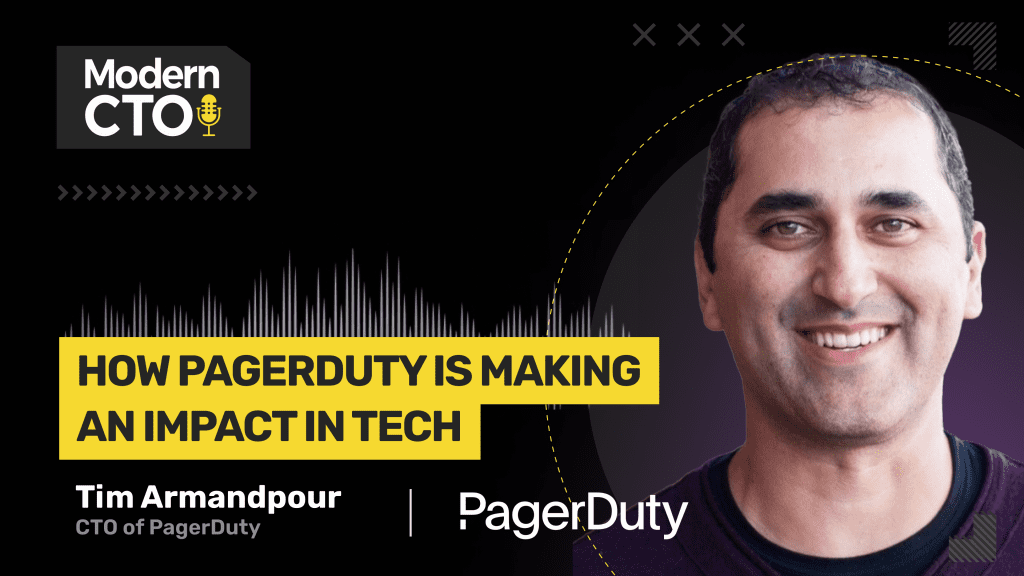
Today we’re talking to Tim Armandpour, CTO at PagerDuty. We discuss how Tim progressed in his career by filling in the gap; the utility in being proud of your work and creating a brag sheet; and how PagerDuty is creating technology that plays a critical role in saving people’s vision.
All of this right here, right now, on the Modern CTO Podcast!
For more about PagerDuty, check out their website: https://www.pagerduty.com/
Produced by ProSeries Media.
About Tim Armandpour:
Armed with a 20-year history of maximizing value to users through technological innovation, Tim Armandpour is PagerDuty’s Chief Technology Officer. He leads our long-term technology strategy, our architecture vision, security and technology research supporting corporate development.
Prior to joining PagerDuty, Tim led product management and engineering teams at Yapstone, a global payment solutions provider. Tim also led the global engineering teams at PayPal that delivered new product experiences across tablets, mobile devices, and the web. He also served as Vice President Engineering at Zong, prior to its acquisition by PayPal. Tim began his career in 1999 as Lead Engineer with Yodlee.
Tim is a graduate of University of California, San Diego, where he received his B.A. in Computer Science. He also holds 4 U.S. Patents.
About PagerDuty:
In an always-on world, teams trust PagerDuty to help them deliver a perfect digital experience to their customers, every time. PagerDuty is the central nervous system for a company’s digital operations. We identify issues and opportunities in real-time and bring together the right people to respond to problems faster and prevent them in the future. From digital disruptors to Fortune 500 companies, over 18,000 businesses rely on PagerDuty to help them continually improve their digital operations—so their teams can spend less time reacting to incidents and more time building for the future.
Dutonians believe that we are a part of a bigger movement of businesses being built to benefit everyone—the customer and the employee, as well as our community. We are go-getters fueled by the fire to reinvent how people and companies work together. We take the lead and get creative to be first in the hearts of our customers. Whether it’s keeping the world on or changing it entirely, Dutonians are fueled by the fire to reinvent how people and companies work together to deliver in real-time, across the globe.
Join us to lead uncharted efforts and reinvent how companies run.
Transcript
(Intro Narrator at 00:00:00) Today, we're talking to Tim from PagerDuty about driving the conversation to further your career. You're listening to Joel Beasley, Modern CTO.
(Tim at 00:00:15) I'm in year eight at PagerDuty.
(Joel Beasley at 00:00:17) You're in year eight at PagerDuty.
(Tim at 00:00:18) Yeah. I got here beginning of April 2015.
(Joel Beasley at 00:00:22) Oh, but you just became CTO in the past somehow.
(Tim at 00:00:25) CTO became a little bit of the title shift.
(Joel Beasley at 00:00:28) Got it.
(Tim at 00:00:28) To an extent. But I got here — we were, I think we just raised B-round money. So I think we crossed over about $20 million in revenue, about 60 or 70 people total. And then the founders were kind enough to hire me as their VP of Engineering, and I give them a lot of credit because it's not easy to hand over part of your baby, especially as technical founders, to someone from the outside. And, you know, I was a past user and buyer of PagerDuty, so I understood it quite well. And I had seen worlds without PagerDuty, how painful things can be and how much better they are with PagerDuty. So I was already a believer. So it was a very easy call for me to take from the recruiter at the time.
(Joel Beasley at 00:01:11) How did the title shift play out? Because, you know, we have our responsibilities and they change. Obviously, I looked at LinkedIn, and you've had a number of roles.
(Tim at 00:01:20) Sure.
(Joel Beasley at 00:01:20) Over the couple years. But how did it specifically go from you not being the CTO to realizing your title is CTO? How did that transpire?
(Tim at 00:01:29) Yeah. It was a long-running conversation with myself, our CEO, Jen Tejada. Part of the shift that we both felt was necessary was twofold. One is we have a — we've had a fantastic Chief Product Officer who's like my partner in crime that joined us a couple years ago, Sean Scott. And he brings an immense amount of experience from Amazon as being most recent. He was there for about 15 years, but just really great breadth and depth of experience overall. And, you know, we started to look for opportunities where there are gaps in terms of coverage, and that's where it really came out to. And then, where are we going to find some new leverage for the company?
(Tim at 00:02:09) And instead of, you know, in terms of — there's VP of Engineering. I was SVP of Engineering with some broader responsibility. For about a year and a half, I ran both product management and engineering, soup to nuts, at PagerDuty. Second time I did that in my career. Very humbling, very sobering in a lot of ways to do that job at the same time. And we felt there's a really good opportunity to help streamline things for just, honestly, for better productivity, better execution, better delivery for our customers, while at the same time having a bit more of a focused outlook on a little bit more into the future. So, for example, you know, typically, companies big, small, or medium-size, we always struggle with the urgent and the important work. Urgency usually shows up, and it kind of takes top of mind, top of day, and it's about, "Okay, today I have to do this. This week I got to do that." But as your business is growing, well, what needs to be true a year from now to support the business? What needs to be true three years from now, knowing that you're going to have a certain growth clip and — or just general, you know, maybe running of the business as a whole, which is a position PagerDuty has been in for a number of years, going from just single product offering into more of an integrated platform offering with a portfolio of products that can work seamlessly together or work individually. And so we've been talking a lot about what all needs to be done almost under the hood to retrofit that to be true in two, three years' time as the business continues to grow, as the business broadens out to various markets, various geographies, et cetera. So a lot of the shift has come into play with respect to part strategy and part execution, a little more focus on the strategy side at the end of the day, especially on software and systems architecture. Security risk management is always top of mind, hot topic always.
(Tim at 00:04:00) And then I tend to lean in pretty heavily to the business side as well. Spend a lot of time with customers, with industry, very close to our corporate strategy, mergers and acquisitions, and some of that fun stuff that typically happens behind the scenes.
(Joel Beasley at 00:04:15) So I want to know — I want you to think about the day you went on LinkedIn and updated it to CTO role. Because here's why. I'll give you some background.
(Tim at 00:04:25) Sure. Sure.
(Joel Beasley at 00:04:25) People that listen to this show often are leaders who are trying to grow. And often, the CTO is one of the highest-ranking positions in technology that you can have. And so everybody's always asking, "How do you become a CTO? How do you become a CTO?" And then I see you go through this nice seven-, eight-year progression, ultimately ending up at CTO in the past seven months. How does it actually happen?
(Tim at 00:04:50) Good question. I mean, I could tell you that that day when I went to update on LinkedIn — I, yeah, super proud. I mean, it has a certain amount of meaning, a little bit of gravitas out in the wild, but I didn't necessarily view it as a promotion all-in. It was more of a shift of responsibility set in the focus area in terms of what can be most impactful to the company. Now, how to get there — I do think it's a lot of grit, lot of grind. I think nobody's going to hand it to you in that respect. You really got to go get it.
(Tim at 00:05:27) And a lot of it ends up showing up in ways of, "What are the gaps that need to be filled? What is the job that someone else isn't doing?" I think that is a big component of it in businesses to be able to rise up the ranks, right? Demonstrate that you can actually take on more. You can be more impactful. It's not about, let's say, doing more in terms of activity. It's the old adage, "How do we make engineers more productive? Well, it's not about getting them to type faster on the keyboard. It's, have something render on the screen quicker." Right? It's, "How can we enable them — enable all of us — to work smarter and more effectively and create more impact?" But there's a lot of owning it and stating goals. One of my goals I was very open about with a lot of our team at PagerDuty is I have this ambition and goal to be a public company CTO. Part of it is because I think it feels like there's this achievement part of it, but also around, you know, what is it that I can continue doing at a certain kind of scale factor with an influence factor that, you know, in heart of all hearts is really beneficial?
(Tim at 00:06:33) And, you know, I think it gets to a point in your career where it's less about the title, so to speak, but more around where and how are you spending your time and where. I think that, in terms of what company do you represent, what brand do you represent, what products, what solutions, what things do you represent, start to go a long way. And I do think PagerDuty has been in this role of doing really good stuff to create a positive dent in the universe. And that, if I can help represent that at a certain level, then, oh my God, I feel like I've arrived. This is amazing. Now what? Now continue to do it. Better, faster, more efficiently seems to be the mantra of the day.
(Joel Beasley at 00:07:14) So as your responsibilities and focus area shifted, you noticed this gap. You went to go fill the gap. Did you go to the board, to the CEO, and did you sort of soft shop the idea around? Or did you ask for it, or did they come to you and tell you that's what you're doing now?
(Tim at 00:07:31) No, I definitely soft-shopped it, but I definitely started and drove the conversation with our CEO. It had been a bit of a longer-running set of thematics between me and her, parts of our team. And, you know, earlier, probably almost like a year ago, I did sit down with her and say, "Here's where my thoughts are." And then we were in the office together, so I could whiteboard and paint a bit of a picture that was a build and almost a refinement of a lot of thoughts and ideas she was already pushing my way, right? And I give her a lot of credit to help open up my aperture a little bit versus just inside the factory, so to speak. But I did drive the conversation, and I then started to shop around with peers because you never do this alone. You need partners. You need help. Every person needs some help. So, you know, talking with our Chief Product Officer, talking with a number of other folks internally about, "Hey, you know, what do you think? Do you know, where are the gaps? Talk with our head of sales. "Hey, where do you see gaps in the business?" "Yeah, do you think I could fill any of these gaps?" And I started then to reconcile parts of my notes and really, in a way, create, again, the continuous conversation with our CEO at the time around, "Okay, what would this all look like?" And, you know, also, you kind of look at, "Okay, what are the risks with changes like this?" Right? Are there risks? Are there — you know, are we willing to hedge and take on some of those risks as known-knowns so we can still kind of manage through in order to create better outcomes? But, you know, for me, it's always been a — you know, drive the conversation. It's a far better position to be in than being driven.
(Tim at 00:09:13) There's no doubt about that. And you may not always get the answer you like. And I think I've had that scenario in my past where I put my hat in the ring, lobbied really hard on it, was told no, and I was really upset about it. And I learned through reflecting back, a little older and wiser, it's like, "Ah, that was a good learning moment. I'm glad he told me no." I was not ready.
(Joel Beasley at 00:09:36) Yeah. It's a nice mix of experience, but also putting yourself out there, right? To know that you're not ready for that level is important too.
(Tim at 00:09:43) For sure. For sure. And at the time, I didn't know I wasn't ready. I was convinced I was, but my boss at the time was like, "No, you're not, and here's why." And I didn't like the answers, but, you know, it was exactly the right thing to do at the time.
(Joel Beasley at 00:09:54) I was talking with my wife the other day, and I love America. I love freedom. But I had a couple conversations with some scientists, and they explained to me your prefrontal cortex and how it doesn't even fully develop until your late twenties. And so I was telling my wife, I said, "You know, I'm pro-freedom. I like being able to do things, but we have these humans that are out driving around these multi-thousand-pound devices at, you know, 50-plus miles an hour."
(Tim at 00:10:23) Sure. Sure.
(Joel Beasley at 00:10:23) "And they don't have the physical appendage to make good decisions. It's not grown on them yet." They — if it were an arm, you could see that they didn't have their arm yet, but yet we let them do all of these things. I was like, "We should just raise the age of everything to 25."
(Tim at 00:10:38) 25. Yeah. There you go. That's better than we are now.
(Joel Beasley at 00:10:43) So —
(Tim at 00:10:43) Yeah. I'm with you, Joel. I've got a 15-year-old son that's starting to ask about driver's ed, and it's freaking us out because love him to death, but I don't know. Is he ready to have that kind of judgment, decisioning on a split-second notice and behind a, you know, 4,000-pound car?
(Joel Beasley at 00:10:58) Yeah.
(Tim at 00:10:59) I don't know. I'm not sure. I don't know whether we were either when we got into driver's ed and got into driver's ed at 16. We definitely weren't. And it's, yeah, it's wild to think about that. It's like, everything should be raised to 25. And then would we actually be in a better place overall?
(Joel Beasley at 00:11:13) Yeah. Well, the AI will take care of that shortly. GPT will be driving us a lot.
(Tim at 00:11:17) Yeah. I was joking with just another part of my leadership team earlier, just before this call, and I was half-joking about this notion — I'm going to start a LinkedIn thread or some kind of thread about, you know, forget DevOps, forget Dev. It's all about now, it's GPT Ops, right? And it's all that — I joke, "Yeah, we could tell a story where, you know, global staffing in our world went from 350 down to, like, six. Is that a good thing? Is that not a good thing? Don't know yet." But GPT seems to be the new hyped-up answer to everything.
(Joel Beasley at 00:11:52) It is. And while it's not the answer to everything, I think as far as all the things that have come across as hype to our general population of humans, this is delivering, I think, the best.
(Tim at 00:12:05) It seems like it. It's always interesting with these new technologies as they show up and kind of watching how they show up and how they manifest in real life for us. And, you know, as the engineer in me, typically I look at something, I'll always be, "Okay, what immediate tasks at my fingertips could this thing solve for me?" Right? "What is it that I'm going to not have to worry about in terms of this?" And it'd be interesting to see with GPT — name your version as it grows — how does that show up in just everyday, maybe, if it does, in parts of everyday life that the users or, you know, humans may not know it readily.
(Joel Beasley at 00:12:43) Have you seen GitHub Copilot?
(Tim at 00:12:48) Oh, yeah. That's nuts. Yeah. It's crazy. I mean, it is wild to sit there and think about it. And now it's like you start thinking, "Oh, okay. Well, all that boilerplate stuff can just be taken care of, and you can take all these other brilliant, creative minds and have them refocus on parts of the creative solutions and solving, you know, harder things that, you know, most software programmers, designers, whatnot should really probably be spending their time on anyways." It's like, is this the next wave of acceleration for us to see that much more innovation out there versus, maybe, the doomsday scenario of, "Oh my God, it's going to take away a whole bunch of jobs"?
(Joel Beasley at 00:13:26) Yeah. Well, I mean, that's since the beginning of time. I always find it odd that people are surprised by this notion since it's what's happened since day one with humans.
(Tim at 00:13:36) Oh, yeah.
(Joel Beasley at 00:13:36) That's what we do. We consolidate.
(Tim at 00:13:38) That's our jobs.
(Joel Beasley at 00:13:39) Yeah. That's literally our jobs.
(Tim at 00:13:40) We optimize. Yeah. We find new ways to survive. We adapt better than anything else out there, right?
(Joel Beasley at 00:13:48) Why do you think when I have private conversations off the podcast with people that run engineering firms that, you know, Copilot's been out for a year-plus — I'm sure there's alternatives and variations — but I was finding sub-15% of their engineers are utilizing any sort of AI code completion concepts at all. Why do you think the adoption rate is at — you know, let's just say for the sake of this conversation, it's at 15%?
(Tim at 00:14:17) Sure.
(Joel Beasley at 00:14:18) Why isn't it at 75%?
(Tim at 00:14:21) That's a really good question, Joel. I could tell you, I have a corporate perspective to it, and there's a personal one. I think from a corporate side, I think there's a challenge in the notion of data privacy and especially IP protection and things like that. It's, "How do you protect from this other thing sitting somewhere else now starting to get a little more deeply involved in the things that I'm producing?" Right? In a very intentional manner, right? I think that is a challenge area for companies to reconcile and figure out. You know, we talk internally — you got Copilot. You have now, you have ChatGPT.
(Tim at 00:15:01) There are companies that have restricted access and usage all in on the ChatGPT beta because they don't want anybody copying and pasting company secrets over there, and now all of a sudden it's out somewhere else that you don't have control over. Right? And I think with a product like Copilot, it is absolutely magical at the end of the day. But that in itself, given that's a little bit of a black box that way, it probably creates a little bit of a steeper adoption curve from a trust factor.
(Tim at 00:15:31) Right? And I think as an individual, this is what I do. Now there's another thing doing it. It's gonna take some time for me to get comfortable in letting someone else in, so to speak. This kind of happened. It's almost as an analogy back in the industry.
(Tim at 00:15:47) Go back 20 years, maybe not exactly 20 years, but close to that, where extreme programming came on the scene, and then there was the pair programming concept. Right? And I think that was like the beginnings of development and software programming starting to become more and more of a team activity, a highly collaborative social team activity, because now you're letting someone else into your mix. And you had to start to become okay with not knowing the answer readily, not understanding how to get something done readily, and allowing someone else in to participate and collaborate.
(Tim at 00:16:23) That itself had a certain steep curve to get over, and probably I don't know what the industry numbers were for adoption. I know a lot of us back in the days trialed and failed with it, tried to succeed partially with that. But I think there's a human vulnerability aspect of that of like, I can't let this thing take my job. And it's still early days with Copilot, I think. But yeah.
(Joel Beasley at 00:16:47) I'm a dive headfirst person. I'm like, if it's gonna—and here is why. Early in my career, I built software that made specifically like a department within a company more efficient. So I'd go in, we'd install it, there'd be 20 people. We'd leave, there'd be two. The two people that stayed
(Tim at 00:17:02) Yep.
(Joel Beasley at 00:17:03) were the two people who were curious about what we were doing there and learned to operate the software. And then they were the only ones who knew how to do it, and they only really needed two people to do it. So I figured for me to stay relevant, I have to just dive headfirst into it and learn to use it.
(Tim at 00:17:16) Embrace it. Yeah. I mean, there's definitely—and I talked to a lot of colleagues and other friends around—I mean, there's no doubt a ton of just sheer intellectual curiosity around it, about what Copilot does and what the next product like it does, so on and so forth.
(Tim at 00:17:35) And it's a matter of, I think, just getting over this hump that, you know, it's gonna be fine. We just don't know what that looks like just yet all in. Because like, how do you constrain and bound it? Right? How do you start to—
(Joel Beasley at 00:17:47) This is what I wanna talk about. Yeah. So I've been looking—you know, my background's software engineering. Did it solid 17 years. I haven't really been doing it much at all the past four or five years since the podcast.
(Joel Beasley at 00:17:57) But
(Tim at 00:17:57) it's so different now. I don't even know how to get started.
(Joel Beasley at 00:18:00) It is very different now.
(Tim at 00:18:01) It's wild. It's like, wait, what do you mean my IntelliJ doesn't just show up? And now it's like I gotta have all these moving parts and everything. It's crazy town.
(Joel Beasley at 00:18:09) It is absolutely bonkers. And it's crazy how fast it changed. I mean, it's really only been four or five years, and I saw some
(Tim at 00:18:16) I'm with you.
(Joel Beasley at 00:18:16) videos the other day.
(Tim at 00:18:17) 100%.
(Joel Beasley at 00:18:18) What I'm searching for and what's not immediately obvious to me is exactly what you were describing. So I have GPT. Right? I love—I'm a premium member with OpenAI. Well, I'm working on a fiction book,
(Tim at 00:18:32) right?
(Joel Beasley at 00:18:33) Just for my own personal side project, creativity outlet deal.
(Tim at 00:18:36) Well, I
(Joel Beasley at 00:18:37) don't—I want GPT to help me with the book, but I don't wanna introduce my stories and characters into GPT because they can share knowledge. It learns. Yeah.
(Tim at 00:18:46) It's true.
(Joel Beasley at 00:18:46) Yeah. So I was trying to find like, how do I get a ChatGPT that's like running locally? Like, how do I get one that's isolated so I can feed it information? How can I have several different, you know, clean rooms or sandboxes where I have different variations of these GPTs, and they're not relaying any information back to some central server? It's just mine, completely air gapped, essentially.
(Joel Beasley at 00:19:09) I can't—I don't know if—I don't know how to ask the right questions. If anybody's listening and knows, send me a LinkedIn message, please. But I cannot for the life of me figure out how to do this, Tim.
(Tim at 00:19:21) I'm with you. I did see a recent post, if I'm not mistaken. I don't know if it was an engineer from Meta or some other company. Couldn't find it and dig it up. But the headline was basically, I can't remember if it was he or she, showcased that you can run a local install of GPT on like kind of a standard off-the-shelf MacBook Pro laptop without all the big compute. Now, how effective that was and everything, I don't know. I didn't read up on the details. But just from the headline, it got me also piquing interest of like, oh, okay, well then there's a way to do it.
(Tim at 00:19:54) In fact, internally, we have a small data research and science team that is right now experimenting with starting to host our own GPT-based models. Oh. And I don't know the details yet because actually, right now, we have our—we have two weeks a year. We take time off the clock as a company and do our own internal hack week.
(Tim at 00:20:19) It's really a week of get in flow, go make something better, and have fun with it. And so we've got a squad of folks that have teamed up to do something, and they're gonna unveil it next Monday. But something with GPT with respect to our own internal dataset, and they know that the rules of the game is we are not exporting our own internal dataset. So I'm intrigued to see how they solve that. So if I figure that out, I'll shoot it your way.
(Joel Beasley at 00:20:46) Well, yeah. And I'm lazy, Tim. You know? I'm not trying to download repos and compile things. I'm tired.
(Tim at 00:20:52) I got day job. I got night job with family and kids just like you. I'm tired.
(Joel Beasley at 00:20:56) I want it to be Apple-like beautiful.
(Tim at 00:20:58) Click. I need a click.
(Joel Beasley at 00:21:00) I want a click, maybe a free trial, maybe $20 a month. And then I want my little space with my GPT that's equally as beautiful as OpenAI's version, and I just wanna be able to interact with it. Look at this. These are like performance graphs. I want none of that, Josh.
(Tim at 00:21:13) No. Josh is showing us how to build that. I don't know. I'm not sure it's good. I don't know how to read that. It's too complex.
(Joel Beasley at 00:21:19) No. I want the button. So when you—
(Tim at 00:21:22) What, the button?
(Joel Beasley at 00:21:22) If you find it in the future or if you decide to build it and wanna work on it, I want a buy now button.
(Tim at 00:21:28) We need a magic solve-it-all button.
(Joel Beasley at 00:21:30) I just want a magic button that has an isolated GPT instance that I have full control over without me having to do any other work. And I want it to be fast, and I want it to be better than OpenAI's, and I want it to be
(Tim at 00:21:42) You're not asking for much, Joel. You're not asking for much at all.
(Joel Beasley at 00:21:45) I'm not. I'm not.
(Tim at 00:21:46) No, no. I'm not at all. It's all good. It's totally plausible.
(Joel Beasley at 00:21:50) When you were talking about filling the gap, right, as you progress in your career—
(Tim at 00:21:54) Well, the
(Joel Beasley at 00:21:55) fill-in-the-gap—I've learned this through my entrepreneurial journeys because it's out of necessity. I've also noticed that it's rare. Most people wanna stay in their lane. I'd say if you have to do the 80-20, 80% just stay in my lane, get the task done, rinse and repeat.
(Tim at 00:22:11) Yep. Move on. Yeah.
(Joel Beasley at 00:22:12) Why is it that the fill-in-the-gap trait is so rare?
(Tim at 00:22:17) I think what tends to happen is, you know, as folks that maybe work closely together as a team or extended team, there is a natural tendency to not want to maybe show somebody up. So if there's a gap, how do you call it out in an effective way such that you can actually participate and do that without putting someone else, some other group of people, on the defensive? Also having, you know, kind of like your own self-confidence and courage to say, I could do that. I could figure out how to do that. Right?
(Tim at 00:22:46) I think those factors come into play, and it's very daunting to say, let's say if you grew up in a technical career and you see a business gap, can you fill that gap? Well, I don't know. It was kinda like, one way to find out. Could you at least start a conversation that might be a catalyst for someone else filling the gap? Well, hey, that's a good way to, you know, broaden your scope of influence. Right? I think that's really what it comes down to. You may not always have to be the one that's doing the work, but if you were to think of like a scope of influence as like concentric circles over one's career, you know, you just come out of school, you start, and you're starting to code. Like, maybe the two of us started our careers, and your real focus area, your scope of influence, is like around you. What can I learn? What can I deliver? What can I build? You know, so on and so forth. Then over time, you start to say, oh, I could probably influence my team because now I carry some clout, got some experience, some time in the seat.
(Tim at 00:23:37) Then that team becomes a group of teams, and then it becomes at the org level and then the company level. Right? And so I think you start to build up like your almost like your internal self-confidence around how to approach those things. And again, sometimes it just needs to start with like asking the right question in the right setting. I think I'm a naturally very, very curious person, just very intellectually curious.
(Tim at 00:24:02) I tend to ask a lot of questions, read up on a lot of things. I might be sometimes too quick to form my own opinions that are just ill-informed. And then ideally, I bring that out and others know me well enough to slap me around and help me become more well-informed. Right? Course correct or like reinforce initial opinions.
(Tim at 00:24:19) But I think it can feel daunting. I mean, one thing we try and do like internally at PagerDuty with a lot of our folks is we try and create a lot of mobility for individuals to broaden out their experience set. Right? And one thing we try and orient people towards, like for example, you take two traditional roles in a company that's building products. You have a product manager and an engineering manager.
(Tim at 00:24:44) You know, wouldn't it be magical if those two roles with those two individuals were fully interchangeable? So on a given day of the week, the engineering manager could speak on behalf of the product manager or vice versa because they're so intricately connected, and they actually understand each other's worlds well enough that they can step in for each other. And again, they've now just broadened out parts of their acumen and aptitude, but then also their scope of influence over time. You know, I'm a big fan of like, find another job to do in the organization that nobody's doing or that needs to get done and convince your manager that that's important for you as you wanna develop your career. Right?
(Tim at 00:25:20) It's a career journey, not necessarily just the job at hand, that one company or in that one role. Right? It's a journey. So it's over a longer period of time. But I think those two factors I stated earlier typically come into play, and it's hard.
(Tim at 00:25:33) Sometimes people need a little bit of just a nudge from an awesome manager that can see something in them and say, I'm not here to solve this for you. I'm gonna nudge you to put you in that scenario. I'm gonna help you, but I'm gonna nudge you, and I'm gonna walk away. I'm gonna pick you up when you fall down. Right?
(Tim at 00:25:49) I think there maybe isn't enough of that always around to have that, but someone's gotta start the conversations too. I do think that that's on the individual versus the, quote unquote, manager.
(Joel Beasley at 00:26:00) When you're talking about, you know, the two parts, how to call out the gap without offending people or causing some other disruption, and then you also mentioned self-confidence and courage. I think the first one's pretty easy to learn tactically. The second one, I think, would be a lot harder because it requires a lot of work on yourself over a period of time. How do you get started building self-confidence and building courage?
(Tim at 00:26:28) That's another good question, Joel. You're really good at this, man. I think how to go about building that up. One is, I think being able to literally—I think I'm a big fan of writing things down. So I can give you like what I've done. Right? And I think it's worked well for me. Writing things down, creating like, you know, internally at PagerDuty, we talk a lot about like, create your brag sheet. Like, be proud of the work that you do. It's okay.
(Tim at 00:26:52) Like, really, really look yourself in the mirror. Write down your accomplishments, what is it for the week, for the month. Be proud of the work that you're doing. Right? And again, if you write it down, it's a good exercise because it really kinda forces you to really engage with what you're writing. Right? So don't go off to ChatGPT for this stuff. Focus on yourself. Write it down yourself. Then you can actually leverage that and use that to be able to facilitate conversation like with your manager.
(Tim at 00:27:21) And there will be moments where there may not be alignment and you have to agree to disagree on like, oh, I thought that was really good work. No, that wasn't good work. Here's why. Here's what happened. Here's what others—here's how. And there may be a different perspective. That's a constant, continuous learning exercise over, call it decades, right, of a career. I think as I built that up for myself, it helped me actually almost become like a bit of an advocate in that regard without showing up as, ideally without showing up as arrogant or as closed off, right, or too narcissistic. Right? And I think if you're able to actually almost like create like your own portfolio over time.
(Tim at 00:28:05) Right? You have things to pull from to say, well, actually, you know, here's what I thought I did really well. You know? And then if there's no strong objections—so what is really getting in your way? And you get a good amount of support. Then all of a sudden you start to learn how to drive yourself. But it's not a one-and-done kind of thing because there are gonna be those moments where you thought it was awesome and you walked away and you're like, that was amazing. And yet you left a room full of people like, wait, what the hell just happened?
(Tim at 00:28:30) So I think that's what's worked well for me over time. I wasn't always good at it because in my early days, I know I was absolutely arrogant to a point where I got feedback saying like, you always look like you have a chip on your shoulder. What are you trying to prove? And it's like, you know, early days of management. I thought like getting into management, you had to have all the right answers, and you were the only one to do that.
(Tim at 00:28:50) It's like, yeah, complete opposite. But like you're only as good as your people are and how well you empower and enable your people and support your people. So even like where I'm at in my career, it's all testament to like my team. My team helps me get to this point, affords me the opportunity to spend time a certain way to help the company.
(Tim at 00:29:08) And ideally then, you know, how do I then keep that continuous cycle going with everyone around me?
(Joel Beasley at 00:29:15) Yeah. That seems to be a theme. Well, let's talk about the arrogant thing. You've said a couple times in the conversation, and from my personal experience, I believe this to be true. You have to—let's start with something everyone can agree with as the example, burnout.
(Joel Beasley at 00:29:31) Okay? You have to actually burn out to know what burnout is, to know when it's coming, to feel it, and then to know how far to back up before you hit it. I think the same thing is true with arrogance and several other aspects of yourself because, to your point, like me too, when I was definitely far more cocky when I just sold some software at 18, and then I realized that that's a very ineffective way to engage with others because people don't wanna work with that guy. They wanna work with somebody who's, you know, humble, outcome driven, trying to get the teams to—
(Tim at 00:30:05) Sure.
(Joel Beasley at 00:30:05) Right? So that seems to just be a theme. But I did wanna know when you're writing things down, do you have a preferred technology, like an Evernote? Are you a paper guy?
(Tim at 00:30:19) I'm a Google Docs person. I'm also pen on paper. So, Google Docs in my own time, pen on paper in meetings. So I still have a notebook that I just have my own shorthand writing style that helps me just process information. I can't in a meeting, I can't take notes on Google Docs. But what I do enjoy doing is reflecting by myself in the low time, put headphones on, put some music on, and do my thing, so to speak. But I do like the pen on paper approach.
(Joel Beasley at 00:30:56) I don't use the computer in meetings. I don't know. It's a weird animal human thing, but it always feels like if you're taking notes on the computer that you're not paying attention. That's how I feel when I'm speaking, and I see someone taking notes on the computer. I feel like they're—
(Tim at 00:31:09) Disengaged. It's like an engagement. In fact, it's like, look me in the eyes. As I'm talking to you, let's look in the eyes and see what's happening. There's a human aspect to that. And, you know, I think with the pandemic and everybody being distributed, now you get in person, I'm really, really—that's where I feel like I thrive the most and get really good energy that way, versus as you're talking, I keep staring at my thing. And the other person doesn't know, are you Slacking? Are you doing this? What are you doing?
(Joel Beasley at 00:31:37) I'm playing solitaire in between my questions.
(Tim at 00:31:43) But let's have a conversation. Let's break some bread. Can we get back to this breaking bread and hanging out? Because if you're outside in a little more of a social setting, hopefully you're not taking notes and then whipping out your phone. One of my biggest pet peeves is you sit down at a physical meeting, you got the laptop on the thing, you put your phone next to it. It's like, really? Like, really? Do we need to do that?
(Joel Beasley at 00:32:05) Tim, I got all my screens, man.
(Tim at 00:32:06) Come on. Yeah. I'm very important, Joel. I don't know if you knew. I'm a CTO, so I'm very important. I gotta have all the screens out.
(Joel Beasley at 00:32:12) You can tell by the Apple Watch. That's screen three.
(Tim at 00:32:16) It's so good. But, you know, I think a lot come down to some of the earlier point you're raising, this notion of being close to a thing. Having empathy through shared experiences is what this is all about. Right? And knowing that it's the old adage, I'd never ask you to do something I wouldn't do myself type of scenario. That has to be really heartfelt. That has to be genuine. That has to be demonstrated and seen to build that trust bridge over time. But, you know, knowing what burnout feels like, knowing what giving someone bad news looks like and feels like, what giving someone critical feedback to help them, even though it's not gonna be popular or very positive, so to speak. Right? Going through that, telling the customer something that they don't wanna hear, but it's the right thing to do regardless—going through that, just all these shared experiences and knowing how hard it is to do that next job. You know, there's a challenge sometimes. You might be so good at your role and your job, and then you just have these presupposed assumptions that maybe the other person in the other department, just because you see a slice of their day in that moment, you have no idea what the rest of their job is or what their craft and their organization is dealing with, and yet you just assume. So coming in with assumptions and that lack of context, that's where walls get built versus bridges. Right? Versus asking, being curious, going, like, okay, well, what are you struggling with? What's the biggest obstacle you're facing? Right? Just lean in. Right? Own the part to lean in, to collaborate, and then partner up, and then, you know, better outcomes happen.
(Joel Beasley at 00:33:56) I used to think that the quality of someone's website design was equal to revenue. And then I'd see these old companies, and I'd say they make how many hundreds of millions of dollars, but their website sucks. Look at—
(Tim at 00:34:07) Enterprise software today. I sit in enterprise software hell at times, and I marvel at the market cap of some companies—not to be named here—and just the lack of anything cohesive happening in parts of their experience, and yet they're generating billions of dollars of revenue a year.
(Joel Beasley at 00:34:27) Well, that is a good lesson, and it's one that I learned very quickly. And it's how to understand how you sit in the market and what—what am I doing for you, Tim, that is so useful, you're willing to open up your wallet and hand me some money?
(Tim at 00:34:41) Exactly. Over and over.
(Joel Beasley at 00:34:42) That thing is. You guys started as a—correct me if I'm wrong—but I believe that the first time I heard about you several years ago—
(Tim at 00:34:51) Yep.
(Joel Beasley at 00:34:51) It was an article discussing how cool it was that this company took a feature that existed in many different softwares and extracted it out into its own thing and then did it really well. Was that you guys?
(Tim at 00:35:05) I don't think that's terribly far off. I'd say there's an "and" part to that, which is, and we took what many companies were doing fairly manually and said, that's not a problem you should deal with. So, for example, the classic—and it still happens in all sorts of companies and customers that we partner with—is this roster of people. Seems simple. Who are they? What's their email address? How do I contact them? Right? And then are they available? Do they have the right context? Do they understand what's going on? Just assembling that kind of knowledge management in a working system is very manual. There are either papers and binders in some companies that have this. Who knows when it's been updated and whatnot? There are internal intranet or Wiki pages that might have a thing with some links to click to get to the person type of thing. Maybe you've got a company directory that you sift through and hope that you remember the team name that they're on to go find them, so on and so forth. But if part of your software and or services are burning due to an issue, you don't have time for that. So the real thesis originally with PagerDuty had a lot to do with, let's elevate that on-call management out from, imagine the visual of the underlings of the basement level work to primetime and really enable technologies the way the likes of GitHub or even Atlassian and Jira did, where it just creates some first-class experiences so the job—that part of the job doesn't have to be that hard. And that's now, in a way, evolved from being that single product offering. So do that one thing really well. I mean, the founders of PagerDuty were, I think, absolutely brilliant in finding some really, really amazing product-market fit very early. And then it was off to the races. Now we're in year 14 of the company, and we've now evolved into a fairly integrated platform offering with a suite of product offerings that help solve very real problems very readily for—essentially, now we're broadening up to be able to go far beyond just dev and ops or IT ops into a wide spectrum of parts of the business.
(Joel Beasley at 00:37:30) Including refrigerators, too?
(Tim at 00:37:32) We've got refrigerators. Pretty much, if something can speak over the wire over HTTPS, it can integrate with PagerDuty. We've got refrigerators being monitored for food services. We have all kinds of nonprofits that use us for some really legit, mission-critical—so one of the best stories to tell, real quick: we have a company called SightLife, and what they do is they harvest corneas and transplant. And so when a cornea is available, right, they have literally less than 48 hours to harvest, transplant, and reattach to a recipient to give themselves a fighting chance. So when that cornea becomes available, what they do is they fire up a workflow inside PagerDuty to bring a number of disparate people together into a single context to now be able to get some really important work done. And then the workflow now helps these individuals hand off and get work done over a certain period of time. And then ultimately, when it's done and it's successful, they then close that workflow out. And, you know, again, you have to think about mission-critical. Our service pretty much always has to be on. We are basically the dial tone, and we don't have the affordance of downtime or hiccups and things like that. So it becomes a really interesting problem to solve when you're building stuff on things you don't control, like the cloud.
(Joel Beasley at 00:38:58) Does that express itself in your organization different than companies who maybe don't have the need for that high of—it's not life-threatening. You know? My CRM system's not life-threatening. You know?
(Tim at 00:39:12) No. It's—there's definitely this business criticality that I like to think that we have really fostered, the ethos in terms of why is our customer at the center? Right? It's because they're depending on us. And we take that responsibility very, very seriously, almost to the heart in terms of how we approach things. So I think our org structure and even our execution structure does resemble that in that we are big believers in you don't share accountability. You can share responsibility. So when you think about the DevOps movement and things like that, being able to really own your own destiny across a large number of disparate yet still interconnected teams really affords the ability to basically deliver the way we need to deliver for our customers versus having to go through a very convoluted set of pathways and structures and approvals and this and that across a bunch of teams. I like to think we're a pretty fluid environment internally to help make that happen.
(Joel Beasley at 00:40:16) And are you mostly in person or remote? How does that work?
(Tim at 00:40:20) No. We are fairly distributed, I think. Once the pandemic hit, we were much like many companies, hiring talent in a whole slew of new cities and states in the United States. Predominantly, we do have six global offices. Our Lisbon office, which is our newest kind of center of gravity, is majority co-located by design. Right now we are fairly distributed, and it's one of those big talks crossing the show: Like, well, what do you do? Do you come back to the office? Well, how can you if, let's say, pick a number, 75% of people don't live within driving distance? Right? Then how do you get intentional about creating some of those—so what we've been talking a lot about internally is around in-office is one concept, but what about in-person? Let's focus on the in-person, create that fabric, because we do have centers of gravity in certain pockets of major metros across the United States and even parts of Canada. So how do we create and facilitate for our people just healthy in-person connectivity? Right? Just to either build from scratch or rebuild and refresh some of that social fabric that you wanna have that we all know just creates better teams, better organizations, better companies, better outcomes. But, you know, one thing I talked to a lot of folks around was like, that's fine. But if you're brand new to a career or a role and you're showing up virtually and you're still—you're brand new, you might be 22 years old right out of school, and you're still living at home. So you're sharing a room in mom and dad's house. Right? How do you actually now start to learn and develop in that virtual setting versus being in the office? Because your manager's virtual, your senior, maybe mentors or coaches are also virtual. Right? They're not, let's say, in the office. So even if you show up to the office because you want to or need to, is your support system there? You know, that's one thing that I think is very top of mind. It's like, how do we actually help develop and grow the younger or brand new talent in a given role in this new kind of situation we find ourselves in?
(Joel Beasley at 00:42:32) What do you think is going to happen long-term? Do you think there'll be companies that just, that's their culture, or do you think everybody ends up going remote?
(Tim at 00:42:41) I think the bigger companies will be able to have a bit more leverage in saying, yep, in-office is the way it used to be. The reason I say that is because they just have a denominator of number of people that's bigger than a lot of the average companies or smaller companies to be able to have that. And my guess—I'm just seeing the data and talking around—is they still have a strong concentration of folks in or near an office who've just, you know, are in a different lifestyle place right now where it's like, okay, maybe it's not an every day thing, come back five days a week, but maybe it's three days a week. And, yeah, I'm a big believer that, you know, as we move forward, how will the office experience create a vastly different experience than while I'm at home? Because it really should, in my opinion. So I think the bigger companies will dictate that, and then people will have choices. I mean, that is part of the reality. Even with, you hear of a lot of the big tech layoffs. Right? There are still jobs. There's still hot demand for all kinds of roles and jobs. It's just the talent is now starting to shift out of very big tech and starting to have an opportunity to be distributed across a lot of different industries that didn't always have that access to the same talent.
(Joel Beasley at 00:43:56) Well, that's one of the positives that when I see all the negative on LinkedIn news and such, I'm like, well, you know what? Yes. They overhired, but I also have been talking to these people for the past six years.
(Tim at 00:44:07) Yeah. Yeah. Yeah.
(Joel Beasley at 00:44:08) And what I've seen is they'll struggle with talent to the point where they're working with local economic development centers.
(Tim at 00:44:13) Yes.
(Joel Beasley at 00:44:14) They're building programs where they're paying people to go through them. They're doing everything they can to educate an entire generation. And so I'm like, look, they did all of that. They essentially said, hey, you breathe and you like tech. Okay. Here's $50K a year. Come play at our office. And so now it's just a—you know, there's a couple things, but the free money, but also those kids on TikTok that were taking videos of their days. Did you see any of those videos?
(Tim at 00:44:40) It's like, did they actually work? No. The answer was maybe not. It's like, wow.
(Joel Beasley at 00:44:45) Like, 20 minutes of work the whole day.
(Tim at 00:44:47) I mean, it's a little wild. I don't know. Do you hear something different than what I talked about in terms of where do we think we're gonna end up?
(Joel Beasley at 00:44:55) No. I haven't asked that question a whole lot. I mean, in my head, I very much see—well, how long is the time frame? Because, eventually, we probably all end up in computers. They'll upload it into something.
(Joel Beasley at 00:45:08) Right? But on the in-between, where are we? I liked your vision. I hadn't thought about that before, where what we see when we say office in our head. When I say office in my head, for some reason I'm on the 5th floor of a big building and it's yellow and there's cubicles that are gray. It's like you don't want to be there, right? And I've never actually been in that building like that, really, or worked there. But that's what I see.
(Joel Beasley at 00:45:25) And I could imagine that if you created this beautiful space that was functional based off of how your people wanted to work, then people would be more inclined to go.
(Tim at 00:45:44) Yeah. I think, you know, a big part, there's the physical layout of the thing, just that visually you paint it, right? 5th floor, cubicle desk, whatnot. You know, I think a lot of these larger companies that have these big office buildings, big campuses sprawling, whatnot. Part of the reality of you being in the office, open up the air quotes, right, is that there's no guarantee that you're actually working physically in proximity to the teams that you are probably working with anyways. They might be in another building across the street or across the way that you still might see once a month in person. So it's almost like, okay, what are we trying to really get done here? Right? And I just think it would be so much healthier and better for all, let's just be very explicit and very clear on what our goals and outcomes are when we say, you know, whether it's in office. You know, at PagerDuty, we're talking a lot about in person because we are fairly distributed. So the reality is we're not going to bring, yo, 35% of our workforce and our team members into our San Francisco headquarters office. We're just not, because we don't have those same 35% people living in the Bay Area anymore, right? They've dispersed or they've left, and we've rehired in Toronto, Atlanta, London, Sydney, Japan. We have an office in Tokyo and then Lisbon, Portugal. So the reality is that's not going to happen. It's like, what are we trying to solve with that beyond maybe a celebration, maybe kick off an important initiative that requires some focused collaborative time, and then now people go off and I'm going to trust that you're going to go get good work done and then come back together. But, you know, these larger places, physical layouts, they're like, well, let's squint a little bit at that one because there's no guarantee person A is going to go see person B any more frequently by literally being, quote unquote, in office.
(Joel Beasley at 00:47:33) We found that the right balance for us, we were in person, about 20 people, so we're fairly small. But we were in person in Florida before the pandemic. And then after that was, you know, three, four years ago, we just made this decision to go fully remote. That way it wasn't this thing in limbo of are we coming back to the office? We just like, this is it. I'm done paying for this lease. No one's been in it for a year.
(Tim at 00:48:02) Yeah. And so, you know, we made that decision. And what we found is at first it's really easy because everybody you were in office with is there, remote. It's just your remote version of Chloe and so on. And then what we learned is that as you bring on these new people, it becomes very important to come together in person at some rate. So what we picked for us, we go between three and four, every three or four months depending on what's going on at the company. We all fly to one location. We have a dinner. We do a team building exercise the next morning, and then they get to hang out in the city for that weekend. And I don't go, of course, you know, because they need to bond amongst each other. They get to do their thing, make their bad decisions, you know, all that good stuff.
(Joel Beasley at 00:48:51) And that's what we found works for us. Does it work for everybody? Probably not. Do I recommend it? I don't know. You could try it.
(Tim at 00:48:59) No, it kind of comes down to, I think, okay, what's needed, right, in one's own opinion? And then, you know, in terms of, again, it should feel like a different experience, right? It needs to fill a certain gap, in my opinion. Like, you know, our team that reports to Jennifer, our CEO, last 18 months we've been together minimum once a month for two or three days at a time. And it's focus time. It's, you know, ideally we get together, maybe it's in a particular city. It's usually around one of our offices. That'll actually naturally gravitationally pull some people to come into the office experience. But we are doing something different. We're hosting ask me anythings. We're making connections. We're hosting a social happy hour. We're hosting a company-wide town hall from the location. And we're having our specific meetings to, as a team, to collaborate and, you know, continue to build that internal glue and that fabric. That's not, may not be required for every single team in the company.
(Joel Beasley at 00:50:00) No. But spoiler alert, if you get the invitation, go. Because the better relationships, the stronger relationships you can form, that's only going to help you whether it's at PagerDuty or your next day. Life is long. You've got to get those relationships with high quality people.
(Tim at 00:50:14) I 100% agree.
(Joel Beasley at 00:50:16) So speaking of different experiences, you bought a yogurt shop and ran that for five years? Can you, we can't leave the interview without talking about that.
(Tim at 00:50:23) We developed it. It was actually my wife's brilliant idea at the time, which was kind of back in 2005 or 2006. We were living in San Francisco. She worked, spent decade plus in corporate advertising, was also a certified French pastry chef. So we said, oh, cool idea to start our own business some way, somehow, and looked at a lot of different concepts and ideas and settled on a gap in San Francisco was a locally owned, locally sourced, organic, yet still kind of on the artisanal tip around frozen yogurt. And this is when there was a bit of a frenzy happening in Southern California around frozen yogurt shops like Pinkberry, and there's another one, Red Mango was another one. Froyo was the thing. We said, well, we'll business plan together and whatnot, figure out how to spool some money together. We had recently just gotten married. I was literally just starting at a new startup, like seed round, A round. And we thought this was going to be a fantastic idea. Six months in, we realized we're having a baby. Hello? And then opened up a store in San Francisco, the Marina District. Had an amazing first 12-ish months. Parlayed that into location number two over by Yerba Buena near the San Francisco Museum of Modern Art, right next door to a Peet's Coffee. We're like, this is fantastic. We'll take the outflow. People spending, you know, $6 on a latte and spend $2.50 on a fresh frozen yogurt. And then 2008 hit, economic tundra, and everything came to a grinding halt. It was wild. It's cool. We developed the brand. We got it out there. It was our own startup. It was, you know, my wife was really the brainchild of it. I was the operational arm, so I'd come in and close the shop at night and make my rounds between shops and whatnot. But it was really all her that made it happen. We were onto something because, you know, frozen yogurt did start to take off in San Francisco, which really wasn't a thing the way it was in other parts of California, just weather-wise, it's not as warm always, right? So, but yeah, we did that for a thing and then lessons learned. We probably should have, we maybe parlayed it so fast. Ended up selling it off for pennies on the dollar, but we learned a ton through that. It was just awesome.
(Joel Beasley at 00:52:44) Well, ultimately you win. I mean, you're in much better shape than I would be if my wife were a French pastry chef.
(Tim at 00:52:51) Well, while she was in school locally, the culinary student there in San Francisco, I gained a lot of weight because every night I was taste testing. Yeah. I mean, and then I found out how much butter actually goes into a croissant. It's mind blowing, but it is delicious. You just can't say no. Or the next pastry, and every night was an assortment of stuff. And she'd come home late. So this is at 11 p.m., 10 p.m., open some wine, have some pastry, and that became lifestyle for six months. So I gained quite a bit of weight during that. It was awesome, but brutal.
(Joel Beasley at 00:53:24) Yeah. I had an up and down thing with weight, and ultimately I decided to weigh and measure and make my own food. And then after I've developed that skill for several years, it blows my mind if I go to a restaurant maybe once a month and I'll see the portions, but then I'll also see the calories, and I'll see this is a steak. How, what magic did you use to get that many calories in that steak? Because I make that same steak at home and it's half of that.
(Tim at 00:53:51) Totally. The butter.
(Joel Beasley at 00:53:53) Butter.
(Tim at 00:53:53) Butter. And butter. It's all butter. They'll put a stick of butter per steak, and they put it in the pan with a stick of butter per steak, right?
(Joel Beasley at 00:54:01) And people say it tastes good. I love it. You know, they'll eat it. But if they were to have to make it themselves, they're like, no, what are you doing? Why would you put that in there?
(Tim at 00:54:08) You would be like, you keep staring at, like, is that real? Is that really what I have to do? There's no way. You put a quarter of that.
(Joel Beasley at 00:54:17) Yeah. Well, man, this has been fantastic. I want to keep going, but I've got some other meetings coming up too.
(Tim at 00:54:23) Yeah, ditto. We've got to get on with our days, I guess.
(Joel Beasley at 00:54:25) We made a podcast.
(Tim at 00:54:26) We got it. Ship it.
(Joel Beasley at 00:54:28) Thank you so much for listening. And if you found this episode useful, please share it with a friend or colleague who you think would get value from it. And if you have topics that you would like to hear discussed on the podcast, either add me on LinkedIn or send me an email, [email protected]. Every time I get an email or LinkedIn message, it absolutely makes my day and inspires me to keep going.