
Episode 703 ·
A Deep Dive into Test and Measurement with Thomas Benjamin, EVP, CTO & Head of Platform and Analytics R&D for NI
Today we’re talking to Thomas Benjamin, EVP, CTO & Head of Platform and Analytics R&D for NI. We discuss the impact of the test and measurement industry in our current technological climate, the ways in which generative AI is making waves in test and measurement, and why Thomas looks at technology through the lens of making the world a better place..
All of this right here, right now, on the Modern CTO Podcast!
For more about NI, check out their website: https://www.ni.com/en-us.html
Have feedback about the show? Let us know here
Produced by ProSeries Media.
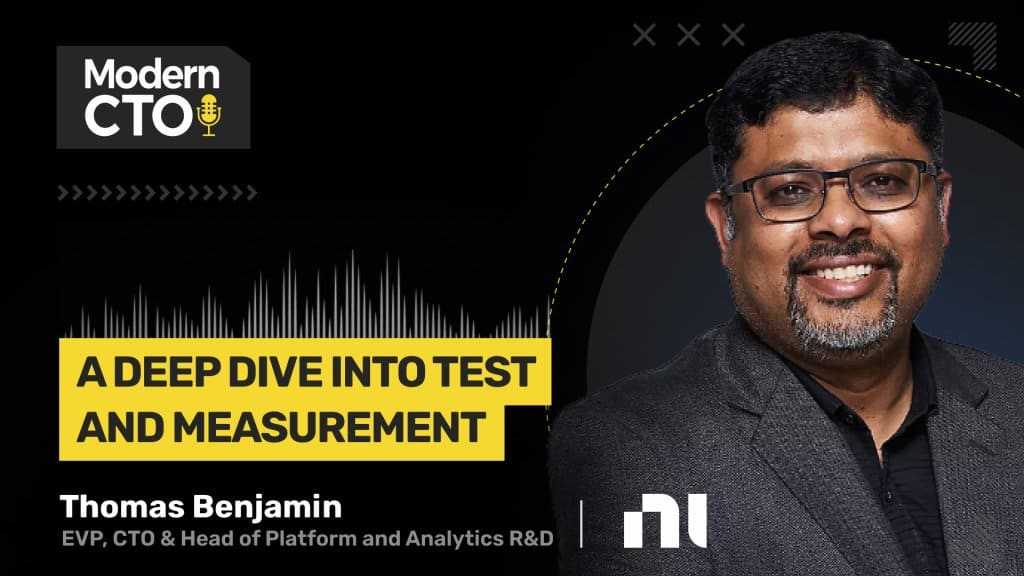
About Thomas Benjamin:
Thomas Benjamin is an innovative leader who has a passion for harnessing the power of our software and hardware systems to create real and unique value for our customers. As executive vice president, chief technology officer, and head of platform and analytics R&D at NI, Thomas is responsible for advancing NI’s software-driven business models for the test and measurement market. He is a champion for software-connected solutions that deliver the meaningful test data and insights our customers need so they can bring their products to market faster, more efficiently, and more reliably.
Thomas has extensive experience building software-as-a-service (SaaS) and cloud native solutions powered by APIs, data, and insights. Prior to joining NI, he served as the CTO and SVP of technology at SAP Ariba. His career has also included CTO and VP roles at General Electric and Emirates Group, and technology leadership roles at Visa, Walmart, and Oracle. He holds a Master of Science in Industrial Engineering from University of Cincinnati and a Bachelor’s in Engineering from The College of Engineering Guindy, Anna University, India, as well as executive certifications from Stanford University, Singularity University, and Harvard Business School Online.
Thomas considers himself a lifelong learner. He’s an avid photographer and a dedicated volunteer and mentor in his Bay Area community, where he also enjoys spending time coding and experimenting with home automation.
About NI:
At NI, we Engineer Ambitiously. We celebrate creative problem solving. And we take our customer relationships to heart.
We believe in the power and potential of making connections—between people, ideas, and technology. In fact, connection is central to everything we do. We constantly challenge ourselves to find those connections because that’s what creates a path forward. This means bringing the right people together to build solutions that make a difference. It means combining fresh perspectives with new technologies to turn your vision into reality.
For more than four decades, we’ve set the standard in automated test and automated measurement systems. We’re proud to partner with the talented engineers and enterprises using our systems to solve the world’s most pressing technology challenges and build better businesses. From data and automation to research and validation, our tailored, software-connected approach is rooted in helping you engineer what’s next. As your trusted partner, we’re committed to helping you set your goals higher and reach them sooner.
We’re here for you, for each other, and for the next generation of innovators who think bigger, aim higher, and go faster. Let’s Engineer Ambitiously.
Transcript
(Intro Narrator at 00:00:00) Today, we're talking to Thomas from NI about the impacts and evolution of the test and measurement industry. You're listening to Joel Beasley, Modern CTO.
(Joel Beasley at 00:00:14) So I was really hoping you could help me pull all this fragmented information together to really understand what is NI, what's their business model, what do they do?
(Thomas at 00:00:23) So NI is a test and measurement company for the industrial world. We focus on four core domain areas or business units. One called semi and electronics. Second is transportation, namely electrification of vehicles, autonomous driving, et cetera. Next is aerospace and defense—missiles, radars, and things like that. Fourth is what's called our portfolio business unit, which is predominantly healthcare, life sciences, and a lot of the broad-based industries. So when we say these four industries, what do we actually do in these industries? We deploy test and measurement hardware and the necessary software. If you look at the software industry over the last 15 years, test and measurement has become really important for any software product.
(Thomas at 00:01:14) Now, as more and more industrial systems become digitized, so for example, when you're making a semiconductor wafer, a wafer can have anywhere between what's called 250 dies—a die is the equivalent of a microprocessor—to about, even in some cases, 7,000, 8,000 dies per wafer. So there's a lot of testing that is done on that wafer before the dies are broken out of that wafer. So we build the test equipment and we also build software that tests these different wafers and the dies within that wafer, detect anomalies. Like, for example, is there a scratch on the wafer? We have routines that detect those scratches, for example, or defects, and determine whether that wafer is a good or a bad wafer before the dies can be cut out of the wafer, for example. That's one use case. The same thing we do for a battery pack, for example. You have a battery pack that's made up of a series of cells. You need to do a lot of tests that test the battery pack for 10,000 hours and things like that.
(Thomas at 00:02:12) So the hardware and the necessary software do it. But right from day one, NI has taken the approach of making sure that the software we write not only works on NI hardware, but also on non-NI hardware. NI started off with a great product called LabVIEW, which essentially was built about 40 years ago, which provided a visual programming language to create test routines. Like a complex electronics board, how do you test it with different types? It's called a LabVIEW VI. So it started off with LabVIEW from the software board. So once you create a test, you end up with a cluster of tests that needs to be sequenced in a certain order. So we have a product called TestStand to sequence the tests. And then we have products like SystemLink, which essentially has agents running on our different hardware that actually look at the configuration of the hardware, looks at how you can manage the hardware, even manage the power consumption of the hardware when you're not doing tests. And finally, we acquired a company called OptimalPlus about four years ago from Israel, where we actually run production analytics on a lot of the semiconductor.
(Thomas at 00:03:15) So that's, in a nutshell, what NI does both at the hardware and software level. And our goal is to help customers reduce scrap, improve yield in the manufacturing process, save time, essentially. That's what we specialize in.
(Joel Beasley at 00:03:30) And were you in the test and measurement industry earlier in your career, or is this your first time doing that side of things?
(Thomas at 00:03:36) This is my first time doing this side of things. I've been in the software industry for more than 25 years, and they brought me in at the executive leadership level to help transform the company more into a software and hardware company. Because look at what Tesla has done. They amplified the value of the car with software. Apple did the same thing with their iPhone, right? They released a release about a year ago, for example, where you can unlock the same iPhone even when you're wearing a mask. So using software, can you complement and actually increase the value of the hardware through some interesting capabilities that you can connect? That's one part of the equation. The second part of the equation is test runs in silos in different areas.
(Thomas at 00:04:17) So if you walk into a lab, a validation lab, or a factory, you'll find hundreds of hardware machines and PCs running tests on that machine, on that piece of hardware, or a product that you're manufacturing. Now, if there is an anomaly that is detected on one piece of the hardware, you wait for discovering the same anomaly in every other machine. But with the advent of cloud and connectivity, we can connect all these bits of software, the workflows, as well as the data to actually identify the root cause of the anomaly. Because in most cases, anomalies don't happen instantaneously. There's a degradation pattern. Can you identify the leading indicators of the anomaly? And if you see that occurring in other machines in the same factory or in other factories and other geographies, can you actually do something to prevent it? And I think that's the opportunity I saw for us. And that's where we use test as a strategic differentiator.
(Thomas at 00:05:09) In fact, to bring this home, let's think about when we were kids, when we went to a doctor, what happened? They looked at us. They looked at our symptoms, and they deduced what was your problem. Today, a doctor essentially gives you a series of tests to take. Based on the test and the data from the test, they have a much more precise manner of diagnosing what's your problem, essentially. And that's the kind of ubiquitousness that test and measurement brings to the industry as we use more and more of that in a connected, digitized world.
(Joel Beasley at 00:05:40) And so were you brought in—tell me more about why you were brought in. Was it to make the products more developer-friendly?
(Thomas at 00:05:46) Developer-friendly and easy to use for customers. So how do we go about doing it? One, by modernizing our product, by connecting it so that you can embrace the big mega trends of big data, cloud, microservices, APIs, and generative AI to be able to create this threaded capability across the world, right? So think of this: when you have a fleet of cars driving down the road and you detect an anomaly on the car, can you in real time harden the test and measurement in your factory or your validation lab without waiting for a recall? Today, the connected technology gives us that capability, right? And that's one example of the reasons why I was brought in to help make this transformation, to be able to complement and enhance the value of hardware by adding meaningful, intelligent, connected software.
(Joel Beasley at 00:06:45) I like it. Yeah. My background is software engineering. I didn't do much with hardware. My father did, though. So my father was hardware in the Air Force and then also did hardware in the private sector afterwards. And so I got to experiment with both, and I just leaned towards the software side of things because I was a kid and you could do everything on the computer. You didn't have to pay for the hardware and all of that good stuff. But when you're talking about test as a strategic differentiator, when you're talking with clients, how new of an idea is that to them? Is this something brand new, or is it something that they're already comfortable with?
(Thomas at 00:07:25) No, I think the advantage that is happening at this point in time is literally 99% of the clients I talk to have a digital transformation journey going on, right? Let's take a step back and look at it. Complex products are becoming much more complex today, right? In your pocket, you carry a supercomputer that has got more computing power than the spacecraft that took man to the moon. Same thing with your cars today. An electric car has 2,000 microprocessors. A non-electric car has about 1,000 microprocessors, to name a couple of the examples of the complexity involved in it. Now, how do you know that the asset is performing? How do you know that the asset is degrading? The only way to get that indicator, or one of the ways to get that indicator, is use test and measurement. And so this is a strategic differentiator that companies are beginning to realize and wake up to. And they're looking for partners like NI who can help get them accelerated on this journey because everybody wants to get a complex product to market faster. Like last year, Qualcomm was on stage with us. And they're one of our big customers on the hardware and the software side. And at our keynote, they essentially mentioned that their time for taking a product from design to production has gone from three years to six months. And we were one of the key partners to help them in that journey.
(Thomas at 00:08:42) So that's the realization that everybody is getting to these days. How do you use test and measurement to improve product and business performance?
(Joel Beasley at 00:08:51) There's your Facebook ad. Just take the Qualcomm person saying that and just make a 10-second clip and run it a hundred times, right? So I've had many conversations about predictive failure technologies with monitoring physical equipment. And I'm curious to know, those predictive failure technologies that can watch the vibration of a machine or something like that and watch how it fails and being able to predict it—and then you've got that here, and then over here you've got testing, strategic differentiator, faster time to market, things of that nature. When do they start to cross? Are you ever using test data to train the predictive models, or do you only watch things in the wild to predict failure? How does that work?
(Thomas at 00:09:36) Actually, we can get them to cross right now today, right? For example, today we use our anomaly detection model for semiconductor manufacturing at 11 of the top 15 semiconductor manufacturing sites. As systems get deteriorated, like as a scratch is coming up in a wafer, we have enough collective knowledge of what are the root causes of the scratch. Though many of these customers are deployed on-premise, we can take this collective learning to improve the quality of the algorithm and the machine learning model that we build. And that's essentially what we have deployed as a design partnership today with a company called Renesas in Japan to essentially do wafer classification based on some of these predictive ML models. And that's just day one in this journey, right? When you layer generative AI on top of it, it takes it to a completely new level. That's where I start with, can you take a test spec and drop it to our product or our AI engine? I actually demoed this in my keynote last month at NI Connect in Austin, where you can use generative AI to read the spec and create a test routine.
(Thomas at 00:10:44) Now, that test routine can then be clustered together as a sequence and deployed into a system to run the test. Now, as the test is being performed, literally 99% of the test systems today are static test sequences. But using generative AI and learning collectively across all customers with the right guardrails of security and privacy in place, we have the ability to dynamically evolve the test sequence based on the context of the customer and different leading indicators to an anomaly that we detect. And then, of course, as you collect all this data, can we actually find the root cause of these leading indicators of deterioration and do something about it to mitigate that root cause? I think that's the holy grail that we are going after. Because by doing this, we can help improve yield, reduce scrap, save time and productivity in the manufacturing process or a lab.
(Joel Beasley at 00:11:39) Can I ask a question just for my own education?
(Thomas at 00:11:41) Yeah, please.
(Joel Beasley at 00:11:43) So, like I said, my background is mostly software engineering. I'm very comfortable with the idea of how a web application or piece of software is tested end to end, right? And I could imagine in my head how you could duplicate some of those same principles over in a physical device to run tests over there. But where I break down and don't have an understanding of is how would you perform that integration test to understand the software interacting directly with the physical hardware? How do you set those up?
(Thomas at 00:12:14) So the way you set that up is that you have agents running on the hardware that constantly collect information. So let me give you a software example and correlate this to hardware. In a previous life, I was running a SaaS company like Ariba for SAP as their CTO. So at Ariba, we actually had a piece of JavaScript on every browser page that a customer would bring up for procurement. And we actually had a 95th percentile performance time of that browser page. Did it load up within a second, and what's the 95th percentile, and what was the degradation pattern of that browser? Now, a bunch of browser pages are served from a particular web server and an application server. Now, if we see performance degradation, can we correlate it to the CPU, memory, I/O, disk utilization on the hardware? You will actually see a proportional change or spike in it. It's one of those reasons causing it. Now, when you double-click on it, what is the reason causing the spike? Is it because you have a bunch of queries that are running slow? Are the queries running against some unindexed columns in a table? Are there memory leak issues on a particular application server? You can start decomposing and correlating to the root cause and resolve it. And our goal there was to resolve or identify a problem even before a customer does it.
(Thomas at 00:13:16) Now, if you take that same thing back to a hardware and software infrastructure like testing a battery pack or a semi line, you have the hardware, which is test equipment, which is actually connected to doing the actual test routine. The first signs of degradation will happen there, which we can recognize in the software layer, and they'll start correlating what's the reason for it. So when a scratch starts, for example, in a semiconductor wafer test equipment, and if it's a lot of data being generated, can we just take a high-resolution image of the scratch and take a few hundred images of the scratch as it propagates and superimpose it altogether to actually understand the degradation pattern and apply machine learning on top of it? Then once you understand the degradation pattern, let's look at all the data we collect from hardware and software and the workflow and the processes to see what are the anomalies that lead to the root cause of the scratch. So these are ways by which you bring human in the loop to actually analyze the situation and come up with the best practice, which then you can codify and teach the machine so that next time a similar root cause begins to happen, it recognizes it and sends out the right alerts and things like that so you can do something proactive about it. I hope this example between the two connects the dots.
(Joel Beasley at 00:14:50) Yeah, no, that is super interesting. I don't get to play around in this world much. So at the surface of it, when I saw that you were testing, my first thought was, oh, there's a software testing type thing. And then I did my research for the show, and I said, oh, this is so cool. It's a whole different world that I don't really get to play in much. Another question I had—most of these questions are just things I'm curious about—so another question I had is you're in many different countries. You're a global company. You're a massive company. You're a leader in the space. When you're making physical devices, is it mostly scientific, or is there enough of a difference to where the U.S. British English one's going to be a different physical case or have different markings than the Japanese physical devices? You make a lot of physical devices. How do you handle cross-language with that?
(Thomas at 00:15:46) So I think it's the same thing, right? There is a core platform that we build from a hardware perspective. And if, for any reason, we need to specialize that for a particular geography, there is a layer of specialization that is added on top of it that you would essentially do. This is very similar to how the software industry does it, right? Like Oracle and SAP, at both places I've worked, we build our ERP product. But then you internationalize it for different countries, for different languages. You have the same thing to do that. It's actually, I think, relatively easier in hardware than software.
(Thomas at 00:16:18) Because what you're internalizing is the measurement unit of measure if you need to do that. But most of the world, English is the standard language used in the engineering space, so it's not a big issue. But if we need to do it, we actually take a modular approach both on the hardware and the software side so that the core platform is common for pretty much every geography in the world. And any specialization that we need on the hardware is specific to that hardware, very similar to how we do in the software industry.
(Joel Beasley at 00:16:47) That makes sense. It's all logical. That checks out, Thomas.
(Thomas at 00:16:53) If you don't do that, your TCO goes through the roof, and then you have a proliferation of versions of product and all that. So the same challenges that you see in software is what you see in hardware.
(Joel Beasley at 00:17:05) What acronym did you just use?
(Thomas at 00:17:07) Total cost of ownership, TCO.
(Joel Beasley at 00:17:09) TCO. Okay. That's actually the number one piece of feedback we got from a poll I did with the audience, is for me to ask the guest what the acronym means. So hope you guys are happy.
(Thomas at 00:17:23) No, feel free to stop me if I say an acronym like that, because I do understand when you're in a certain domain, you just do it subconsciously.
(Joel Beasley at 00:17:31) Oh, that's efficient, right? It's a very, very efficient thing to do. Have you seen the submarine that's lost? Have you seen this in the news?
(Thomas at 00:17:40) Yes, I've been following that. It's a really interesting scenario, and it's sad too with all the technology development. And one eye-awakening fact is that we know more about space than the ocean below 3,000 feet or more, right?
(Joel Beasley at 00:17:53) Isn't that so curious? Like, how could they lose it? I mean, we've been tracking things in water for a long time. That's fairly advanced. I mean, I know it's not as advanced as other things, but you would think that there would be some beacon safety system that would send up a flare.
(Thomas at 00:18:12) You think there would be something, right?
(Thomas at 00:18:15) I would think there's something. Because just take a step back. As a software person, we know that the entire world is connected through the cloud through deep sea underwater cables, right? Can we create a mesh of beacons like you said? But the key thing is, having measured that depth, because of the pressure of water, how many beacons can survive the pressure that is being placed at that level? So I think that's the interesting part that we have to figure out. But I think the other, this is just my hypothesis, I don't think there'd be so much innovation or investment in exploring the ocean floor and understanding it more because I don't see a big set of use cases associated.
(Joel Beasley at 00:18:57) Yeah. Yeah. I wouldn't have gotten on the sub because I would start asking basic questions like, oh, okay, how does the sub communicate with the surface? And the moment they tell me, oh, it doesn't really, the parent ship above on the water sends text messages down to it and then that's how it navigates, I'd be like, I'm out. I want it to have GPS in there. I want to be able to see a relay happening. I want to be able to see live connectivity because that's what we have with rockets. I mean, we don't lose connection. We keep connections with them, and we track them really well as they go into space and do their missions. Why wouldn't we, like, we should never lose direct coordinate understanding of the vessel while it's doing its mission, right?
(Thomas at 00:19:44) So let me just use this point. I'm not going to divert the topic, but just want to highlight the importance of hardware and software here.
(Joel Beasley at 00:19:50) Let's do it.
(Thomas at 00:19:51) All these examples that you just stated is an example of how software has crept into our day-to-day life, that you wouldn't get into a sub without a GPS system, you wouldn't get into a sub without connectivity, right? And all of this has covered the amalgamation of hardware and software. I think we have that kind of an opportunity to do that in the industrial world, right? A lot of the whole concepts and evolutions of tech trends in the software industry can be layered with hardware. Because is Apple a hardware or a software company? You can't say that today. And I think we're getting to the point where this would apply to pretty much most industrial companies as we speak going forward.
(Joel Beasley at 00:20:30) I agree. Have you ever watched that movie Dune or read the book?
(Thomas at 00:20:34) No, I haven't.
(Joel Beasley at 00:20:35) Dune?
(Thomas at 00:20:36) It's on my list. Yeah.
(Joel Beasley at 00:20:38) I highly recommend. The most recent movie was good. There's a 1980s movie. I didn't find it very interesting. But the recent 2020-something movie was great. But the big takeaway I had from watching that was the technology is, like, ambient, right? You don't see a lot of screens and things. The technology is just kind of around you in existence, and I believe that that's the direction the technology is headed, that it's there, but it's not really pronounced in a way that, you know, it's a bunch of blinking lights and it's crazy busy. It'll be more about the humans living their lives and the relationships, and the technology will be there to support that in the background to some degree.
(Thomas at 00:21:20) No, I completely agree with you, right? That's why I believe that the future of test is not a test instrument. It's an autonomous, hyper-automated system of systems that connects a bunch of systems, hardware and software, in a mesh so that you can essentially work in the background. Google Maps is a good example of that, right? As you drive through the road, if there is a traffic anomaly ahead of you, the map automatically redirects you. It's collecting information by a bunch of systems ahead of you, knowing from past patterns and getting you to the destination, and doing this all subconsciously. So that's why you're saying today, you won't get into a vehicle without a GPS system, especially when you're going to a place you've never been before, for example, right?
(Joel Beasley at 00:22:03) Yeah. I was talking with my wife the other day as we were driving, and I need to take some of the advice I was giving her. She was telling me about something that didn't make sense, and I said, well, you know, typically I just go with that as the default that it doesn't make sense. Then when it does, I'm pleasantly surprised. But 80% of the time, things often don't make sense. For example, back to the sub thing, they have a receiver that can receive the text message from the vessel above, and that then is how it plots its course or makes its movements, right? So if it has the capacity to have that technology onboard, why don't, and it can receive, why don't they just have the inverse true where it's emitting out its location? That just doesn't make sense why you wouldn't do that.
(Thomas at 00:22:47) Well, let me give you another point. If we could send the Voyager all the way to Pluto and track it. Yeah. And that to me is what amazes me is mankind, we don't know enough about our own globe under the water, especially, right? But we have a lot of these tools. It's finding ways to apply it for the right set of scenarios, especially mission critical like this.
(Joel Beasley at 00:23:09) So you get to work on all of this technology, very prominent company. You get to meet all sorts of interesting people working on interesting projects. Of the ones that you're allowed to talk about, what have been some of the really cool moments since working at NI that you've gotten to meet really interesting people or work on really interesting projects?
(Thomas at 00:23:32) I think the most interesting one is the one that I'm working on right now, which is using generative AI to essentially go from spec to test, test sequencing, test deployment analysis, and root cause analysis, and mitigation, prevention, and leading indicators identification. Because the reason I'm so excited about it, and we did a lot of internal prototypes and we demoed it to our customers and they loved it, is that you don't have to rewrite all your software to layer generative AI. As long as you have an API interface, you can essentially make a leapfrog advantage by renting this capability from the two leading providers who have it today. So that to me is most exciting because it accelerates the way in which we save time, money, resources into the entire test and measurement industry. And I would say this is one way of making test and measurement sexy all over again, very similar to what happened to the DevOps world with containerization. Generative AI can make a huge change in this space.
(Joel Beasley at 00:24:33) And as a business leader, as you started to watch this generative AI emerge, did you go stack your, stack one team and just build a team of just AI experts? Did you find one person and plug them into your project? Did you already have the talent on your team that had this background? How did you, as a business leader, say, okay, generative AI is becoming more important. I see the applications because I tinker with things. And now I need to bring in someone who really knows this stuff on a deep level to help us understand how we can actually apply it.
(Thomas at 00:25:04) I mean, I take a very startup-like approach to a lot of this stuff, right? Let's start with finding out the right use case that adds value to the customer. And I look at it like, can it save time? Can it make life of a test engineer even better? So with that said, we identified a couple of use cases and put a small team of three or four engineers who first spent some time learning this. And let's just build a scenario that we can solve problems for our customers. And once we built a prototype, we showcased that prototype with customers, got their real-world feedback, and we are trying to convert it as an MVP with design partners. That's kind of how I look at it. Because as engineers, one thing that we've always learned is that we are not coding or working on the same things that we learned when we graduated from college. We pick up a lot of new things as we go down the way, right? And engineers have the open-minded mindset. So I don't go look out for AI experts. If I can get somebody, great. But there's not many experts in this space, and they're only with the Googles or the Apples and the Microsofts of the world, right? The key guys. But let's partner with some of them and let's figure out how we can self-educate our own team. Because I believe that this piece of technology is as disruptive as the internet, that we're going to create that habit of picking this up internally within the team. And so far, we've seen some great progress and great results in just the last 90 days.
(Joel Beasley at 00:26:25) Now I'm very outcome driven, right? So it's like, alright, what's that outcome I want to hit? And then I learn only enough, and I pull only the right information in to achieve it. From a business process standpoint, I'm curious. Because I've always had a small company, built it, sold it, I've never gotten to the point where working with thousands of people in really large organizations where I'm a full-time employee. We've had them as customers, but I've never been in that position. So I'm curious to understand when you're going to, let's take one of those. You said you found a use case. You built a small team. You had them build a prototype, MVP, design partners, things like that. When you wanted to go do that, you're Thomas. You're like, okay, we're going to go do this. How did you communicate with others on your team? Were you writing design briefs or proposals? Or how did you go from having this idea that you want to make this happen to actually making it happen within your organization?
(Thomas at 00:27:23) So in an organization, there are multiple stakeholders. The easiest stakeholders to convince are the engineers on my team. So we kind of got a couple of the engineering leaders, and folks, when ChatGPT came out, we kind of had a few brainstorming sessions to play around with and understand what it could do. And we started thinking of, can we use this to actually take a spec and create a LabVIEW VI code? We started off with that. Once we started off with that, we said, once we created the spec, can we create a really complex spec? And by just feeding the generative AI about 10 or 15 LabVIEW programs, it started learning and spitting out LabVIEW code. So we knew that it was possible. Of course, we got to fine-tune it to get the accuracy better, and we started doing that. So once we know that phase one of spec to test is possible, can we sequence a bunch of tests together in real time? We have enough experience in having done this for 40-plus years to understand test sequencing and sequence evolution and drift and things like that. And we used the heuristics to come up with it, and then we taught the AI and it started spitting out things. Then we thought, why don't we use a UI like a low-code, no-code utility to do test deployment, to be able to study our other pieces of software and connect it all with generative AI? And that's totally progressed. And slowly, the use case became richer that customers were beginning to get interested, which we demoed in my keynote a month ago. Now, at the same time, when generative AI came, when I saw it and I was blown away by it, I worked with AI in a lot of our previous life with custom data science teams and all that. I first exposed it to my CEO and everybody in the C-suite to actually get them to play with generative AI and start using it even at home, right, to teach your kids to do different things at home. It's a great tool to use. And they started seeing the value about it. Then when we got a couple of business users and built an end-to-end prototype, because you can show whatever you want in PowerPoint, but when you actually have a prototype that shows that you can essentially connect this cutting-edge technology with a 40- or 30-year-old piece of infrastructure and software together and make it work, it begins to open people's eyes to the art of the possible, right? And that's how we went through this journey. It took us from about November to today. And there's a lot of buy-in within the group. And literally, a lot of the engineers and my whole team is excited about this. The business unit teams are excited about it. It's, how do we take this to our end customers? Because this is a great opportunity to show how we can bring hardware, software, data, and domain expertise that, by using generative AI, we can democratize the best practices of test and measurement in a secure and controlled manner to the industry.
(Joel Beasley at 00:30:02) How did you become so good at this side of things? You're very well-articulated. You described an amazing way that you just worked with your teams, got buy-in, and pushed things through your organization. But when you think about yourself, why do you think you're successful?
(Thomas at 00:30:24) So I'm a person who likes to try new things. Learning is one of my core skills, and as for my strengths, learning is one of my top strengths. And right as a kid, that's kind of how I've evolved in my career. And I always like learning new things, and I'm always passionate about the intersection of hardware and software and how we can create value to people. And this is something I've learned over the last 25 years. I didn't have this mindset when I graduated from college. So that being said, I always look at a very simple thing. If a customer pays me something, or buys something for $10, can I give them at least $100 of value? And that $100 of value, how do I give that with the latest tools and capabilities? Because when somebody is buying something and you're going to buy a TV today, you're not going to go buy a plasma TV or a cathode ray TV today. You want an LED TV with an 8K display today, right? That's typically how. And how do we give that capability to our customers? But give it in a manner that you can actually make their existing products and investments also leverageable into that capability. It's not a massive rewrite in the industry space, normally. The time or the effort or the budgets today. So that's something that I've learned in hardware. I've made a lot of mistakes in the process, but that's kind of what has helped hone me. And that's what these gray hairs help you at the end of the day.
(Joel Beasley at 00:31:46) Where did you learn that? I've never heard that before. It sounded brilliant. How do I get someone to when they buy something for $10, how do I give them $100 of value? Where did you learn that principle?
(Thomas at 00:31:57) It was something that came from one of my previous mentors at Emirates where I was working. His name was Nathan Chopra. And he was always talking about as an airline business, you're working at a cutting edge margin. So when somebody pays you a thousand dollars for an international ticket, how do you give them an experience that blows their mind away, essentially? Emirates is one airline that demonstrated.
(Thomas at 00:32:18) That's something that stuck with me.
(Joel Beasley at 00:32:20) That's a good lesson. How long have you been doing this for? How long have you been building technology? You said forty years?
(Thomas at 00:32:27) No, no. It started in '96.
(Joel Beasley at 00:32:30) '96.
(Thomas at 00:32:31) It's been about twenty five, close to twenty five years.
(Joel Beasley at 00:32:34) Were your parents in this space as well?
(Thomas at 00:32:36) No, they were not. My dad was a cinematographer for movies in India. I grew up in India and came here for my master's. So I'm probably the only tech guy in my family, but I love technology.
(Thomas at 00:32:48) Right from the first day I got exposed to an Apple computer learning basic programming and playing the play command on the Apple computer. That was the most—that's what hooked me into computers right from day one when I was in eighth grade or so.
(Joel Beasley at 00:33:02) And then as you've grown in your professional career, did you have to sacrifice family to be able to do that? Or were you able to have both a successful career and build a family?
(Thomas at 00:33:12) Well, I'll be honest. I built a family, but I wish I had more time to spend with my family. Because being a passionate technologist, the way you can be on the cutting edge of technology is by self-educating yourself. And when you have a full time job, and on top of that, trying to self-educate yourself, it eats into your personal life. So you have to make some sacrifices.
(Thomas at 00:33:34) And my wife has always been really accommodative and supportive. I couldn't have done this without my family's help. But for me, family is number one. My passion and love and hobby is coding and technology and programming. So that's kind of what helps me too in both ways.
(Joel Beasley at 00:33:50) If you were to take me back to India in 1994—have you been back to India recently, by the way, in the past four, five, ten years?
(Thomas at 00:33:58) I've been to India about three years ago.
(Joel Beasley at 00:34:00) Three years? Okay. So compare and contrast 1994 India to three years ago India. What changed there?
(Thomas at 00:34:08) Everybody is connected today in India. Even the most, lowest person that you see has got a phone and is connected. And the second part is everybody speaks English really well. So those are the two big changes that I've seen in India.
(Thomas at 00:34:26) Of course, it's gotten a lot more populated in the process. But the ubiquity of connectivity and technology has crept into everybody's life in ways that nobody's imagined. Nobody even realizes in many cases.
(Joel Beasley at 00:34:39) Did you see in society their ability to connect with the world? Because in 1994, it was mostly countries were connecting with their neighbors. And now we can all connect with the world. We can consume—I could consume Indian movies if I want. They can consume American movies. So culture is obviously changing. Did you see—other than the connectedness of the teenager looking at the screen—did you see any other meaningful changes in the culture because of the connection?
(Thomas at 00:35:07) No, it is the kind of content and cultural evolution, the kind of cuisine evolution, and the open-mindedness within people has become a lot more. People are much more open-minded to embracing new ideas. But there's also a negative side of this, which is people are connected more to technology than connected to people. That's the side effect of this too.
(Joel Beasley at 00:35:30) That is true, and that's happening everywhere technology exists. Yeah. I tell people it's like we're being invaded by silicon aliens. You said you've gotten to go—or at least I've read that you've gotten to be all over the world, different regions, cultures, all of that—and you've been in leadership roles and technology. What advice would you give to somebody that's going to—you know, they're a leader and they're about to take over a team in another country where they've never experienced the culture, but they're about to make this career transition.
(Joel Beasley at 00:36:04) Maybe they're expanding internationally and they're setting up an office in a new country and they're going to interact with a new culture. How should they approach interacting with a new culture that they've never had experience with before?
(Thomas at 00:36:16) I would start to—don't go into any new area thinking you know it all. Go with a sense of humility because every culture and every area that you go in or domain you go in has something to teach you. Understand what are those golden nuggets and don't try to change everything. In fact, I would say don't change anything in your first six months. Study everything that is there.
(Thomas at 00:36:39) Once you study it really well, then you can determine further. It's always a combination of people, processes, the right set of platforms, and the right set of products. So start with studying the people and the processes, respecting it, understanding what's the value in it, and then blending it with what's the best you can bring to the table. Don't try to change it to what you know. It's about taking what you know and combining it with what's the best that is there to essentially figure out what's something even more special that you can create. And that's kind of journey that I go after.
(Joel Beasley at 00:37:12) What is your—because, like, I get to talk to a lot of people, and you're really great, to be honest with you. I mean, you've got really well thought out ideas, and I like your leadership style. Now I'm curious. What does your continuing education look like? Do you think it's largely just because you care a lot as a person and you're curious and that's how you're evolving? Or are there specific books or influencers you follow? Like, how do you create an environment for yourself where you're always growing?
(Thomas at 00:37:44) So it's a couple of things I look at and I've matured over the years. And the perspective that I'm at this point of time is, how can I use technology to make the world a better place? How do you improve the sustainability factor? That's one angle of it. Even in test and measurement, can we measure the power consumed in each device and optimize it based on its usage? That's one angle. The second angle is, how do you get most out of the people? Get more people to be passionate about? Because I always like to look at it from this perspective. I am a follower of basketball.
(Thomas at 00:38:17) And when Steph Curry, the coach of the Golden State Warriors, was injured one year, the team still went to win an NBA. For me, that is a great example of a leader simply because even when they are not present, they were able to get their team to operate at a level even better than when they were present. So as a leader, I'm successful in my job if I invalidate my job, which means, how do I grow other people to operate at this level and higher? Because that's kind of how—at the end of the day, what you build is a relationship with people. And can I do my best to help other people get even better?
(Thomas at 00:38:51) Because a lot of people have helped me in my journey in this place. Leadership is one thing that's never taught in universities or in any of our academic programs. It is something we learn by watching others and if we have some great mentors. And the last is books and looking at a bunch of podcasts. Because I read a book called The Medici Effect, which had a big transformation on me fifteen years ago. It talks about disruptive innovation being in the intersection of different domains, which is why consciously in my career after my first thirteen years at Oracle, whenever I switched jobs, I went into a different domain. Because you can take ideas that you can cross-pollinate others. And for me, I thought it's helped me a lot in my professional journey. One, it gives you humility. Because once you're really good in one domain, when you get into a new domain, you start back at scratch.
(Thomas at 00:39:38) And you go with the sole open-minded mindset of learning from it, respecting what is there, and then figuring out how you can add value, combining the best of what you know versus what you can learn from there and take it to the next level.
(Joel Beasley at 00:39:51) I fully agree. For me, I found out that my love was getting to learn new industries and solving problems. So I started my career essentially as a contract app developer or building teams for somebody and then from there to businesses. And what I really enjoyed was going into financial services for two years and understanding all the problems that exist and then coming out and then going into fitness and then real estate, and then you would start to connect these things. It's very similar to when I was learning different programming languages.
(Joel Beasley at 00:40:27) After you master one, you can take those principles and it's easier to learn the second one. But you have to master one. So I always tell the kids in code school, like, stop jumping around. Like, figure out one language so you understand the general concepts of how the whole language works. But I like that idea. I like how you describe that. What questions am I not asking? What else do we want to get out there to the world?
(Thomas at 00:40:54) I think the one thing that we need to look at as people is how do we make the world a better place than where we left when we leave this world. What can we do in a professional life to leave it a better place than where we started out with so that the next generations can take it to the next level? I think that's something, as you get older and as you get more mature, it's a perspective that we start getting into. And each and every one of us can do something in our day to day jobs.
(Thomas at 00:41:18) And I would challenge everyone to look at it from that perspective, because that is something that's important. We are relishing the benefits of our forefathers who gave this to us. And we owe it to the next generation to be able to do that in whatever way our professional life is because I think everybody has something to contribute to the journey.
(Joel Beasley at 00:41:39) The next generation, right, that you're talking about. You've got some of those people on your team. Right? The next generation.
(Thomas at 00:41:45) Yeah.
(Joel Beasley at 00:41:46) So what do you do in order to grow them? Are there leadership programs at NI that you nominate them for? How do you grow those people on a very specific or tactical level?
(Thomas at 00:42:00) So one technique that I've used in the past, and I continue to use it with a few people at NI, is that I would have—I've done this more in the past. I have to start doing it more now. Because I would have one of the people that I've mentored—there's a couple of people I've mentored today—I have them shadow me and spend at least half a day with me in all my meetings. Just be a fly on the wall. Because I think one thing that we've got to teach the next generation is, how do we make decisions? What are the different dimensions that we factor into the equation when we make a decision? Because there's no perfect model to it. And a lot of this model is based on your past history and intuition.
(Thomas at 00:42:37) Intuition is derived from your past experience and consciousness that's buried within you. So I typically have my mentors work—spend a day or half a day, depending on the time availability—and just join me in all my meetings. And at the end of the day, we have a debrief session for an hour where we can discuss why some things were good. And sometimes I learn from them because I get new perspectives from them, too. This is a technique that somebody used with me in the past, which I thought was really helpful in my journey. And I would encourage others to explore techniques like this because these are things that give people a firsthand experience of what are the factors you factor. Because we all make decisions constantly every day. And how do we spend time on making those decisions? That's the one thing that I would ask the next generation to focus on. Because that's one thing that we don't spend a lot of time on—how much time do you spend on making decisions?
(Thomas at 00:43:28) We make these decisions impulsively. Encourage them to spend more time and help train them towards that perspective.
(Joel Beasley at 00:43:35) I like that. I heard somebody talking about decision making in the following way. They said that the amount of time they spend making a decision is directly connected to how permanent that decision is or how much impact that decision will have. I was like, oh, that's not a bad way of equating it. Now are you producing content? Do you blog? Do you have a podcast? Do you write? Are you doing any of that?
(Thomas at 00:44:05) I have not done that. It's on my bucket list of things I need to do, and I need to find time to be able to do that. I'd love to do that and go forward.
(Joel Beasley at 00:44:14) Yeah. I would encourage you. You've got great content. And is there any newsletters or anything that your company puts out that we could direct listeners if they want to keep up with that?
(Thomas at 00:44:23) We have NI Perspectives, which essentially is a blog post on our NI website.
(Joel Beasley at 00:44:28) Where
(Thomas at 00:44:29) we share a lot of things that happen in the test and measurement space in the different domains. My goal is to make test and measurement very much like DevOps as a strategic differentiator in the industrial space, driven by data and all the key capabilities like microservices, Cloud, AI, ML, and generative AI that we have in the software space.
(Joel Beasley at 00:44:48) Oh, nice. Well, this was really great, man. I genuinely enjoyed this. That's all the questions I had for you, man. We made a podcast. How do you feel?
(Thomas at 00:44:58) I feel good. Thank you, Joel. It was a good discussion.
(Joel Beasley at 00:45:01) Thank you so much for listening. And if you found this episode useful, please share it with a friend or colleague who you think would get value from it. And if you have topics that you'd like to hear discussed on the podcast, either add me on LinkedIn, or send me an email [email protected]. Every time I get an email or LinkedIn message, it absolutely makes my day and inspires me to keep going.