
Episode 629 ·
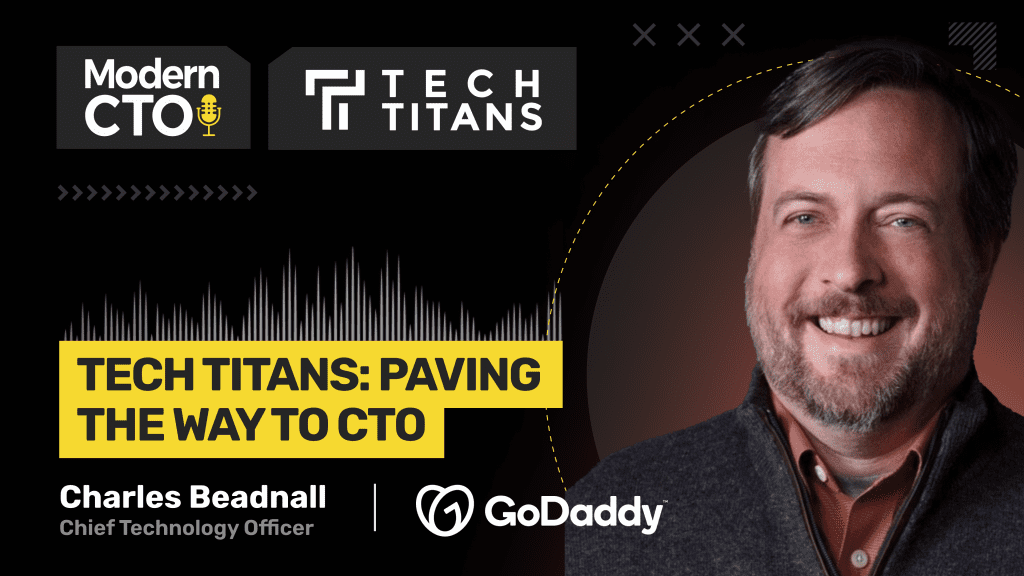
TECH TITANS: Paving the Way to CTO with Charles Beadnall, CTO of GoDaddy
For the next 6 episodes, we are doing something very special. We are taking the best leadership episodes from the most popular past guest and distilling them down to 10 min segments to turbocharge your leadership. If you want even more 10 min condensed leadership episodes you can subscribe to Joel Beasley Tech Titans in your podcast app. Charles Beadnall, CTO at GoDaddy, joins us in this episode to share his greatest leadership advice on focusing less on tech and more on people.
All of this right here, right now, on the Modern CTO Podcast!
Check out more of Charles and GoDaddy at https://www.godaddy.com/
About Charles Beadnall:
Charles is responsible for ensuring GoDaddy engineering delivers a more powerful, integrated experience to customers through the adoption of key technologies. He leads the company’s global platform and infrastructure organization.
Before joining GoDaddy in 2013, Charles was responsible for ad serving and personalization platforms at Yahoo! Prior to Yahoo!, he held engineering leadership positions at Metaweb Technologies, Verisign and WR Hambrecht + Co.
Charles studied at Ludwig-Maximilians Universität and holds a Bachelors of Arts degree from Northwestern University.
About GoDaddy:
GoDaddy helps the world easily start, confidently grow, and successfully run an online presence. GoDaddy was born to give people an easy, affordable way to get their ideas online. Today, we have millions of customers around the world, but our goal hasn't changed. We’re here to help people easily start, confidently grow and successfully run their own ventures - online and off!
Transcript
(Intro Narrator at 00:00:00) For the next six episodes, we are doing something very special. We're taking the best leadership episodes from the most popular past guests and distilling them down to ten-minute segments to turbocharge your leadership. If you want even more ten-minute condensed leadership episodes, you can subscribe to Joel Beasley, Tech Titans in your podcast app. Charles from GoDaddy joins us in this episode to share his best advice on focusing less on tech and more on people. You're listening to Joel Beasley, Tech Titans.
(Joel Beasley at 00:00:35) You're the CTO of one of the most known brands on planet Earth, arguably in the universe. How did you get to where you are today? If you have to look back, obviously it's probably more than one thing. But when you're talking with the next generation of technology leaders and they're like, "You know, Charles, how did you do that? How did you become CTO? How did you get to that point in your career?" When you look back, what do you think got you there?
(Charles at 00:01:01) You know, I had a mentor a long time ago tell me something kind of pithy, and it was something to the effect of good things happen to people who continue to be useful. I think it's easy to say, "Hey, I want to do this," or "I want to do that." But I think when you're talking about a company, you kind of have to look at what does the company need. And I think, you know, it's ideal when your motivation and your skills line up with what that company wants and delivers. But I think I've seen kind of counterexamples where folks are really focused on building a thing that they really want to build, but it may not line up with what the company really needs.
(Charles at 00:01:45) And so I think you really have to ask yourself a question. First is making sure that you understand what the company needs, and not just in this particular moment in time, but even looking out six, twelve, you know, twenty-four months into the future. And I think lining yourself up with things that will help drive the company in a better direction—those are the things that I think you really want to focus on. And sure, I wanted to be a CTO in my career for probably a long time. I don't remember exactly when that original nascent thought occurred.
(Charles at 00:02:25) But I always focused on making sure that what we were doing was lined up with a benefit to the company and our customers. And so I think that's advice that I would give folks: take that look at what the company needs. And obviously, if you're in a company where you can't find that, maybe you need to find someplace where you can. But you know, otherwise, I think that that's the most productive path that I can see to evolving.
(Joel Beasley at 00:02:57) Do you know where the name GoDaddy comes from?
(Charles at 00:03:00) You know, I know that it was the founder and I think his head of marketing at the time. It was one of those kind of funny names that they came up with that sounded catchy, and it kind of took off from there. I think, like you had mentioned, when you start a company, you know, essentially the first thing you do these days, I think, is try to find the domain name. Because ultimately, you're not going to file paperwork to incorporate with a name that's already been taken, or you're going to get some really long, elaborate permutation of it. Naming companies is its own exciting phase, and naming a product as well in a larger company.
(Charles at 00:03:42) And I think, you know, looking for the domain name and being able to find alternates quickly—that's an area that we spend quite a bit of our time focusing on because 70% of the time, the domain name that you want to find isn't available. And so that means you're going to iterate a few times to come up with a different name that is available. And so, yeah, obviously, at the time GoDaddy was founded, it was more likely to be available than it would be even today. But I think it was a similar type of process.
(Joel Beasley at 00:04:13) Yeah. I noticed your tools did get more advanced for domain picking. When you type the domain in that you want, it'll provide all these different alternatives now. And they're actually—at first, everybody kind of had it, right, when it was emerging and it was whatever. It was okay.
(Joel Beasley at 00:04:28) But then they started to get really good, like actually coming up with some really creative things and understanding the name better and the context better. And so I was pretty impressed about the improvements there in the past two or three years.
(Charles at 00:04:41) Yeah. And it's an interesting area because, you know, most search engines are really an inverted index of available documents. And so you're just basically sorting and ordering those in an efficient way, whereas finding a domain name is a very different problem because, essentially, you're looking for the blank space. It's like you want to find the thing that isn't there. And so, obviously, we look at what other people—their permutations of, they don't find it the first time, what do they look for the second time, and what do they end up buying to basically help short-circuit for everybody else, building models that incorporate those different methods.
(Charles at 00:05:26) And obviously doing that in different languages, different regions. I mean, there's quite a lot of complexity that goes into that.
(Joel Beasley at 00:05:36) Yeah. We talk about mission a lot on the show. Last time we were talking about it was with this company called Release. They're like an environment-as-a-service type company. And the guy I was talking to, his name is Tommy.
(Joel Beasley at 00:05:47) Pretty cool dude. But they, you know, they were very, very mission-driven. Their whole thing was like enabling developers to add more value to the world. And when you have the GoDaddy mission, what's the sentence that you use around the office?
(Charles at 00:06:05) I don't know that I have a sentence, but I guess I have a story. I was helping out my local county economic development office during the first months of COVID. And, you know, what I saw was a lot of companies that were in a period of upheaval in terms of they were used to having people coming into their restaurants or shops, and they had their point-of-sale terminal, and they were able to take orders. But all of a sudden, people weren't coming in, and they had to scramble like crazy.
(Charles at 00:06:37) And most of these folks are not software developers. They're not necessarily even the most technically savvy people in the world. This is what they need to do to run their business. But, I mean, their business is making things or cooking things or doing things, and not futzing around with the technology. And, you know, I think it was really at that point where it became super clear to me what the value of GoDaddy was.
(Charles at 00:07:08) And it was to pull those pieces and parts together in a way that allows them to focus on their business and not everything else. And we've subsequently gotten into the point-of-sale terminal business. It allows you to purchase something in a store. It allows you to sell that same product through your own online store or sell it through a number of different external marketplaces. And I think that's really the benefit of our mission: helping these customers out with it.
(Charles at 00:07:39) Because I don't see anybody else really stepping in and trying to help them. If you've got 20 employees, 200 employees, yeah, sure, there are lots of companies out there that'll help you. But if you're very small and just getting started, or you have—you're in a smaller environment—that's something I think that we can help with.