
Episode 717 ·
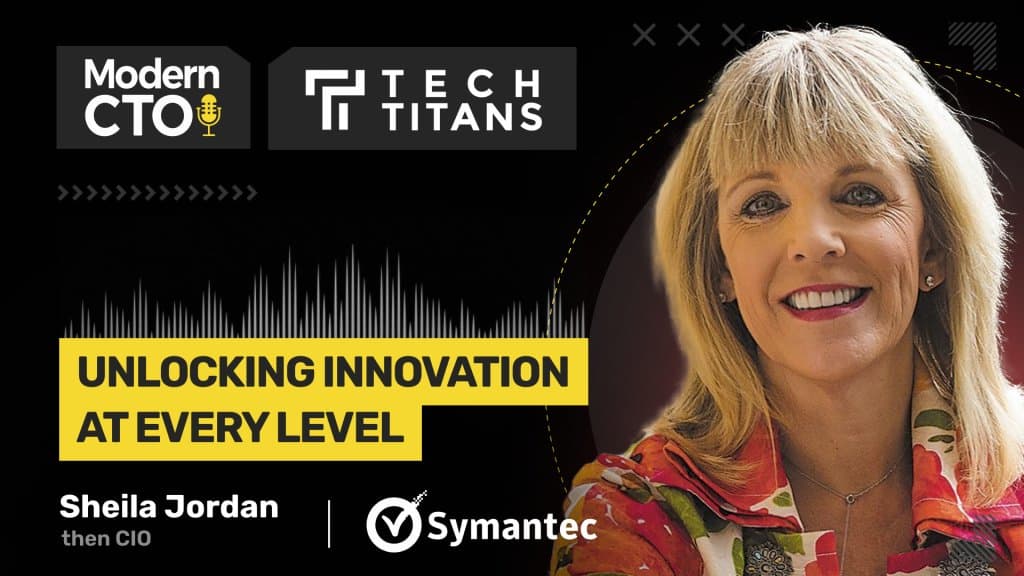
TT: Unlocking Innovation at Every Level with Sheila Jordan, then CIO at Symantec
Today we have an episode of Tech Titans. It features summary episodes of our best leadership advice from Modern CTO. Sheila Jordan, former CIO at Symantec, joins us in this episode to share her greatest leadership advice on how to excel at your role and continuously improve processes.
All of this, right here, right now on the Modern CTO Podcast!
Check out more about Tech Titans on Spotify, Apple, and iHeart!
Have feedback about the show? Let us know here
Produced by ProSeries Media.
About Sheila Jordan:
Sheila Jordan is senior vice president and chief information officer at Symantec. She is responsible for driving Symantec's information technology strategy and operations ensuring that the company has the right talent, stays ahead of technology trends and maximizes the value of technology investments. Her goal is to drive increased productivity, better efficiency and strategic business partnerships through simple and intuitive experiences for Symantec’s global workforce.
Since joining Symantec in February 2014, Sheila has set the vision and strategy for Symantec IT, developed an experienced leadership team, and insourced IT operations from an outside vendor by building Symantec’s next generation secure data center in the company’s virtual private cloud. Sheila also led the effort to split IT operations when Symantec separated its security and information management businesses – a highly successful, transformative initiative accomplished in nine months. Sheila’s role includes oversight of the Global Security Office, and she has established the strategy for “all things security” in an ever-changing and dynamic landscape.
Prior to joining Symantec, Sheila served as senior vice president of Communication and Collaboration IT at Cisco Systems. Within her purview at Cisco were collaboration platforms, user experience and support, and communications, collaboration and mobility services. During her nine-year tenure at Cisco, Sheila’s IT organization was recognized by the industry with awards presented by CITE, InformationWeek and CIO Magazine. She also received the 2010 Cisco Executive Sponsor Catalyst award for her leadership in developing successful relationships with customers, including several Fortune 100 companies.
Earlier in her career Sheila worked at Walt Disney World in Orlando, Florida, where she was senior vice president of Destination Disney. A key architect of the strategic planning process, she was responsible for delivering profitable growth. She was instrumental in integrating marketing, sales, and services across the organization as Disney transformed its business from a product-centric to a guest-centric organization.
In June 2016, Sheila joined the Board of Directors of FactSet Research Systems Inc. (NYSE:FDS) (NASDAQ:FDS), a $6.5 billion global company that delivers the world's best insight and information to investment professionals through superior analytics, service, content, and technology.
She holds a Bachelor of Arts degree in accounting from the University of Central Florida and an MBA from Florida Institute of Technology.
About Symantec:
Symantec Corporation (NASDAQ: SYMC), the world’s leading cyber security company, helps organizations, governments and people secure their most important data wherever it lives. Organizations across the world look to Symantec for strategic, integrated solutions to defend against sophisticated attacks across endpoints, cloud and infrastructure. Likewise, a global community of more than 50 million people and families rely on Symantec’s Norton and LifeLock product suites to protect their digital lives at home and across their devices. Symantec operates one of the world’s largest civilian cyber intelligence networks, allowing it to see and protect against the most advanced threats. Visit https://www.symantec.com/blogs/ for the latest #cybersecurity news. For additional information, please visit www.symantec.com or connect with us on Facebook, Twitter, and LinkedIn.
Transcript
(Intro Narrator at 00:00:01) Today, we're bringing you an episode of Tech Titans. Sheila Jordan, former CIO at Symantec, joins us in this episode to share her best advice on continuously improving business processes. You're listening to Joel Beasley, Tech Titans.
(Joel Beasley at 00:00:20) What are a couple of the leadership themes, things that you would pass on to the audience or other young leaders that are just coming into the corporate world?
(Sheila Jordan at 00:00:29) Yeah, so I have a lot. So one is I have a pretty significant intern group. At Cisco, I created one, and then also I have it here at Symantec. So I spend a lot of the summers working with young interns trying to figure out what they want to do when they grow up in life, which, by the way, I still want to figure out what I want to do when I grow up.
(Sheila Jordan at 00:00:48) Me too. I love my career role. But I would say a couple of things. One is when you walk into a job, you are being evaluated and scored and just evaluated on your current job. So do your job really, really, really well. I mean, excel at it. Do it better than anyone else. Look for ways that you can make it better, improve it, either productivity play or, you know, you learn that there's something that's missing. So don't be afraid to, you know, one, do your job really well. The second part of that is we really do want new, fresh ideas and fresh thinking and young thinking. And we also completely recognize and understand that the millennial generation just works differently. So don't be afraid to give the older people in the organization those ideas, those suggestions, all those kinds of things that can help make you more productive and, or, if you see an opportunity in the company that we're just missing. Sometimes when you've worked at corporate for a long time, you get so used to policies and rules and procedures that we forget sometimes that it might not be smart. So raise questions, ask questions. In my opinion, there are really no dumb or inaccurate questions. Ask, raise, why do we do the things that we do? You know, really be participatory and engaged would be my second point. And the third point, then, is don't be afraid of being ambitious. I think sometimes people get labeled that they're too aggressive or they're too ambitious, and I would say don't be afraid of being ambitious. Do your job really well, get engaged and suggest other things to improve it, but then if you have aspirations and you want to go do something else or go shadow another department or you want to take on more responsibility, if you think you can, there's nothing wrong with asking for that. Nothing wrong at all. So just make sure that you have that dialogue with your manager and just make sure that you're, don't be afraid of being ambitious. That would be my third point.
(Joel Beasley at 00:02:46) Let's say that you have, say it's an engineer. They're interested in moving from individual contributor into team leader. They've got some, they don't really know how to do that, how to focus it. What sort of advice would you give to that individual?
(Sheila Jordan at 00:03:01) So I think one of the actual hardest jumps to make is being an individual contributor moving into management, whatever level that management is, because a couple of things. One is you've got to let go of, when you're an individual contributor, you take super pride in the actual results of your project or Excel spreadsheet or code or whatever that you're doing. And then as you move into management, you have to become less controlling of what the exact output is. You have to say to the teams, here's the guardrails, here's the expectation. I'm going to set the frame and let you guys figure out your style, your way, however you decide to do it. I mean, I liken it to, my husband and I, I don't load the dishwasher the way he does, and he thinks it's wrong, and in my view, the dishwasher is loaded and they're going to get clean or they're easily loaded. But that's the difference. And I use that example because that's the difference in management. You've got to let go of the exact way to load the dishwasher, but you've got to focus on the guardrails of what's the output, which is, you know, the dishes. So I think as a manager, it's the hardest thing to let go of, but to guide and put those guardrails in, but to be very serious about what the expected outcome is. So raise your level of awareness, raise the communication, be clear about the end state, not about the mechanics of how to get there. That's the biggest distinction.
(Joel Beasley at 00:04:20) You're around all these great people all the time, great teams. And so they do different things that stand out to you. And so what catches your eye about a great leader? Someone that you see has a tremendous amount of potential and you'd say, I'm going to keep my eye on that person. What stands out to you about those types of people?
(Sheila Jordan at 00:04:36) I'll raise the question two ways. I want to talk about who are the people I love to work with and who I work for and what's interesting to me, and then I'll talk to you about how I look for leaders in the organization. But to me, and they're not necessarily so different, but they are in one degree. So as a leader and as a leadership team, I just look for authenticity. First and foremost, if you don't have trust inside an organization, then it's hard to get the team to work like a team, like a real team. So I would say authenticity. And again, leaders have a really hard job to do. They can share with you some information. They know what's going on and they can share with you some. Some is there's a cycle that we can't talk about right now because it's strategic and it's quiet, we can't. And others are, you know, we're just not, we haven't quite thought about, you know, we just haven't quite thought about the future of the vision. And so they're always dancing, and I mean it in a positive way, but dancing between the clarity of how they can communicate to the organization, but also recognizing there's some things they can't communicate. And so I think it's super important that I've worked for leaders that are really clear about that. Like, this is what I can tell you right now. This is where we are. We are thinking about this black cloud thing over here. We just can't talk about it right now, but just know there's a lot of energy happening and thinking about it. And when I can talk about it, I will, but I just can't talk about it right now. So I think that level of communication, authenticity, and sharing their view, because, again, leaders have such a different broad view of the company, and people love to hear the breadth of it versus the specific thing that they're working on. The other final thing I'd say from a leader is their job is to create an environment, I think, and a structure of which people feel aligned to the overall mission. So the mission of the company is one thing. The strategies are really going to be clear in the vision. But I want to know that everyone in my organization understands what they're working on, the specific project that they're working on, how that aligns and ties to the mission and the vision. Because, while we all love our jobs, we all want to feel really important and we want to feel great about it, we also want to know that what we're working on is bigger than us as an individual, and we are participating in a bigger mission. And that's why I think Symantec is at such a great spot because we have such an incredible mission, which is to protect the world. I mean, it's pretty big and important. And so we want to make sure everyone in the company can tie to that mission, which is what we're working through right now. As far as leaders I look for, I think, again, I go back to I look for people that do their job really well. Flawlessly. They see it, they connect the dots, they understand what they're working on, but how it connects to others. They have an empathy towards the connection and the ability to connect and make sure that what they're doing isn't going to negatively affect someone else. And if they do, they at least have that conversation about it and they just aren't in it for their own growth and their own agenda. I have no tolerance for that. But then I also will look for people that have a positive attitude, can do, ambitious, and really can think of not why not, but why. You know, why we should be able to do this. We should have the opportunity to go explore stuff. Technology exists. So, you know, what I love is none of the glass is half full, but let's always explore opportunities and ways we can do something versus being no. Let's go ahead.