
Episode 605 ·
TECH TITANS PREVIEW: Brandon Wolf on Servant Leadership in the Workplace
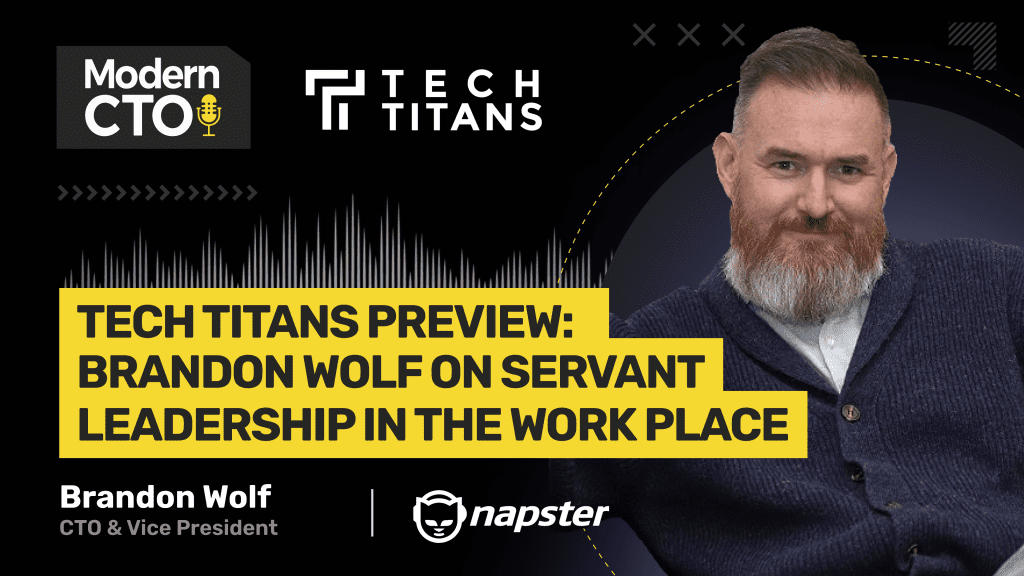
Today we have an episode of our newest podcast, Tech Titans. It features summary episodes of our best leadership advice from Modern CTO. Brandon Wolf, CTO at Napster, joins us in this episode to share his greatest leadership advice on how to integrate a servant leadership perspective and much more. So let's have a seat with CTO of Napster and TECH TITAN, Brandon Wolf.
All of this right here, right now, on the Modern CTO Podcast!
Check out more about Tech Titans on Spotify, Apple, and iHeart!
Produced by ProSeries Media
About Brandon Wolf:
Highly adept problem-solver and executive-level software development and delivery expert. I am a seasoned and industry-recognized expert in software development, architecture, infrastructure, and implementations.
About Napster:
Napster was the original music industry disruptor of the Web1 era. A name steeped in innovation, we are proudly synonymous with music. We started a revolution as the very first platform to imagine how we would all enjoy entertainment in the future.
Utilizing peer-to-peer technology, the original Napster put fans front and center by creating a new means of music distribution. In subsequent years, it evolved into a fully licensed subscription-based music streaming service.
The recently refreshed Napster is currently available in 33 countries across a wide range of connected devices.
At Napster, we believe that diversity of thought, experience, and background are critical to our success, and we’ve created a culture that supports, inspires, respects, and includes all individuals (including colleagues, customers, contractors, and suppliers).
Napster is an equal opportunity employer, and we do not discriminate on the basis of race, colour, sex, sexual orientation, religion, gender identity, marital status, age, disability, parental status, national or ethnic origin, veteran status, citizenship, or other protected characteristic. Working with us is solely down to your talent, experience, qualifications, and professional competence.
This policy applies to every aspect of life at Napster, including recruitment, hiring, training, advancement, and termination. The Napster family live this policy because it’s the right thing to do. It’s who we are.
Transcript
(Intro Narrator at 00:00:00) Today we have an episode of our newest show, Tech Titans. This show features ten-minute summary episodes of our best leadership advice for modern CTOs. Check the description for a link to subscribe. Brandon, the CTO of Napster, joins us in this episode to share his greatest leadership advice. You're listening to Joel Beasley, Tech Titans.
(Joel Beasley at 00:00:26) I want you to think of a person right now who's within your org. You don't have to name them. And they're doing well and they're showing signs, and you're thinking, hey, maybe I should invest a little bit of my time into them and opportunity. What are those things that they're doing that are standing out to you?
(Brandon (CTO of Napster) at 00:00:42) So it would be initiative. You know, I think the initiative is going to be the first part. You've got some people are very much heads down. Tell me what to do and I'll do it. And I don't want to devalue that type of work at all because they're usually very good at that too, and that's just how they like to operate.
(Brandon (CTO of Napster) at 00:01:00) But if we're talking about advancement, you know, primarily to a leadership role or managerial role or something like that, and I don't believe in just because you do a good job, you're therefore qualified as a manager. It's two totally different skill sets in most cases. But for that person that you just described in that scenario, I would say the initiative has to be there from a, like, I am going to take this on. Now the initiative has a lot of different aspects to it. One of them is a nonconformist mindset.
(Brandon (CTO of Napster) at 00:01:27) I'm not just going to follow the status quo. I'm not just going to follow the direction said. I'm going to challenge the conventional thought that's out there. I personally love Socratic method, people who think like that, that are very questioning of things, and they ask questions in a way that kind of lead them to a truth. And that to me shows initiative too, when you are honestly seeking truth in terms of solutioning or designing or architecture.
(Brandon (CTO of Napster) at 00:01:51) Like, these are the things I look for from people like that that are moving on that. And that's an initiative-based aspect for me, not just getting the job done autonomously.
(Joel Beasley at 00:02:00) What would you credit your advancements between your roles? Was it relationships? Was it recruiters? How did you get a leg up?
(Brandon (CTO of Napster) at 00:02:07) I think it's the constant curiosity and self, you know, the autodidactic nature of I've never set foot in a computer class. You know, I don't have a computer science degree, but I went from developer to CTO, I think, just off of just being naturally curious about things and wanting to understand. It's an engineering mindset. You know, I don't think you become an engineer. I think you just naturally are an engineer, and it's what you do with it is really what matters.
(Brandon (CTO of Napster) at 00:02:37) And so I had that engineering mindset. I like to understand how things work. Can I break this and put it back together again? I do this stuff with, you know, just outside of technology too, and a lot of people are like that.
(Brandon (CTO of Napster) at 00:02:47) And I think that credit is constantly keeping up with it, but that's what drew me to it in the first place, because it changes so much. This is not a static, you're not a factory line worker stamping the same piece of metal as it walks across the conveyor belt. You know, you're always having to learn. Like, learn what's coming out. When cloud came about, like, I was all about that.
(Brandon (CTO of Napster) at 00:03:05) I was just invested in this. Like, this is amazing. Nobody really knew what it was. It's kind of like Web3 now, so it was this kind of ubiquitous term. What is cloud? Where is the cloud? How does the cloud work? But that's the part of being a technologist is that you have to keep up with it in order to be good at it. But you should have a natural curiosity and love of that in order to, and it just kind of perpetuates.
(Joel Beasley at 00:03:26) When I was first starting this, I was trying to figure out, you know, what's the recipe for a great leader. So we did all these interviews and we asked them all these questions, all these leadership-related things, and we started tracking them in a spreadsheet. And I was trying to figure out what's that one formula. And after 600 episodes, I've come up with the following, like, one or two things. Number one is everybody has something that anchors them, some sort of system or something that they find very important that they do religiously and consistently.
(Joel Beasley at 00:03:54) So that's one thing that I've seen. And then curiosity, that's the other thing. And then when to become better, it's like people would ask me, I was like, how do I become a better tech leader? And I used to answer like, oh, you know, check out this book or check out this whatever resource material. And then I realized after living, so I'm interviewing these people, I'm building my business, I'm implementing their advice in my business, and then sometimes it goes great, sometimes it doesn't.
(Joel Beasley at 00:04:25) And what I end up finding out is that it's really, really difficult to constantly improve yourself, but that's the answer. So when people ask me now how do I become a better leader, I'm like, well, how many days do you work out? What's your diet look like? Because if you're constantly improving yourself and improving those areas of discipline, then that makes you a better leader because leaders are typically people, well, they're people that you want to follow, right?
(Joel Beasley at 00:04:56) That's why it's so interesting when people get up early. You know, it's how much respect someone gets if they wake up at 4:30 in the morning. But if you're in a different time zone, I mean, yeah, it's not the act of it being 4:30 in the morning. It's the act of it's something difficult that you don't want to do and they can do it.
(Joel Beasley at 00:05:12) And so having that realization, I was like, okay, cool. So all I have to do is do really difficult things for the rest of my life.
(Brandon (CTO of Napster) at 00:05:19) One of the one question I ask of everybody I interview for a leadership position, whether you're managing two people or 250 people: What is your definition of leadership? That's what I asked them, and I look for the one thing that I've taken away as my definition of leadership. And mine actually comes from my time in the Marine Corps. I served under this three-star general at the time. His name was Charles Krulak, and he later became commandant of the Marine Corps. And he was a decorated Vietnam veteran, platoon commander, purple heart, Silver Star, you name it.
(Brandon (CTO of Napster) at 00:05:48) His father was General Krulak, commandant of the Marine Corps during World War II. So we're talking about an organization that deals in life and death on every day. And so leadership from this type of individual is going to be well received. He came to one event we were at. It was just kind of we were all very low rank, you know, E-1s, E-2s, E-3s. And he's like, let me ask you something: What's your definition of leadership? He walked around and asked us, and we were like, oh, you know, it's setting the example, and it's, you know, the constant improvement.
(Brandon (CTO of Napster) at 00:06:16) Those things, like, he nodded and he's like, look, all of the answers you gave, none of them are wrong. You know, I'm not looking for a right answer here, because let me tell you mine just to help you out. He goes, it is just this simple: Serve those in your charge.
(Brandon (CTO of Napster) at 00:06:27) So what we now know of as servant leadership. And that has stuck with me to this day, and I evolve that all the time. So when I ask someone coming in for managerial role, what's your definition of leadership, they're not going to give me a wrong answer. Now they're going to give me a true, honest answer. But what I look for in leaders are people who actually serve those. You've got to be there for them.
(Brandon (CTO of Napster) at 00:06:46) You need to be reliable. People don't follow people because of titles. They follow people because they believe in what they're actually after. This is a Simon Sinek type of—
(Joel Beasley at 00:06:55) I love that guy.
(Brandon (CTO of Napster) at 00:06:56) Yeah, same. Same. So that type of philosophy I can incorporate through. He did a study on the military too, which was super interesting. But, you know, I think there's got to be that inherent trust there, that I trust this person to look after my best interests, and therefore I'm going to make sure that I earn that trust every day, and I've got to earn their trust every day. That's just important to me.
(Brandon (CTO of Napster) at 00:07:17) And trust goes laterally too. You can't have a good C-suite without that trust. You know, I have to rely on the CMO, the CFO, CIO, all of them. There's a trust that's inherent across the board and top to bottom as well. You've got the technical teams, the trust between the users, the trust between the C-suite like I mentioned, board members, investors. And CTOs, I think, need to be highly attuned to that audience so that they can talk about what they're doing and build that trust in a way that's not ivory tower or siloed. So anyway, I went on a little bit of a long tirade there, but I think that's imperative to a well-functioning, not only leadership body, but a leadership individual.
(Joel Beasley at 00:08:01) All right, let's go back to Napster. So when I found out we had a date booked to talk, I was like, oh, I've got to do my research.
(Brandon (CTO of Napster) at 00:08:09) So—
(Joel Beasley at 00:08:09) I went and signed up for a Napster account. So thank you for making it easy to sign up quickly and all of that. And then my first thought was this is a blue Spotify. The interface is blue, right? And I was like, this is Spotify. But it was slightly different, and I didn't dig deep enough into it because I'm not a power user of Spotify, so I wouldn't be able to compare the granular features. So I figured I'd just ask, you know, Brandon, what's the big differences between Spotify and Napster?
(Brandon (CTO of Napster) at 00:08:40) That's a great question. Yeah, first thing, you know, it's important to know the missions are different. Spotify is, look, you can go and watch the, I think it's called The Playlist on Netflix, which talks about their history. It's very interesting. I watched it myself. But we're really about bringing the artists and fans together. And so that artist focus and the fan focus, you know, is really what we're zeroing in on. This isn't just take anything away from, you know, Spotify or YouTube Music or iTunes.
(Brandon (CTO of Napster) at 00:09:12) But we're very invested in that particular piece. And, you know, Spotify, iTunes, YouTube Music, they're not really my north stars in terms of what I look at from a, like, what's going to be the Napster of the future. I don't want to be strictly beholden to just playing piggyback. First of all, we don't have the resources to match those. Secondly, what the streaming platforms, all of them do, including us, is they create a very isolated experience. And so, I mean, in Spotify you can go in and you can have a friend and you can see what they're listening to and possibly even listen along.
(Brandon (CTO of Napster) at 00:09:50) But there's no real room for collaboration. Like, hey, you know, I'll share a playlist with you, but let's make one together. Let's have a jukebox party at the house. We bring some fans and friends over. We can sit around and add music to it individually from our own phones and just create a working group playlist, things like that.
(Brandon (CTO of Napster) at 00:10:05) So we want to explore that more, not only from the user experience side, but also from the artist experience side. One of the things with the reports that you may have seen out there is how much royalties are actually given back to the artists in the forms of their royalty payments. You know, Napster has been noted as higher. Now I will caveat to say that that's based on a very limited test set or sample set of data. It's not always going to be the case because each contract is very different per the labels, per the artist.
(Brandon (CTO of Napster) at 00:10:35) It's just not quite something you can zero in to say Napster pays their artists more than anybody else. But where we're looking at with the Web3 aspect, where we're bringing in, you know, what Algorand is trying to do, is to kind of introduce, you know, open up multiple segments that fulfill a largely untapped market. And this is really three areas: the community building, which I talked about, because, look, we can start to build organic communities around the genres that you're interested in, the sub-genres, the artists themselves, the music festivals that you attend. You know, we can start to gather this information and give a more curated experience around that.
(Brandon (CTO of Napster) at 00:11:14) The second is going to be music distribution via NFTs, which I can talk about in a bit. And the third would be the royalty reporting, which is a big problem in the industry that every one of the DSPs and, you know, anybody who does music distribution shares. But from a user experience side, coming back to your question, it's just a blue Spotify. It's a fair point. You know, we had to make out this major relaunch, what we called in '21, which was launched earlier this year.
(Brandon (CTO of Napster) at 00:11:41) And a lot of that was a couple of years of culminating updates to the user experience and the platform itself, the back end, the front end, all of that. We did, you know, almost a complete revamp.
(Joel Beasley at 00:11:52) It looks great. It looks great, by the way.
(Brandon (CTO of Napster) at 00:11:54) Thanks. And, yeah, once we launched it, it's like we were still trying to play piggyback. So we can't keep looking at that. Look, we want the behavior to be familiar. We don't want it to be something like I've got to learn an entirely new thing of, like, where do I get to my playlist?
(Brandon (CTO of Napster) at 00:12:07) And they call it a library and we're calling it my music. And, you know, all these differences just confuse people because they have a much larger audience than we do, and we don't want to make it difficult for them if they want to choose to use our platform. So hopefully that answers your question, at least in a bit of a roundabout way, because it's, you know, it's not that we looked at it and go, let's just do this, let's just do that. It kind of like user experience and behavior patterns all seem to kind of align when it gets to my playlist as quickly as possible.
(Brandon (CTO of Napster) at 00:12:34) I want to search and find music based on, you know, metadata that is common and easy to categorize and find information on, and then create, curate my own list of that and mark my favorites, and then just go back and listen to it.