
Episode 712 ·
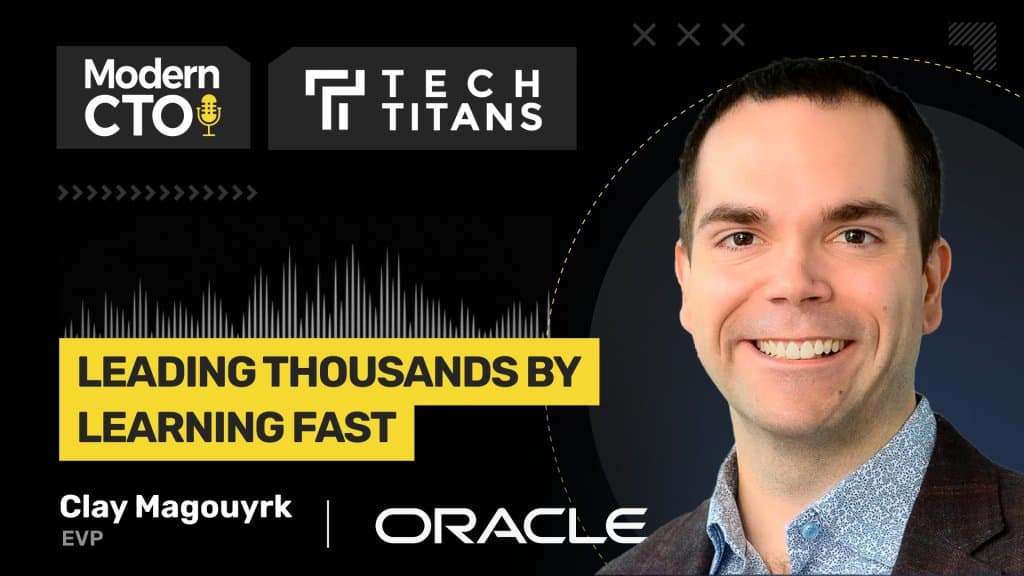
TT: Leading Thousands by Learning Fast with Clay Magouyrk, EVP at Oracle
Today we have an episode of Tech Titans. It features summary episodes of our best leadership advice from Modern CTO. Clay Magouyrk, Executive Vice President at Oracle Cloud Infrastructure, joins us in this episode to share his greatest leadership advice on attracting top talent by crafting an ambitious mission, enabling growth by developing leaders and being ready to learn new skills as your organization evolves.
All of this, right here, right now on the Modern CTO Podcast!
Check out more about Tech Titans on Spotify, Apple, and iHeart!
Have feedback about the show? Let us know here
Produced by ProSeries Media.
About Clay Magouyrk:
Clay Magouyrk is senior vice president of engineering for Oracle Cloud Infrastructure. He is responsible for engineering and technical operations for Oracle’s enterprise-focused infrastructure-as-as-service (IaaS) platform and focuses on service delivery for an expanding product portfolio including compute, storage, networking, edge, and containers.
Magouyrk is a founding team member of Oracle’s cloud engineering development center in Seattle, tasked with building and deploying Oracle’s next-generation cloud infrastructure. He now leads a team of thousands of cloud engineers focused on supporting customers’ most mission-critical workloads via best-of-breed products and solutions.
Prior to joining Oracle in 2014, Magouyrk spent four years as a senior engineer at Amazon and Amazon Web Services (AWS). Before that, he spent two years at Hilton Hotels in engineering. His experience has been focused on highly secure, reliable, performance-based systems. Magouyrk holds a BS in electrical engineering from the University of Memphis.
About Oracle:
Oracle Corporation is an American multinational computer technology corporation headquartered in Redwood Shores, California. The company sells database software and technology, cloud engineered systems, and enterprise software products—particularly its own brands of database management systems.
Transcript
(Intro Narrator at 00:00:00) Today, we're bringing you an episode of Tech Titans. Clay, the Executive Vice President at Oracle, joins us in this episode to share his best advice on crafting an ambitious mission as a leader. You're listening to Joel Beasley, Tech Titans.
(Joel Beasley at 00:00:19) And that seems to be what's happened over at Oracle. You guys attract some of the best talent in the world, right?
(Clay at 00:00:24) Yeah. I think there's a few key things to attracting good people. Right? I joined Oracle five and a half years ago, and there were four of us in a tiny little corner of an office building in Seattle. And now we have more than 5,000 people working on this overall effort we call Oracle Cloud Infrastructure.
(Clay at 00:00:42) And for us to get there, a lot of it came down to, well, how do you attract people? Because it turns out it's really hard to build a cloud with four people. And I got a really quick crash course on how do you get a team together. And having done hundreds of interviews and hired hundreds of people, it's really quite simple. People want to make sure there's the basics, right? People want to have a place to work where there's an office, or they can work remotely, and they want to make sure they get paid. And there's certain things that matter like that. But really what attracts people is who they work with, the people they work for, and the work they're doing, and the mission that all comes together. And so if you have a very attractive mission, an ambitious goal that is not guaranteed to succeed, but very exciting, and you have interesting problems to solve to get to that goal, and you have good coworkers and great people that are leaders, that's all you need.
(Clay at 00:01:35) And, of course, you still have to pay them and make sure they have a place to sit and give them some computers and things like that. But, really, it's about having those overall mission pieces together. And what I love about that is that there's no limitation on those things, right? Those are all something that as a company or as a manager or the team, you get to decide what you should be doing. And you can either choose to be ambitious and interesting, or you can choose to be boring and myopic. I think in general, you'll be more successful by being more ambitious, and you'll attract better people, and they'll be much happier to work there as well.
(Joel Beasley at 00:02:13) Were you on the founding team of this division that you're a part of now?
(Clay at 00:02:17) Yeah. So there were, when I joined, there was four of us. And that was five and a half years ago now. And so it's been a pretty crazy ride over the past five and a half years.
(Joel Beasley at 00:02:28) So did you have to learn PNL type responsibilities? Or did you already have those skills? Or are they not necessary because you have other people on those four that deal with that?
(Clay at 00:02:36) I had to learn a lot. So, you know, my background when I joined Oracle, my background is I used to be a software developer. I was at Amazon for many years and I wrote software. And obviously, you know, coming from Amazon, you have a lot of operational background. So you understand how to maintain services and do operations and that kind of stuff. And you know how to hire and build teams. But there was a whole lot of the giant crash course over the past few years about understanding what does it take to actually run a large organization. What are the responsibilities from a business perspective? How do you even just communicate the financial perspective? And how do you manage things like massive amounts of capacity? How do you build data centers all around the world?
(Clay at 00:03:15) As you grow and scale a larger team, one of the things that's also interesting and difficult is you're no longer managing a team of people that are like you, in the sense that, you know, when you have a small dev team, you typically manage a bunch of developers. Well, when you get to a large organization, you have all different types of people. You have finance people, you have operations people, you have designers, you have technical content writers. And so then how do you actually effectively manage all those different types of roles in a single organization, keep them motivated? There's it's been a very interesting and fast ride over the past few years.
(Joel Beasley at 00:03:49) Yeah. But it's fun, though, right? Because you're always learning new things and expanding your experience.
(Clay at 00:03:55) I've never had an opportunity like this in my life before, and the opportunity I've been given at Oracle is something I'm thankful for every day. It's not always clear to me exactly why they gave me the opportunity. You know, sometimes you look back and go, well, I'm not sure that I was highly qualified at each step of the way, but it seems they've worked out so far, and it's been extremely rewarding for me.
(Joel Beasley at 00:04:16) Yeah. Well, the opportunity floated in front of you, and you had the ability to stand up and grab it, right?
(Clay at 00:04:23) Yeah. And I think that, you know, just to be clear what I view the opportunity as, it's not just the opportunity to grow my personal career, right? In large part, I joined Oracle to make Oracle a successful cloud infrastructure provider. When I joined Oracle five and a half years ago, Oracle was already a very successful technology provider. It has some of the most successful technology pieces in the world, things like Oracle Database, but also MySQL, Java programming language, things like Oracle Linux, middleware pieces like WebLogic, et cetera. And then, obviously, Oracle was already very successful in the application space. Previously, on-prem applications, things like E-Business Suite, JD Edwards, PeopleSoft, Siebel. And then more recently, but still very successfully, things like Fusion Applications where, you know, ERP systems, HCM systems, supply chain management, et cetera. So Oracle was already very successful in all of those areas.
(Clay at 00:05:15) And when I joined, the opportunity really was, well, let's make Oracle that successful, that relevant in the cloud platform space. And so, you know, having worked at Amazon for many years, I knew how difficult that was going to be. But I also knew that this was the closest I could kind of get to doing a cloud infrastructure startup. You know, there's not a lot of VCs willing to give you many, many billions of dollars a year to throw into a giant pit to one day actually have a successful worldwide global cloud scale set of systems. And Oracle was both crazy enough and smart enough to know that that was what they needed to do and then hire some people and make it happen.
(Clay at 00:06:00) And so the opportunity I joined Oracle for is still the same thing that, you know, I'm here today working on. It's still the same thing that I sell candidates all the time. This cloud infrastructure space is going to be very, very large. I think we're still very early on in the overall adoption of cloud. And there's gonna be a relatively few number of players. It's not gonna be 10. It's not gonna be one. And when we make Oracle one of those players, it's going to be a very, very successful business. And also, we're going to solve a lot of the problems that our customers have that our customers just aren't realizing the benefits of the cloud today, and we're gonna be able to deliver that value to them very, very soon.
(Joel Beasley at 00:06:41) How do you specifically recruit these people? Do you look for them to go to conferences to look for? Do you find them through friends? How do you find these high-level leaders?
(Clay at 00:06:50) Sure. Well, there's a few different ways. One way is you grow them as you go. So as you scale an organization, sometimes you find people that can grow with you, and you promote them, and they grow that way. Sometimes, you know the network, right? You hire people, you have connections, and then you end up hiring people that you know are good and you bring them in. Also, a lot of it is you work with the executive recruiters. So, you know, companies like Oracle have a very successful executive recruiting team that have a lot of connections in the industry. You know who are people that can handle orgs of these size, and how do you then go and recruit those people.
(Clay at 00:07:28) And then you interview them and you sell them on the position and the overall opportunity. So I think you kind of do all of those things. It's not so much go to a conference. You do look at people who speak at conferences. But, typically, you know, you're not going to meet them at a conference because the people we're looking for, they're gonna be busy and probably don't wanna talk about that right there. They're giving speeches and they have a bunch of other responsibilities when you're doing that. But you do look for people that are relevant in the industry and have a perspective and a persona because it's also part of the job, right? You need, as you become more senior, you need people that can actually represent themselves internally, that can represent themselves externally, that can speak, and that is a part of the job description as well.
(Joel Beasley at 00:08:10) Looks like now people are gonna be copying you, which makes you the leader, right?
(Clay at 00:08:15) Yeah. I, you know, I try not to get caught up in who's copying who or who's leading. What I really try to focus on is—
(Joel Beasley at 00:08:23) You got me excited. I know. I got excited.
(Clay at 00:08:25) What are the problems that our customers have, and how do we help them solve those problems? The reality is, I still remember the very first time I used an EC2 instance, and I realized that I could back it up and restore it. And I no longer had to worry about messing up a computer, and it changed my life. The reality is this is now ten years later for me, and the vast majority of computing environments still cannot take advantage of that. This is just the facts. My job is to make sure that everyone gets those advantages. That's what I come to work every day to do. That's what we're very focused on here at Oracle, and we're super excited to bring that to all of our customers.
(Joel Beasley at 00:09:07) Just like a mic drop moment. This is a great way to wrap it up. Dude, Clay, we did it. We made a podcast.
(Clay at 00:09:12) Thanks for having me on today, Joel. I really appreciate it.