
Episode 709 ·
TT: How to Scale Company Culture with Parker Harris, CTO at Salesforce
Today we have an episode of Tech Titans. It features summary episodes of our best leadership advice from Modern CTO. Parker Harris, CTO at Salesforce joins us in this episode to share his greatest leadership advice on how to scale your culture as your company grows and how to deal with stress as a leader.
All of this, right here, right now on the Modern CTO Podcast!
Check out more about Tech Titans on Spotify, Apple, and iHeart!
Have feedback about the show? Let us know here
Produced by ProSeries Media.
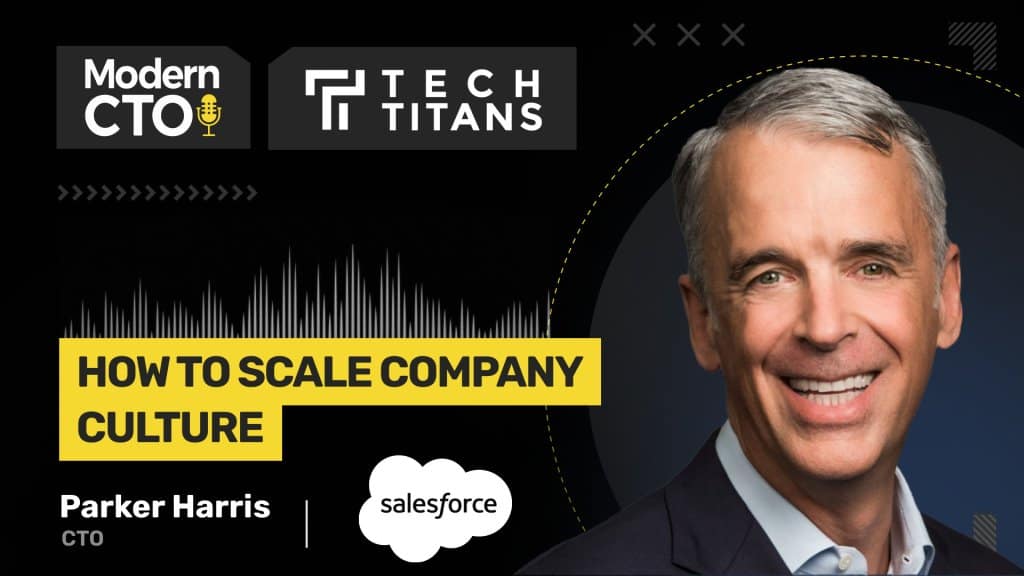
About Parker Harris:
Parker Harris oversees product strategy for Salesforce, from design to development
to service delivery. He is also a member of the company’s Board of Directors.
Parker founded Salesforce along with Marc Benioff, Dave Moellenhoff, and Frank
Dominguez in the spring of 1999.
Prior to Salesforce, Parker developed cloud computing expertise at Left Coast Software, a company he co-founded in 1996, and salesforce automation expertise at Metropolis Software, an early pioneer in field salesforce automation, subsequently acquired by Clarify.
Parker developed a love of math, science and computer programming at an early
age, but also developed the other side of his brain with a fluency in French and a
degree in English Literature from Middlebury College.
About Salesforce:
Salesforce is the Customer Success Platform. Our social and mobile cloud technologies—including our flagship sales and CRM applications—help companies connect with customers, partners, and employees in entirely new ways. Privacy Statement: http://www.salesforce.com/company/privacy/
Transcript
(Intro Narrator at 00:00:01) Today, we're bringing you an episode of Tech Titans. Parker Harris, CTO at Salesforce, joins us in this episode to share his best advice on how to scale your company culture. You're listening to Joel Beasley, Tech Titans.
(Joel Beasley at 00:00:19) Let's run a hypothetical. We'll have fun. I like to have fun. Okay. Let's say that I'm going to do my first acquisition of another technology company, and we have similar customer base, and so I want to acquire them and pull them in.
(Joel Beasley at 00:00:35) And let's talk about the human side of things, so we don't get too technical on the business side of the hypothetical. Human side of things, what should I look for? What advice is, like, after doing all these acquisitions you have, like, a top three hit list, I'm sure, of where you're going to start probing. Give me some advice. It's like, I'm going to do my first acquisition.
(Joel Beasley at 00:00:53) Where should I focus some of my energy?
(Parker Harris at 00:00:57) Well, I think first, you need to try to understand their culture. You know, is it a command and control type of culture where it's very hierarchical? Is it a really flat, super collaborative culture? Is it a culture where teams fully own their areas? You know, you talk about autonomy and mastery, or is it a kind of company that is more matrixed?
(Parker Harris at 00:01:25) And then, hopefully, you understand what your culture is like. And you can do that by, you know, just talking to leaders and understanding their personalities. Ask them about their leadership style. Ask them about their org structure and how, and basically, how they think about building and growing their own company. And then try to figure out, are you similar or are you really different?
(Parker Harris at 00:01:54) And that doesn't mean you should do the acquisition or not. It's, you know, it's not a disqualifier if the culture is different. But I would say if culture is similar, that bodes really well for your success. And it's not that one culture is better than another. It's just that, you know, people are different.
(Parker Harris at 00:02:14) You know, companies are different depending on, you know, really the founders and how they crafted the original organization and vision. If it is different, then you should definitely think about, well, how are we going to integrate them and our, you know, how much are we going to try to change them? You know, it's kind of like a bad relationship. You say, well, this person is really different than me and, you know, but I can fix them. Usually, that doesn't work out well.
(Joel Beasley at 00:02:43) That's my last few girlfriends. No, I'm just kidding.
(Parker Harris at 00:02:48) So that's, you know, from a cultural perspective, super important, and we've grown over time to understand that as important. Definitely look at security. We will disqualify companies, you know, because trust is still our number one value, always has been. And so, you know, technically, how are they dealing with cybersecurity? How do they talk about it and think about it as a priority?
(Parker Harris at 00:03:19) And, you know, we always have to uplevel companies when we bring them in, but how much of a problem is that going to be? And sometimes it can be such a problem that it's deep in the architecture, and it means that it's going to be very expensive to go fix. You know, at Salesforce, our, you know, trust is number one, then customer success, our second value. Well, you know, how does the company you're looking at think about customer success? How do they think about serving their customers?
(Parker Harris at 00:03:51) Are they selling features and hoping that eventually they will deliver and, you know, customers are frustrated? Or are they really focused on making their customers successful at listening? And it's not that, you know, you don't have customer issues. It's how do you deal with them when you do have a customer issue. You know, early on, as we were growing, you know, you get a two-person company, a three-person company complained to us in an email, and Marc would say, we'll get right on it.
(Parker Harris at 00:04:21) And we would put our top people on it. And, you know, if you look at that as a size issue or a money issue that, you know, what they're paying us versus what we're putting on it, we're not making money on that account. It's totally the wrong way to think. It's, you know, make every single customer successful, and they will help you grow your company. They will become the Trailblazers is what we call them now, because they'll spread word of mouth.
(Parker Harris at 00:04:48) They'll talk about your company, and they'll frankly help you scale.
(Joel Beasley at 00:04:55) How do you personally deal with stress?
(Parker Harris at 00:05:00) Yeah. Well, you know, one of the things that, you know, as I said, our people are most important. And we have, in our planning process, which we should probably talk about, our first priority is actually people and their well-being. And so what I've always done is, you know, obviously, food and sleep, it's the basics. Like, make sure you're eating right, make sure you're sleeping.
(Parker Harris at 00:05:30) I get exercise. And exercise certainly helps with stress. But, you know, we've had some super stressful times, and I usually try, at some point, you have to let yourself, you have to give yourself permission to be less stressed is what I would say. And you can do that by stepping back and try to get a little perspective on the situation. And, frankly, I also use humor.
(Parker Harris at 00:06:00) I think humor is a great stress reliever that, and some people find it a little dark. But in the most stressful situations, when things are really, really tough, I usually will make a joke out of it, you know, and just laugh about it. And that makes me feel better and usually helps others kind of get a little relief.
(Joel Beasley at 00:06:22) No, I love it. And I like that you talked about the basics too because they're always the most boring and everybody knows them, but they're the hardest to do consistently.
(Parker Harris at 00:06:33) Yeah. Yeah. And I always tell people, look, we are not running a sprint here. You know, we just had our twentieth birthday. We are running a marathon.
(Parker Harris at 00:06:43) You know? As you said, you're a runner. You're here in San Francisco, and you say, I'm going to keep going. You keep going across the Golden Gate Bridge. Well, I want all of our engineers to keep going.
(Parker Harris at 00:06:51) And so, you know, if we're overstressed in the short term and we feel like this one thing is the most important thing in life and nothing's more important, then how are you going to get to that next one if you become so stressed that you get burned out, that you need to take a break? And sometimes that happens, and that's okay. And, you know, that's another way to relieve stress. It's like, okay, you really need to take a break. So we'll tell people, go take a break.
(Parker Harris at 00:07:16) One of our top engineers at a previous company, we tried to hire him early on. His name was Craig Weissman. He was our second CTO. And we brought him into the office. He was, and he was really stressed out.
(Parker Harris at 00:07:32) And we're trying to hire him. And they said, alright, Marc, we want you to talk to Craig. I want you to close. It's really important. So Craig goes into Marc's office, and they're talking and talking.
(Parker Harris at 00:07:44) We're waiting for him to come out. We're, like, really excited. Like, Marc is a consummate closer. He is going to close. Craig comes out and he says, well, Marc told me I need to go to Spain for a month, and I need to spend a lot of money on a great house that, you know, I could live in and that I just need to go relax.
(Parker Harris at 00:08:17) I'm like, what? You're supposed to come here and help us build Salesforce. What happened? And Marc just read him and said, you know, you're too stressed. You know? You need to leave and go take care of yourself.
(Parker Harris at 00:08:28) And he did, and then he came back. And, you know, he's the father of Apex Code, father of Visualforce. You know? He brought some of our coolest and most successful technological advances, and it was worth waiting. And so, you know, your well-being and your ability to deal with stress is super important.
(Parker Harris at 00:08:56) I think, you know, we're never perfect, but we focus a lot on it.
(Joel Beasley at 00:08:56) No customer should ever have anything but a perfect experience. That's what we shoot for. And, right, it just, it's amazing how, like, it attaches to you, and it's like you can't let this happen. You know?
(Parker Harris at 00:09:06) Yeah. And so my advice to you, you know, if you think about your company, you said you had, what, 10 people? Yeah, 11.
(Parker Harris at 00:09:14) Yeah, 11 people? So it's easy for those 11 people to understand your culture and understand that value. But, you know, that's why it's been important for us to write our values down, to talk about them.
(Parker Harris at 00:09:26) You know, when we have events and we market to our customers and our partners, we want our employees to go to those events because we're also teaching our employees about what we value and what's important. And so think about, you know, if you were going to go from eleven to, you know, 10,000 people, which would be pretty cool, how do you then make sure they all share your values, what you just said? And so making sure you write it down, making sure you're communicating transparently as a company, reviewing it openly and transparently regularly. And, you know, how do you onboard your employees to teach them not just about your technology and your mission of the company, but your values is super, super important.
(Joel Beasley at 00:10:18) I'm taking notes, Parker. And then I'll develop lots of relationships with great people like you to help keep me on the right track. But, yeah, we have dreams of complete and total domination of the industry. Simply because if we're, that's, like, by us doing our best work, that's the natural byproduct.