
Episode 711 ·
TT: Ditch Your Comfort Zone with Duncan Epping, Chief Technologist of VMware
Today we have an episode of Tech Titans. It features summary episodes of our best leadership advice from Modern CTO. Duncan Epping, the Chief Technologist of VMware, joins us in this episode to share his greatest leadership advice on taking steps forward in your career and how to get out of your comfort zone.
All of this, right here, right now on the Modern CTO Podcast!
Check out more about Tech Titans on Spotify, Apple, and iHeart!
Have feedback about the show? Let us know here
Produced by ProSeries Media.
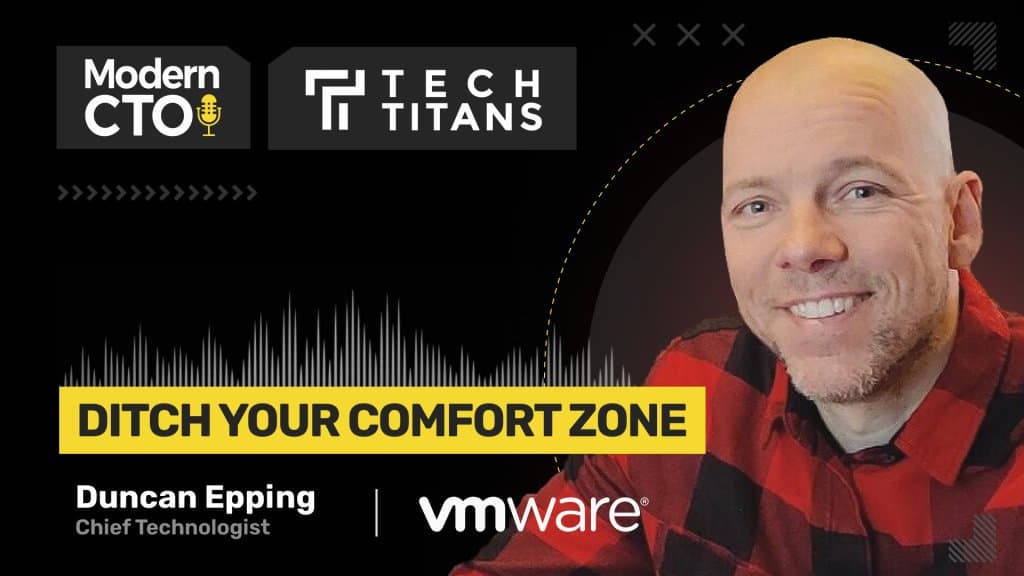
About Duncan Epping:
Duncan Epping is VMware’s Senior Director and Chief Technologist for HCI. In that role, he serves as a partner and trusted adviser to VMware’s customers and partners. Main responsibilities are ensuring VMware’s HCI future innovations align with essential customer needs and translating customer problems to opportunities. Duncan is a recognized leader in the technical community and considered one of the top 50 most influential leaders globally on the subject of Storage & Availability, virtualization, and cloud. He has 6 patents granted and 5 patents pending on the topic of availability, storage, and resource management.
Duncan was amongst the first VMware Certified Design Expert's (VCDX007) and the main author and owner of VMware/Virtualization blog Yellow-Bricks.com, which is one of the leading virtualization / hyper-converged / SDDC blogs. Duncan is a regular keynote speaker at industry events like IP EXPO, Partner Exchange and VMUG User Conferences globally. Duncan has presented at every VMworld in the US and Europe since 2009.
About VMware:
At VMware, we believe that software has the power to unlock new opportunities for people and our planet. We look beyond the barriers of compromise to engineer new ways to make technologies work together seamlessly. Our compute, cloud, mobility, networking and security offerings form a digital foundation that powers the apps, services and experiences that are transforming the world. Since our founding over two decades ago, our 24,000+ employee community and ecosystem of 75,000 partners have been behind the technology innovations transforming entire industries – from banking, healthcare, and government to retail, telecommunications, manufacturing, and transportation. Every day, we work to solve our customers’ toughest challenges through disruptive technologies like edge computing, artificial intelligence, blockchain, machine learning, Kubernetes and more – to define the digital foundation that will accelerate the next wave of innovation.
Transcript
(Intro Narrator at 00:00:00) Today, we're bringing you an episode of Tech Titans. VMware's Chief Technologist, Duncan Epping, joins us in this episode to share his best advice on how to get outside of your comfort zone. You're listening to Joel Beasley, Tech Titans.
(Duncan Epping at 00:00:19) If you—
(Joel Beasley at 00:00:19) would have explained to me ten years ago or tried to get me to understand ten years ago this concept of value creation, people pay for solutions to problems and all of these things, I just wouldn't do it. But after going through the motions, it's so obvious and right in front of us. And so I love that your mind is right on value creation.
(Duncan Epping at 00:00:39) Yeah. I mean, that's a key thing. And I think that's the key thing and everything you do, right? You asked the question in terms of just a couple of minutes ago in terms of, you know, career development and stuff like that. How do you go from senior or from a senior consultant to Chief Technologist?
(Duncan Epping at 00:00:54) And, you know, I think there a couple of things that are really important. First of all, providing value. If you don't provide any value, then, you know, you're not going to get noticed in any shape or form. But then secondly, which is what I tell—I do some mentoring for people. And one of the things I always mention to people is that what's really crucial is communication, right?
(Duncan Epping at 00:01:14) If you don't speak up, right? If something is not right and you don't speak up, then you're never going to stand out. And in some cases, you may find yourself in a scenario, situation—I've been there, right?—where the whole company or a large portion of the company doesn't appreciate the feedback that you've provided.
(Duncan Epping at 00:01:35) But in the end, if it solves the problems for customers, at some point in time, those people will look back at it and be like, you know what? He actually had a point. He wasn't just trying to be, you know, a nasty person. And they've used some pretty nasty names when it comes to me when providing feedback. But he was trying to solve a problem for customers.
(Duncan Epping at 00:01:53) And in the end, you know, he actually did have a point. And, you know, he did it to make sure that not only the company, but, you know, the product that those people were responsible for did become successful.
(Joel Beasley at 00:02:07) So let's say we've got some people listening and they're like, I want to progress in my career. I hear these two individuals talking about these concepts of providing value and communication that they need to get better at understanding these two things. Where do you point people that you mentor? How do you tell them to get better at understanding value and get better at communication?
(Duncan Epping at 00:02:25) Yeah. I mean, of course there are a multitude of books that you could start reading. Typically, well, I do read books, but I'm not the biggest book reader. So one of the podcasts you may have heard of the podcast, but one of the podcasts that I tend to listen to is The Art of Manliness. And The Art of Manliness, they have, you know, an insane amount of episodes that typically discuss, you know, anything from public speaking, you know, just communication in general.
(Duncan Epping at 00:02:56) You know, how to work, how to work at being uncomfortable, how to get comfortable with being uncomfortable, which has everything to do, you know, could be part of your career as well, right? Everyone wants to progress to the next level. But in order to progress to the next level, you need to, you know, move out of your comfort zone, which isn't always, you know, the most pleasant space to be at. So you need to get comfortable with getting out of your comfort zone. But that is one of the things that I've been focusing on, listening to some of the podcasts, and especially the Art of Manliness.
(Duncan Epping at 00:03:30) They have some really great episodes where they discuss, you know, things like communication and stuff like that. The other thing that I would say what probably helped me personally the most is public speaking. I mentioned that at the start, I used to be terrified of public speaking. So even, you know, at school back in the days when I was 14, 15, I wouldn't do any presentation whatsoever. I would get physically sick.
(Duncan Epping at 00:03:55) So I would call in at eight in the morning, tell them that I was sick and I would actually be sick, just thinking about the fact that I do a present—I had to do a presentation at school. I forced myself to start doing that at smaller events and larger events. Unfortunately for me, I wasn't the smartest when I started out. So I started out with one of the largest IT conferences that there is in this space. So I started out at VMworld, unfortunately, which is not a smart thing to do, which I would never, ever recommend anyone doing. So if you're interested in learning how to communicate, how to speak to an audience, whether that's a small group or a larger group, you know, public speaking is key because the one thing that I think it taught me most is to think about what you're going to say. Think about the key points that we like to get across.
(Duncan Epping at 00:04:45) And before you do, you need to get an understanding of the audience. And I think those things are key in general when it comes to communication, because you and I can be talking, you know, for an hour. But if I don't understand, you know, at what level, for instance, in terms of technology you are, right, you may have heard about VMware. You may have not heard about VMware. And I can start talking about, you know, things like transparent page sharing and how DRS scheduler and whatever it is.
(Duncan Epping at 00:05:12) But if you barely know what a virtual machine is, you're not going to understand, right? So by doing public speaking, you basically—it will force you to get a better understanding of the audience. And then, you know, it will force you—how to know—it will force you to learn how to interact with the audience as well. You can see their responses, you know, what to say at certain points in time.
(Duncan Epping at 00:05:33) And it will allow you to learn how to make or how to figure out what is absolutely crucial in terms of the message to get across. So I think, you know, that is probably the most important thing.
(Joel Beasley at 00:05:46) Yeah. And I was going to say, usually the way the world works is even if you want to get up and get in front of a lot of people, you can't because you just don't have those—you had the title and you had to be able to—
(Duncan Epping at 00:05:58) Well, it's an interesting thing because let me let me tell you the story. This is probably funny for the people listening. So it is probably about eleven years ago. I had just joined the company. I was still a senior consultant and I was already doing a lot of blogging on the topic of vSphere availability.
(Duncan Epping at 00:06:17) So it's very specific for our space. I just provided one of the engineers some feedback and that engineer was actually—he submitted a session for the conference. I didn't submit a session for the conference. He submitted the session with conference. And after we had a couple of conversations, he reaches out to me and says, you know what?
(Duncan Epping at 00:06:35) Would you like to join me during this session? Well, I'm terrified of public speaking. So my first answer was, no, not really. I'm not interested. I don't want to do it.
(Duncan Epping at 00:06:44) You know, I've got too much thing going on, trying to find an excuse. He's like, you know what? Could you help me create the deck? Because you are in touch with customers on a daily basis. I just want to make sure that my content actually reflects what these guys would like to hear.
(Duncan Epping at 00:06:57) I said, you know what? Sure. I'm happy to help you with the deck. So the two of us started creating this deck. And then, you know, after two months of going back and forth, going back and forth, having meetings, conference calls and going over the content, he was like, you know what?
(Duncan Epping at 00:07:11) You know the content really well. Why don't you just present half of the deck? I'm like, yeah, I don't know. I don't really want to do it. But at that point in time, I realized that, like I mentioned, in order to move forward, I need to do and make sure to get my name out there.
(Duncan Epping at 00:07:26) And I need to get comfortable with public speaking because, you know, at some point in time when you get to a certain level, you will need to present in front of a large group. So I said yes. But before I said yes, I asked him, I said, how many people are going to show up to this session? He said, well, on average, about 100 people. If we're very lucky, 125, 150. I'm like, whoa, okay. So I immediately start to get nervous. Now, two weeks before the event, he drops me an email and he says, you know, Duncan, I've got a problem. We have this release coming up after VMworld.
(Duncan Epping at 00:08:00) I have six escalations that I need to take care of, so I need to solve these bugs. Otherwise, we can't ship the release. So, you know, that's obviously not not not an option. I'm like, okay. So now what? He said, well, you need to deliver the session on your own.
(Duncan Epping at 00:08:15) Okay. I said, well, you know what? It's 100 people probably. Who cares? I'll do it.
(Duncan Epping at 00:08:23) So he emails the VMworld team and says, you know what? I can't be part of the session any longer. Please register the session fully to Duncan's name. So VMworld registers the session to my name and I get an email that mentions the session is registered to your name. Here is the back end system.
(Duncan Epping at 00:08:40) You can see how many people signed up. Well, you probably can already guess what happened. I click on the link. I go to the session itself and I notice that it doesn't say 100 or 125 or 150, but it actually says 730 people. So they bumped us off to, like, four times to the biggest room that they had available within the Moscone Conference Center in San Francisco.
(Duncan Epping at 00:09:05) Not only did they have the session once, but they scheduled the session twice because there were so many people that wanted to see the session. As you can imagine, when you need to go up in front of 700 plus people, you know, a room which is literally, you know, hundreds of meters deep, you know, probably 100 meters wide. It's just—it's terrifying. It's terrible. And like I said, that's why I would never, never recommend anyone to start out with a large conference because it just, you know, it wipes you out.
(Duncan Epping at 00:09:33) I was drained for the rest of the day when I delivered that session. I could tell you that I was sweating. I couldn't eat. I couldn't drink. I felt sick.
(Duncan Epping at 00:09:41) It was horrible. But in the end, although it wasn't my best session ever, it was, you know, probably the worst session I ever done. I knew it was. I realized that as well, that it wasn't good. But I knew, you know, you know, I did it and it can't get worse than this.
(Duncan Epping at 00:09:59) So I just need to make sure I get more practice. I do it more often and probably the next time, hopefully it's going to be a smaller session, which of course at VMworld will never happen. But at some of the user conferences, it will happen. So, you know, I made sure to just do it more and more often to ensure that, you know, at least at this point in time, I could do a decent job at it because it's not a great feeling when you get off stage in from 700 people and you know that it wasn't what you would hope for.
(Joel Beasley at 00:10:31) No. But when you crush it, when you get off stage after you crushed it, that is an unbelievable feeling.
(Duncan Epping at 00:10:38) Yeah. I mean, that definitely happens, of course, but definitely usually not the first time. That happened when you've done it a bunch of times.
(Joel Beasley at 00:10:45) Yeah. For me, it was, you know, standing up in front of, you know, a team or just a small group of people and then, you know, giving my first presentation. I think there's probably, like, 10 people in the room and then did another one, 10 or 15 and then did another one, like, 30 people, 35, and then, you know, 50, and then 100. And then I, you know, did that for a couple months. I was speaking to rooms of 100, and then it went 500, 5,000.
(Joel Beasley at 00:11:11) And then there were—I noticed that there wasn't really much of a difference between, like, 5,000 because you can only—it can—the room can only feel so big. There can only be so much energy. I think, like, if you go to, like, 25,000, if you were—it would be different if you were, like, in a stadium. Right? But as long as you're in the rooms where they're just, like, pulling down those walls and expanding it deeper and wider, you kind of get that, like, front stage—you get the feeling of the room, and I don't know. It's fantastic.
(Duncan Epping at 00:11:40) But that also very much depends on how often you've done it. So the one thing that I've noticed the very first time that I did a—that I did my session at VMworld, which was the one that I was just talking about, is, because I was so nervous, I got really hyper sensitive. So, you know, if someone would drop his pen all the way at the end of the room, I could hear it. I noticed, you know, every single thing in the room. That was mainly because I was so freaking nervous.
(Duncan Epping at 00:12:05) These days, you know, if someone's phone will ring, you know, I will probably make a joke and continue with the conversation. Right. It's not a problem anymore. But especially, you know, when you get started with these types of things, you tend to get hyper, hyper sensitive. The thing that I probably learned most is that the most common mistake that people make is when they start presenting and especially when they have a slide deck and they've rehearsed it many, many times, they are so focused on the content.
(Duncan Epping at 00:12:35) They're so focused on delivering every single bullet point that's on the slide. And then when they forget a slide, they tend to get extremely nervous or they forget, you know, a bullet point and they tend to get extremely nervous. What a lot of people don't realize is that no one in the audience knows what your talking track is for the slide, right? It's just that the slide is there to support your story.
(Duncan Epping at 00:12:56) So make sure that it doesn't contain an insane amount of detail. Right. A picture, a couple of words—that usually works really well, something that supports your story. But more importantly, if you forget to say something, don't get nervous because you can repeat it. You can say it the next slide or five slides down the line.
(Duncan Epping at 00:13:14) You could take a step back and come back again. Right. It doesn't really matter. People don't know what you're going to say. And the other thing that I think is really important, something that I didn't realize, is that especially with these, you know, technology conferences, every single person in the room is there to learn something.
(Duncan Epping at 00:13:29) So if you're speaking, you don't need to get nervous that someone's going to be heckling you or, you know, they are looking for you to fail. They are spending, you know, that time during a conference to learn something. They're not going to sit there for an hour waiting for you to fail. They're there to learn something. So you probably have something valuable to mention.
(Duncan Epping at 00:13:47) Otherwise, they wouldn't have picked the session. Yeah. Don't get nervous.
(Joel Beasley at 00:13:51) Yeah. They are on your side for sure.
(Duncan Epping at 00:13:53) For sure. But it's easy to forget, right? When you have 700 people staring at you or 50 people, whatever it ends up being, the first few times you will forget about that. But it's definitely something you need to ingrain, you know, in your memory because it's important.
(Duncan Epping at 00:14:07) It will help you deliver the story.