
Episode 659 ·
TECH TITANS: Navigating the Cosmos of Leadership with Douglas Terrier, CTO at NASA
Today we have an episode of our newest podcast, Tech Titans. It features summary episodes of our best leadership advice from Modern CTO. We’re bringing you a throwback from 2018: Douglas Terrier, CTO at NASA, joins us in this episode to share his greatest leadership advice on how to precisely implement the right amount of safety, and why you should act like you don’t know what can be done.
All of this, right here, right now, on the Modern CTO Podcast!
Check out more about Tech Titans on Spotify, Apple, and iHeart!
Have feedback about the show? Let us know here
Produced by ProSeries Media.
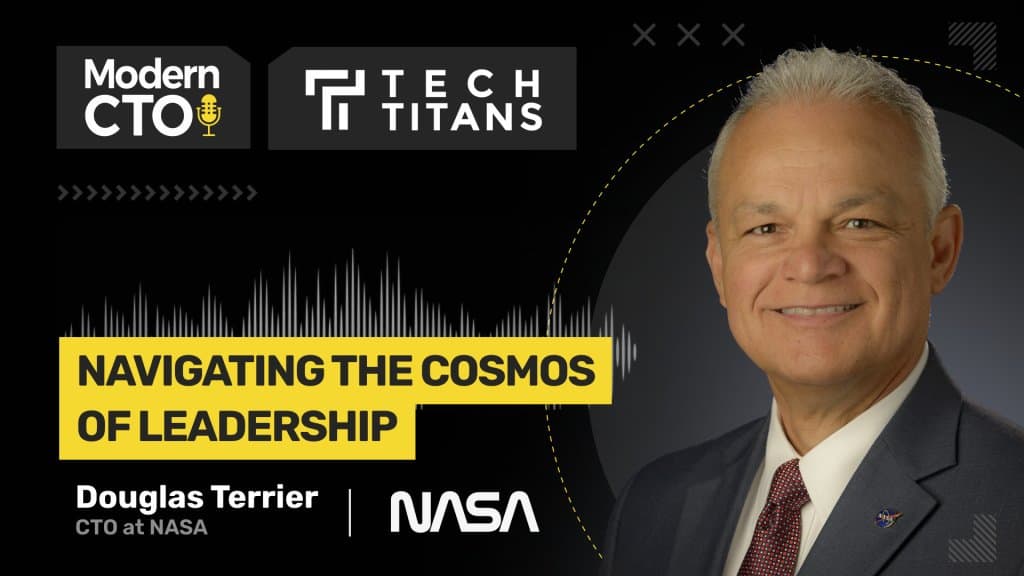
About Douglas Terrier:
GDIT Federal Civilian Division VP and Chief Technology Officer with over 20 years of experience in Federal Government Technical Contracting. Michael oversees a team of solution architects who focus on bringing creative and purpose built solutions to GDIT’s Civilian, State and Local government customers.
About NASA:
For more than 50 years, NASA has been breaking barriers to achieve the seemingly impossible—from walking on the Moon to pushing the boundaries of human spaceflight farther than ever before. We work in space and around the world in laboratories and wind tunnels, on airfields and in control rooms to explore some of life’s fundamental mysteries: What’s out there in space? How do we get there? And what can we learn that will make life better here on Earth?
We are passionate professionals united by a common purpose: to pioneer the future in space exploration, scientific discovery and aeronautics research. Today, we continue NASA’s legacy of excellence and innovation through an unprecedented array of missions. We are developing the most advanced rockets and spacecraft ever designed, studying the Earth for answers to critical challenges facing our planet, improving the air transportation experience, and so much more.
Join us as we reach for new heights and reveal the unknown for the benefit of humanity.
Transcript
(Intro Narrator at 00:00:00) Today, we're bringing you an episode of Tech Titans, and this one is a throwback from 2018. Douglas Terrier, the CTO of NASA, joined us in this episode to share his best advice on having a limitless mindset. You're listening to Joel Beasley, Tech Titans.
(Joel Beasley at 00:00:21) What sort of project iteration practices do you have? How do you ensure the high availability systems? Do you have any tips for us on that? A lot of our listeners make product. Whether it's hardware or product, they go through these life cycles.
(Joel Beasley at 00:00:35) And sometimes they get a little crazy with pushing stuff too early.
(Douglas Terrier at 00:00:40) Well, so, you know, the thing about space flight is—I mean, it cannot be overstated—space flight is the most challenging environment, period. It's a very, very hard business. So, you know, as I said, I worked 20 years on stealth fighter technology at Skunk Works at Lockheed, which is pretty cool, pretty demanding, and that was an amazing experience for me.
(Douglas Terrier at 00:01:03) Even from the outside, I used to look at NASA and kind of, obviously like most people, admire what NASA was doing. But I didn't appreciate until I became a part of this organization that the bar is a little higher. So the reasons—there are a couple of reasons. One is that the environment is the most challenging environment because of temperatures, pressures. You know, reentering at Mach—so you fly a supersonic aircraft at Mach two, Mach three, at 80, 90,000 feet, and you're really pushing the envelope, so to speak. Right? That's not even the—that's a corner of the envelope in space flight where you're going to reenter at about Mach 25 reentry speeds. Temperatures outside approaching the surface of the sun.
(Douglas Terrier at 00:01:46) And, you know, just to have any material, any system survive in that environment is really difficult to explain just how hard that is to do from a physics perspective. We literally have one example that I think is really important to just give you a sense of it. Right? The temperatures inside a liquid oxygen, liquid hydrogen engine burning are much, much higher than the melting point of steel. But we build engine nozzles from basically steel, and we have a flame inside that is easily a blowtorch that will melt through that in less than a second.
(Douglas Terrier at 00:02:20) And what protects that material from burning through is a thin film of cooling film of liquid hydrogen usually, or gaseous hydrogen that's millimeters thick. And that's how precise the control is, and that's how small the margin is. So when you're operating in an environment like that, there really literally is no room for error. And that's something you don't encounter in other systems. So back to your question, if you're designing a bridge, if you're not sure, you use a safety factor of two. You put twice the material that you need. And most people don't realize it, but when you build a structure of any kind, build a bridge, do your calculations as well as you can, estimate the loads, and then you just multiply by two.
(Douglas Terrier at 00:03:02) So you've got some pad there to ensure that you won't have a failure. If you build an aircraft, typically a safety factor of 1.4 is about all you can afford because it'll be just too heavy to fly. When you build a spacecraft, as an example, if you read the book The Martian or seen the movie, you know, first man with the arms, finally it's landing, we left the ground with about 6 million pounds of fuel.
(Douglas Terrier at 00:03:27) The Eagle landed with about 10 seconds of fuel remaining. That's how razor thin the margin is. Point is you can't pad, so you have to get it exactly right. With that being said, you know, you don't have the advantage of just kind of adding more stuff or adding more redundancy or more mass than you need.
(Douglas Terrier at 00:03:48) So what we have to do is a very, very stringent acceptance testing process to ensure that we know for a fact it's going to work every single time. And that's different than most industries. That acceptance testing, a very rigorous qualification environment, is very different than most industries. And that's what I learned coming in: the difference in margins and, because of that, the difference in how rigorous the testing has to be.
(Joel Beasley at 00:04:14) That's interesting. I'm going to look for some books written by NASA-related type project managers or engineers on how they draw a line with how much rigor is too much rigor. There's a process.
(Douglas Terrier at 00:04:30) You're exactly right. And, you know, the important thing to realize is that—so there is a discussion about, hey, are you putting too much safety? You know, what is too much safety? Well, I think many of us who are involved in this—first of all, NASA is a very different culture than you may find other places because we don't have test pilots.
(Douglas Terrier at 00:04:52) We have astronauts who are part of the team, whose kids go to school with my kids in Houston with my son, literally. Same churches. We go to the same baseball games on the weekend. So this is a family, and there is no higher value than safety here. None. Having said that, as I just mentioned, the margins are so thin that you have to be pretty—you have to really stress every possible analysis and test just to make it work. So I think it's actually not realistic to say, maybe you're putting too much pad on it, because there really isn't room for very much. We have to make sure it's in the right place to keep the system safe, and there's just enough to make it work.
(Joel Beasley at 00:05:37) I want to talk about some leadership stuff because I have you here, and the way you speak and just knowing you, you're a visionary and you're an exceptional leader. And so I've got to know, with your team that you work with, how do you go about feedback and doing sort of your feedback loop with your current team about how you improve and how you give them feedback? Could you talk a little bit about that?
(Douglas Terrier at 00:06:00) That's a really good question because, like with everything else, right, it's all about the people. And I'll tell you something that is a little different than maybe in other places, particularly in the commercial sector where I come from. When I took the job here, I'll share this with you. My boss at the time, the acting administrator at the time, called me in, and he said, "Hey, now I want you to know I was a member of the senior leadership team."
(Douglas Terrier at 00:06:25) And he said something really interesting. He said, "I want you to understand that I'm not actually measuring you from what you invent or what you do, your personal technical accomplishment. I'm measuring you by how well you grow and mentor your team." And that's a very different way to think about leadership. And that's the way NASA thinks about leadership. It's empowering the team to be as great as they can be. Because we have this incredible advantage that everybody wants to work at NASA. So you get the brightest and the best people. And really, what you need to do is create the conditions for them to thrive and, by definition, the organization to thrive.
(Douglas Terrier at 00:07:03) The way we do that and have historically done that is really just to focus everybody on what we've been talking about, that audacious, inspirational mission. And as long as everybody can get their energy inspected around—well, everything you do every day is about enabling that mission to occur safely and productively. You could be pretty amazed at how much people can do if they're given the very precise mission and given—you know, empowered to go do that. So one of the things we do in my group, just as an example, is we have, you know, we'll have a little retreat with the whole group and go off and take a day off and think about what our goals are in our particular organization and the technology investment world that we're concerned with.
(Douglas Terrier at 00:07:45) But we try to talk about who is our customer, and what does that customer value? And in our case, that's the leadership team and the mission that we're trying to accomplish. And we look at every single thing we do, every activity, and we try to analyze whether that's actually delivering value. And if it's not delivering value on that mission to that customer, then we don't need to do that, or we look at how we can do that better in every one of our engagements. And I think, you know, that sounds pretty simple, but it's actually—it is people's thoughts. It's everybody pretty clear on what the goal is, and everybody will get behind that. Because we actually don't have the problem of trying to motivate people. We have extremely motivated people.
(Douglas Terrier at 00:08:30) We need to be able to channel that motivation and have it aligned, unequivocally aligned, focused on the mission at hand, and to give people all the tools they need to succeed.
(Joel Beasley at 00:08:43) You went through, like, seven of my questions just there. No, you're exactly right. Because when you were talking about that, I imagined an astronaut with their tube being hooked back up to an oxygen tank. When you have that focus, and I find myself as a leader of my team—we only have about seven people—
(Joel Beasley at 00:09:06) but I find that whenever there's a disconnect, I just have to connect them back to what we're actually doing because you get so lost in the details and they really don't matter. It also, when you have, like you said, that very clear mission and all those people marching towards that very specific goal, it gives you certainty. It gives you confidence in knowing what to add or what to drop because you know your objective. And before it's like, well, you could add a feature or you could not add, or you could do this, you could do that. But then now you have a system, like a filtration system of your goals to align against.
(Joel Beasley at 00:09:44) You have, like, a true north for your to tune your compass to.
(Douglas Terrier at 00:09:48) No, we talk a lot about that. We talk about alignment and integration. So it's, like I said, it's about knowing—if you know exactly what you're trying to accomplish, exactly what value you're trying to deliver, then you have a way of measuring everything you're doing and seeing, does that really contribute? Can I do it better? But the second part, the part you said, is really important. Are there things I could stop doing?
(Douglas Terrier at 00:10:05) It really doesn't add any value. Can I stop doing that? And those are the harder conversations, actually, because we kind of get—you know, whatever we're doing, we kind of get used to doing it a certain way and want to just kind of embrace the status quo. So we're constantly trying to look at how we can break that status quo. We're doing an event at the end of November where we get the National Academies of Sciences, Engineering, and Medicine, partnered with them to get our whole leadership team together for a day or two and talk about exactly this, you know, about exactly where we at NASA are going, our future vision and how we can kind of organize the whole team around enabling and inspiring everybody around that vision.
(Douglas Terrier at 00:10:51) So that's a constant process, and we keep working at it.
(Joel Beasley at 00:10:56) I expected the leadership to be great, but it was superb.
(Douglas Terrier at 00:11:01) Thank you.
(Joel Beasley at 00:11:02) Now if you could go back to the beginning of your career and give yourself a piece of advice, what would that be? But only one piece of advice.
(Douglas Terrier at 00:11:11) Yeah. So the thing—I actually have the opportunity, not to myself, but to talk to a lot of younger folks coming into the business. And this is going to sound a little—it's going to sound a little paradoxical maybe. A lot of what we do as you get older is we learn all the things you can't do because it didn't work out. Maybe you had a failure.
(Douglas Terrier at 00:11:32) You kind of develop those scars and you develop—in fact, sometimes those become officially incorporated in process documents and so on. Here's all the ways you can't do something. I tell people, act like you don't know what can't be done. Just blow it up. Just try something. And, you know, the cool thing is we have an organization where we can say that because we've got senior people that can actually watch over it. Right?
(Douglas Terrier at 00:11:56) You know, you've got to be careful. You don't do something dangerous. We talked about safety. But it's important to realize that the guys and women that you talked about in that film, in Hidden Figures, a lot of those guys were in their twenties.
(Douglas Terrier at 00:12:13) There was no handbook on how to build a spacecraft. There was no database. There were no computers. There was no knowledge capture. They were doing stuff that had never been done.
(Douglas Terrier at 00:12:23) And a lot of what they did, they didn't know it couldn't be done, so they just did it. We're seeing that today in many parts of this industry. We continue to see that by exciting developments that we're doing here at NASA with, you know, a lot of our team in the development of vast technology work. We see that with companies like SpaceX and Blue Origin, where maybe these people aren't heritage space folks, and they look at the problem from a different angle. They don't know you can't do it this way and they try something that hasn't been tried. And it turns out sometimes that works really well. So that's probably the advice, you know, I'd give to any person is just don't get so intimidated. It's really important to listen to legacy knowledge and to kind of take that seriously, but don't be afraid to try stuff.
(Douglas Terrier at 00:13:09) We've invented, you know, look, we've invented a whole new industry out in Silicon Valley in the last 20 years because there was no handbook. People just made stuff up. Everything you see on the Internet—it didn't exist.
(Douglas Terrier at 00:13:21) And if you'd asked someone, you know, my age, I might have told you that you can't do that. Turns out you can.
(Joel Beasley at 00:13:28) And I like that leaders—I had many mentors that, you know, I learned to program very young at the age of eight and then up through 13. And so hanging around my father's office, I had some mentors that would teach me things about code, and I realized that there was a difference between the good ones and the not good ones. And I found that the good ones, they would know that something that I wanted to do wasn't possible with the code or that was a little bit crazy, but they wouldn't say no, it's not possible. They'd say, "Oh, give it a try," and then I'd get down a little bit, I'd learn something, and then I'd get down the road farther and I'd learn something.
(Joel Beasley at 00:14:04) I would slowly learn why it wouldn't work, and I found that that can almost parallel or translate to even the enterprise, where you find the more senior leaders in engineering, sometimes they might not just slam it down so fast because they've had a career of finding out the things that they thought weren't possible were possible. So sometimes you let them walk the path if you're up in the air about it.
(Douglas Terrier at 00:14:28) And I think that's one of the, you know, it's one of the most difficult balances to find. Because, you know, you alluded to this before, we have safety concerns if we've got a human crew. And even if it's a robotic mission, a Hubble Space Telescope or something, or a James Webb, these are multibillion-dollar investments, right?
(Douglas Terrier at 00:14:45) So it's not okay to just try crazy stuff and wait and see if it's going to work.
(Joel Beasley at 00:14:50) Right.
(Douglas Terrier at 00:14:51) But at the same time, you have to allow a path for those crazy ideas because one out of ten of those might just be the answer you were looking for. Right? So, you know, you ask kind of different parts of this question throughout the talk here. It's important that you have an opportunity for people to really innovate and try new ideas. But it's also important that you have in place a system that can rigorously, methodically, deterministically evaluate whether there's a problem there or a failure mode you didn't anticipate so it doesn't make it onto the final vehicle.
(Douglas Terrier at 00:15:22) Right? But at the same time, you want to give it a fair shot.