
Episode 657 ·
TECH TITANS: Turning Failures into Growth with Sri Shivananda, CTO at Paypal
Today we have an episode of our newest podcast, Tech Titans. It features summary episodes of our best leadership advice from Modern CTO. We’re bringing you a throwback from 2020: Sri Shivananda, CTO at Paypal joins us in this episode to share his greatest leadership advice on how he transformed his failures into growth, his four phases of leadership, and how Sri developed confidence in his career.
All of this right here, right now, on the Modern CTO Podcast!
Check out more about Tech Titans on Spotify, Apple, and iHeart!
Have feedback about the show? Let us know here
Produced by ProSeries Media.
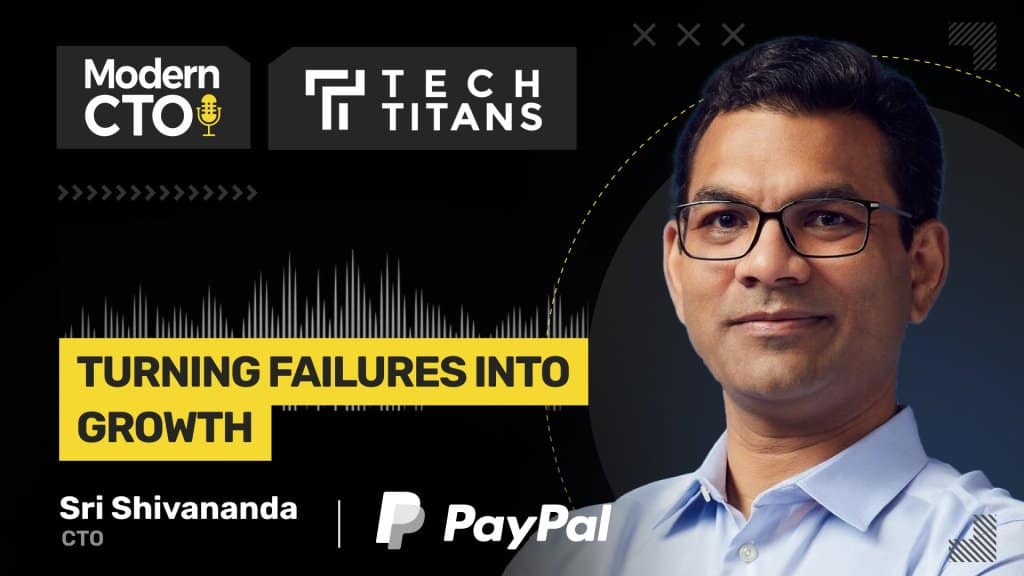
About Sri Shivananda:
Sri Shivananda is Senior Vice President and Chief Technology Officer at PayPal. Sri plays a critical role in helping PayPal remain at the forefront of innovation and oversees Core Platform, Infrastructure & Information Security. Sri leads a talented global team responsible for the company’s secure, reliable and scalable global infrastructure and strategic core platform, the foundation that enables PayPal to deliver innovative products and services to consumers and merchants all over the world.
Prior to his appointment as SVP and CTO, Sri was Vice President of Global Platform and Infrastructure, directing his team of technologists to drive massive growth at scale across a completely disruptive payments platform. Sri was responsible for all core technologies covering PayPal’s data centers, internal private cloud, online and offline data infrastructure, internal developer frameworks and tools, and various platform services.
Before PayPal, Sri was with eBay for more than 15 years, working his way up from a software engineer to Vice President of Global Platform and Infrastructure. As VP, he was responsible for the company’s technology infrastructure that powered the eBay Inc. businesses, including eBay’s hundreds of millions of listings and PayPal’s millions of payments every day. Sri found his way to eBay via the acquisition of Deja.com.
Sri is a geek at heart and his passion for learning is evident – he’s constantly pushing the boundaries of innovation, encouraging creative ideas and solutions that solve complex problems with technology.
About PayPal:
At PayPal, we believe that now is the time to democratize financial services so that moving and managing money is a right for all citizens, not just the affluent. We are driven by this purpose, and we uphold our cultural values of collaboration, innovation, wellness and inclusion as our guide for making decisions and conducting business every day. It is our duty and privilege to be customer champions and put those we serve at the center of everything we do. We are one team that respects and values diversity of thought for everyone, everywhere, and we actively seek to create an energizing workplace that brings out the best in all of us. If you’re ready to shape the future of money, join the team at PayPal. We're proud to work here. You will be too. PayPal is headquartered in San Jose, California and its international headquarters is located in Singapore. More information about the company can be found at www.paypal-media.com
Transcript
(Intro Narrator at 00:00:01) Today, we're bringing you an episode of Tech Titans, and this one is a throwback all the way from 2020. Sri, the CTO of PayPal, joins us in this episode to share his best advice on transforming failures into growth and developing confidence. You're listening to Joel Beasley, Tech Titans.
(Joel Beasley at 00:00:23) When you were a kid, did you think you would grow up to be a CTO, or did you just know that you love technology?
(Sri at 00:00:29) No, Joel. I often tell people that I'm here by accident. And what I'll also say to you is I'm here because of failures. And while that may feel surprising, let me walk you through it. My intent as a teenager was to become a pilot in the Indian Air Force.
(Sri at 00:00:48) And I made a few attempts at it, and it was a great process to go through. It made me a better individual. But I tried about three times. At the end of the third one, my dad told me, like, look, you've tried three times. Like, how long is this gonna go on? And he convinced me to go take the engineering entrance exam at that point in time. And by the way, this was one year after all my buddies were already in college. I took a break of one year trying to pursue that. And I wrote my engineering entrance exam and got into engineering school.
(Sri at 00:01:30) And at the end of the first year of engineering, I was given the option of either buying a motorcycle or a computer. And keep in mind, this is the early nineties. It was 1992, if I remember right. And buying a computer and having a computer at home was, like, no one ever thought of that. And this was a PC with a 320 kilobyte floppy drive that I got with a CGA monitor, not a VGA monitor, but a CGA monitor.
(Sri at 00:02:00) In fact, you put your boot disk in, got the computer up and running, put the programming disk in, you program. And if you messed around with memory and the whole thing came crashing, lose all your work, start all over again. Right? But, you know, what it teaches you is you train hard so you can fight easy.
(Joel Beasley at 00:02:20) Yes.
(Sri at 00:02:20) Right? Those experiences were formative for me, and I fell in love with computing. And as I continued to program and learn new programming languages, I would also open up the desktop and look internally and pull out cards and put them back in. And within about a year of owning the computer, I was assembling and selling computers to other people who wanted computers and didn't want to pay retail. So that's how I got into computing, and that doesn't mean that set me up for a CTO.
(Sri at 00:02:54) I've had various other things, and this is where it's easy for someone to think of a career as just a single path upward. It's not.
(Joel Beasley at 00:03:05) I know. Yes.
(Sri at 00:03:06) Yeah. There's a place where you move upward, sideward, downward, and I've had all of those transitions in the two, a little over two decades so far. And when people ask me, like, hey, would you change anything about what you went through? I go, nothing. Nothing. Everything that happened, good and not so good, is actually all good when you look at it in retrospective. And I'm thankful for the opportunities. I'm thankful for the successes. I'm thankful for the failures.
(Sri at 00:03:39) I'm thankful for the learnings because I think that's a journey still. Learning every day is what I get excited about. That's what makes me spring out of bed to get to work is because there's gonna be some new learning every single day. That's what I learned.
(Joel Beasley at 00:03:59) How did you get involved with developing yourself?
(Sri at 00:04:02) You know, I was not always ambitious in terms of growth. And I think there were certain failures I had both in my career and in my life that caused, call it, that propulsion to occur. But if I were to package that whole thing into one cohesive narrative, I would say that what I've noticed is four phases of leadership. And allow me to take the long path to answering your question.
(Joel Beasley at 00:04:38) Please. Yeah.
(Sri at 00:04:38) The first phase is a phase of effectiveness. This is where your skill, you're building skill a lot. You're figuring out ways of working with each other and on a team and so on. This is about outputs and finishing projects and managing well if you're managing people at that time and so on.
(Sri at 00:05:00) And that quadrant is the first quadrant of leadership, and I call that the quadrant of effectiveness. You had to be an effective manager as you start growing. Now what happens with effective managers is people notice that they're delivering, and the ecosystem, whether it is the world as a whole or the company, starts to give them more opportunities. And now these folks find themselves, all of us, in a place where we need to scale. Right?
(Sri at 00:05:34) Effectiveness got you opportunity. Now opportunity makes you scale. Now what is scale? Scale is just like in technology. If PayPal received only a million payments, we'd be of a certain scale. When we receive 50 million payments today, that's a different scale. Now can you run 50 million payments with the same infrastructure that you run 1 million with? No. So how about you as a person? You as a person, can you actually scale to the new opportunity with the same capabilities that you had with the previous one?
(Sri at 00:06:07) No. And this is that whole concept that's made very popular by the book, what got you here won't get you there. Right? And so it becomes a continuous learning journey in how do you get better. And in that quadrant of scalability, you're thinking about, okay, how do you manage crises and conflict, and how do you manage change?
(Sri at 00:06:29) How do you lead through other leaders, and how do you put design patterns in place that allows you to be effective at a larger scale? That is scalability. It's that second quarter. Now keep in mind, I already talked about a fair amount of learning that you have to go through. Because if you're not learning continuously, you're not ready for the new game that you're in each day.
(Sri at 00:06:55) The third phase is actually, in my mind, the most important phase and is relevant to the points that you brought up. And this, unlike the previous ones, the previous ones are all about demonstrating to the world what you can do. The third phase is where you have scaled enough, and you have more opportunities to come where you start to doubt yourself a little bit. You're saying, like, really? Am I capable of doing this?
(Sri at 00:07:20) Can I, will I learn? Like, why are these people being so critical about some of the choices I'm making? And the journey turns inward. Now suddenly, you go from demonstrating to everybody else what you're capable of to creating a little bit of confidence for yourself to say you're capable of more. This is happening for a reason.
(Sri at 00:07:42) It's a moment. It's actually a window of time in reflection. And I often talk about, you know, in the first two quadrants and continuing, leadership is a lot about what you do. But in this phase, you start to realize leadership is a lot about what you become, and that's where mindfulness kicks in. How do you manage time?
(Sri at 00:08:06) How do you delegate even better? Like, how do you manage the stresses of every day? Like, how do you deal with the expectations people have of you? How do you deliver to people who are expecting you to be more than you really are? And that starts to change you internally.
(Sri at 00:08:26) First of all, your identity moves inside because you become your own self critic, you know, in a hard way. You're harsh with yourself.
(Joel Beasley at 00:08:34) I know. I had to talk with myself the other day about being too hard with myself.
(Sri at 00:08:39) Exactly. And that's a balance too. Right? I mean, you shouldn't overdo anything, including being critical of yourself. If you get past all of these things, so effectiveness, capability, resilience, now you get to be a transformational leader where you're inspiring.
(Sri at 00:08:57) You have a followership of people long beyond you holding a title or a role at a company and so on. Even after you're done, people still reach out to you for advice and help and so on. And that journey, look, I am no master in this journey, but it's that journey that excites me. Not every day has gotta be great.
(Sri at 00:09:20) In fact, now what happens is that the moment you hit a tough spot, you don't get scared and anxious. You get excited because you know on the other side, there'll be a better you and a better leader for your people. So I know that was a long winded—
(Joel Beasley at 00:09:39) No. I feel like we're best friends. You know, I've always known about myself that I'm very slow with confidence. But once I have it, it's cement. Like, it's there. It takes me so long to get it, especially, like, with engineering.
(Joel Beasley at 00:09:53) I mean, I wrote code every day of my life, like, 17. I mean, it took me ten years to get, like, confident with it. Once I got it, I got it. And, you know, going through those growth stages is, I don't know. It's so interesting.
(Sri at 00:10:08) That's beautiful. Look. I think I, you're right. It feels like we've known each other for a long time even though I think we only started talking about, like, forty minutes ago or something like that. Yeah.
(Sri at 00:10:20) The reason is I've always struggled with confidence. Always. And I would say I still continue to in many cases. And at the same time, what I've discovered is confidence is actually a cumulative trait, and it comes from giving yourself permission to fail and therefore take risks. So if you give permission to yourself to fail, then you start to take one risk.
(Sri at 00:10:48) And in most cases, it works. Because what you're gonna do, given being given yourself critical is, you'll bring the best you. You will be buttoned up, and you will overdo what is needed to succeed. Now you took that risk. You succeeded. Your confidence is a little higher.
(Sri at 00:11:08) And now you take a little bigger risk and a little bit, little bit. By the way, you'll hit a point where you'll have a failure. But now you're on the sixth step of the ladder coming down to the fifth step. You're not dropping down to the bottom. And you will remember memories of each one of the four steps where you made the move up. And that gives you the confidence to get back up again.
(Sri at 00:11:32) In fact, I talk about four ingredients for success. One is IQ. One is EQ. The third one is CQ. And the fourth one is grit.
(Joel Beasley at 00:11:46) What's the CQ? You wanna take a guess? Curiosity quotient?
(Sri at 00:11:53) Here you go. That's it.
(Joel Beasley at 00:11:53) Oh, nice.
(Sri at 00:11:54) Yeah. So emotional quotient is the biggest portion, and that's important to know. And emotional quotient does actually more discovery of yourself than discovery of others. But curiosity is what continues to give you momentum and energy, knowing more and more and more about technology, about people, about business, about the world, and so on. Two points I wanna make that were triggered by, inspired by what you said, which I remember from before is I used to think that the potential is a fixed line, and your performance moves up to meet potential.
(Sri at 00:12:30) I have come to realize over the last five years that potential is changeable. And each time you reach that limit, your horizon is bigger. Your ability to visualize is bigger. Your realm of opportunity is bigger. And you sometimes discover you have potential. It's a discovery journey.
(Sri at 00:12:53) It's not when I was three years old, there was this potential and that's it. Right? So potential is also a changing thing. Second is, John Rainey, who is our CFO and a great colleague of mine. You know, in one of my first conversations with him, this is probably in 2015 or early 2016, he talked about this concept of legitimacy values and legacy values or eulogy values.
(Sri at 00:13:19) And there's some time in life where it shifts. You go from, I want the success. I want this compensation. I want this fame. You shift and go, I wanna make a difference in the world.
(Sri at 00:13:31) And that is a never ending goal. Right? So, like I said, I mean, this conversation is fun because there is so much mirroring that is going on in the things that you're saying and the fact that I think of it the same way. So this is great. Thank you.