
Episode 336 ·
Sir Tim Berners-Lee & John Bruce - Creating a New Web For All
Today we are talking to Sir Tim Berners-Lee: the inventor of the World Wide Web and CTO at Inrupt, and John Bruce: the CEO at Inrupt. We discuss how Inrupt is building a new layer on the Web called Solid. How Solid’s unique API significantly reduces the need for back-end development, and how Solid gives users control over their personal data.
All of this, right here, right now on the Modern CTO Podcast!
To learn more about Inrupt and Solid, check them out at https://inrupt.com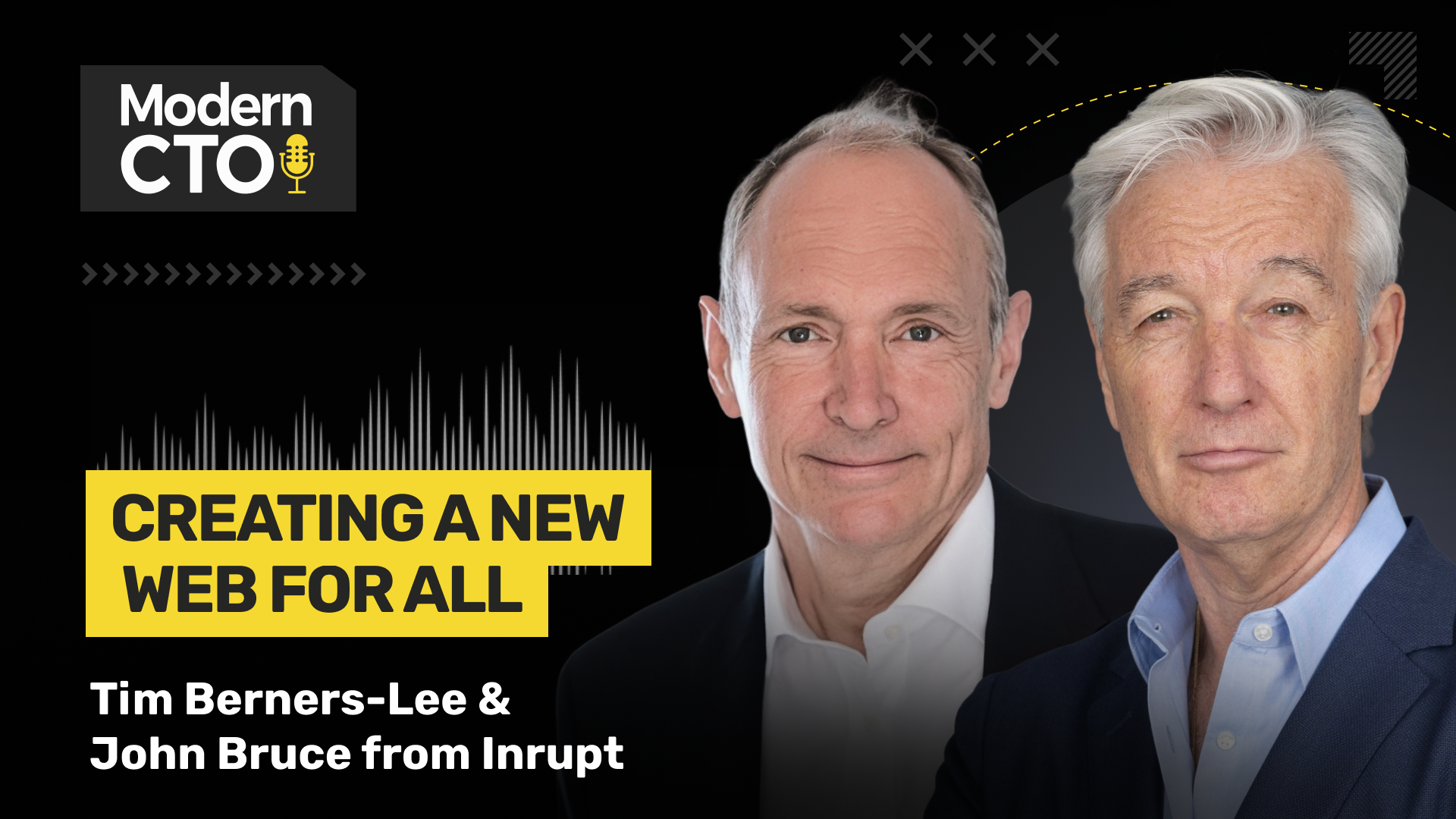
About Sir Tim Berners-Lee:
Named one of Time Magazine’s ‘100 Most Important People of the 20th Century,’ Tim invented the web while at CERN in 1989. He is the Founder and Director of the World Wide Web Consortium (W3C), the international standards forum for technical development of the Web, and the Web Foundation whose mission is that the World Wide Web serves Humanity. He co-founded and is President of the Open Data Institute in London.
Tim is a Professor at the Massachusetts Institute of Technology (MIT) in the Computer Science and AI Lab ("CSAIL”) where his research group works to re-decentralize the web. In April 2017, Sir Tim was awarded the Turing Prize which is considered the "Nobel Prize of Computing”. Tim is a long time defender of Net Neutrality and the openness of the web.
About John Bruce:
With a background as both a founder and an executive at global tech firms, John is uniquely qualified to help engineer the next phase of the web alongside his co-founder Sir Tim Berners-Lee. He brings to bear decades of successful business leadership and experience creating new markets around innovative software. Prior to partnering with Tim, he was the co-founder and CEO of Resilient, now an IBM company, that developed a new approach to cybersecurity.
Through Resilient and four other successful startups, John has experienced first-hand the strategic challenges that the current structure of the web causes for users, developers and organizations around the world.
About Inrupt:
Inrupt is delivering Sir Tim Berners-Lee’s original vision of a web of shared benefit, for everyone
We are a worldwide team of inventors, investors, entrepreneurs, developers and academics who believe in Sir Tim’s vision for the web.
Inrupt’s technology puts individuals in control of their data, gives organizations new opportunities to create value for customers, and allows developers to thrive in an open marketplace of innovation.
Transcript
(Joel Beasley at 00:00:00) Hello, my friends. Today we are talking to Tim Berners-Lee, the inventor of the World Wide Web and CTO at Inrupt, and we're also talking with John Bruce, the CEO at Inrupt. We discuss how Inrupt is building a new layer on the web called Solid, how Solid's unique API significantly reduces the need for backend development, and how Solid gives users control over their personal data. All of this right here, right now on the Modern CTO podcast.
(Joel Beasley at 00:00:35) Here we go. This is the Modern CTO podcast.
(John Bruce at 00:00:46) Hello. Hello. Hey, Joel.
(Joel Beasley at 00:00:49) How are you guys?
(John Bruce at 00:00:50) Yeah, good. How about you?
(Joel Beasley at 00:00:52) Fantastic. Fantastic. I'm super excited to meet both of you.
(Tim Berners-Lee at 00:00:55) We're excited to do this. Likewise. Yeah.
(Joel Beasley at 00:00:59) So what we do is we just kind of hang out and talk, like if we're all at lunch or something of that nature. We can talk about whatever topics we want. The editing team is super brilliant and they will edit it up to make us sound way smarter than we are. So we're lucky to have them. So we could just be ourselves and do what we'd like. Is that cool?
(Tim Berners-Lee at 00:01:20) Yep.
(Joel Beasley at 00:01:23) I think we should start with some introductions. Since we have two people on the podcast, people will be hearing your voice. Tim, could you please introduce yourself?
(Tim Berners-Lee at 00:01:30) Okay. My name is Tim Berners-Lee. I invented the web in 1989. Since then I've promoted it, developed it, worried about it. Now we're flipping it around to fix the problems it had from when it was Web 2.0 to be the new Web 3.0.
(Joel Beasley at 00:01:51) That's amazing. I'm super excited. I've got so many questions for you guys. And then John, can you introduce yourself?
(John Bruce at 00:01:57) Yeah, sure. Tim's a tough introduction to follow, actually. I'm his co-founder and partner here at Inrupt, and we founded the company, I guess, three and a half years ago now, Tim. It's flying by.
(Joel Beasley at 00:02:10) What was the reason that you founded it? We already have an internet.
(John Bruce at 00:02:15) It needs fixing, though. I'll leave Tim to describe why it needs fixing, but I think you'd appreciate that everybody does. I mean, we need to put it right.
(Tim Berners-Lee at 00:02:27) So the web was, you know, I invented the web thirty years ago. And I guess for maybe ten, fifteen years, if you went to the street and you asked people about it, they'd say, "Oh yeah, it's exciting technology." They use it, you know? And then, but now, last five, ten years certainly, you can ask anybody what's, how do you feel about the internet? And they go, "Well, actually, I'm worried about—I can't tell what's true, and I'm worried that I'm being manipulated." And, or, it was, I'm worried that other people are being manipulated using data that I have given to big social networks and so on. I'm worried about—so there's lots of problems with the web, and things to do with personal data were a big piece of those.
(Tim Berners-Lee at 00:03:07) And so we started the company, this company, Inrupt, in order to make a new world possible. A new world, the world of Solid. Solid is a protocol. So protocol, it's still a protocol. It's still HTTP and still DNS. There's still websites, except now it's much more like everybody has their own website. Everybody has their own website which they completely control—they have control over.
(Tim Berners-Lee at 00:03:44) So instead of your data all being inside the belly of all of the social network sites that you use, you get to put it where you choose. We call it a Solid pod. And so I say, oh, you can have several data pods. People, if you're on this call, you're probably personally involved in all sorts of different things, and so you probably have a few email addresses.
(Tim Berners-Lee at 00:04:09) Similarly, you'll have several Solid pods. One for home, one for this work, one for that work, and so on. That is a world in which, but it's not a world where technically it's very, very different from what we're in. You know, data goes across the internet, there are protocols, but it's one where we add a few things that we really needed before in order to fix these issues that a lot of people are aware of in this web.
(Joel Beasley at 00:04:39) That's exciting. And I was reading on your website about the pods and the different developer tools that you have. My background—software engineer, seventeen years, mainly built commercial web applications. And then from there I started doing some writing and then hosting the podcast. And then over the past four years it grew to a pretty cool point, and so that's my professional history.
(Joel Beasley at 00:05:01) One thing I was curious, like as I was very excited about this interview. So leading up to this interview, I've been asking other people, you know, what do they want to know about John? What do they want to know about Tim? And one of the questions I got a lot of is, what was your childhood like, Tim?
(Tim Berners-Lee at 00:05:20) So mine was great. My parents were both mathematicians. They weren't computer scientists then, but they actually—so they met on the team at Ferranti Limited in Manchester, which was building the first actual stored program computer. Manchester University made a computer. Ferranti University commercialized it.
(Tim Berners-Lee at 00:05:39) They worked for Ferranti. So that sort of—that was—so I was pretty lucky. They were neat people anyway. I grew up in London between the park, Richmond Park and the Thames, which was beautiful as well. Well, they didn't—I was here with excitement, right? Because in the early days of computers they'd shown like a Turing machine. If you have a computer, then it's actually equivalent to anybody else's computer, like by the imitation game, if you've seen the movie.
(Tim Berners-Lee at 00:05:57) So Turing showed that all computers are basically compatible. They can all do the same thing.
(Tim Berners-Lee at 00:06:15) So if you program a computer and I program on the computer, what we do is not limited by our computer. It's limited by imagination. And that was massive, this excitement of, "Wow. You know, these computers will do anything we can imagine them to do." That was a spirit of my parents and people around me.
(Joel Beasley at 00:06:38) That's amazing. Yes. If you are at this company, you'll often hear me say that you're only limited by your own imagination, because often I see great people and they're able to work. They have the work ethic. They've got some talent, but sometimes their imagination needs a little bit of love, you know.
(John Bruce at 00:06:54) A bit of courage too as well, Joel.
(Tim Berners-Lee at 00:06:56) Yes.
(John Bruce at 00:06:57) I mean, having the imagination, the stimulus for the web, and then the courage to do something.
(Tim Berners-Lee at 00:07:04) Yeah. Take that with persistence. You have to actually go and do it, not just imagining.
(Joel Beasley at 00:07:10) That's something that I worked on a lot too.
(John Bruce at 00:07:13) Yeah. We're trying to make a difference.
(Joel Beasley at 00:07:17) Where do you get your courage from, John?
(John Bruce at 00:07:19) Oh, yeah. I don't know. I mean, I was an inner city kid from Liverpool, so I actually was there. There's a place in Liverpool called Toxteth where most people from Liverpool don't like to go. It's a fabulous place, but, you know, my mom and my dad were working class, gave me the, I guess, the work ethic and the, maybe the will to win, the will to succeed.
(John Bruce at 00:07:32) So partnering with Tim's a fabulous privilege and an opportunity, and here we are, sitting this ride, an immense opportunity to change the web with minuscule resources to do it. And so I think everybody who joins us in the mission has to have courage to push the vision. If we want it and we should, so we're putting the answer in, we can get that.
(Joel Beasley at 00:08:07) Have you gotten other tech founders to show interest in this and to help promote the mission? I know that the CEO of—I don't know if he's the CEO, I apologize—I know that one of the founders of Twitter, Jack, is pretty into this decentralized computing. Have you guys linked up with them yet?
(Tim Berners-Lee at 00:08:25) Yeah. Yeah. I think, looking into talking to Jack about the difference between when you start something, whether you design a protocol which all the computers in the world talk to each other, like email or HTTP, or you make a website, or you make a system. And he was thinking—so Twitter was a website. It worked.
(Tim Berners-Lee at 00:08:47) Now what happens? It had been protocol. So yeah.
(Tim Berners-Lee at 00:08:55) He's really interested and I'm pretty passionate about both how can you make this thing not depend on sort of being the sort of central thing. But also, how can you make—he's very passionate about technology serving humanity. And so, you know, when we build a Solid world, what we imagine is that we'll build another infrastructure, another platform. You know, now we have a Solid platform on top of the web, which is on top of the internet.
(Tim Berners-Lee at 00:09:33) And when you build this platform, we'll try to give it—it'll be a place where developers can build apps that work for their users, right? Because they're not assuming that you're gonna be running a social network which gets its money by advertising. And so your job is not to help your user, but to try and ambush their thought and take them to go and buy something. Your job is not gonna be to make clickbait as horrible as possible. Your job in making a Solid app is about making an app for users.
(Tim Berners-Lee at 00:09:55) You know, that used to be when people made—when apps were on floppy disks, when you put them in a PC, you know, you put your app, you bought the app, and basically the guy built the app, you paid money for it, and it works for you. And you've got no apps now. All open source software works for you. And so, you know, because there's this sort of dysfunction where people are on the social network and the network is milking them through information and trying to exploit them and isn't on their side, you know, that people—a lot of people out there,
(John Bruce at 00:10:25) a lot
(Tim Berners-Lee at 00:10:26) of people in this video tend to say, "That's how it's gonna be. That's how the business model of Silicon Valley works." But actually, hello, there are lots of people like me chatting to you just saying, "Oh, these things can change. We can take back control.
(Tim Berners-Lee at 00:10:39) We can give the users that control."
(Joel Beasley at 00:10:41) It'll take some really smart people and a movement, and I'm excited for it personally. I'm a huge fan of an open and free internet. I love the words that you chose too, because I heard you just use it in a sentence. "When we build a Solid world"—now it's like, oh, there it is. I love the word play there.
(Joel Beasley at 00:10:59) How did you come up with the name, Inrupt?
(Tim Berners-Lee at 00:11:02) Oh, that was me. So, well, there aren't very many—weren't very many .com short words. But if you're—everybody's talking about innovation, and everybody's talking about disruption. So innovation and disruption.
(Joel Beasley at 00:11:17) That's brilliant.
(John Bruce at 00:11:18) Mhmm. Yeah. When we first got together over dinner and Tim said the word, Inrupt, I thought, "Okay, one of the first things I'm going to do is change the company name." But it's like a really new pair of shoes, you know, the type that hurt at first, but then you get used to them and they're comfortable, and it just fits for us now.
(Tim Berners-Lee at 00:11:35) Yeah. After enough people, everybody will get to know it. So all—and I mean, I have Inrupt behind me, right? I've been put a bit of the I and a bit of the R and they'll know, "Oh, that's Inrupt." I didn't even know that.
(Joel Beasley at 00:11:50) For the background, because my context is building commercial software usually for larger organizations, and I don't have a computer science engineering degree background to where I was, you know, talking to some of these people leading up to this podcast and they were explaining to me like OSI and the different layers of a network, because I was just calling everything the web. And I was calling everything the internet. So they helped me sort of differentiate between the different levels.
(Joel Beasley at 00:12:24) But for me to understand it from my context, you've got Solid, you've got these pods. Do you have a working example of a specific technology that could be like, you use this, or a story?
(Tim Berners-Lee at 00:12:33) Okay, let me—can I sort of just—so where are you coming? Are you a full stack developer? Have you done front end back? Or—
(Joel Beasley at 00:12:41) Yes. Yes.
(Tim Berners-Lee at 00:12:41) Okay. You're front end typically. You're on JavaScript, and the system you put together has got JavaScript running in the browser, and it's got PHP typically running on the running on the server. And whenever you did anything, all those apps that you put together, somebody wanted a new tweak, they wanted to add a new checkbox, "Has this person been vaccinated?"
(Tim Berners-Lee at 00:13:00) You go, "Oh, right. I can do that. I will change my JavaScript. I will change maybe that. I will add into the form, 'Has this person been vaccinated?'"
(Tim Berners-Lee at 00:13:11) And then I will go into MySQL for the backend, and I will add a new—well, I've got all these tables. Which one is it? Oh, right. I'll add a new—I'll add a new bit, a new Boolean into the data structure to store that I'm storing on the disk. And then I've got to tweak my API so that you've got—so now you've got the front end, when somebody checked that, "Yeah, I've been vaccinated," is gonna go, "Ooh, gotta do—gotta do something, write down back end to back end."
(Tim Berners-Lee at 00:13:42) Back end's gotta store it in the database. So that is the—that's how a lot of stuff is done. And it ends up with—you end up with these—you need to understand all that stuff about the front end and back end. And also, whenever you change, yeah, you've gotta change the front end and back end.
(Tim Berners-Lee at 00:13:57) So you have all these different sort of frameworks you may use to try to make that easy. But, actually, basically, it's difficult because you've got to change stuff which is on the server and stuff which is in the client. Okay? So Solid is different from the developer point of view. You don't have any backend programming.
(Tim Berners-Lee at 00:14:15) You have a generic API. Instead of having your version one API, Twitch API, or Facebook API to the Facebook store, or the, you know, each—or Strava API to the Strava or Dropbox back to Dropbox store—for every different backend out there. Solid said, "Actually, if we let that application just store arbitrary data structures, if you could, you know, if we let them just store trees and tables"—and in fact, if we store a graph, because a graph is very, you know, that graph can be any shape. So you can take a tree, store it as a graph. You can take a table and store it as a graph.
(Tim Berners-Lee at 00:14:50) So what the Solid data is, the Solid pod, as we call it—personal online data store—anything that supports the Solid protocol allows you to write to it. So in the app, you write an app and it asks the user, "Hey, where do you want me to store this? Which pod do you want me to store this stuff?" And all they—you log in and you get them pointed to their pod. And you just store whatever you like.
(Tim Berners-Lee at 00:15:14) And when somebody wants you to—you store these graphs, and one of these graphs has got a tree, and on that tree, it's got a few things that you're asking somebody about, and you're gonna add another thing, alright? And that all happens in the cloud. So you just add a piece—you add on to the form, "I'm gonna add a Boolean. The predicate is going to be, 'Are you vaccinated?'"
(Tim Berners-Lee at 00:15:33) Yes. And that will store an "Are you vaccinated?" flag, Boolean flag, in the graph structure in the Solid store without you having to change the backend at all. So that is fundamentally different, alright? So it means that socially, that means that you sort of—it's different to be a developer.
(Tim Berners-Lee at 00:15:52) You could think of a really cool COVID tracking app, and you can write it. You write it as a Solid app, and everybody can use it with their existing Solid pod, and you don't have to write any back end. Now, for all the people, you know, I've had people in the audience say, "But I'm a back end developer. What's gonna become of me?"
(John Bruce at 00:16:08) Yeah.
(Tim Berners-Lee at 00:16:09) All is good. We need lots of back end developers. But when they work on the back end of the Solid pod, they are making a very, very—they make a generic Solid server, and it will work with any app. And to a certain extent, we want people just to work on the servers, but they're all the same. And right now, there are five different, completely different stacks, some commercial, some not, for the servers.
(Tim Berners-Lee at 00:16:36) We've got five you can write for your pod, and you'll run on the five key stacks. And one of the core things that I knew we would need at this point is for developers to be able to say, "Yeah, but how do I know that the server is gonna run reliably?" And so when John and I started, we said, "Developing a serious enterprise vision of all this stuff is gonna be one of the things that we need." So one of the things about that is the Inrupt Enterprise Server, and it's the best.
(Joel Beasley at 00:17:08) And where is—so the pod stands for Personal Online Data Store. Is that correct?
(Tim Berners-Lee at 00:17:12) Yep.
(Joel Beasley at 00:17:13) Where does this pod live? Am I hosting it off of my own computer? Is it living on yours? Where does it live?
(Tim Berners-Lee at 00:17:23) All the above.
(Joel Beasley at 00:17:24) All the above. Yeah.
(Tim Berners-Lee at 00:17:25) This is the new architecture for data and people. Right? So different—you might go home, people listen to this, the geekier ones will go home and maybe grab a little computer, grab a Mac Mini, fire up, grab a Docker image, and put a Solid pod on it and have it sitting there in their living room where they can keep an eye on it. So people—and yeah, I've got a Solid pod right there with a whole bunch of data on it where I can keep an eye on it.
(Tim Berners-Lee at 00:18:01) And all the people in the early Solid community would like that. But most people, they'll get—there'll be lots of different types of pods you can get. There'll be free pods that some people will give you or just because you're a new customer, sort of thing. And a lot of them will be in the cloud, but it'll be cloud where you're in charge. So it's like a basic sort of—and people currently give you storage for various reasons now. They'll be giving you Solid-compatible storage in the future.
(John Bruce at 00:18:36) Good chance you'll have a number of them, Joel. So you'll have, particularly if you're technically competent to the degree you are, you'll have your own pod probably running on your own infrastructure. But then very good chance you'll have one that's issued by your government for social services. You might have got one from the bank because they first engaged with you to give you some financial services, and now it's an excellent place to keep your more valuable data. I mean, it's all stored in the same way, so consider it one conceptual pod area, but broken into—could be broken into multiple pods depending on who services you or what they're servicing you with and what people you've got inside. And that's actually how it's rolling out in real projects.
(John Bruce at 00:19:20) So if you look at what's going on in some countries, the government agencies are issuing pods, corporations are intending to issue and self-service citizens with pods, and fast forward a few years, they can all hang out together.
(Tim Berners-Lee at 00:19:32) Yeah. We've worked with a bunch of financial services companies, and sometimes when the skeptical people have privacy concerns, they say, "Well, what company would I trust to store my data anyway?" You say, "Well, what about your bank?" And they go, "Well, I guess, yeah, I think I trust my bank to store my data."
(Tim Berners-Lee at 00:19:49) They store my money. So yeah, that will work. If I could have a safe deposit box Solid pod with my bank, I think I'd do that. I think I'd trust that.
(Joel Beasley at 00:19:59) So let's say—let's take this banking concept farther so I can better understand it. So as a full stack developer, if I were writing a banking app, there would be—let's start like a small bank, right? There's going to be a single database, and it's going to contain all the rows of all the individuals and their information and their balances and all of that. But if I did it in a pod way, there would be different pods for each one of the customers versus it all being in one area. Am I understanding that? Is that how it works?
(Tim Berners-Lee at 00:20:30) Yeah. So the banks—in such a case, because the relationship I have with the bank is that mostly we've got this list of transactions that we've gone through over time—bank statements and stuff—and it's really important that we agree on those. So every now and again I log on, or every now and again I see my bank statement. But in an ideal world, I should know immediately. I should know on every device. At the moment, if somebody used my credit card—being never. So the vision is that the bank's database, from your point of view writing the bank code, the bank database is the core gospel truth. But on the other hand, you've got an obligation in relationship with me to sync with my pod the moment you can. And if my pod's online permanently, that means within a few seconds or a few minutes, when transactions happen, you'll sync with my pod. So my pod—whether maybe my pod's sitting in my house, maybe my pod's sitting somewhere in the cloud—but then I might give you sort of append-only access.
(Tim Berners-Lee at 00:21:33) I might say, "You can write new transactions in here, but you can't delete them." So I know that the pod won't even let you remove—so the moment you've committed that a particular transaction had happened, I give you append access. I know that it'll always be there because the pod, the person who provides the pod will ensure that that database just does. So there are lots of different ways the companies and the individuals can share data, but the banks are one because you definitely have some copies—one with the pod and one with the bank.
(Joel Beasley at 00:22:08) I'm starting to get it.
(John Bruce at 00:22:09) But it's not quite as brief a form as you described, Joel, just to interject a little, inasmuch as there are commonly understood ontologies—financial services, health care, and so on. Actually, Google run a pretty large one too. And so that describes how you can install the data. And then in the context of the layout of it, there are well-understood RDF term shapes. So if I'm building an application intending to access that data, I don't need to worry necessarily about how to refer to it or where to find it. I just ask for access to it, confident in the knowledge that it's stored in an appropriate fashion inside the pod. That's the joy of having everything to agree to inspect. Right?
(John Bruce at 00:22:54) I mean, it's all very open. It's all agreed to, and it means a lot of the heavy lifting for developers—one API, one way to access the data, one way to get permission to access it and then refer to it, and then all I need to worry about is creating the app.
(Joel Beasley at 00:23:12) Yeah. It's gonna make everything a lot easier. Alright. I'm almost there. I think I'm 75% of the way there. And then usually when I get to 100, I realize I know nothing. But let's get to the hundred first. Alright. So let's take this bank concept a little farther. So they have their—I'm the developer. I have my central bank, but I've also enabled pods because my customers demand them. They want them. They want this abstracted new layer of the internet where they own their own personal information. So I set up—I allow my central database to sort of reflect this user's data, can give them permissions, control it. Like you said, they can read, but they might not be able to delete, or they could write.
(Joel Beasley at 00:23:49) But alright. So then they have their pod. It's this new layer, this new abstraction, if you will. And then if they choose because it's their pod, they can go then and work with a third party and say, "Okay, I'm gonna give you access to my pod. You get any inherited permissions, but I'm gonna give you access to my pod. And now I can interact with that third party without them having to go through all the long process of actually integrating with the bank and all the paperwork there because I'm saying this is my data, I own it, and I want this feature, this platform to help me manage it."
(Tim Berners-Lee at 00:24:24) Yeah.
(Joel Beasley at 00:24:25) Absolutely. Yeah. That's brilliant. It's hard.
(Tim Berners-Lee at 00:24:29) In the UK, there's legislation called Open Banking, which says banks have gotta do this. And there are standards like artifacts and stuff. So in other words, you have as a citizen in the UK, you have the right to any data from any financial institution. So Open Banking in the UK was put in place largely in order to stimulate a market for all kinds of cool apps. So you might then leave the bank to go and sit by yourself and make all kinds of things—apps to help me do my taxes, apps to help me run my lunch.
(Tim Berners-Lee at 00:25:08) Because you'll be able to look at bank data, you'll be able to look at my credit card data, you'll be able to maybe figure out some nutrition data, maybe you'll look at my fitness data downloaded from my devices. So you'll better help me write—you'll better write a program to help me run my life, help me decide whether or not I should run a marathon. And if so, who are my friends I should run with and what types of pizza I should stop eating and so on. You could, because you can pull in data—sort of data about fitness, data about health from the hospital. Health, of course, is massive. And then data about my day-to-day life. You could help me on that marathon. But also while you're at it, you could look for weak signals that I'm gonna be diabetic.
(Tim Berners-Lee at 00:25:54) So if you help 100% of the people, because the people who use your app to run a marathon—and actually, for 1% of them, you help them, you tell them to go and see their doctor because they could be pre-diabetic. So you've seen the benefit of information insights coming to the—you're getting that information insights from collecting data together. But it's the person, it's the citizen, it's the consumer that's actually benefiting from the new insights from linking all that data.
(Joel Beasley at 00:26:24) I love this. It's the future. I'm officially sold on it. I'm a fan. Now here's the important part. If you look at Elon Musk, I'm a huge fan of having a brain app store where I can download different things through my Neuralink. But you have to start with curing Parkinson's or spinal injuries or whatever it may be, because you have to have a business-valid reason to generate revenue and then a decade of time to actually reach the end goal. For you today, what is that business value that will allow us to gain this momentum and ultimately end up where pods are a common thing everywhere?
(John Bruce at 00:27:01) Fabulous question. Right? Because that's the gotcha. What comes first? The applications or the users? That's a noodle. So we go to big organizations who want to satisfy—this has only been an enterprise app development for a number of years. So we go to organizations who have constituents. They want to service those constituents with quite explicit needs and consider this just like an enterprise piece of technology. You can deploy this. It services those constituents. It does it in a new, novel, and empowering way. Your developers find it easier to build apps. Your users enjoy a relationship with you that's a bit more evenly balanced. You as an organization get utility because you can do any one of a number of things.
(John Bruce at 00:27:48) You can take disparate pieces of data about those users and merge them at the pod. Now the user has a holistic representation of themselves that they can use for ongoing services. And a good example of that's health care, where you now are composed in a holistic sense in your pod. You can go visit your doctor. Your doctor can see the whole of you, not just a piece of you, a sliver of you. And that's just one small example—fairly significant in terms of value, but one example of many we've got. So now organizations, they like it. It's a more balanced relationship with constituents. Developers build the apps. And guess what?
(John Bruce at 00:28:26) As a consequence of tens of millions of constituents now being serviced with this technology, they've got pods. And the next app can access those pods or come alongside those pods, and away we go. We sort of have a little analog we use inside the business. It's like Edison with his light bulb when homes were burning down left and right because we lit them all with gas lamps, and everybody was over-rotating on more efficient gas lamps, better and better gas lamps. Up pops this guy with an idea of a light bulb to light your home. But in order to switch the bulb on, you have to lay out the electricity.
(John Bruce at 00:29:06) So having provisioned electricity, on goes the light bulb. Mission accomplished. Look. Fast forward 100-and-whatever years, and think about how many devices exist in the home as a consequence of electricity being provisioned for the home, and it's just boggling. We think we're in exactly the same point with deployments like this. We're switching on light bulbs for these various organizations, either governments or large corporates. But those light bulbs are going on, and now the users have got electricity provisioned. So in due course, we'll be able to teach them how to cook food instantly, or keep it fresh forever, or be entertained with moving pictures in the corner—all stuff that when the light bulb was first rolled out would have seemed crazy. I mean, so futurist. Right?
(John Bruce at 00:29:54) And you wouldn't be able to wrap your head around it. So we're in the light bulb business today, helping our customers switch them on.
(Joel Beasley at 00:30:01) If people are listening to this and they're interested, maybe they're at a large enterprise and they're forward-thinking—I happen to know some of the people I've talked to, I found that there's just a steady stream of really forward-thinking leaders that come out of Walmart, Walmart Labs. They're always looking for the next thing. AmEx—they were really forward on blockchain and adopting new technologies. It's not all of them. It's not everyone, but there are these cultures within some of these large organizations where they want these types of things that you're discussing. They want them to happen. How do you reach them, engage with them? How does that process go?
(John Bruce at 00:30:39) So far, we haven't is the straightforward answer. I mean, we released the enterprise-grade version of all of this last October, and we've done that with a number of partners like National Westminster Bank and BBC and the NHS Trust. So they helped us shape it. We released it last October, and now we've got a number of countries mobilizing around it, which is really exciting. Big organizations like telecoms carriers, big retailers here in the US, banks, pharma, insurance, and they were all kind enough to approach us.
(John Bruce at 00:31:14) They were all kind enough to call us up and say, we're interested in what you've got. Can you explain more? So far, we haven't actually—we don't have any salespeople, we don't have any marketing departments. All of it's all been about building the technology and doing our best to help people appreciate what we've got and why it's so relevant to either their corporation or their country. And it's moving. I mean, you might be shocked to know how quickly some things are mobilizing around this because the appetite for change, either by end users like all of us, or developers who feel constrained by the API madness out there trying to get access to various amounts of data, various silos of data, or organizations who are struggling with this whole, "I want to create new lines of business. I'm constrained by regulatory implications," appropriately so in most cases, "or I have to be experts in security and privacy because I have to take this data and become responsible for it."
(John Bruce at 00:32:13) And if you can flip that and leave the data in the hands of your constituents and service them, you stick to your core competency. It's hugely energizing, actually. So if any of your listeners find what we're saying equally interesting, then they should—I mean, there's various ways to get to us. Most straightforward, look at the Solid community, which is a vibrant and growing community. Any developers out there can spend time there.
(John Bruce at 00:32:43) Contact Inrupt. There's various ways to do that, and we'd be obviously delighted to talk to people to help you understand more.
(Joel Beasley at 00:32:51) And what are you both spending your days doing? Is it mainly raising awareness, doing conversations like these so people understand? Is it building the technology? What's the—if you were to break the way you spend your day up into a pie slice, what would the three big slices be?
(Tim Berners-Lee at 00:33:10) I suppose, for me, I mean, it'll be a lovely day when somebody has broken it into three pieces of pain.
(Joel Beasley at 00:33:21) I know.
(Tim Berners-Lee at 00:33:23) So sanity, for—I suppose the CTO, that's a job. But I'm also sort of spiritual leader and sort of architectural leader of the Solid community. And so some part of that is being involved with a group of people who are running resource software, which is generally on the client side. That's really exciting. So building new apps and building a thing called the Solid Operating System. But I feel when you get a Solid pod, then it should be—down the road, at the moment, they're quite simple. The apps are being quite simple. But down the road, it should be really sexy. It should be—you know, I imagine Steve Jobs looking over your shoulder and saying, you know, the iPhone isn't sufficiently—it isn't smooth enough, isn't smart enough, it should be easy enough to use. So we should imagine we've got Steve looking over our shoulder when we look at all of the UX. Everybody should look over their shoulder like they did with an iPod, an iPad, an iPhone, and they should say, "I want a Solid pod because, oh, you could do—oh, let—show me that. Give me—how do I get one of those?" And you might as well buy anything. Just log on.
(Joel Beasley at 00:34:41) I want to buy something, though. I think if you—if I could put my Solid pod cylinder next to my Alexa, be like, there's my Alexa. She helps me answer questions, figure out what time it is so I can put the kids to bed. Is that bedtime? Yeah.
(Joel Beasley at 00:34:54) And then there's my Solid pod. That's got some information about my family. My kids have a little directory in the Solid, in this pod. My wife and my family. I mean, I would like to look at it, and I would like it to be designed beautifully too.
(John Bruce at 00:35:08) Not quite ready for you yet, Joel.
(Tim Berners-Lee at 00:35:13) Well, if I can—
(Joel Beasley at 00:35:15) If I can—you know, third-party people could do that too because the technology's open, right? If I can take it and image it onto my Mac Mini out there, I could just do it onto my own custom computing system, Raspberry Pi, put a case around it, have the case 3D printed.
(John Bruce at 00:35:31) Yeah, yeah. Absolutely right.
(Tim Berners-Lee at 00:35:35) You might not be the first person to put a Solid bottle in a Raspberry Pi, but definitely. And by the way, you mentioned Alexa. What's trusty about Alexa? Is that Alexa knows a lot about—Alexa knows what you've bought from Amazon and all the things you've done through Amazon. Imagine that you have an assistant, equally beautifully made, physically or more so. But this assistant has access actually to, to open retail down the road, to all of your pod, all of your life. And so—big difference. You know? Alexa, who do you work for? Uh, well, I worked for Amazon. Oh, well, I am for Alexa. So imagine Charlie. We have a Charlie is your AI, works for you. Your assistant has access to your AI. Who do you work for? Who do you work for, Charlie? Well, I work for you, Joel. I am programmed just to make your life better, and I'm not taking any checks from anybody else, and I don't get—I don't take bribes from people to try to sell you stuff. When I work with your data, I am programmed to work for you.
(Joel Beasley at 00:36:54) And if I'm extremely capitalistic, it's the easiest way for me to sell my personal data. You can make that Solid pod up. Sell your personal data, generate some revenue. Could I do that?
(Tim Berners-Lee at 00:37:06) Yeah. Could. All right. You could. But the value of your personal data is more in the using of that. And it's more interested in you than anybody else. If it finds out that you should—you may be pre-diabetic or you should check that part—you are interested in it at least another. Okay? You will be able to get, because you'll be able to give your AI data from all across your life, you'll be able to come to very strong conclusions, and they're relevant to you. Okay? If you get—if you—yeah. You can say—so there are people who always suggest, will I be able to sell my data? And you will be. And there will be systems where you sell your data for the researchers in particular, and then make—and some of them will be really—some of them, you may give your data for free to everybody doing cancer research, for example. Okay. All the clinical data, that sort of thing. Or come COVID, you know, hands up, who will give the last the clinical data and their positional data and their social networks of the government. We only need 1% of the people to do that, to do this. So there'll be times when you get to donate your data as well. But the value—but selling it is adjusting it like oil. The idea that there is oil is gone, but, you know, it doesn't have a price per bit. It's priced per insight and, you know, and the insight you get—
(Joel Beasley at 00:38:35) Until I develop the exchange. Okay. I'm kidding. I'm joking. I—the reason why I think this is fun is because, you know, I create things, and so I see how people misuse them. You've created something, and you can see how, like, what your intended use was for it, and then how people will misuse it or use it against its intended use. And so by me asking these, you know, somewhat silly questions, I was trying to figure out how free your system is. Because if I'm able to make an exchange for selling personal data on top of your technology, then it really truly is free because that's one of the reasons why it was created for that not to happen, right?
(Tim Berners-Lee at 00:39:13) No questions are stupid, by the way. No question. There's no such thing. They're all valuable. Yeah. I think, realizing that, you know, people don't—if you describe to them the Solid world, as we have, where you have maybe several pods and but in fact, whenever you go and use a photograph app, it pulls in data from all the pods and integrates it. As a—you know, you're a programmer, you can understand, you could imagine that. But for people to really understand what it'd be like to be a person where you have complete control of your data? You know, they don't—it's difficult to understand because, for example, currently, they're laboring with the problem that they've got friends on Facebook and they've got their colleagues on LinkedIn, and they've got their photographs on Flickr or something. And they can't just share those Flickr photographs with a family group they have on Facebook and a work group they've got on LinkedIn. Or and so they have to say, um, sorry, all my colleagues, dear colleagues, you have to come to Facebook because I can't—because this having two different social networks is a problem. People don't—people will get used to that. Some millennials imagine it's the way the world must be. But actually, even just effort that people—that once you point out the frustration that they are actually going through to have to cope with the, you know, the fact that their data is in these silos, and they can't use the Facebook data in LinkedIn just like that, then to a certain extent, you can think, just be able to do that. Just be able to break down those silos. They say, I'm in. Yeah. Give me a Solid account because I know that all my Solid accounts will talk to each other. Where I haven't have as many Solid accounts as I like and many Solid apps that I like and Solid pod is that I can do, all talk to each other. No. That will be just so much—yeah. So much so empowering compared to my partner.
(John Bruce at 00:41:25) I was going to say the inverse is also—it's like a yin and yang. If you look at the organizations and the value for that, the use cases that we're underway with now, these are organizations that are being granted access to data by users that ordinarily they'd never get anywhere close to because they're not needing to take it away. To Tim, for example, a little earlier, you know, there's one retailer here in the US, and their project is all about, let me know all the other things you buy for your home along with that which you buy from my store. And as a consequence of that, I can do things for you. I can suggest maintenance agreements, or I can get you, you know, recommendations of how you might want to upgrade stuff. Or if you've got particular flooring and you want to get it replaced, I can give you an instant quote because I mean, you know, the notion that with the relationship between the organization, principal organization, and their constituents, if the constituents are confident they're being treated with respect and trust, then they can grant permissioned access. And now we open up a whole new raft of innovation. I mean, the kind of work that Tim originally invented. So—
(Joel Beasley at 00:42:34) I had a personal frustration, I don't know, about six or eight months ago. So we do this podcast, right? We make clips and we promote the clips. And so we've got clips on LinkedIn. We've got clips on YouTube, episodes everywhere—Facebook, Twitter, you know, all of our different pages where people find us and watch everything. And people were asking for stats. Like, what are the stats? Like, how many people watch this interview or watched all these clips across all these networks? So I said, you know what? It would probably take me an afternoon just to API into a couple of these companies, pull all the data in, and, you know, link everything up through URLs. And, um, so we could just put all the URLs in once, and then it'll constantly keep all the views up to date. I was incredibly wrong. This was a multi-month project with unbelievable amounts of paperwork in the context of making videos, talking to Facebook developers to get access to my data. I don't want anyone else. Like, I didn't want to be a situation where I'm this app developer and other people are using it through me. I just want to see how many views my video that I got posted—I can see it right there when I'm in the browser. I don't want to screen scrape, right? And go through that. Just give me access to my data. And ultimately we made a number of concessions, but we got something to work, you know, pretty well. We ended up having—on LinkedIn, they won't give—they still to this day, won't give it to you for your own personal account, but you can make a company page. So we started posting from the company page instead. And that way we can get some analytics on videos going forward, but not the past four years, right? Incredible amounts of views. So if Solid was the thing and it was just my data, it would just be my data. And I would just be able to write a little script to pull all of the views together and do what I want. And my favorite part of this whole process that we're in right now, because we're in the early stages—I love the beginning because I'm a persistent person and knowing this uphill climb, it's fun and difficult, but that's like the spice of life. But my favorite part is the moment that these big companies start realizing that they're losing their user base and therefore their ad revenue because people are moving to a solution like this. That's the power of an idea. That's why I like Simon Sinek because he talks about, like, these ideas are contagious. They can spread fast. And overnight, you can have millions and millions of people decide not to use Facebook and instead to use this other technology. And those companies are left there with their current expense and cost structures and revenue models. And so there will be this tipping point when they start realizing that the people want this. And then from there, it's just going to be like a flood, and it's just going to go crazy. And that I'm—I'm excited for that moment when all the hard work pays off.
(John Bruce at 00:45:19) Yeah. Remember, most organizations don't make a living out of ads. Most corporations don't make a living out of ads. They make a living out of their core competency, selling shoes or whatever it is. And if they can live in a world where they don't have to take the data, they want access to it, but they don't want to be responsible for it. They have a relationship with you where you will give them access to it without them necessarily being responsible.
(Tim Berners-Lee at 00:45:43) Out of the window. Like, all your preferences, what sort of pizza you like. And you're certainly dietary preferences when you log into any restaurant, and you just share it. You might not even—you might put your dietary preferences in your public profile so that you don't even have to authenticate. So the moment you will log in with your ID, the restaurant pulls your profile. It's got some cute pictures of you, and, uh, it's got a little bit of your CV. It's got your favorite phrase, and, oh, it's got language you speak. It's got your favorite pronoun—your preferred pronouns and your dietary preferences. So basically, anything that a company, uh, needs to—a respectful company wants to put in straight away, you put them on your public profile and bingo.
(Joel Beasley at 00:46:31) How do you—when you're working with these teams to create something new, there's a lot of things happening, right? Because you're having to build these mental models for something as it goes from, you know, imagination into reality. It's one of my favorite processes in life. But what's the formula for putting together a great team to build these really difficult new technologies?
(John Bruce at 00:46:54) I think this is an essence of sincerity and sense of truth on building teams. I mean, you know, I really do mean this. If you pick the right people and get out of the way, that really mean get out of the way, then you can assemble fabulous teams. I believe that's true. That starts with Tim's vision. And then we needed to make sure we had the best minds on security on the team. So we were fortunate we got Bruce Schneier to join us. And then we needed to get somebody who could build this, so we got a vice president from Mastercard who was used to building big global applications and so on around the team, who was somebody who's responsible for digital rights and privacy. And they all come to the mission. You know, they can all do a bunch of things, but this, they believe in.
(John Bruce at 00:47:45) This is like I said, my kids are actually interested in what I do for the first time in my career. And they want to know how it's going because they want this web that we're after. And I think, you know, the people we're fortunate, the team we're putting together believe that too. And they want it to work, and we're going to make it work. And so, anyway, I could ramble for a while about the passion we believe in, the mission.
(Tim Berners-Lee at 00:48:14) Yeah. No one found us just as our customers found us. And some of our team, quite a lot of our team, were working, were trying to build something like Solid, for example, and got quite, got, did well, got close, didn't quite get it. And they say, oh, yeah, actually that's, and I want, and then they come sort of very passionate because they can imagine what it was. They've been worrying about this issue, or they've been dreaming about a new world which they think is different. And so they've done the imagining, and then they sort of suddenly there's this mind now. And they think, yeah, it's actually Solid is what we need, what I need to work on.
(John Bruce at 00:49:05) And you too, Joel. You're now in the team. Yeah. Of course.
(John Bruce at 00:49:10) Hopefully, they'll come and join the team too. We all pull together. We'll make this work.
(Joel Beasley at 00:49:17) Yes. And I'm excited as this grows, this ball, right, of snowball starts to grow. And then people join your team that, you know, manage communities. I'm sure you have some of those as the community is emerging. Give us something more that we can do. You know, like, I'll talk about it. That's the thing I think would bring the most impact is me continuing to talk about this with other leaders in technology. And so that will be my part. If there's ever a time where there's more that we can do, just reach out to us and let us know.
(Tim Berners-Lee at 00:49:49) Thank you. Thank you. We really appreciate it.
(Joel Beasley at 00:49:52) I have a fun question, like a hypothetical. I've been, I on the weekends, I relax and I disconnect from work and I spend time with my family. And then sometimes, like on Sundays, some weird questions pop into my head. And so I write them down and I was like, all right, I'll ask some people about these. We don't know how it goes. Sometimes we leave it in the show. Sometimes we cut it out, but we just go with the flow and hang out. So the question this week that I've got on my mind for Tim, here's the hypothetical situation. Are you ready?
(Tim Berners-Lee at 00:50:22) Yep.
(Joel Beasley at 00:50:23) Okay. So I snap my fingers, and then you wake up, and you realize your entire life that you just lived up until that point was a simulation, a game. And I'm sitting there, and I'm the creator of this game. And I ask you, Tim, for feedback on your experience.
(Tim Berners-Lee at 00:50:42) Good job. Good job. Those fractals you used, if you, the fractals you used in creating some of these forests, you know, and the rush that you get turning off the highway to go through, go to run over the grass is pretty amazing. Yes. Good job. If you create, yes, if you see, if this was simulation, it was, no, I liked it.
(Joel Beasley at 00:51:12) Would you change anything?
(Tim Berners-Lee at 00:51:14) Yes. So who are... There's, if I could change things, like, for example, I decided to use the domain name system. It turned out that the domain name system I thought it was going to be managed by people at Jon Postel in the public interest. It turned out the domain name system has been very, very over-commercial. There's been a lot of... So at some point, you know, if Jon Postel had not died, and he, in fact... So if you could tweak the simulation at that point, so he stays alive and he gets really rough with the... And he takes a strong command. He creates a foundation which looks after the domain name system so that anybody who thinks of an idea, they don't have to pay $100,000 for the domain name for it because it's been chosen by AI. So basically, if life could've turned out so the DNS had been run in the public interest rather than so commercially, then I think it would have helped a lot of innovation.
(Joel Beasley at 00:52:20) Well, I can make the changes. Should I hit reboot now? Oh, man. This is great, Tim. Thank you. I really appreciate it. It's really great to hang out and talk with you and you too, John. You guys are awesome.
(John Bruce at 00:52:33) Thank you. It was fun doing, Joel. It really was a pleasure. I enjoyed it.
(Joel Beasley at 00:52:39) Thank you so much for listening. And if you found this episode useful, please share it with a friend or colleague who you think would get value from it. And if you have topics that you'd like to hear discussed on the podcast, either add me on LinkedIn or send me an email, [email protected]. Every time I get an email or LinkedIn message, it absolutely makes my day and inspires me to keep going.