
Episode 599 ·
The Fight Against Cobalt; Blood, Sweat, and Tears with Siddharth Kara, activist, and author of “Cobalt Red: How the Blood of the Congo Powers Our Lives.”
Today we’re talking to Siddharth Kara, expert on modern-day slavery and author of “Cobalt Red: How the Blood of the Congo Powers Our Lives.” We discuss the human rights abuses behind the Congo’s cobalt mining operation; the societal conditions that the people of the Congo trudge through to provide for their families; and why solving this problem starts with the leaders at the top of the supply chain.
All of this right here, right now, on the Modern CTO Podcast!
Check out more of Siddharth and his book here.
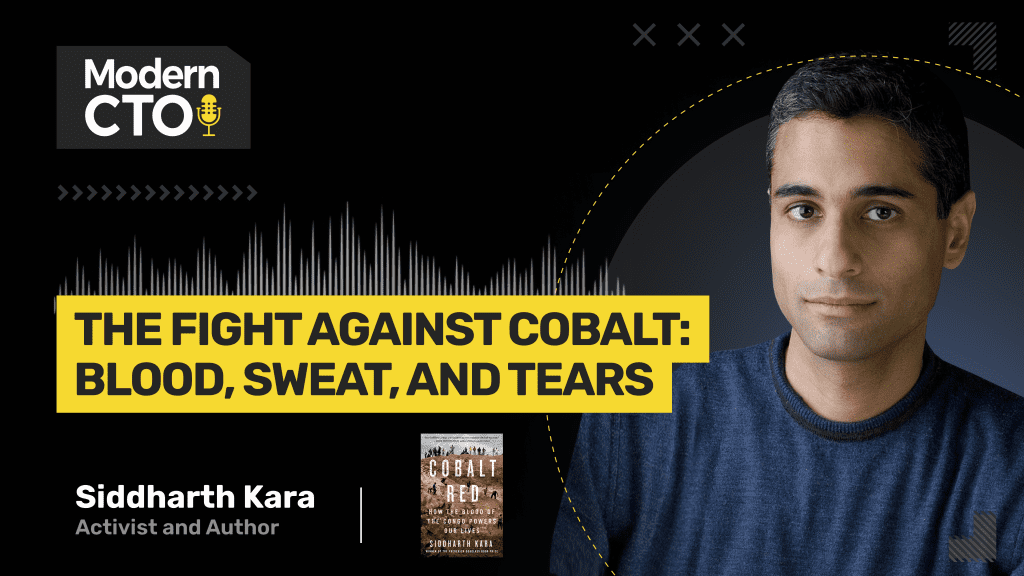
About Siddharth Kara:
Siddharth Kara is an author, researcher, screenwriter, and activist on modern slavery. He an adjunct lecturer at the Harvard Kennedy School of Government, and a Visiting Scientist at the Harvard School of Public Health. Kara has authored three books on modern slavery: Sex Trafficking: Inside the Business of Modern Slavery (2009); Bonded Labor: Tackling the System of Slavery in South Asia (2012); and Modern Slavery: A Global Perspective (2017), each with Columbia University Press. Kara adapted Sex Trafficking into a Hollywood film, Trafficked, which held its world premiere at the United Nations in New York. Sex Trafficking also won the prestigious Frederick Douglass book prize at Yale University for the best non-fiction book on slavery. Kara has also authored the reports: Tainted Carpets: Slavery and Child Labor in India's Hand-Made Carpet Sector (Harvard, 2014), and Tainted Garments: The Exploitation of Women and Girls in India's Home-Based Garment Sector (UC Berkeley, 2019). He is working on a fourth book about the horrors of cobalt mining in the Congo.
Across twenty years of almost entirely self-funded research, Kara has traveled to more than fifty countries to document the cases of several thousand slaves of all kinds. He has mapped global human trafficking networks, explored the perilous underground of trafficked sex slaves, and traced global supply chains of numerous commodities tainted by slavery and child labor. Kara advises several UN agencies and numerous governments on anti-slavery policy and law. He has also appeared extensively in the media as an expert on modern slavery, including on CNN, the BBC, the Guardian, CNBC, National Geographic, and numerous documentary films. Previously, Kara was an investment banker at Merrill Lynch, then ran his own finance and M&A consulting firm. He holds a Law degree from England, MBA from Columbia University, and BA from Duke University.
Transcript
(Intro Narrator at 00:00:01) Today, we're talking to Siddharth Kara about the human rights abuses behind the Congo's cobalt mining operation. You're listening to Joel Beasley, Modern CTO.
(Joel Beasley at 00:00:15) Hey, buddy. How are you?
(Siddharth Kara at 00:00:16) Okay. I'm fine, Joel. How are you?
(Joel Beasley at 00:00:18) Good, man. This is gonna be fun. Well, I kinda wanna jump right into it. Can we do that? Is that okay? Can I just get right into the thing I'm interested to talk about?
(Siddharth Kara at 00:00:26) Yeah. My philosophy is always jump in.
(Joel Beasley at 00:00:28) Okay. I watched the interview on Joe Rogan. What's the answer to this? Like, how do we solve this problem?
(Siddharth Kara at 00:00:37) Okay. So we're skipping to the end. Yeah. How do we solve the problem? Okay. The key to beginning to take steps to solve this problem is accountability. So the stakeholders at the top of the chain have to accept responsibility for the people in the Congo working at the bottom of their cobalt supply chains. That's just the sort of conceptual step or philosophical step that needs to be achieved. Once the stakeholders, consumer-facing tech and EV companies at the top of the chain, accept responsibility for the people digging out their cobalt in the Congo in appalling and subhuman conditions, then the initiatives, efforts that need to be undertaken to candidly do the things they say they're already doing can be undertaken. So for instance, you know, all these companies say they have zero-tolerance policies on child labor in their supply chains, that they uphold human rights standards all the way down to the mining level, that they maintain sustainability practices all the way down to the mining level, and that their supply chains, again, all the way down to the mining level, are 100% audited.
(Siddharth Kara at 00:01:54) Now that all sounds good. But when you get on the ground in the Congo, you see that almost none of it is actually happening. So, really, the solution is these big tech companies, the EV manufacturers, simply need to do the things they say they're already doing, but actually implement it on the ground.
(Joel Beasley at 00:02:14) How much of it do you think is sheer ignorance? Like, they actually believe it's happening versus they know that they're saying one thing and doing another?
(Siddharth Kara at 00:02:23) Well, let's be charitable and say maybe they're not fully aware of the scale and severity of human rights abuses and environmental destruction that is a consequence of how cobalt mining is taking place in the Congo. I have a feeling, I have a pretty good feeling, they're generally aware of the truth, but let's say maybe they don't fully appreciate the scale and severity of it. Well, honestly, I would say it's their job to know. I mean, they initiated this supply chain. No one said you must put cobalt in everything.
(Siddharth Kara at 00:02:59) No one put a gun to their head and said, "Please get cobalt, stick it in the batteries." So it's their job to know what's happening in their supply chains all the way down, all the details. And so if they're not fully aware of the scale and severity, then they should be. They should know. And so the question is, how many of these companies have sent teams to the ground as I've gone to see where the cobalt's coming from? How many of the CEOs of these companies, all multibillionaires many times over in no small part because of cobalt?
(Siddharth Kara at 00:03:29) How many of them have spent a week of their lives to go down and see, "Now, where exactly is my cobalt coming from?" And if the answer to that is few to none, then I think that's an oversight, an omission, and a problem that has led to massive negative consequences on their part.
(Joel Beasley at 00:03:49) Are there any alternatives to cobalt?
(Siddharth Kara at 00:03:51) So battery manufacturers are looking to create alternate battery chemistries. And there's a few reasons for this. Number one, there's not that much cobalt on the planet, at least that we know of right now. And with future demand projections, cobalt will probably run out 20, 30, 40, 50 years from now, if not sooner. So there's a need to find alternate battery chemistries.
(Siddharth Kara at 00:04:16) Also, because the supply chain is so heavily concentrated in the Congo, which is a very poor, war-torn country, there's geopolitical risk. There's security risk in the nature of that supply chain. So for that reason as well, there's a desire to find alternate battery chemistries. Now to my knowledge, there's really nothing being done in the consumer electronic world right now in a meaningful way to find an alternative for smartphones, tablets, laptops, and so forth.
(Siddharth Kara at 00:04:45) Some EV manufacturers have started using cobalt-free batteries, primarily lithium iron phosphate batteries that don't use cobalt. You have to forfeit a few things like energy density, power, and so on, and thermal stability. But most of, if not 90-plus percent of the EVs on the road today have cobalt in the batteries. And even if every EV manufacturer and every consumer electronic manufacturer for that matter stopped using cobalt tomorrow, that in no way repairs or accounts for the massive amount of violence and harm that's been inflicted upon the Congo, its people, and its environment for the last 12-plus years.
(Joel Beasley at 00:05:28) So I've got so many questions. I'll try to contain myself. I'm curious. What would happen if we found an alternative and we switched 100% to that alternative and we didn't have any more cobalt jobs for the Congo? What would they do then?
(Siddharth Kara at 00:05:43) Well, so this is what I'm trying to say. So number one, it would not do anything to repair the massive amount of human and environmental destruction that's taken place for the last 12-plus years. Now going forward, you'd suddenly have a population of a few million people who have been surviving on those $2 or $3 a day for the last decade. I mean, it's literally the difference between eating or not, survival or not, struggling to survive because their livelihood would have been stripped away. Their environment's been destroyed.
(Siddharth Kara at 00:06:21) There have been hundreds of thousands of people displaced because of expanding mining operations. Villages have just been laid waste. So you'd have a whole population of people left struggling to survive, completely displaced, surrounded by an utterly contaminated, toxic environment as a result of mining activity. It would be a humanitarian catastrophe layered on top of an existing humanitarian catastrophe.
(Joel Beasley at 00:06:49) If they were to be paid more—I saw your video, first of all, and you went into the Congo. You developed all these relationships. You got this really interesting behind-the-scenes video showing these laborers working in ridiculous conditions. So that definitely pulled at me a lot, and that's one of the reasons why I said, "Hey. We need to have this guy on the show so we can get this message out," because, well, I'm in technology, and I made my entire living writing code and all of these things. And that's who our audience is, and this is happening largely because of advancements in electronics. So maybe, you know, helping you get the word out would cause some positivity, if nothing more than just to make people aware. Because you're right. They can't—I mean, they can, but they aren't—flying down and checking their supply chains.
(Joel Beasley at 00:07:37) And you sort of did that as this, you know, a journalist, and I think that's incredible. So I have a ton of respect for you there. When I saw that video, I noticed the militia, and you even talked a little bit and told some stories about how you almost got in a really tight situation, but because you had this signature, you got out of it. If the government is in all of this disarray and corruption, let's say that tomorrow, one of the big tech companies wakes up and they say, "Look. I saw Sid." Can I call you Sid? I don't wanna, like—
(Siddharth Kara at 00:08:08) Sure. Sure.
(Joel Beasley at 00:08:09) I talked to Sid, and I saw what happened. I invited him to my office. We talked, and then now we're gonna triple their pay. The way it looked to me is that there's a good possibility that the corruption in the government and the militias would just take their extra pay.
(Siddharth Kara at 00:08:26) Yeah. So the solution has to include engagement with local government, local stakeholders. No question about it. You know, you can't just do this externally. And the good news is the Congolese government wants solutions.
(Siddharth Kara at 00:08:41) The current administration of President Tshisekedi wants solutions. You know, they signed an MOU with the U.S. government, the Biden administration, just last week or two weeks ago, looking to secure and improve battery supply chains. Now that's language. It's aspirational. What does that actually mean?
(Siddharth Kara at 00:09:01) We'll find out. But the good news is the government of the Congo is looking for positive change. And the coal, copper, cobalt mining areas are largely under the control of Chinese, Chinese state-run mining companies. And, candidly, that's part of the problem because they operate in a way that doesn't always maintain the kinds of human rights standards we'd expect to be implemented in the West. And as I said, the environment—and this is a key part of the story—the environment has just been completely destroyed. Millions of trees have been clear-cut to make way for giant mining concessions. These mining companies dump toxic effluence into the air, earth, and water in a way that they wouldn't do in their home countries. So the Congolese government sees what's happening. This very valuable resource that is needed for the global economy is being ransacked out of their country with little benefit to their people, and that has to change.
(Siddharth Kara at 00:10:02) So I think we'd have willing partners in the Congolese government. That's not to say you just snap your fingers and the problem is solved, because there's a lot of corruption still on the ground. There's a lot of violence, and all of that would have to be dealt with.
(Siddharth Kara at 00:10:16) But look. These companies at the top of the chain, quite apart from Western governments, I mean, we have solved massive problems before, much more complicated than achieving basic dignity for people in the Congo. I mean, just what it took to design a smartphone or an EV battery pack is far more of a challenge than ensuring that we don't have children caked in toxic filth in the Congo digging out cobalt. That's a small problem relative to the other problems consumer-facing tech and EV companies have already solved.
(Siddharth Kara at 00:10:51) So I think it's just a matter of will to say, "Okay. We actually do want to solve this problem." And so then the question has to be asked, because I do believe they are all generally aware of what's happening in the Congo. So the question has to be asked, "Well, why haven't they done enough about it?" And I think the unavoidable answer to that question is because it's those people over there, and they count less than our people over here.
(Joel Beasley at 00:11:17) Are there examples? I mean, you gave some examples about technology being created. We've put people on the moon, and there was a very clear financial and national incentives, you know, to do those things. I'm trying to figure out how you would financially incentivize people to solve this problem.
(Siddharth Kara at 00:11:39) Well, just consider the amount of money that's made at the top of the chain. Okay? And all of that, a lot of those strategic earth minerals flow through China. So there's geopolitical interest in solving this problem and being more active agents in ensuring solutions to these problems and ensuring safe, secure, dignified supply chains. So I think that should be sufficient.
(Siddharth Kara at 00:12:06) I mean, setting aside that there's a moral imperative, which candidly should be sufficient. If that's not enough, then the geopolitical imperative should be sufficient. Finally, what kind of world do we want to steward forward as a nation? Right? I mean, we're in this moment now where there are differing philosophies that are jockeying for influence on the world stage.
(Siddharth Kara at 00:12:32) China, Russia, countries like that, and then you have the U.S. and its western allies. And these are two different sort of worldviews, two different outlooks, two different opinions of how the global economy should be constructed. And I'm not saying one is right and one is wrong, but they're certainly different. And what's our responsibility as a nation to steward forward a more dignified global economy? And I think the answer to that is fairly obvious, but we're not doing it.
(Siddharth Kara at 00:12:58) And the proof is on the ground in the Congo for anyone to see, and I would invite any CEO of a tech company or an EV company or any other company that has cobalt in its supply chain. I'm happy to take them there and show them firsthand what's happening on the ground. And I make that offer because I think once they actually see it with their own eyes and realize the immense human harm upon which great fortunes are being built, they'll feel morally compelled to solve these problems.
(Joel Beasley at 00:13:27) Yeah. That's what I was thinking about before the show because, you know, I'm a software engineer by trade, and then I started this show, and I'm very outcome-driven. I'm very problem-centric and wanting to figure out, "Okay, talking is great. Once you've hooked me emotionally, I see that." I say, "Okay, there's gotta be a better way to do that."
(Joel Beasley at 00:13:48) Now let's figure out the problem. You seem to be the one that's leading this entire charge. Are there other people like you that have risen up in popularity discussing this?
(Siddharth Kara at 00:13:59) There, I'm sure there are and I'm sure there will be. You know, it's not that the world—well, it's not that participants in this chain are unaware. You know? And there have been some journalists that have gotten down there and written some stories. NGOs have been talking about this for many years.
(Siddharth Kara at 00:14:15) But it's been shrouded. You know? And it's enshrouded in no small part because of the fictions that are put out at the top of the chain that, "No, no. My supply chain's clean. We maintain human rights standards. There's no child labor here. Maybe in someone else's supply chain, but not in ours." And, you know, if that's true of all these companies, then where's all this child-mined cobalt going? You know, if no one's buying it.
(Siddharth Kara at 00:14:42) And if everyone's supply chain is clean, then what did I see down there? You know, it's not being dug out of the ground for no reason, not for sport. But these fictions have been put out, and as a consequence, people largely look the other way. Business carries on as usual. I think my book, "Cobalt Red," will hopefully be a big part of bringing the truth from the ground out into the world, and that will hopefully stimulate more people to get down into the Congo to understand the truth, maybe more companies to wanna engage, to understand and deal with their supply chain issues.
(Siddharth Kara at 00:15:17) And I have no doubt in my mind. There will be a new generation of heroes that will come forward to solve these problems. And the reason I say that is this. This is not the first time the Congo has been ransacked for resources. I mean, this is a multi-generational curse on the heart of Africa going back to colonial times.
(Siddharth Kara at 00:15:39) And, ironically enough, for the first automobile revolution, which needed rubber tires. And the Congo had one of the largest rubber forests known at the time, and King Leopold deployed a mercenary army to terrorize and enslave the local population to pull rubber sap out of the ground, and he walked away with billions. And now we come forward 130 years, and we have a new automobile revolution, this time, electric batteries that need cobalt, among other things. And lo and behold, where's more cobalt sitting than anywhere else in the world? In fact, more cobalt is in the Congo than the rest of the planet combined.
(Siddharth Kara at 00:16:19) So it's just the same story again and again, but there were heroes that came forth the first time around and the second time around. And there will be heroes that come forth this time around to see an end to this injustice.
(Joel Beasley at 00:16:32) If we follow the financial chain, are we saying that most of—is it most or all of them are owned by other countries and we buy from the businesses that are run by these other countries, or do we actually operate as Americans those facilities directly? Meaning, we directly interface with them and there's no other country in the middle.
(Siddharth Kara at 00:16:57) Well, okay, so this is how the chain works. And important to recognize, there's not a single American mining company operating in the Congo. Okay? So it's all China plus Glencore plus some Canadian, one or two Canadian companies, one or two Middle Eastern companies, and that's it.
(Siddharth Kara at 00:17:19) There's not a US-based company, a mining company operating in the DRC. So the mining companies pull copper and cobalt out of the ground. Cobalt's always attached to copper and nickel in nature. It's not found on its own, so it's always attached to something. So the mining companies pull the ore out of the ground.
(Siddharth Kara at 00:17:40) Most of that ore, the copper, cobalt, nickel, it gets separated in a preliminary processing phase in-country and then gets exported, most of which goes to China for commercial-grade refining. China produced, I think, 70 or 80% of the world's refined, commercial-grade refined cobalt last year. So that commercial-grade refined cobalt gets sold to battery manufacturers. The top six are based in China, South Korea, and Japan. The biggest of which is a company called CATL.
(Siddharth Kara at 00:18:12) It's a China-based company which has about a one-third market share globally of lithium-ion rechargeable batteries that are used in gadgets and cars. So those battery manufacturers, of which there's a big six in those countries I mentioned, they then sell batteries of varying sizes and kinds to smartphone manufacturers, tablet manufacturers, and of course, EV manufacturers. And those companies are based all over the place. But that supply chain from dirt to battery is dominated out of the Congo into China and a couple of other East Asian countries. And then, of course, there are many US giants that dominate the consumer-facing side of it.
(Joel Beasley at 00:18:51) I don't like that they use the word artisanal or artisanal miners. It tries to put a pretty spin on something that's not pretty.
(Siddharth Kara at 00:19:00) Yes, it makes you think, oh, this is quaint work by trained artisans. And it's one of the many kind of word games that are used to belie the truth. Truth is ugly. It's horrible.
(Siddharth Kara at 00:19:16) It's offensive. It's repugnant. It's degrading. You step into some of these mining areas, and it's like the clock has been dialed back two centuries to colonial times. I mean, the conditions are so subhuman and so degrading to essentially humanity.
(Siddharth Kara at 00:19:34) So yes, this term is ridiculous. We should call it what it is, which is just brute labor of digging out valuable minerals in immensely harmful, dangerous, hazardous, and toxic. I mean, cobalt is toxic to touch and breathe, and you've got hundreds of thousands of people, including children, including babies on their mother's backs, touching and breathing the stuff every day to feed it up the chain.
(Joel Beasley at 00:20:04) Do they have the ability to leave? Like, legally, can they leave, or are they stuck there?
(Siddharth Kara at 00:20:09) There's nothing else to do. There's no place to go. I mean, you're talking about some of the absolute poorest people in the world. There is almost no sanitation in that part of the Congo, almost no electricity. I mean, imagine the irony that this little patch of dirt in the Congo is home to the largest supply of one of the most essential metals used in rechargeable energy in the world, and the people who live there don't have electricity.
(Siddharth Kara at 00:20:37) There's almost no alternate livelihoods, even more so because mining companies and these massive mining concessions have just obliterated the landscape. I mean, the largest mining concession down there is about the size of London, just to give you a sense of scale.
(Joel Beasley at 00:20:51) Oh, wow.
(Siddharth Kara at 00:20:52) And that means the hundreds of thousands of people that were once living on that land were just kicked out, displaced. They've been there for generations, and a huge mine with giant—you can see these things from space—giant pits, one after another after another. Now multiply that by fifteen, twenty different mining concessions that have just swarmed the entire landscape, and all the people have been displaced. There's no place to go.
(Siddharth Kara at 00:21:19) There's no money. There's no alternate livelihoods. Arable land is almost extinct. Water supplies are dwindling. Scrounging out some copper cobalt for a couple of dollars a day is, for the rural population, almost the only way to survive.
(Joel Beasley at 00:21:35) So I want to handle this delicately, okay? Because it's an important subject, right? So if I were there, like, if you drop me in a helicopter and you just drop me in the Congo, I would run, try to hunt, and get to another country.
(Joel Beasley at 00:21:58) Would the other country let you in if you're a Congo person, or are the militias keeping the people there? How can they not just physically stand up and start walking to another country?
(Siddharth Kara at 00:22:09) Well, let's look at what's surrounding that part of the Congo, okay? So to the north and to the west, it's just wilderness until you get to some other area. There's some more—there's mining of other battery minerals, microprocessor minerals a bit further north, which is also a hellscape, so you're not really escaping that way.
(Siddharth Kara at 00:22:29) To the west, it's just wilderness, villages, hills, forest, whatnot. So there's not much to go to there. Now you can go to the south or southeast. That's the border with Zambia. That part of Zambia is about as dirt poor and overrun, in this case, by copper mines, as the place they're in.
(Siddharth Kara at 00:22:48) So that part of central Africa is just swimming in minerals. And so if you look at a map, the southeastern part of the DRC, Haut-Katanga and Lualaba provinces, you'll see this little patch of dirt in the southeastern corner, and then there's Zambia on the other side. It's mines on the other side of the border too. It's just copper, big copper mines. And again, you can see these things from space.
(Siddharth Kara at 00:23:14) They're huge. So there's—you know, if you're talking about people getting on foot and going, there's just no place to go. I mean, maybe there's some bus you could get onto and try to get a little further, but that part of Africa is just very, very poor, and there's not much to do by way of migrating for a better life. I mean, if you get across Lake Mweru, then you're into Tanzania. It's just pure wilderness over there too.
(Siddharth Kara at 00:23:36) So it's all subsistence survival in that part of Africa.
(Joel Beasley at 00:23:41) Are these people educated at all? Do they even understand the map and that there are other countries and there are other places that have wealth?
(Siddharth Kara at 00:23:48) Yeah, I mean, there's movement across the border with Zambia. I mean, it's right on the border, so there's movement back and forth across that border. It's pretty militarized, you know, because of the value that's at stake in terms of minerals crossing the border.
(Siddharth Kara at 00:24:06) So people know where they are, sort of geographically, generally. You know, literacy rates are very, very low in that part of the Congo. There are just not many schools. And of course, children are by and large not going to them because they need to work, to earn, to help the family survive. You know, life there is a struggle for daily survival.
(Siddharth Kara at 00:24:30) You know, you and I can kind of cast long eyes into the future, make plans, think about, well, maybe I'll move to this place because there's opportunities, or maybe I'll pursue a different career, and in which case maybe I'll go to that city. And we have these options. You know? Down there, it's just, can I eat today or not? And what does it take for me to make sure I eat?
(Siddharth Kara at 00:24:54) And casting long eyes into the future is just not a luxury people down there have.
(Joel Beasley at 00:24:59) When you were down there visiting with the local people who are participating in this mining, you're sitting around the campfire at night talking. What type of conversations are being had?
(Siddharth Kara at 00:25:12) Well, you know, one thing that I learned very early on in my research, and this goes back many, many years, is research into slavery and child labor, which has taken me to a lot of very, very poor, miserable parts of the earth. There's great power in listening. When I stop, when anyone stops to just listen, it just conveys so much power to a person who doesn't feel like anyone can hear them. Their cries, their suffering, their torments. And because it's true that for the most part, they're crying into an abyss.
(Siddharth Kara at 00:25:54) And so oftentimes, just sitting and listening to what people have to say, and it could be anything, completely off-topic to mining. You know, just the pains, the suffering. People tend not to talk about their dreams or what they want out of life. You know, it's just about this torment and this painful struggle to survive and this feeling that no one can see or hear them. And invariably, conversations move to what's happening around them.
(Siddharth Kara at 00:26:22) And, you know, there's a sense that people don't understand, and they understand all too well what's happening. I mean, they see these big, big foreign mining companies ransacking their environment. They can see and understand that a massive amount of money and wealth is being generated by everybody else but them, and it's their dirt. It's their earth that they have lived on for generations. And they understand that in due course, they're going to be left with nothing but valueless dirt and nothing to show for it.
(Siddharth Kara at 00:26:54) And people understand that. They have dreams for their children, and they'll often talk about that. I don't want my child working with me. I know they might get injured. I know something horrible might happen.
(Siddharth Kara at 00:27:05) But if they go to school, I can't pay the fee. And even if I could, that means we don't eat. And so they're caught in this vice, this grip, this suffocating noose of having to decide, do I put my child at risk to survive, or do we not survive? And the feeling is, well, you know, they don't care. And I'm saying this because you feel it.
(Siddharth Kara at 00:27:28) You know, that maybe they don't care about their kids as much as we care about ours. Maybe they're not as aware of the value of childhood and child education as we are. And those types of sentiments come from people who have never stepped foot or spent five minutes in the Global South talking to the poorest people in the world because they understand the importance of childhood and education and security and health and well-being. And they all want a better life for their kids. Every parent I ever spoke to, every mother, every father, all they said is I wanted—I'm doing this. We want a better life for our children. I'll never forget one father who lost his child in a tragic accident said to me, you know, I wanted my son to work with his mind, not with his hands.
(Siddharth Kara at 00:28:01) Like I had to. I wanted him to get an education, but it wasn't possible for us. And then you look at the top of the chain and the amount of money that's being generated.
(Siddharth Kara at 00:28:30) In no small part by availing of the resources and labor of these communities, and how much investment is being sent back there to build schools, to pay a decent wage, to provide some protective equipment so they don't have to suffer toxic exposure every day, to maybe build some medical clinics, sanitation, electrification. I mean, any number of things that would help enhance community strength and stability and help parents realize their dreams for their children, just as you and I have dreams for our own children.
(Joel Beasley at 00:29:02) Are there any churches that go down there?
(Siddharth Kara at 00:29:05) Yeah. Yeah. Look, they're—you know, the Congo is a country of great faith. You know, the irony is, you know, Christianity was brought by missionaries, and, you know, foreign influence, of course, had primarily negative effects on the Congo, in no small part the slave trade from the dawn of the arrival of the first Portuguese ship at the mouth of the Congo River across centuries of the slave trade.
(Siddharth Kara at 00:29:31) Ultimately, then with the colonial period under King Leopold and then eventually the Belgian state, missionaries came along. And initially, what's interesting is they became some of the first truth tellers of what was being done to the people of the Congo by sitting and talking to people, which the pillagers and pirates, of course, never do. And today's pillagers and pirates of global industry never do either. All you have to do is sit and talk, send someone to sit and talk and listen. Anyway, so it's a country of great faith.
(Siddharth Kara at 00:30:04) It's about 50% Catholic, a quarter Protestant, and then a handful of other religions, Hindus, Muslims, and local faiths. And so churches, especially the Catholic Church, is very active in trying to get children out of mines, keep them in schools, strengthen communities, look after orphan children. There are thousands upon thousands of orphans, young children, six, seven, eight, nine, ten, digging in trenches and pits because their parents were killed in a mining accident. So the church is active, but, you know, there's only so much that can be done.
(Joel Beasley at 00:30:43) Now I just want to revisit the campfire-type situation for a second. I'm very curious. I see the video. I see the people with guns. I see the poor conditions.
(Joel Beasley at 00:30:57) I understand it would be massively difficult to physically stand up, leave your homeland, and go to find a better life. I understand that's incredibly hard, and you have the possibility of dying in the process, right? But I'm just curious for my own sake. Can they do that, or are those militias preventing them from leaving the land?
(Siddharth Kara at 00:31:22) No, I mean, you could get up and go. Okay. Where you go is another question. Whether you make it there is another question.
(Siddharth Kara at 00:31:29) Yeah. Um, you know, if you survive the journey, it's to an unknown destination, and there's huge risk associated with that. Whereas there's a sense that if I stay here and I do this, I live for another day. It's a miserable life, but I live for another day. Um, now there are—there are some cases, and I talk about it in Cobalt Red, where local militias or the army has moved people into an area, and they are under guard to dig and kept there in very remote areas.
(Siddharth Kara at 00:32:04) And that's just outright slavery. That's not the norm, but I do talk about a couple of cases that I uncovered very far afield, deep in some wilderness areas where militias are controlling a population of people. There are a couple of villages also. Again, these are more remote areas where there are militias kind of in control of people. Now the other thing is some of these militias are very involved in child trafficking.
(Siddharth Kara at 00:32:30) You know, you've got a country of just grindingly poor people, a lot of orphans again. And I spoke with many children who had been recruited, trafficked from another part of the Congo by a militia network, brought down into the mining provinces to dig because that's money. That's money for the militia. And that happens a lot, actually.
(Siddharth Kara at 00:32:56) There's a part of the Congo a little bit north of the mining provinces called the Triangle of Death. And there's three cities that kind of form this Triangle of Death, a little bit north of where the cobalt is. There's some other things there like gold, coltan, tin, tungsten that go into microprocessors. But I spoke to a lot of children who've been trafficked down from that area by militias into the cobalt part of the country, you know, because look at what the spot price of cobalt has done in the last few years. You know, it's going up and up and up.
(Siddharth Kara at 00:33:29) And when you talk about how aware are people of the world around them, they know that. They know cobalt's getting more valuable. From 2019 to 2021, I think it doubled in price on the London Metal Exchange. People know that. Militias know that.
(Siddharth Kara at 00:33:43) So there's money to be made. There's children. Take the child, make them dig. And that's what happens. And I spoke to several children in some remote village areas under militia control that had been trafficked.
(Siddharth Kara at 00:33:55) And that was—you mentioned the one anecdote I discussed with Joe Rogan. That was one of the places I was when that group of commandos came, berserker-like, at us with machetes and AK-47s because we were in one of those areas, and they didn't want anyone uncovering what was happening there.
(Joel Beasley at 00:34:17) Is there hope down there?
(Siddharth Kara at 00:34:19) Of course. I mean, you and I, the conversation we're having right now is proof there's hope. It's bleak. Okay? I mean, it is heart of darkness, and that's the great tragedy.
(Siddharth Kara at 00:34:31) You know, Conrad wrote that a hundred thirty plus years ago, and here we are still talking about this part of the Earth being the heart of darkness, and it still is. So you might say, man, this is just cursed. That the heart of Africa is cursed. There's no, I don't, I don't—
(Joel Beasley at 00:34:47) I don't buy that. I don't buy that.
(Siddharth Kara at 00:34:49) I don't buy that. No. There is hope. Yeah. There absolutely is hope.
(Siddharth Kara at 00:34:52) Because we live in an era now where no one's going to argue, at least vocally, that those people over there are worthless. They may be part of an economic chain that demonstrates in its governance that those people are considered to be worthless. But no one's going to come out and say it. You can't feel that way anymore, and you can't run an economy that way anymore, even if that's what's happening. So there are pathways forward. You don't have to convince anyone that slavery is wrong.
(Siddharth Kara at 00:35:24) Child slavery is wrong. You don't have to convince anyone of that anymore. At least you shouldn't. So our conversation, other conversations, my book, other journalists, other researchers, and, crucially, the courageous people on the ground in The Congo who are trying to empower their communities and need a reaching out, a hand to the global community, an open hand. And all we have to do is reach back and do the simple things that can be done to completely and radically transform the basis of exchange of our world with theirs in a way that is more dignified and decent and uplifting and empowering and sustainable.
(Joel Beasley at 00:36:09) Is the UN an entity that could get involved with China and make laws? Or how would you, let's pretend that this problem was solved. How did it get solved? We don't have US mines there directly. We're buying from suppliers that are controlled by China and a couple other countries downstream, and they go up to the battery level.
(Joel Beasley at 00:36:29) And how do you create that change on an actual technical execution basis?
(Siddharth Kara at 00:36:38) I think the role for the UN to play and government aid agencies is in community strengthening, you know, building schools, supporting, expanding public health, sanitation, things like that that improve human development outcomes and strengthen these local communities. But from the standpoint of this value chain of dirt to phone and dirt to car, that has to start at the top of the chain. Those companies need to be on the ground. Shoulder to shoulder, trench to trench in the dirt with their Congolese stakeholders, their Congolese employees. They need to be on the ground seeing, intervening, dealing with, and doing the things they say they're doing.
(Siddharth Kara at 00:37:30) It can't be passed down the chain. You know, a big tech EV company can't say, well, I rely on the battery maker to solve this problem, because the battery maker is going to say, well, I rely on the mineral refiner. And the mineral refiner is going to say, well, I rely on the mining company. You get the, you get what's happening here, right? Then everyone is relying on someone else downstream until the last finger is pointed at the kid caked in filth and grit in The Congo. And no one's taking responsibility for that child. So if these companies said and meant it, they said and meant it, we can't buy cobalt mined in these conditions, then it would all change. And if they said, we'll get on the ground and make sure of it, then it would all change.
(Siddharth Kara at 00:38:18) But they're not on the ground. They're not making sure of it. They're happy to keep buying the cobalt and promoting fictions that the supply chain is clean and audited and so forth. That's how the problem gets solved on the ground. When the big tech and EV companies take responsibility and solve this problem directly.
(Siddharth Kara at 00:38:39) Keep a team there permanently, making sure there are no kids, that people are being paid a decent wage, everyone's got safety equipment, that millions of trees aren't being clear cut. And if they are, a million more are planted in their place, and so on.
(Joel Beasley at 00:38:53) Do we have to fund the government there? Because you would think that would be a requirement because you would need some stability if you start building schools and sanitation. You would need some sort of legitimate government and policing and, you know, to have a society.
(Siddharth Kara at 00:39:10) Yeah. That's all part of capacity development. I mean, the national budget of The Congo is something around the state budget of Idaho. Okay? But it's got 50 times more people.
(Siddharth Kara at 00:39:22) So, you know, it's a country that's just a massive place, very poor. And when you are big, massive, and poor, that leads to corruption, poor governance. They just completely lack capacity. I mean, take an Apple, or a Tesla or a Samsung or a Google. They probably make as much money in a week as The Congo spends in a year.
(Siddharth Kara at 00:39:49) So I'm not saying it's their responsibility to run the Congo, but it's their responsibility to promote development, to support the communities there. And more needs to be done to support the Congolese government to build capacity to secure the nation, and things like roads, schools, infrastructure, sanitation, electrification. I mean, it all needs to be done. It's astonishing to me that we've availed of so much of the value of the heart of Africa without really taking time and effort to strengthen that part of the world. It's a win-win.
(Siddharth Kara at 00:40:24) What do we lose by strengthening the heart of Africa? We lose nothing.
(Joel Beasley at 00:40:29) I'm trying to create the chain of logic here.
(Siddharth Kara at 00:40:33) Sure.
(Joel Beasley at 00:40:33) Because I want to validate it so I can understand it in my own head. The chain of logic is there's a supply chain. Bad stuff's happening at the bottom. The people that make the most money and have the most money from the entire process need to step in as the big kid and say, no, that's not going to be okay.
(Joel Beasley at 00:40:53) That's what needs to happen. Correct?
(Siddharth Kara at 00:40:56) Yeah. That demand starts at the top. So solutions have to start at the top. Demand doesn't start in the middle, and it certainly doesn't start at the bottom. Okay?
(Siddharth Kara at 00:41:05) It starts at the top. Everything that has flowed, good, bad, and ugly, as a consequence of demand for cobalt only exists because of the demand that starts at the top. And that's where the solutions have to start. And, again, let's be clear. They already all say they're doing it.
(Siddharth Kara at 00:41:25) Okay? We're not telling them to do anything they don't already all claim to do in their quarterly reports, press statements, annual reports, human rights statements, and so on. They all say—
(Joel Beasley at 00:41:37) They're saying all the way down to it coming—
(Siddharth Kara at 00:41:40) To the mining level. Now they use that word very carefully. What does mining level mean?
(Joel Beasley at 00:41:46) Yeah. That's what they do. Yeah.
(Siddharth Kara at 00:41:48) Okay. But you and I know what mining level means. Mining level means people doing the mining. Okay? So, they all say down to the mining level, it's clean.
(Siddharth Kara at 00:42:01) Now what they think they're saying or what I think they think they're saying is the industrial mine is okay, right? Mining happens in two ways in The Congo. There's industrial and artisanal. The fallacy is that those are two separate things.
(Siddharth Kara at 00:42:20) They're not two separate things. But what the company at the top says, that industrial mine where I buy cobalt from, that is okay. There are no children there. There's no artisanal miners there, and the cobalt coming out of that mine is not mixed with the child-mined cobalt. So that's what they mean by mining level.
(Siddharth Kara at 00:42:36) Truth, however, is if they, like me, were to actually go to said mine, they'd see there are children, there are women, there are artisanal miners working in and around almost all those industrial mines. And they do that because it's for the mining company at the mining level, a cheap way to boost production. Pay this kid a dollar, pay his mother a dollar fifty and his father a dollar eighty, and you get a couple more sacks of cobalt. So number two, all the other cobalt, like that video I showed on Roje, where there's 15,000 people crammed in a pit and some scene you might imagine from a thousand years ago. All that cobalt is going where?
(Joel Beasley at 00:43:28) Upstream.
(Siddharth Kara at 00:43:28) Into the formal supply chain. It's not going somewhere else. It's not going to Mars. It's not going to some other company on some other planet. It's all going into the formal supply chain, but they disown that.
(Siddharth Kara at 00:43:44) Okay? So mining level means all of these things, this thick wall that's supposed to exist between industrial and artisanal doesn't exist. And that's the value of actually getting on the ground and seeing what does mining level actually mean. This is what it means. It means it's all mixed together before it ever leaves the country.
(Siddharth Kara at 00:44:02) And at that point, you can't disaggregate what was dug out as a consequence of an excavator and what was dug out by some kid. You can't disaggregate that anymore. It's all been batched together and semi-processed together before it ever leaves The Congo. Now the other reason why there are artisanal miners, this is, as a tech or a scientist, you'll appreciate this crucial element. Although no mining company will say we've got artisanal miners, you know, in our minds.
(Siddharth Kara at 00:44:31) But many of them do. The reason is, if you imagine how industrial mining works, big machinery, it's a bulk, high volume, low yield business. You take out mounds of dirt, and there's a small amount of it that's valuable. What a human can do is handpick what's valuable. Stick it in a sack and you've got a sack of valuable dirt, valuable cobalt without all the stuff that's not valuable.
(Siddharth Kara at 00:45:03) So it is a low volume, high yield business. Now it doesn't make sense economically unless you don't pay them anything, or you hardly pay them anything, and you don't look after them in case they get injured, and you don't do any of the things you'd expect to do for basic human labor requirements. But it does make really good sense if you only pay them a dollar or two. If they get injured, never mind. If they get killed, never mind.
(Siddharth Kara at 00:45:30) But you get that high yield sack of cobalt for a dollar or two, and you add that and multiply that by tens of thousands, hundreds of thousands of people. And now you're talking about tens of thousands of tons of high grade cobalt that's supplemented into the formal supply chain for a de minimis cost of business. Do you—
(Joel Beasley at 00:45:56) Do you think you could start a program with a country that would fly a helicopter in and set up some tents and put a sign up sheet and say, if you want out, we'll let you enter our country. And just let them get on the helicopter and just leave.
(Siddharth Kara at 00:46:13) Well, the question is, who is taking them?
(Joel Beasley at 00:46:17) The other like, we would get a country to agree. Like, hey. Every country agrees. I'll let in, you know, so many thousands. First of all, let's start with how many thousands of them are there?
(Siddharth Kara at 00:46:27) Oh, well, there's a few million people living in that part of the Congo. Not every one of them digs cobalt every day, but there are hundreds of thousands of them who do. Okay. You know, if you find the country, now we're getting into a migration discussion, right? I mean, you know how hard it is just to get a couple of thousand Afghani people into this country after the Taliban took over and we left, right? I mean, that was a long haul. That was a hard ask. That was a big ask.
(Joel Beasley at 00:46:54) But there's so many developing countries out there. Like, there's a lot of countries out there.
(Siddharth Kara at 00:46:59) I guess the question is who's going to take them? What's the, you know, what opportunities are there for them in that new country when countries can barely account for and take care of their domestic population? Is it a popular thing politically? You know, will a politician take that risk? I mean, there's a lot of other questions that one has to work through in a displacement kind of theory.
(Siddharth Kara at 00:47:22) But I don't think that solves the problem.
(Joel Beasley at 00:47:25) Oh, I agree. I agree. I'm just, I'm just curious. I'm a curious guy.
(Siddharth Kara at 00:47:28) If you took those couple of million people and just put them, let's just say we set them up in California or London or Hong Kong or whatever, that they were going to be okay. Let's just assume that for the sake of argument. There's another 2 million people just south, east, north, and west of the mining provinces who will come right in for that two or $3 a day because that's a better deal than they probably currently have. Oh, wow. That's how, you know, wretched and poor and miserable and ransacked that part of Africa is.
(Siddharth Kara at 00:48:02) I mean, the population of Congo is what? 80 million? Something like that, you know. And they're all, we're talking about people who per capita income is just a couple of dollars a day, if that, probably a dollar. Life expectancy, you know, very short.
(Siddharth Kara at 00:48:16) Maternal mortality, you know, all these things, right? It's just it's a very bleak existence in no small part because so much of the value of what's there is just siphoned out with little benefit to the people who live there. I think the solution is fix the broken reality there. Repair it piece by piece, stone by stone, life by life, get down there.
(Siddharth Kara at 00:48:44) It wouldn't cost that much money. It's not that complicated. It wouldn't take too much effort. It's just a matter of will. Much, much bigger problems have been solved in short order relative to what it would take to simply mine cobalt in a decent and dignified way.
(Joel Beasley at 00:49:00) I love that. You've given me a lot to think about. This is, it's not an easy thing. I know you've been living in it, and you've been researching it, and you've been writing the book.
(Joel Beasley at 00:49:11) How do I buy your book? What do we do?
(Siddharth Kara at 00:49:14) Yeah. So the book is released on January 31st. So in a few short days, you know, you can get it on any online bookseller very easily and presumably nearby bookstores as well, to the extent those exist in your neighborhood. But I think that the point of the book is really to bring the voices of the Congolese people to the world. This coming back to your, you know, analogy of sitting around in a campfire listening.
(Siddharth Kara at 00:49:43) So this is inviting the reader to come do that, to come and hear the truth, the ground truth, the experience of the Congolese people. They're true. Not what's said about them outside of The Congo, but what they have to say about their lives inside the Congo. And so they're speaking their truth through the pages of the book, and then it's up to the reader to hopefully feel motivated to be a part of solving this problem.
(Joel Beasley at 00:50:11) Are you doing a documentary?
(Siddharth Kara at 00:50:14) Yeah. I've got an early stages of a documentary in the works. You know, it's all about awareness right now. That's always the first step in making significant human rights change is awareness. People need to know.
(Siddharth Kara at 00:50:29) And because there's a sufficient proportion of humanity that is good. I believe that. That has a good heart, a good conscience that cannot abide injustice, particularly if it touches their lives. And this injustice touches all of our lives. You and I would not be having this conversation right now without cobalt.
(Siddharth Kara at 00:50:49) So it touches our lives. So the world is a participant in this unwittingly, and there's a sufficient proportion of humanity out there that once they learn of this injustice, I have every confidence will not abide it and will do whatever it takes to see these injustices brought to an end.
(Joel Beasley at 00:51:11) Yeah. It hurts my heart. I've got three kids. And when I saw that, I just was like, what can I do? Right?
(Joel Beasley at 00:51:18) And I was like, I can have Sid on. I was like, that's the best thing I can do.
(Siddharth Kara at 00:51:23) That's it. That's right. Yeah. Amplifying this story, this truth, this reality being suffered by the Congolese people and their children to the world. And you've done that.
(Siddharth Kara at 00:51:37) You've done that today. That's an immense service to the people of the Congo. You've participated in bringing their truth to the world, and I think that that is a greater good than many of us appreciate. And I hope you know that you've done something immensely beneficial and powerful and good for the people of Congo.
(Joel Beasley at 00:52:00) Thank you so much for listening. And if you found this episode useful, please share it with a friend or colleague who you think would get value from it. And if you have topics that you'd like to hear discussed on the podcast, either add me on LinkedIn or send me an email [email protected]. Every time I get an email or LinkedIn message, it absolutely makes my day and inspires me to keep going.