
Episode 754 ·
Revolutionizing API Integration: Merge's Founding Story with Shensi Ding, Co-Founder at Merge
Today we’re talking to Shensi, Co-Founder at Merge. We dive into the story of Shensi and the founding of Merge, explore the unique challenges and innovations in API integration, and discuss Shensi's leadership style and team dynamics.
All of this right here, right now, on the Modern CTO Podcast!
To learn more about Merge, visit their website here.
Have feedback about the show? Let us know here.
Produced by ProSeries Media.
For booking inquiries, email [email protected]
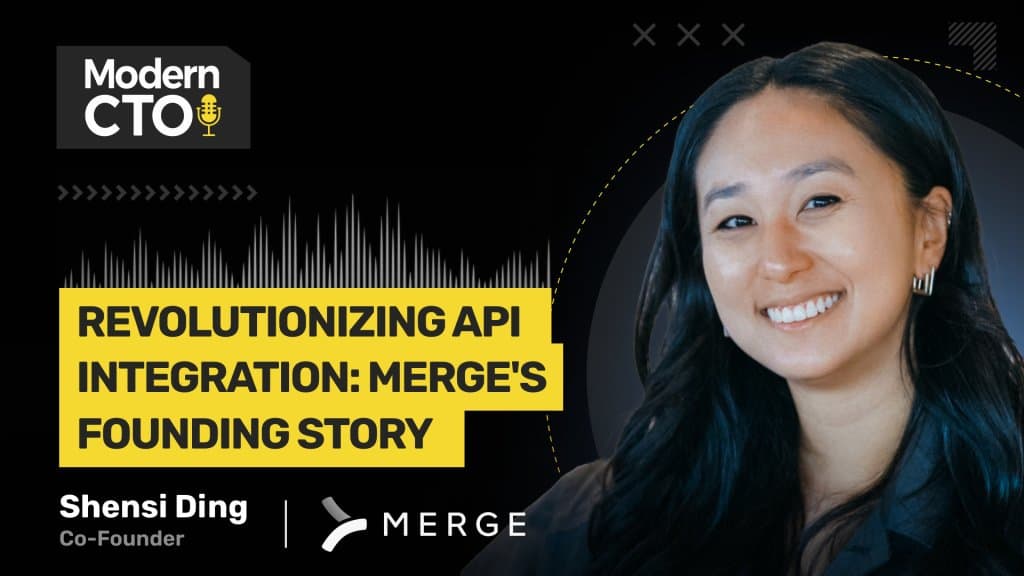
About Shensi Ding
Shensi is the visionary founder of Merge, a company that's redefining the landscape of API integration. With a strong background in tech and a passion for innovative solutions, Shensi has led Merge from its inception through significant growth phases. Known for a dynamic leadership style, Shensi emphasizes team cohesion and strategic thinking. Under their guidance, Merge has established itself as a frontrunner in the tech industry. Shensi's forward-thinking approach and commitment to excellence continue to drive Merge towards new horizons in technology and business.
About Merge
Merge provides the tools to transform how B2B companies realize customer-facing integrations. With Merge’s Unified API, developers integrate just once with one API, for all integrations. Merge takes charge of the entire lifecycle of integrations and adds new platforms every week.
Merge is backed by $75 million in funding from Accel, NEA, and Addition. Merge was founded in 2020 by Shensi Ding and Gil Feig and is proudly built in San Francisco and New York City.
Transcript
(Intro Narrator at 00:00:00) Today, we're talking to Shensi, co-founder at Merge, about her founding journey and how Merge is revolutionizing API integrations. You're listening to Joel Beasley, Modern CTO.
(Joel Beasley at 00:00:17) So hey, you're calling from New York right now? You're in New York?
(Shensi at 00:00:20) Yes, I'm in New York City.
(Joel Beasley at 00:00:21) Is it winter cold yet?
(Shensi at 00:00:23) Oh, it is, but it's so nice. It's really nice to just be walking around in the cold right now because I feel like it was too hot for a long time, and I'm still traumatized from that over the summer. So it's good. I haven't gotten traumatized from the cold yet. And then once I do, then it's going to get warm again. That's how they trick you.
(Joel Beasley at 00:00:40) Yes. 100%. It's still kind of like fall. Like, oh, it's cold today. And then in two months, it's going to be like, when will this be over?
(Shensi at 00:00:46) Yeah, for sure. Also, it's nice to actually have an excuse to just be inside and not do anything on the weekends versus when I was in San Francisco, the weather was always good, so I was always tired. I was like, oh no, I have to leave the house.
(Joel Beasley at 00:00:57) When did you make the move?
(Shensi at 00:00:58) Around two and a half years ago. We started the company in San Francisco, and we had around eight people in San Francisco at the time. We were always in person. We were always together. And we started selling to Europe and Israel pretty early on because everyone was remote. So many engineers, all over the place. And we found the time zone in California was pretty tough, especially in the early days where we really wanted to get as many sales meetings as possible. And so New York was just a lot better for that, time zone-wise. And Gil, my co-founder, we both met in college. We went to school in New York. And I'm just a New Yorker. I'm an asshole. I love being inside. I hate nature. I'm allergic to everything. And so I was like, oh, maybe this might be a good time for us to start a New York office so we can really get a good go-to-market team going here. So I moved out to New York with one of my team members, got started, had an office, and it's just been really great. Actually, now most of the team members are in New York, although we still have a really big office in San Francisco. But it's nice to be able to serve a lot more customers from this time zone versus just in California.
(Joel Beasley at 00:01:55) So how many people do you have in New York?
(Shensi at 00:01:57) We have 70 people in New York and around 30 people in San Francisco. We actually just signed a San Francisco office. So we're finally moving out of a WeWork. We're signing a full floor. So that'll also be very exciting for the San Francisco team.
(Joel Beasley at 00:02:08) Yeah. What's the real estate market like there? Is it still pretty crazy? Is it good for renters or no?
(Shensi at 00:02:14) I think it depends on what size you're looking for. So if you're a huge company or you're going to have a huge lease, I think it's absolutely bonkers. Everything is super, super, super cheap. But if you're around our size or if you're the size of our San Francisco office, which is around 30, that's a really popular size to look for space. So it's really competitive, which is really annoying. And then also if it's a lease that has a lot of sunlight, it's very competitive as well because there's a lot of leases that are just super dark and emo, and those no one wants.
(Joel Beasley at 00:02:44) Yeah, yeah. This is fun. All right. So why did you even decide to do this company? How did this come about?
(Shensi at 00:02:50) So Gil and I are best friends from college, and we've always been really good friends. I moved to San Francisco, and I moved into tech, and Gil was already there. And we just always would get dinner, lunch. On the weekends, we'd do workout classes, and we just talk about work. And around 2019, 2018, we were both at startups in San Francisco. They ran into this problem of needing a lot of integrations with different competitors in the same category, and we were also actually working in very different industries. I was in cybersecurity. He was in recruiting tech. But what we were noticing was that, fundamentally, it was a very similar problem, and no one was solving it. There are so many companies that are solving automation and workflows and internal tooling, connecting various systems that people had already purchased, but nothing was solving the problem of adding integrations to a product for customer-facing use cases. And we wanted to solve it. So that's why we quit. It completely took over our lives. And now fast forward, we're four years in, and it's just been really, really fun.
(Joel Beasley at 00:03:50) When people first see this, when I first saw it, I was like, oh, this is kind of like Zapier, right? Trying to understand what it is. But it seems like it's not. Can you explain to me how it's not Zapier?
(Shensi at 00:03:59) So Zapier has a very different purpose, and we use Zapier a lot internally as well. So Zapier very much focuses on, if I need to do this all the time, then trigger this, do that, blah blah blah. Very much for internal business use cases, usually a non-technical business user as well. Merge is not for that. If someone comes to us and they want to use some internal workflow, they have two systems they want to connect, we always just say, I'm sorry, that's not what we're for. There's so many other companies that are much better at that, and you should use them instead. What Merge is really for is, hey, Customer A is using one vendor. Customer B is using their competitor, and then Customer C is using another competitor. And they're all in the same exact category, but you don't have integrations with any of them. Or maybe you have integration with one of them, but you don't have integrations with the remainder. Instead of having to build all of them one by one by one in-house, having a horrible code base that you have to continuously maintain, you just use Merge, and you're done. We have a completely normalized API schema. Get the same data model over and over again regardless of which platform your customers are using. We maintain the integrations for you. Everything from pagination, rate limiting, and obviously, the data is handled on our part as well. So it really creates a great developer experience. It allows them to offload that team basically out to us.
(Joel Beasley at 00:05:09) And when did you realize that you had product-market fit?
(Shensi at 00:05:12) So we did a lot of research before we even quit our jobs because we wanted to just see whether people would even use this. It was a very different angle. Previously, I think what was very different on the market was that the onus was on the buyer to have to connect these two systems. You'd buy Marketo and you'd buy Salesforce, then you would be responsible for connecting the two. But instead, the onus was starting to move towards the vendor because there's so many vendors out there. There's so much competition. There was so much VC funding. And so if you came out of the gate and you didn't have any integrations, no one would fucking use you. And so you needed to have all these different integrations. Otherwise, you just couldn't even compete. And we were seeing that it was going to keep getting worse and worse and worse. So we talked to a hundred companies, talked to every single department because I really wanted to see what the pain was, whether it was in partnerships, it was customer success, it was presales, it was the exec team. So who was feeling this pain? And it turns out it's everyone. A whole company is really impacted by integrations. Don't have integrations. You can't sell your product. Building these integrations means having to go hunt for API access, trying to purchase the sandbox account. Your partnerships team might take six months in order to even get access in the first place. And then once you finally do get access, you build, you scope, you try to design how to add it to your product. You spend so much time building the integration. And then after, you continuously maintain it, and your customer success team has no idea what's going on. Maybe something is a bug because you didn't handle some edge case in your code base. Or maybe something is just because your customer went through authentication flow and didn't give you the correct permissions. There's so many different issues that can happen with integrations, and it's really, really hard to figure out what's going on. And what it always requires is a huge team completely focused on it.
(Joel Beasley at 00:06:47) So who are you selling this to? The business side of things? The founders? Who are you selling it to?
(Shensi at 00:06:52) Depends on the company size. If it's a really small company, it's always founders because they're the buyer, they're the decision maker, and they just implement us immediately. At slightly larger companies, they can still be the CTO or a VP engineering or VP product. At much larger companies, it's usually the product manager for that department or engineering leader that owns that responsibility. It kind of depends on how that org is structured. They can be a little bit lower down in the organization. But in the end, it is a permanent decision. It is strategic. And when you decide to make a bet on Merge, it's really hard to pull it back. And so usually, we do have to get final sign-off from the CTO or CPO.
(Joel Beasley at 00:07:29) So help me understand in the context of my previous product that I built. So I've built a couple different softwares. We'll use the leadership software that we built. So we built a leadership software and, you know, people wanted it to integrate with payroll systems so they didn't have to add people to leadership. They wanted it to integrate with their content. They had these other content systems that would track employee growth. They had all these different things that they wanted us to integrate with. How would we use Merge?
(Shensi at 00:07:58) You would use us for the payroll use case where, say, one of your customers, Uber, comes to you, they're like, hey, we're using Workday. We need you to have an integration with Workday. Instead of having to build Workday, you would use us. Because what will probably happen is that the next customer, Lyft, comes to you and they're using Oracle. You don't have an Oracle integration. Instead of having to build the integration in-house, you just flip on a switch. You're just using Merge. No code changes on your end. And then say another company, I don't know, UPS comes to you. They're using some random HR system. You also don't have an integration there and Merge does. You just flip it on. It's already ready. Or most of our customers, what they do is they integrate with us. They turn on all 50 HRIS integrations, and their customers come, they look at their integrations page, and they just select whichever provider that we already offer, and they onboard without you having to do anything.
(Joel Beasley at 00:08:45) Oh, that's awesome.
(Shensi at 00:08:46) Yeah, that's really fucking awesome.
(Joel Beasley at 00:08:47) Rather than me having to go actually build, maintain relationships, gain API access, and then code them all with their own, you know, they get the sample code and then, right. And then maintain all that code. I just integrate once to Merge, and then I can go in there and maybe map some stuff for each integration or do some...
(Shensi at 00:09:05) No, you don't do anything like that. No. It's just one API.
(Joel Beasley at 00:09:07) Okay.
(Shensi at 00:09:08) No mapping. Nothing. No transformations. You're not responsible for any of that. We've already handled all that. It's one API.
(Joel Beasley at 00:09:13) So did you just give me one set of everything I could need to send to Merge and I send it to Merge and Merge handles everything across all the different variants?
(Shensi at 00:09:23) Yes. So it's category-specific because, again, we do have to normalize across a category. So if you're like, hey, I want to add some random gambling provider to your HR API, we just can't do that. It's not normalizable, and it would also lower the quality of our integrations. But if you're like, hey, I want you to add some Ethiopian HR system to your HR API, we'll add it. And then it just automatically shows up in your product with no code changes on your end.
(Joel Beasley at 00:09:45) Oh, you standardized across the category. Okay. I'm not the smartest person in the world, but I'm kind of picking up on it. That makes complete and total sense. Okay.
(Shensi at 00:09:56) It's a new category called unified APIs. It's definitely very new. So the way we try to explain it is just we help you add integrations to your product, but it's a once and many API.
(Joel Beasley at 00:10:07) See, that's, yes. Okay. I can process that. That is actually really, really, really interesting. And so how long have you been at this journey? Where are you at on the growth stage? Are you guys billionaires yet?
(Shensi at 00:10:18) No. Definitely not. We've always been—we hired a VP finance and operations early on who is very fiscally responsible. And so we never over-fundraised. We never got really crazy valuations. We were always pretty reasonable about how we wanted to fundraise and, you know, hire people and give them good equity offers as well. So we never got into the 2021 craze.
(Joel Beasley at 00:10:41) What are you most excited about right now?
(Shensi at 00:10:43) Well, we're moving into enterprise, and it's been really, really exciting. Like many of our customers, we're also seeing them doing the same thing, especially with the current market downturn. But I think what's especially exciting is that currently, there's so many companies that are now getting introduced to Merge, and they've never had an option like this before. They may currently have hundreds of people focused on this, or they may want to launch a new product in order to create new revenue streams. And we're a really easy way for them to experiment with new products or handle long-tail integrations as well. So especially in a situation where money is really tight, there's not a lot of budgeting, what's really great about Merge is that we are revenue-generating and also cost-cutting at the same time.
(Joel Beasley at 00:11:18) That's awesome. So I want to talk a little bit about team building, leadership because you're the founder and you're the current CEO. Correct?
(Shensi at 00:11:26) Yes.
(Joel Beasley at 00:11:27) All right. I'm a founder and CEO. This is not easy business to do. It's always staring—I think someone, Musk, said it was like staring into the abyss and eating glass is how he described it. Yeah. So what are you learning right now throughout this founding?
(Shensi at 00:11:41) So we lost our marketing leadership earlier this year. And for a while, we tried to have other team members stretch themselves a little bit and kind of manage the marketing team, but it was really, really tough to do that because everyone's super busy. No one has marketing experience at all. And in early October, I was just looking at what the big gaps at the company were, and I realized that the one area where I could probably have a really big impact was marketing, managing the marketing team directly. So immediately after that, I had six ICs reporting to me and we changed the operating cadence of the team significantly. So before the team was meeting every week, every single team member was doing one-off marketing. They were not really working together on certain projects. So it was kind of like you would own a project end-to-end and no one would really help you and no one was really aware of what everyone else is doing. So I cut all that. So we started all over.
(Shensi at 00:12:31) We started meeting every single day, and we would have some really uncomfortable conversations like, "This is just not enough work in a day. You need to add more," or "This is not important. Let's cut this," or "Who asked you this? I'll talk to them." And everything was just really focused on pipeline, pipeline, pipeline.
(Shensi at 00:12:48) That's the only thing that's really important. Everything else is nice to have. The most important thing for our marketing team to do is generate pipeline, and we became really ruthless about it. So every day meeting, everyone's sharing what they're doing all day, saying, "Hey, this isn't enough," or saying, "This is too much."
(Shensi at 00:13:04) If there were any gaps in capacity for the team, we would help each other out. And also just really making sure that whatever we were measuring, it was actually being measured. We were not measuring things properly at all. So we had no idea what was working, what wasn't working. It was really a huge overhaul of what the processes looked like.
(Shensi at 00:13:21) But in the two months since I've started managing the marketing team, now we've doubled pipeline.
(Joel Beasley at 00:13:25) Oh, that is awesome. And what did you find is the most important thing to focus on?
(Shensi at 00:13:29) Operating rhythm and also measuring things properly.
(Joel Beasley at 00:13:32) Operating rhythm? What's that?
(Shensi at 00:13:34) It's the little things, like making sure everyone's meeting every day. We're a team. We're not individuals. Everyone is a team member. We have to know what everyone is doing, and you have to be able to help each other out.
(Shensi at 00:13:44) It has to be a ball that you're continuously passing to another person so that finally you could throw the ball and get to the goal. Or sorry, that's not a sport at all, but you know what I mean. I don't know.
(Shensi at 00:13:54) Whatever. You know what I mean.
(Joel Beasley at 00:13:55) We do. Anyway, I got you. I got you. Yeah.
(Shensi at 00:13:56) You got it. Whatever. Or kick the ball, whatever. You know what I mean. And so, yeah, meeting every day, making sure there's a full day's worth of work. Because it's really easy, especially if you're meeting once a week, to think about your projects in terms of weeks instead of days.
(Shensi at 00:14:10) And a lot of projects that probably should have taken four full days ended up taking weeks just because there
(Joel Beasley at 00:14:16) was
(Shensi at 00:14:16) no responsibility to share with other people how long things were taking and no one was holding people accountable. So I think operating rhythm is a baseline, and there's still so much more upside just from improving our operating rhythm. And the team right now, they're killing it. They're really, really killing it. And they have full visibility to what everyone else is doing, and they're learning a lot from each other as well now.
(Shensi at 00:14:35) And it's just hard to feel like a team if you're only meeting once a week and if you're not sharing what you're doing and you're not working on projects together.
(Joel Beasley at 00:14:44) And then is there a lot of market pressure here as far as a lot of people looking for these solutions? Are they going crazy right now trying to find the thing that Merge solves?
(Shensi at 00:14:52) They are, and we were not distributing it enough. A lot of the onus of educating the market about Merge was on the SDR team, and our SDR team was super, super, super productive, and they're amazing. But we needed to make sure we were scaling that in a way, and that meant putting it onto marketing.
(Joel Beasley at 00:15:09) Okay. So if we have engineering leaders that are listening right now, what's the big business reason? What's the reason that they're going to contact Merge?
(Shensi at 00:15:17) If you need a lot of integrations because your customers are asking for them and you don't have capacity to build them, you probably have a lot of other shit you need to build. You should be using Merge.
(Joel Beasley at 00:15:26) Boom. Nailed it. That's awesome. Is this your first company?
(Shensi at 00:15:29) Yeah, it is.
(Joel Beasley at 00:15:30) And what are you learning?
(Shensi at 00:15:32) I mean, everything is new. Everything's very, very new. I've been a manager before. I've worked at a startup before. But from being the founder now, I really understand a lot of the decisions that my old CEO made.
(Shensi at 00:15:43) And before, I was chief of staff, and I would see him do certain things. I'd see him be really stressed out, and I would see him save the company over and over and over again when there was a point where everyone was like, "Oh my god, you guys were so fucked." And I now see why, and how he did it, because you have no choice.
(Shensi at 00:16:00) You have to figure things out. And so I think I've just learned a lot. I've got a lot of empathy towards what he had to do and how hard it was. It has made us a lot closer as well. So the TL;DR, everything is new, but I think this part that especially is new for me is now understanding how difficult leadership is.
(Joel Beasley at 00:16:17) And so when, obviously, leadership's incredibly difficult. And, yeah, I've heard so many people talk about every time you feel like you get it going, it's two steps forward, ten steps back type deal. It's rough. It's rough. But it's—
(Shensi at 00:16:30) Especially right now because we started during COVID, and then SVB happened, and then the downturn's happening. And it's just, we can't just have—no, I just want a good time too.
(Joel Beasley at 00:16:42) Oh, man. So as you are going through this process of growth and you're looking for great people, obviously people make all the difference in the world, what type of traits or characteristics inside of your direct reports are you looking for?
(Shensi at 00:16:55) So we have a couple filters already that do constrain who we can hire at Merge. So we're 100% in person, five days a week. We're New York and San Francisco, and we're opening an office in Berlin. But if you don't live in those areas or you're not willing to relocate, unfortunately, you just can't join Merge. We made this decision pretty early on, and it was definitely very controversial.
(Shensi at 00:17:13) But what we found is it's helped a lot with employee retention. It's helped a lot with employee happiness. It's also made us more productive and move faster too. And so that's why we chose it. And, unfortunately, it decreases top of funnel a lot.
(Shensi at 00:17:24) But even among that top of funnel, we're very opinionated about our culture. We still work really, really hard. The team is grinding every single day, and they are also just great people to work around. I think we have a really awesome, kind, hardworking team that is extremely enthusiastic. Everyone is really excited about integrations.
(Shensi at 00:17:43) And integrations, obviously, is a drag. API providers change. Things just happen. But because everyone around us is just so positive and really excited, it just makes work really fun. Every day we go to the office, we bully each other really closely. We know each other personally. And so we've been really intentional in making sure that everyone we hire is just a really nice person. And so I think that's why it's so great to come to work and talk to everyone who's here.
(Joel Beasley at 00:18:09) When I, when you first started talking when we came into the interview, my brain said, "Oh, she needs a shirt that says Bubbly AF." That's what I say. There's your clothing line.
(Shensi at 00:18:21) Well, you said to my cofounder, he's even crazier than I am. But, yeah, I mean, everyone in our company is really enthusiastic, and it's actually one of our values. Enthusiasm is momentum, because if you're super enthusiastic about it, you go into a meeting, you're energizing everyone around you. It makes everyone really excited to get this project going, you know, really do well, make our customers super happy, close the deal.
(Shensi at 00:18:41) And there's so much that enthusiasm can do for you. And so we found that it's been a big advantage for us.
(Joel Beasley at 00:18:46) Have you been able to find enthusiastic engineers, software engineers?
(Shensi at 00:18:49) All of our engineers are really enthusiastic. Yeah.
(Joel Beasley at 00:18:51) That is awesome. That's awesome.
(Shensi at 00:18:52) I love that you guys are—the new person, really awesome. Yeah. Enthusiastic nerds.
(Joel Beasley at 00:18:56) That's a crazy recipe.
(Shensi at 00:18:58) Yeah. By the way—
(Joel Beasley at 00:19:00) I love that you're in person. I think that that's fantastic. It's incredibly hard. The first couple years of our company, we were in person, and then when COVID happened, we went remote.
(Joel Beasley at 00:19:09) And I gotta be honest, I think about going in person all the time because there's just that little extra edge. And, ultimately, at the end of the day, we're all in a competitive marketplace. Right? And whoever has the edge, it's the doing the little things well that give you that extra 1% that you need to win. And so I can see that as a huge advantage. Did your investors like that as well?
(Shensi at 00:19:31) I don't think they felt super strongly about it in the beginning. And I think now as the company has continued growing, you know, they're able to see our metrics. We're also able to see the reputation that we have in the market. They're starting to see, yeah, Shensi and Gil are super opinionated about it.
(Shensi at 00:19:42) It definitely makes exec hiring harder. Limits, again, limits top of funnel significantly. But we have just a really, really tight knit team, and it's had so many advantages that have compounded over the years that I think at this point, they're like, "Yes, they did what worked best for them."
(Joel Beasley at 00:19:57) All right. So you're screening for talent, enthusiasm, attitude. What else are you looking for?
(Shensi at 00:20:03) Well, you baseline, you have to be able to do the job too. Because if you're really bad at your job and you have all of those things, unfortunately, it's also not going to work. But I do think if you have a really great attitude, you can do anything, and you can always do better. If you really care, if you're working really hard, even if you're not starting off as a top performer, you can turn anything around.
(Joel Beasley at 00:20:20) And then did you guys get capital before you left your job, or did you get customers before you left your job? How did that transition happen?
(Shensi at 00:20:27) No. So we gave notice. We both had to give pretty lengthy notice because we were at our last companies, and we were working pretty closely with the founders there. And then we had a period where we were just heads down coding. I actually hadn't coded since college.
(Shensi at 00:20:41) So I was pretty rusty and pretty shit, honestly. But I had to contribute to the company as a software engineer because there was nothing to do in the beginning but code. I think a lot of people are like, "Oh, you know, I gotta do the business stuff. I can do, you know, incorporation, blah blah blah." But there's a ceiling for how much you can really do if you're building a technical company, and you just in the end, you just have to code.
(Shensi at 00:21:01) So I got back into it. Gil spent a lot of time really teaching me, investing in me so that I could help accelerate the team. And all we did was code. We woke up, biked to his apartment. We were coding. Go home at 9 p.m. I'd get back to my house. I'd be coding. The next day, go—same thing. Rinse and repeat.
(Shensi at 00:21:17) And we did that for a month before we had a really great demo, and we were able to show people what we were thinking. And that was when we started fundraising. We had already several commits from people in the Valley that were saying, "Yeah, if you guys can build this, we'll test it out. We'll use it."
(Shensi at 00:21:33) And that was enough at the time. But unfortunately for us, we were fundraising around June 2020, and it was still awkward to fundraise over Zoom because people weren't used to meeting with people over Zoom at the time. Everyone had just transitioned from meeting a person to Zoom, and so we were really nervous about how it was going to go. But, yeah, we worked really hard at prepping, you know, did a lot of practice. And especially for the seed round, it's kind of your debutante ball.
(Shensi at 00:21:58) You want to meet as many people as possible, but practice really, really makes perfect. And it's good to see all the questions that people ask you because it makes you realize you need to know the answers to everything. And it shouldn't be a situation where someone else brings you a question that you haven't thought of before. And it's a muscle that, as you continue going, you definitely need to remember. But I think especially for people who are very new to it, it's a good reminder of that.
(Joel Beasley at 00:22:20) And what's your plans now? Are you continuing to fundraise? Are you just growing off of capital, your cash?
(Shensi at 00:22:26) We barely touched our Series B, so definitely not right now. I'm not a huge fan of spending money and time fundraising unnecessarily. Because if I do fundraise right now, it kind of screws my current team, and it also makes it a really difficult situation for the people who end up coming to see a lot of upside if I'm way overvalued. So my goal is to make sure that what this team currently has is a really great deal. They feel like they're intrinsically motivated, and I'm not irresponsible with how we're spending our money and also our cap table.
(Joel Beasley at 00:22:57) Do you have smart parents too, or is it just you?
(Shensi at 00:23:00) They're okay.
(Joel Beasley at 00:23:01) They're okay? All right. So did you learn business and things like that from your parents, or no?
(Shensi at 00:23:09) Not really. My dad is much smarter than I am. He's a true inventor. I'm not, but he's a chemical engineering scientist and he has so many different patents. But I started coding pretty young and I knew I really wanted to be a software engineer.
(Shensi at 00:23:24) My mom is a software engineer as well. So I went to college and became a software engineer and studied CS. But I think it was pretty clear to me that a major gap that I had was the business side. So I had to fill in that gap very much after school from my work. So did investment banking, moved into private equity. But otherwise, I wouldn't have known any of this.
(Joel Beasley at 00:23:41) Oh, when you shared your story about how you helped with coding, I thought you were coming from not a coding background, and you were just kind of learning it. You went to college for this stuff, and your mom did it. So you had familiarity with it. Gil wasn't teaching you basic, like, hello world concepts.
(Shensi at 00:23:55) No. But I was still really bad. Yeah. So, yeah, he didn't teach me, like, object-oriented programming or databases. I knew all that, but it had been a really long time.
(Shensi at 00:24:04) And it's very different coding in school projects versus coding for a company.
(Joel Beasley at 00:24:08) Oh, 100%. I've done some—for several years, I did mentoring with kids, or kids, adults, I guess, that were in college learning programming. And I got to see, and I didn't go to college for programming. So I got to see what they were being taught and how they were being taught. And I was like, "Oh, wow. That's not how it happens in life."
(Shensi at 00:24:29) Yeah. That's very different. Yeah. It's super different.
(Joel Beasley at 00:24:33) Yeah. All right. We are chomping. We are—your words per minute is admirable.
(Shensi at 00:24:40) I need to slow down. It's, I know. I know. That's what my mom always says. She's like, "You really need to slow down at some of these podcasts."
(Shensi at 00:24:47) She also says we say "yeah" so too much. And so Gil and I've been really careful about that too.
(Joel Beasley at 00:24:52) Do you take any public speaking? Have you taken any public speaking courses or classes or anything like that?
(Shensi at 00:24:58) Yeah. I've also done media training too.
(Joel Beasley at 00:25:00) Oh, what was that like?
(Shensi at 00:25:02) It was really good. We learned a lot from that. I actually thought it wasn't going to be super helpful, but we did it before we went to a conference in San Francisco where Accel was like, "Hey, you guys should probably prep a little bit for this because we don't know if you guys are going to do a good job." But what they were really good at was especially in situations where there's information that you don't want to talk about, how to address it.
(Shenxi at 00:25:24) We are very fortunate to not be in that situation right now. But eventually, if we are, I think that what he taught us will always be helpful. So I really appreciate that they spent that time with us.
(Joel Beasley at 00:25:35) Oh, any tips for me?
(Shenxi at 00:25:36) You have to be prepped. Obviously, you have to know what to say. And even if the journalists continue to hound on the thing that you don't want us to talk about, you need to answer not exactly what they're saying, but say something more positive. So one example, for instance, is he showed us this clip of where Facebook, I believe, Facebook lost the bid for showing the Super Bowl or something like that. And the exec in that department was on Good Morning America or something like that.
(Shenxi at 00:26:04) And the journalist kept being like, oh, how do you feel about losing this bid? How do you feel about losing this bid? And in the end, what he said was he didn't even answer it. He was just like, what we'll display is the behind the scenes stuff, and that's the most important thing, and that's what our competitive edge is. So he just didn't answer it, but he implied that they were okay.
(Joel Beasley at 00:26:23) Oh, that's brilliant.
(Shenxi at 00:26:24) But it always is gonna come up. And similar with, I think there was another interview that he showed us where Brian Chesky from Airbnb was super prepped as well, especially for some of the legal issues that are happening. And there's no way around it, especially if you're doing a media tour. They're gonna ask you the hard questions, and you just have to have an answer that you're okay with.
(Joel Beasley at 00:26:42) Yeah. What's the call to action? How do people get started with your product? Is it a free trial? Do they talk to salespeople? How does that go?
(Shenxi at 00:26:49) Super easy. We have a self-serve option. So if you go to merge.dev, there's a sign up option. You can just click sign up, put your credentials. You don't have to talk to a single person.
(Shenxi at 00:26:57) You can immediately start testing. Alternatively, we also really love it when people reach out to our sales team so we can show them a really great demo too. There's a lot of nuances with integrations that people don't know about. And especially if it's your first time building an integration, we would love to make sure that we could educate you and really be your partner through it.
(Joel Beasley at 00:27:12) And so we'll put the link in the show notes so people can go sign up and explore and see what this whole thing is about. But what was your first category? You said you've done category based integrations. You can correct me if I didn't use the right word. What is the first category that you did?
(Shenxi at 00:27:30) First categories were HRIS and ATS. The reason why we chose that was because Gil already had familiarity with ATS, but I knew the TAM was too small. And so we also added HRIS because it had a wider TAM. It was more broad, probably less urgent than ATS integrations, but I thought it would give us some interesting challenges that were very different from the challenges that ATS would present for us. And I'm really glad we did both because it forced us to be really stretched from the very beginning, and it really built a muscle of allowing us to add new integrations and cause ourselves a lot of pain but power through it that no other company has been able to do.
(Joel Beasley at 00:28:08) That's awesome. Well, I think we made a podcast. And is there anything else that we need to get out there to the world, or did we cover it all?
(Shenxi at 00:28:15) I think we covered it all. Maybe if you need integrations and you're looking to get in contact, you can go to merge.dev, sign up for a demo, or you can reach out to me directly at [email protected].
(Joel Beasley at 00:28:26) Thank you so much for listening. And if you found this episode useful, please share it with a friend or colleague who you think would get value from it. And if you have topics that you'd like to hear discussed on the podcast, either add me on LinkedIn or send me an email, [email protected]. Every time I get an email or LinkedIn message, it absolutely makes my day and inspires me to keep going.