
Episode 816 ·
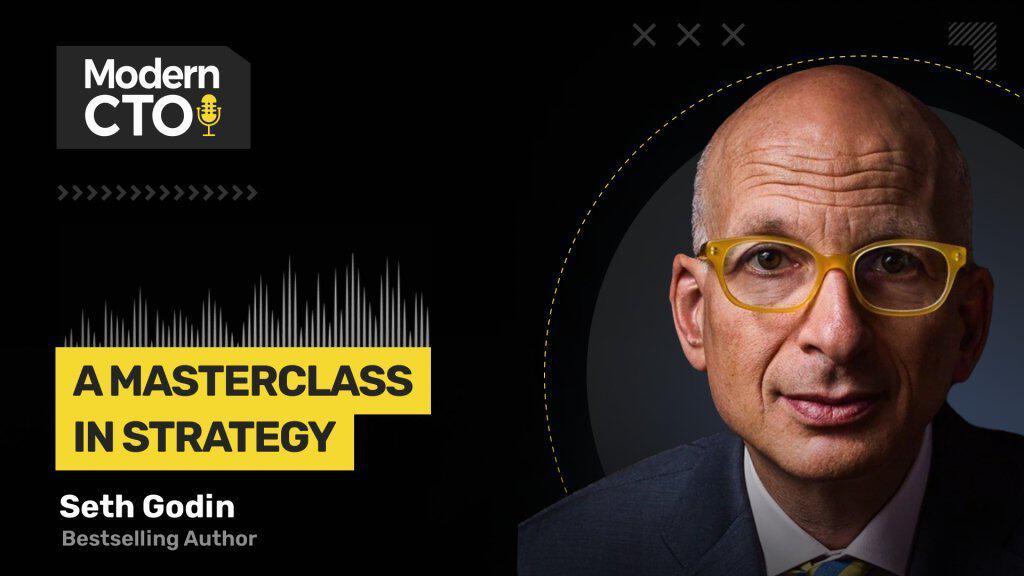
A Masterclass in Strategy with Seth Godin, Bestselling Author
Today, we’re talking to Seth Godin. We discuss the true meaning of CTO, what it takes to most effectively build strategy, and how to create systems so that the wind is always at your back.
All of this right here, right now, on the Modern CTO Podcast!
To learn more about Seth Godin, check out his website here: https://www.sethgodin.com/
Produced by ProSeries Media: https://proseriesmedia.com/
For booking inquiries, email [email protected]
About Seth Godin
Seth Godin was born on July 10, 1960, in Mount Vernon, New York. He graduated from Williamsville East High School in 1978 and went on to study computer science and philosophy at Tufts University in Massachusetts, where he graduated in 1982. After Tufts, he earned his Master of Business Administration (MBA) degree from the Stanford Graduate School of Business.
Godin has started several companies during his career and published 20 bestselling books that are translated into 40 languages.
On his website, Godin explains, “For more than thirty years, I’ve been trying to turn on lights, inspire people and teach them how to level up.”
Transcript
(Intro Narrator at 00:00:00) Today, we're talking to bestselling author Seth Godin about his latest book, This Is Strategy. You're listening to Joel Beasley, Modern CTO.
(Joel Beasley at 00:00:15) I want to start with, if the title is This Is Strategy, then what is strategy? Can you help define it?
(Seth Godin at 00:00:23) Let's start with, what is a CTO? Because a lot of people who came up through the ranks moved up because of the T part, the technology part. And it's easy to imagine that you get better at your job by having a Swiss Army knife and some pliers and solving technical problems. But I think the T actually stands for teaching, and that the job of the CTO is to teach the organization how technology transforms what they do, who they do it for, and how they do it. And we're hesitant to do that because we're indoctrinated as we move up to an organization to do our job, to follow instructions, not to lead.
(Seth Godin at 00:01:13) And a lot of CTOs are simply managers. They use power and authority to tell other people what to do. Leadership is different. Leadership is voluntary. Leadership is, we're going over there. I'm not exactly sure how to get there, but I have some assertions to make. Who wants to come with me? And that gets us to the discussion of strategy. Strategy isn't tactics. Strategy isn't planning. Organizations love planning because they get to celebrate their power. They get to say, we have a plan and we will execute it. But strategy is a philosophy of becoming. Strategy is how we deal with an uncertain future to create the conditions for change to happen. And we're all surrounded by systems, and the CTO knows this better than most. And the systems influence our strategy, and our strategy changes the systems. How's that for a rant?
(Joel Beasley at 00:02:18) It's beautiful. I love the book, by the way. I got through, honestly, I got through about a third of it before the interview, and I was just blown away. I said, I'm going to spend the rest of the afternoon completing the book. It was fantastic. You did something interesting. There's not chapters. There's just all of these points that are these jumping-off points for discussion. And I had seen an interview with you on Impact Theory, and you talked about having conversations with people. And then I see this book and I'm like, oh my goodness, you've wrote this is the most advanced piece of your work yet, and you've completely taken a leap here with not doing chapters and doing these points, because you understand this principle. And correct me if I'm wrong, but it sounds like what people buy are books that they talk about with their peers.
(Seth Godin at 00:03:10) Right. So there are two parts going on here. There's more than 250 sections in the book. There are no page numbers. And I don't believe people learn things in order. From the time we're born, we go from one thing to another, that you don't learn all of biology and then take a chemistry class, because there's chemistry in your biology and biology in your chemistry, that we layer things. And so that's where this approach begins. And then why bother making a book? I can reach more people with a blog post, and it's a lot easier. I made a book because, like many things, strategy only works if we talk about it. So the idea is you hand someone a copy of the book or a Kindle edition or an audiobook, and then you say, well, I want to talk about number 87. And we can open to riff 87 and have a conversation about how it affects us. And if these conversations happen, then I will have succeeded in spurring the organization forward.
(Joel Beasley at 00:04:17) Well, they will definitely happen. I mean, people have already been doing this with your past work.
(Seth Godin at 00:04:22) We can hope.
(Joel Beasley at 00:04:24) No, we know. I know. I've had conversations about your content with my peers. So yeah, it was very helpful for me when I moved from, so I started as an engineer, and then I wanted to get into the business side of things. And in order to understand that, you need to understand sales and marketing, and that's when I found you about 10 years ago. And then I'd have conversations about what I read from your stuff, and I like it because while a lot of your work to me is marketing-related, it's also philosophical and life-related too. I find myself reading your content and then also being inspired just as a general human.
(Seth Godin at 00:05:06) Thank you. I think marketing is anything that touches the market, which means everything we do. And so I invented this phrase, which I call marketing, to replace what marketing used to be, which was advertising, hype, hustle, annoying people, getting the word out. Well, that went away. There are still people who do it, but it wears you out. And instead, we have a chance to create the conditions to make a change happen. And if that sounds philosophical, well, it's because philosophy is the science of thinking. And how are we going to think about the change we want to make?
(Joel Beasley at 00:05:48) And at what point were you thinking that it would be a good idea to tell people to use Claude AI in conjunction with your book, and how do you do that in your book?
(Seth Godin at 00:05:58) So I started studying artificial intelligence with Doug Lenat at Stanford in 1983. And I worked with Arthur C. Clarke and Ray Bradbury and Michael Crichton when I was 23 years old. So I have been thinking about AI for a very long time. And for a long time, AI was simply everything a computer can't do yet. So when they made a chess-playing computer, people said, that's not AI. It's just a gimmick. And we kept making that excuse until nine months ago. And now I think most people agree it's here. And what I found is that ChatGPT is annoying and arrogant and gets in my way. But when I started working with Claude, I discovered that if you use it at what it's good at, it is the biggest leap since the invention of electricity. And my personal experience was I use it every day for at least half an hour. I do not use it to do my writing because I want people to know my writing is my writing. But for example, I had a 40-page business plan that had been written over five months with six different authors, all asynchronous. And I uploaded it to Claude, and I said, please read this, highlight the inconsistencies, and challenge me on five things that don't make sense to you. And in less than 30 seconds, it wrote an MBA-level two-page analysis. And it was right. And it was more right than a typical person would have been. And what I have found is that if you ask it good questions, giving it a lot of data, it will give you provocative answers that will open the door to you being able to question your own assumptions. And so what I'm trying to do in the book is say, go ahead and ask Claude about this topic when it relates to you and your business plan. And it will give you a very thoughtful analysis of whether what you say you're doing is what you're actually doing. And it's much easier to have these conversations with AI than it is with a person. But if we get in the habit, we can start having these conversations with people too.
(Joel Beasley at 00:08:31) And so what do you, in your mind, what is Claude really good at?
(Seth Godin at 00:08:41) The thing that I have found the most extraordinary is if I give it a list of four or five or six things and say, please give me 10 more, it's just off the charts. Off the charts. And that was its contribution to the book where I would say, here are five elements of something, and it would say, no, you left out these two. And I would think about it and say, yeah, I did. And it's extraordinary to me that something that is basically a magic trick that understands nothing truly can simulate this level of understanding.
(Joel Beasley at 00:09:17) Yeah, I used it similarly. So I wrote a fiction book last year, and I hired a professional writer to work with me, and I was really interested in story arcs and all of that. But I was able to use it like, how do they escape the situation? Give me five ideas of how they could escape if this were the context. And versus generate a chapter on. So yeah, I found it very useful for helping me ideate. When I want to think through things, I find myself going to this type of technology.
(Seth Godin at 00:09:48) Yeah. And a lot of big companies, I think, are blowing it because they don't really understand the uncanny valley. And if you search on my blog for uncanny valley, you will see a picture you will never forget. It will be stuck in your brain. I apologize. The uncanny valley is when an AI is almost a person. And it's that when a robot AI—
(Joel Beasley at 00:10:17) Josh is going to put that up in the video. Oh my, it is best described as a dog with a human dog face, like if a dog and human were bred together.
(Seth Godin at 00:10:28) Yeah. So if it gets too close to being a person, it freaks us out. So if you call a company and an AI starts answering your questions but pretends to be a person, nobody's going to be happy. Just don't do that. There are so many things that people are still good at. Let's celebrate those. And when we bring an AI in, let's explain to someone what we've done. But it's in that in-between, the lazy, cheap part, that companies just keep making the same mistake over and over again.
(Joel Beasley at 00:11:00) One thing I wanted to get your thoughts on is you said in the book, if you want to understand why someone makes a choice, look for what people want. And so I want you to explain to me what do people want.
(Seth Godin at 00:11:13) People want three things. Everything else is noise. The three things we want are status, affiliation, and the freedom from fear. So what are those things? Status is who's up, who's down. Status is not just a luxury car. Status are all of the things that we look for as clues to decide where we are. Who eats lunch first? Status has all sorts of negative side effects. Systems of caste and oppression and colonialism are all based on status. The second one is affiliation. Who's to my left? Who's to my right? Everyone's wearing a tuxedo and I'm not. I feel left out. How do I fit in? And the third one is fear used to be a very important emotion because if a saber-toothed tiger is about to eat you, you don't have a tomorrow. But if we live in a place where we have a roof over our head, enough to eat, and health care, all the other fear is just noise. It's a false signal. But people still do lots of things to avoid the feeling of fear. Those three things drive almost all behavior that people have.
(Joel Beasley at 00:12:31) And how does that tie back to strategy? So I've learned this nugget of information. You explain what strategy is, and how do I, how do they connect?
(Seth Godin at 00:12:43) So strategy is built on four ideas: systems, empathy, games, and time. Empathy says other people have power. The power to say yes, the power to say no. The power to sign up, the power to walk away. What will cause them to say yes? We are not them. When we say, well, this is what I would do, I don't care what you would do. What would they do? Why does someone pay twice as much to be in a better seat at a Taylor Swift concert instead of 20 rows back? That's about status. You don't have to be a Taylor Swift fan to understand that and to sell Taylor Swift tickets. So when we think about how do we build a strategy, how do we get people on our team to adopt a new operating system, how do we decide to distribute over here instead of distribute over there, sooner or later, we have to acknowledge people are going to make a choice. And we can decide to go to where they are and help them get to where they are going, or we can insist that we are right. And when you do the second thing, people don't like you, and they're just going to do it because you made them. And that's not an elegant strategy. That's not how you make a change happen.
(Joel Beasley at 00:14:11) Let's use my show as an example of how we could apply some of these principles. So I market out to people and tell them that we go and we get the greatest insight and advice from technology leaders and bring them together to help them grow and improve. And they come, and then we do just that. We extract the best information we can. And the thing that drives me is I was a software engineer that didn't have communication skills, and I had to learn those in order to do anything more than just my individual contributor role. And I want to help other people make that transition as well. But then I also found that when the CTO of Microsoft comes on, or NASA, or one of these top-level people, they'll say that the reason why they listen is because they can hear from their peers in a very effective way. So usually, they're the most important person at the conference, so they're not necessarily always in a room with a bunch of their peers. And so they like to be able to, while I'm flying across the country, I can listen to what's going on at the head of Verizon, T-Mobile, all these different industries.
(Seth Godin at 00:15:19) Right.
(Joel Beasley at 00:15:20) So tell me, with that knowledge and information dump, how can I use your body of work to be better at what I'm doing?
(Seth Godin at 00:15:29) So let's decode the very idea of a podcast. At the beginning, there was a podcasting shortage, and the scarcity of podcasts combined with their very, very low price meant that if you had a podcast, you would get your share of listeners. That quickly became, if you're looking for a podcast, I have a podcast. And the problem with that is there are too many podcasts. Therefore, you're not going to get more than your fair share. What you heard from the CTOs who gave you feedback is my status goes up if I am informed, and my affiliation goes up if I feel like I am in sync. And when we find a breakthrough podcast, the way they did, the NPR podcast that went off the charts—I can't remember, about the guy who didn't commit the crime, and then there was another one of those—you needed to listen because the other people in your circle were listening. And that is actually the role that a successful podcast or a successful book fills, which is not I'm going to describe to you in detail all the reasons why you should listen. It's simple. People like us do things like this. Either you're people like us or you're not. If you're an insider, this is the ticket. You have to have this ticket. If you're not, then I can't help you. And so what you could surround the podcast with is all of the soft tissue of connection. The discussion board, the annual conference, the places for people to talk about it. So in the case of my blog, I only had 100 readers the first few months, and now I have a million. But that didn't happen because I promoted it. I have never promoted it. It happened because I wrote things that the people who read it wanted to send to other people. And so, for example, I'm not saying you should do this, if you had an annual episode where you ranked the 10 most important CTOs in America and explained why, a whole bunch of people would want to hear that episode, would want to be on that episode, would want to not lose their slot from last year, et cetera, et cetera. So the Academy Awards are not as good as any movie, but they are seen by more people than watch most movies because we care about status and we care about affiliation.
(Joel Beasley at 00:18:20) See, that's such a good example of the necessity of human interaction. So you basically just told me that stuff. I read it in your book this morning. You kind of described it at the beginning of the show. But then when I asked you to apply it to my situation, those things took on a whole new, like, writing things people want to send to other people—I can't explain to you how profound of a, I just got the goosebumps situation. Right? I was like, oh my goodness. Instantly, my brain told me my best-performing content was just that. It was conversations people heard and like, oh, I've got to send this. So now I could probably do that better and more intentionally by asking people what they wish they could talk about with their peers, or at least using Claude to come up with some interesting conversations. Now how did you handle the, did you create community on your blog? Can people interact on your blog, or do they just take the post and then go share that with a friend? How did you handle the community aspect?
(Seth Godin at 00:19:20) Okay. So my blog is more than twenty years old, and it is a labor of love. It's not my job. So I can create digital community, but I have chosen not to do it around my blog. It was more organic than that, which is you knew if you went to a meeting, you could bring up my blog and it would make you look a certain way to your boss if you had read it before they did.
(Seth Godin at 00:19:47) Or you could forward the email around and people would write back to you. But when I did the Carbon Almanac with 1,900 people in 90 countries, I built a Discourse, not Discord, which I hate, a Discourse. And we wrote a 97,000-word almanac fact-checked, illustrated, footnoted in one hundred and fifty days. All volunteers with no errors. I have friends all over the world as a result of that project.
(Seth Godin at 00:20:18) That was a community, and it gave us solace and connection to be able to do this work together. And so I have no idea if there is a vibrant, useful, gated, thoughtful, curated community for CTOs at big companies. If there isn't, someone should build it. If you have the time to build it and put it right next to your podcast, I think the world would appreciate that. If you don't build it, someone else is going to, which is also fine, as long as they are talking about what you said because they're viewing you as a trusted, high-status individual who gives them today's agenda.
(Joel Beasley at 00:21:05) It's going to take a minute for this to sink in. I hope you don't mind the pause. I got time. Oh, wow. That's some really interesting stuff.
(Seth Godin at 00:21:14) You know, so let me tell you the story of Thornton May. I don't know if you've ever met Thornton. Thornton was the head of business development for a tech consulting firm in the 1990s. He grew it to hundreds of millions of dollars in revenue. And it was, I don't remember the name of it, a huge firm.
(Seth Godin at 00:21:37) And his sales strategy was so simple and incredibly effective. What he would do is reach out to a friend like me and say, can I pay you a little bit to come to breakfast in Boston? And then he would invite 10 CTOs or CIOs—actually CIOs—from Fortune 1,000 companies in the Boston area to breakfast. And so I was the bait, other people usually. And, but the real bait was the other CTOs are going to be there.
(Seth Godin at 00:22:11) And if you're a CTO of a big company, you have a problem. Can't tell your bosses the truth. Can't tell your employees the truth. You have no peers. And so it's very lonely.
(Seth Godin at 00:22:20) And the idea that you could come to breakfast with 10 other people—Exxon would be there or Texaco or whatever—you got a lot out of being in that circle. And as breakfast would go on, Thornton would turn to somebody and say, what's not working for you? And he would just write down whatever anybody was frustrated with. And after breakfast, he would send them a note saying, I think Bob at this company had the same problem. He'll tell you about it.
(Seth Godin at 00:22:51) Or he would say, I talked to my team and we can solve that problem for you. That's it. That's all he did to build the whole company is he connected the 1,000 CTOs or CIOs of the 1,000 biggest companies, person to person, 10 at a time, earning trust, building status, creating affiliation, solving problems, doing it again and again and again. I mean, that's how it works.
(Joel Beasley at 00:23:20) Is Thornton still out there doing business?
(Seth Godin at 00:23:24) I think he retired a couple years ago. He's quite a character. I haven't talked to him in a couple years. He's a really good guy.
(Joel Beasley at 00:23:30) And he did that in the nineteen nineties. That's amazing. It's amazing how I think what I was doing is new, but it's just been done so many times in different ways. Oh, wow. All right.
(Joel Beasley at 00:23:42) I had a couple more questions here about the book. You mentioned people are rarely rational. I think this was in the context of systems and all of that. But my internal dialogue thought, okay. If people are rarely rational, what are they mostly?
(Seth Godin at 00:24:02) Well, you have a voice in your head, and you're probably intimate with that voice. And you in that voice have a perception of how the world is. So I'm guessing you don't eat raw eel or fried ants. There's no rational reason not to do that. It's just how you grew up and what you, quote, like.
(Seth Godin at 00:24:24) And people who say they ought to work for the money, I get that, but they don't work at Goldman Sachs. So they've already decided to take a huge pay cut wherever they are. They've made this series of choices. And most of our choices are influenced by culture. Culture is what are things like around here?
(Seth Godin at 00:24:45) Culture is our version of the way things are, what makes them normal. And culture is driven by systems. So the people who are listening to this are some of the smartest people I'll talk to in a long time. So I can do the short version. Systems are easily understood if we think of the solar system, which is the most famous system.
(Seth Godin at 00:25:06) I don't know whether Pluto is a planet or not, but I know that there's the sun and there's the Earth. The Earth rotates around the sun but doesn't do it because it wants to. Doesn't do it because it's being rational. It does it because of gravity. Gravity is this invisible force.
(Seth Godin at 00:25:23) And there are all these invisible forces in our lives. So what Bill Gates did was he built the invisible force of interoperability, meaning you couldn't keep using WordPerfect because you were surrounded by people who used Word. So you had to switch to Word because the system of exchanging files required you to be in sync with other people. You could argue that that was a rational choice, except most of the time you were writing on your own. But this one little thing would cause you to shift the whole game.
(Seth Godin at 00:26:00) And so there are these systems. When AWS shows up and tries to persuade CTOs to move to the cloud, there's pushback at the beginning because the CTO says, I'm not going to get promoted for this, but if our stuff gets hacked or crashes, I'm going to get fired. I don't want to go first. That was at some level rational, but also based on freedom from fear. If you don't change your file storage system, you don't have to be afraid.
(Seth Godin at 00:26:30) But enough early adopters shifted to this other platform to create a new gravitational force. And once that gravitational force works its way through the Gartner Hype Cycle, once it becomes over time a new system based on change agents and new technology, people will make a new decision based on new information. And we don't usually talk about these things. When we talk about them, when we're clear about them, we will make better decisions.
(Joel Beasley at 00:27:08) So, you know, with the CrowdStrike thing that just happened.
(Seth Godin at 00:27:12) Mhmm. Right?
(Joel Beasley at 00:27:12) I could see there's a lot of fear there. Fear that you now have a decision made because your grandma even knows about the CrowdStrike thing that was in the news so much. Right? So now you've got this decision. If you stay with them, you've got to make this choice. You have to think about it.
(Joel Beasley at 00:27:29) And if you start talking about it with a peer or two and they're like, yeah, I was scared about that too, but then I just decided to move over to XYZ provider. That is more powerful than any sales pitch of someone you trust who had the same fear as you, and then they successfully migrated over to this other technology that was defensible by X, Y, or Z.
(Seth Godin at 00:27:48) Yeah.
(Joel Beasley at 00:27:48) Yeah. That's interesting.
(Seth Godin at 00:27:50) A tech stack that I still want to build, I almost built a few years ago, is called I Will If You Will. And the inspiration for it was people would reach out to me and say, we're doing a conference. If a whole bunch of speakers will speak at the conference, will you speak? But it's always this weird thing because you don't know who's telling you the truth, et cetera. And my answer would be, here's a list of 10 people. If six of the people commit, I'll commit.
(Seth Godin at 00:28:17) So we could easily create this thing, doesn't even have to be on the blockchain, with a smart contract so that we just list all peers. And if everyone says, I will, if you will, and we hit a big enough number, then we all do it at once, creating new standards for connection and, you know, group cohesion. Because if you and your six biggest competitors all agreed to switch to a different thing, everyone's life would get better. But we don't have a dynamic yet in place to cause that to happen.
(Joel Beasley at 00:28:57) How long have you been thinking about this?
(Seth Godin at 00:28:59) Like, five years.
(Joel Beasley at 00:29:01) And why haven't you done it?
(Seth Godin at 00:29:03) So I rolled it into one of the most audacious plans I've ever had. So just to rewind, I invented email marketing in nineteen ninety and rode that until Yoyodyne was acquired by Yahoo in '99. And it was thrilling and exhausting. Building a software stack and platform is life-changing, culture-changing, and it's hard for someone at my age to do it again. So my stack that I'm imagining here is an entire informal voting regime because the only votes that we currently have in our society are the every-couple-of-years civic votes.
(Seth Godin at 00:29:49) But there are so many other things that we could apply smart voting to. So, for example, lots of CTOs go to meetings where there's eight people around the table, and it tends to be that the loudest, most senior angry white man at the table gets the biggest say, even though that person might not be right a lot. And if we had a way to keep track of who has been right in the past or we could keep track of who has earned the ability to speak more loudly, that tally of voting could influence how we make decisions going forward. And so there's all these ways that you could use a voting mechanism, rank choice, et cetera, for informal situations where we currently adjudicate disagreement in ways that are hard to track and understand.
(Joel Beasley at 00:30:47) Have you followed Ray Dalio's work in this area?
(Seth Godin at 00:30:51) I know Ray. I saw him a couple of weeks ago. Some of his outspoken views on how organizations can work together I think are deliberately provocative. I don't think that most people want everything they do to be recorded and tracked and et cetera.
(Joel Beasley at 00:31:11) And voted on. Yeah.
(Seth Godin at 00:31:13) Yeah. I do think that a lot of what we built into our culture today originated when we didn't have the tech to do things a different way. And so now we're sort of backing into this weird surveillance, monopolistic surveillance capitalism thing without actually thinking hard about how we're doing it and why. And I'm not sure being an extremist in support of it is the best way to socialize it to most people. So where I would start is six friends figuring out where to go to dinner tonight. That would be a fine place to start.
(Joel Beasley at 00:31:54) Let's talk about making better plans. You've gotten to see many plans in your life be created and mess up. When you're looking at different companies that are making plans and messing up, what are some of the common takeaways that you've encountered?
(Seth Godin at 00:32:14) I think that plans can get into trouble in a couple of ways. One is narcissistic, selfish, short-term demands that the world adhere to what you want. Right? That we're going to require every single person who comes to our store to get fingerprinted because we're tired of check fraud. Yeah. Well, no. That's not going to happen. People are just going to go to a different store.
(Seth Godin at 00:32:38) The other kind of place we run into trouble is failure of imagination combined with failure of cooperation and coordination. So I've had a bunch of very big failures in my career. Some noticed, some not noticed. One of them was when I was at Yahoo, I had what I thought was the perfect opportunity to end spam, which is spam happens because some people send 5,000,000 emails a day. The people who are sending 50 emails a day aren't causing the spam problem.
(Seth Godin at 00:33:31) So I was at Yahoo, which accounted for 10 or 30% of all the email processed in the country. I was friends with the people who ran AOL. And if you had just one or two other sources there, it was at least half of consumer email in the US. And so I tried to put together a group and say, look, let's just charge stamps. Let's put stamps on email. And the deal is everyone gets 50 stamps a day. And if you want to send more than 50 emails, they're a penny each.
(Seth Godin at 00:33:51) And it would, if you did the math, A, it would be a nice little profit center. B, it would interfere with almost nobody doing what they needed to do except for spammers. Spammers would disappear. The problem was these companies were achieving their short-term goals, which is that the stock price was going up every day. And so if you went to somebody and say, I want to change a fundamental principle of what we do around here and how the Internet works, they would say, the stock price went up $3 yesterday.
(Seth Godin at 00:34:28) No. We're not going to change anything. In fact, we got a guy over there who knows how to change things, and we have three people whose job is to make sure he doesn't do anything. And I didn't care enough to show up and show up and show up and show up to write articles, to go to conferences, to put together an advisory board, to change the system. Instead, I had the arrogance to say, I got a good idea, and then I'm done.
(Seth Godin at 00:34:57) That never works. It just doesn't lead to the change we seek to have happen. That's why plans are insufficient. We need to create the conditions for systems to change.
(Joel Beasley at 00:35:10) And you talk a lot about systems. Can you just give me your short definition of what you're saying when you're saying systems?
(Seth Godin at 00:35:19) So there is a gravitational force. There is culture. There are individuals who are making decisions in their own interest, but those decisions are not rational individual decisions. They are based on an assumption of what things are like around here. So if you go to Harvard and say, I want to put all your courses online for free.
(Seth Godin at 00:35:45) First of all, there is no such thing as Harvard. There are just the people who work in the system that is Harvard. Right? And any individual you call on is going to think a great deal about all the people who are going to say no to them and all the challenges they're going to have. That's because the system that is higher education has no one in charge of it, but it has a real culture around it.
(Seth Godin at 00:36:13) And the fact is, if you work for a company that has more than 100 people in it, you have a system as well. You might have a C in your title, but you're not really the chief of anything. You are simply a planet in a solar system, and you are well aware of all of the gravitational forces.
(Joel Beasley at 00:36:33) As I was reading through your content, I noticed myself wanting to bring it down into a tactic constantly. Wanting to turn it into a plan, turn it into a tactic, and execute on it. And so that was just, I guess, some feedback from what, and then the next thing is if I go talk to somebody about it, that would be a good progression of that idea. But I think one of the things that I was wondering as I was going through all of these great ideas is if I'm somebody—and I didn't even think about it till the interview started because you started with what's a CTO and what many of the CTOs are, like, order takers, and they're not these visionaries—how can you make that first transition?
(Joel Beasley at 00:37:19) Is it as simple as sending a section of the book to your peers, your CEO, and your COO, and saying, hey, I want to work through this strategy and answer these four questions together? How do I, as an introverted person who's in this leadership position, who hasn't shown this behavior before, how do I make that step and do it for the first time?
(Seth Godin at 00:37:45) Let's put a pin in the word feedback and come back to that because there's some feedback loop things I want to talk about. Okay. But first, I want to talk about two-year-olds, three-year-olds. We call them toddlers. And the reason they're called toddlers is that they toddle.
(Seth Godin at 00:38:01) And no one is born knowing how to walk, but most physically fit people learn how. And they don't do it by saying, I'm going to run the Boston Marathon tomorrow. They do it by taking one step and falling down in a way that isn't fatal. And so the way we shift from management to leadership is with the tiniest steps we can imagine, where we find an issue that doesn't really matter that much and we practice talking about it. That we engage in decision making where the stakes are low, but where the activity of making a decision is something we can get better at.
(Seth Godin at 00:38:47) And so the idea here is a lot of times we spend looking for a map, and that's what tactics are, not a compass. But we need a compass before we can get our hands on a map. A map is not the territory. A map is always going to be incomplete. As soon as someone writes a map, it's obsolete.
(Seth Godin at 00:39:11) But the compass, understanding where we are heading, that doesn't change. So if you make bets, and Jeff Bezos was a master of this for more than 25 years. He said, look, I can't imagine a future where people aren't going to want to buy stuff. And I can't imagine a future where they don't want that stuff cheaper and faster. So we're going to build an engine that does those things.
(Seth Godin at 00:39:39) The wind will always be at our back. It doesn't matter how much the world changes, those things are our compass. So the tactic of free shipping, that shows up way later. It'll come. It'll go.
(Seth Godin at 00:39:52) You'll figure it out. But first, we have to have these conversations about what trees are we planting? How long do things like this take to grow? And how do we engage with systems that will support us? The way to be a better surfer is to find better waves, not to just stick on the wave you've got.
(Seth Godin at 00:40:14) So that's sort of my rant, but I want to talk briefly about feedback loops. Systems always have feedback loops. Feedback loops are different than feedback. The one-star reviews you got on Amazon, you should ignore those. Those are feedback from people you don't need to hear from.
(Seth Godin at 00:40:31) But feedback loops, there are two kinds. There is a negative feedback loop, which is the thermostat. If it gets hot, it turns on the AC. If it gets cold, it turns on the heat. It keeps you in the center.
(Seth Godin at 00:40:46) There are lots of systems in our lives that are negative feedback loops. And then, weird name, there are positive feedback loops. Positive feedback loops spiral out of control. So if you're at a wedding and the DJ holds the microphone up too close to the speaker and you hear that horrible noise, that's because the sound got amplified, got amplified, got amplified, got amplified, got amplified out of control. And so we need, as CTOs, to think hard about what are the feedback loops in the system that we are confronting.
(Seth Godin at 00:41:19) How do we lean into something that tends to spiral in the right direction and not waste time fighting against powerful feedback loops that want to keep us where we are?
(Joel Beasley at 00:41:32) How do you identify a positive feedback loop early? Or can it only be figured out once it's out of control?
(Seth Godin at 00:41:40) No, no. They're not that unique. They're just sort of rare that we can use them in a practical way. So if you bring rabbits to Australia, you have a positive feedback loop for a long time until the negative feedback loop of predators shows up.
(Seth Godin at 00:42:00) Right? The rabbits multiply like rabbits. When we think about Hotmail or we think about Facebook, the network effect is a positive feedback loop. If you can get from 100 users to a thousand, you're probably going to get from a thousand to 5,000. That the only job that someone like Andrew Chen has when he's working at Uber is to turn what they built into a positive feedback loop.
(Seth Godin at 00:42:26) If it's not, you're never going to have enough money to make it grow. And if it is, you already have plenty of money.
(Joel Beasley at 00:42:35) Yeah. There's an—and then there's also a point in which you've satisfied the market and then you just understand the steady stream of new entrants. Right? Like, we had a lot of growth, but there's only 70,000 CTOs in the world that speak English. Right?
(Joel Beasley at 00:42:52) And so we just rocketed up to that, you know, in our first couple years. And then we see steady growth, but it's like, alright, these are the new CTOs that are coming in at this rate. So that's interesting.
(Seth Godin at 00:43:07) That's right. So when we get back to what is—what do you make? You can say I make a podcast. But you could also say I make smarter CTOs. And if that's what you make, the number of things you can do where growth will support you through a positive feedback loop goes way up. Because the number of ways you can offer that change to people is wide.
(Joel Beasley at 00:43:39) When you were talking about asking yourself the question, am I tapping into an insatiable desire? Is that similar to what you said Bezos's strategy was? Is that what you were getting at?
(Seth Godin at 00:43:51) Yeah. I mean, people have an insatiable desire for convenience, for status, for peace of mind. They have an insatiable desire for things that give them satisfaction or that are convenient and/or waste time. And so once you start offering people five minutes of internet a day, they want 10 and then they want 20. Once you start offering somebody a hundred songs to choose from, they want 300 songs to choose from.
(Seth Godin at 00:44:29) It's different than what happens if you hand somebody a chocolate bar because the third chocolate bar is not better because you had three today. It goes down really fast. We hit a limit faster for something like how much chocolate can I eat in one sitting than we do for how do I find myself on a journey? So one of the things we notice about really rich people is they have an insatiable desire to make even more money. Money they don't need.
(Seth Godin at 00:45:02) That you would think that over time making more money would be silly because they have the freedom to do something else that's joyful. But instead, the people who have the most money have the most money because they have an insatiable desire to make more money.
(Joel Beasley at 00:45:21) Yeah. My desire got satiated at around a million dollars a year. When I broke through because I had done pretty well with software and stuff before. But when I broke through and got to the point where, like, I'm not writing software. I'm just talking with people, and this is paying the bills and allowing me to do art. Like, I can't go out and buy jets, but I could do what I want to do.
(Joel Beasley at 00:45:47) Then I realized that, alright, I guess I'm just going to keep doing this. You know, wake up every day and do this.
(Seth Godin at 00:45:53) I think that you should be—we should build a statue for you. And this philosophy makes so much sense. And yet the media celebrates people who are broken. Like, I know a bunch of people who have an enormous amount of money, and I would say almost every one of them is broken.
(Seth Godin at 00:46:16) This is not a role model that we want to spread.
(Joel Beasley at 00:46:19) Yeah. Well, my big change happened about five years into the company when the deal with my wife and I was we were having our first kid when I started the company. And the deal was I could work 24/7 as hard as I wanted to make this thing work for us, and I could always go back to software engineering if it didn't. And a couple years into that, we were wondering when that day is going to come, and then I got a phone call, and she was at her dad's birthday party. And grandpa—my wife was at her dad's birthday party. And grandpa asked in the background to my daughter, who was like four or five at the time, he says, hey, is daddy coming? And she goes, no. Daddy doesn't do things with us. All daddy does is work. And I hung the phone up, and I went out and I bought a camper.
(Joel Beasley at 00:47:09) And I showed up to the house, and I was like, we go camping now. Daddy's at home on nights, and daddy's at home on weekends, but daddy's a highly productive person, so we have to have an activity. We can't sit around and watch Netflix. Like, we have to be doing something. We have to build stuff.
(Joel Beasley at 00:47:25) And that progressed into us selling everything that we owned, buying a larger RV, and doing a year-long camping trip around the United States, which I did the podcast from hotel rooms and then the RV. And then that landed us into buying a farm just outside of Nashville. And so I built a studio on the farm, and I walk back and forth between the farm. We homeschool our kids, and I get to be highly present in my kids' lives. And it's made a massive difference.
(Joel Beasley at 00:47:51) I have three little ones now under the age of 10, and it was the right move at the right time versus continuing to chase the money.
(Seth Godin at 00:47:59) You know, your kids are super lucky to have you and vice versa.
(Joel Beasley at 00:48:04) Well, Seth, thank you so much for doing this. I really appreciate you did it as a champion with the voice all the way through. Thank you so much.
(Seth Godin at 00:48:13) It's a pleasure. Keep making this ruckus. It's not easy. People don't appreciate how hard it is to show up on the regular. And so thank you.
(Joel Beasley at 00:48:23) Thank you so much for listening. And if you found this episode useful, please share it with a friend or colleague who you think would get value from it. And if you have topics that you'd like to hear discussed on the podcast, either add me on LinkedIn or send me an email, [email protected].
(Joel Beasley at 00:48:41) Every time I get an email or LinkedIn message, it absolutely makes my day and inspires me to keep going.