
Episode 835 ·
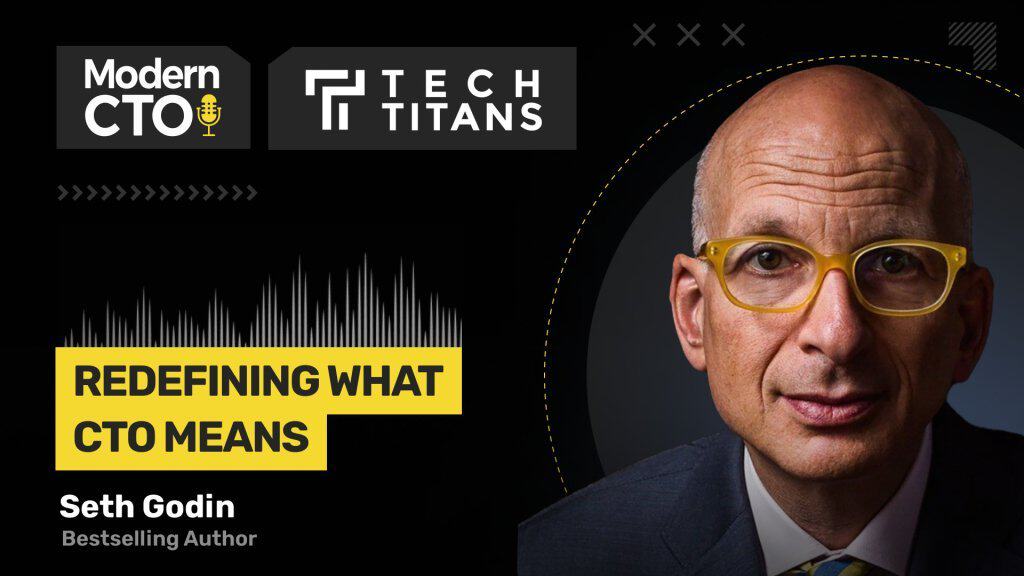
TECH TITANS: Redefining What CTO Means with Seth Godin
Today, we're talking to best selling author Seth Godin for an episode of Tech Titans. We’re bringing you Seth’s best advice from his definition of CTO, why people aren’t truly rational, how to avoid positive feedback loops, and more.
All of this right here, right now, on the Modern CTO Podcast!
For more on Seth Godin, check out his website here: https://www.sethgodin.com/
Produced by ProSeries Media: https://proseriesmedia.com/
For booking inquiries, email [email protected]
About Seth Godin
Seth Godin was born on July 10, 1960, in Mount Vernon, New York. He graduated from Williamsville East High School in 1978 and went on to study computer science and philosophy at Tufts University in Massachusetts, where he graduated in 1982. After Tufts, he earned his Master of Business Administration (MBA) degree from the Stanford Graduate School of Business.
Godin has started several companies during his career and published 20 bestselling books that are translated into 40 languages.
On his website, Godin explains, “For more than thirty years, I’ve been trying to turn on lights, inspire people and teach them how to level up.”
Transcript
(Intro Narrator at 00:00:00) Today, we're bringing you an episode of Tech Titans, where we break down the most impactful leadership insights from our conversation with bestselling author Seth Godin. And if you want to hear even more from Seth's conversation, check out the full episode on YouTube. You're listening to Joel Beasley, Modern CTO.
(Joel Beasley at 00:00:23) I want to start with, if the title is "This is Strategy," then what is strategy? Can you help define it?
(Seth Godin at 00:00:31) Let's start with what is a CTO? Because a lot of people who came up through the ranks moved up because of the T part, the technology part. And it's easy to imagine that you get better at your job by having a Swiss Army knife and some pliers and solving technical problems. But I think the T actually stands for teaching, and that the job of the CTO is to teach the organization how technology transforms what they do, who they do it for, and how they do it. And we're hesitant to do that because we're indoctrinated as we move up in an organization to do our job, to follow instructions, not to lead.
(Seth Godin at 00:01:21) And a lot of CTOs are simply managers. They use power and authority to tell other people what to do. Leadership is different. Leadership is voluntary. Leadership is, "We're going over there. I'm not exactly sure how to get there, but I have some assertions to make. Who wants to come with me?" And that gets us to the discussion of strategy. Strategy isn't tactics. Strategy isn't planning. Organizations love planning because they get to celebrate their power. They get to say, "We have a plan and we will execute it." But strategy is a philosophy of becoming. Strategy is how we deal with an uncertain future to create the conditions for change to happen. And we're all surrounded by systems, and the CTO knows this better than most. And the systems influence our strategy, and our strategy changes the systems.
(Joel Beasley at 00:02:25) Oh, wow. All right. I had a couple more questions here about the book. You mentioned people are rarely rational. I think this was in the context of systems and all of that. But my internal dialogue thought, okay, if people are rarely rational, what are they mostly?
(Seth Godin at 00:02:46) Well, you have a voice in your head, and you're probably intimate with that voice. And you in that voice have a perception of how the world is. So I'm guessing you don't eat raw eel or fried ants. There's no rational reason not to do that. It's just how you grew up and what you quote "like." And people who say they ought to work for the money—I get that—but they don't work at Goldman Sachs. So they've already decided to take a huge pay cut wherever they are. They've made this series of choices, and most of our choices are influenced by culture. Culture is, what are things like around here? Culture is our version of the way things are. What makes them normal? And culture is driven by systems. So the people who are listening to this are some of the smartest people I'll talk to in a long time, so I can do the short version.
(Seth Godin at 00:03:44) Systems are easily understood if we think of the solar system, which is the most famous system. I don't know whether Pluto is a planet or not, but I know that there's the sun and there's the Earth. The Earth rotates around the sun, but doesn't do it because it wants to. Doesn't do it because it's being rational. It does it because of gravity. Gravity is this invisible force. And there are all these invisible forces in our lives. So what Bill Gates did was he built the invisible force of interoperability, meaning you couldn't keep using WordPerfect because you were surrounded by people who used Word. So you had to switch to Word because the system of exchanging files required you to be in sync with other people. You could argue that that was a rational choice, except most of the time you were writing on your own. But this one little thing would cause you to shift the whole game. And so there are these systems when AWS shows up and tries to persuade CTOs to move to the cloud. There's pushback at the beginning because the CTO says, "I'm not going to get promoted for this, but if our stuff gets hacked or crashes, I'm going to get fired. I don't want to go first." That was at some level rational, but also based on freedom from fear. If you don't change your file storage system, you don't have to be afraid. But enough early adopters shifted to this other platform to create a new gravitational force. And once that gravitational force works its way through the Gartner hype cycle, once it becomes over time a new system based on change agents and new technology, people will make a new decision based on new information. And we don't usually talk about these things. When we talk about them, when we're clear about them, we will make better decisions.
(Joel Beasley at 00:05:50) I think one of the things that I was wondering as I was going through all of these great ideas is, if I'm somebody—and I didn't even think about it till the interview started because you started with what's a CTO and how many of the CTOs are order takers and they're not these visionaries—how can you make that first transition? Is it as simple as sending a section of the book to your peers, your CEO, and your COO and saying, "Hey, I want to work through this strategy and answer these four questions together"? How do I, as an introverted person who's in this leadership position, who hasn't shown this behavior before, how do I make that step and do it for the first time?
(Seth Godin at 00:06:39) Let's put a pin in the word "feedback" and come back to that because there's some feedback loop things I want to talk about. But first, I want to talk about two-year-olds, three-year-olds. We call them toddlers. And the reason they're called toddlers is that they toddle, and no one is born knowing how to walk. But most physically fit people learn how. And they don't do it by saying, "I'm going to run the Boston Marathon tomorrow." They do it by taking one step and falling down in a way that isn't fatal. And so the way we shift from management to leadership is with the tiniest steps we can imagine, where we find an issue that doesn't really matter that much and we practice talking about it. That we engage in decision-making where the stakes are low, but where the activity of making a decision is something we can get better at. And so the idea here is, a lot of times we spend looking for a map—and that's what tactics are—not a compass, but we need a compass before we can get our hands on a map. A map is not the territory. A map is always going to be incomplete. As soon as someone writes a map, it's obsolete. But the compass, understanding where we are heading, that doesn't change.
(Seth Godin at 00:08:11) So if you make bets, and Jeff Bezos was a master of this for more than 25 years, he said, "Look, I can't imagine a future where people aren't going to want to buy stuff. And I can't imagine a future where they don't want that stuff cheaper and faster. So we're going to build an engine that does those things. The wind will always be at our back. It doesn't matter how much the world changes. Those things are our compass." So the tactic of free shipping, that shows up way later. It'll come. It'll go. You'll figure it out. But first, we have to have these conversations about what trees are we planting? How long do things like this take to grow? And how do we engage with systems that will support us? The way to be a better surfer is to find better waves, not to just stick on the wave you've got. So that's sort of my rant, but I want to talk briefly about feedback loops. Systems always have feedback loops. Feedback loops are different than feedback. The one-star reviews you got on Amazon, you should ignore those. Those are feedback from people you don't need to hear from. But feedback loops, there are two kinds. There's a negative feedback loop, which is a thermostat. If it gets hot, it turns on the AC. If it gets cold, it turns on the heat. It keeps you in the center. There are lots of systems in our lives that are negative feedback loops. And then, weird name, there are positive feedback loops. Positive feedback loops spiral out of control. So if you're at a wedding and the DJ holds the microphone up too close to the speaker and you hear that horrible noise, that's because the sound got amplified, got amplified, got amplified, got amplified, got amplified out of control. And so we need, as CTOs, to think hard about what are the feedback loops in the system that we are confronting. How do we lean into something that tends to spiral in the right direction and not waste time fighting against powerful feedback loops that want to keep us where we are?
(Joel Beasley at 00:10:25) Thank you so much for listening. And if you found this episode useful, please share it with a friend or colleague who you think would get value from it. And if you have topics that you'd like to hear discussed on the podcast, either add me on LinkedIn or send me an email: [email protected]. Every time I get an email or LinkedIn message, it absolutely makes my day and inspires me to keep going.