
Episode 706 ·
Strategies for Scaling with Sasha Siddhartha, Co-founder & CTO at Thrive Market
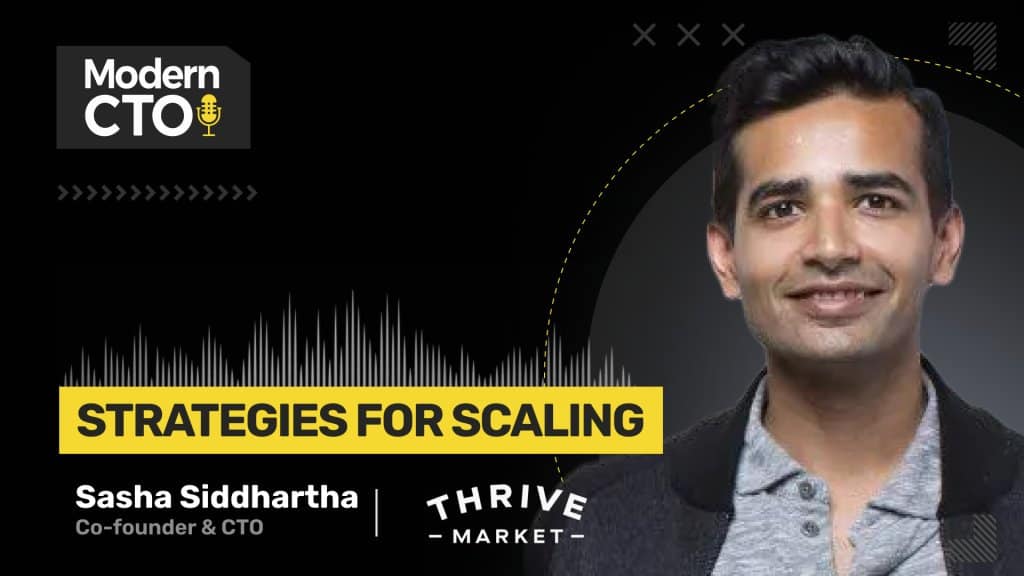
Today we’re talking to Sasha Siddhartha, Co-founder & CTO at Thrive Market. We discuss Sasha’s tactics for scaling Thrive Market as a technologist, the magic of hiring domain experts to grow your business, and why every team member should play a mission critical role.
All of this right here, right now, on the Modern CTO Podcast!
For more about Thrive Market, check out their website: https://thrivemarketjobs.com/
Have feedback about the show? Let us know here
Produced by ProSeries Media.
About Sasha Siddhartha:
Innovative, performance-focused technology executive with 18 years of experience driving growth and business results in both established and emerging technology companies. Flexible problem solver capable of developing business strategy, partnering with other C-Level executives, while also taking responsibility for the design and implementation of robust, scalable, and cost-efficient technology solutions to support the business goals of the company. Proven track record of delivering high quality technology solutions across desktop, web, and mobile. Diverse project and personnel management experience, bringing enterprise level quality and scalability to engineering organizations while maintaining the speed and agility of a startup.
About Thrive Market:
Thrive Market is a membership e-commerce platform on a mission to make the world’s highest quality natural and organic products affordable for every American family. For $60/year, Thrive members get access to their favorite healthy snacks, supplements, home, beauty, and baby products at 30-50% off retail value—all shipped to their front door for free.
As part of our Thrive Gives initiative, each paid membership on the site also sponsors a free membership for those in need. Wholesome products at wholesale prices, we're Thrive Market and we can't wait to be connected with you.
Transcript
(Intro Narrator at 00:00:00) Today, we're talking to Sasha from Thrive Market about his tactics for scaling his business as a technologist. You're listening to Joel Beasley, Modern CTO.
(Joel Beasley at 00:00:14) So I actually learned about Thrive when preparing for this interview, and it looks like it would be right up my alley. Can you tell me a little bit about what it is from a high level?
(Sasha at 00:00:26) Yeah, so Thrive Market's a membership-based online grocery store. So our members pay us $60 a year or $12 a month, similar to a Costco membership. And in exchange, they get member-only pricing and free delivery on a top-selling catalog of the highest quality natural organic grocery products. So the kind of stuff you'd find at a high-end or health-focused grocery store like Whole Foods, except the prices up to 30% off delivered free to their door. So the mission of the business is to make healthy living easy and affordable for as many people as possible. So we want to be able to provide access to those higher quality natural organic products at prices that are closer to the conventional equivalents. And the business has been around since late 2014, so almost nine years into it at this point.
(Joel Beasley at 00:01:18) And did you get started at the very beginning, or did you come in partway through?
(Sasha at 00:01:22) No, I was there more or less in the beginning. I was one of the co-founders of the business. So I ended up meeting my business partners, Nick, Gunnar, and Kate in the summer of 2014. I'd been an e-commerce entrepreneur for about three years before that. I'd run a company in the fashion technology space. I just ended up selling that business and figuring out what to do next. I knew I wanted to work on another business from the ground up. I knew I wanted to work with business partners who'd been through the grind a few times and had already seen success in their entrepreneurial careers. But probably most importantly, I wanted to work on something that had some real scale potential and that was in an industry that was closer to my personal interest. So health and wellness is something that's absolutely personally important to me, more so than women's fashion. So we ended up getting connected through some mutual friends in the LA venture scene. And over the course of a few weeks, just fell in love with the mission of the business and what they were looking to accomplish. And then jumped on board. It was July of 2014, so just about nine years ago now.
(Joel Beasley at 00:02:30) And so the way it works—because I buy a lot of the organic type food, and so right when I saw it, I was like, yes, this is going to be cool. So I buy membership. It's like $60 a year, and then I get random coupons on the thing. I tell it what I buy, and then it just gives me coupons here and there. Is that right or no?
(Sasha at 00:02:49) No. So you will get deals. So you sign up for membership, and then you can browse and build a basket the same as you would on any other e-commerce site. So we host—we own and manage all our own inventories. So we carry about 5,500 products. We fulfill them out of our own fulfillment centers and a network of third-party logistics centers that we also manage. So it's all product that's curated by our team. It's held to the highest standards in the grocery industry. So we carry probably about the top 5% of the natural organic products that are available today. So everything's carefully selected for ingredient quality and the ethics of the supply chain. It's tagged according to 90-plus filters for your dietary preferences, ingredient sensitivities, health goals, and so on. So our goal is to make that shopping journey really easy for the health-focused consumer. So you buy your membership, you jump on to the website or the mobile apps. You can go through a personalized onboarding sequence where you answer a lot of questions about the kinds of products you're interested in, your diet, your lifestyle goals, and so on. We will recommend products to you, but at the moment, you're building that basket. Our average customers will be adding upwards of 15 items to the cart. Once it's past $49, you get free shipping on the order, and then you can place the order like any other e-commerce experience, and we'll deliver to your door in a couple days.
(Joel Beasley at 00:04:12) Oh, that's actually really cool. So you're like a giant online grocery store?
(Sasha at 00:04:16) Correct. It's online only. We only sell through our own platform. Consumers transact in our platform. We manage the logistics and delivery to your doorstep. And unlike local delivery options, we ship through national carriers. So we have customers in almost every zip code across the Lower 48, so we can deliver to urban areas, but also customers who live in food deserts where there's no local option. So that's one of the things that makes it a little bit different from some of the other players in the space.
(Joel Beasley at 00:04:47) How do you deal with the temperature control?
(Sasha at 00:04:50) So for the most part, we do dry non-perishable. So the kind of stuff you'd find at a center aisle, packaged goods—that's the bread and butter of our business. We do have an assortment of frozen meat, seafood, and other kind of freezer aisle products that we ship using insulation and cold packs. During the summer months for products that are temperature sensitive, we'll use cold packs as well. So chocolate's an example of where in the winter, it'll ship just fine through national carriers. But during the summer months when the temperatures get hot enough, we have to refrigerate it in transit. Sometimes when the temperature crosses a threshold beyond which we can't maintain quality service, we'll mark those items as unavailable on the store at the time. But frozen meat and seafood and frozen essentials and most of the dry goods are available year-round.
(Joel Beasley at 00:05:44) So if it's like the height of summer in Florida, we're getting a heat wave, and I want a chocolate bar, it's probably going to be marked as non-deliverable.
(Sasha at 00:05:53) Correct. Because past a certain—given these products spend a couple days in a FedEx truck—past a certain temperature threshold, all the insulation that we can use isn't going to make a difference in preserving quality. We're not going to ship in Styrofoam. We're not going to ship air freight for sustainability reasons. So I think our members have sort of learned to work around some of those limitations, but at the same time, also appreciate that we're building a business that obviously caters to the consumer, but also takes into account other stakeholders like the environment.
(Joel Beasley at 00:06:28) Yeah. And in conversations, I like to find the edges of everything. But it makes sense. Like, in my mind, I like to reduce things to make them simple. And I would say, okay, for those center food type aisles—like, if I want to get some high quality, I eat a lot of almonds, I eat a lot of cashews, those types of things—I could get those from you. Or my kids, like, my daughter's gluten-free, so she needs the special gluten-free Goldfish type deal. So you guys have a lot of that organic and gluten-free stuff, right?
(Sasha at 00:07:00) Correct. And we not only merchandise—everything that you mentioned there is sort of our bread and butter. So whether it's snacks, nuts, meal ingredients, all that stuff we carry. We also try to make it as easy as possible for consumers to identify—if you're following a gluten-free diet, there's a gluten-free filter that'll allow you to parse everything on the store. The recommendations that you'll see once you declare yourself as a gluten-free consumer will be oriented towards that dietary restriction and so on. So yeah, the goal is to reduce as much of the thought and effort for the shopping process as possible.
(Joel Beasley at 00:07:35) Yeah. I saw that when I was going through the onboarding process of selecting gluten-free. But you can obviously turn that off, right? Because my wife and my son aren't gluten-free, but me and my daughter have to be. And so you would be able to—it just helps how it preferences the screen if you're selecting "I'm a gluten-free consumer." You can still get all the other stuff.
(Sasha at 00:07:56) Correct. I mean, the shoppers are going to have full control. We will continue to recommend products based on both things you're explicitly telling us about yourself and also what you actually end up buying and browsing and searching for will inform future recommendations. But ultimately, obviously, everyone can shop the full catalog and we're not hiding any products from consumers and so on. This is an area that we're continuing to focus on. So as we continue to evolve the platform, one of our goals is to really lean into this idea of one-to-one personalization and make sure that we can continue to really reduce that effort and continue to present the products to consumers that are most relevant for their needs based on as many signals as we can gather about your behavior and the kinds of products that you're into.
(Joel Beasley at 00:08:45) A lot of our listeners are technology leaders and they're growing in their career. And people ask me constantly about different tips and all of that. I know there's not just one thing, but I'm curious when you're going about growing this company and then scaling it up, you run the technology side of things. You've got lots of great technical people on your team and technical leaders. But what's something that a leader or an engineer does that stands out and you think to yourself, "I want to give them more. I want to invest in them because of this behavior or something that they're doing"? What is that thing that stands out to you?
(Sasha at 00:09:22) I don't know if there's any one thing, but I think what we tend to emphasize the most is ownership. So we're a growing business. We're still a relatively small team. Anyone who comes to work at Thrive Market, within the matter of days or weeks, is going to be working on something that is barely business critical. And if we're really in a position to empower them, we want to see the folks who take on those problems as if they were their own, who regard their time at Thrive Market as not just kind of a job that pays the bills, but an entrepreneurial journey they get to be part of. And what you see with that is better autonomous decision-making. So being able to make the right decision for the long-term success of the company and the consumer even when it may involve short-term effort or short-term pain or more work or more ambiguity. You see more discretionary effort. So people will go above and beyond to solve a problem and solve it permanently without having to be told to do so. And you see people who think ahead because they're regarding their role in this journey as being long-term. They want to make sure that the technology they build isn't just functional today, but is flexible and scalable enough to meet the needs of tomorrow. So I'd say that's the biggest thing, and it's one of those things that it's hard to measure in metrics. But I think all of us sort of know the people who exemplify this in their workforce, but also in their lives. So I think for businesses at our stage where we're charting kind of an unknown course in some ways—we don't know exactly how we're going to evolve the business over the course of any given year in the future—we need folks who really kind of take on our problems as their own and go above and beyond to solve them.
(Joel Beasley at 00:11:19) Do you think because that was your mentality with your founders from the beginning that it's somewhat baked in, like, it's an expected behavior that employees will see across the entire company?
(Sasha at 00:11:30) I do. So it's codified in our values. So tenacity is one of our values. So that boils down to we really want folks who will be scrappy, will deliver results. So it's in the conversation. It's how we go about running performance review cycles. Like, it's in the language that's used there, and it's definitely part of the expectation on a day-to-day basis.
(Joel Beasley at 00:11:57) Nice. Nice. Have you built a family? Like, do you have a wife and kids and all that?
(Sasha at 00:12:02) I do. Yeah. So I was married with Josh. I've been married for several years. We've got a nine-month-old daughter and a two-year-old dog at home. So it's been a fun couple years expanding the household and kind of diving headfirst into parenthood.
(Joel Beasley at 00:12:19) Oh, I'm just a step or two ahead. I've got a six-year-old, a four-year-old, and a 10-year-old. Yeah. So is the baby sleeping through the night yet?
(Sasha at 00:12:29) She is for the most part. She'll be up at 5 a.m. like clockwork, but she sleeps well.
(Joel Beasley at 00:12:36) Well, at least you didn't have a boy. Boys, you get punched in the crotch at 5 a.m. like clockwork.
(Sasha at 00:12:42) Yeah. I think for everything I've heard from parenting advice, I think girls are a little bit easier earlier on in the parenting journey.
(Joel Beasley at 00:12:51) Oh, for sure. Yeah. So does your wife—is she a user of the application? Is it an application or just a website?
(Sasha at 00:12:59) It's both. So we have a website and mobile apps for iOS and Android. So yeah, we both use it and have been since we launched. It's sort of central to our grocery shopping rhythm. Now, obviously, we also go to the traditional grocery store, but for all our non-perishable essentials, Thrive's the choice.
(Joel Beasley at 00:13:22) As you guys are hitting scale, I saw you had a huge background in technology, pretty cool career there at Microsoft and some other places. And also, you have that founder streak in you as well. But I'm curious, now that you're hitting this scale—obviously, you have several hundred employees. It's a medium, I guess, SMB, but it's growing, right? And you're serving the whole country. What type of scale issues from a technology standpoint are you currently working on today?
(Sasha at 00:13:53) So it's interesting. I was thinking about this. I mean, the beauty of being software is in many ways, the technology is actually the easiest part to scale, particularly for a business like ours. We've been cloud-native since day one. We've got a headless composable system that's a mix of different services that we can scale independently. Tools like AWS have provided managed services to cover such a broad range of the kinds of resources that we would need to consume on technology platforms. So actually, we've had surprisingly few challenges scaling the actual core technology platform. But at the same time, we're a physical goods business delivering physical product to consumers. So that's the area where scaling is more challenging and has to be managed with a lot more rigor. So to kind of give you a sense of the pace we went through in the early stages of the business—we manage our own fulfillment since day one.
(Sasha at 00:14:52) So we kind of manage our own inventory. We pick, pack, and ship our own boxes. And it's atypical for really early-stage e-commerce businesses to do that, but we chose to do that for a couple of reasons. One is no one was actually doing this back in 2014. Certainly no one was doing this in grocery at all at any scale.
(Sasha at 00:15:12) So the quality of service would have not been something that we'd have gotten from a third party. Second is we want to be able to take as much cost out of our entire supply chain as possible and pass those savings on to the consumer. So we took this on, and when we launched the business, we had 2,500 square feet of warehouse space. And within 18 months, that expanded to over 700,000 square feet of warehouse space in a very short period of time. So managing those transitions while maintaining quality and efficiency at that pace is really challenging because you're hiring a lot of people.
(Sasha at 00:15:51) You've got to get those people trained. Every order needs to go out with the same SLAs and quality level as the one before. So that's been an area of major investment for us, and it comes down to getting a combination of the right leadership into some of those roles on the operational front and more operationally intensive sides of the business. And then having good process and also really keeping our ear to the ground in terms of how consumers are receiving the experience and making sure that we've got both good metrics, but then also good qualitative feedback channels to ensure that things aren't degrading as the volumes grow. So in terms of the consumer-facing aspects of the business, scaling logistics has been the most challenging and resource-intensive part of it.
(Sasha at 00:16:42) Beyond that, as companies scale, the areas that get really interesting are, as we've hired a lot of people, how do we continue to ensure that people have the same level of alignment to the mission and context around what we're trying to do as when we were a really small company? When you can fit everyone into a single room, it's really easy to keep everyone aligned. Once you're at several hundred people, often doing really specialized roles, some of whom have not been with the company a long time and don't have the kind of tribal knowledge that the early folks do, it's really easy for businesses and individuals to sort of get out of alignment with the core business.
(Sasha at 00:17:13) And the way we've tried to tackle this—and this is continuous work in progress—is how do we continue to focus on company values and have that be a consistent language that we use to drive who we bring in to the team, how we expect people to make decisions, what those decisions should result in, and so on. And the other piece is being as transparent as possible as a company and providing as many people as much context as we can. So an example of this is we still do a weekly all-hands meeting where we invite the entire company. There's well over 200 people in the corporate offices today, and the meeting goes for hours.
(Sasha at 00:18:00) It's a very expensive meeting, but we cover everything from who are the new employees who come into the company at the time, who celebrated an anniversary, to a rundown of all the business metrics for the past week. So we try to be as open a book as possible about how the company is doing, what matters, what are the strategic priorities, where we're trying to get to in the next quarter or next year, so that everyone can start to connect the dots as cleanly as possible between their day-to-day work and the objectives of the business.
(Joel Beasley at 00:18:31) That's pretty cool. Are you having a lot of fun doing this?
(Sasha at 00:18:34) Yeah, I mean, it's been nine years, and it's been just an incredible learning experience. So it's rare to be able to come into a job where, just by virtue of the scaling of the company and the scaling of the teams and the scaling of our problems, you're learning new things every year, certainly. So if I wind back to the beginning, I was writing all the code in the platform and, with a couple of the developers, got the product launched. So it was very much in the weeds, very hands-on.
(Sasha at 00:19:03) Since then, I've learned to delegate, learned to hire the right kinds of people, learned to put in process and structure and scale myself as a leader. And one of the benefits of being in a mission-driven company is we've been an absolute talent magnet within technology and also in the other functions for, you know, absolute best-in-class people at every level of seniority, every function. So it's just been an awesome learning opportunity to see the new perspectives that some of these folks bring in. And it's almost magical, right, when you're a founder and you're used to doing a lot of different things and doing it sort of so-so, to see someone who's an absolute domain expert in that space come in and start to operate. And we continue to see that with every senior hire we bring into the team these days, continuing to have transformative impacts that keeps it really exciting and engaging.
(Sasha at 00:19:55) And the other half is just the positive impact we're able to have. So we serve over a million households at this point. So those are all folks for whom we're able to provide access to healthy essentials that they may not have been able to afford on a habitual basis before. So it just makes it an incredibly fulfilling place to work.
(Joel Beasley at 00:20:16) That is pretty cool. And so you can get this food anywhere that, you know, UPS and FedEx are delivering?
(Sasha at 00:20:23) Correct. So we ship to all the Lower 48. We don't do Alaska or Hawaii yet just because the freight rates are prohibitive at the moment. But yeah, every zip code, everything other than PO boxes, we can get deliveries in.
(Joel Beasley at 00:20:38) And then you've been doing this for basically a decade, right? And you were one of the first players in this space, and you did it. You made the right move by being able to control the entire experience end-to-end and not subbing it out to a third-party logistics-type company. But standing where you are today and looking back nine, ten years ago, is there anything that you would have done differently at the beginning?
(Sasha at 00:21:05) I think it's one of those sort of "move slowly to move fast" things. So I didn't hit this when we were talking about how we scaled. I think the areas where a lot of businesses get challenged as they get larger is, and we were by no means immune to this, when you've got no resources, you stay laser-focused on what is ahead because you're really avoiding existential threat at that point. As our business scaled and we were able to raise capital, we were able to kind of have resources, have a team. And at that point, you're confronted with a real universe of possibilities.
(Sasha at 00:21:34) So one of the things we definitely had in, I think about kind of year three, four, five of the business, for example, is there was some real shiny object syndrome because we were in a very large market. There's a lot of ways that we could potentially have grown the business, and we had the capability to theoretically go after a lot of these.
(Sasha at 00:22:01) So I would say if I went back, I would bring a lot more disciplined decision-making. So our ability to kind of orient and act quickly, I think, is generally speaking a strength, but taken to an extreme, you end up with a lot of investments that don't necessarily pay off long-term, versus spending more time on kind of deep thinking and planning to figure out what are the few things that should really be non-negotiables for the business. And I think the biggest sign of maturity in our business to me is that is very much the way we think these days. So we've done a better job kind of filtering down the universe of possibilities down into a smaller set of commitments that we try to really knock out of the park.
(Joel Beasley at 00:22:49) I learned that personally. Once you start to have success and you have money and you can do different things, you can quickly work yourself to death and then also have too many irons in the fire real quick. And then you just learn and you're like, "Well, that's not going how I wanted it to go," and you develop that discipline. Yeah. Very cool, man. This is awesome.
(Joel Beasley at 00:23:13) So what's next for you guys? What are you and your co-founders talking about right now?
(Sasha at 00:23:17) So I think the focus is on—I mean, one of the nice things for us is the actual mission of the business, even the vision of how we achieve it, hasn't really changed. So the big priority for us going forward is how do we continue to work towards cracking the code on grocery e-commerce? And I don't think this is a single solve that we're going to put in place. But fundamentally, e-commerce paradigms from a UX perspective have been around a long time. In many cases, people are shopping for groceries online the same way they were shopping for books in the '90s.
(Sasha at 00:23:50) And that may not necessarily be the right long-term pattern to create true kind of habit formation for online grocers like us. So we're really hyper-focused on how can we eliminate friction from that experience. How do we help consumers build carts of 15 to 20 items rather than one to two items that the average e-commerce retailer has to deal with? And how do we build for a high-frequency experience where we're creating a real habit in our platform? So the average grocery shopper in the country goes to the grocery store one and a half times a week.
(Sasha at 00:24:25) So that's much higher frequency than most e-commerce platforms will ever see. So how do we get as close to that experience for consumers as possible while taking the guesswork, all the inconvenience, and as much of the decision-making as possible out of the equation? So that means for us, continuing to lean into onboarding and personalization and being able to predict the kinds of products that people would want in their grocery baskets, both their initial orders and their ongoing basis, the things they would need to replenish. So we're in a nice place where 95% of our catalog is consumable. So things you'll run out of and eventually need to reorder.
(Sasha at 00:25:06) So we already have the benefit of frequency and the fact that people are ordering these things multiple times in our datasets. So looking ahead, combining all the data we have with the power of some of the kind of emergent technologies like LLMs to be able to figure out how can we help consumers express their preferences in the most natural, intuitive ways possible. How can we leverage both our internal data and also the plethora of third-party data that's out there and accessible now to help provide recommendations and basket-building tools to them. And then how can we create the right experience that keeps them shopping on a recurring basis on our platform while also ensuring that we're not accidentally overwhelming customers with product and setting that right balance where we feel like a real value-add utility on a consistent basis.
(Joel Beasley at 00:25:59) I did, about 15 years ago, a project with Boar's Head, the meat company. And I learned a little bit about some of the things that they think about. And one of the fun facts that I pulled away from that is the way that the different grocery stores are structured, the flavors and seasonals and all that stuff will actually be community-dependent, right? So one community will have different shopping patterns than another, and that will dictate the inventory and the locations and all of that. When you guys are watching all this data across the Lower 48 states, do you see any cool trends, patterns, interesting things happening with purchasing behaviors?
(Sasha at 00:26:42) So we definitely see trends that are both—there's definitely seasonality to our business, as well as different types of products tend to resonate with different frequencies between our East Coast centers and our West Coast centers. I mean, our catalog is nationalized. So at least at the moment today, we sell exactly the same product nationwide regardless of where you're located. So I think over time, hopefully, there is an opportunity for us to lean into those local preferences in a more intentional way.
(Sasha at 00:27:17) So right now, our recommendation system and so on will take customer location into account in terms of what ends up getting recommended. But I think there's a lot more to be done there in the future.
(Joel Beasley at 00:27:30) You guys have customers who are asking for fresh groceries?
(Sasha at 00:27:35) It does come up.
(Joel Beasley at 00:27:36) Strawberries and things like that. Yeah.
(Sasha at 00:27:38) Yeah. I mean, it's certainly our long-term ambition to be kind of a full solution to our members, and it is absolutely something that comes up in customer feedback as a resonant theme. We've started the business focused on the non-perishable side of the catalog because it drives a very significant portion of the basket. It's obviously from an e-commerce fulfillment perspective a lot more manageable. But over time, fresh is something we'd want to conquer.
(Joel Beasley at 00:28:10) Yeah. We'll use the Instacart thing sometimes, but what we don't order from Instacart is fresh fruit or certain meats because they just kind of pick the first thing that they see, and we like to get the meat and the vegetable or the meat and the fruit that we like. That'd be—I'd be curious to see how that problem gets solved on a larger scale. I guess it would just be your teams having a high quality level of standard, like a standard of what the fruit could be or things like that.
(Sasha at 00:28:44) Yeah. I think that's definitely feedback we've heard as we've studied the space. Everyone's got their unique preference around the level of ripeness they want in a banana or an avocado or something and wants to pick their own steak out of the case. It's interesting. It's not a—I haven't seen anyone solve this yet online, and it's doubly tough for a marketplace business like Instacart where they just don't have the level of control as a direct retailer like we would be able to.
(Sasha at 00:29:17) The good news is I think most of the things like ripeness levels and so on, most of the data is actually available under the hood. So whether it be us or some other retailer, I think there is definitely a pathway towards being able to expose more and more of that to the consumer. Yeah. I think there's probably limits in terms of if you're literally sifting through fruit or cuts of beef and wanting to pick the exact one you want.
(Sasha at 00:29:44) I imagine that's going to be a little tough to replicate, but it's a bit of trade-offs, right? Most of convenience involves giving up a little bit of control to be able to get value in a different area. So it may not be something that everyone ends up habituating into, but I think there's obviously a consumer who may be less picky or less concerned about the exact item they get.
(Sasha at 00:30:16) I mean, it's sort of interesting going through this over the pandemic because I was very much in the same boat where, you know, go in and feel every single thing and then be very selective. But once you've gone through getting your groceries delivered sort of almost forcibly for several months, it's sort of interesting what you get used to.
(Joel Beasley at 00:30:38) When you mentioned a couple of times when we first started talking about the mission and it not changing and it being clear, that's a hard thing to do. How did you and your co-founders—did you make mistakes, or how did you talk about keeping that North Star the North Star?
(Sasha at 00:30:53) So I mean, I'll start by saying, look, we're a bit fortunate in that the mission of the business is fairly broad, right? We're focused on access and making these healthy essentials easy and affordable for everyone. So that's a broad range of ways in which we could attack that problem and make progress towards it. We've also been very committed to the membership as our vehicle to deliver that value. So for a fixed cost on an annual basis, we're able to provide our members a significant multiple of what they would pay us in the membership fee in savings on our platform.
(Sasha at 00:31:31) And yeah, I think one of the biggest decisions we made was we were going to stick to this from the early days. So if you wind back to 2014, 2015, it was a time where a lot of other businesses were moving away from membership models. So, you know, Jet.com is a famous example. They launched their membership during their beta phase, removed the membership when they went out to market.
(Sasha at 00:31:53) Yeah, so we sort of looked at those businesses a lot harder to figure out, like, is this—should we be doing this? But I think, fortunately, we made the decision that the value equation we're able to create for both the business and the consumer through membership is very differentiated because, obviously, it helps us front-load our profitability as a business and allows us to invest that back in creating both the right customer experience, but then also providing that underlying value in terms of the savings we can deliver on products. So that fundamental engine has remained through these nine years.
(Sasha at 00:32:30) And obviously, we've presented the membership in different ways. Previously, you'd buy membership at checkout. Now you buy membership upfront. So we've actually had the membership become even more front and center. So I think the fact that that dynamic worked has been really, really helpful. The other major area is in being able to find these real win-win solutions and prove that our commitment to the mission is not a cost center for the business.
(Sasha at 00:32:56) We're able to find ways where it resonates with all our stakeholders or with our consumers, their suppliers, the environment, and so on. So an example of this is we've gone zero waste in all our fulfillment centers, which, you know, you sort of look at it from arm's length, that feels like something that you had to invest real capital in and is a cost center. What we found is we've actually been able to do this in an ROI-positive way. So, you know, all the cardboard and other waste products that are coming out of fulfillment that we're able to recycle and resell, we're able to make back the cost, the capital investment that goes into finding those programs.
(Sasha at 00:33:35) And since then, we've open sourced that concept so that other e-commerce companies can see that, okay, you can actually stay true to your roots around sustainability and do it in a way that is accretive to the business. Same thing with our one-for-one membership program. So for every membership we sell, we give away a free one to a low-income family, student, teacher, veteran, first responder. And unlike many of these one-for-one programs, obviously, the membership is a free product that we're able to give out, which allows us to provide access to those communities who most need it. But, obviously, they're then able to come and transact on our platform, which helps drive growth and scale and purchasing power for our business, which then we can fuel back into additional savings for our entire membership base.
(Sasha at 00:34:19) So there are countless examples like this that create virtuous cycles for us where we've been able to execute on the mission in a way that really creates these win-win-win scenarios where it's neutral to positive for the business, our consumers appreciate it, and the mission constituencies, whether it be our Give members or the planet, are also the beneficiaries.
(Joel Beasley at 00:34:45) I like the open source, how you were able to do that to show everyone else it's possible. You're like an Elon Musk for groceries.
(Sasha at 00:34:54) I'll remember that one.
(Joel Beasley at 00:34:56) There you go. Well, is there anything else that we want to get out there to the world today? People go sign up. Is there a free trial or something we could point people to?
(Sasha at 00:35:05) No free trial at the moment, but the membership is just $60. You know, sign up. Anyone doesn't like it, you have a 30-day period to reach out and you'll get your money back. But we're confident that anyone who goes out and tries it will have an amazing experience.
(Joel Beasley at 00:35:21) Amazing. Well, Sasha, man, we made a podcast. How do you feel?
(Sasha at 00:35:25) Feels great. This was a lot of fun.
(Joel Beasley at 00:35:27) Thank you so much for listening. And if you found this episode useful, please share it with a friend or colleague who you think would get value from it. And if you have topics that you'd like to hear discussed on the podcast, either add me on LinkedIn or send me an email, [email protected]. Every time I get an email or LinkedIn message, it absolutely makes my day and inspires me to keep going.