
Episode 730 ·
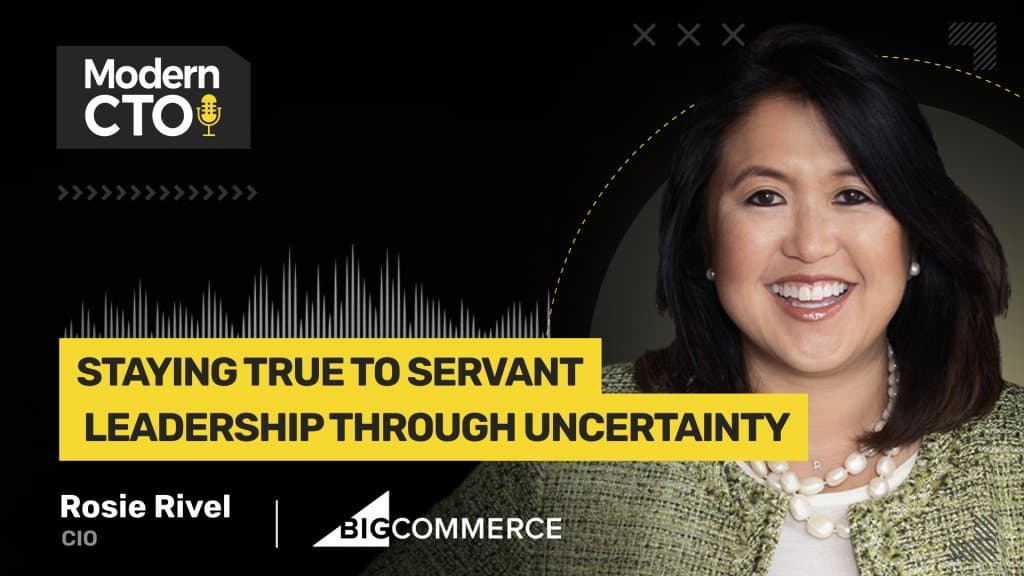
Staying True to Servant Leadership Through Uncertainty with Rosie Rivel, CIO at BigCommerce
Today we’re talking to Rosie Rivel, CIO at BigCommerce. We discuss how Rosie is facilitating difficult but necessary conversations in her teams, the tenets of servant leadership in an era of uncertainty, and how to balance delivering on time with delivering on budget.
All of this right here, right now, on the Modern CTO Podcast!
For more about BigCommerce, check out their website here.
Have feedback about the show? Let us know here.
Produced by ProSeries Media.
For booking inquiries, email [email protected]
About Rosie Rivel
Seasoned IT professional with over 25-years of experience leading global Information Technology teams and transforming organizations for growth. Pragmatic, articulate leader who enjoys fostering relationships with internal and external stakeholders. A demonstrated history of empowering teams to innovate and deliver their best work. Proven track record of delivering on business objectives and implementing enterprise solutions on a global scale.
About BigCommerce
BigCommerce (Nasdaq: BIGC) is a leading Open SaaS ecommerce platform that empowers merchants of all sizes to build, innovate and grow their businesses online. BigCommerce provides merchants sophisticated enterprise-grade functionality, customization and performance with simplicity and ease-of-use. Tens of thousands of B2C and B2B companies across 150 countries and numerous industries use BigCommerce to create beautiful, engaging online stores, including Ben & Jerry’s, Molton Brown, S.C. Johnson, Skullcandy, Solo Stove and Vodafone. Headquartered in Austin, BigCommerce has offices in London, Kyiv, San Francisco and Sydney.
Transcript
(Intro Narrator at 00:00:00) Today, we're talking to Rosie, CIO at BigCommerce, about how to stay true to the core of servant leadership through uncertainty. You're listening to Joel Beasley, Modern CTO.
(Joel Beasley at 00:00:16) So how long have you been at BigCommerce?
(Rosie at 00:00:19) Well, you know, I am approaching my first anniversary. Can you believe that? I joined at the end of September, and I am proud to say I'm the inaugural CIO as well. So this is the first CIO position at BigCommerce.
(Joel Beasley at 00:00:36) So first position, and it was an outside hire.
(Rosie at 00:00:39) Yes, yes, yes, exactly. I've been in the IT industry for a very long time, almost—I hate to admit—approaching 25 years. And so it was really exciting to be able to come to BigCommerce because it's my first in the software SaaS industry. And so I really appreciate the difference in everything from, you know, having a full constituency that's all technology. You know, some people in the industries I've been previously like to fancy themselves as technologists, and some of them truly are. But in a SaaS company like BigCommerce, they're all very strong in their technical acumen. So it's great to not have to sell the concept of technology to my business and my business partners.
(Joel Beasley at 00:01:32) And were you in commerce before, or just IT in general?
(Rosie at 00:01:35) IT across multiple industries: consumer products, pharma, automotive—hence why I'm partially based in Detroit. And I may have said consumer products, but yeah, across multiple industries. Oh, and staffing. Staffing as well.
(Joel Beasley at 00:01:51) And when you're not in Detroit, where do you spend your time?
(Rosie at 00:01:53) Half the time is in Austin.
(Joel Beasley at 00:01:55) Okay.
(Rosie at 00:01:56) So BigCommerce headquarters. My family is from the Texas area, and so it was great. I luckily was able to spend a lot of time in Austin, so it feels like a second home. But I raised my son here in the greater Detroit area. So he's still in school here, so I go back and forth quite frequently. I'm trying to get to the point where I can do summers up here and winters in Texas.
(Joel Beasley at 00:02:22) Best of both worlds?
(Rosie at 00:02:23) Yes, the best of both worlds, exactly.
(Joel Beasley at 00:02:26) So what is your role like as a CIO at BigCommerce?
(Rosie at 00:02:30) Oh, gosh. It's exciting. It's a relatively young company. I've been in well-established organizations. You know, I started my early years implementing ERP systems, and so I've worked at Fortune 500 companies, well-established organizations, et cetera. So having now been here for a year, I have to say that it's a young company, very scrappy and enthusiastic in building our solutions, growing our solutions. As I mentioned, I'm working with constituents that are very strong technically as well. You know, prior and absent of having a CIO role, a lot of the technology functions sat in different parts of the business, and they recognized in order for us to grow at scale, they have to centralize the function, adopt best practices, and just general IT operations. And now that we're also a publicly traded company, there's a lot of security controls that we have to abide by as a publicly traded company. And so that's everything that I bring, and I really enjoy being able to implement a lot of those things here at BigCommerce.
(Joel Beasley at 00:03:47) How big is the company currently? Like, how do you talk about that publicly?
(Rosie at 00:03:50) In terms of revenue, close to 300 million, as well as about—not specific numbers—but 1,400, 1,500 employees globally.
(Joel Beasley at 00:04:01) Okay.
(Rosie at 00:04:02) Yeah, so fairly large.
(Joel Beasley at 00:04:05) So other than the controls, do you have any fun challenges? Sorry, like, the compliance challenges don't seem that much fun. Do you have any other type of fun challenges?
(Rosie at 00:04:19) I would agree with that statement wholeheartedly. But, you know, one of the things that we're doing at BigCommerce is that part of our strategy is to also grow and pursue enterprise customers. And in order to do that, we have to look internally at our operations to see how we can grow at scale to do that. And so we're looking at a whole transformation program right now in evaluating our internal processes, how we capture the data, how we measure ourselves and KPIs, as well as what systems we use today, and determine whether that's going to actually enable us to grow as well. So that's a pretty significant program that I'm helping lead with some of my business partners. So I would say that's fun as well. It depends on how you define fun.
(Joel Beasley at 00:05:09) Well, when you come in and you're in a completely new role, did they allocate certain teams to be under that specific role, or did you sort of network with the constituents, as you're saying, and figure out where the needs are in your first year? How does that work?
(Rosie at 00:05:24) Well, I think that there were some roles, some groups and teams that were known as true technologists that support and enable our business, and those were immediately allocated to my team. And then as we were surprisingly dealing with some of our controls, it was recognized that more teams needed to move and consolidate, and that's what we decided to do as well. And it's a little bit of both, Joel, where, as there's more autonomy certainly with technology teams sitting as close to the business as possible, there's a lot of things that we have to just negotiate through and say the teams won't get repurposed or reallocated when they get centralized, and things like that. But overall, it's been a great move to do the consolidation, and we're not done on that journey, but looking for continued improvements in our ability to serve the entire organization.
(Joel Beasley at 00:06:25) Now I've never done what you've done, so I don't know. But I would imagine that if I come in outside hire, new department, new teams, things moving around, I would really be focused in thinking about the communication and interacting with those people, because typically people are scared of things they don't understand when they're new. There's a lot of conversations going on. How did you, as a leader, go into this situation and win over the people on your team and within the organization?
(Rosie at 00:06:55) Yeah, no, that's a really great question. You know, when I first joined, my first 30 days was really getting a lay of the land, getting to understand who my main business partners would be, understanding where the technology sat. I also took on procurement because, certainly for a technology company, we buy a lot of technology. So I took over the procurement function also. And so there was, depending on the type of engagement that they had with their technology, there is certainly some apprehension, of course, you know, because there's a movement of cheese, if you know what I mean. But the biggest thing was trying to establish a good relationship, making sure that I'm completely transparent. I'm here to help support and serve the organization and help institute best practices in our IT operations. So once they were able to understand my intent and my goal, we established kind of a common goal. And for those teams that had to transition over, there was certainly some shared expectation about how we would do that transition. And for the teams themselves, certainly, again, there's mixed emotion on that, because the existing teams—their ways of working was well established. But I believe that with my continued discussions with the team, being very transparent, explaining my general leadership style, they had a lot more comfort in how I execute in this role. And so by and large, I have to say that it's gone really, really well. I'm really pleased with how I've integrated into the organization. I met with all the executive leaders. I have responsibility to the board as well, so I have regular discussions with them also. And so it was great. It was a very smooth process. But certainly, I mean, even for myself, it's almost like starting a new school or starting at a new company. There's always a bit of apprehension of, you know, culturally, will I fit with the vibe of the company? But that's one of the key reasons why I joined BigCommerce, was their company culture.
(Joel Beasley at 00:09:21) What's that like?
(Rosie at 00:09:22) Oh, it's amazing. When I was going through the hiring process, and now sitting on the other side hiring talent into BigCommerce, what we mainly focus on, and what resonated with me through my own interviewing process, is that they look for two things. One is just what you have on your resume, right? It's what you come to the table with in terms of the fit to the role. But another equally important dimension is what we call bucket two, which is how collaborative, and the EQ or emotional intelligence, and the self-awareness that you bring. So that even though one could be extremely productive, highly successful at the bucket one, the things that you're good at in your resume, without being good at the bucket two things, there will be a point at which a person may stagnate because of the challenges of just emotional intelligence and the ability to collaborate and work through courageous conversations. And so I really appreciate the fact that the company looks at both dimensions equally.
(Joel Beasley at 00:10:32) Do you have any favorite leadership authors or people you like to follow?
(Rosie at 00:10:36) Oh, gosh. I'm never good at quoting these, but, you know, I've always—Simon Sinek. Sinek? Yeah, Simon.
(Joel Beasley at 00:10:47) Yes. Yes. I mess up his last name all the time. I know it's not Sinek, but I call him Simon Sinek because I don't know.
(Rosie at 00:10:53) That's, I don't know.
(Joel Beasley at 00:10:54) That's what—
(Rosie at 00:10:54) I think. Yeah, I know, I know. But I do like the way that he looks at leadership. I am a firm believer in servant leadership, especially in the role that I play. And as I moved through my career, the higher, the more influence you have in the role that you play, it's so important to ensure that you're enabling and serving the teams that you lead. And so I've been really privileged to have an executive mentor that taught me a lot about servant leadership and how to stay aware and recognize that we lead a whole person, not just an employee with a specific job. It's the whole person, and they come to the job as a whole person. So we have to help support them as a whole person, and that's what I really, really enjoy about being in leadership.
(Joel Beasley at 00:11:51) One of the things I found to be most interesting about hiring people and building teams is that there's a good portion of humans who believe that their work self and their personal self are separate, and then there's the group of humans that are just completely aligned. And for me, it took me a long time to figure out that I have to find the human that's as aligned as possible and that whatever carrot they're going after is the same carrot I'm going after, or our paths run together, so we're all in the same direction. They win and we win. And that took me, like, many hires and lots of money to figure that out.
(Rosie at 00:12:30) Yes, yes, yes, yes. It can, at times, be a very expensive lesson, you know. And so interviewing and being able to hone in on such a short period of time—right? Interviews last 30, 45 minutes sometimes. It's so difficult to hone in on that, and that's the reason why I use and probe very deeply on situational leadership, situational interviews, and situational questions, because it's really important to understand their frame of mind as they approach challenging situations.
(Joel Beasley at 00:13:04) Do you have any good examples or hypotheticals that you run often?
(Rosie at 00:13:08) Oh, yeah, oh, yeah. Typically, it's more of asking them to explain in detail their biggest challenge in their experience. What was it? How did they overcome it? And what was the lesson learned on the other side? So I asked them to go into a lot of detail about that, whatever it may be.
(Joel Beasley at 00:13:32) What are some of the crazy responses that you've gotten? Can you share anything? What's a—can you share what a bad experience or a bad answer would be?
(Rosie at 00:13:41) Oh, well, certainly, well, usually if HR has to be involved and have them walked out would not be the best response. But they usually don't outline those kinds of scenarios in an interview. But yeah, I think that where I can see if they are challenged in that space, on the bucket two, is if they can't really answer, kind of the thoughtfulness involved in learning from that experience and how they've applied it. And so that's usually where I see if they've really learned from those things. Because without that level of self-awareness, it becomes a challenge. It continues to propagate, and that's not what I'm looking for.
(Joel Beasley at 00:14:36) Yeah. When you were asking that question, I was like, oh, which one? Which learning journey would I share? Yeah.
(Rosie at 00:14:44) Yes. Everybody has one.
(Joel Beasley at 00:14:47) So do you ever have to ask yourself that question?
(Rosie at 00:14:50) Oh, yeah, all the time. I think it's really important as a leader to do a lot of self-reflection, because we're still human too. As much as I've been a student of servant leadership, I still have to recognize that at times, even though I'm here to address a lot of the team's frustrations, and so by and large, more often than not, I find myself a lot more calm in situations where my teams are frustrated so I can get to resolution quickly. But I still do find myself at times frustrated. And so I just have to acknowledge and give myself some grace and just recognize I've got to work through it. But at least the most important thing is that you recognize when it's happening, so you can work yourself through that so that you can be there for your team. And that's what I try to do. No one's ever perfect at it, but it's important to still continue to do that for the sake of the team.
(Joel Beasley at 00:15:48) Yeah. What big project are you really excited about right now?
(Rosie at 00:15:52) Good question. It's the transformation project. We're doing quite a bit in our—and it's going to be from an end-to-end, from our go-to-market side to our back office. And so we're looking at how do we position ourselves the best to sell to our enterprise customers. And what kind of metrics do we want to drive? What deeper insights do we want to build for our leaders as well as our sales and marketing organization to ensure that we are honing in on the ideal customer profile, and we're targeting our efforts towards that population.
(Joel Beasley at 00:16:32) Well, people are listening and they're hearing about the product. They're like, ideal customers. Like, well, this is a great time to plug BigCommerce. Who's your ideal customer?
(Rosie at 00:16:39) Well, I would say that it's anyone that sells product. And then, you know, growing internationally, we look for enterprise customers that are challenged with—and certainly right now with the economy as challenging as it is—you know, it's the recognition that for those enterprise customers that are trying to grow, we're here to help support their own transformation. The great thing about our product is that it's completely composable, and I struggle with the same thing. And the other thing that I would say is that being a CIO at a SaaS company, the strategy of the solution we sell is the strategy that I'm also implementing internally. And so, you know, Brian and I talk about this frequently, that, you know, the composability, the flexibility, the open API, you know, it's really creating an enterprise platform that is affordable for companies, that every company is not immune to the state of the economy. So as I look for technology solutions that are affordable to our own business to run our business, I know that my counterparts that look at our solution have to do the same thing.
(Rosie at 00:18:00) And so when you look at our solution and you're building for an enterprise customer, our platform basically is completely composable. So for me, the trade-offs are always the most critical thing. And our solution gives us a platform by which you can add functionality at any time, depending on financial constraints, trade-offs on priorities. And that's what I really enjoy about our solution—that composability and flexibility still provides scale when they need to scale and when they're ready to scale.
(Joel Beasley at 00:18:38) Do you ever, or does the company ever, put out market report trends about what they're seeing? Because you have the unique position to be able to see across multiple industries, multiple countries, all of this data on how sales and things are doing. Or is that information that's considered private and you don't create these types of reports?
(Rosie at 00:18:56) That is a good question. And I will have to say that with my only year experience, I haven't gotten—yeah, I don't know for sure. But I know that we have access to that data. I just don't know if it's publicly available, unfortunately. But yes, we do, and we do leverage it.
(Joel Beasley at 00:19:13) I would be asking my peers to be like, alright, so obviously there's different governments and you operate globally, but I would be really curious to see if the numbers that were coming out at a state level or a federal level matched what we saw in our trends. Obviously, there's all different types of economies and all different types of things you can sell.
(Joel Beasley at 00:19:34) But I'm always curious in the companies that are the software-as-a-service companies that touch thousands of businesses, and they have this amazing data on how the economy is actually performing.
(Rosie at 00:19:47) Yeah. You know, and I can say at previous employment, there's a lot of input that we've used to inform labor trends and things like that at staffing companies. But here also, I would imagine that data is getting aggregated. I just don't know if it's being input to—we have relationships with Google Cloud, and I'm sure that that's getting aggregated. If it's not already publicly available, I'm sure it's getting ingested and being leveraged in that capacity.
(Joel Beasley at 00:20:20) And so now where the maturity of the business is at, is you're finding these large businesses to work with. When I first came across BigCommerce, like, fifteen years ago, it was this script you would download or would be available in cPanel to run. And so it's come a long way.
(Rosie at 00:20:38) It has. It has a lot. And there's continued growth. I mean, with our robust technology partners and agencies, there's so much available now to leverage. So it's exciting to see how the platform is growing, and we're exploring AI as well.
(Joel Beasley at 00:20:56) Yeah. That was actually my next question. No interview in 2023 is complete, even with your grandparents, without discussing AI.
(Rosie at 00:21:05) That's right. That's right. I would say that both on our product platform as well as our internal operations, we're exhausting the different use cases that we could apply and make it available on our product, but also internally. So, yeah, and all solutions are getting enabled there. We would be left behind if we didn't consider that.
(Rosie at 00:21:26) And so it is, and we have a lot of other marketing material that covers that. But yes, we are diving into the AI space and have a strong roadmap to implement and enable that.
(Joel Beasley at 00:21:39) We're so close as a people too. You know, if you look back at, what was that movie with Jarvis? Iron Man?
(Rosie at 00:21:46) Iron Man. Yes. Yeah. Yeah. Yes.
(Joel Beasley at 00:21:47) Where you could just ask Jarvis anything. Right? That was sort of the feeling we were hoping for with the Siris and the Alexas and all of that. But then when the large language models came out, it was like, woah. They delivered so well.
(Joel Beasley at 00:22:02) Yes.
(Rosie at 00:22:03) And, you know, for what we provide our experience, we track the clicks. We look at what the trends are in terms of our customer's customer and what they're looking into. And so it helps provide insights to our customers about their own customers around their products, et cetera. So it's hard not to—it's almost more difficult not to be able to take advantage of those things now, because in order to stay competitive, you've got to implement a lot of these capabilities. And so we're excited to have that on our platform.
(Joel Beasley at 00:22:38) Yeah. I think we're maybe a year or two away from me being able to take all of the QuickBooks, all my customer, all my data, and just throw it into this private box and then just say, hey, follow the—this is one of my favorite authors in business. If they reviewed my business, what would they say? Or this is my favorite M&A firm. By the way, I feel like such a loser having one. But this is my favorite M&A firm. You know, what would they—how would they evaluate or value my business? And it would just have all of that information. We're not ten years away from that. We're a year or two away from that.
(Rosie at 00:23:14) Oh, I know. It's very—we're on the cusp, and that's the—I don't know how else to call it—but exciting. And watching how this is gonna grow, just the rate of our ability to innovate is just accelerating. So staying on that bleeding edge is so critical for a company like BigCommerce, and I know that we invest a lot in making sure that we're on that leading edge.
(Joel Beasley at 00:23:38) I wonder how long, Rosie, until I have some sort of data pack that as a potential employee I could share with you and plug in, and it would have all information about, you know, conversations I've had or how I handle situations, and it would just detect if it aligned with your culture. That'd be crazy cool.
(Rosie at 00:23:55) Wouldn't it? Wouldn't it? Yes. Yes. I mean, we're close. All the other personal data is available kind of in that way—blockchain, et cetera. So we're not far. We're definitely not far.
(Joel Beasley at 00:24:10) So what other conversation topics did we wanna get to? I haven't really looked at Josh's prep document at all. I was just excited to talk with you.
(Rosie at 00:24:18) Likewise. Likewise. I would say we could talk about from where I came from in my early years with doing SAP and the ERP implementations, which was considered innovative back in the day. And when I say back in the day, that was only in the nineties. Back then, there was—if I don't, if you don't mind me saying—there was a different business model of which those ERP systems was transformative to help enable.
(Rosie at 00:24:49) In the evolution of so many different technologies with mobile and then becoming mobile apps, et cetera, it's changed so much that now with the evolution of our business models and the rate of change of our business, the composability of our platform is extremely aligned to the rate of change of companies. And so that's what I look for for the systems that we implement internally at BC. But I also know, in a lot of the conversations that I have with Brian and our strategy, is that we create that same level of flexibility on our platform. So I'm excited to say that, you know, the strategy that we implement on our product is our strategy internally as well. And that's just the exciting part of my job is doing the exact same thing.
(Joel Beasley at 00:25:40) A lot of people say eating your own dog food. Right?
(Rosie at 00:25:44) Yes.
(Joel Beasley at 00:25:44) But I had this awesome girl on named, oh, I hope I get her name right, Archana, three years ago. And I've done 750 of these, so I forget names a lot.
(Rosie at 00:25:53) Wow.
(Joel Beasley at 00:25:53) But I believe her name was Archana, and she was the CIO or the C-some-CXO-something over at, oh, I could see it in my head, but I can't remember. Anyways, huge design company, a company that I specifically had liked. They do a lot of ticket management type—software engineers will use their software.
(Rosie at 00:26:15) Oh, like Jira or something like that?
(Joel Beasley at 00:26:17) Yes. Like, who's the company that makes Jira? Whatever that company is. Either way, this girl was so cool and she said something about eating your own dog food and then she goes, I like to say drinking your own champagne. And I was like, that is a much better way to describe it. I was like, that's much classier.
(Rosie at 00:26:35) Yes. Yeah. So very true. Yeah. So very true. We have to, you know? But the great thing about it is that our solution is in line with what companies are struggling to deal with today. Right? They are positioned to speak the language of my role and my constituents. Right? They understand that. So we have to—we are the front line. So my feedback is solicited to understand what are the challenges that other CIOs have. And really right now, it's just managing it to enable the business in very tight financial budgets and economies. And so we are definitely drinking the champagne. Definitely.
(Joel Beasley at 00:27:30) So when you're working with all of these great people and the company has an excellent culture, you're loving your job, you're going into year two. When you look at the next generation of leaders that are within your org, what trait stands out to you that specifically causes you to think, you know, I should spend some of my time investing in this person because I saw them do that and I know that that type of behavior, if I invest in them a little bit, they're gonna be ten times better than if I didn't invest in them. What behavior or what trait is that that you're looking for?
(Rosie at 00:28:05) That's good. Very good question, Joel. I would say that, you know, if they are able to—with technology in my organization, regardless of what company I'm in, if technology is difficult to deliver, right, we always come up with challenges. You know, the most cynical perspective is, you know, it's difficult to deliver on time, on budget, and with our business teams being completely satisfied. Right? There's always that. The person that I would look for that has that kind of leadership potential is one that can overcome—overcome the adversity and stay balanced in their view of the challenges that we deal with on a day-to-day basis, because there's always challenges. Right? And so that kind of individual is able to stay balanced and look ahead and work through the adversity and bring the team along and make sure that we stay, we find the through line as they call it, and be able to make sure that we have a path forward and rally the team in a kind of a collective thought that even though this is a challenging moment in time, that there is a path ahead. And that's what I look for.
(Joel Beasley at 00:29:25) And you said you're a parent. Right?
(Rosie at 00:29:28) Oh, yes.
(Joel Beasley at 00:29:29) I have three under six right now, so that's where I'm at right now. When you—thank you. Thank you. When you started ex—first of all, did you work professionally the entire way through raising your kid?
(Rosie at 00:29:44) Yes. As a single parent too.
(Joel Beasley at 00:29:46) Oh, wow. You're strong.
(Rosie at 00:29:48) Yeah. It's a lot of sleepless nights. I have to say through his early years as a single parent, I worked—the company I worked for before allowed me to have a flex schedule, but that required me to work late into the evenings. But I very much appreciated that balance to be able to do what I did.
(Joel Beasley at 00:30:08) Is he at the age where he's appreciative of it yet, or will that happen again at like 20, late twenties, thirties?
(Rosie at 00:30:13) Yeah. I'm gonna forecast the thirties.
(Joel Beasley at 00:30:19) Yeah. Yep. That's route 28, 29 is when I'm 36, 35, 36-ish. I can't remember. But around 27, 28 is when I started to have that new type of relationship with my parents where I'm like, oh my goodness. This is what they dealt with when I started to have kids, of course, and understand that. But I always found it really interesting to talk with executives and, you know, professionals like you. And you're extra strong, so that's great. I like you even more now. But for your ability, when I was—my kids have tantrums. Right? And I find that dealing with those situations if you're in a car, you got three kids screaming and crying, they're throwing stuff, it's just going—it's bonkers town, right, in the car. And yet you're still driving and you're focused and you're dealing with all of this stuff. That definitely prepares you to deal—I've never had a situation at work that was as crazy as three kids just on temper tantrums. Right?
(Rosie at 00:31:19) Yeah. Yeah. Yeah. Yeah. Oh, there's a lot of synergies or similarities between the parenting perspective and leading and mentoring teams. Right? Because you do recognize where they are. You have to meet them where they're at and help them to the next level. And that's exactly what parenting does. Right? Certainly, you have a lot of vested interest in the children, but, you know, good leaders also have vested interest in the careers of their teams. So, yeah, very much understand the challenges with pure chaos that you're going through.
(Joel Beasley at 00:32:02) Yeah. Yeah. And it's not—no disrespect to people that are early on in their lives. But, you know, when you're maybe early twenties and you're single and your biggest issue is you ran out of waffles and now you have to go all the way to the grocery store—
(Rosie at 00:32:13) Oh, yeah.
(Joel Beasley at 00:32:14) That's just a different—that's a different bar of difficulty than, you know, raising a gaggle of small children. Right?
(Rosie at 00:32:22) Yes. Oh, yes. Adulting is definitely a thing that he's going through at the moment.
(Joel Beasley at 00:32:28) Yes.
(Rosie at 00:32:28) And it's frustrating for him as with most of the age. Right? Because they have not—he's a second year in college. So he's kind of getting his feet under him, but it's still not quite all the way. And so he's learning and still doing age-appropriate things, you know, which you can recognize having been there before. So yeah, I'm enjoying every step. I only have one. So it's always gonna be my first and last experience.
(Joel Beasley at 00:32:58) But it'll be a great one. Yeah.
(Rosie at 00:33:00) Yes. Yes. Yes. But, yeah, it's a great—you know, I'd have to say parenting teaches you a level of patience that you never realized you could have.
(Joel Beasley at 00:33:10) Yes. 100%. I tell my wife all the time. I said, when these kids, they're complaining that they're hungry. I was like, we need to do a missions trip or something. We need to show them what we have. I was like, what about that—what about that room full of food? There's a whole room full of food. And they're like, oh, I'm hungry. I don't know what snack I want. I'm like, man, we need to go do some type of mission work or global type work to show what, you know, other types of civilizations that exist and how—and then that will give you an appreciation for a, being useful for helping other people. And for b, just having context of how good life is.
(Rosie at 00:33:53) Yes. Yes. Totally. I 100% agree. Having awareness of what else is out there gives you definitely appreciation for what you have.
(Joel Beasley at 00:34:01) Yeah. Like, if you have a bad software and you need a good one, you go to BigCommerce.
(Rosie at 00:34:06) Absolutely. Absolutely. We would totally be able to support any from small, medium business to enterprise for sure.
(Joel Beasley at 00:34:16) I love it. So that's just bigcommerce.com?
(Rosie at 00:34:19) Yes. Bigcommerce.com.
(Joel Beasley at 00:34:21) I think we did it. I think we're professionals. Thank you so much for listening. And if you found this episode useful, please share it with a friend or colleague who you think would get value from it. And if you have topics that you'd like to hear discussed on the podcast, either add me on LinkedIn, or send me an email [email protected]. Every time I get an email or LinkedIn message, it absolutely makes my day and inspires me to keep going.