
Episode 596 ·
The Secret to Healthy Business Growth with Roi Ravhon, Co-Founder & CEO at Finout
Today we’re talking to Roi Ravhon, Co-Founder & CEO at Finout. We discuss how young people can think creatively out of problems into new solutions; Roi’s workplace culture that allows for entrepreneurs to be born out of the company; and why “growing healthy” in business is a result of proper KPI alignment.
All of this right here, right now, on the Modern CTO Podcast!
Check out more of Roi and Finout at https://www.finout.io/!
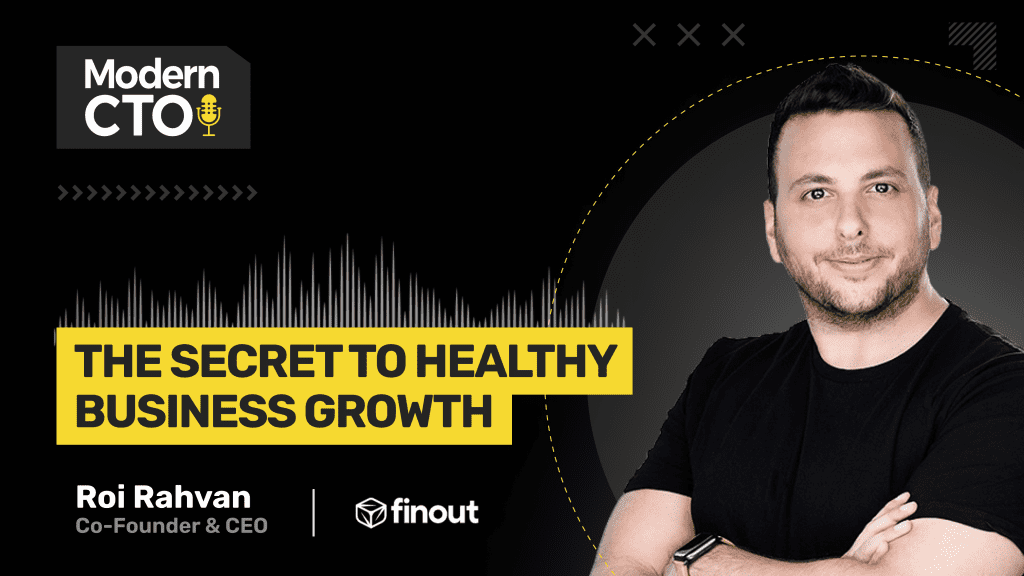
About Roi Ravhon:
Roi is the CEO and co-founder of Finout. After more than 12 years of DevOps and engineering experience, including almost six years at Logz.io, Roi became an entrepreneur to solve the pains he experienced himself as a Director of Core Engineering. In less than two years; Roi, his co-founder, and team raised $18.5M and launched a FinOps platform that helps dozens of industry leaders worldwide, including Orca Security, Alphasense, and Riskified.
About Finout:
Finout is the first self-service cloud cost observability platform that combines business metrics with your cost, slicing it up to customers, features and unit metrics. With Finout, FinOps, Finance and DevOps can help their organizations make healthier business decisions that improve efficiency, pricing and go-to-market strategy.
Transcript
(Intro Narrator at 00:00:00) Today, we're talking to Roi Ravhon from Finout about healthy growth in the cloud and more. You're listening to Joel Beasley, Modern CTO.
(Joel Beasley at 00:00:13) So that's the brief background about me and where I'm at.
(Roi Ravhon at 00:00:17) Makes sense. Thank you. So brief about myself. My name is Roi, co-founder and CEO of Finout, one of three partners. Like most of the Israeli entrepreneurs that you're probably talking to, I started my way in the Israeli military. I had the intelligence unit, the DNA equivalent. I spent there around seven years. Afterwards, I joined a company called Logz.io. If you know them, it's like a Datadog Splunk competitor. And I joined Logz.io when we were like 10 people sitting in an old bridal salon in the port of Tel Aviv.
(Roi Ravhon at 00:00:49) So I really wanted to get the full Israeli startup experience as far away as I can get from that huge military background. And I joined as a DevOps engineer, moved through a couple of positions within engineering. The last one, I was engineering director responsible for the entire Logz.io infrastructure. So all of the data that goes in and out, kind of high-tech plumbing, if you will. So I managed a team of 30-some tech engineers, all struggling to make Logz.io work at scale.
(Roi Ravhon at 00:01:22) And in there, I wore like two very contradicting organizational hats. Like one was in charge of the company's SLA. So I needed to make sure that companies are getting their logs and metrics in time and every query is getting back super fast and like everything's working as it should. And that usually required spinning up lots of infrastructure in order to support that. And on the other hand, I was in charge of the cloud financial management and I needed to make sure that we're financially viable, which usually required reducing servers in order to make everything work.
(Roi Ravhon at 00:01:58) So I was debating with myself, honestly, like, do we need the servers, do we not need the servers? And this became like a pretty difficult dial to tune, right? Because infrastructure just became more and more complex as we grew on. So we started to use more and more AWS managed services in more and more regions, and then migrated some of the workload to Azure, and then purchased Akamai and Twilio and Mailchimp and Stripe and a bunch of security products.
(Roi Ravhon at 00:02:24) And now I have like 50 different usage-based price software that I'm constantly paying. And I'm not even controlling what invoices that I'm going to get because those are based on the usage of my product based on our customers. And suddenly, very simple questions like, our AWS bill has gone up by 5%. Is this good or not? started to become really complicated and a lot more complicated than we thought and we wanted it to be.
(Roi Ravhon at 00:02:55) And when running a multi-tenant environment, we started to get questions like, how much do we pay for this specific customer? What's the price of that feature? What's the gross margin for that deal? What's the minimum pricing we can give? All sorts of questions that we really struggle to give answers with with the current solutions in the market.
(Roi Ravhon at 00:03:12) Then we decided that we just need to go ahead and start and build a company to solve that. And that's the origin story of Finout.
(Joel Beasley at 00:03:22) So it was born out of this Logz.io site?
(Roi Ravhon at 00:03:26) Yeah. So I started there. I met one of my partners who was the product manager that was assigned to my group. And we got joined by our CTO, who was the first employee in a company called Lemonade. It's an insurance company in Israel that we met in the Israeli military.
(Roi Ravhon at 00:03:44) So that's the initial team that started then.
(Joel Beasley at 00:03:48) For the Israeli military, the IDF, what did you learn through that experience about how people work and how to manage and work with people?
(Roi Ravhon at 00:03:58) So I think something very unique about the Israeli military is that you're very young. You're drafted at 18. You don't understand anything of anything. And you can be either sent to combat and that's a super difficult experience on its own, or you can be sent to do technological stuff behind the scene and support the ones in combat.
(Roi Ravhon at 00:04:23) And as a DevOps engineer in the Israeli military, an 18-year-old, you're responsible for systems that can't be down because if they were, someone's gone back. So you have like tons of responsibility very early on. And I think this is one of perfect catalysts for what's happening now in terms of innovation in Israel. Like, you're getting lots of responsibility really, really early in your life. You have no adults around you.
(Roi Ravhon at 00:04:53) Like, everyone is super young. And even like the commanders in charge of you, like a 40-year-old is one of the oldest ones there. And it's a very unique experience.
(Joel Beasley at 00:05:04) Yeah. I'm about 35 now. And to think that 40 used to seem so old, right? They have all the answers.
(Joel Beasley at 00:05:12) They know everything. And you would feel secure and confident around them. Now I look around at people who are, you know, 35, 40, and, oh, were these the people in charge?
(Roi Ravhon at 00:05:23) Exactly. But I think on the other hand, it's like a huge advantage because the military is full of young people who still don't know what's impossible. So they just keep on trying and they keep on making the same mistakes. And for a lot of times, it actually works. So it really creates like a big innovation hub with this mindset like you're facing problems that a 50-year-old would tell you that it's impossible to solve and you should try something else. But a 30-year-old doesn't know that. So you can try it. And I think that creates something that is really unique.
(Joel Beasley at 00:05:56) And things are moving fast too. I was talking with my wife last night about ChatGPT. I had seen a couple different videos on YouTube of engineers and other types of people using it. One individual wrote 12,000 books in one month that ranged from children's books to fiction and nonfiction. And another person was showing how they could use it to assist them in writing code.
(Joel Beasley at 00:06:25) They had a problem, and they were able to feed it information and ask ChatGPT about solutions. And as I was watching these interactions on YouTube, I was just blown away. And so, unfortunately, I watched those videos at night before bed, right? So now my brain is going.
(Joel Beasley at 00:06:42) But I sat there and talked with my wife and I said, this is going to be something that is a massive change. It's like the smartphone coming out. It's going to completely shape our society. But the one positive here, and I think you'll agree with me as an entrepreneur, is humans trade value with each other through the medium of currency, through money. We trade value.
(Joel Beasley at 00:07:09) So that's been happening since caveman days, since groups of humans got together. That act will not stop happening. So even if technology comes and automates things away, that money will just be reallocated to some other useful thing that humans can do for each other. So that idea calmed me down a lot.
(Roi Ravhon at 00:07:32) Yeah. I think the narrative of AI is really one of the—it's going to be one of the biggest revolutions over time. We still don't get the full extent of it. Like, it's still very, very early on, but it looks different than what people thought that the blockchain was going to be the next revolution. Some still are.
(Roi Ravhon at 00:07:50) But I think that generative AI has like a real ability to impact a significant part of our life. But obviously it's going to lead to monetization at some point. Like the ability to use machines in order to help humans to make a better, faster, quicker job, to be more productive and eventually generate more revenue for themselves. But still everything is always surrounding money and currency. Like, it's not going to go away. But I think that AI has the capabilities of helping the smart humans generate more money and is going to be another catalyst in technology.
(Joel Beasley at 00:08:31) That's exactly right. And I'm curious to talk about money. I saw when I was doing my stalking of LinkedIn on you, you had a big banner. You guys have raised 16 or 18 million dollars for this current project. Is that right?
(Roi Ravhon at 00:08:48) Yeah. 18.5.
(Joel Beasley at 00:08:50) Was that hard or easy? What was that? Was it a really difficult thing?
(Roi Ravhon at 00:08:55) So as an entrepreneur, you know that raising money is never an easy or a fun task to do, even in the high tides of '21. But I think when you have a real problem that you're solving and you have a real pain that you're servicing and you have customers that are willing to pay for that pain that you're creating, fundraising is a bit less intimidating. You know, it's never an easy task, but I think when you're fundraising, you're learning so much about yourself, about the company. You're getting a 360 view of everything that's happening, of all the weak spots in your business, of exactly raw feedback on what you're doing.
(Roi Ravhon at 00:09:38) And I think that we learned so much from each of the rounds, and I'm looking for the next one for that purpose as well.
(Joel Beasley at 00:09:47) It is a very difficult thing. And one of the reasons why I brought it up was because you mentioned that you are a divestiture or a spinout of this other company. So you were working with this team. You had success scaling this Logz company. You found a problem inside of that company that many other companies were experiencing.
(Joel Beasley at 00:10:10) You built this solution, Finout, to help cloud observability and cost. And I was just wondering, you know, if you guys had gotten your initial investors from the Logz company or from the investors involved with the Logz company, did that make it a little bit easier, or did you just go get brand new outside investors?
(Roi Ravhon at 00:10:31) So when we started Finout, we created a clean job. You know, we did it very clean. We gave long notice and started to have a bunch of conversations. But the Logz.io CEO actually helped us a lot with the intros and accompanied us with advice. And we're still talking from time to time.
(Roi Ravhon at 00:10:54) They're sitting a few floors above us now and they are our customers. So it really makes all the difference, you know, when you want to leave a company and start your own company. So keeping good terms with your former employer, making everything smooth and the transition smooth. And I think like, eventually I'd really be thrilled as an entrepreneur to grow more entrepreneurs within Finout. So if one of my employees is going to start his own company or his or her company, I'm going to do everything I can in order to help them.
(Roi Ravhon at 00:11:29) And I would be so proud to have a company spin out of Finout.
(Joel Beasley at 00:11:32) Where did you learn that behavior?
(Roi Ravhon at 00:11:35) So I think I was one of—I really grew working together with the company from 10 employees to 250. Like, I really saw lots of the decisions. I also grew up with a CEO mom, you know, that you always see career. You always see folks that are doing something and really are really wanting to achieve and run super fast in a super achieving environment. So this, I guess, always gave me that direction and gave me that will and desire.
(Joel Beasley at 00:12:09) Well, especially if you—you said you had a CEO mom who was in it, so you grew up around it. And it's kind of hard to be in those environments and not be successful because you watch their behaviors, you watch their habits and their patterns and how they think, their mindset. You know, I meet people all the time who their parents are military, so they have a high level of discipline, or they were in sports, so they have a high level of discipline. And I'm assuming that you got your discipline just from the culture of your mom and then being a part of the IDF?
(Roi Ravhon at 00:12:41) Yeah. So I think growing in Israel is an experience on its own. And in the army, you're getting through a very specific path. You learn when you should think, when you should not think, and start to get more disciplined. But all in all, I think it's a matter of education, of the environment that you grew up in, of who your friends are, who your family are, who your role models are growing up that really shapes you to be the person that you are.
(Joel Beasley at 00:13:10) Has your mom given you any advice on how to be a founder or a C-suite executive and grow a family?
(Roi Ravhon at 00:13:20) So, you know, I really experienced it on the other hand of Mom always working and always traveling. And, you know, it's almost the part that I'm taking to myself now of how to balance my time at work versus my time at home. I obviously need to travel a lot. And what's—how's my fiancée going to feel and how I'm going to continue to be there and to be present even if I'm away. And, you know, when it's time to start a family, that's part of the core concept that I'm going to adopt because I grew up in that situation.
(Roi Ravhon at 00:13:58) Like, I experienced what it means to have a CEO as a parent, and I need to make sure that I'm balancing between the two.
(Joel Beasley at 00:14:08) Were you together with your fiancée before you started this company?
(Roi Ravhon at 00:14:13) Yeah.
(Joel Beasley at 00:14:14) How was she as far as supporting you and helping you through the decision to start your own company? How did that go?
(Roi Ravhon at 00:14:21) So she is super supportive. I don't think there is any other way to do that. Like, if you don't get your support and approval from your home, from your base, from when times are tough, it's almost impossible. And happy that she was so on board of this and really pushed me through hard times. And she's bearing up with all the nonsense and the long hours and me traveling a lot.
(Roi Ravhon at 00:14:53) And it's based on good communication and high level of trust and the understanding that it's an episode of our lives, and we'll see what the next one holds. Now it's my turn to run and to achieve, and then it will be her turn to do that, to run and achieve. And we're supporting one another and we're communicating well. That's important.
(Joel Beasley at 00:15:15) Yeah. That's how my wife and I—we look at it. We're best friends. We're a team, and we look at our different skill sets and say, how can we do the best that we can do at life given how we're both gifted? And it takes a lot of work to shut out the culture and what people are telling you you should be doing or how things should be, and really just create your home cocoon, right, your home base, like you said, which I loved, and decide what's right for your base.
(Joel Beasley at 00:15:47) And I think that if people did that more, we would get a better culture as a whole. So I like you. Thank you for doing that.
(Roi Ravhon at 00:15:58) Thanks.
(Joel Beasley at 00:15:59) So as far as leadership advice goes, what is the best piece of leadership advice that you ever received and then it stuck with you for a long period of time?
(Roy Yi at 00:16:12) And the LogsAir CEO told me that in my first interview, there is something that he calls the beer test. And, you know, with each candidate that you're hiring, you need to make sure that you think it's gonna be fun to grab a beer, you know, after work together with them. And it's a statement that is really, you need to adapt it a bit to make sure that it does not affect inclusion and it does not affect you hiring people that are very different than you. But I started to think about it a lot. And you see, when, like, even there is someone completely different than me, you know, different cultures, different religion, different anything, but you feel that that's gonna be an interesting person to talk to and you're gonna spend a lot of your waking hours together with them.
(Roy Yi at 00:16:56) If the answer is gonna be no, like, it's gonna be impossible to spend time out of the fort together with them, so this might be, you know, a wrong person to hire for your current existing culture. And while you grow, culture starts to evolve, it starts to get, you know, more and more shapes and sizes for different parts of the organization. And it's okay, you know, to start and expand that. But if you end up bringing a bunch of different people that have no cultural value together with one another and making sure that you're not compromising on inclusion, I think that's one of the most important stuff to, you know, when building a company, especially this one.
(Joel Beasley at 00:17:34) We think about that with our clients too. Like, because you have to spend a lot of time, you know, with your clients and working together. So I like the beer test. I've found that to be true in my life as well.
(Roy Yi at 00:17:47) I agree.
(Joel Beasley at 00:17:47) I've never met somebody who I think to myself, I don't wanna have a beer with that person, and then it turned out to be a great working relationship.
(Roy Yi at 00:17:56) I agree.
(Joel Beasley at 00:17:57) Alright. What I am most curious about is to better understand why people are looking to save money with the cloud cost. So I'm gonna ask you a bunch of different questions. If I hit a wall or an area that's too deep, just say, I don't know. Because I don't know how much you know about cloud cost.
(Joel Beasley at 00:18:15) I'm gonna ask you a bunch of stuff like a small child. Sure. Now I imagine that if I was looking at your company like an investor, I'd be attracted to it mostly because the more successful CEOs are making cuts and becoming lean right now because of the economy and what's happening and the overall uncertainty that exists in the marketplace. Right? And so I would imagine that a tool like yours that helps with being able to observe cost, track spend.
(Joel Beasley at 00:18:51) You'll probably explain it better than me, but it looked really cool when I watched the video on your home page. But when I saw it, I said, okay. A tool like this is probably going to gain a lot of market traction in a downturn. Have you seen that? Is that true?
(Roy Yi at 00:19:05) Yeah. So we see a lot more demand, you know, in the last two quarters than what we've seen before. And when you look at the balance sheet of a company, oftentimes, you know, salary is the first line and infrastructure expense is the second one. Infrastructure expense is also, you know, a runway extender, but it's more importantly than that, the number one thing that affects your bottom line. And because you're, when you're measuring cost of sale, you need to make sure that, you know, you're selling software significantly more expensive than what it cost you to generate it.
(Roy Yi at 00:19:45) And if your cloud costs were getting out of control or, in the worst and a lot more common case, losing touch with your revenue, I mean, that your cloud cost is growing in a higher rate. This not only means that you're in a bad place now, but that you don't have any business viability as a company and you don't have a future. And this is where, you know, companies, more and more companies are starting to understand that in order to, you know, to draw this path to profitability, it's not gonna happen by firing, you know, 10% of the company. It's not gonna happen by cutting down your cloud cost by 10 or 20%. It's gonna happen when you're, you know, you're gonna double your revenue, but you're gonna increase your infrastructure expense only by 30 to 40%. This is like where you can start to have the economy of scale to kick in and you can really show, like, this is like the deals that I sold was in bad margin.
(Roy Yi at 00:20:43) I know that. But look at what's gonna happen next and look at how I'm gonna improve as a company and look at my path and look at, you know, the improving year over year with a bit of deal size and viability that it happens in business. And I think this is a huge trend that is happening right now in the market. Like everyone are talking about path to profitability. Everyone are talking about designing, you know, for the future, improving the bottom line, not only the top line, and becoming more efficient and keeping it up as, you know, when we're designing to efficiency.
(Roy Yi at 00:21:17) So economy of scale is not a magic thing. So if you're going to grow as a business, it doesn't mean that your gross margin is going to improve. Look at Twilio. It's a prime example for that. It's happening when you're really working on it and you're implementing a culture within your organization that is really, you know, cooperative and creating responsibility for cloud costs.
(Roy Yi at 00:21:38) Really the same as we did with DevOps that improved SLA. So FinOps is improving our financial management, and I think it's one of the biggest trends that's gonna happen in 2023.
(Joel Beasley at 00:21:48) Now is it just a way to view and analyze and observe cost, or do you offer suggestions about how to reduce the cost?
(Roy Yi at 00:21:59) So obviously, when you start, you don't have anything. You have a bunch of managers just laying down on the floor. Right? You have unused instances. You have over provisioned databases.
(Roy Yi at 00:22:10) You have a disk that are too big. You have a Kubernetes that is poorly managed. So there's a bunch of stuff that you can just do in order to lower down your cost. And this is something that obviously, Finout helps with. And when we start to, you know, to look a few months later, we want to start to make sure that we're growing healthy.
(Roy Yi at 00:22:32) And growing healthy means that we keep correlation between our KPIs and our costs. So essentially the unit cost, how much money does this cost us to produce this unit that we're selling is remaining constant or even decreasing with time. Because it's okay to spend more money to cloud providers. And this is the basic paradigm, which is all. Right?
(Roy Yi at 00:22:52) We're paying more money for the cloud providers every month. We don't have any way around this. But we want to make sure that we're standing at the right time. And Black Friday is not an anomaly. It's a day that everyone needs to, you know, spin up more servers in order to support more traffic.
(Roy Yi at 00:23:07) Like, it's a worldwide issue. But as long as I brought in more revenue for my company, like, everything is okay. And it's something that is very hard to measure over time and having a tool like, like, yeah, that helped you to, you know, to track down your unit cost and convert them into your unit economics and really explain your growth and make sure that both finance and engineers speaks in the same language instead of, you know, constantly pointing fingers to one another is the best thing, like, long term observability and savings.
(Joel Beasley at 00:23:37) Now is your customer coming from the CFO wanting to be able to have more insight into cost, or is it the CTO or CIO that are trying to get their own cost in line? How are you seeing this originate within your companies, within your customers?
(Roy Yi at 00:23:58) So we see demand from both sides. Yeah. So CFOs are underpowered with modern companies like that. They're looking at the ERP systems. They have a five lines that says coffee and one that says cloud cost, which is like absurd.
(Roy Yi at 00:24:16) They don't have anything, and they can't really deal with engineers. Right? Engineers can just tell them, no, Kubernetes. And they can deal with, you know, this kind of curse words. But on the other way, engineers are getting, like, constant requests from finance.
(Roy Yi at 00:24:31) Like, why did this grow? Why did this grow? What did this work? And because the cloud expense is growing month over month, engineers need to keep on explaining to finance, like, what you're doing. And we found that we can be really beneficial for both sides.
(Roy Yi at 00:24:46) So, you know, if you're talking to DevOps, like, we can help you get finance off your back. Like, we can help you give the answers that you look for and continue to run fast and innovate. Like, we are, you don't think of Finout as a as a big brother, you know, kind of solution the other way around. Like, we got you back. Just run as fast as you want.
(Roy Yi at 00:25:03) We'll let you know once it's bad, once, you know, once you need to take actions. And we'll be able to, you know, show finance what you're doing in order to, you know, to stop them nagging you. And telling Finance is exactly the opposite story, but still, it's one system that serves them both.
(Joel Beasley at 00:25:20) I love that. That was the best explanation of what the company does. I loved it. So has any customers come to you that were just the CFO came to you, or is it mostly through the technology teams?
(Roy Yi at 00:25:32) So we got, we started talking mainly to CFOs, but, you know, because DevOps are, you know, one of, and I'll say it gently, the most difficult personas in, you know, in the cost of the in the engineering world. When DevOps got a system that, you know, was brought to them by the CFO or finance, they immediately said, like, no. This is something that's gonna watch my back. I wanna do my job. I don't need a solution like that, and it's, like, it's gonna be harder.
(Roy Yi at 00:26:04) So it really depends on the organizational culture and the way that, you know, who is the right persona that we're talking to. But we oftentimes, you know, when running sales cycles, we're talking both to engineering and the finance departments as well because, like, we need to buy in from both. It's often, like, relatively easy to show, you know, each persona their own value, which is usually, like, exactly the opposite from, you know, from the other one. But it's easier to get for organization through engineering to finance rather the other way around because of, you know, DevOps being kind of stiff.
(Joel Beasley at 00:26:39) Yeah. That's putting it lightly.
(Roy Yi at 00:26:43) And I'm trying to keep, you know.
(Joel Beasley at 00:26:44) We love DevOps. We love you guys. You're like the technology cops of the company.
(Roy Yi at 00:26:49) Woo hoo. Woo hoo.
(Joel Beasley at 00:26:52) Okay. I have a question about, I'll tell you a short story. So we use Zapier for task automation. And the other day, we were talking about cost, and my wife overheard the conversation, and she asked me later, she said, hey. Why wouldn't you switch from Zapier to this alternative provider if you could save $7,500 a year?
(Joel Beasley at 00:27:13) And I said, well, because that's a system that runs $2,000,000 of revenue. And for me to move something to save $7,500, for me to mess with that system, the cost of the personnel to move the system and the training and the potential downtime or sort of hidden bugs that we'd find out six months down the road, we're not as much outreach was going out when we saw our sales numbers drop. There's so many reasons why we wouldn't mess with that just to save $7,500 a year. And that got me thinking as I knew we were going to have our conversation.
(Joel Beasley at 00:27:52) And I was curious how much money has to be saved before someone takes action and does something like buy a system like yours? Like, how much money does that do you get what I'm saying? Yeah. Do you guys know that over there? Do you have any data on it?
(Roy Yi at 00:28:10) So I don't think that they have any concrete kind of number, but it really depends on the, you know, the journey that the company has. So if it's a seed stage company that have, like, you know, few million dollars in the bank, like, and spending over 20 Ks on AWS services a month, like, that's, it's a huge expense that they need to work on optimizing. And, you know, if it's a big company that is, you know, spending millions of dollars, it's also a huge expense. But from another time, we see like there is a very funded company that held, like, lots of money or public, and they don't really care, understanding, like, a relatively low amount on cloud expense. But those companies as well start to start to think about, you know, optimization, from the reasons that I talked about before, like, improving the bottom line because, like, if you can save more money in cloud expense, you can improve your gross margin by another point, which can be, which can be crucial.
(Roy Yi at 00:29:04) And I think that's a topic that's gonna draw more and more attention over the next couple of years. You can be more sustainable. So if you're just wasting money on cloud resources and it means that you have servers that are running and consuming electricity and polluting and they're doing nothing. And you don't make, you know, enough money and you don't have, you know, justification as a business to run. And we see more and more companies that starts to measure their, you know, pollution once it starts to get to net zero, carbon neutral.
(Roy Yi at 00:29:33) And to do that, they need to be aware of cloud cost, which starts to be one of the biggest polluters that, you know, that the company is running.
(Joel Beasley at 00:29:42) Yeah. We're both running computers right now. So they're not making a cost. Like, your system is an observability system that plugs in through read only permissions to the different providers. Right?
(Joel Beasley at 00:29:58) So there it's not like they're switching, in my example, from Zapier to this other service, they're not switching from one observability service to this other service. But they are, you know, integrating this with their read only permissions, and you get access to see the configuration and all of that. Now do you let them know what the pricing difference is between the provider they're on and other providers? Do you do any of that insight saying if you were to run this workload over at, you know, GCP or you were to run this at Azure or Amazon, that the price difference would be a, b, or c?
(Roy Yi at 00:30:37) So that's a future road map item, you know, to help companies with what if scenarios. But even on the same cloud, like, if you get an anomaly or you're seeing something that is acting differently, like, it's okay not to take action. Like, you said, you have a very, you know, a very explanatory reason to why you're not gonna switch from Zapier. But at least you know that you took the decision. But what if you're, you know, you're gonna end up to figure out that you can save, you know, ton of money and you didn't even know that that was an option?
(Roy Yi at 00:31:10) So we believe that the solution like Finout is responsible to have the discussion. Right? So we're gonna surface the discussion item. You can take it, you can leave it, you can establish what you want to do, but it's a discussion that you should have. It's okay to take no action, and it's gonna be a very short discussion.
(Roy Yi at 00:31:26) Being blind to your options and being blind to saving opportunities and whatever you can do throughout the less ideal kind of solution.
(Joel Beasley at 00:31:36) For preparing for this, I started researching cloud growth. And what I found is that that's somewhat of an ambiguous term because you have the growth of the cloud versus on prem market share. You have the growth of as far as the financials look for publicly traded companies, what's the growth there? How much larger are they than last year? And then you have the growth of the physical data.
(Joel Beasley at 00:32:04) How many teraflops are you producing, and how much more are you going to be producing? In your world, when people on an everyday basis are just using the term "cloud growth," what are they referring to?
(Roi Ravhon at 00:32:17) So I think this is one of the most difficult terms to actually measure because if we would have AWS as its own public company, that would be significantly easier. But AWS is part of Amazon, and GCP is part of Google, and Azure is part of Microsoft. And they're not sharing that specific cloud cost. So it's very hard to measure the cloud growth as a whole. So we can try to extrapolate based on data, based on teraflops, as you mentioned before.
(Roi Ravhon at 00:32:45) We can start to separate based on stuff. Gartner is usually spending a lot of time on that. They have cloud growth metrics every year. What our governance is is that it's going to be until 2025 that 50% of the workloads are going to be migrated to cloud. So digital transformation is not even halfway there yet.
(Roi Ravhon at 00:33:09) So I think everything that we just seen happening on cloud, it's nearly halfway. So it's amazing how much more those companies have, how much more workloads are still traditional. And I think the entire migrate from CapEx to OpEx really changed the way that we consume, buy, and deal with the infrastructure. And again, finance doesn't have an RFP to buy servers and then deprecate them for X amount of years and everything that makes sense in the financial world. Now everything is billed by the second.
(Roi Ravhon at 00:33:49) And now, what assets do you have as a company is a question that its answer is changing every couple of seconds—and that's if you can even tell that. So we are experiencing, I think, a fundamental change in the way that we manage our financials with innovative companies. And we're going to see a lot more challenges the next couple of years that are going to accompany that migration from CapEx to OpEx and to move to user-based pricing.
(Joel Beasley at 00:34:15) I'll check out that Gartner cloud growth metrics. I think that'll answer a lot of the questions I have about it growing. And one of the reasons why I'm bringing this up is because I do research and I read articles online, and people are talking about how cloud growth is slowing. Then I do interviews with some of the people that control massive amounts of data, some of the largest data providers on the planet, and they tell me that the thing that they're spending most of their time on is figuring out how to move massive amounts of data overnight around the globe and the growth of that data. And so I'm like, I talk to the practitioners.
(Joel Beasley at 00:34:55) They're saying that the data is growing at such a rate. It's the most important thing that they're trying to figure out how to deal with it. And I open up and I see the financial people and some different articles talking about how the cloud growth is slowing. And my mind just kind of says, what's going on here? What don't I understand?
(Roi Ravhon at 00:35:10) So I think there's a lot of difference between a new business and existing business in cloud expenses. And we can see that a lot more companies are more cost conscious. So it's not that they're not growing. They're just growing healthier. So they're consuming cloud resources in a more sparse way.
(Roi Ravhon at 00:35:29) They are a lot more optimized. Think, the last—I don't remember where they were and don't catch me on any number—but something around 30-something percent is just waste. So you can cut down, even on cloud growth, but you're not going to change anything in the way that you operate. Just turn off something that is unused. So companies are getting more and more efficient with utilizing cloud, especially in this macro environment when they need to make sure that they're not overspending.
(Roi Ravhon at 00:35:54) And while doing that, I think it's the first quarter that cloud has slowed down a bit. But I think it's artificial because of the way that we're just utilizing the cloud rather than big environment changes. People are still migrating to the cloud, but enterprises have slowed down a bit on the cloud migration. Everyone stopped doing crazy things in 2023. Everyone wants to watch what's going to happen before dumping lots of money into innovation and transformation stuff.
(Roi Ravhon at 00:36:27) But it's a blip in time, and in my opinion, it's going to increase and dramatically increase in the future.
(Joel Beasley at 00:36:35) Yeah. I think 2023 will do well. We're in quarter one right now. Everybody's a little bit scared and uncertain. But regardless of if the results are good or bad at the end of quarter one, I think the anxiety will be relieved.
(Joel Beasley at 00:36:52) Because once you know it's bad, you can run the bad plan. And once you know it's good, you can run the good plan. But when it's uncertainty, that's a tough one to—that's a hold-type plan, right? It's a difficult one.
(Joel Beasley at 00:37:02) Yeah. Any good stories that you have of your customers that love you, that have used your product and think it's fantastic?
(Roi Ravhon at 00:37:09) Yeah, sure. So we in Finout, you can get all the way to cost per customer. So we can create those unit economics that we talked about before and then allocate it back to the customer based on the proportional usage of those unit economics. And essentially, we sit at the junction of—we see both the usage information and the cost information and the data-type information as well.
(Roi Ravhon at 00:37:35) So we have one customer that we actually helped them identify where customers are spending less money than it's costing because they're using more than what the contract that they actually got sold to. And the delta number of the actual units that they did consume multiplied by that unit price—we can see how much money is actually being unaccounted for. And when you're calculating your margin, you can say, okay, if I'm going to charge all my customers what they're actually owing me, this is what the impact is going to have on my top line. This is the impact that it's going to have on my margin. So it's an amazing use case to use Finout not only to lower down your cloud cost, but actually to grow your bottom line as well, your top line as well.
(Roi Ravhon at 00:38:25) Because we can help them be stronger with negotiation with their customers when it comes to renewals, get smarter decisions, see which—maybe there is a sales rep that's closing at drastically lower rates than the others and something is not working. Maybe there's a customer that is underusing the product, and we can discount them even proactively, something that customers usually really love. So FinOps and something that I can really connect our go-to-market into engineering usually get the true insights on profitability and what can be done.
(Joel Beasley at 00:39:05) All right. So future of cloud. Let's think really, really big. What will the cloud look like in five years?
(Roi Ravhon at 00:39:14) Wow. It's a big one. So I think that we're starting to see a trend where the big cloud providers are getting too big, and they're starting to—like AWS can't do everything the best. So Snowflake got a significant share out of their data warehouses, and Datadog got significant share out of the monitoring, and Akamai got CDN. This is going to continue to happen. And I think that in a couple of years, you're going to start to see that trend happening again to those secondary companies. So Datadog is starting to get too big and Snowflake is starting to get too big. And the same—AWS is actually a sponsor of Snowflake because it's eventually like kind of a sub-zero game.
(Roi Ravhon at 00:40:00) Like AWS is getting the consumption on Snowflake and doesn't really care enough if they're getting the direct revenue, indirect revenue. They understand in order to be big enough, they have to support indirect revenue as well. So Snowflake is going to happen to start and do the same as well. So solutions are going to be built on top of Snowflake. They're going to allow that its functionality to happen.
(Roi Ravhon at 00:40:19) Snowflake is going to start to endorse as well. So I think that we're going to see that third layer starting to happen. And companies already are not super scared about purchasing infrastructure from multiple providers. That's a pattern that changed a bit, as long as they have like a consolidating way of managing everything and consolidating way of viewing the billings, consolidating way of monitoring. But it's okay to purchase the best solution for the job.
(Roi Ravhon at 00:40:48) And I think that we're going to see more and more abstract solutions running on top of that that is really servicing the best-of-breed kind of approach and companies adopting and increasing the circles of their cloud consumption.
(Joel Beasley at 00:41:07) And then how does Finout play into that?
(Roi Ravhon at 00:41:11) So I think one of the main challenges that this kind of environment holds is first, what's the best vendor that we need to choose for our use case? And second is, how can we consolidate everything? We believe—we built a concept in Finout called MegaBill. So once you build it, it gets old, you use the best price software. We don't really care where it's originated.
(Roi Ravhon at 00:41:33) So in my vision, Finout is going to be integrated with any of those vendors. You can have—add to Finout with MegaBill from every billing console that every vendor is going to have. It's going to jump directly into your certified solution for your organization. Finout is going to consolidate for you. You're not going to deal with invoicing or anything. Everything will just flow through Finout.
(Roi Ravhon at 00:41:54) And we will be able to help you run those what-if scenarios that we talked about before. So for your specific use case, this is what you can do. This is the best solution you can purchase and start really to get the upfront with cloud cost management as one. But I think the more abstraction there is we need to pass through—we already experienced the second layer, and when you get the third, it's going to be harder and harder. So the more upstream we will go, the more companies we can service and the bigger we can get on servicing.
(Roi Ravhon at 00:42:27) And really, and I know it's a really big name, but act as the cloud-native ERP extension.
(Joel Beasley at 00:42:34) Now if people want to go experience the software for themselves, where do they go?
(Roi Ravhon at 00:42:40) So finout.io. They can ask for a free trial. We'll add them real quick, and then they can start to onboard themselves, play around with Finout. We have a very low entry point in terms of pricing for companies, and we are the most competitive priced solution in the market yet, but also the most advanced one and really building super quickly. We're playing the Israeli card.
(Roi Ravhon at 00:43:08) So we're running really, really fast and innovate and really break everything we can just to deliver the product that we wanted to use when we used the competitors.
(Joel Beasley at 00:43:20) I love it. I love it. And I know you guys are going to be successful. When I saw your pricing, I said that's completely reasonable. Any company that has these large bills, the value of having MegaBill, which it doesn't sound like something that you want on the surface—like, do you want mega bills? Like, I don't want a mega bill. But when you see what it is...
(Roi Ravhon at 00:43:41) A MegaBill?
(Joel Beasley at 00:43:42) Yeah. It's giving me a bunch of insight to my bill versus just "servers cost X." This is awesome. I think you guys are going to do fantastic, and I look forward to watching you go from 30 or 40 people to 200 people to 500 people. It's going to be great.
(Roi Ravhon at 00:44:01) Thanks, Joel. Thank you so much for those words.
(Joel Beasley at 00:44:04) Thank you so much for listening. And if you found this episode useful, please share it with a friend or colleague who you think would get value from it. And if you have topics that you'd like to hear discussed on the podcast, either add me on LinkedIn or send me an email: [email protected]. Every time I get an email or LinkedIn message, it absolutely makes my day and inspires me to keep going.