
Episode 763 ·
Revolutionizing Retail: From Pizza to Piercings with Rohit Kapoor, EVP CIO at Claire's
Today we’re talking to Rohit Kapoor, EVP CIO at Claire's. Rohit shares his journey from Pizza Hut to a Claire’s, all the while pioneering retail technology. Discover the intersection of fashion, tech, and leadership that's shaping the future of shopping. A must-listen for anyone fascinated by innovation and the transformative power of retail.
All of this right here, right now, on the Modern CTO Podcast!
To learn more about Claire's, visit their website here.
Have feedback about the show? Let us know here.
Produced by ProSeries Media.
For booking inquiries, email [email protected]
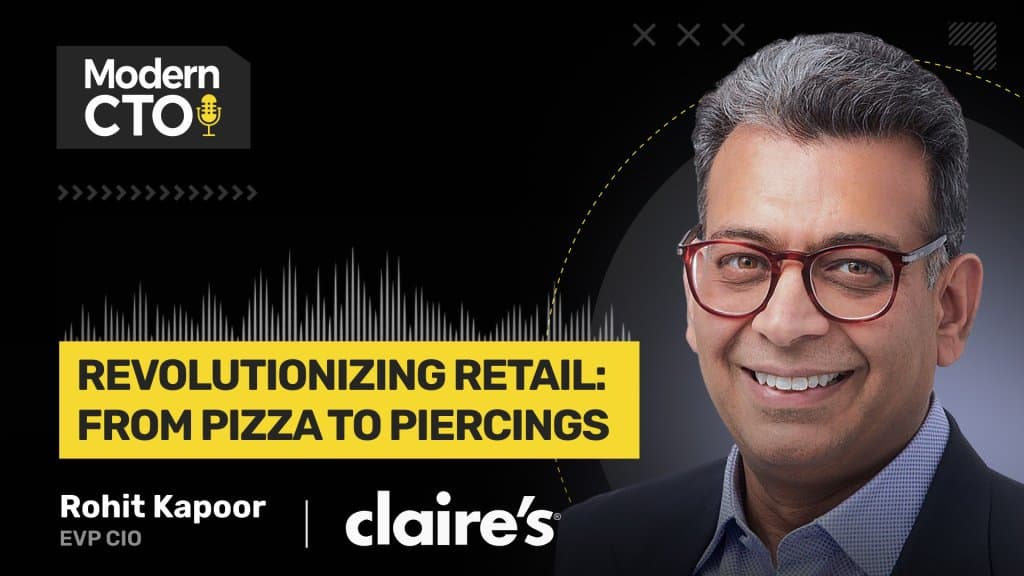
About Rohit Kapoor
Rohit Kapoor is a C-Level technology executive with extensive experience in large retail with global reach. As a game-changing leader Rohit understands current and emerging consumer trends and how to design technology solutions to deliver preemptively the right customer experience, especially in dynamic retail markets. Rohit has, time and again, delivered on this mission throughout his illustrious career. Knowing how speed is critical in consumer space, Rohit has been delivering technology solutions that are implemented in quick order followed by planet-scale deployment.
Currently, Rohit is EVP and CIO at Claire’s, a global retailer of accessories, jewelry, and toys primarily aimed toward tween and teen girls, patterned after his string of transformational successes at the coffee giant Starbucks. At Claire’s Rohit saw a unique opportunity to transforming the retail giant’s customer and associate experience through modernizing merchandizing and supply chain, analytics & AI, infrastructure and ERP products, to rapidly expanding the global footprint.
At Starbucks, Rohit served as a part of US Licensee and Canada BU Leadership teams. He spearheaded modernizing store technology to seamlessly integrate its 6,500 licensee stores with 9,000+ NA stores and transform the digital customer and employee experience. This success is now in scaling with implementation in 2200+ license stores and growing rapidly.
As the Claire’s opportunity presented itself, Rohit foresaw parallels in how he had transformed Starbucks’ legacy technology by revamping how its technology teams handled introducing new technology products and services with a plan to liquidating mounting technical debt. He modernized the technology stack and set up the launch of the coveted rewards programs to Licensee business, which alone have led to multi-millions/Yr. in revenue growth momentum. His leadership in Uber Eats and DoorDash partnerships to drive the delivery business was also a breakthrough.
Previously, at Pizza Hut and its Parent YUM Brands (US, Singapore, and India) in a variety of technology leadership roles, Rohit focused on driving digital sales and providing a major revenue lift, rounding out his global leadership skills.
Throughout, Rohit has been a creative, game-changing, market/customer-focused, and entrepreneurial leader. Working collaboratively with business partners and alliances in complex ecosystems he conceived and built innovative technology products and solutions that quickened business growth, while future-proofing the businesses.
About Claire's
For more than 60 years, Claire’s has opened the door to self-discovery for people of all ages. We’re dedicated to encouraging this through each experience and product discovery. As a global brand powerhouse for self-expression, we’re passionate about our purpose and our people.
Trusted by consumers around the world, our Claire’s and Icing brands deliver immersive experiences through more than 2,300 company-operated Claire’s and Icing stores in North America and Europe, more than 300 Claire’s franchise stores primarily in the Middle East and South Africa, and over thousands of concessions globally across our trusted retail partners.
Behind each consumer experience, is a team of truly inspirational people who show up as they are and encourage others to do the same every day. Supporting our team members as they grow, change and reinvent themselves is how we get stronger and more innovative as an organization, creating an inclusive and diverse culture that inspires us all to dream and achieve.
Transcript
(Intro Narrator at 00:00:00) Today, we're talking to Rohit Kapoor, EVP and CIO at Claire's, about his revolutionary journey in retail. We're listening to Joel Beasley, Modern CTO.
(Joel Beasley at 00:00:16) So when I started evaluating this opportunity, right, when we reached out through chat, I was like, Claire's? What is that? That's the girl store in the mall for my kids that has the jewelry and such. What on earth are they doing? Are they more than just a point of sale system? What's the technology stack at Claire's?
(Rohit Kapoor at 00:00:37) So first of all, I think I should tell you more about who we are. And I would start with, I was still when I was in the interview process, and I have two boys, so I had no idea about the brand and the customer. So I'm a store person. I went with my wife to a few stores.
(Rohit Kapoor at 00:01:03) And I saw one of our, you know, I call, we call them Zalphas, our customers, because half of our customer base is Generation Z, that is 13 to 24 years. And then we have Alphas, which is under 13.
(Joel Beasley at 00:01:19) Mm-hmm.
(Rohit Kapoor at 00:01:19) And she was definitely an Alpha. And she started to talk about her ear piercing, which happened a year ago. And she spoke to our associate, and the way she said was, "Hey, do you know me? You pierced my ears a year ago, and I'm here because I want to do more."
(Rohit Kapoor at 00:01:45) And, you know, I spent a lot of time in retail and F&B until then. That connection of the customer that, look, we have a special bonding because you made me look different than I was. You are helping me self-express, which is the core tenant of our brand, which is such an exciting thing for Claire's. You know? And we're the industry leader in our space.
(Rohit Kapoor at 00:02:14) We've been doing, especially in piercing, for 40-odd years. So I call Claire's a 60-year-old startup. You know? We are in 2,750 stores, 17 countries, 40 different partners. And if you see, just to answer your question, you're getting into the tech stack.
(Rohit Kapoor at 00:02:36) I mean, you think about where the customers want to be, and that's how our journey has been. Our customers wanted us to go to more countries. The customers wanted to be in CPG locations. And we started to expand, and customers wanted to talk to us on the mobile channel, and we opened up our whole e-commerce business. And then we launched Shimmer World, which is a Web 3.0 experience for our customers too.
(Rohit Kapoor at 00:03:05) So we're all over, and it's powered by, of course, a lot of technology, which is a combination of some of our classic technology, you might call it, and some of our new. But it's a powerhouse brand for the customers in the category we are in and have, you know, it's an amazing sort of heritage that the brand has, and it continues to move in the right trajectory when it comes down to managing our customers and giving them the products where they want to be, when they want to be, and how they want to be.
(Joel Beasley at 00:03:41) What's the coolest thing that you're doing there?
(Rohit Kapoor at 00:03:45) The coolest thing is, to me, is going back to the basics. It is so important in retail. And within that, that makes sure every customer that gets into any of our stores, any of our channels, they get the experience they deserve. And then it comes down to the internal customers, which, you know, do I have the data that I need to take decisions? Do I have it on a timely basis?
(Rohit Kapoor at 00:04:24) That's pretty cool if we could make that happen. But essentially, what we're doing is we're looking at how we build the future of our experiences built on a powerhouse of solid data, solid insights, continuing from the great work which has already happened in building some of those foundations. Essentially, our goal is to build those foundations so that we can try out and scale Gen AI for our internal customers who are leveraging information to take decisions. Also, look at how we can power some of our experiences using the same technology and insights.
(Joel Beasley at 00:05:10) So what are you doing with Gen AI within your teams?
(Rohit Kapoor at 00:05:13) It's still in the foundation stages. If you see some of the work which has already started to happen within our marketing team and the content. But essentially, at this stage, what we're doing is getting our foundations in place. So think of organizing our data by domains, which is so critical.
(Rohit Kapoor at 00:05:36) Making sure that we have all good stuff in it, you know, all good content in it. And then we're actively looking at technologies to power the experiences, which can happen pretty fast as soon as we have some of our foundational work in place.
(Joel Beasley at 00:05:54) Does your wife and your boys think that what you do is boring? Like, my wife thinks what I do is so boring.
(Rohit Kapoor at 00:06:03) Yeah. You know what? I think your job is cooler than mine, I can say that. No doubt about it because you talk to so many people. Right?
(Rohit Kapoor at 00:06:13) Here is the fun part where I think I will have an edge. When the work we do translates into an experience for our customers, that becomes cool. And I've seen that happening across my tenure. I mean, it's just, you know, I start from whether it was Yum in India, Asia, or in the U.S., or in Starbucks. It's that smile you see on your customer's faces, and I would add even on your associate's faces, when you do some cool stuff, which may be boring when we build those things, but it's that excitement that you see, as I saw.
(Rohit Kapoor at 00:06:57) You know, just let's talk about the journey which, you know, the customer I saw during my interview process. She would have gone through a very good online scheduling system. She would, or perhaps saw us in TikTok or Instagram, picked up what she wanted to do, and she came in after that whole experience to our store and got through a very great customer experience, which she remembered so well that she wanted to come back and introduce herself and do more transactions with us. That's the cool part of what we do.
(Rohit Kapoor at 00:07:37) And that's the stories we often get to our teams within technology. Just imagine if you're a head of network in our company, or you're a network engineer in our company, or a data engineer. And you hear and you connect those dots on how you're powering the customer journey, it is so powerful for them. This is so powerful. So that's, I can give you so many stories about this.
(Rohit Kapoor at 00:08:06) So, you know, when we at Starbucks, when we launched the mobile experience, the complete experience for our licensees, and, you know, you would often go to a host store, and you would not be able to use the Starbucks app for a long time. And during COVID, there was a good stuff which was happening within the tech team to power that. And then we started, I was actually coming on a plane from Seattle to Chicago, and I heard two of the customers talking to each other, you know, our passengers, and say, "Well, Starbucks has launched this cool stuff. Now I can order through my mobile order and pay, even in the store at the airports."
(Rohit Kapoor at 00:09:07) And I was the person who was deeply involved in it to make that happen. The moment they landed, they put in their order because they knew exactly which gate they were getting in, and they got their coffee. It's so cool to see that one of the products which you were engaged in building is actually making an impact on people's day-to-day life.
(Joel Beasley at 00:09:27) You gotta program a little back door in there so you get some free coffee. Some extra points.
(Rohit Kapoor at 00:09:35) Extra points. Extra points.
(Joel Beasley at 00:09:37) So you did Yum, Yum as in like the food brands?
(Rohit Kapoor at 00:09:45) Yes. Yeah, that was interesting. There was like, when I was just getting into Starbucks, and I came from a delivery background because of Pizza Hut. So one of the things Starbucks had already done was to tie up with Uber Eats to do delivery. It was a new channel.
(Rohit Kapoor at 00:10:03) Again, it goes back to what the customers wanted. You got to be there where the customers want you to be there. And who would imagine delivering coffee? And the cool thing was that they had established the partnership, and the work which was required was how do we build integrations with our environment to make it easy for everyone so that you don't have those several tablets in a store, you know, getting Uber Eats orders and then, you know, disconnected services, you know, or disconnected data. So what we did was we built the whole integration platform with Uber Eats to power that experience, which is cool.
(Rohit Kapoor at 00:10:50) It just happened in a very, very fast way. I think we went to the first store in 90 days, and it just grew over a period of time. Some amazing, amazing stories that came out of it, but it became a huge business as I look at Starbucks now in their earnings, how big their delivery business is. It started small with some powerful ideas from the business side and powered by some great tech that went behind it.
(Joel Beasley at 00:11:22) Well, humans love convenience. Yeah. I mean, my wife got sick last week, and we just pressed some buttons on the cell phone, and our grocery order just came to us. We usually go after church to get the groceries and everything. But we didn't go because she was sick. And on Sunday, she just ordered it. And then within two hours, they had our grocery order there. And I said, wow. This is kinda, and I live out in the country. Like, I live out on a farm. Like, this is unbelievable that this is possible.
(Rohit Kapoor at 00:11:50) I don't remember. This probably happened in, I think, 2018, 2019. But the thing is, when you have great people behind an idea and a purpose, then magic happens. And it was, you know, in this case, it was solid talent from Uber Eats, solid talent from Starbucks coming together across various, you know, domains, I would say, which co-created this experience for the customer, which delivers convenience and comfort. It's solid. It's awesome.
(Joel Beasley at 00:12:34) So we talked a little bit about what you're excited about there. You mentioned, you know, the experience and all of that. Do you have any specific tech projects that you can talk about that you're particularly excited about, like, on a detailed level?
(Rohit Kapoor at 00:12:48) There's a lot of work which is going to happen on the commerce space because we are going to become more composable over a period of time in this year. And it might go beyond that, but, you know, that's probably not worth it at this stage. But our direction, our goal as an organization, and whether it is digital tech, is to build or evolve our tech stack into composable services, which can power experiences wherever the customers want us to have that experience. You know, you probably would have heard this: "I want what I want when I want it."
(Joel Beasley at 00:13:27) Oh, yeah.
(Rohit Kapoor at 00:13:29) And it comes with a platform which can make that happen, which can enable that. And that's where the composable services are going to happen, and which will empower our experiences. And we are already on a path to make that happen. The exciting thing which, while we're doing well, while we plan for all that action to happen sometime this year, is to make sure that we're powering our people with the right, most accurate information and give insights. I mean, that's again very fascinating.
(Rohit Kapoor at 00:14:07) You know? You have observations and you have insights, and you can't run business with observations. And this is where we continue to offer great insights to power some good decisions. And that is one of the big things which we are doing this year.
(Joel Beasley at 00:14:24) I talked to Sephora's CIO or CTO or something of that nature, maybe like two years ago. And they were telling me that they were building these mirrors, which you could go in the store, you could look at, and then you could digitally put eyeliner on you. And it would have that eyeliner in stock, and you could digitally manipulate yourself with the products. Have you guys done anything like that with the piercings or anything?
(Rohit Kapoor at 00:14:48) I don't know of that. Definitely not in the stores. But there's a lot of thought going on from an app point of view to give similar experiences because, you know, everybody is moving to an app now.
(Rohit Kapoor at 00:15:02) And how we can power some of those experiences, it's actively being thought through as we look at our customers and what they're looking for.
(Joel Beasley at 00:15:12) Yeah. I guess jewelry is a little, you guys are mostly jewelry. Right?
(Rohit Kapoor at 00:15:15) Yes. Yeah.
(Joel Beasley at 00:15:16) Because that's something you can hold up to your ear. You can hold it up to whatever. That's not as, like...
(Rohit Kapoor at 00:15:21) Accessories are a big component.
(Joel Beasley at 00:15:23) Yeah. Makeup's more like, it's not something you could try on a bunch of different makeups really quickly, physically, even if they were samples there. Right? Because you have to, like, take it off, put it on. Not a makeup expert, but that's my experience watching my wife take her makeup off. But it's a project. Yeah.
(Rohit Kapoor at 00:15:40) But we are, yes, jewelry is a big part of our business, but we're in beauty. We're in fashion. We're in hair. We are everywhere. And that's the power of this brand. I mean, we will be where our customers want us to be. And that space is, of course, piercing is one of our biggest businesses, and we are the leaders in piercing for 40-odd years now. So which is very powerful.
(Joel Beasley at 00:16:12) So one of the things I was curious about was your world travel. You've been all over. Japan, Korea, U.S., you go everywhere. Why? Or is that just in your nature? Are you just an explorer, or was it purely for work reasons?
(Rohit Kapoor at 00:16:27) So it started with work. I mean, when I started my KFC journey or Yum journey in India, and then I moved to Asia, you know, through work. And my role in Asia was, we were at that time, we were in about 14 countries. We had about 24 franchisees across the three and, during for a certain time, five brands at Yum, because it had A&W, Long John Silver's, if you remember. It just gave me an opportunity to interact with people.
(Rohit Kapoor at 00:17:04) And initially, my role was to give them know-how and get their capabilities built. And very quickly, I realized that it was a two-way street for us. I was learning equally more from them than what I was able to give them. And that was the power of my, you know, my relationships and my engagements with our franchisees. And so I love talking to people.
(Rohit Kapoor at 00:17:39) I love different cultures. I won't say I learned languages. But in tech, essentially, it all comes down to the tech jargons, which we all knew. I don't know Japanese. But one of the best times I had when I was in Asia was with the Japan team.
(Rohit Kapoor at 00:17:55) We went through a complete tech transformation of our KFC Japan business when I was there. And it was so good because we all had the same mission, same purpose, and we had respect for each other. And we had a good goal, and we could co-create some great transformation because of that. Likewise, in Korea, I thought the amount of innovation that happens in the retail space in Korea is, I haven't seen that in a lot of other countries, even, you know, during my Starbucks days. And they do it pretty smartly.
(Rohit Kapoor at 00:18:31) You know, they would do it in a very reasonable, cost-effective way, and they would keep the customer front and center of it. And they have this knack of getting into the root of the problem and taking it and doing it pretty fast. One of the cool things that I saw in Starbucks was they would, in the drive-through, they would read the number plate of the cars and pre-authorize their tire payments and so forth, and they would know your order too. So your journey in drive-through is so fast because a lot of this is pre-authorized, and they would know, you know, who you are just by the number plate of your car.
(Joel Beasley at 00:19:21) That's interesting.
(Rohit Kapoor at 00:19:23) And then, you know, there is, if you look at countries like Indonesia where a lot of people, there's so many people in that country. They're hungry for the foreign brands, and they're the most innovative bunch of people, you know, I met. And they would do cool stuff, you know, whether even building upon a sale in a very quick time frame because it was the need of the hour for them. And when I was in Asia, this is the cool thing, Internet was just becoming something. You know?
(Rohit Kapoor at 00:19:59) And there was no Oracle ATG. There were no hybrids at that time. And this creativity of folks in that business was, we were big on call centers. A lot of our countries took the call center engines and put a web front end and launched their commerce platform, which is cool. And they could do this because of creativity, partnership, ideas, and then hammer them to execution in a very good way.
(Rohit Kapoor at 00:20:37) So I always enjoy because I learn I get a lot of things back from them in terms of there are few things I love about that travel. A, you always find people who are willing to give you more than what you are giving them, which makes you feel that how you can give more back to them. B, they do it with a lot of humility. So, you know, you can see a lot I've seen a lot of people with a lot of pride, but when you have people who have a lot of courage and they still have a lot of humility, it goes a long way. And that is what I saw in my travel.
(Rohit Kapoor at 00:21:25) And then, you know, I see a lot of fearless attitude too because of the situations which they have seen. They have evolved over a period of time in very difficult circumstances in some of those countries, and you get inspired by seeing some of that.
(Joel Beasley at 00:21:44) What are some of the different leadership styles you saw in the different countries?
(Rohit Kapoor at 00:21:48) Let's start with Japan. It's it was a lot top to down. You know? But I saw that I also saw a change in my seven years, you know, there would be leaders who would be inviting their teams knowing that there would be a lot of respect, but still inviting them and giving them permission to speak.
(Rohit Kapoor at 00:22:15) And I thought that was a pivotal moment, you know, in my experience with the Japan was when I saw in those relationships that the leaders were giving them the permission knowing that, you know, our traditional style has been top to down. And that changed the game in terms of how people were looking at problems, how people were looking at solutions. I saw a lot of focus on empowerment, you know, and a lot of commitment in growing people. So and it's infectious once you get into the rhythm. So a lot of collaborative style amongst the peers on how the peer to peer accountability worked in some of those countries, which made their teams much stronger.
(Rohit Kapoor at 00:23:25) And their ability to build teams and trust amongst each other, which is the foundation of every leadership team, I saw that consistently in several countries I visited.
(Joel Beasley at 00:23:41) What were they doing? What was it like specifically?
(Rohit Kapoor at 00:23:45) First was clarity on purpose, on what we all are here for. So that was important. And the second was be straight and honest with each other. You know? When we are having a discussion, just say it. Just say it with respect.
(Rohit Kapoor at 00:24:13) And we were in a relationship which was, you know, we were the franchisor, and I worked a lot with our franchise organization. But you could see that at times that the transparency and the trust which was built through mutual respect and common purpose and good peer to peer accountability. It was good to see that.
(Joel Beasley at 00:24:38) Oh, I'm watching time. I just want to make sure we are good on time. What'd you do at Pizza Hut?
(Rohit Kapoor at 00:24:47) So Pizza Hut was I was the CIO for the Pizza Hut brand in the US. And the way I got in the business was, you know, our pizzahut.com at that time. The site was going down, you know, two Fridays, three weeks before Super Bowl. So, again, that experience was amazing because I didn't know the stack. It was a third party who was doing the work, and how we assembled the team across our teams at Yum and with the vendor and tweak the architecture in a record time and have a record breaking Super Bowl, was one of the amazing experiences.
(Rohit Kapoor at 00:25:41) And it needed change everywhere in the infrastructure. It need also needed science. You know, what is the kind of expectations we have in terms of orders per minute, and are we ready for it? How are we doing the testing of our sites and our stack? How does that stack up? You know, basic fundamentals.
(Joel Beasley at 00:26:04) Are they getting thousands of orders a minute or, like, tens of thousands or hundreds of thousands? How what's the order?
(Rohit Kapoor at 00:26:08) At that time it was, I think, 1,600 orders per minute.
(Joel Beasley at 00:26:14) Whew. That's a lot of pizzas.
(Rohit Kapoor at 00:26:15) Yeah. It, you know, it doesn't happen across the if there's you get, yeah. Of course.
(Joel Beasley at 00:26:21) Specific. I'm not ordering pizza at 6 AM. Yeah.
(Rohit Kapoor at 00:26:23) Because so you got, like, I think it was, it was a certain time before the Super Bowl, actually, when you see it. And then the other interesting thing in that space was during that time, I think people didn't realize how mobile web was becoming a big deal. And while people were still working on the desktop version of the site, there was a small team which was iterating on this mobile web experience. And, suddenly, as we were tracking numbers, we saw a clip that it went more than 50% of our overall web sales through the web. It essentially comes down to, do you have the foundation in place which can take the scale?
(Rohit Kapoor at 00:27:18) Do you have the right stack, you know, on the front end part of it, which you can use to innovate? And do you have the right talent, and you have the right culture empowering that talent to make it happen, and then the magic happens. So, I mean, that was Pizza Hut. And, you know, if you just look at even the Starbucks and just, you know, look at the we're taking the whole digital experience in entirety to the licensees, sparked through it was powered by a small team of innovators, and it happened pretty quickly. You know?
(Rohit Kapoor at 00:27:59) Well, everybody was sitting up in homes during COVID. A lot of engineering work was going on. And I've lost track of how many stores they have expanded, but, you know, it's all when I when I left all the stores at the airports, a lot of Kroger stores, you would have the same experience, which comes down to get to the root of how we can be focused on our customer experience and how tech can power it. And these are some great stories about how it happened.
(Joel Beasley at 00:28:35) Did you get to work with Howard? I wonder what he's like in person.
(Rohit Kapoor at 00:28:40) Look. That brand is awesome. I mean, just think about how it got evolved, the stories. I've read the books. It needed the vision which he had, and I have so much respect for his passion.
(Rohit Kapoor at 00:28:54) His love for the brand is amazing. Seeing him in action, but, you know, the way he thought about it, the way it evolved, it's not easy to have that vision and to deliver it at the scale. It's amazing.
(Joel Beasley at 00:29:09) When you guys are at the leadership team, are things coming up like Kylie Jenner building a billion dollar brand on Instagram with and selling things that compete against your products? Like, do you guys have conversations about the influencers, or is it not big enough on the radar yet to?
(Rohit Kapoor at 00:29:23) We have influencers. Yeah. We have. Oh, cool. And our marketing team is awesome.
(Rohit Kapoor at 00:29:31) Yeah. In terms of their social engagement, we could always do better, but they're always on top of this dial. It's just so critical for our brand and especially our customers. We're all in the forefront of it. And it's such an important part of our business.
(Joel Beasley at 00:29:47) Yeah. I was interested to talk about those areas. Sometimes people don't want to. But I did have a conversation, and it did really well as far as, like, how well the episode performed with a guy named Nathan, who is the CIO or CTO of, uh, of synergy, like, cinemas, like a chain of cinemas. Yeah.
(Joel Beasley at 00:30:07) And I asked him at the beginning of the interview. I was like, hey. So streaming, like, I would much prefer coming directly to my device. Sometimes they dual release. Like, what are you guys thinking and how are you overcoming it?
(Joel Beasley at 00:30:20) And he was just, like, really honest and open and transparent about the whole, like, streaming thing and, like, yeah, it's definitely a threat and, yeah, it's killed market share, but this is how we're adapting. And I thought it was really fascinating. They started doing things like building half cinemas, half, like, activity centers. So there might be bowling inside of it or a restaurant inside of it and doing making these adaptations to the marketplace in order to counter the loss of business from this direct to home streaming services.
(Rohit Kapoor at 00:30:51) You know, I think I listened to that podcast. Oh, you did? Yeah. I was it was great. Look.
(Rohit Kapoor at 00:31:00) This is our as I mentioned, it all starts with our consumer. And, you know, we have, we have a new store experience, which we are launching. We have launched, actually, in Dallas area. Nice. We would continue to this is the brand we are.
(Rohit Kapoor at 00:31:21) I mean, this is the brand you always want to be, listening to your voice of your customer and continue to evolve, and add more components to it as we hear back from the customers on, you know, the experiences that we are launching, testing. And this is just not just the experience even on the products. Right? So that's what we are here for, because our customer is probably one of the, you know, the Zalphas, are the most creative, most savvy, most diverse. And it's so critical for us to just continue to listen to them and respond to them in the form of our products, our experiences, and so forth.
(Rohit Kapoor at 00:32:04) So that's the best part of this job or this organization, this brand, because you're always looking ahead, you know, in terms of experiences.
(Joel Beasley at 00:32:17) What's the experience in Dallas? How is that different from the one in Nashville or another place that I might see, Claire's?
(Rohit Kapoor at 00:32:23) It's, you know, you see less products, different organization, different workflow.
(Joel Beasley at 00:32:30) Okay.
(Rohit Kapoor at 00:32:30) Easy experience and different set of products too to some degree. So if you ask to the associates in our stores, they would say, I have more time for my consumers now or my customers.
(Joel Beasley at 00:32:44) Mhmm.
(Rohit Kapoor at 00:32:44) To, because they have things which are managed with the new design. So it's customers are loving it.
(Joel Beasley at 00:32:55) What is your single best piece of advice for emerging technology leaders?
(Rohit Kapoor at 00:33:01) First of all, get the basics in place. If you don't have the basics in place, everything that you're building on it would fall one day. So whether it when it is data, it's garbage in, garbage out. I can run Gen AI anywhere, but if I have garbage in, it'll throw garbage out. To me, that's get your foundation in place, get your clean data, get your infrastructure in place, have the right investments in technology, which can power you to scale.
(Rohit Kapoor at 00:33:41) Because at the end of the day, every business is gonna grow. A lot of businesses are not able to scale when the demands shoot up. And so make those investments. And last but not least, build a strong team with the right talent, with the great attitude, and a culture which can unleash their capabilities.
(Joel Beasley at 00:34:09) Nailed it. Dude, this is great. We did it. We made a podcast. How do you feel?
(Rohit Kapoor at 00:34:14) I feel we need more time, but, you know, we could, yeah, we could spend more time later.
(Joel Beasley at 00:34:19) Thank you so much for listening. And if you found this episode useful, please share it with a friend or colleague who you think would get value from it. And if you have topics that you would like to hear discussed on the podcast, either add me on LinkedIn or send me an email [email protected]. Every time I get an email or LinkedIn message, it absolutely makes my day and inspires me to keep going.