
Episode 545 ·
Developing Saudi Arabia's megacity: The Line, with Robert Mogielnicki, Senior Resident Scholar at The Arab Gulf States Institute
Today we’re talking to Robert Mogielnicki, Senior Resident Scholar at The Arab Gulf States Institute in Washington; and we discuss the incredible growth of technology in the middle east; the exciting futuristic city in development known as THE LINE; and how this area of the world is using technology to reduce waste and promote sustainable growth.
All of this right here, right now, on the Modern CTO Podcast!
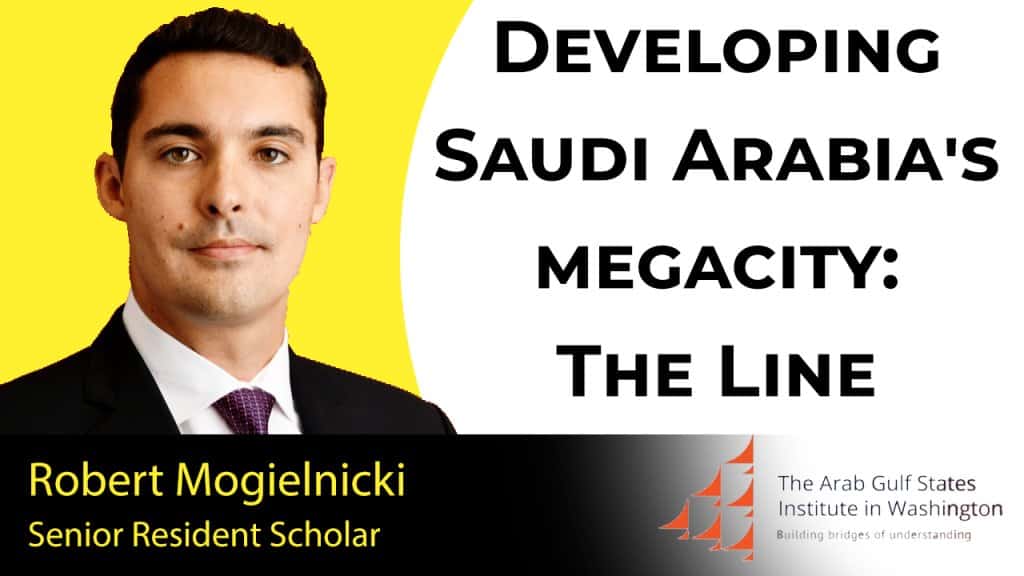
About Robert Mogielnicki:
Dr. Mogielnicki is a political economist focusing on the Middle East and North Africa (MENA) region. He specializes in the political and economic trajectories of Gulf Arab states, China-MENA relations, and regional technology trends. His current professional affiliations span top-tier research institutes, academic institutions, NGOs, and consultancies. Dr. Mogielnicki is the author of A Political Economy of Free Zones in Gulf Arab States(Palgrave Macmillan 2021), and he is currently working on an edited volume about the political economy of sovereign wealth funds in the Middle East and Asia. He is a Term Member with the Council on Foreign Relations and a recipient of the Middle East Policy Council’s 40 Under 40 Award. He holds a DPhil from Magdalen College, University of Oxford.
He combines deep knowledge of the political economy of the Middle East region with strategic communications skills. An Arabic speaker who has worked across the U.S., Europe, the Middle East and North Africa, he excels at leveraging regional knowledge and policy analysis expertise to accomplish clear business outcomes. He is sought after by research-driven organizations and private firms seeking to understand new markets, utilize subject matter expertise, identify regional trends, expand operations, and mitigate risk.
About The Arab Gulf States Institute in Washington (AGSIW):
The Arab Gulf States Institute in Washington (AGSIW) is an independent, nonprofit institution dedicated to highlighting the importance of the relationship between the United States and the Gulf region through free and open exchange of multiple points of view on issues that concern the Gulf.
AGSIW strives to support this goal by:
–Providing expert analysis and thoughtful debate on the economic, energy, environmental, security, social, cultural, and political dimensions of the Gulf Arab states as well as their relations with the United States and other countries.
–Informing a global audience of policymakers, legislators, businesspeople, academics, media, youth, and others as the foundation for strategic decisions regarding this important region.
–Employing multiple avenues to inform public understanding of the importance of the relationship between the United States and the Gulf Arab states.
–Encouraging strong academic coverage by developing scholars who concentrate on the study of the region.
Transcript
(Intro Narrator at 00:00:03) Hello, my friends. Today, we're talking to Robert, senior resident scholar at the Arab Gulf States Institute in Washington, and we discuss the incredible growth of technology in the Middle East, the exciting futuristic city in development known as The Line, and how this area of the world is using technology to reduce waste and promote sustainable growth. All of this right here, right now, on the Modern CTO podcast.
(Joel Beasley at 00:00:36) Here we go. This is the Modern CTO podcast. Tell me about your journey. Where did you start? How did you get here?
(Robert at 00:00:50) Maybe I'll move backwards because in looking backwards, it actually seems to make more sense than moving forward. Well, right now, my full-time job is as a resident scholar at the Arab Gulf States Institute in Washington. And I manage the political economy research at the institute, which essentially means anything to do with numbers comes to my desk. The bread and butter issues are really trade, investment, labor markets, energy. Those tend to be what a lot of our audience is interested in and which fall into the political economy domain.
(Robert at 00:01:28) But I've also created a number of specialties at the institute that I pursue as well, both at the institute and in a number of external affiliations. One is a research initiative called NextGen Gulf, which looks at how technology trends are shaping the region's economy and government. And the second is a China Gulf Initiative, which, as you might suspect from the name, looks at China's involvement in the region. So that's my full-time gig at the institute. The institute pays me every two weeks to think, write, and speak about the Gulf Region, that segment of the Middle East.
(Robert at 00:02:06) But I also teach at Georgetown University and George Washington University as an adjunct professor or professorial lecturer, which is the same, sounds cool, title essentially for a non-full-time tenure track professor. And I advise and consult NGOs, political risk outfits like the Eurasia Group, and government agencies about the Middle East. So I wear many different hats, as many colleagues in the think tank world tend to do, but spend a lot of my time thinking about the Gulf Region, where Saudi Arabia sits in the world and technology trends in the region and how it impacts, in particular, the economies of the region, but also the governments because this is a region that, for better or for worse, is very difficult to separate the economics from the politics and the politics from the economics.
(Joel Beasley at 00:03:01) Are you from Saudi Arabia?
(Robert at 00:03:03) I am not. I grew up just north of Boston in Massachusetts.
(Joel Beasley at 00:03:07) So close.
(Robert at 00:03:09) Yeah. Just a little ways away from Saudi Arabia. But I did tell you that I would work backwards, and I forgot to do so. So that's all what I'm doing now. I guess I got there via the UK and the Middle East.
(Robert at 00:03:25) So working backwards, I got my PhD at the University of Oxford. Also did my master's there and enjoyed it so much, I decided to stay on. While I was a master's student, I started working for a consulting firm that was based in Oxford and the Middle East. And they started sending me out on consulting projects to the Gulf, to Saudi Arabia, to the United Arab Emirates, and to Qatar.
(Robert at 00:03:52) And I started to think, you know, there's really something to this region. For much of my academic career, I had been focused on North Africa because leading up to 2011 and the Arab Spring, North Africa was really where everything was happening. This is where the big protests were happening, democratization, revolutions. There was a lot of interest in places like Egypt, where I lived for about three years, and Tunisia, where I also spent some time. But around 2014 and 2015, the oil prices around the globe just crashed.
(Robert at 00:04:27) And all of a sudden, we started to see new players emerging onto the political scene in the Middle East. Among them was the now Crown Prince of Saudi Arabia's father, King Salman. In 2015, he became king of Saudi Arabia. And, really, that started to initiate some major changes across the region and, at least in my academic and professional world, shifted my attention from North Africa to the Gulf Region. And from then on, I really started to dig into this region both as an academic researcher and then as a professional.
(Robert at 00:05:04) And so far, it's been a very interesting and fun ride.
(Joel Beasley at 00:05:09) So can you define NGO? What's that?
(Robert at 00:05:12) Non-governmental organization.
(Joel Beasley at 00:05:13) Okay. So that's the organization that you're a part of?
(Robert at 00:05:17) I mean, what you'll find here in Washington DC are a number of NGOs. They can work on anything from migrant rights to freedom and transparency to democratization across the globe. So we have a pretty robust network of NGOs here in DC, and a number of them do work on the Middle East and pull in advisors like myself to work on particular projects.
(Joel Beasley at 00:05:42) So what's going on in technology in the Gulf?
(Robert at 00:05:47) Gosh. A lot's going on. Just in Saudi Arabia, I mean, there are three or four big developments that seem to have happened just within the past week in Saudi Arabia, which gives you some indication of the pace of interest in the tech sector, interest in the digital economy, and really the pace of technological change going on in the kingdom and in the broader Middle East. First and foremost, there was a major conference on AI. I think it's called the Global AI Summit that took place in just the middle of September.
(Robert at 00:06:22) So you had, I think, 200 speakers from across the globe descending on Riyadh in the capital of Saudi Arabia to attend this major summit. And this, in many respects, is part and parcel of the Crown Prince Mohammed bin Salman's strategy to position Saudi Arabia as this emerging technology hub, not just within the Middle East, but really in the world as a global hub for technology. So there's this major summit, number one. Number two, the Crown Prince just, I believe, sometime around maybe a couple days before, maybe a couple days after, announced a national gaming and esports strategy for the kingdom. So this is an area that has also generated a tremendous amount of interest across the Middle East, but in particular in Saudi Arabia.
(Robert at 00:07:17) One reason for that is that the country's population is very young. I was, before our conversation today, tried to look up the latest demographics and figures, but we're talking about a country where approximately 60 to 65% of the entire population is under 35. And those figures are from a year or so, a year or two ago. So, you know, it's safe to say more than 60%, somewhere probably between 60 and 70%. That's a significant youth bulge that forms an important constituency for the political leadership of Saudi Arabia.
(Robert at 00:08:00) Now they don't have a formal political system that has a formal mechanism for the leadership to essentially respond to a political constituency of voters like we have here in the US. But there are informal ways that the local population of young Saudis can express their discontent with the way things are going in the country. So there are informal modes of political participation, so to speak, and certainly responsibilities that the leadership has to keep this large segment of the population content and happy with the direction of economic development, the direction of social change and reforms going on in the kingdom. And, you know, to my mind, a focus on gaming and esports is a way to tap into this young constituency. And the third development that happened really just within the past week actually is more on the nitty gritty of economic planning.
(Robert at 00:09:03) The Ministry of Commerce launched a new program or a set of announcements that basically makes it easier for e-stores to operate in the kingdom, which, you know, is not necessarily the sexiest announcement, but it shows that the bureaucracy within Saudi Arabia is committed to pursuing all different avenues of the digital economy and enabling various companies, especially local companies, to really take advantage of the growth of the digital economy going on in the kingdom. So, you know, those are just three announcements that happened recently. We, I suspect, are going to talk more about Neom and the tech focus, the tech-focused components of Neom. And that's something that, as you mentioned before, there's been substantial interest in both within the kingdom and outside of the kingdom.
(Joel Beasley at 00:10:01) So is that a project that Saudi is leading?
(Robert at 00:10:04) Yes. So NEOM is a special economic zone, I would say, is the best way to characterize this project. And just as a quick disclaimer, you'll have to cut me off whenever you get bored of hearing me talk about special economic zones because I published a book last year on special economic zones and free zones in the Gulf. So I've been looking at this topic for many years, longer than any rational, normal human being should look at a topic like this and can talk forever about it. But, essentially, this project was announced by the Crown Prince in 2017.
(Robert at 00:10:50) It was part of a new vision that the Crown Prince put forth for his country that essentially lays out a very ambitious economic and social transformation for the country, which has a lot of potential. It has a lot of natural resources, in particular, hydrocarbon commodities, but it also has been traditionally, it's a very traditional and conservative country. And there were a lot of factors, you know, in many respects holding the kingdom back from exploiting the true commercial potential that many Saudi officials believe that the country has. So Mohammed bin Salman embarks on this very ambitious economic and social transformation project, which he calls Vision 2030. Anyone who is closely following the kingdom will be very familiar with Saudi Vision 2030.
(Robert at 00:11:44) And one of the flagship projects of this Vision 2030 has become NEOM, a special economic zone that in 2017 was marketed as a next-generation special economic zone that would actually not only incorporate territory from the northwestern part of Saudi Arabia, but it would also absorb territory from Egypt and Jordan, two neighboring Middle Eastern countries. Now this got a lot of people in my world and think tank world and academia, and also those of us who look at special economic zones rather interested because we've seen a lot of examples in Latin American countries, in Asia and in Europe of special economic zones being created for various developmental objectives. Usually, they occur within a host country or are marketed as some type of offshore zone, but it's quite rare that they pull in territory from other countries. So this was quite a new concept in many respects. If we fast forward a couple of years, the territorial incorporation from Jordan and Egypt has really fallen by the wayside, and this has now become a fully Saudi project.
(Robert at 00:13:06) And if the Jordanian and Egyptian components have kind of faded away, what they've been replaced with have been extremely ambitious, next-generation, high-tech, environmentally friendly components of a large megaproject that in many respects is an extremely experimental approach to how humans are going to live in the future. There are three key components to NEOM. The first is The Line, which we can talk about in more detail according to your interest. But The Line is essentially, as you can imagine, a linear form of urban development that is supposed to stretch from the Red Sea into the desert. It'll have two parallel, mirrored skyscrapers, essentially, stretching from the sea into the desert.
(Robert at 00:14:07) And then the entire urban structure would be or is supposedly going to be constructed within the space between those two mirrored skyscrapers. I'm a big reader of The Economist, and anyone who reads The Economist will recognize the Neom advertisements that are regularly on the back of The Economist or within The Economist magazine. And the latest advertisements has said that this is going to have the cleanest air found anywhere in the world. So, clearly marketing toward a clientele, I mean, maybe from some parts of Asia and from China that are dealing with significant population demographics and pollution who are looking for clean air. I mean, that's just one segment, I think, of the clientele they're attracting to Neom.
(Robert at 00:15:01) But that's one, that's just one component of The Line. The second component is Trojena, which is marketed as redefining the tourism experience. And from some snazzy videos that we can watch online, apparently, there will be skiing for at least part of the year at Trojena. There are mountains, and occasionally they do get snow in Saudi Arabia, but I do feel it's quite a long shot to market and count on this part of Saudi Arabia being a sustainable ski resort. So that's very experimental, I would say.
(Joel Beasley at 00:15:48) You mean, hold on a second. You mean, economically, a ski resort in the desert is probably not going to work out?
(Robert at 00:15:54) Not only is it not necessarily going to work out, but this is one area wherein we can see some very real contradictions emerging in the different development trajectories and aspirations associated with this project. On the one hand, Saudi planners are trying to be very experimental and ambitious, and, certainly, creating a ski resort in Saudi Arabia falls into that category.
(Joel Beasley at 00:16:26) I mean, aren't they even getting far ahead of themselves? I mean, this was in 2017. Does any part of this exist today? It looks amazing, by the way.
(Robert at 00:16:35) It looks amazing. None of what we see in these promotional videos, as far as I know, have materialized.
(Joel Beasley at 00:16:44) Have they broken ground on it at all?
(Robert at 00:16:47) Yes. As far as we can tell, and because of COVID and the pandemic, it's been more challenging to travel out to the region. I've unfortunately had to rely on, for at least for Saudi Arabia, reports about progress from others and journalists based out of the region who have visited. Very little of the extremely experimental elements of this project have actually materialized. They are very much in the concept stage and trying to move into implementation.
(Robert at 00:17:20) There are a number of hotels, an airport. You have a number of service-oriented development structures in place, a palace for the ruling family, and they spend some of their time in this region of Saudi Arabia. So there are certainly indications that this is an area that is up and coming, so to speak. But, no, what we see online is still very much aspirational. And, you know, I think there are very serious, you know, there's good reason to be critical about, to ask critical questions about what parts of this project are actually going to see the light of day and what might just remain kind of aspirational components or meant, you know, or initiatives to generate media buzz and promotional activities.
(Robert at 00:18:18) But just to get back and conclude this idea of some contradictions, a big part of this project is that everything is going to be environmentally friendly as well. So when you start thinking about trying to create a ski resort in the desert, trying to reconcile that with being one of the most environmentally friendly and sustainable megaprojects that the world has ever seen, it's not hard to imagine that there are some very real contradictions there that Saudi planners, if they're not thinking about right now, certainly are going to have to grapple with in the near future.
(Joel Beasley at 00:18:55) This feels like to me, okay. So in software development, there's a thing called feature creep. Right? Where it's like, okay. You have this idea, and then you have another idea and another idea, and you didn't actually build your first original idea. Right? The features sort of creep up and stack up on you, and then you never really get a whole lot done. And the way that they solve for that is an MVP. Right? Like, minimally viable product.
(Joel Beasley at 00:19:19) So just, like, building one notch of that city and then just with its most basic iteration and then improving it from there, why is nobody trying to do that?
(Robert at 00:19:31) Well, Joel, I mean, that's a great point. And the reality is that is most likely how this project is going to unfold. The Line component that we discussed earlier is going to take place or, apparently, as the reporting tells us, is going to be built in segments. So there'll be kind of chunk after chunk after chunk developed that eventually, if all goes well, it will continue to extend the full length of the planned project. Many observers expect only a small portion of that Line project to actually materialize and to be delivered.
(Robert at 00:20:10) So you'll have a scaled down version of this linear development. Same with the tourism, the redefining tourism, the Trojena segment. Again, you know, I think that there are certainly some very exciting tourism offerings in Saudi Arabia. You have the desert. You have mountains.
(Robert at 00:20:32) You have beautiful coastline. You know, all of those elements present opportunities to exploit, so to speak, for tourism offerings. I'm not so sure that the ski resort will be the strongest foot that they can put forward. The final element here that we'll also have to wait and see if it materializes is called Oxagon, which is a floating industrial city. And, again, this looks great on paper.
(Robert at 00:21:02) It's a very intriguing design. It's an intriguing concept. But not only do the Saudis have to figure out how to make this work from a standpoint of minimizing pollution, making sure that it's eco-friendly and sustainable, making sure that it's functional for business. But here, they're going to actually have to attract investors and business people to come and set up on this floating city. And here, this is in many respects where the Saudis will face significant difficulties because even if the government has the resources to fund this project and to break ground on a floating industrial city, the next big obstacle is actually bringing people in and having them fill up the warehouses and fill up and service tenants, commercial tenants in this city.
(Robert at 00:21:54) So there are many challenges, and you're right to say that thus far, those of us who've been watching this very carefully continue to see and to hear new announcements and new plans. And instead of reported progress on results, there just seem to be more and more plans pushing this project further and further into the future. So eventually, I suspect that foreign investors and the local constituency that I was talking about earlier, Saudi citizens who have a stake in, at the end of the day, the way that the government is spending the financial resources that the country has at its disposal. These local and foreign actors, they're going to want to see some results, and we're not quite there yet. This is a project that is going to take some time, and there is a little bit of leeway and room for the Saudi leadership to still demonstrate results.
(Robert at 00:22:55) But pretty soon, they're going to have to show something for all their efforts.
(Joel Beasley at 00:23:00) It's called, in software, vaporware. So companies will be really good at marketing it, showing it, explaining it, taking pre-orders for it, raising money for it, and then the software never actually happens.
(Robert at 00:23:13) And here's the other angle. I've been saying for some time that the technological component of this project that has emerged really only within the last year or two, it is in many respects a hedge against this project not realizing its full potential. And what I mean by this is early on, the project was all about bringing in Egypt, bringing in Jordan, creating this major special economic zone spanning different countries within the region. That was scaled down. Now it's just about Saudi Arabia.
(Robert at 00:23:45) And then it becomes, well, we're going to have the most high-tech megaproject in the region. And then it's become even narrower to say, we're going to create a way for those residents and investors who share our vision and are willing to join our journey. We're going to create this next generation way of living for those individuals, for those investors, for those companies that come and decide to be part of NEOM. And for me, this is a very, I guess, this makes sense as a strategy to be able to say, you know, looking back and after a year or two from now, if the Saudi planners do not get the foreign investments that they expected and that they anticipated, if they do not get the number of firms to come in to relocate and they don't have the number of residents—I mean, we heard figures of millions of people that they hope over the coming years to relocate to NEOM and be part of this, in their words, this experiment—they can at least say, well, for those who have come, for those who have relocated, they are living this next generation form of living.
(Robert at 00:24:58) They have the best apps at their disposal. They have the most technologically advanced services. They are living, so to speak, in the future. And in some respects, it is a hedge against not fully meeting expectations that can be measured in terms of how many people have located, how much foreign direct investment you have. It's a very nifty safeguard, so to speak.
(Joel Beasley at 00:25:27) Yeah. I mean, look. I want this to exist. I think it looks great. Let's get it done.
(Joel Beasley at 00:25:33) Like, just build that first small version. I mean, even if it's closer, even if you did a variation of it inside of Saudi or really close to where they have other resources in Saudi Arabia, that would be really cool too. But a couple points. The first one is I'm really excited about floating cities. I've gotten to do some interviews on floating cities, and those projects are getting funded and in construction.
(Joel Beasley at 00:25:58) The way I've seen it is they're more pitching it not as industrial. And from my conversations, I'm sure it has different iterations in different parts of the world, right?
(Robert at 00:26:07) Mhmm.
(Joel Beasley at 00:26:07) But in the one that I was speaking to, they were doing some, like, research facilities, and they were specifically going after budget of places that were on the edges of water because of sea level rise. So they're trying to figure out how to connect these floating cities' usability to the fact that sea levels are rising and things like that. But then these pods, for lack of a better term, these floating cities, they would be sort of self-containing on these platforms. And it looked like not even a block, like a city block, and it didn't have everything on it. It had, like, a main building, water processing, the ability to stabilize itself, and all of that.
(Joel Beasley at 00:26:47) I think that would be really cool. So, basically, what they're doing—I'm new to all of this, by the way—what they're doing, it seems, is they're trying to come up with some really cool interesting stuff so that they're relevant on the world stage and that they're advancing technology and that they're bringing people in to grow their country because that's what countries should be doing, right? They should be growing, right?
(Robert at 00:27:06) Yeah. That's absolutely it. And at times at times, the economic development strategy appears, at least to me, to be something akin to throwing a big plate of spaghetti at the wall and seeing how it sticks because we have just seen such an incredible number of various initiatives, announcements. And, you know, it seems that the government has tasked all of the various officials leading these different strategies and initiatives and projects to race at a hundred miles per hour in every different direction. And, you know, on one level, you can say that's crazy.
(Robert at 00:27:42) You can't go a hundred miles an hour in every direction and expect some clear progress. But the strategy seems to be very much, let's try everything that we can and see what works. And along the way, at the very least, we're going to generate a lot of interest and a lot of media buzz, and we're going to try to channel that interest in Saudi Arabia and show audiences from across the world that this is a country that in many respects, especially from an economic and a social perspective, is changing, and it's changing very quickly. So there are very strong feelings about Mohammed bin Salman. He's a very controversial character, the young crown prince of Saudi Arabia.
(Robert at 00:28:24) But one thing that, you know, that very few people, reasoned close observers and informed observers of the country and of the region can deny is that he is extremely committed to this Vision 2030 that he put forth, and he's committed to changing the country's economy and much of its social structure in a way that he thinks is more fit for the twenty-first century and, you know, for many decades to come. This is a young crown prince. He's in his thirties. He's likely to become king very soon. And, you know, if he continues to be healthy, he could be king for many decades and leading this country well into the future.
(Joel Beasley at 00:29:09) And what was his name again?
(Robert at 00:29:11) Mohammed bin Salman. He is the son of King Salman, who is still the head of Saudi Arabia, the king of Saudi Arabia. Mohammed bin Salman is the designated crown prince, and it's expected that at some point in, you know, in the near future, he will become king. His father has been playing less and less of a public role. There are some reports that he's somewhat ill and not of the best health.
(Robert at 00:29:39) So we'll see what happens with a potential political transition. The other thing worth mentioning about Saudi Arabia is this is a country where there's a tremendous amount of economic momentum at the moment. It's going to be one of the fastest growing economies in the world this year, if not the fastest growing economy. And that mainly has to do with the fact that a good chunk of its economy depends on exporting oil and gas resources, in particular, crude oil.
(Robert at 00:30:08) And as we know, oil prices have...
(Joel Beasley at 00:30:12) My oil portfolio is doing pretty well.
(Robert at 00:30:14) That's right. Prices have been rather high over the past year, and that benefits a country like Saudi Arabia and in particular, the government, which derives anywhere ballpark around 75% of its public sector revenues from oil and gas, from the oil and gas sector. So if oil and gas prices are high, the Saudi government's revenues tend to be doing pretty well, and they're going to generate hundreds of billions of dollars. When I say that, I mean, Saudi Arabia's government is going to generate hundreds of billions of dollars this year just from oil and gas exports. And that gives them a lot of money to play with, so to speak.
(Joel Beasley at 00:31:01) I was looking, not preparing for this interview, but like, about three days ago, I follow this guy named Ray Dalio. He's like a very successful international investor person.
(Robert at 00:31:12) Of course.
(Joel Beasley at 00:31:12) And but he had said something. He was talking about these market cycles, and it prompted an interest in me to go look up which countries have the highest, like, debt to GDP ratios. And Saudi Arabia was at the top of the list of having virtually, it was very low. It was in the top ten of the lowest countries in the world because it stood out to me because I go, oh, and my headset, oh, it's probably a lot to do with oil. They have a great important product.
(Robert at 00:31:39) Yeah. For many years, Saudi Arabia has been able to enjoy significant budget surpluses, and the government's been able to, you know, plow those financial resources from budget surpluses back into the economy or into rainy day funds or into development funds, and then to also use those financial resources to fund budgets for the next year. So the country has not had to resort to issuing sovereign debt in a way that we see with many other countries across the globe—U.S., Europe, and many other Middle Eastern countries, by the way, that are not as, you know, that have the same degree of hydrocarbon resources that Saudi Arabia does. So, yeah, I think you're right. The figure is somewhere, when I last looked, it was somewhere just above 30% of GDP because Saudi Arabia's GDP has skyrocketed, you know, over the past year or so because of high oil prices.
(Robert at 00:32:38) Even if the debt doesn't change, if they're not paying down debt with a higher GDP, you're going to see a lower ratio, but that's a very good and healthy place for a country like Saudi Arabia to be. They don't have a debt issue, so to speak. And most of the debt that a country like Saudi Arabia takes out and many of its neighbors as well—Qatar, Abu Dhabi—it's actually just to generate activity in its debt markets. They want to be players. They want to have access to cheap debt.
(Robert at 00:33:07) It's good for the economies, good for banks, it's good for investors. It's good for a lot of reasons. So even in some cases when they wouldn't necessarily need to issue sovereign debt, you will see countries like Saudi Arabia doing that just to keep, you know, activity humming and to keep momentum going in that space. But, yes, it's one of the fastest growing economies in the world. It's low debt to GDP ratio, and the government has a tremendous revenue source at the moment.
(Robert at 00:33:39) That's not going to last forever. We understand that, but oil and gas definitely has, there's more money to be made in oil and gas than...
(Joel Beasley at 00:33:48) Oh, for sure.
(Robert at 00:33:48) ...than many people forecast just a couple of years ago. And the Saudis seem willing to put their money where their mouth is when it comes to NEOM and the government supporting this initiative. They announced that they will create an $80 billion fund that will supposedly help to push forward various aspects of NEOM. So, there are still details that remain to be seen, but as far as we know at the moment, this is going to be called a NEOM fund, and it will have, I guess, the aspirational target is it will have about $80 billion. The takeaway there is there's a lot of government money and capital behind this project.
(Joel Beasley at 00:34:31) Is the U.S. and... are we on good terms with Saudi?
(Robert at 00:34:36) Well, that's a complicated question because there's so many different levels to relations between two countries.
(Joel Beasley at 00:34:43) By the way, just so you know, for me personally, I am not politically smart. Like, I don't spend a lot of time there. My focus is on technology, and sometimes politics come into technology specifically with, like, policy of AI and things like that. But for the most part, I'm a pretty center person. I'm curious to know who in Saudi Arabia is the most important person in technology, like the CTO of Saudi Arabia, and do they speak English?
(Robert at 00:35:13) I can almost assure you that the officials charged with overseeing the technology portfolios definitely speak English. I would have to look up who the latest officials are. There are a number of different departments and ministries that are overseeing various technology initiatives. So you have strategies, you have departments, you have authorities. They created, Saudi Arabia created a Data and AI Authority.
(Robert at 00:35:41) You have ministries as well. I mean, Saudi Arabia doesn't have a Ministry of Artificial Intelligence like their neighbor, the United Arab Emirates, has, but they do have a number of departments and ministries that essentially have similar portfolios. So, I mean, there are a number of different officials. And, yeah, you'd be really testing my knowledge to give you a full rundown of a list of all of them, but I can get back to you on that.
(Joel Beasley at 00:36:08) That'd be great because we've gotten to have, like, the leaders, like, the CTO of the United States and, like, you know, different technology leaders for different countries. I think it'd be cool to have, like, we haven't gotten to go to a talk with another country for a while, so I think it'd be cool to do that with Saudi Arabia or the UAE, right? I think that would be cool.
(Robert at 00:36:28) Yeah. The UAE is, of course, it's a smaller country. I mean, we're talking 10 million people. It's a slightly smaller economy than Saudi Arabia. Population's about 10 million compared to Saudi Arabia's 35 million or a little bit more.
(Robert at 00:36:46) So it's a smaller country, but they've been moving very quickly on the technology front, and they've been doing it for longer than Saudi Arabia has. So they do have a head start, so to speak, in terms of positioning themselves as a regional technology hub. They attract a lot of startups, a lot of entrepreneurs. A lot of tech companies have their headquarters, regional headquarters, in Dubai or Abu Dhabi. Many are in Dubai. And much of what Saudi Arabia is doing in the tech space is to try to leapfrog, so to speak, a number of the technology-oriented initiatives and developments that are taking place in Dubai and transcend the region, so to speak.
(Robert at 00:37:30) And by doing so, transcend the leader in that space at the moment, the UAE, and really market themselves to a global audience of investors and businesses. They're not there yet. There's still a lot of work to be done, but they do have, as I said, they have a bigger population. They have, in many respects, more financial firepower than the United Arab Emirates, and they have a very, very ambitious young crown prince pushing forward this agenda. So the technology domain, whether you're looking at various segments of the technology sector, you're looking at digital economy, digitization as well, transforming government services.
(Robert at 00:38:18) All of these areas are, to my mind, worth betting on. Now I'm not a betting man, but, you know, were I a betting man, I would put my chips behind this area of economic development in Saudi Arabia because it's really recession-proof. Government officials in Saudi Arabia and quite honestly, many other countries in the region, they see investments in technology as a worthwhile venture, whether we're in good economic times or bad economic times. And when the times are good and money's flowing into government coffers, they reinvest that money through their sovereign wealth funds into tech ventures, both local, regional, and international, as a way to essentially future-proof their economies. And when times are bad, you know, during those bad economic times, we see austerity measures across much of the economy.
(Robert at 00:39:15) These governments are still investing in various technological services, platforms, apps because they see technology in a strong, robust digital economy as, in many respects, a way to reduce waste and also to promote sustainable growth, the type of growth that's going to be around for a long time and is in many respects very different from the growth that has been attached to the hydrocarbon sector that's enabled economic development in these countries for many decades. But it has a shelf life. It's not going to be around forever. We're not going to be filling up our cars with gasoline until the end of time.
(Joel Beasley at 00:40:02) Yeah, hopefully. I hope it ends up being some fascinating new technology that we come up with that's, you know, maybe an improvement on nuclear and making that more accessible on a smaller level. But to have an industry that doesn't vastly mature is just not something that happens. Like, technology matures the industries, and then it just goes farther and farther.
(Joel Beasley at 00:40:24) So yeah, I'm looking forward to that, obviously. You know, I've got kids, and so I want the world to be cool for them. Last question. If, let's say, you made Biden upset and he kicked you out of the United States, can't live in the United States anymore, where would you live? Like, what other country would you live in?
(Robert at 00:40:39) Well, my partner, she's from Holland, grew up just outside of Amsterdam.
(Joel Beasley at 00:40:44) Okay.
(Robert at 00:40:45) We also have young children at home, twins. They're going on four months. So I'd probably, we'd probably relocate to Europe. Yeah. Not only because we have a family connection there, but I spent a good amount of my academic career in Europe.
(Robert at 00:41:02) So in England, when it was part of Europe, as a master's student and as a doctoral student, had a great time living in England. In many respects, Europe, it's between the Middle East and the US where I grew up, so it's a nice compromise, so to speak.
(Joel Beasley at 00:41:20) Twins? Come on now. That's tough.
(Robert at 00:41:22) That's right. Yeah. Third generation in a row. I'm a twin. My father's a twin.
(Joel Beasley at 00:41:26) So yeah, we had two for one. Joel, is there anything we didn't cover or anything you wanted me to elaborate on before we go?
(Joel Beasley at 00:41:34) No. Just if, do you have a blog? Do you have a newsletter? Do you have...
(Robert at 00:41:37) Oh, sure.
(Joel Beasley at 00:41:38) Yeah. Yeah.
(Robert at 00:41:39) Well, I would encourage many of the listeners to go on to the Arab Gulf States Institute in Washington, and you can follow a range of topics related to Saudi Arabia and other countries in the Gulf. If you're interested in Next Gen Gulf, which is the research series that I created and oversee, that, as I mentioned earlier in our discussion, focuses on how technology impacts the economies and the governments in this region, then you can find all of the latest publications and events for this initiative and also register to receive updates about that as well. Your listeners are also free to reach out to me. My contact information is easy to find, and I run a Gulf political economy listserv for a few hundred MENA-focused, Middle East and North Africa-focused professional contacts. So yeah, I'm very open to receiving unsolicited inbound requests for those interested in speaking and thinking and talking about the Middle East.
(Joel Beasley at 00:42:40) Thank you so much for listening. And if you found this episode useful, please share it with a friend or colleague who you think would get value from it. And if you have topics that you'd like to hear discussed on the podcast, either add me on LinkedIn or send me an email, [email protected].
(Joel Beasley at 00:42:58) Every time I get an email or LinkedIn message, it absolutely makes my day and inspires me to keep going.