
Episode 767 ·
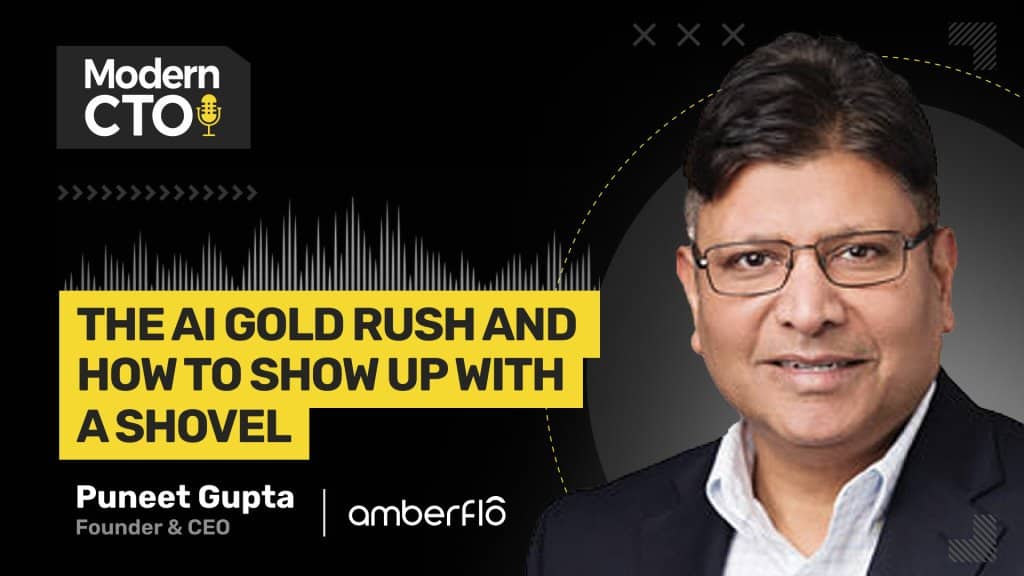
The AI Gold Rush and How to Show Up with a Shovel with Puneet Gupta, Founder & CEO of Amberflo
Today we’re talking to Puneet Gupta, Founder & CEO of Amberflo. Puneet discusses the shift to usage-based pricing driven by generative AI. He explains how Amberflo enables companies to meter AI consumption, construct flexible pricing plans aligned with product usage, and gain real-time visibility into customer billing.
All of this right here, right now, on the Modern CTO Podcast!
To learn more about Amberflo, check out their website here.
Have feedback about the show? Let us know here.
Produced by ProSeries Media.
For booking inquiries, email [email protected]
About Puneet Gupta
Puneet served as a GM at Amazon Web Services (AWS) where his team built and launched two tier-1 services – Amazon CloudSearch and Amazon ElasticSearch. He also served as VP of Product Development at Oracle as part of the founding team to built next generation Oracle Cloud Infrastructure where he led the metering and billing infrastructure teams. Puneet has 25 years of experience bringing new products to market with startups and high growth technology companies. He started his career as a software engineer.
About Amberflo
Usage-Based Pricing and Metered Billing made easy.
We are a developer-friendly, Cloud Metering and Usage-Based Pricing and Billing Platform.
We enable you to design, build and deploy usage-based pricing and business models.
Platform Overview
- Metering Cloud – Full-featured Usage and Cost data ingestion and aggregation.
- Billing Cloud – Usage-Based Plans with on-demand metered invoicing and billing.
- Customer Billing Portal – Real-time usage and billing dashboards.
- Intelligence and Analytics – Actionable insights derived from usage, cost and billing data.
Why businesses choose Amberflo
- Seamless Billing and Invoicing.
- Increase customer sign ups.
- Succeed with Data Driven Business Insights.
- Easy to setup and use. Self-service and API First.
Amberflo Differentiation
- Product Design and Approach – Decoupled Metering Cloud from Billing Cloud. Fully API First.
- The only Self-Service, Pay-as-you-go, full-featured Metering and Billing Cloud.
- Full-featured – Metering and Billing Cloud. Metering at any scale. Billing for any use case.
- Pricing – Usage-Based, fair and transparent pricing.
- Rich Connectors and Integration Framework
Transcript
(Intro Narrator at 00:00:00) Today, we're talking to Puneet Gupta, founder and CEO of Amberflo, about making the most out of the AI gold rush through the power of usage-based billing. You're listening to Joel Beasley, Modern CTO.
(Joel Beasley at 00:00:19) There's about a million questions that I have for you, but I wanted to start with, you know, last year when we were talking, ChatGPT was just starting to emerge. We had that discussion, but we were also talking about what you're doing and innovating with usage-based billing. What's happened in the past year?
(Puneet Gupta at 00:00:37) Wow. You know, Joel, first of all, what exciting times to be in. And yeah, it just, I don't know, it just keeps getting better. I think we're just so lucky. I just feel that we're seeing this in our lifetime, you know. I'll just kind of preface with that. But yeah, just sort of a quick update on our side. Things have been just rock solid. When you and I last chatted, as you said, it's already been about a year. We had just launched. We're enabling businesses to shift to usage-based pricing and billing. We enable them to track usage and then build out flexible, customizable usage-based pricing plans and offer that to their customers.
(Puneet Gupta at 00:01:19) And, you know, this is something... We're coming up on four years into our journey as a startup. We raised money, venture-backed, all that good stuff. But when you and I chatted, we were starting to see signs of—I probably must have talked about that—you know, there was going to be an inflection point where we were leaning in, obviously from our founding thesis, that usage-based pricing, consumptive pricing, is going to become the dominant business model. And so much so that if you asked me, I probably would have said this even to you last time when we met: forget dominant. I mean, it will be the business model. I'm sure there'll be like onesie-twosies, you know, holdouts here and there that are on some custom pricing. But the reason is, that's just how the world works. The world works on consumption. You pay for how much you eat at a restaurant. You don't subscribe to a restaurant. You pay for the miles you fly or that mileage you travel. You pay for the amount of groceries you buy, right? So all the world, all along, has always been usage-based, consumption-based. So subscription has been a little bit of an aberration. Anyways, I'll probably get off track, but yeah, this has been great.
(Puneet Gupta at 00:02:29) And I think one of the things—I'm sure we'll get into what's happened in the last year—our conviction that this is where the world is going to go, usage-based pricing and billing...
(Joel Beasley at 00:02:41) Uh-huh.
(Puneet Gupta at 00:02:41) You know, we've seen a few things, and it came from a certain point of view. But I couldn't have told you two years back that there's going to come around a catalyst in the form of generative AI, LLMs. It's going to light a fire under everybody's product roadmap, and lock, stock, and barrel, people are going to make a beeline shift to incorporate these models into their products and services. And guess what? That is the inflection point of the world moving to usage-based pricing and billing. Right?
(Puneet Gupta at 00:03:12) If you're going to do anything with any form of LLM, generative AI, or even down below, AI/ML, my friend, you're down the path of usage-based pricing and billing. Because those tools are going to charge you on a usage basis, and you are no longer operating in a world where you could just flatline $99 per user per month. That is just not going to work. You're going to have to meter how much of the LLM you're using for which user, for which customer. You're going to have to have real-time optics into that. You're going to have to parlay that into your customer-facing pricing plan and make sure that the two are aligned. And that's how the business is going to go going forward. So that's what's changed.
(Puneet Gupta at 00:03:53) We're seeing the same thing—huge influx. More and more companies are shifting into this model. So things have been great.
(Joel Beasley at 00:04:01) I like it. I've got a lot of thoughts on it. The first one is that it makes the market more efficient. And so when I see your software—I see Amberflo—I said, well, this is great, because we're experiencing the greatest acceleration in market compression in human history right now, which means we're experiencing the greatest shift into consumption-based pricing that we've ever seen before. And I love it.
(Puneet Gupta at 00:04:25) Yep. Hands down. The economic vectors that you outlined, 100% agree. I think that's where the curve goes, right? At some point it sets in. But I would also say, you know, the reason why it goes that way is because it is sort of a proven thesis, right? It's a proven model that that is the only way to sustain it. Whether you call it race to the bottom or anything like that, if anything that's going to keep you afloat, in my view, it is this consumptive usage-based pricing. Not just because—because the flip side of, you know, race to the bottom, nobody wants to be on the race to the bottom, but it's inevitable, as you called out. I think that's just a function of maturity curve, so to speak.
(Puneet Gupta at 00:05:08) But if you are on a consumptive usage-based pricing plan, our view is that it still keeps the innovation window open for you to grab onto, right? And you can still claw your way back in the other direction because you can layer on things, and you are not beholden to set ways and legacy contracts and legacy of customer install base that you can't kind of get out of, because you've had long tenure to these relationships and multi-year contracts that are set in stone. And you want to make and do something, but that sort of becomes the albatross around your neck. Okay? So I would also put this out there for the audience: don't underestimate the operational benefits and optics that come on the backs of usage-based pricing.
(Puneet Gupta at 00:05:59) It always gives you that flexibility and that nimbleness to wiggle out and do something quicker than otherwise.
(Joel Beasley at 00:06:08) Yeah. I think we could use my business as an example. Maybe you tell me how companies are handling this. But at the podcast production company, we've got maybe 20 customers that are in annual contracts paying month to month. We noticed that there's a certain amount of people that we have meetings with where we're not even close to their price range. We don't—and then we found that if we could labor arbitrage with other countries, that we could offer them basically like a watered-down version of the service. But we didn't really want to kill our core business with our big customers. That being said, we understand that there are two different products. So basically, we just had—I could see how companies would have this struggle of how do I introduce usage-based pricing when I have large customers who are already paying these higher rates? How do they actually handle it in practice?
(Puneet Gupta at 00:07:06) Yeah. A couple of things. You know, we see that. You might imagine—and you're not the only ones. I mean, many companies find themselves in that situation.
(Puneet Gupta at 00:07:19) Couple of things I would say, and pardon my analogy, but it comes down to sometimes it's kind of the tail wagging the dog. You've got these large customers, right? And obviously, you worked hard to get them. They are your large contracts. And you don't want to mess with that, right? You want to make sure—you worked hard to get that million-dollar deal or whatever that is, right? But see, here's the thing. I think maybe companies have realized, and I think there's enough data now: at some point, the check is going to come due. Right? Okay. If they're not getting value, fine. You may have had them locked in for a year, two years, even a three-year contract. But after that, you know, it's going to be a struggle. I mean, when time comes to renewal, you know it and they know it. Yeah? And oftentimes, what's happening is, in today's environment, Joel, nobody has a monopoly anymore.
(Puneet Gupta at 00:08:15) Right? As we've talked about last time, a couple of guys in a garage can start just about anything with cloud computing. So there are competing products out there in just about anything. Even if you were so revolutionary, put something out there new, within a couple of weeks—you know, a couple of months, certainly a few months—somebody else is going to have something out there that's either riding on your coattails or copying you, whatever. So there's always choices now for customers, unlike 20 years ago when there were a similar set of vendors and it was hard to kind of come in. Okay. So the checks are going to come due at some point. If you are already getting visibility that they're not using what they signed up for or what they paid into, it is really incumbent upon you as the vendor to do something about it, and do something about it early. Yeah. It doesn't matter. It's not a function—the pricing model is not the one to blame or the one to rest your laurels on. This is fundamentally a value problem. This is an innovation problem. Okay? If the customers are not using as much as what they signed up for, well, kudos to the salesperson who sold it as such, obviously, because they were all incented.
(Puneet Gupta at 00:09:25) But the sooner you come to terms with it, bring something new to the table, dive in, figure out why is it not working. And if those large customers are valuable, focus your energies in trying to deliver value so the usage goes up, number one. And then this is sort of this—what I call—this spiral, sort of the death trap, right? Because you've had that long contract, you are sort of disincentivized to do something different because you got that locked and loaded. Let's say even if you wanted to put out a new feature or maybe even a new product. Well, now how am I going to do it? The other contract doesn't include that. Should I, already midstream, have a conversation? Okay. We have this new product, new feature, Mr. Customer. We'd like for you to use it, but it's going to cost you more. We're going to have to revisit the contract, or we're going to have to do a new contract, or we're going to have to do some grandfathering or whatever. I mean, see, that's the problem with that old school.
(Puneet Gupta at 00:10:10) Now contrast that with the playbook that AWS pioneered. They knew that they were just going to continue to innovate. We are in an innovation cycle. You know, we've got to continue to bring out new features, new products. So they just opened up the door on a unit-based pricing. Like, Amazon does not offer a starter plan, an enterprise plan, a progression plan. You pay for what you use. Everything is a line-item basis, right? Come three months into the contract, and that's totally fine. So here's the long-term customer contract. Somebody pays AWS $100,000 upfront, right? They start using any number of services. All those services are usage-based priced.
(Puneet Gupta at 00:11:06) Three months down the road into that $100,000 contract, Amazon, or for that matter any other company that's following this model, launches a new product or a new feature that they want to monetize on that's charge-worthy. You simply add it to the catalog. Customer has a choice whether they want to use it or not. If it's of value, they'll use it. No change to the existing contract. The moment they start using it, they start paying for it. So you decouple the internal thinking from, "Oh my God, how many customers with fixed contract? Do we do this?" You know, there's going to have to be back-office operations teams. They're going to have to manage these contracts. We're going to have to redo these contracts, reset, renewal, all that stuff—totally out the window, right? So that is the power of this model. And you can still have it. It doesn't mean everything has to be pay-as-you-go at the end of the month, right? People want visibility, budgeting, all that stuff. So we do it all the time too with Amberflo with our customers. We have usage-based pricing, but we invite customers to pay money upfront for 12 months.
(Puneet Gupta at 00:12:07) Okay? And we say, great. Look. You've given us money upfront. We'll give you a discount on the backs of that. But we're still going to meter your usage. What do you actually use month over month? And then draw down against your prepaid, right? And if the prepaid depletes before 12 months, then we give you the option to renew or uplevel it, right? And in the meantime, if we launch any new feature products, we don't need to go revisit the contract. If you start using it and you start paying for it, it will just continue to draw down from that upfront money.
(Joel Beasley at 00:12:43) Interesting. Does your software allow the ability to—like, I'm always a little selfish on these calls. If I wanted to go in there, like, could I log into your software and set this stuff up and then have my clients actually be logging into your software and using it? Or do I have to manage my own system?
(Puneet Gupta at 00:13:05) 100%. Yeah. That is—and the questions you're asking, these are the questions we encounter all the time, right? And people would be a little bit scared to kind of lean in because, you know, no question about it, delivering usage-based pricing and billing, operating a business on the backs of that, it is a little bit of a heavier lift, no question about it, compared to just a standard $99 per user per month. Short answer to your question: 100%. So you, of course, can—everything that I described, you have flexibility. You can offer these prepaid models. You can also run in parallel with a pay-as-you-go model, okay? And Amberflo provides you real-time dashboards. We call it a customer billing portal, where you can expose this to your customers. In real time, they can log in and at any time see how much they have consumed on a month-on-month basis, actually on a daily basis. And if they have engaged with you on a prepaid model, they know exactly what's remaining, how much they've consumed, when it is coming up for true-up, and so forth.
(Joel Beasley at 00:14:10) That's so interesting. Okay. Sorry. Enough about my production stuff. I just—I had to ask because I looked at your website last year, and I looked at it again. It's changed entirely. You have done so much. I don't know if you talk publicly about your revenue growth or customer growth, but do you have any cool stats to report on growth over the past year?
(Puneet Gupta at 00:14:32) Growth's been amazing. Like I said, a lot of it is just driven by the fact that the world is shifting in this direction. I think in terms of what can I say—I think it's multi-hundred-percent growth, which is kind of typical for a startup that is finding product-market fit and going in that direction. So if you just even look at the logos that we have on our website, we now have public companies that are trusting us with their metering, pricing, and billing and rating engine.
(Puneet Gupta at 00:15:01) So we are SOC 2 Type 2 compliant. Companies like PTC, Equinix, are running their workloads on Amberflo. Our scale continues to increase. We'll be actually publishing some more stats and numbers over the next few months. We're actually going to go with another revamp on the website, I think. And my plan is to also perhaps go back second half of this year for another funding round to meet the scale and growth that we're seeing.
(Joel Beasley at 00:15:30) So what are you seeing as far as the coolest use of monetization with generative AI?
(Puneet Gupta at 00:15:37) There are some verticals or sort of segments, I think, that are starting to emerge that are perhaps on the leading edge. But, you know, and I think as you and I talked about last year, very little was clear. Okay. What does this even mean? How is it even done? I think that things have moved forward in a very meaningful way. And so just, you know, taking a step back, just as a technologist, I think it's going to ripple through everything. Okay? I know there's still some, perhaps, some doubts here and there. Okay.
(Puneet Gupta at 00:16:08) What does it look like? But, you know, that has always been the case till it happens. But I think this is one of those phenomena. There's no turning back. It is just going to impact and ripple through just about everything that we touch, engage, work with on a daily basis.
(Puneet Gupta at 00:16:23) Okay. What we are seeing, you know, from our side, companies who are the first to kind of come knock on our doors or the use cases, I think particularly with respect to GenAI, ChatGPT type, you know, LLMs. One of the concentrations that we're seeing, companies that are sort of the first to market are in customer engagement space. Right? So CRM support software, customer support interaction. Give me some example, you know, so classic customer support, help desk support site, but also, you know, and sort of within that different vertical use cases.
(Puneet Gupta at 00:17:06) For example, you know, what we're doing right now, online conversations, web meetings, transcription of that, summarization of that, next sort of, you know, step follow through. There have been a bunch of tools in this area. A lot of them have leaned in to leverage LLMs to be more effective, to be more precise, to uplevel that whole user experience. Right? So there are a few that we're working with, just to give you further detail on how this is playing out and what is the need and where we fit in. AmberFlow's right in the middle in this whole GenAI LLM wave. Okay?
(Puneet Gupta at 00:17:40) So this company, that scenario that I just described, right, let's say a web meeting. So they are using, for example, let's say, an LLM, ChatGPT, where they take the transcript, send it to ChatGPT. ChatGPT does all kinds of magic in terms of summarizing the transcript, and then more importantly, sort of, okay, what might be the next steps and all kinds of things. Right? And then they have their own sort of learning models that sit on top of ChatGPT. Okay? So that is their back-end infrastructure. Now guess what?
(Puneet Gupta at 00:18:15) First things first, they need to track how much of LLM is being used. As we just talked about earlier, by which user, you know, which transcript cost them how much by user, by customer. Okay. So metering is the starting point. And our tool provides them not just metering for LLM by user by customer, but they can also put in what the LLM is charging them.
(Puneet Gupta at 00:18:53) And, you know, as you might imagine, Joel, if you look at, for example, like, ChatGPT charges on input, output tokens. Different LLMs have different charge vectors. They're constantly changing. Number two, they have different versions, so each version has a different price point. Yeah.
(Puneet Gupta at 00:19:10) So our customer can model all of that into AmberFlow and have a full real-time view of what is being spent by that customer on LLM, what the LLM is charging them by their customer, their user. Yeah. So now that I have this, you can imagine this company that's doing web meeting transcription summarization. They're not charging on an input, output, or token basis. Right?
(Puneet Gupta at 00:19:42) Their model is per hour charge, how many hours of recording you have. So they have to parlay, you know, the back-end, they have this cost structure which is in the form of input, output tokens. But me, my products and services, I project that in the form of number of recording hours that I'm going to sell, and I have different types of recording hours. Okay? So we enable them to construct what we call these custom or simplified pricing plans that they want to expose to their customers that are aligned with their product and use case.
(Puneet Gupta at 00:20:18) So then they can present to their customers, as you and I just talked about, on-demand metered invoicing and billing, give them the options to pay upfront or do pay-as-you-go or commit or true up or whatever they have. So we provide all of that. And now they have a full platform, monetization platform, and ecosystem where the alignment is there, the dots connect. So from the time the user starts to consume their product, they have full visibility into how much they have to charge them and how much this customer ended up costing them on the LLM use. Yeah.
(Puneet Gupta at 00:20:49) So this is a huge, um, you know, this is, I think just scratching the surface. Right? You can imagine if you agree that LLMs are going to embed themselves in just about every interaction, every software that we use. This is what the model is going to be. So we're leaning heavily into this, and you'll see more from us coming in this direction, because we are the only ones that can do both, not just customer-facing pricing, but also cost tracking and cost-based pricing.
(Joel Beasley at 00:21:24) Yeah. It's pretty cool because you're typically building it in a spreadsheet, and then you kind of deploy it in the wild. But the idea that you have a dashboard to watch it play out and it can be so detailed is actually pretty fascinating, especially as the LLMs, what I am seeing happen, if I were guessing the future, is the LLMs are going to start doing business with each other. So I'm going to have, like, an, I'm going to have an LLM that I am using that's going to help me delegate out things that need to get done, and those other LLMs it's delegating to have specialties. I think it's going to be just like humans.
(Joel Beasley at 00:22:06) It's just like humans. It's just human intelligence, but just happening there. And the reason why it's cool in your sense is these LLMs will be able to interact and do business with each other and charge and have the appropriate models because they have, you know, a system like AmberFlow behind them that can do all of that. It can know that it's going to delegate this task to this LLM and what the cost will be. Yeah.
(Puneet Gupta at 00:22:31) Yeah. 100%. You know, there was already some beginnings or narrative even before the LLMs showed up on the scene, if you might recall. You know, people have started to talk about sort of this API economy. I don't know if that, you know, right, or microservices, API economy.
(Puneet Gupta at 00:22:51) Everything was starting to become more like a marketplace. Systems and systems were interacting with each other, right, through marketplaces. We kind of seen that even before LLMs. Like I said, you know, sort of I would say the first batch or the second batch of mobile apps that came. Right?
(Puneet Gupta at 00:23:04) I mean, if you think about Uber, I'm always intrigued by the fact that, you know, here's a company that really didn't invent anything. And I'm not, I don't mean to decry them, but, like, what I mean by that is, you know, they leveraged on somebody else's maps infrastructure that was already built. Right? They leveraged on, they didn't build automobiles. They didn't build mapping software.
(Puneet Gupta at 00:23:24) They didn't build tracking software. They didn't build mobile software or phones or anything like that. Right? The ecosystem existed. They leveraged it in a unique and innovative way to deliver such a profound value.
(Puneet Gupta at 00:23:37) Right? But if you think about it behind the scenes, it's basically an API economy. They're using APIs for those. They're using APIs, you know, for maps. They're using, you know, mobile Android or, you know, iPhone, all that kind of stuff.
(Puneet Gupta at 00:23:47) So things are kind of, you know, going in that direction where systems were interacting with each other. And there was, you know, on the basis of APIs, monetizations were being sort of settled, but it hadn't quite exploded on the scene. And, yeah, like you just said, you know, with LLMs, I think it's going to go 100x, thousand x.
(Joel Beasley at 00:24:07) I read your article on the generative AI monetization platform, and there was a quote there from you that said, don't show up to the gold rush without a shovel. What do you mean by that?
(Puneet Gupta at 00:24:18) Yeah. Don't show up to the gold rush without a shovel. I think, you know, that, by the way, just generally just popped into my head one day, you know, because everybody is making a rush into, right, as I said, I can't imagine there's a company out there, doesn't even have to be anymore like a software or technology company, everybody's gotten in a room with a product team, engineering team, and said, hey, what does LLM mean to us? What does it mean to our products and services? K?
(Puneet Gupta at 00:24:44) So that's sort of what I refer to as the gold rush, okay? And when I say don't show up without a shovel, and I've seen it, you know, you and I have been around, or I've been around, you know, long enough that it is sort of this last mile, right, that you might overlook, where don't punt the how are you going to monetize it? What is your business model? Once you bring LLM into your products and services, yes, that is definitely the starting point and that is a big lift, but you're not going to come full circle till you figure out how to effectively monetize it and put it on some kind of a virtuous cycle. Okay?
(Puneet Gupta at 00:25:26) And what we have been talking about is that earlier you bring that thinking into the equation and not use the traditional world of punting it to some back office team once the product is done, that's going to be flawed. You're not going to solve this. It has to be just as well in that same conversation when you got in the room to decide what you want to do about the LLMs, you also have to start thinking about, what does it do to how do I monetize this? What is my current pricing plan?
(Puneet Gupta at 00:25:54) How does that impact that? Because as we just talked about, it's going to be in the product. You're going to have to do some of the instrumentation in the product. It's product and engineering led. So that's what what I mean by, you know, don't forget the shovels because, you know, while you may show up and you're in that race, but, you know, it's the shovels that are actually going to make you do something and make it meaningful, which is the monetization.
(Joel Beasley at 00:26:16) What will the ghost towns end up being in the gold rush analogy?
(Puneet Gupta at 00:26:21) I think this one may be slightly different, Joel. You know, I think, I think, you know, this is, this may be one of those, sort of the one flew over the cuckoo's nest. I mean, this is where if people get it right, I think this is the profound change. I think anybody, so I was, okay. The ghost town would be the ones who don't, I think it'll really be, you have to take it on the chin. Like, it'll be your doing. It's not that, you know, the technology wasn't there or you could not have done it. I think if you didn't do it or didn't work out for you, it's you probably misfired somewhere, you know. You you didn't connect the dots the right way.
(Puneet Gupta at 00:27:05) So that's what I would say. But I won't say that, you know, okay, maybe it doesn't apply here or it may be this vertical here that, you know, finds itself, if they tried, but, you know, it was really not, never meant for them. I don't think so. I think this is going to be everywhere. I mean, yeah.
(Joel Beasley at 00:27:20) Yeah. There's people that stick their head in the sand and, or their experience of it is I heard someone talking about it, so I went on GPT and talked to it for 30 seconds, and then they dismiss it as, oh, no. But what they're missing is this idea that what it is is it's intelligence. At whatever maturity level you want to argue, everyone can agree it's intelligent. ChatGPT is smarter than a lot of people I know, right?
(Joel Beasley at 00:27:44) And it can process things and remember things. It's quite brilliant technology. And so you say, okay, we've got this infant level technology that is amazing. You just fast forward 10 years, it's not hard to see that it's going to be integrated into every single aspect of our daily lives because what it is is intelligence. It's just intelligence and it's really useful and it's giving more people more opportunity.
(Joel Beasley at 00:28:10) Because before, if I wanted to run a business off an idea off of a biologist, I would have to go out there and network, validate, figure out all these biologists. Now I can bounce it off. I could say, hey. Act like these three authors in this space and then answer this question, and I can get that first set of research done. And I can do it basically for free.
(Joel Beasley at 00:28:30) That's unheard of. Right? Like, back in the 1900s, you'd have to, to fly these people into a location to talk to them. Right? It was crazy.
(Joel Beasley at 00:28:42) So it's just made this more accessible to everybody.
(Puneet Gupta at 00:28:45) Yeah. You know, totally. And I think so that is sort of the great leveler, so to speak. Right? And then so I think I just, you know, then back to, you know, who may, who may falter and, you know, who may not.
(Puneet Gupta at 00:28:58) I think it'll become a function of, and we're now starting to see, you know, I sort of look at it in building blocks, a sort of analogy. So the base, which is the broadest, as you said, you know, it's just raw intelligence. Right? And that is going to continuously get better and better. So it's going to, right out of the gate, give you a lot more, as you said, you know, than traditionally it would have, and that bar is going to continue to move up.
(Puneet Gupta at 00:29:25) However, I think just as well, and we can kind of chalk this up to just the overall industrial maturation phase where the next building block on top would be your domain knowledge or your knowledge that you gather. And back to this example that I gave you of all the meetings that you have recorded. Okay? Taking that and layering that on top of the underlying raw intelligence model and make it that much more specific to your use case. I think so.
(Puneet Gupta at 00:29:58) We're going to see.
(Joel Beasley at 00:29:59) There's companies doing that too. They approached me, and they said what they'll do is they'll take all of your past interviews, turn it into this bot, and then people can talk to it, and it'll reference. You ask it a question, like, oh, the CIO of IBM answered that here, and then the AmberFlow CEO answered that here, and it'll just give you the time codes. And it's quite fascinating what they're able to do.
(Puneet Gupta at 00:30:20) Yep. Then only you can provide that. Right? So there, that becomes your value add. Yep.
(Puneet Gupta at 00:30:25) Well, you know, anybody can go to ChatGPT and ask anything about anybody, but, right, your set of recordings, that's your material, that layered on top of the underlying LLM, your interface will be able to provide sort of that next level of, you know, maybe somebody, as you said, can interact and ask questions beneath that. Right? AmberFlow, or the CEO of IBM, or where, you know, folks have showed up on your show. So I think that's sort of where it's headed in that direction.
(Joel Beasley at 00:30:53) Oh, yeah. Yep. I had a, I have a friend named Christopher who's doing that. He has a top podcast for chief learning officers, CLOs, and and he's doing that over there, and it's been quite fascinating to watch.
(Puneet Gupta at 00:31:08) Wow. Cool.
(Joel Beasley at 00:31:09) Yeah. The technology is pretty good. Yeah. So I'm a sucker for technology. Been building it my whole life.
(Puneet Gupta at 00:31:15) Yeah. Totally.
(Joel Beasley at 00:31:17) Yeah. So how are you, let's talk, let's step a little bit back away from AmberFlow. I'm just curious. How do you feel about how AI is changing humanity?
(Puneet Gupta at 00:31:30) Yeah. Some of it just kind of goes back a little bit to, I mean, what can I say? You know, I've been a technologist at heart, you know, for me, like I, I became in tune with technology early in my life, you know, dots connected for me, so I've always leaned in. And, you know, just somebody looking at glass half full, glass half empty, I'm always looking at glass half full when it comes to technology. Now I think we are sort of in this era where something as profound as this, right, that we've never had an experience, something so profound in just a short amount of time, and getting compounded in, you know, in the ways that we've just not seen.
(Puneet Gupta at 00:32:14) Okay? So there's that element of it, but I think, you know, if anything, if you have, if you have seen some technology curves before, I think at least that gives me the confidence that things will, things will settle out. Like, you know, so I'm, I'm, I just want to say this the long way. I'm not scared by it. You know, we hear some, some scary things about where this could go and how it can be.
(Puneet Gupta at 00:32:46) I think, yes, perhaps the scale might be different from what we've seen, but there's going to be bad actors always in anything. This is going to be no different. Could they do disproportionately more damage than other bad actors in other domains? Yes, potentially. But guess what?
(Puneet Gupta at 00:33:02) The flip side is also true. So far we've been able to protect, and there's a good balance here. The bad actors continue to move forward, but the good actors are always able to sort of keep them down. So I think we're gonna be in that realm because if the bad actors have better tools, the good actors also have better tools to keep them at bay.
(Puneet Gupta at 00:33:20) So that's sort of how I look at it, just very broad themes. With respect to impact on humanity, like you said, I'll look at the glass half full, Joel. I think it's gonna be for the better. I think we are going to see things change in a more rapid manner than we have seen in the past, where the technology curve has been a little bit long and drawn out. I think here it's gonna be a little bit faster.
(Puneet Gupta at 00:33:43) So I think the disruption is gonna be perhaps a little bit more accelerated, but just as well, I think new opportunities are gonna come, new venues are gonna open up. I think one thing people overlook, and maybe that's just human nature. You know, this job over here is gonna get eliminated, or this job over here is gonna get eliminated, or this domain altogether. But I always believe that there's gonna be a whole bunch of new domains that are gonna land.
(Puneet Gupta at 00:34:05) They're gonna be created. Right? And yes—
(Joel Beasley at 00:34:08) Me too.
(Puneet Gupta at 00:34:09) Yeah. And, you know, of those new domains, fine. Maybe 60% of that will be automated through ChatGPT or LLMs or whatnot, but there's gonna be still net new job growth opportunities, things that are gonna be created. Right? So yes, there will be a shift, but I think it'll be for the positive, hence so.
(Joel Beasley at 00:34:31) Yeah. The only—so I'm an optimist too, by the way, when it comes to this. I've thought about it a lot. I've gone through the whole acceptance-rejection curve, like the whole mourning situation. But yeah, look, the markets are gonna compress faster than they've ever compressed before, which means we're gonna have some sort of—we're gonna need to develop some type of response to where if we wake up tomorrow and an entire industry is consolidated by, let's say, 80%, that we somehow reallocate those people quickly or we find some economic way to handle it so that things don't crumble. I think that's just a problem to be solved, right, when it does happen. So yeah, I think markets are gonna consolidate.
(Joel Beasley at 00:35:15) They're gonna consolidate faster than they ever have before. Lots of people will lose their jobs. At the same time, lots of new jobs will come on. And our thing that we're gonna have to get good at as a society is how to handle the reallocation of talent. And once we figure that out, how do we bridge people as they reallocate?
(Joel Beasley at 00:35:32) How do we get them to reallocate? How do we do that as a people? I think that's gonna be one of the big things that we face. And to your point earlier about the good guys and the bad guys, as I've gotten older and grown and have three kids and a family and all of that, life more and more and more seems like that yin and that yang, that good versus evil. And it's like, there's a force of good.
(Joel Beasley at 00:35:54) I think one day we'll be able to prove it with science. But today I believe with faith that there is a force of good and there is a force of evil and they are at each other. And I believe that good wins. I'm not like—have you ever watched Russian cinema? They all end sad. My friend Alex was showing me this. I was like, dude, these are the worst movies in the world. Look, I'm an optimist and good.
(Joel Beasley at 00:36:23) It's supposed to be really cold over there in Russia, so.
(Puneet Gupta at 00:36:27) True. That's true. You know, Joel? Yeah.
(Puneet Gupta at 00:36:30) I think we're gonna see some change. It's gonna—I think just like any new thing, there's gonna be a period that we're gonna have to navigate, but I think it's gonna all end up in a better place.
(Joel Beasley at 00:36:44) 100%. 100%. People wanna learn more about Amberflo, where do they go?
(Puneet Gupta at 00:36:51) Please, yeah. Visit our website, www.amberflo.io, or reach out to me, [email protected].
(Joel Beasley at 00:36:59) And what type of talent are you looking for? Are you growing your team at all?
(Puneet Gupta at 00:37:02) We are. Actually, we're pretty well situated. We're still pretty much an R&D engineering team, but obviously looking for smart backend engineers. But more recently, making a huge push now into go-to-market. So on the marketing side, head of marketing, product managers, product marketing managers. Anybody out there listening, yeah, please reach out to me.
(Puneet Gupta at 00:37:24) We're ready to go.
(Joel Beasley at 00:37:25) Awesome. Yeah. Lots of people that are trying to grow in their career and taking that next step are the ones who listen. So in that tone, what's the best piece of advice you have for technologists that are trying to level up in their career?
(Puneet Gupta at 00:37:41) I think, you know, go out there, walk an inch taller. I know it's easier said than done, but when I say that is, things are yet again sort of in this renaissance. You know, lean in, lean into this new technology set, learn a new skill, brush up, update your resume. Like I said right at the outset, I mean, if you're a technologist, man, there's gotta be one of the best moments and best times we're living. And, you know, zero in. Go hang out at meetups.
(Puneet Gupta at 00:38:11) There's never been a time like this where everybody's talking technology. How do I leverage this? How do I leverage that? Have a voice, sit in, be part of something, and you'll get picked up. As simple as that.
(Joel Beasley at 00:38:23) Nailed it. Are you a dad?
(Puneet Gupta at 00:38:27) I am. My older one, he is now a junior at Cal, at Berkeley. I like to say I got one through the ringer. He was doing computer science. And the younger one, he's a sophomore in high school.
(Joel Beasley at 00:38:43) What is the younger one into technology-wise?
(Puneet Gupta at 00:38:47) Yeah. You know, so as you might imagine, we're a technologist's house. Good thing is, I mean, there's some sanity in the house. My wife is not from tech. So, you know, back to this yin and yang.
(Puneet Gupta at 00:38:56) Okay. So that's what it'll be. But the younger one also—I mean, he's just, you know, just any parent would know how kids are very different from each other even though grown up in the same household. But no, he's just one of those ones who sets his mind to it. So he's also technology bent.
(Puneet Gupta at 00:39:12) You know, back in COVID, he built this project. This was even in middle school, where, you know, he built a Python software that could detect a mask on somebody's face as they were entering a door, just through random stuff, pulling different libraries, and I don't know how he even pulled that off. But outside of that, you know, he's big with the speech and debate. He's part of the speech and debate club inside the school.
(Joel Beasley at 00:39:39) Oh, nice. What technology is he spending—like, when he's in your house still because he's in high school, what do you see him on all the time?
(Puneet Gupta at 00:39:48) No, he's, you know, from that regard—
(Joel Beasley at 00:39:50) You can't say Amberflo. You can't say he hangs out on Amberflo all day, just admiring the billing.
(Puneet Gupta at 00:39:56) He's just—I see him playing games with his friends late into the night. So yeah, all kinds of stuff.
(Joel Beasley at 00:40:05) Childhood's still childhood. That's good.
(Puneet Gupta at 00:40:07) So, you know, I don't pull him back for that because I believe you gotta have the childhood play out, you know. So yeah.
(Joel Beasley at 00:40:15) Our kids are younger. They're two, five, and seven.
(Puneet Gupta at 00:40:21) Okay.
(Joel Beasley at 00:40:21) And the five and the seven-year-old, a boy and a girl, they're both into playing Roblox. So they got two tablets.
(Puneet Gupta at 00:40:28) They'll—
(Joel Beasley at 00:40:29) Both be on—we limit their Roblox time. Yeah. But they'll both be in the same world and go around and play with each other in the same world. And they really enjoy that game.
(Puneet Gupta at 00:40:39) Yeah. You know, that's so cool. I could see my younger one, you know, he's what I call the iPhone generation. Right? So when he—
(Joel Beasley at 00:40:47) Mhmm.
(Puneet Gupta at 00:40:48) Worn iPads and iPhones already around. My first one kind of missed that, you know, just literally by a few years. So I can even see a little bit of distinction. They, the younger ones, just totally—their life is all around all these devices.
(Joel Beasley at 00:41:01) Well, any other questions for me? Are you ready to wrap up?
(Puneet Gupta at 00:41:05) I think we're good, Joel. Yeah. This has been great.
(Joel Beasley at 00:41:08) Awesome. Well, I look forward to our next conversation, my friend.
(Puneet Gupta at 00:41:11) Yeah. Likewise, Joel. Super cool. Always exciting to be back with you.
(Joel Beasley at 00:41:15) Alright. See you, buddy.
(Puneet Gupta at 00:41:16) Alright. Take care, Joel.
(Joel Beasley at 00:41:17) Thank you so much for listening. And if you found this episode useful, please share it with a friend or colleague who you think would get value from it. And if you have topics that you'd like to hear discussed on the podcast, either add me on LinkedIn, or send me an email, [email protected]. Every time I get an email or LinkedIn message, it absolutely makes my day and inspires me to keep going.