
Episode 567 ·
Surviving Company Mergers with Nicolaas Matthijs, Vice President Of Product Management at Anthology
Today we’re talking to Nicolaas Matthijs, Vice President Of Product Management at Anthology; and we discuss big takeaways from Nicolaas’s experience in companies merging; how experimentation and video-driven collaboration drives Anthology’s product development ; and where Nicolaas gets inspiration from as a product manager.
All of this right here, right now, on the Modern CTO Podcast!
Check out more of Nicolaas and Anthology at https://www.anthology.com/!
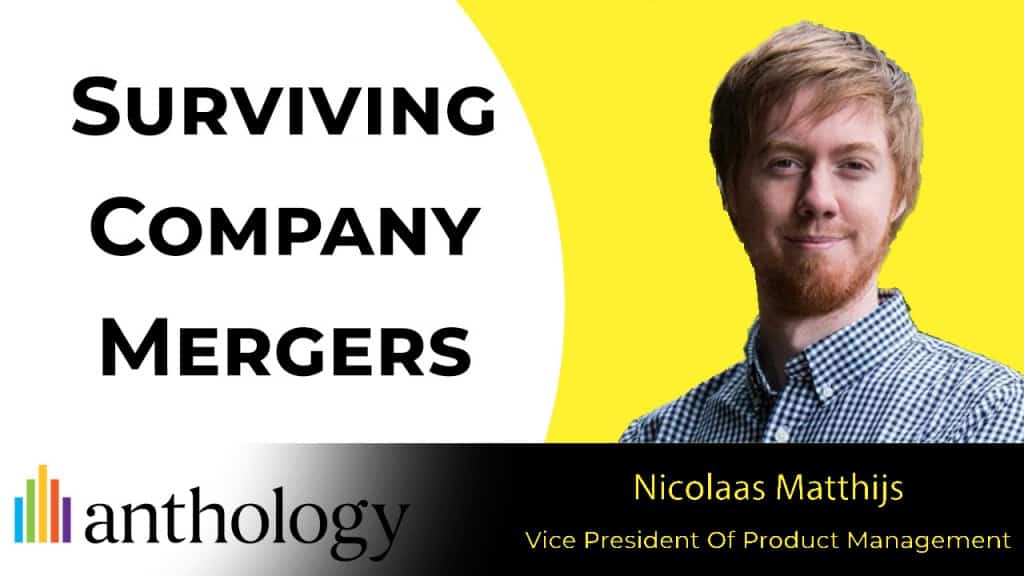
About Nicolaas Matthijs:
Nicolaas Matthijs is an entrepreneur, product creator and Full Stack developer with over 15 years of experience in Educational Technology. Nicolaas has led the development of Learning Management Systems, Academic Collaboration Tools, Learning Analytics solutions and other learning tools.
Nicolaas was the co-founder of Fronteer, developing a revolutionary tool, called Ally, that helps institutions make their course materials more accessible for all learners. Following the acquisition of Fronteer by Blackboard, Nicolaas acted as the Product Director for Ally at Blackboard where he helped grow the product to support 1,000s of educational institutions around the world.
Nicolaas now leads the Product Management team for the Learning Management System at Anthology, setting the overall product direction and roadmap in close collaboration with the development and design teams and leading a team of 20 Product Managers.
About Anthology:
An LMS, a SIS, and a CRM. At Anthology, we offer you these tools and more because a learner doesn’t exist inside one system alone. Our holistic ecosystem of EdTech solutions is designed to open a world of possibilities for your institution and your learners. With a heart for education and eyes set on the future, we are uniquely positioned to provide dynamic, data-informed experiences to the global education community so that learners and educators can achieve their goals.
Transcript
(Intro Narrator at 00:00:01) Today, we're talking to Nicolaas from Anthology about optimizing product development feedback loops. You're listening to Joel Beasley, Modern CTO.
(Joel Beasley at 00:00:15) What's up, Nicolaas? Is that how you say it? Is it Nicolaas?
(Nicolaas at 00:00:17) Nicolaas is perfect. Yeah. You did better than most.
(Joel Beasley at 00:00:20) It's a different spelling than I'm currently used to. But typically, I find that when it is different, it's usually said the same.
(Nicolaas at 00:00:27) That is accurate, and it is a very old spelling even. So I'm from Belgium originally, so Dutch is my native language. So this is kind of a Dutch version of the name.
(Joel Beasley at 00:00:37) I like it.
(Nicolaas at 00:00:38) Even in Dutch, it's kind of a weird spelling, but Nicolaas is absolutely perfect.
(Joel Beasley at 00:00:42) I love it, man. This is great. I was super excited to talk with you specifically because we have a somewhat similar background in web technologies and things of that nature. And I did some learning education stuff a few years ago as well, so I got to learn about some of those technologies. Not near the level that you're involved with edtech. I just barely scratched the surface. But I was hoping that you could give me a brief origin story of where did you start? How did you get involved with technology, and how did you get here today?
(Nicolaas at 00:01:14) Yeah. It's a good question. So basically, my undergraduate degree was in computer science. That's really where I started. I had interest in that area for basically forever. So as I was finishing up my undergraduate degree, we got the opportunity to do a foreign internship as part of a European Union program. And I absolutely wanted to do it. I always wanted to move abroad. So there was actually an opportunity. One of the opportunities, or one of the foreign internships we could do, was at the University of Cambridge. And so we could go on-site for three months. And actually, it was the department that was responsible for educational technology at the University of Cambridge that was accepting these foreign internship students. So I went over there, had a really good time, really enjoyed those three months. And then at the end of the three months, they actually offered me a job. I almost pretty much straight after college rolled into educational technology, and then I worked for them for a few years and did a whole bunch of things, mostly on the software development side of things. So I built different systems for the university. And then at the end of those two years, I decided to carry on my studies a little longer. And so I did a master's at Cambridge as well, given that I was local, in computer speech, text, and internet technology. So really natural language processing, machine learning before it was cool, and those types of things. And then I ventured outside of educational technology for a little bit as I was wrapping up that program. I spent some time at Microsoft Research, which was really good from an industry experience perspective. And then decided after doing that for a while and really not enjoying the writing-up side of research, I decided to go back to the roots and into educational technology again. And really have been doing it ever since. So I've worked for multiple universities doing educational technology, then went into consulting and running my own consulting company where I worked with different universities on all types of different educational technology projects. And then I was one of the founders of a very small educational technology startup. That startup was acquired at some point by Blackboard, a large educational technology player, and then we joined in, and I'm still here. So it's been a long road, but a relatively direct one.
(Nicolaas at 00:03:53) Yeah.
(Joel Beasley at 00:03:54) So you've been through a couple of these merging of cultures together. Right?
(Nicolaas at 00:03:58) Quite a few, actually. Yeah. So and very different perspectives there as well. So with the small startup, there was essentially five or six of us that moved into—we were very early stage—and basically moved into a large organization like Blackboard, which has several thousand or had several thousand employees. It had multiple products in its portfolio. So that was just very different, moving that small group of cross-functional people into a larger organization. And then the merger between Anthology and Blackboard, which happened about four to five years after I joined, after we joined Blackboard, it was very different in nature. Just to give you a little bit of background, so Anthology itself was basically founded about two years ago, and basically, that was the combination of three educational technology companies. And so with Blackboard joining in, that essentially makes four of them. So it's four different cultures coming together into a single organization, but it's four relatively large organizations coming together. So from a cultural perspective, it's been really interesting.
(Joel Beasley at 00:05:11) Yeah. Yeah. What have you been learning as the leader of people throughout this merging of cultures?
(Nicolaas at 00:05:18) That's a difficult one. I mean, one of my key beliefs, I guess, is never lose agility. And regardless of the size of the organization, always try to act as if you are still part of a small startup so you don't get bogged down by—I don't want to say I'm an anti-process person, but I think process is useful on a day-to-day basis, but you've got to just roll through it or poke through it whenever you need to go around it just to be as efficient as possible. So never lose agility would be my big lesson. The other big lesson that I have is never let functional silos get in the way of getting work done. You don't, as a product organization, get work done inside of one functional area like development or like UX design or like product management. You actually get work done by working together across those silos. So it's really all about making sure that there's no silos in the first place. I'm a very strong believer in that. And I think my background points to it as well because, as I said, I started off as an engineer, did that for several years, was very closely involved on the design side of products as well. And then ever since I joined Blackboard, I've basically been operating as a product manager and really more on the roadmap strategy, client vision side of things. And so I've been on all different sides of the cross-functional fence, I guess, and I just see the real value in making sure that you work as a very tightly coupled cross-functional team as much as possible over being siloed in different functional silos. So those have been my two lessons: basically remain as agile and as nimble as is possible.
(Joel Beasley at 00:07:09) If you see me looking down, I'm taking notes, just so you know. I'm not texting my wife. When you get to work on these projects, do you have one specific product that you manage or you get to work on multiple products? How does that work for you?
(Nicolaas at 00:07:25) So basically, I'm usually focused on a single product. So when we were acquired by Blackboard, I then basically led product management for that product that was acquired for about the next four years. So we really grew it from basically pre-revenue to, I think it is now the third or fourth biggest product in the combined Anthology portfolio. So that was really interesting to really be on that growth trajectory with a product from almost its birth to basically being a well-established product in the industry. And then a few months after the pandemic, I actually made a jump to a different product. So the biggest product in the Anthology portfolio is the Blackboard learning management system, which many people will have used in college back in the day. We're actually going through the process of—so I'm overseeing product management for that product now, which actually includes a much wider product management team that I head up. And what we're doing with that product is we're really developing what I'll call the next-generation version of it and really modernizing the learning management system, improving its usability, improving its UI, improving its capabilities, innovating there as well. So that one's very different. That one, we're essentially starting from—I don't quite want to call it a legacy product, but a product that's been established for a very long period of time, does show some signs of aging, has been losing a little bit of market share in the market—and really getting it to the next version of the product, which, if all goes well, should be much better. And we're in that process of seeing our clients and institutions move from the old to the new. So it's a very different type of process in this case, but it's definitely equally interesting and probably more challenging.
(Joel Beasley at 00:09:22) Well, on behalf of the entire next generation, thank you. Because, I mean, I've been around—
(Nicolaas at 00:09:28) It was time. It was time. Yeah.
(Joel Beasley at 00:09:30) First of all, everybody knows what it is. It's ubiquitous in the college system. Right? And it has a very distinct look. You can see from across the room, you're like, oh, they're on Blackboard. Right? And for it to get modernized and look more like a Silicon Valley type application would be really sweet.
(Nicolaas at 00:09:49) And I'm—
(Joel Beasley at 00:09:49) And that's what you have to do. Right? It's really hard too because you juggle, like, okay, you've got to keep the current systems going. You have to keep everything operating, and you also have to innovate. And then you have to make incredible amounts of design decisions on how you actually do that transfusion or how you do this. So it's—I've done that before. I've taken a product that's—you know what? We'll use the word established instead of legacy.
(Nicolaas at 00:10:16) Established is a great one.
(Joel Beasley at 00:10:17) An established product, and I've made a new version of it. It is not easy. So I think it's pretty sweet that you're doing that.
(Nicolaas at 00:10:24) It's hard for sure. And, I mean, especially for something like the learning management system, which is extremely feature-rich and just has a lot of edge cases and a lot of features that are used by a small percentage of the user base. And there's a very long tail to this problem. And, yeah, it's hard for sure. And then we've got literally tens and hundreds of thousands of instructors that have all built courses in the old system that at some point do need to move over to the newer version of the system. So there's a lot of—yeah, there's no lack of challenges. I'll put it that way. But as you said, if we are successful, we'll actually get students and instructors into something more modern, a little bit more personalized, a little bit more, yeah, just a little bit more fun and better to use.
(Joel Beasley at 00:11:16) When you get it. Yeah. Right? Because that's what we want. I'm pulling for—and by the way, when you get to the point where it's public or whatnot, when it's not private, send me some screenshots too because my wife and me, everybody knows what Blackboard looks like. And so I want to be like, check it out. This is what it is now.
(Nicolaas at 00:11:36) So it's entirely public already. We actually have—
(Joel Beasley at 00:11:38) Oh, it is?
(Nicolaas at 00:11:39) More and more institutions that have adopted the new version. So I will send you some screenshots. You will definitely see that it looks very different.
(Joel Beasley at 00:11:49) Oh, nice. Other than the user interface, user experience, what are the trends right now happening in education technology? I mean, I kind of see this AR thing happening or virtual reality, and I kind of—I think it might have very specific use cases for very specific types of learning. But joining the class with AR goggles on, I'm like, I don't think we're there yet. Where do you see the technology going right now for education technology?
(Nicolaas at 00:12:18) Yeah. It's interesting. I actually agree with you on things like AR, for example. I think there's a place for it, but it is a very specific place where for certain programs, like medicine programs, for example, there may be specific activities where it makes sense, but I agree. I don't think it's something that we'll all be sitting out with AR goggles on at some point in the near future. And, I mean, ironically enough, I think—I mean, there's a lot of different trends. One of the things that I think COVID has done is, I mean, first of all, it's made educational technology ubiquitous. Its adoption has gone up a lot. Because of that, what I actually think will be one of the main trends, and this is not going to sound very exciting, but I think is going to be one of the main trends for the next several years, is really better use of the technology that exists. And actually, there's a lot to be done there. And this is really from a pedagogical perspective, making sure that modern course design principles, that modern engagement activities, that those are made a seamless part of the digital course environment as well. You can engage with other students and engage in activities in a way that feels similar to what you're doing in face-to-face activities. And really, the sector as a whole has to, or had to, come quite a long way. Before the pandemic, a lot of the use from a learning management system was essentially as a file distributor or a filing cabinet where instructors would upload the PDFs for the course, and then maybe some of the examination would be online as well, but that would really be the extent of it for many instructors and many courses. And that's gotten a lot richer since, and I think as we go forward, it's just that focus on course quality, the focus on course design, I think will be very strong because, I mean, a lot of institutions have gone partially back to face-to-face, but the online component of that is much stronger than it was before. And it just has to be just as engaging as far as the student's concerned. So I think there will be a lot of emphasis on the fundamentals and making sure that high-quality course design pulls through into the online space as well, and a lot of institutions have made a lot of progress in this area. The few other things that I think we're starting to see is just, and this is again the sector, I think, catching up to what's happening elsewhere, is just better use of, I guess, personalization and data in a way that meets what you can do in other systems that we use on a day-to-day basis. Now I'll use one example from something that we're actively working on. So something we're actively working on is called progress tracking.
(Nicholas at 00:15:13) So it's the idea that, as a student, you can very easily see what you've already done in a course, where you've left off, where you need to go next, and just kind of personalizing that experience a little bit more in a way that you wouldn't even think about it when you see it in the system. It's something you would expect. And so making sure that the student has got that very personalized experience where everything's kind of adjusted to where they are in the course, and they can receive personalized feedback. They can see where they are. A lot of that can be automated as well.
(Nicholas at 00:15:46) But then also the flip side of that, actually starting to provide more information to the instructor about kind of how students are engaging in a course, where they're at, where they may be falling behind, just to give—I'm not a huge believer in data making decisions in an educational context, but I'm a huge believer in data providing more insight and essentially allowing instructors, allowing institutions, allowing students to make more informed decisions because they can see more of the information that surrounds them in a way that's actionable to them. So that's something that I'm—the whole concept of using the data more to allow the people involved to make more informed decisions. I think we'll see a lot more of that, and we see that across the sector. And then the last one, it kind of comes back to my first one, which is as we've been doing research with students, especially throughout the pandemic, the number one feedback that we got from students is that the learning management system and the digital environment can feel like a very lonely place.
(Nicholas at 00:16:52) That's across all learning management systems, and that's a big problem because we know from the research that one of the big factors to student success is how much of a sense of belonging that they have with their peers, with their program, with their instructor, with their course, with the institution. And if that isn't present in an online environment, that's obviously a very big challenge. And so I think we'll see a lot of focus on not necessarily turning educational technology into social networks—I think the opposite—but making sure that it provides the right triggers, I guess, for that sense of belonging between the student and their peers, their instructor, their course to be created just seamlessly as part of the experience. And a lot of that comes back to course design, activity design as well, but it's something that we refer to as the collective or sense of collective. And I think we'll see a lot of focus on that.
(Nicholas at 00:17:48) So not very inspiring, those three, but I think a lot of focus on just the fundamentals and making better use of what's available.
(Joel Beasley at 00:17:58) Yeah. No, I like that sense of community aspect, and there's all different types of ways to implement it. I didn't set out to get into learning technology, so I started the show, right?
(Joel Beasley at 00:18:11) And then we kept having really great people on, and they would share advice. And so one day, I had a guest say, "Hey, I heard this advice from, you know, CTO of NASA. Can you clip that? Like, take that three-minute piece of advice and send it to all my leaders so that they can go do that, and then we can talk about it."
(Joel Beasley at 00:18:29) I was like, "Okay. Cool." So I built a quick Rails app over the weekend that would help distribute it and everything. And we sent it out, and then they could write a little comment box about what happened when they implemented that exercise. And so what we ended up doing, it grew into an entire business.
(Joel Beasley at 00:18:47) I raised capital. We grew. It was awesome. Yeah. And it was basically like a leadership training platform specifically for leadership. And so many customers would try to get us to be like an LMS, and that's when I started learning what an LMS was. But, ultimately, it didn't do super well because when the pandemic hit, we lost like 80% of our business in a week because people didn't need leadership training to run their business. It was something that was nice to have, right? It's necessary to train leaders, but it's not necessary on a P&L.
(Joel Beasley at 00:19:20) Right? So it's funny that you happen to be meeting you now because two weeks ago, we have like three or four customers that are still on it. You know, it's just not like a main thing that we do. I said, "Hey. We've got these three or four customers, but let's open it up to the world and just put it out there because we spent so many years working on it."
(Joel Beasley at 00:19:38) And, ultimately, we had way more success over here in the media world. And so I don't want to just let the tool rot or die or whatnot. So I was like, "Let's open it up." So we're in that process right now. So I'm pretty excited about just putting that out there to the world and see what people do with it.
(Nicholas at 00:19:54) Yeah. Absolutely. You'll have to send me some screenshots as well.
(Joel Beasley at 00:19:57) Yeah. It was a lot of fun. You're bringing up all these memories from the past four or five years.
(Nicholas at 00:20:03) Fair enough. And, actually, with the pandemic, we almost experienced the opposite, right, where the learning management system was not a nice to have at all. It was basically the only place where learning could really happen at that point. And so it kind of flipped the adoption entirely and almost went to almost 100%, which has kind of brought out a lot of additional needs, but also shortcomings in the platforms that traditionally exist. I do think it was funny that you kind of called out that people were pushing you for it to do additional things and become an LMS because that is one, I guess, unwritten rule.
(Nicholas at 00:20:42) I actually think there's a name for it, but it's a law in EdTech that everything eventually becomes a learning management system, unless you're really good at saying no to feature requests. But it's funny, and it's kind of true as well.
(Joel Beasley at 00:20:55) Well, it's partly—I figured out it's partly designed because the way the organization is designed and budgets work, their budgets get allocated into specific categories and to put a new category in there. So they would look at us and they'd be like, "Okay, I don't want to take from the leadership activity where we fly everyone to Fiji. I don't want to take from the leadership training budget because that budget was allocated to that, but I can take from the LMS budget because we have, you know, surplus budget over there."
(Nicholas at 00:21:21) Fair enough. Yeah.
(Joel Beasley at 00:21:22) Yeah. Now video—so all of our stuff was like video-based too, right? Because it would be a clip from a leader and everything. One of the requests we started to get towards the end, but we didn't build it ultimately, was for them to respond—for that text box that they're responding to the challenge.
(Joel Beasley at 00:21:36) And there was like coaches involved and stuff so the coaches could respond. So it's like, "This is what I did," and then they, you know, all of that. They were asking for video to be added so that they could do a video response. So instead of typing my response, I could go run this example with my team in my weekly stand up, and then I can go on my phone and just hit a button and be like, "Alright. This is how the challenge went," and just talk for a little bit.
(Joel Beasley at 00:21:57) Are you noticing that video is becoming more important? Not specifically from like education, like, "I'm gonna make an animated video or I'm gonna teach someone a course," but as far as people interacting with each other?
(Nicholas at 00:22:12) It is. And I would actually say—and that's been on a very consistent upward trajectory over the last several years. And it's really more, I would say, micro videos that have kind of gained a lot of importance. And so we actually have—we've got this functionality as part of our learning management system as well. When you, for example, as an instructor, when you grade a student's work, you can actually go in and record a very quick video to basically provide feedback to the students, or you could do it in an announcement or or basically anywhere where you're communicating with the class. And we do see actually very high levels of uptake.
(Nicholas at 00:22:51) I would have always kind of, before starting this job, assumed that it's a lot more work. I mean, it feels like a lot more work to be recording all of these videos rather than just entering something in text. But a lot of the instructors that we talk to actually, first of all, they think it's pretty efficient because they can just share the thoughts that they have. It's kind of a stream of consciousness. They can just get it out, and it builds that connection as well.
(Nicholas at 00:23:17) So we've actually seen a huge increase, I think, in the usage of those capabilities, especially from a feedback perspective. But we see similar things in, like, the LMS has got discussion forums as well. And in there as a student, you can actually record a very quick video, get that into the discussion, and then people can reply to it with a video as well. So those things have definitely gone up very considerably. Obviously, with that comes a lot of demand for the accessibility surrounding those videos as well, things like automated captioning, transcripts.
(Nicholas at 00:23:55) So there's a lot that comes with it, so it's not quite—and there's legal requirements around this as well. So it's not quite as straightforward as just allowing someone to record or upload a video. There's a lot that comes with it. But, yeah, the usage has gone up a lot. And, also, from an instructional perspective, I think there's a lot more that we are starting to do but also can do with video content and things like—I mean, there's some standard things like when, as an instructor, you're providing instructional content or instructional video on something, you could break that up with things like quick knowledge checks before you go to the next part.
(Nicholas at 00:24:32) But then you can start to make it really interesting. Like, you could have students react to different parts of the video. You can even do asynchronous watch parties where you can see what other people have commented or reacted maybe while you're not even looking at it at the same time, where you can see which parts of the video other students spent the most time on. And there's just infinite possibilities, I guess, with video, and some of it's still unexplored. But, yeah, generally, usage is going up very significantly.
(Nicholas at 00:25:04) Yeah. And then this also comes back to that collective aspect, I think, where it's important that sense of belonging is—those triggers are there, and you create that sense of belonging. And I think video is a good way to make it a little bit more personal. It's more difficult to automate, though, but it's good to make it personal. Yeah.
(Joel Beasley at 00:25:22) Yeah. How do you run these experiments? Right? We're talking about all these various different ideas. How do experiments deploy within your part of the organization?
(Nicholas at 00:25:31) There's an infinite number of ways, I think, in which things make it into the product. We actually have quite an extensive, what we call client engagement framework or client feedback framework, where we think of it as in three different phases or three different stages where the first phase is really what happens before something is even in any form of development, which we refer to as the discovery phase. And in that—I mean, this is all about—I'm a huge believer in involving clients and users as closely as possible and as continuously as possible in the entire process. And so there's a lot of ways in which clients provide feedback. They provide ideas.
(Nicholas at 00:26:19) So we've got, for example, we've got an Idea Exchange, which is a place where clients and users, they can submit ideas. They can see other people's ideas. They can vote on ideas. They can comment on ideas. That's actually turned into a really rich place where, obviously, you don't want to take every idea at face value. You want to dig into what's the underlying problem that you're trying to solve and bring those together as best as possible. But if we—yeah, if we look at, I think in the last three months, we've had over a thousand ideas submitted. We've had thousands of votes. Actually, out of the top 10, I think six or seven are in active development. So that's a very active part of the community.
(Nicholas at 00:27:00) And then there's other things like we've got a student advisory council, for example, where every so often, we've got a large group of students that we engage with. We've got lots of community activities. So there's lots of different ways for feedback and ideas to flow into the top of the funnel, I guess. And then the second phase is really about once something's been picked up for exploration, for design, for development, for experimentation. Again, there's a whole set of activities that come with that.
(Nicholas at 00:27:34) So we—just to give you a few examples, like, we do weekly focus groups—actually, we do multiple focus groups every week where we get a small number of users in. We dig into anything from, like, something that's early conceptual to all the way down to something that's almost ready to be released. And we ask them open questions. We get designs in front of them. We get their feedback.
(Nicholas at 00:27:58) And so those have been really useful to just get things in front of people really early on in the process. And then but then we also do other things like, and this is really where technical previews, for example, where relatively rudimentary AB testing starts to come in as well. So we're doing more and more releasing things behind feature flags, doing technical previews where a number of clients will sign up to trial a particular new feature, provide feedback about it before we then decide what to do with it. And so there's a lot of quantitative and qualitative data that goes into those experiments, but we've tried to operationalize that a little bit so we can—I mean, we typically have multiple technical previews running at the same time for different things. And so there's, yeah, there's a sign-up process that we try to operationalize.
(Nicholas at 00:28:51) There's the quantitative qualitative data that we try to operationalize as much as possible. And then there's the third phase, which is what happens when something's been released into production, which may actually be—well, maybe not the most important phase, but very close to being the most important, which is, again, looking at that quantitative and qualitative feedback as the feature becomes available. So getting feedback directly inside of the products, both as a whole as well as for individual features, looking at the usage data, mapping that back to the usage hypothesis that we set forward, and then really defining the next iteration based on that. So I know that was a very broad answer, but there's this very extensive feedback and involvement cycle that allows clients to be involved if they wish to be so in the entire process. And that's ultimately how I like it and how I prefer it.
(Nicholas at 00:29:47) Like, I'm probably too transparent a person, and I would basically want to involve all of our clients in the whole process and the uncertainty and the messiness that comes with it. Not everyone can deal with that equally well, but some are brilliant. And it just allows us to put out much better products, which will hopefully lead to a much better LMS in the future. Yeah.
(Joel Beasley at 00:30:10) Do the engineers themselves—like, obviously, you're product management. Do the engineers get to see how they respond and be in the room when they're doing those testing?
(Nicholas at 00:30:19) Absolutely. And this comes back to continuing to operate as a cross-functional team as much as possible. And so to me, it's really important that it's not just a product management activity. But, I mean, just to give you a few examples, for the weekly focus groups that we do, we actually have watch parties for those. We don't want to overwhelm the session with people from Anthology, but we've got watch parties where essentially the entire product organization is invited, and actually our field organization as well, to just observe and listen to the feedback. And then we'll put out special invitations to the engineers and the designers that are working on a specific feature so they can all hear it.
(Nicholas at 00:31:02) They can all hear it firsthand. Our entire team's got access to all of the quantitative data, all of the qualitative data. In the technical previews, again, there'll be different points in time where we'll get the clients together to provide their feedback, and we'll make sure that design engineering is directly exposed. I think the direct exposure is really important, and it just means that things get less lost in translation in the first place. But secondly, it comes back to that sense of belonging as well, because I think when I was an engineer and I could hear something directly from a client or a user's mouth, then I had a much stronger connection to that feedback, and I was much more—I felt much more ownership over wanting to solve that problem as well.
(Nicholas at 00:31:54) So I think it's one of the most important things to make sure that the full team's exposed. We're trying to put everything in place to make sure that that exposure is as broad as possible. Obviously, we can't fix every or do every individual thing that's brought up in those, which you always gotta manage and make sure that we design something that works for the largest common denominator first and foremost. But yeah, the full team's always involved as much as possible.
(Joel Beasley at 00:32:22) Yeah. You guys know your stuff. Sometimes I feel like a doctor when I meet people where I ask them how their engineering teams are working and looking for what they're not doing that's best practices. And I've got nothing for you. You seem to be doing everything that you should be doing.
(Joel Beasley at 00:32:37) Who do you look up to? Where do you learn this stuff? You're reading books? You follow somebody specifically online? How do you get inspired with being a great leader and product manager?
(Nicholas at 00:32:49) You know, that's actually a really difficult question. I get the most inspiration from being exposed to problems, if that makes sense. So I love hearing about problems that, first of all, we have internally in our product organization. Nothing's perfect. Obviously, I love talking to other people in other product companies.
(Nicholas at 00:33:10) And I tend to focus in on what are the main challenges that you're currently having rather than what are you doing that's working really well, although that's part of the conversation as well. But I'm an engineer by heart, so I tend to focus in on problems, and I'm wanting to solve those problems. So I really do get most of my—and I'm lucky that I've spent a lot of time in the educational technology world on the one hand and then the startup world on the other hand. And so I've got a pretty broad network, pretty varied network. Just one-on-one conversations is ultimately what I get the most out of, I think, rather than—obviously there's different blogs that I follow.
(Nicholas at 00:33:50) People on Twitter that I follow, but no one consistent that I think has all of the answers, but more picking up on individual bits and pieces. What I do know is that there was no framework in the world that has all of the different answers. This is why we have to be agile, nimble, and just respond to whatever comes up rather than expecting a framework or a process to fix a problem for us.
(Joel Beasley at 00:34:13) I fully agree. You are exactly right. There's not one specific framework or process that you can follow that—you know, people will ask me when I do talks at conferences or something, "Oh, do you prefer Tribes or two-pizza teams like Amazon or Netflix?" I'm like, guys, it's designed backwards from the problem you're trying to solve. They didn't decide that pizzas were a good idea to base everything off of.
(Joel Beasley at 00:34:40) They designed it backwards from whatever problem they had. And so that's one thing that I see a lot of newer people doing is reading a lot of different books in a lot of different ways, and rightfully so. They should be gaining experience in reading other ways. But just the business side of things, I have found to be incredibly valuable. If you understand how those work, and to your point, I'd say the most important thing there is being close to your customer. And you mentioned that, and you guys clearly have an amazing system.
(Joel Beasley at 00:35:07) I've actually never heard that before, that you record those types of sessions and then have watch parties. That sounds awesome. I bet you there's some Silicon Valley tool out there for that.
(Nicholas at 00:35:19) There may very well be. We're just abusing Teams to basically do a screen share of—because we do these live. So as we're conducting the focus group, we actually have, in many cases, literally a hundred people in a different room just watching the live session and having discussion amongst themselves, which is—yeah, maybe there's a business in there or product in there.
(Joel Beasley at 00:35:43) Right? That's the entrepreneurial part. Your brain can't stop producing business ideas. I'm just like, continue to focus on what's working.
(Nicholas at 00:35:51) So many opportunities. And the thing is most of these are very easy to implement, as you said. Over a weekend, you can get an MVP going, and then it just takes off from there.
(Joel Beasley at 00:36:02) So you mentioned that you learn a lot from talking to people. Me too. I like to just talk to a bunch of different people, and then I sort of get this emerging knowledge at scale, for lack of a better term. Right? Where everybody's kind of saying the same thing but differently, and then you can sort of extract principles.
(Joel Beasley at 00:36:17) When you're doing one-on-ones with your teams or your direct reports, what type of mindset do you go into that conversation with? Like, what are the key points that you want out of your one-on-one, or at least you try to get most of the time?
(Nicholas at 00:36:34) Yeah. And this is where I may be a little less conventional. So I do not have regular one-on-ones with people on my team. I don't have them with my direct line manager either, and I was never a huge fan of them because often they just felt like conversation for the sake of conversation, if that makes sense. And so I'm a huge believer of basically—I try to make it as clear as possible to my team, and I've got about 19 product managers that are on my team, so it's a fairly sizable team from a PM perspective.
(Nicholas at 00:37:10) I try to make it as clear as possible that whenever something comes up, whenever they want to talk about something, whenever there's a problem, pull me in or whoever the appropriate person is. Happy to have a conversation at any point in time. It does not have to wait for a regularly scheduled event. It has to be—again, I'm a huge believer in being truly agile. And so if something happens, let's jump on a quick huddle, and let's hash it out in the next ten minutes.
(Nicholas at 00:37:37) And if it needs an hour, we'll take an hour. And it's just—I prefer to do these things in a very ad hoc way. Once we do have those conversations and this kind of comes back to a lot of the process and models that are out there that were really designed backwards from the problem they were having. So try to make it as clear as possible that once there's—I mean, so first of all, if there's uncertainties, if there's questions on how to solve something, let's always get back to the evidence. Let's involve our users and clients.
(Nicholas at 00:38:10) Let's look at the quantitative data that we already have. Let's collect more if we need to. Let's not overanalyze either, because analysis paralysis doesn't help us either. But if we can couple it back to any evidence, I think that's hugely helpful. And then the second thing is the only thing that really matters to me is our output.
(Nicholas at 00:38:31) It's the quality of what we put out and the impact that it has and how good a job it does at solving a real problem. If we take that as a starting point and we do that right, everything else kind of flows from there. So yeah, that's probably a pretty unconventional approach towards one-on-ones—to not have them at all.
(Joel Beasley at 00:38:50) It's whatever works for you. Yeah. And different things will work for you at different stages in life, at different stages in your growth. And so I'm just a curious person. Right? So I believe that from what I have learned in almost 600 interviews, that it doesn't really matter what you're doing, which system you picked or whose philosophy you're following. The one common thing between all of those is that they do it consistently and that they care about their people. They care about the quality of their work, and they have something, a routine. Wake up, work out. You know?
(Joel Beasley at 00:39:28) Some people wake up at 5 a.m. Some people wake up at 10 a.m. It doesn't really seem to make a difference as far as achieving high levels of success. But I've never met somebody who doesn't have some sort of driving philosophy that they adhere to. So that's just my personal experience.
(Joel Beasley at 00:39:45) I do have a more specific question though about the—I think you said 19 people that are project managers below you. What in your schedule or in your world allows you to get consistent time in front of those people? Do you have a team meeting, an all-hands? Like, how are they seeing your face consistently?
(Nicholas at 00:40:04) So there's a number of different ways. So first of all, and this is probably the most consistent we have—so we actually divide because we've got a fairly large combined product team. We actually organize our product team into value streams. And so each value stream has got one or more dedicated PMs.
(Nicholas at 00:40:22) It's got one or more dedicated UX designers, and it's got one or more dedicated engineering teams or groups of engineers. And so every value stream is essentially dedicated to a different logical part of the system or a different overarching problem that a particular part of the system is trying to solve. So they're basically a continuously aligned cross-functional team that works within that value stream. And so basically, what we do every week, and this takes up a lot of my time, we have a meeting with each of the value streams. We actually have 16 value streams, and we have a meeting with each of the value streams every week.
(Nicholas at 00:41:08) And what we go through is basically—and it's more like a brain trust. It's an opportunity for them to share what they've learned and any open questions they want to get some additional feedback on. And so essentially, what we'll go through is what are you currently thinking are the main priorities for this value stream? What have we learned in the last week that changes how we were thinking about things or changes prioritization? What has come in that actually needs to be treated with priority or anything along those lines?
(Nicholas at 00:41:42) What are some designs or what are some prototypes that have come out in the last week? Let's have a look at them. Let's provide some feedback. So with each of the 16 value streams, we've got some very focused face-to-face time once every week where we do—I'll call it we'll do real work. Like, we'll talk about the details of what we're doing.
(Nicholas at 00:42:04) So that's one. We've got a number of other cadences as well where we review. Those check-ins are more directional in nature and where are we going next. Then we've got a more tactical one as well across the entire team, which is more about what are the things that we expect to have in the next release, what are the things that we expect to have in the release after that, making sure that we're on track for all of those. And then we do things like we've got a monthly all-hands, for example, for our product specifically, which actually involves not just the wider product team, but also the sales team, the support team.
(Nicholas at 00:42:39) Everyone gets invited to that, and we just go through, "This is what's been done. This is what's happened. This is the progress that we've made. Here's some challenges that we're having," and we just kind of talk through it. And that's about an hour as well.
(Nicholas at 00:42:52) So there's a lot of individual cadences, but the value stream ones is probably the most important because that's where we spend the most time talking about substance and where changes in direction happen the most.
(Joel Beasley at 00:43:06) Yeah. Thank you for that. I just didn't want people to hear it and be like, "Oh, he doesn't have one-on-ones, so I'm gonna ignore my people." No. He's seeing them and interacting with them in other ways.
(Nicholas at 00:43:15) I prefer to do real work over just having a conversation for the sake of conversation. But yeah.
(Joel Beasley at 00:43:20) 100%. We're doing real work now. If people want to learn more and purchase the product, where do they go?
(Nicholas at 00:43:26) Yeah. So basically, if you go to www.anthology.com, you'll be able to find the most recent or the most up-to-date information on the learning management system. I actually think there may be some recent screenshots on there as well. And then the thing that we didn't really talk about because it's outside of my direct control, I guess, but Anthology does have a very broad portfolio and probably the broadest that's out there from an educational technology perspective. It's not just the learning management system, but also a range of other teaching and learning tools.
(Nicholas at 00:43:58) There's a student information system. There's a CRM as well. So if you want to learn more about that broader portfolio, that would be the place to be as well.
(Joel Beasley at 00:44:07) Amazing.
(Nicholas at 00:44:08) But obviously, what I'm hoping to see is that, especially for institutions that we work with already, participate in focus groups, ID Exchange, community sessions, because that's where most of the value is.
(Joel Beasley at 00:44:21) Boom. Dude, we did it. We made a podcast. How do you feel?
(Nicholas at 00:44:24) Perfect.
(Joel Beasley at 00:44:25) Thank you so much for listening. And if you found this episode useful, please share it with a friend or colleague who you think would get value from it. And if you have topics that you'd like to hear discussed on the podcast, either add me on LinkedIn, or send me an email [email protected]. Every time I get an email or LinkedIn message, it absolutely makes my day and inspires me to keep going.