
Episode 412 ·
Bringing a Feed to the Lock Screen with Mohit Saxena, CTO of InMobi
Today we’re talking to Mohit Saxena, the Co-Founder and CTO of InMobi. And we discuss how InMobi has continuously evolved with the times since its founding. How to encourage your employees to think big and come out of their shell, and why it’s important to celebrate failures as well as the victories.
All of this, right here, right now, on the Modern CTO Podcast!
To learn more about InMobi, check them out at https://www.inmobi.com
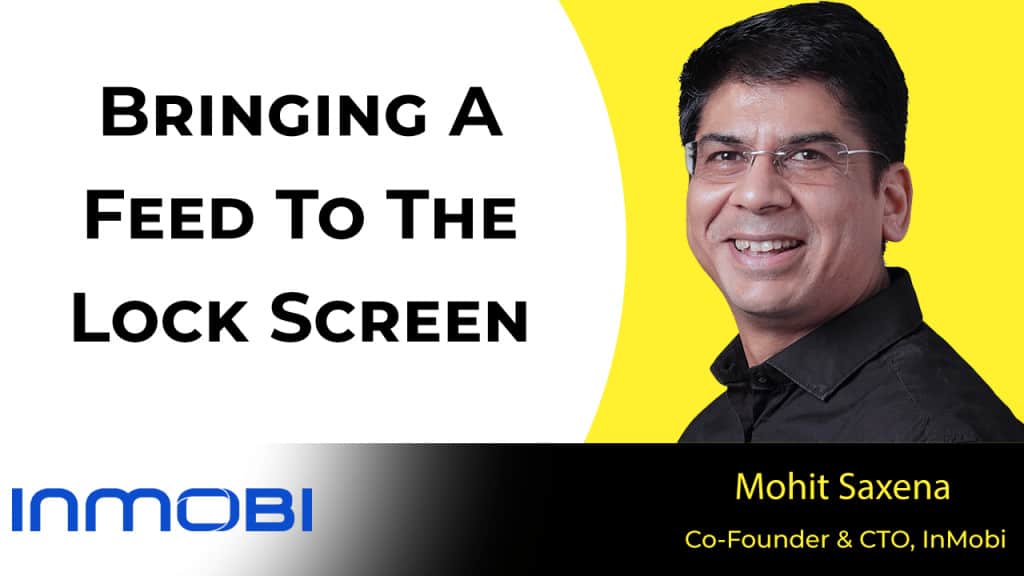
About Mohit Saxena:
Mohit is one of InMobi’s co-founders. Before InMobi, Mohit managed technology operations at Virgin Mobile, designing and deploying their post-paid billing system and their pre-paid revenue recognition system. Mohit earlier worked at AT&T and has contributed to many patents filed in the telecommunications area.
Fascinated by small ideas that turned into global powerhouses and innovation, simplicity and the potential of technology have always been his passions. InMobi is a both a passion and a dream come true for him.
Mohit has a Bachelor’s degree in Engineering from the Indian Institute of Technology, Roorkee.
About InMobi:
InMobi is a world-leading provider of marketing and monetization technologies reaching billions of consumers around the globe. With deep expertise and unique reach in mobile, it is the trusted and transparent technology partner for marketers, content creators and businesses of all kinds. InMobi’s mission is to power its customers’ growth by helping them engage their audiences and build meaningful connections. Its affiliated businesses – Glance, the world’s largest lock screen-based content discovery platform and video platform Roposo – help InMobi create new content and commerce experiences in a world of connected devices. InMobi maintains dual headquarters in San Francisco and Bangalore with operations in New York, Chicago, Kansas City, Delhi, Mumbai, Beijing, Shanghai, Jakarta, Singapore, Manila, Kuala Lumpur, Sydney, Melbourne, Seoul, Tokyo, London and Dubai. To learn more, visit inmobi.com.
Transcript
(Joel Beasley at 00:00:03) Hello, my friends. Today we're talking to Mohit, the co-founder and CTO of InMobi, and we discuss how InMobi has continuously evolved with the times since its founding, how to encourage your employees to think big and come out of their shell, and why it's important to celebrate failures as well as the victories. All of this right here, right now on the Modern CTO Podcast.
(Mohit at 00:00:31) Here we go.
(Joel Beasley at 00:00:32) This is the Modern CTO Podcast.
(Mohit at 00:00:43) Interestingly, my education, I'm a material science engineer. I was supposed to make steel. While I was studying, the world around us was changing quite drastically. In fact, I got my first job in a steel plant, but instead of working on a steel plant, it was mostly to work on the automation, and that's where I got my first interaction with software. Working in a factory and writing automation software over there is a little different because it requires a lot of complexity, and any mistake can be really expensive in terms of lives and money. So I think it was a great experience that helps you learn to be more cautious and how you do very difficult programming early in life.
(Mohit at 00:01:35) And with that, I think it just happened. I ended up joining a telco in California, and it was Pac Bell. You know, way back when AT&T divided into every regional Bell. So I was part of Pac Bell back then, and then AT&T acquired it. So I ended up in the telecom industry.
(Mohit at 00:01:54) And since then, pretty much I've been in telco, mobile advertising, and marketing, and playing in that field only. And in that process, I ended up meeting three of my other co-founders who very strongly believed that the whole of Asia—I would say anything east of the West—almost completely missed the wired digital era. There was absolutely no infrastructure, and it was completely gone. And sometimes, innovation can be faster if you just take a massive leap rather than making incremental jumps.
(Mohit at 00:02:31) So what happened in Asia, since they never had any digital infrastructure, the wireless came in a very different way. So if you see the sort of wireless revolution that you are seeing in China, India, and the number of subscribers and all those, the main reason is basically they just completely missed that part and they directly moved on to 3G, 4G, and 5G. And that's where you see that adoption and cycles are so positive as compared to this part of the world. And these three founders, like ten, fourteen years ago, were so convinced that if you want to do something in mobile, I think we need to be in that part of the world. We need to start from there because that's where the need is, that's where the customers are, and that's where the innovation will happen. So I really liked their passion and story and the willingness to execute around it, and then I decided to leave AT&T and Virgin Mobile.
(Mohit at 00:03:20) These are the two companies that I was working at over here, and I decided to join them. And so far, it has been a really good story, coming from the East and expanding towards the Western world. And now we are back in the U.S., which is once again the land of opportunity. If you're doing anything, you want to grow it big, you have to have a presence here. So that's the story of my life.
(Mohit at 00:03:42) Yeah.
(Joel Beasley at 00:03:43) Yeah. And I think in late 2018, I spent a little bit of time in Hong Kong, and I was learning about how Huawei in particular started out as a huge telecom infrastructure provider, just laying—like, the advantages that were involved with starting from scratch and laying modern tech down in the late 2010s rather than how in America we have years and years of old infrastructure that we just keep building on top of in our telecom.
(Mohit at 00:04:20) No, it's a very simple thing. Sometimes it's easy to burn down the house and build fresh. It's like burning the forest, and then the fertility of the soil goes up drastically. But since you keep on making modifications, and beyond a point, it actually becomes very difficult.
(Joel Beasley at 00:04:37) Yeah. Absolutely.
(Mohit at 00:04:38) So those are some of the things that you can see in Asia. If nothing is existent, then you have all kinds of flexibility to go for the best. And I think that's what has happened in many areas.
(Joel Beasley at 00:04:49) So before we get into InMobi and what you're working on today, there's another part of your LinkedIn that I wanted to ask you about where I saw you're doing some work as a DJ right now. Can you tell me about that?
(Mohit at 00:05:02) Yeah. So I think it was so funny when you were talking about your story. You know, you have a little bit of interest in music, and you were doing programming. And the same thing for me. I really was into music right from the beginning, but my early part of my life was in India. And at that point in time, there was no Spotify or something like that.
(Mohit at 00:05:23) And essentially, music was really not the first option for you, especially if you're not trained and if you're really not pursuing it. It was really hard. So mostly it was just the pleasure or occasional listening and all those things, and that's where I left it and went back to studies and all. But I pretty much never picked it up all the way until recently, two, three years ago. I was always listening to music, but never doing something or just making any of my own music or going deeper into it.
(Mohit at 00:06:04) But as they say, every problem comes with opportunity. So when you are in COVID, pretty much you are locked up inside a room. And I thought, you know, how do I kill the time? If you just do work and work, it was becoming pretty mundane, frustrating, and depressing for everyone. So I ordered a small DJ machine.
(Mohit at 00:06:24) I thought, why don't I try something? This is one area, and I ordered a small DJ machine and I started trying a few things out. And I really liked it. And so much so that I started regretting, why did I order the beginner machine? I should—I need something better. And then from there, I got a bigger one and the next one.
(Mohit at 00:06:46) And I think I really invested a good two, three years—I would say two years. And I thoroughly enjoyed it, and I started learning as I go. And to be honest, right now, I just love it so much that I want to be associated with that. And I do play occasionally for my friends, family, or sometimes if I'm in Bangalore, even for some clubs as well.
(Joel Beasley at 00:07:13) That's awesome. So now you've got a pretty big setup? Are you running four decks, doing some complex mixes going on?
(Mohit at 00:07:19) Yeah. Yeah. So CDJ-3000 on the four decks.
(Joel Beasley at 00:07:26) Super cool. Yeah. I actually worked as a DJ for three years in the past. Did a lot of fun.
(Mohit at 00:07:31) For software programmers or engineers, I think it's a lot easier because music, I think, is built around math.
(Joel Beasley at 00:07:37) Yeah. Absolutely. And we see lots of people that come on the show that are involved in music in some way or another. It just seems like a really great escape that jives well with the way engineers' brains work.
(Mohit at 00:07:52) Yeah.
(Joel Beasley at 00:07:52) But, so, oh, by the way, do you have a DJ name?
(Mohit at 00:07:56) Yeah. I have, by the way, adopted a name called DJ Sicario.
(Joel Beasley at 00:08:01) Nice.
(Mohit at 00:08:02) It's with an E because I didn't get the I. Someone already taken it.
(Mohit at 00:08:06) So DJ Sicario. It is one of the movies that I saw, and in the thriller category, they have Sicario as a hero, and I really liked that movie. So I wanted that name, but since Sicario with the I was taken, I still put the name and I replaced I with E, and I got it on SoundCloud and everywhere.
(Joel Beasley at 00:08:24) Nice. Nice. Very cool. Also, tell me a little bit about how you originally got involved with InMobi, where you're at today.
(Mohit at 00:08:32) So, as I told you, I met these three founders. And at that point in time, they knew that they wanted to do something in the mobile area. But there was not enough clarity on what do you want to do? It's pretty vast, and then I ended up joining them.
(Mohit at 00:08:48) And, like I said, every startup, if you see the story, I think the first product, most probably nine out of ten cases, they will never see the day of light or it's never a successful product. But if you have entrepreneurship, then you start figuring things out from there and then change. And once you find the market fit, that is what becomes your original idea. Same thing at InMobi. We started with something called—you all know the concept of Groupon, where you get these coupons and deals.
(Mohit at 00:09:19) So we launched a product in Mumbai, in India, which was basically a SMS-based coupon. And I would say that product was way ahead of its time in 2008.
(Joel Beasley at 00:09:29) Yeah.
(Mohit at 00:09:29) Where you would send some SMS and say, "Hey, deals on jeans or maybe deals on sneakers or something." And then it will come back with some of the offers that are going on in that location. And imagine in 2008, and this is before, you know, iPhone was launched. It was launched that year itself, but imagine the phones prior to that.
(Mohit at 00:09:49) So there was no web, mobile web concept. So everything was mostly on SMS. That's why we chose that medium. And what it was doing is as soon as you basically threw these keywords, it would throw them onto a search engine and it would return with a lot of options for you, where you can go and see what kind of deals are going on. Ideal on paper and even being implemented and executed.
(Mohit at 00:10:11) But what we saw in the market is it was a little ahead of time, and advertisers were really not sure. So everyone was liking it, but nobody was paying for it. And so we were trying to figure out what do we do. But right there and then, this new iPhone came in. And when it came, I think we just saw the power of this medium and we really believed that this is the future and this is what eventually is going to change the whole thing. So immediately, we just converted the idea from SMS to mobile web-based.
(Mohit at 00:10:44) Because apps were still relatively new, you know, how it will happen. But using that medium, we started converting our idea from SMS to web-based. And actually, on day one, not only did we have paying customers, in fact, the server crashed.
(Joel Beasley at 00:11:02) Wow.
(Mohit at 00:11:03) Yeah. Because we were just running on a three, four machine web server. And for SMS, that was kind of enough. It was a semi-asynchronous process. You know, you get any question, you do that. Once we saw those symptoms, we knew that this is the idea, and this is what we are going to pursue. And InMobi was born, which is today the mobile advertising and marketing platform, from SSP to DSP and every other component, but that was really the beginning.
(Joel Beasley at 00:11:29) Nice. And so I see in your background, you have both InMobi and another logo that says Glance. Can you tell me what Glance is?
(Mohit at 00:11:36) So InMobi, I think for a good ten years, the big part of our offering is a marketing cloud, which is mostly a B2B business. We work with various advertisers to basically help them reach out to the relevant users based on the proposition that they have. And at the same point in time, we work with various publishers to help monetize their property, understanding their users, what their behaviors are, and what are the propositions which might be useful for them. So pretty much it's a marketplace. It's a two-phase marketplace where we help advertisers reach out to the right user, and we help publishers monetize their own users as well.
(Mohit at 00:12:20) Glance is something very different, and it's actually our B2C offering. And if you see what is happening in the world is basically, earlier the media business or rather the way you see media consumption was pretty limited. You always had these big production houses, these movie studios and, you know, studios like yourself, podcasts and all those things where everything is managed. And there are a few people who will produce something, and there will be a lot of consumption by the users outside. We live in a snackable economy right now.
(Mohit at 00:12:53) Video is commoditized. People, anyone of us, me and you, can be a creator. And if you are doing something, you are putting your genius into it or, you know, innovation can come from anyone and you never know. Any ten seconds, fifteen seconds, or sixty second clip can be popular and can be viral all over the world. So if you think about it, what is happening over there, there's really an explosion of content and a disruption is happening. Every day there are influencers who are being born. Some kids are just 15 years, 16 years old and they have bigger power or rather bigger influence on users as compared to one of the biggest rock stars in their category.
(Mohit at 00:13:36) So Glance is really part of that community because everywhere when the ecosystem explodes, you need to figure out how users will get better value out of it. So Glance is really a whole suite of B2C products that we have, and we work with a lot of OEMs like Xiaomi, Oppo, Samsung. What we realized is basically, despite all the real estate, there is one property, which is the lock screen, which is completely not utilized.
(Mohit at 00:14:07) People stare at it or they just play with it, but every time you have to click six or seven times to even go to the relevant information. And let's say if you are just sitting and you want to pass your time or you are in a train or you're just going somewhere, rather than just having those seven, eight clicks, can I convert your lock screen into your own personal zone where everything—like a feed—is designed around you.
(Mohit at 00:14:36) What your interests are, from video binging to news, to politics, to sports, and everything right over there. So that is really what our vision is, basically bringing your world to your doorstep in the form of your lock screen. Not only that, it has an app version as well, which is Roposo, which is a short video content, highly popular among that part of the generation. Not only that, we have made it a little bit more interesting because it has inclusion of live commerce in it as well because, you know, the influencers are there to basically tell people what they know and what they feel passionate about.
(Mohit at 00:15:19) It could be objects or it could be something that they are doing. And a lot of people, they see it, they like it, but after that, you know, the experience breaks right there. What do you do after that? Let's say you are showing something and, you know, hey, I really like it, but what do I do after that? So we also saw a big opportunity.
(Mohit at 00:15:32) What if when an influencer is showing or showcasing something or demonstrating something, if there is a commerce option there as well. So it will open up another earning potential for the influencer as well. And at the same time, it will create a very seamless, interesting buying experience for our users as well. So how we are doing things differently in Glance also is not only these feeds. Some of these feeds and these live shots are interactive.
(Mohit at 00:16:00) You can actually interact with them, not only with the influencer, but you can lead all the way till the purchase as well. So coming from a marketing background from InMobi, we believe this is where the world is heading. And that's what we are trying to—Glance. And we hope the world will eventually converge, and this will become your new media for the masses as compared to what we have seen in the past.
(Joel Beasley at 00:16:26) That's really cool. So are you integrating other content platforms and pulling content from TikTok or Instagram or your news source and putting it together on Glance, or is Glance its own platform?
(Mohit at 00:16:42) Yeah, so it depends. We are definitely not integrating from TikTok or Instagram and all those things, but there is some relevant content that I think we feel is useful for users. So that component comes over there. So, for example, news feed. There are so many news channels, so many specialists out there depending on what sports, what region, what location you are, and we do collaborate with people on the basis where we see there is more value to our user. Everything that we design, everything that we do is basically user is the center of that.
(Joel Beasley at 00:17:15) Makes sense. That's cool. What's the relationship like between the Glance teams and the InMobi teams?
(Mohit at 00:17:22) We clearly believe that the teams need to be self-reliant and they need to move really fast. So end of the day, if we need to help each other, it is just like any other company. You know, if you work with any other partner, that's how you do it. Both teams are quite independent. They have their own road map, and they execute based on their own velocity and circumstances. Yes, we do collaborate. We do partnership with each other, but for all practical purposes, these are two different companies so that one is not bothering another, and they all have their own creative freedom to basically go in the direction that makes sense for them.
(Joel Beasley at 00:17:56) Got it. So where are you spending most of your time today?
(Mohit at 00:17:59) So both teams. And not only these teams. I think even within this group, the way we operate and how teams are set up is basically every small team has their own CEO. They have their own CTO, because the thing is that that team makes the call what is best for their group, and then they do that. And it allows us to basically really breed the culture of a startup within a startup. You go, you figure things out, and you make what's best for you. You manage your budget, you manage your strength, and you get the right speed that you want. But at the same point in time, you know, I think we do have a very long legacy of building some really good stuff and having a really competent tech team all across. So there is a common foundation that is available to everyone who wants to use it and who wants to basically save time and build on top of it. And at the same time, there are a few things that actually don't change, you know—the cultural aspect of it, the discipline of being a good engineer to a really good engineer. You know, you are a programmer yourself. You can write code, and then you can write really good code. And that knowledge should not get lost somewhere. It should always increase the knowledge base, and it should be available to everyone, every new person who's joining the team. So I work with these various teams to make sure what is the minimum common denominator and the commonality that we need to create as part of our engineering culture and engineering infrastructure that can save time. So then build once, but it can be utilized. At the same point in time, keep an eye on the innovation that can happen in every corner. And since you have a visibility because I'm seeing things at 30,000 feet, then you immediately know, hey, I think this part can be utilized by this group because they are also struggling with a similar kind of problem. So help teams stop reinventing the wheel, leverage across whatever background they have, apply it all over the place. Cutting-edge culture all across so that the team can thrive on it, grow in their professional and personal career. And at the same point in time, help them so they have the foundation that will save time for us and allow them to focus on the product and launch it fast in the market.
(Joel Beasley at 00:20:15) That's cool. So you're providing the objectives and strategy for the teams within your company.
(Mohit at 00:20:21) Yeah. And the other way you can say they are really sharp kids, and there is a teacher who is helping them to basically finish their assignment on time and really be excellent on it.
(Joel Beasley at 00:20:31) Nice. So where do you get your news to stay up to date on everything? I guess a more intelligent question would be, how do you keep your finger on the pulse of what customers are looking for and guiding your teams towards those objectives?
(Mohit at 00:20:51) So I think in my opinion, there are three things that are quite important. First thing is, obviously, you need to keep in touch with the industry you are in, what's happening. So, for example, if I take the example of Glance, I mean, I have everything on my phone—TikTok, YouTube, Raposo, Glance, our own app. And I do spend a significant amount of time over there, not from the content point of view, but I try to understand things a little bit in a deeper way. What are they doing? Where is it heading? And, you know, to be honest, one thing that I felt is when I started DJing and all, I figured out how do I want to stream it? Can I play it for 50 people, 60 people? And when you do that, you actually yourself become a user. And when you yourself become a user, you start to say, oh, this app helped me get online and start streaming in five minutes, while I got stuck over here. The steps were too complex or not user-friendly. So it really helps you to eat your own dog food concept where you can see, hey, this guy's really doing good, and this is a better way of doing it. If I'm the creator and I want to be online in five minutes, what should be done? So I think that one part is understanding and being part of the ecosystem all the time. So you really learn what's happening, and you make sure that we are one step ahead of that.
The second is, obviously, I think we deal with a tremendous amount of scale and complexity in our system. And we have been actually quite at the forefront of building our system right from the beginning, and we were quite transparent in that sense. You know, one of the companies from Asia who ran data centers across the globe and all those things, and we have been there and done that. But I think the world has changed really fast. If you see the cloud offering has taken the world by storm. And at this point in time, two, three years ago, we decided, you know, running your own DC and all those things may not be a wise move because it just takes a lot of time. So we started working strategically with some of the three big names—GCP, AWS, and Azure. And even we have business and tech teams in China, and we work with AliCloud as well. So we are one company who pretty much works very deeply with all the four cloud providers that you can imagine—GCP, Azure, AliCloud, and AWS. And that is also one source of information where we are always connected with what's happening in their ecosystem. Who are their big customers? What are they working on? How are they solving? There's so much to learn. I think that is, I would say, the second medium of getting that information, and I try to basically do that along with my teams.
And last but not least is basically the problem is the mother of all innovation. That very specific environment that we are working on, the challenges that we are solving—and some of the greatest minds and rock star engineers that we have in our team, I think I love my interaction with them because that's where you see a completely new out-of-the-box thinking. So I think these three things for me is what is my source to keep myself updated and what's going on. And I really believe in learning is a lifelong process, and you never stop. And once you get those perspectives, it forces you to figure out how you want to add value to the existing knowledge base. And I think that's the cycle that we all need to be in.
(Joel Beasley at 00:24:35) Is it challenging working with all four different cloud providers? Do you run into any difficulties?
(Mohit at 00:24:42) I think it is very tricky because every cloud provider has its own philosophy, how they want to do things. So what we have done is—and I wouldn't say one is bad, one is good, because we work with all four. They all have a specific strength. And as a consumer, we are quite aware of who is good at what. And what we do is basically that's where we are very careful in figuring out who do you want to use in these kinds of applications. So when you have a user first, everything starts from there, and you start getting all the answers. If this is the kind of experience I want for my user and these are the things that are part of my system implementation, then who are the providers and who are the people who will help me get there faster? So the key thing is if you want to build products fast and something that is best for the user—the best thing that you can imagine—and then try it out, then you start to ask the question, who is going to help me get there? And then what are the things that I'm going to use over there? So we always apply that lens. Here is what I need. Now I need to fit this provider somewhere in between to the business. So we make that call very cautiously and very judiciously, very strictly—who's going to basically be the right partner for us to achieve the result that we want. And once that is there, everything else falls into place.
(Joel Beasley at 00:26:12) That's really cool. I mean, it sounds like—I mean, I've been learning a lot about cloud recently just due to some guests we've had on the podcast. A couple days ago, we had a company called Spot. And one of their offerings is that they really help with figuring out when and where to utilize cloud compute that costs the least amount possible. And there's like all these—every cloud provider has a different method of offering their compute up for grabs when it's not being utilized very much. And this company Spot helps you find those times and areas of utilization where you can purchase compute for 90% less. I thought that was really interesting that there's this whole economy just around saving costs on the cloud because everybody's spending so much money with them.
(Mohit at 00:27:10) So I think any tech decision end of the day comes down to three things. One is basically the value that your system and your program is going to give to the user. Then efficiency of compute, what you want to call it—performance, efficiency, compute. I would put everything into that bucket. And last but not least, that everyone worries about is the cost. Because there's no limit to it. I mean, I can be as fast as possible, but what if it is just costing me an ounce, and by the time I'm done with it, I have nothing left? So you always have to juggle these three balls and then figure out what is my best combination.
So, for example, there are applications or other things where one millisecond may not make a very big difference. In those decisions, you may not worry too much about it. So, for example, if you take human eyes, we can figure out 60 frames per second. That's where the eyes can capture. And if you are building a visual product, visual science or something, and then you are trying to basically get more frames per second and doing all this processing—human eyes are not going to basically appreciate anything that you're doing. Same thing goes for the pixel as well. Four K, eight K, 16 K, 32 K. But the thing is if your screen size is that limited, the density is not going to help anything. So compute is nothing but that calculation—what you really need. And a lot of people in the tech world that what I have seen is apply the 80/20 or 90/10 rule where almost 80% of what you want you actually get by spending 20%, by spending comfortably what is in your range. The remaining 20% gets very hard, and every improvement beyond that increases exponentially. So, for example, I want to hit something in one millisecond, and I'm almost at one millisecond. But, hey, I want to get to half a millisecond. So possibly half a millisecond could be four times as expensive as reaching or doing some processing at one millisecond. So is that—the question that you always ask: if I do this in half a millisecond, what will happen? And if you are not able to justify your ROI, and if you know that you are never going to recover that cost, that constant money, then in my opinion, that is basically just wasting a lot of money and not really getting something.
So that is also one of the jobs of the CTO—what is the right equation that you get? And you may not get it right one or two times, but you get better at it. And then eventually, you figure out how it works. So how do you manage these three dimensions are always the key. And every cloud provider has a different way of doing things. And there are many ways. So, for example, as you were talking about the company Spot and all those things, you can be a little opportunistic. When the rates are low, you take more and more instances and you try to finish more of your processing. And when the rates are peak, you actually start releasing them, and then you utilize what you did earlier. So there are, you know, like I told you, there is no right or wrong way. There are multiple ways this problem can be addressed and can be attacked. So based on the circumstances, based on your specific needs, I think that's the balance that one needs to create on all these three fronts.
(Joel Beasley at 00:30:41) So I want to hear a little bit more about InMobi's offerings. I have in my notes you have a product called Pulse. Can you tell me a little bit about that?
(Mohit at 00:30:52) Yeah. So I think we are a very big believer that gratification and attribution is very important. Whatever you do and whatever anyone is doing, the visibility or analytics or the data around is quite important. What is happening? So Pulse is also a great product, in my opinion. When a lot of advertisers or publishers or something, they run campaigns with us and they do certain things—
(Mohit at 00:31:23) Pulse really helps them to collect significant data points from the actual user outside and what exactly people are thinking about it, what they really are doing with it. And it's very flexible. They can customize it based on the information that their team really wants to understand, what is happening out there. So you can integrate your advertising and marketing campaign along with some data gathering as well at the same point of time so that you are getting a constant feed and fine-tuning and addressing the need of your customer in the best possible way. So Pulse is an integrated survey product along with that, that helps you collect the right analytics around your own user about the sentiments, about the usefulness, and any kind of attributes you want to collect around your campaign objective.
(Joel Beasley at 00:32:14) So it's for taking in the qualitative data?
(Mohit at 00:32:19) Yeah. I think, like I said, you can customize it in any format. You can create sentiment analysis. You can create a highly qualitative index around it, or maybe just the trending, or maybe just see what's happening out there—a comparative study or just thought process of the user before launching something new. So that's the beauty of this product.
(Mohit at 00:32:42) You decide what structure you want, and it helps you implement and get those results.
(Joel Beasley at 00:32:46) So have you had to implement any natural language understanding AI into that?
(Mohit at 00:32:52) Yes. Yes. So I think everything pretty much we do. You know, if you want just a little bit about the marketplace itself, we are living in a world where you have billions of users and the billions of users seeing maybe trillions of proposition campaigns and ads out there.
(Mohit at 00:33:10) And same thing with these publishers that we work—I mean, they have enormous scale. And it's, I mean, I would be exaggerating if I say this is also another rocket science. You know, how do you make the best possible decision for all three entities: advertiser, publisher, user? Or even if I take example of Glance, everyone has a unique personality. How do I get closer to who you are? What are your traits? What you like? What you don't like? And I don't think it is ever a finished job. It's a constant learning because you are evolving as a human being as well. And same thing at the marketplace—the dynamic is evolving.
(Mohit at 00:33:53) So there is a huge amount of data that gets analyzed to understand what is happening, and then algorithms that are making calls on them. And at the same point of time, on a real-time basis, the feedback flows back into those algorithms to make the right tuning. And any attribute—even time of the day, day of the week, seasonality, cultural, social fabric—anything can have a very big impact. And sometimes you can predict it, and sometimes you can't even predict it. So all that magic is basically based on the data science and a lot of time, the AI that we run on the back end.
(Mohit at 00:34:33) And I think this is one of the most important parts of it. Rather, I would say that's really the core reactor of everything that we do. And in today's world, data is the new oil, and there's nothing you can do unless you understand what exactly is happening. So pretty much a very important part of what we do.
(Joel Beasley at 00:34:51) So when you're thinking about the strategy in the future in ad tech, are there any emerging technologies that you're really thinking about how to position yourself for in the future, like AR and VR? And I know I've been seeing articles coming out about how Facebook is racing to build a metaverse, and I don't really buy it. But what kind of emerging technologies are you thinking about?
(Mohit at 00:35:19) To be honest, I think science and innovation is pretty interesting. And the one thing that I have started doing right now is I don't deny any existence, any idea, because what I have learned in ten years is that, you know, ten years ago, someone would have said there'll be a car that will be running at this speed and all these hypercar—there'll be a problem because someone would come and claim this battery and you'll be able to do zero to 60 in less than two seconds. And, you know, like six Gs will be pumped into your chest when you're doing that acceleration. You would say, "Hey, that's crap."
(Mohit at 00:36:01) You know, somebody would come and say, "Hey, there'll be a flying taxi. People will fly over there and all those things," and possibly we would have ignored all that. But I think what I've learned is this world is changing so fast. So yeah, I do understand your sentiments when you are saying we are in a metaverse that Mark Zuckerberg has stopped talking about. And I would say, I think at least especially on the virtual side, it is a technology that is there for quite some time, and I think it has not grooved wherever it needs to. But nothing can be discounted today. So what we need to do is keep a very close eye on what's happening and always be part of that innovation that is happening out there, because you never know what will pick up.
(Mohit at 00:36:51) So you take the right amount of input and you always remain in a ready state. And, you know, when it becomes big, I'm going to double down on it. I'm going to spend really good time on it. But yeah, I think AI is not a niche anymore. This is basically lifeline for anyone. If you are not using data, if you are not using artificial intelligence or not applying a human-like intelligence to anything you are doing, I think the time is very less. All those things who are behind or have not jumped onto this bandwagon will possibly become obsolete very soon. And AR and VR is also, for me, is one more dimension. And you never know. Right now, there are little physical constraints. You really have to put that device on, and some people may not be comfortable, and, you know, the user experience is not as good where it becomes mainstream. But the day you learn to figure that out, I mean, think about it. Maybe possibly we'll be doing this interview sitting side by side. You could be at some other location. I could be at some other location, but we are virtually at one place.
(Mohit at 00:38:00) Right? That's really the promise of the metaverse. So I would not be surprised if in five years down the line, our thought process will change completely.
(Joel Beasley at 00:38:08) Yeah. Absolutely. I mean, people get proved wrong saying stuff like that all the time.
(Mohit at 00:38:14) Yeah. I don't know whether you remember or not. I think three years ago, there was a concert, and it was a famous song with Snoop Dogg and Tupac were singing together, and it was a hologram using Microsoft hologram technology. And, you know, it was just right there singing those verses, and it was quite exciting. At that point of time, it was completely cutting edge. But, you know, I think some of those things are happening. People are using holograms, and they are being your virtual assistant.
(Joel Beasley at 00:38:49) Yeah. Absolutely. I can totally see a world where lots of, like, entertainment and concerts are holograms up there, which, I mean, the musician in me cries a little bit that it won't be as live. But I mean, you can totally see, I don't know, twenty years from now.
(Mohit at 00:39:08) And the other thing is basically, you know, as I told you, the need and the problem really drives the innovation. So I know many industries where virtual reality has already become mainstream, especially in the medical field. You know, one of the expert doctors, if he's doing a surgery, you know, a lot of people are participating virtually in that surgery and really seeing how it's being done rather than seeing the video and all, because there's nothing like actually seeing it. So I know medical is using it to a greater extent. Automobile, automobile industry, construction—I think VR is already mainstream in all those AutoCAD designing and all those areas.
(Joel Beasley at 00:39:48) Yeah. We actually had a company on the podcast a while ago that's utilizing augmented reality for firefighters. Um, and it's super cool. Like, the camera can see through the smoke and outline objects in the room for the firefighters. Makes that job a lot safer, which is really sick.
(Mohit at 00:40:11) Yeah, absolutely.
(Joel Beasley at 00:40:12) So I want to hear a little bit about the culture at InMobi. I know you mentioned in the past you've worked at some really big telecoms like AT&T and Virgin Mobile. How is it different? What are some things that you took from those companies and brought with you?
(Mohit at 00:40:30) I think every company has its own culture, has its own flavor, and culture is nothing—it's basically the behavior that most of the people exhibit at one place is what gets defined as culture. And obviously, you know, the things are a little different at telco, and for the right reason. You know, as I said, there's nothing right and wrong. Generally, there is a conservative thinking because, you know, any disruption or anything could be quite damaging, delivered one of the most stringent regulations. So you have to think twice before taking any call, any risk and something. At InMobi, I think what we wanted to create—and one thing what's most important for us—is basically how we can let our employees just think wide and big. You know, we are really into thinking big. You are a slave to your own inhibition. It's all—all the bottleneck is in your mind.
(Mohit at 00:41:32) And what we felt is basically through the culture or rather the behavior or the traits that we all display in the company, can we help employees come out of their own shell, come out of their own inhibitions? Thinking big is very important for us. No idea is bad, or, you know, "This is stupid" and all. If something is think big and the best way to find out whether it's good or bad is try it out. You know, that's what you do. So we really promote an ideology where you think big, you are not scared of taking risk. You know, because the failure sometimes could be the best teacher that you can ever imagine. You know, that's how you would learn in life and be an entrepreneur. In entrepreneurship, you own all the consequences, and that's why you basically apply all the learning and you start all again.
(Mohit at 00:42:23) Thinking big, taking the risk—and ownership is not enough if you are really not executing on it. So what the entrepreneurship mindset that we see as a big value of our culture is basically, how do you take an idea and make it a reality and really figure out what is happening? So I think these are some of the aspects that are really very important for our culture. So if you ask me to sum these values, basically, think big, be entrepreneurial, think positive, take risks, and take ownership. As long as you are doing this, I think the good things will happen. And that's really the core of what we do in every team here.
(Joel Beasley at 00:43:08) So what does it look like in practice? Like, what are some things you do on a daily basis to reinforce those?
(Mohit at 00:43:16) To be honest, we live by all these values on a daily basis. The idea and the decision making is very decentralized at InMobi. You know, if you think about it, in Glance generally or even at InMobi, sometimes when we have meetings, there are 200 people who are looking at a demo, and there are ideas flowing from all over the place. But then at the same point of time, you know, there is some order to the madness, and you see, "Hey, let's do a prioritization," because once you apply entrepreneurship judgment over there, you know, you will never be able to pull off 100 things. But then it forces you to prioritize—what are the 10 things or five things I'm going to do out of these 100 insane ideas so that I can produce the most value for our customers?
(Mohit at 00:44:03) So it is a funnel where you don't want to stop it at the top level. In most of the places, you know, the idea generation itself can be limited. So you are hardly getting anything, and then you are putting a prioritization. So you are basically, end of the day, what you're getting is really a drop in the ocean. You know, everything else got filtered in some way. So our concept is get as much ideas as possible. Let people basically defend their idea. Let them be passionate about it. Let them tell what this can bring, and then apply brutal prioritization like your life depends on it, and then go for it. Once you go for it, then we also are a company who celebrates failure, because failure is just one part of the outcome, you know?
(Mohit at 00:44:46) And there can only be two outcomes: success and failure. So every idea, there is half-half chances that either you will succeed or you'll fail. So I don't think we are worried about or we are scared of failure. And it actually gets celebrated at InMobi because once you fail, you exactly know what not to do.
(Joel Beasley at 00:45:02) Yep.
(Mohit at 00:45:02) And then when you're trying it next time, you're getting more and more wiser. And eventually, you will see enough failure in your life that the only option left for you is actually success. So that's how we do this, and that's how we live these values in our life.
(Joel Beasley at 00:45:20) That's awesome. Yeah. I talk to a lot of cybersecurity people, and that reminds me of a common thing that they say, which is never let a good disaster go to waste.
(Mohit at 00:45:29) Yeah. Yeah. And when it comes to security and privacy, I think every incident is very precious because you need to do everything so that it doesn't happen again.
(Joel Beasley at 00:45:40) Yeah. Absolutely. So working in advertising, speaking of security and privacy, how do you think about trying to find the line between offering ads that are personalized in a good way and offering ads that might be seen as too personal and like, "How did you know that?"
(Mohit at 00:46:00) I'm one—you know, to be honest, my personal belief and as a company, we are one of the—we very strongly believe in privacy, and we very strongly believe that this data belongs to users. It's very precious to them. And especially when you apply the lens of advertising and marketing, to be honest, I don't think it requires a very intrusive level of personal information. You know, why would someone want to do that? So as a company, we believe, you know, everything that—and once again, you know, that 80/20 rule that I was telling you. Most of the cohort-level information or what you call non-PII information is enough to basically understand who you are, because if you think about it, the proposition and the newsfeed and all those things, do I really need to know your personal information? No. What I'm talking about are some harmless behavioral traits that most of the time people are telling themselves—"Hey, I like this news corner. I like this sport and I like this kind of music." And I think that is enough for the majority of the work that is being done. There have been instances where people try to explore that. We are quite dead against it.
(Mohit at 00:47:21) We have a very strong privacy and security program within the company. In fact, to be honest, there is a very strong committee where a lot of members from very diverse parts of the company, from HR to legal to engineering to product, participate. I myself chair that group within the company along with our general counsel, and not even a single product or anything that we do goes without the approval of this process. So at least there are six or seven sets of people who are going through the whole logic, and they are making sure that even if one of us is slipping or not paying attention to something, there are seven more people to look at it from another set of perspectives and make sure that we are not doing anything where the user information will ever be at risk. So for us, it's very important.
(Mohit at 00:48:17) To me, it's a trust thing. And once you lose it, it's very hard to bring it back. So we want to make sure that there is never a time in our life where our users don't trust us.
(Joel Beasley at 00:48:29) Yeah. I mean, that's super important. And I think it's cool that you've put together such an interdisciplinary team for that purpose because it's important to have all those different thought processes involved. I mean, the legal team's going to think of different things than the engineers than the sales. Everyone's got their specialties.
(Joel Beasley at 00:48:51) And on such an important issue, it's really important to have every possible viewpoint on it.
(Mohit at 00:49:00) Yep. Yep.
(Joel Beasley at 00:49:02) Well, that's awesome. And so before we wrap up, is there anything that we didn't get to touch on that you want to make sure we get out there to the world?
(Mohit at 00:49:12) I think, you know, one thing I would say is we are living in one of the most exciting times and most challenging as well, especially with the last two years that we have seen and a lot of people got impacted with the pandemic. But more so, I think this is one of those periods where innovation has opened up so many opportunities for young engineers and young people out there, where they just need to basically let all their inhibitions go and think what they're best at. You know, they should not worry about this whole world is designed where everyone is there to tell you, hey, you are not good at this.
(Mohit at 00:49:57) You are not good at this. You are not good at this. And in my opinion, that's not important. Let's not worry about when someone else is telling you you are not good at this thing. What is most important is what you think you are good at.
(Mohit at 00:50:09) And you could be a programmer and you could be a musician at the same point in time. There is no fixed taboo or there is no fixed combination over there. So find your inner self, and your role model is not somewhere outside. It's actually you five years down the line. And I remember, you know, Matthew McConaughey, in one of his Oscar speeches, he said a lot of people get confused chasing role models.
(Mohit at 00:50:39) But the thing is, most of the time you fail because you're chasing someone who you are not. Right? That is just the infatuation. You just like their persona. But exactly what the role model that you should be chasing is what you want to be five and ten years down the line.
(Mohit at 00:50:54) And if you get that clarity sooner in your life, it will be far more easier because it's you who you are chasing. So everything that you are doing comes naturally to you, and you have all the strength to be that person five years down the line. So if you can align your goal and if you can just manage your life around it, I think you'll find true success, peace, and happiness in life. And that's what I would tell to the people out there.
(Joel Beasley at 00:51:21) Thank you so much for listening. And if you found this episode useful, please share it with a friend or colleague who you think would get value from it. And if you have topics that you'd like to hear discussed on the podcast, either add me on LinkedIn or send me an email, [email protected]. Every time I get an email or LinkedIn message, it absolutely makes my day and inspires me to keep going.