
Episode 791 ·
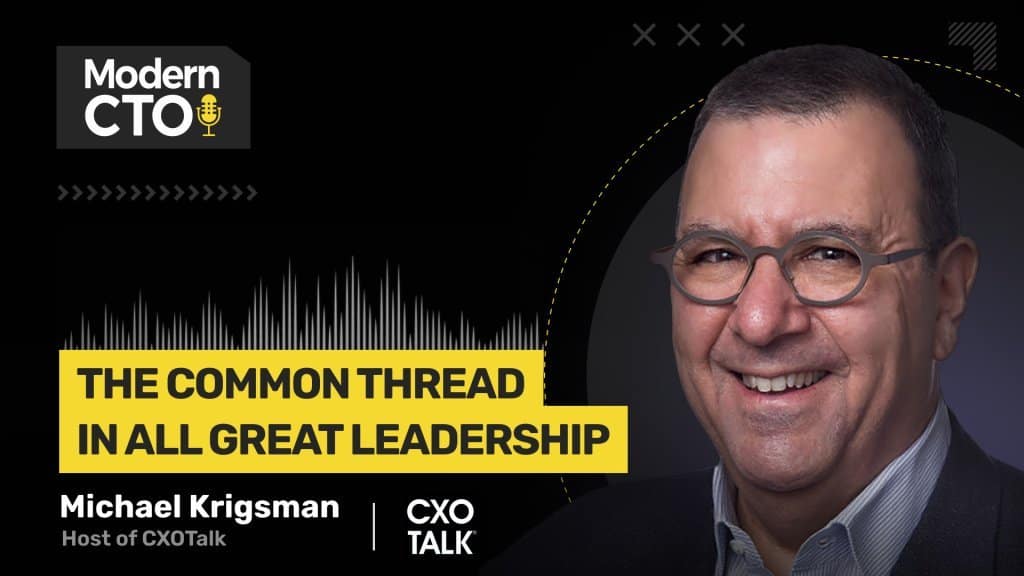
The Common Thread in All Great Leadership with Michael Krigsman, Host of CXOTalk
Today we’re talking to Michael Krigsman, Host of CXOTalk. We discuss Michael’s journey interviewing top executives for nearly 1000 episodes, what he’s learned from these exceptional minds, and how CTOs in particular can become the best versions of themselves.
All of this right here, right now, on the Modern CTO Podcast!
To learn more about CXOTalk, check out their website: https://www.cxotalk.com/
Produced by ProSeries Media: https://proseriesmedia.com/
For booking inquiries, email [email protected]
About Michael Krigsman
Michael Krigsman is an industry analyst and publisher of CXOTalk. For three decades, he has advised enterprise technology companies on market messaging and positioning strategy. He has written over 1,000 blogs on leadership and digital transformation and created almost 1,000 video interviews with the world’s top business leaders on these topics. His work has been referenced in the media over 1,000 times and in over 50 books.
He has presented to groups such as Oracle OpenWorld, Digital Enterprise Show, CIO Summit Boston, D-Summit, Harvard University, Babson College, Seton Hill University, University College London, CIO Summit Scottsdale, CT Executive Symposium, Federal Home Loan Banks, Boston University, Suffolk University, SAP Sapphire, NetSuite, MIT CIO Symposium, Educause, CRM Evolution, SXSW, Cloud CIO, Minn. HR Tech Expo, CIO Mobility Innovation Summit, Enterasys Partner Advisory Council, Dynatrace Perform, SaaStr conference, Roundtable on Digital Strategies run by the Center for Digital Strategies at the Tuck School of Business at Dartmouth, Chief Digital Officer Summit, Chief AI Officer Summit, Chief Digital and Analytics Officer Summit, and many others.
He is also a photographer whose work has been published by the Wall Street Journal, MIT, CNET News, the National Park Service, Inc. Magazine, and others.
About CXOTalk
Michael Krigsman is an industry analyst and publisher of CXOTalk. For three decades, he has advised enterprise technology companies on market messaging and positioning strategy. He has written over 1,000 blogs on leadership and digital transformation and created almost 1,000 video interviews with the world’s top business leaders on these topics. His work has been referenced in the media over 1,000 times and in over 50 books.
He has presented to groups such as Oracle OpenWorld, Digital Enterprise Show, CIO Summit Boston, D-Summit, Harvard University, Babson College, Seton Hill University, University College London, CIO Summit Scottsdale, CT Executive Symposium, Federal Home Loan Banks, Boston University, Suffolk University, SAP Sapphire, NetSuite, MIT CIO Symposium, Educause, CRM Evolution, SXSW, Cloud CIO, Minn. HR Tech Expo, CIO Mobility Innovation Summit, Enterasys Partner Advisory Council, Dynatrace Perform, SaaStr conference, Roundtable on Digital Strategies run by the Center for Digital Strategies at the Tuck School of Business at Dartmouth, Chief Digital Officer Summit, Chief AI Officer Summit, Chief Digital and Analytics Officer Summit, and many others.
He is also a photographer whose work has been published by the Wall Street Journal, MIT, CNET News, the National Park Service, Inc. Magazine, and others.
Transcript
(Intro Narrator at 00:00:00) Today, we're talking to Michael Krigsman, host, publisher, and industry analyst at CXOTalk, about the common thread in all great leadership, Michael's adventures as a podcast host, and more. You're listening to Joel Beasley, Modern CTO.
(Joel Beasley at 00:00:21) Michael.
(Michael Krigsman at 00:00:22) Hey, Joel.
(Joel Beasley at 00:00:23) Have you ever done a podcast before?
(Michael Krigsman at 00:00:27) I've heard of this thing called podcast. I actually saw a clip the other day from Steve Jobs where he was introducing the idea, the concept of podcast to an audience, and he said it's a concatenation of iPod and broadcasting. I thought that was really interesting.
(Joel Beasley at 00:00:49) Oh, wow. Do you know why he made the iPod? I don't know. He made it for his daughter.
(Michael Krigsman at 00:00:54) Oh, really? I didn't know that.
(Joel Beasley at 00:00:55) He didn't have a good relationship with her, and he saw her carrying around all the records, and he's like, you know what I'm gonna do for her? I'm gonna build her a device where she could just have, like, a thousand songs.
(Michael Krigsman at 00:01:06) You know, it's funny. When people are in their, say, late teens or going to college, sometimes they'll become musicians because they can meet girls. Or I suppose if it's a girl, they can meet guys. And when people running companies are feeling estranged from their daughter, they say, you know, gee, I can build a device that will make her like me. So it's really funny, the motivations that people have.
(Joel Beasley at 00:01:30) Right. Right. And if that's what he does, if he's a maker and he wants to show his love, you know, then that's the route he'll take. Well, I was excited because it's a very rare opportunity. I'm about ten years and a thousand episodes in, and you're almost a thousand episodes in yourself. And it's very rare that I get to talk to other hosts who have done that volume of shows. So can you tell me a little bit about how it got started?
(Michael Krigsman at 00:01:59) Yeah. You know, I guess, like probably most people, you never know where things are gonna end up. But in 2013, I was doing consulting, advisory consulting for many of the largest enterprise software companies like Microsoft and SAP and a bunch of smaller ones. And I was at an event, and Guy Kawasaki was speaking. And I thought, you know, there's this video thing that's happening, and it might be too late to get involved in this, but it might be interesting. And nobody is doing a live video show discussion series for the enterprise. Right? Podcasting had sort of emerged, and video was emerging. And I thought, gee, this would be kind of interesting to do a live show. And CXOTalk was born out of that. And I realized I like doing this a lot. So I gave up consulting, and I focused just on CXOTalk. And that's how it started.
(Joel Beasley at 00:03:06) And now it's your full-time job?
(Michael Krigsman at 00:03:07) It is definitely my full-time job.
(Joel Beasley at 00:03:09) And then what's the primary topic for your show, and why do people listen? What's the value?
(Michael Krigsman at 00:03:17) I think the real value is interviewing the most senior executives from the largest organizations in the world and the most well-known brands in the world. And my goal is to humanize these folks, to actually have a human connection conversation, and they're live, and we take questions from the audience.
(Joel Beasley at 00:03:53) Your shows are live? Oh, yeah. They are definitely live. Wow. So you stream them live, and then you edit them down into a podcast.
(Michael Krigsman at 00:03:59) So we stream them live, and then we do light editing. And then we release that video. It's all on video. We release the video, that edited version, and then we pull the audio off of the video and release that as an audio podcast.
(Joel Beasley at 00:04:20) Oh, okay. Where can people watch this? Where do you stream live from?
(Michael Krigsman at 00:04:25) So the best thing is just go to cxotalk.com. Sign up for our newsletter because we always announce our upcoming shows on the upcoming schedule, and then they can watch it on our site. We also stream live to LinkedIn. When LinkedIn is working, you know, sometimes you press the button to go live on LinkedIn, and nothing happens. I mean, it's LinkedIn. So mostly on our website is the best place to watch.
(Joel Beasley at 00:04:54) Oh, awesome. I looked on your website. You've got huge brands, CXOs from IKEA, McGraw Hill, Estée Lauder, and so on. That's awesome, man.
(Michael Krigsman at 00:05:05) You know, it takes a while to build up the trust, especially when you're doing it live with senior people from these big companies. So I'm very used to being vetted by their PR departments and their comms department. I mean, I'm very used to being kicked and poked and prodded and evaluated and checked out. But at the end of the day, my goal is really simple. It's to find the smartest, most interesting people that I can find and create an environment where they can be at their best for the benefit of the audience. And so I want them to feel comfortable, and it's hard, you know, to be live for an hour. Our shows run for an hour where we take questions from the audience, and the questions are not scripted. You never know what the audience is going to ask. And these are people, in many cases, running huge public companies, you know, with hundreds of thousands of employees. So there's a lot of stress, and I think it's really hard. It's really challenging to be a guest on CXOTalk. And I just want them to feel as comfortable as they can, you know, given the fact that it's in a pressure cooker. You're in a pressure cooker, but try to relax. You know? Feel comfortable.
(Joel Beasley at 00:06:35) It's a pressure cooker? Like, what type of questions are you asking?
(Michael Krigsman at 00:06:38) Well, just the environment. You know, the questions are really trying to understand what they do. So for example, if I'm speaking with a CTO, tell us about the technology, but also tell us about how that technology is embedded in the broader context of this business, of the organization. But there's no room for fluff. You know? I'm not interested. I am not interested in hearing why you got interested in computers at 10 years old, and I'm not interested in hearing your marketing pitch for your company and to be a walking, talking brochure. It's like I have no interest in that. It's interesting, I'm sure, but not to my audience. So it's very substantive.
(Joel Beasley at 00:07:29) Yeah. I found out really quickly in my first 100 episodes that everybody thinks their story is unique, and there's only, like, three stories for how the people entered this job.
(Michael Krigsman at 00:07:40) Yeah. I mean, at the end of the day, you have to think about, and this is advice I would give, by the way, to CTOs. I mean, you're the Modern CTO. And so the advice that I would give to CTOs is very directly relevant here. I would say communication is fundamentally important in order to get your job done, in order to be successful in your job. And the foundation of communication is simultaneously understanding, being clear about what you're trying to communicate, and understanding and being clear about where the audience is. Because that's the only way to match up your goal as a communicator to express whatever you're trying to say and make sure that they, meaning your audience, receives it, understands it, forms an emotional connection to it, internalizes it. And I think, you know, you're a communicator. You've done all of these episodes. You understand this, but I think a lot of technical leaders are weaker on this dimension.
(Joel Beasley at 00:08:56) Oh, for sure.
(Michael Krigsman at 00:08:58) Yeah. So I think that the best CTOs that I know, and I've interviewed some really, really good ones, great ones, the very best of them have this deep understanding of the business. They have a deep understanding of the technology, and they have a very clear understanding of how that technology supports the underlying, or the fundamental, business goals.
(Joel Beasley at 00:09:32) I completely agree. Usually, the biggest red flag that I see is people asking me what the responsibilities of the CTO are, and they wanna know what they are so they can go check them off. And I was like, there's really one responsibility, and it's to know your organization and figure out how to bring value to whatever they're trying to accomplish.
(Michael Krigsman at 00:09:50) What I find very interesting is we're talking about what is ultimately a very technology-based subject. Right? We're talking about chief technology officer. And yet at some point in the career of a CTO, they need to make a transition from being focused as a hands-on technologist leader to understanding that technology, but being able to talk business, as you just indicated.
(Joel Beasley at 00:10:24) It's pretty rare, but I'd say 10% of the CTOs, maybe less that I run into, will think it's a badge of honor that they're still programming eight hours a day. And I'm like, well, you know, you have over a thousand engineers in your company, and you're not doing something. Like, who have you relegated that responsibility to, or who have you delegated that responsibility to? Because if someone's not playing that role, things are probably not going well if you're writing code all day every day still.
(Michael Krigsman at 00:10:57) Yeah. I mean, if you have a thousand engineers, then who's developing the vision for what these folks are working on? And how is that vision being developed? Are you, you know, kind of saying, well, this seems kinda cool, so we should do that? At a company, at a large company, probably not. At least, I hope not.
(Joel Beasley at 00:11:18) I think the interesting part for me was finding that they think it's, like, a good thing that they like, they didn't wanna become the business person. And they're like, I managed to, like, achieve success and not become that person. And I'm like, that's not a bad person to become. It's a different role. But you're exactly right to your point of the, if I have to boil it down and look at the top 1%, the top 1% have an incredible understanding of the, let's use Kyle. So Kyle's the CTO of, well, he's actually the CEO now. Kyle Malady was the CTO of Verizon Wireless, and then he became the CEO of Verizon Business. I think I got that correctly. But he was, like, incredibly competent on a technical level. Like, he'd go in the lab and frequencies and everything. Like, he can talk all the way down to the smallest unit of measurement in his field. But he was also really good at people, time management, storytelling, communication, and all of those things. And it's almost like you could see he had, you know, twenty years of both things, almost, of experience. And that's what I find in the top 1%. So I think you and I, both having done nearly a thousand interviews, have come to the same conclusion.
(Michael Krigsman at 00:12:35) Well, those are the people that I seek out to be guests on CXOTalk. Those are the ones who are killing it. I mean, there's a person named Inderpal Bhandari, who recently left IBM as their global chief data officer. He sits on the board of Walgreens Boots and other companies. But when you have, and now he's a chief data officer, but still, at a company like IBM, that's a big job. So when you have somebody like that who has that really profound technology background and you see them sitting on the board of directors of a public company, it's really obvious. Like, this person knows both the business and the technology domains really, really, really well. Like, extraordinarily well.
(Joel Beasley at 00:13:41) So I wanna do a brief section of this conversation on tips for podcast hosts. What's the most important learning you've picked up doing almost a thousand episodes?
(Michael Krigsman at 00:13:52) It's a good question. There's so many things, but I think if you boil it down, you have to actually care about your guest. Now we need to unpack that. So that means you must listen carefully to the guest. You must have an understanding of your audience so that you can help guide the guest because you know your audience better than the guest. And I think it's important to develop the intuition of what works for your audience because at the end of the day, you as a podcast host or me as a podcast host, we work for the audience. And it's our job to create a conversation that the audience will find useful, helpful, interesting, and engaging. And so that means that when the guest is doing well, you give them the space to stay on that roll. It means that when the guest is just talking, talking, talking too much, not allowing any space and maybe being really boring, that you somehow find a way to break in in order to change that cycle, that negative cycle that's happening. But, of course, you have to do it in a respectful way. So I think the bottom line is having empathy for the audience and empathy for the person you're interviewing and the confidence to drive the conversation where it needs to go.
(Joel Beasley at 00:15:48) Who is the favorite guest? Like, of all the people, I know there's a lot, and there's probably just gonna be one that pops into mind. But who was one that you were, like, really, really excited to have on? You had them on, and then they absolutely crushed it.
(Michael Krigsman at 00:16:04) You know, I am so selective about who I accept as a guest. I mean, we're pitched endlessly, and I'm sure you are as well for people who wanna be a guest on CXOTalk. And we evaluate every one of those pitches so carefully. So nowadays, there are very few flops. The guests are so great. It's so, it's really hard to choose who—
(Joel Beasley at 00:16:40) I'll tell you. I'll go first. I'll go first. Creator of the Internet, Sir Tim Berners-Lee, creator of the World Wide Web. Like, for me, that was just, I was excited about it for weeks leading up to it. I got to meet him. He was awesome. Great conversation about the next iteration of the Internet. And I'll, like, forever, I'll remember that episode on my deathbed. Right? It was, another one was Kevin Scott. He's the CTO of all of Microsoft. Like, he came into the LinkedIn acquisition. I was hugely excited for that one. And so just great people. And, you know, there's gotta be one that you were, like, really excited about for, like, weeks leading up to it.
(Michael Krigsman at 00:17:24) Okay. So the one person who's, there's so many who are, like, really fascinating. But one person who's really interesting is John Halamka, who now is the president of the Mayo Clinic data platform. He used to be the CIO of Harvard Medical School and, at the same time, CIO of Beth Israel Deaconess Medical Center, which is a big medical center here in Boston. And he's like a superhuman person. He does so much. He, on the side, in his spare time, runs an animal sanctuary, where they have llamas and all kinds of many animals. And he's been a guest several times on CXOTalk, and each time, it's like, how do you do this? How do you, where do you find the time? How are you so skillful in so many different areas? But he's not the only one. That's the thing. I mean, he's incredible. But there's other people. You know, a friend of mine, Anthony Scriffignano, who is the chief data scientist at Dun & Bradstreet, is another one of these people.
(Joel Beasley at 00:18:44) Gosh. He's amazing, isn't he?
(Michael Krigsman at 00:18:47) Anthony. Yes. Anthony—
(Joel Beasley at 00:18:49) Oh, he will, he is one of the people that sticks with you, you know, of the thousand. That guy was, he was just so articulate and intelligent. Yeah. That guy was awesome. Sorry. Sorry to get so excited.
(Michael Krigsman at 00:19:03) No. Anthony, Anthony is amazing, and he and I are collaborating on some different projects as well. So Anthony, say hello. I will. Actually, I've been, he and I, I have a call with him at 4:15 today.
(Joel Beasley at 00:19:18) Oh, cool.
(Michael Krigsman at 00:19:18) I will. So yeah, Anthony, Anthony is amazing. I mean, there's so many. I mean, I'm just looking through my list.
(Michael Krigsman at 00:19:30) There's a fellow named David Bray, who used to be CIO of the FCC. And actually, I introduced Anthony to him. Sol Rashidi. I'm just looking through the list of people that I've interviewed who was the chief analytics officer of Estée Lauder and the chief data and analytics officer of Sony Music and on and on. Like, there's all these brilliant people.
(Michael Krigsman at 00:19:56) I'm just looking. Oh, Lord Tim Clement-Jones from the House of Lords, who's been a guest a number of times on CXOTalk, who just recently wrote a book, published a book on AI ethics and algorithms.
(Joel Beasley at 00:20:13) Do you know what the title is?
(Michael Krigsman at 00:20:15) I don't see it here, but it's Lord Tim and then Clement, C-L-E-M-E-N-T, hyphen, Jones. And if you search for him, you'll find it.
(Joel Beasley at 00:20:25) Yeah, immediately. Pretty unique name.
(Michael Krigsman at 00:20:27) So, you know, he's another one who has an extraordinary mind.
(Joel Beasley at 00:20:35) Yeah. Well, this is great. What other information? If we need to leave the chief technical officers of the world with one piece of advice from Michael, what would that be?
(Michael Krigsman at 00:20:48) The advice would be choose your career trajectory in one of two directions. Either go down the path of pure technology. And if you choose that path, do soul searching because you better be—I won't curse, so I'll say it nicely—you better just be damn good at it. The best.
(Michael Krigsman at 00:21:18) Because there is a place in the world for those rare, unique souls who are so good with technology that people will just leave them alone to do that because they are just at that level of technology brilliance. That's option number one. Very few people should aspire to that because very few people possess that level, that unique, incredibly unique caliber of skill if you're trying to reach the top levels. Okay? For most of us, to be successful as a CTO, be really good with the technology, be really good with understanding the business, know how to communicate, know how to establish a vision, and get people behind you to support that vision. And then get out of the way so that your team can do what they need to do, and then hire the right people.
(Michael Krigsman at 00:22:19) Get out of the way so that those right people that you've hired can do their job, reach that vision, and then you, as their leader, will communicate it to whoever it needs to be communicated to. And you'll be successful, and your team will be successful, and then you'll get a chance to do it again at a bigger scale. That's my advice.
(Joel Beasley at 00:22:42) Brilliant. Well said, Michael. Thank you so much for doing this. I was looking forward to this all day. I was like, man, we're both at about a thousand episodes. And so if you ever need anything from me, introductions to past guests, or if you—I know you got a million people coming at you all the time—but if you ever think that I might be useful for something, I'm here for you. Okay?
(Michael Krigsman at 00:23:03) Well, thank you. And likewise. I really enjoyed this, Joel. Thank you so much for inviting me. I've been anticipating and excited about this as well, and congratulations on all of your success. I just think it's awesome.
(Joel Beasley at 00:23:16) Thank you so much for listening. And if you found this episode useful, please share it with a friend or colleague who you think would get value from it. And if you have topics that you'd like to hear discussed on the podcast, either add me on LinkedIn or send me an email, [email protected]. Every time I get an email or LinkedIn message, it absolutely makes my day and inspires me to keep going.