
Episode 749 ·
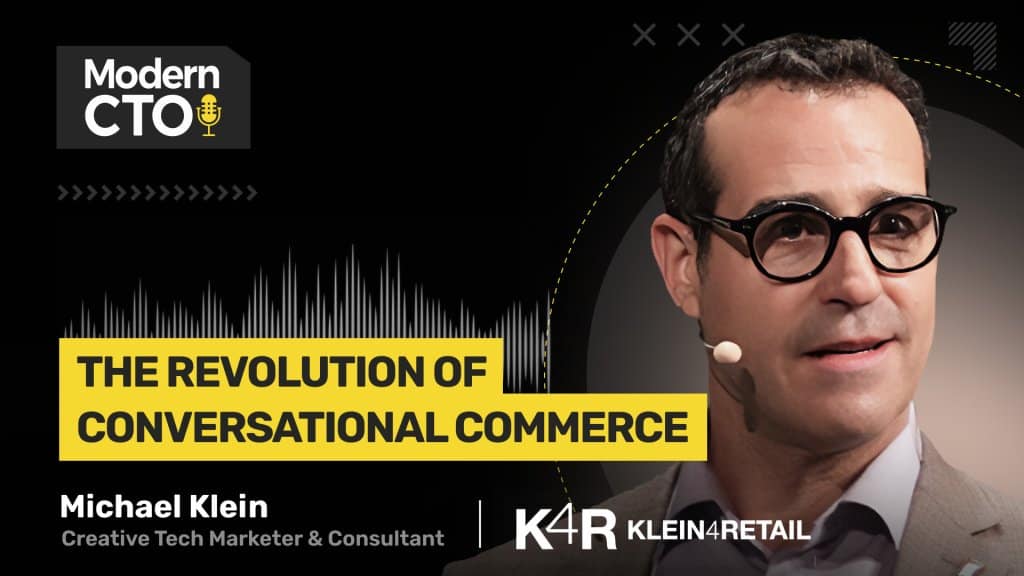
The Revolution of Conversational Commerce with Michael Klein, Creative Tech Marketer & Consultant
Today we’re talking to Creative Tech Marketer & Consultant, Michael Klein. We discuss the origins and evolutions of conversational commerce, how it’s transforming the way we interact with the market, and why authenticity matters more in today’s commerce climate than ever before.
All of this right here, right now, on the Modern CTO Podcast!
To learn more about Michael's upcoming fireside chat with Algolia, visit this page.
For more on the latest conversational commerce trends, visit this page.
For more about Klein4Retail, check out Michael's website here.
To learn more about Algolia, check out their website here.
Have feedback about the show? Let us know here.
Produced by ProSeries Media.
For booking inquiries, email [email protected]
About Michael Klein
Michael Klein is a strategic business advisor with deep expertise in the technology and
consumer industries. Considered a retail industry thought leader in global and digital
commerce, Michael regularly contributes to industry events.
Michael is working with tech providers, agencies, retailers, consumer brands and trade
associations to improve their business strategy, storytelling, and GTM messaging to support
business development and pipeline generation. Areas of focus include industry marketing,
executive advisory, content strategy, ABM, event marketing, B2B/B2C research, thought
leadership and public speaking engagements.
Prior to starting his consulting practice in 2023, Michael was the Global Director of Industry
Strategy & Marketing – Retail, Travel & Consumer Goods – for the Adobe Digital Experience
business unit from 2011-2022. Michael was responsible for creating, progressing and closing
pipeline as a trusted executive advisor to Adobe’s enterprise clients. Michael’s contributions
produced a 167% increase in annual recurring revenue for the consumer industries.
Michael began his career on the shop floor and worked his way up to the corporate office as
a senior merchant and marketer for brands such as William-Sonoma, Harry & David,
Discovery Channel Stores, eLuxury.com (LVMH Group), Dean & DeLuca and wine.com.
Transcript
(Intro Narrator at 00:00:00) Today, we're talking to creative tech marketer and consultant, Michael Klein, about advancements in conversational commerce and lessons he learned working in San Francisco during the .com boom. You're listening to Joel Beasley, Modern CTO.
(Joel Beasley at 00:00:19) And so is that what you've been calling home for the past couple decades?
(Michael Klein at 00:00:23) Oh, yeah. I came out here with the .com boom and bust in 1999. So it's been December '99, so I've been here twenty-four years.
(Joel Beasley at 00:00:34) Wow. That got me thinking just now. We talk a lot on the show about leadership and growing tech teams and lessons learned, and we talk a lot about it in present day, right, what people are learning today. Did you have any, were there any big learning moments in the .com bubble in regards to leadership or management that you picked up on?
(Michael Klein at 00:00:53) There are no bad ideas. That's probably one thing that I've always picked up on. And no matter where you may be in the organization from interns to individual contributors, frontline managers, up to, obviously, the C-suite, there's a lot of good information and ideas that come from all parts of the organization. And if you're only listening to the chiefs and not all the different folks that are around the organization, then you're probably missing the boat. So I think that's one of the things that I've certainly learned.
(Michael Klein at 00:01:31) And, you know, the other idea is just there has been over the decades some silly money spent, and make sure that you vet out your opportunities. And there are only so many unicorns out there anymore.
(Joel Beasley at 00:01:47) You gotta hunt the unicorns. There are some bad ideas. I like, I know I agree with the sentiment and the general idea, but then sometimes there are bad ideas. So when people do have, like, just bad ideas, how do you respond to that?
(Michael Klein at 00:02:04) How do you respond to that? I think you listen. You let it play out. And I've been in situations where I had seen leadership have some bad ideas, and sometimes you have to let things run their course and, you know, learn from those experiences as an organization and as humans. But sometimes you just, you can't always beat people over the head with a two by four to get your point across. So, you know, sometimes you gotta let it run its course and then course correct when things come to fruition where you think that was a bad idea and it actually turned out to be a bad idea.
(Joel Beasley at 00:02:49) Yeah. I always struggle with that with growing the teams. There's, you want to let them make their own mistakes, but sometimes there's just a mistake that you know is, like, too expensive. And it's like, oh, I just have to jump in here. Like, I just know that this doesn't work. That's always a hard thing to figure out if you should do or not. Right? It's like, should I let them make this mistake and learn? Or is this mistake too costly? And what's the timeline? And it's all so situationally dependent. I don't have a good, like, across the board answer for it other than just trying and failing a bunch and figuring it out for yourself.
(Michael Klein at 00:03:22) Because to your point, there is no one answer to all of those situations. And sometimes you can reason with data and logic. And other times, it's just a gut feel that you've seen this before, and it's just not gonna work. So there isn't that one response. And fortunately, if you do have some logic and data and also sponsorship and you're not the only one beating heads with one other person, that also can help.
(Joel Beasley at 00:03:53) Yeah. Getting buy-in from peers and those around you.
(Michael Klein at 00:03:58) Exactly.
(Joel Beasley at 00:03:59) So I got to speak with Sean over at Algolia. He said you guys were doing some work together, partnering on some things. Could you tell me about that?
(Michael Klein at 00:04:08) I've known Algolia for a while because they're a partner of Adobe, and I spent fourteen years at Adobe before striking out on my own this year. And they were looking to bring some thought leadership to the NRF event in January and approached me through our relationship and one of their former partner managers. And I talked to them about what they're doing at NRF and talked also about some of the other programs I had led and managed from a campaign perspective around NRF. The idea that it's not only what happens on the show floor, but what happens leading up to it. So we've pulled together a full campaign that addresses conversational commerce.
(Michael Klein at 00:04:55) We're in the midst of publishing an article around conversational commerce, where it's come from, where it's going. I think we've shared that with you as well. And that should be published any day now. By the time this airs, I'm sure it'll already be out in the wires out there. So we're really focused around making the most out of NRF and bringing thought leadership and demand to the booth.
(Joel Beasley at 00:05:23) Oh, that's pretty cool. So tell me about the conversational commerce. Like, what is that, and are people using it today?
(Michael Klein at 00:05:33) We've been using it for many years at varying levels of satisfaction and experience. The idea of conversational commerce came out probably about ten years ago or so, 2014, when Amazon introduced the Echo and Alexa as an assistant. And we were asking it to time an egg, what the weather was, what the news was. But there was this whole promise that we were gonna have this new wave of shopping through speaking to a device through voice. And initially, it was pretty disappointing.
(Michael Klein at 00:06:20) Quite often, it was, I don't understand what you're asking for. And, you know, if you were reordering something that was already in your shopping history, it could prove to be a pretty frustrating experience. It's evolved over the years to, especially in the digital space, to how does a brand, a retailer, engage with a consumer similar to how they might engage in a brick and mortar store through digital. And the most popular example of this now is a chatbot. But we're gonna be moving into the future into other capabilities, especially with increase of computing power, NLP, Gen AI, all of the capabilities that have evolved over the last decade to really duplicate in some way, shape, or form some form of experience conversation that a consumer will have with a brand that would look like what I would if I walked into a store, Neiman Marcus, Nordstrom, Macy's, you name it, Best Buy, and start out a conversation with a store associate.
(Joel Beasley at 00:07:42) So what's the first thing you've ever bought through conversational commerce, not with a human?
(Michael Klein at 00:07:49) Well, I did, I have reordered through my Alexa. So that was years ago. It was my water filter for my refrigerator because it was in my history. And I knew exactly, they knew exactly which one I need, and I need one twice a year. So it was Alexa, send me another Whirlpool water filter. So that was the first conversational commerce. Now, fast forward to most recently, I've been working on a bathroom remodel and I've used conversational commerce and some chatbots to get a little closer and understand the different types of fixtures I needed for my bathroom and what might look best. So that's my most recent example.
(Joel Beasley at 00:08:41) You chatted with them to find out what might look best? How do you mean?
(Michael Klein at 00:08:45) So I had a certain style already, a style guide in terms of the colorway and the finish of chrome. And I input those into a chat and receive back product recommendations that met those requirements of finish and brand. Because I was looking for particular brand and a particular finish.
(Joel Beasley at 00:09:13) What tool did you use specifically for this?
(Michael Klein at 00:09:15) It was both chat and search box.
(Joel Beasley at 00:09:20) Like, GPT-4? Like, what did you use that actually gave you the recommendations?
(Michael Klein at 00:09:27) Oh, so this was an on-site chatbot. I could not tell you what it was. It was my own prompt engineering asking the bot what I was looking for. So I can't indicate what that particular brand was using for their AI chatbot if it was ChatGPT. So I didn't go to ChatGPT and ask. I was on-site on a brand. I didn't start with OpenAI. I started with a brand.
(Joel Beasley at 00:10:03) So the brand had this ability. You went shopping on the brand's website, and it had this ability to help you understand finishes and all of that.
(Michael Klein at 00:10:11) Correct.
(Joel Beasley at 00:10:12) One of those just, like, fine-tuned AIs. How are they doing this?
(Michael Klein at 00:10:16) They're typically doing it with a robust product catalog, product search, and being able to connect product search to the bot. And the bot has an advanced capability to understand the catalog similar to how search might be, but having a better use of NLP, natural language processing, so that I don't have to be as precise as I might've had to be in the past in order to get the results I was looking for, where, you know, if I wasn't as precise and speaking in general, right? That's part of the evolution in the future is that we can have an intuitive natural conversation with a bot now that will be understood that will bring back relevant product results. Where in the past, if it wasn't structured and it didn't hit the product catalog and the database exactly the way they were looking for, I could have gotten garbage back.
(Joel Beasley at 00:11:33) And so is this what you're doing primarily right now, consulting, helping build these types of conversational commerce systems?
(Michael Klein at 00:11:41) I'm advising companies in a variety of ways. I know enough to be dangerous technically, but I'm a business strategist and focused on developing programs for tech providers as well as retailers. On the tech provider side, I'm helping them with go to market strategy, messaging specific to the commerce industry. So many tech providers are looking to increase their game, so to speak, and be more relevant to specific industries in the sense of vertical marketing. And that's where I come in.
(Michael Klein at 00:12:24) I can help some of these great product marketers in the tech world do a better job of telling a story and messaging to a particular industry. And retail is my sweet spot, having been a retailer for many years prior to coming over to the tech side.
(Joel Beasley at 00:12:44) What is the most interesting thing that you're seeing? Like, really cool use cases, anything stand out to you?
(Michael Klein at 00:12:50) Yeah. I'm seeing a lot of interesting use cases around both content and data. And as we're, the topic of conversation, you can't get out of any conversation without talking about AI in some way, shape, or form or Gen AI. You know, how brands are doing a better job or streamlining the process of product detail pages. And I'm also a big believer that the fear of AI replacing humans is maybe not as prevalent or shouldn't be as much of a concern. And there's a phrase that I've taken on. I forget exactly who said it, but I believe wholeheartedly that AI is not going to necessarily replace humans, but a human using AI is going to replace another human. So it's this idea that we've heard so often now, especially from the likes of Microsoft around Copilot. So how do brands and retailers use AI for content creation? There are certain fashion brands now that are using artificial intelligence and avatars and models to be able to adjust who that model is. If the brand knows your body type due to their customer relationship management system, and they knew you were a particular size in the past, they can adjust the model for that so that it's more relevant and approachable for you.
(Michael Klein at 00:14:32) If you may not be five ten and, you know, a hundred and five pounds as a woman or, you know, a guy like me who doesn't have a beer belly or something. So, you know, there's some interesting things happening in terms of modeling and content creation, bringing content together, leveraging AI as well. So those are some of the interesting things I'm seeing in the largest brands, even small brands across the globe are testing AI in some way, shape or form to either improve the customer experience, product findability, product discovery, or making life better for the employee internally. I think that's some of the most exciting stuff right now is how we're gonna tap into this, knowing also that resources, especially in retail, are challenged. Whether it's food service or retail, there's sort of more than enough stories out there telling you that, you know, getting employees or staff, not easy.
(Michael Klein at 00:15:43) If folks are walking out the door because they have other things in the gig economy that they can do rather than sit in a shop and wait for customers to come in or, you know, stand behind the counter at McDonald's.
(Joel Beasley at 00:15:56) So I like this phrase, humans using AI. Like, AI won't replace humans, but humans using AI are going to replace them. That sounds like something a political strategist came up with. Right? If one human using AI can do the job of three humans, technically, AI just replaced humans. Like, that's not, I have a six-year-old daughter who can do that math. Right? That's what it is. It's just a softer, nicer, more friendly way to say it, but it's still AI replacing humans.
(Michael Klein at 00:16:28) Well, I'm a business strategist. I need, and I'm trying to get clients. So I don't wanna blow everybody up. But, you know, I'll have some of those hard conversations behind closed doors when I have to really beat somebody over the head with a stick. Yeah. The other thought of this is how do we retrain those that may be in jeopardy of losing their job? How do we put them into different roles within an organization? How do we redeploy that staff? So it, yeah, there may be some folks that have to leave the building, but then again, we're gonna have folks that are going to learn and take on new skills.
(Michael Klein at 00:17:11) And the other thing which I was having conversation with a client just a few days ago talking about some of the things we're gonna be doing at NRF, and I really like the idea that he's thinking about it in terms of allowing employees to focus on higher value activities. So the monotony, think, let's take copywriting, writing product detail. That can be, if you're a copywriter, that can be fairly monotonous. New season, you got to write a thousand new copy blocks. How does AI help for that process and allow that copywriter to be more focused on editing and fine tuning the copy, but not writing it from scratch?
(Michael Klein at 00:18:03) And that's one of the examples I think where a copywriter in particular is probably going to be more pleased and satisfied with their role if they're doing this on a different level than just trying to write the original copy. And they're doing more of an editing role and making sure that it's in the voice of the brand and all the details are straight and make sense.
(Joel Beasley at 00:18:36) When you're out there working with brands, are, we'll do real talk here. Are people, like, generally, if you had to paint it with a broad stroke, like, are they generally scared of the idea? Like, the business owners, executives, are they scared of the idea of implementing something that would eliminate a lot of jobs, or are they, like, hungry for it? If those were your two options, which one would you say they skew towards?
(Michael Klein at 00:19:03) I think it's more the latter, but it's not that they're scared that they're going to have people lose jobs. It's that they're already resource constrained. So it goes back to, and maybe you're gonna take this as a political statement, but I'm not a big fan of the statement that says doing more with less. It's the idea of doing more with what you already have. And, again, this idea of redeployment and that, yeah, they're already having hard time getting the right talent into the corporate offices as well as into the physical brick and mortar store.
(Michael Klein at 00:19:50) So if I don't need to look for X amount of employees to do the jobs that I need done and AI can help me get to the finish line quicker, then the C-suite, the managers, the VPs, they're all looking at this as a win-win for them that they can keep their resources they have and be able to get the most out of those resources that they already have, but not necessarily need to reduce sales for the workforce because there's already enough to be done. They just can't get it all done.
(Joel Beasley at 00:20:27) You think that that's where a lot of the businesses are?
(Michael Klein at 00:20:30) Oh, definitely. Sure. It becomes, you know, that's why we have a list of priorities and we have to decide what are we going to do for this particular year and what has to wait till next fiscal year? What is in the development cycle? Because we can't do it all at once.
(Michael Klein at 00:20:51) We have to determine what is the low-hanging fruit, what is innovative that's going to keep us cutting edge, giving tools to different demographics, especially Gen Z that are looking to shop perhaps slightly differently than a golden ager or a baby boomer.
(Joel Beasley at 00:21:12) So, well, how so? How are they trying to shop?
(Michael Klein at 00:21:15) Well, I don't have TikTok, and they do.
(Joel Beasley at 00:21:21) Do they go on TikTok to shop, or is it just they're going on TikTok for entertainment and shopping opportunities occur?
(Michael Klein at 00:21:28) What does it matter which way? Because they may have in their mind that they want something. I mean, we see it in food. In food, TikTok is a huge influencer now on how young people are consuming food.
(Joel Beasley at 00:21:46) Really?
(Michael Klein at 00:21:47) Oh, yeah.
(Joel Beasley at 00:21:49) Do you have an example? Like, is it like Drake's salad and you see it and you're like, oh, I want that salad? Or how?
(Michael Klein at 00:21:55) And they're getting ideas of what do I eat today. I did a keynote at the Grocers Association here in California in September, and I did do a little bit of research. And the three top food trends in September on TikTok were chopped sandwich. Okay? So you're in Florida?
(Joel Beasley at 00:22:24) Tennessee. Nashville. Okay. I was in Florida.
(Michael Klein at 00:22:27) Depending on where you are in the country, an Italian sub is either an Italian hero or it's an Italian sub or it's a hoagie. Okay? So picture an Italian sub.
(Joel Beasley at 00:22:39) Okay.
(Michael Klein at 00:22:39) Taking all the ingredients in that and chopping it up.
(Joel Beasley at 00:22:44) Okay.
(Michael Klein at 00:22:44) And then taking all of that and putting it between two slices of bread. That's a chopped sandwich. That's a TikTok trend and phenomenon. Potato as bread. So folks are going to the supermarket, and they're going to the frozen food section. They're buying those potato hash browns or the potato pancakes, whatever, and they're frying it, and that's what they're using as their bread.
(Joel Beasley at 00:23:14) So—
(Michael Klein at 00:23:15) Making sandwiches out of potato hash browns out of the frozen food section. And then the other one was, there's a big trend on sardines and canned fish.
(Joel Beasley at 00:23:28) Okay.
(Michael Klein at 00:23:29) So, yeah.
(Joel Beasley at 00:23:31) People just like to eat it? They just are like, go buy the sardines and canned fish?
(Michael Klein at 00:23:34) Yeah. I forget there was something else. It was like number three, but the potatoes as bread and the chopped Italian sandwich were the top two.
(Joel Beasley at 00:23:42) And so the grocers can see these trends happening through consumption, right?
(Michael Klein at 00:23:47) That's what I told them. I said, you better be on TikTok, because if you're not, folks are gonna be coming in. If you're not well-stocked on frozen potato products, then you're gonna be missing the boat for those TikTokers coming into your store.
(Joel Beasley at 00:24:02) That is interesting, because if you think about it, historically—I did a very small project or two in the grocery world with Bosch a decade ago, and so I learned just a teeny bit, right? And I learned that they track these seasonal trends of how people buy, all the way down to the supermarket level, so they know how to stock the aisles. Well, if you were just, let's just say for argument's sake, that the resolution of that is annually, review the past seasons to—for you to pick up on TikTok trends would be really difficult, because you would just see these random shortages of potatoes here and there. You know what I'm saying? So if they're not looking at their data with the idea in mind that social applications can be affecting their consumption, then they wouldn't even know to be looking for those patterns, right?
(Michael Klein at 00:24:54) No. And there should be, and there are—I don't have those specifically right now anecdotally—but there are organizations that have folks that are responsible for monitoring social media in order to understand trends.
(Joel Beasley at 00:25:16) Oh, okay.
(Michael Klein at 00:25:16) I mean, look at what the likes of Shein or Temu are doing, right? They're looking at what's happening not only on their website, but in social media, to determine what type of products they should be putting out into the marketplace.
(Joel Beasley at 00:25:34) I don't know those companies. I assume they're grocery stores?
(Michael Klein at 00:25:36) No, they're fashion from out of Asia.
(Joel Beasley at 00:25:39) Oh, they're fashion.
(Michael Klein at 00:25:39) Shein, S-H-E-I-N. They're—okay. Right now, there's—
(Joel Beasley at 00:25:45) I'm not up on my Asian fashion. Most of the clothes I wear from Target, so—
(Michael Klein at 00:25:52) Yeah. Well, Target and the Walmarts and Amazons of the world and Abercrombie and Fitch, H&M, you name it, they're all keeping an eye on both Shein and Temu, T-E-M-U.
(Joel Beasley at 00:26:06) Oh, you know what? They just stormed my feeds in the past three weeks, Temu. Out of nowhere, they just exploded, and they've got product results for everything. I was like, who is this? It felt like the new Amazon. I'm like, who is this brand? Who is this brand?
(Michael Klein at 00:26:21) Yeah. They're both out of China.
(Joel Beasley at 00:26:23) Why did it explode to me? My perspective is never heard of it in my life. And then I was buying, I don't know, maybe a case for one of my rifles or something, and it came up. And then my wife, I saw it on her phone. It was there for makeup. And I'm like, what is this thing? And why is it everywhere selling everything?
(Michael Klein at 00:26:41) They're looking at your feed, and they're advertising to your preferences. And they know that—Shein is specific to fashion and apparel, if I'm correct. Temu has a much wider assortment of products. And if you could wait a few extra days to get something and you wanna pay a fraction of the price than you might from a U.S. retailer, they're hitting the market and they're being picked up very strongly by younger demographics. Some of this stuff, there have been people who review products out there. One might consider some of these goods somewhat disposable because the quality may not match the value or the price. So you're paying a low price, but you may not be getting a sweater that's gonna last more than half a season.
(Joel Beasley at 00:27:42) You know what? I try to be fashionable. Yeah, I get a lot of my plain shirts at Target. But just to set the record straight, because it's bothering me, I'd say 80% of my wardrobe is probably from Lucky. I really like the Lucky jean company. Because for me, I like the quality of it. I did try one day, I was like, I'm gonna be a big boy today, and I'm gonna go—I always see these nice shirts and stuff on Instagram, scrolling through the feeds since you're in retail. And—
(Michael Klein at 00:28:08) I was—
(Joel Beasley at 00:28:08) Alright. I'm gonna order one of their expensive shirts. I've never spent that much money on just a casual T-shirt before, right? But they're like, it's the ultimate casual T-shirt. So I was like, all right. So I bought five, six, seven of them. Different brands, different styles, all had crazy reviews. And it was like they were all so garbage. They were literally the worst shirts ever. I returned all of them, and I was like, you know, the $10 shirt I get at Target is my casual T-shirt. That is way better than any of these $90 perfect cut T-shirts, you know, that are out there. And it just really felt like I just got drop-shipped a bunch of generic junk. Do you see a lot of that happening, or is that just one bad experience for me?
(Michael Klein at 00:28:56) I think that it's gonna be all over the board in that, you know, that's your idea in terms of what you're looking for as a consumer. But there's nothing wrong with that. And somebody else might—I don't know. Was Mac Weldon in the mix of your shirts? Does that brand come up? Because they have—I've never bought anything from them, but they have one of those $90 T-shirts, whatever. And they—I get physical mail order catalogs, Stayin' on the Bar, because I'm in the city here in San Francisco Bay Area, and from New York, so I like my fashion. I probably spend a little bit too much on it sometimes. So they've definitely targeted me as somebody that might actually buy and spend $90 on a T-shirt. But there's nothing that is a direct correlation all the time to price and quality and value. Because sometimes it's marketing and it's brand perception. And what's the difference between the $10, the $90, and the—if you go to a Louis Vuitton or a Gucci, you can buy a T-shirt for several hundred dollars.
(Joel Beasley at 00:30:12) Really?
(Michael Klein at 00:30:13) Oh, yeah.
(Joel Beasley at 00:30:15) There are T-shirts that cost several hundred dollars?
(Michael Klein at 00:30:19) Oh, yeah. Definitely.
(Joel Beasley at 00:30:20) That is unbelievable. What are they? They're handmade?
(Michael Klein at 00:30:23) What do you think Jay-Z wears?
(Joel Beasley at 00:30:25) Target shirts. I don't know. I guess he's got—I don't know. I'm not there yet. Wait. Josh is gonna show us something. I get shoes. I'll spend a couple hundred dollars on shoes. I like Johnston & Murphy as a brand. You know, I typically will spend more money on that.
(Michael Klein at 00:30:43) Quality. That's yeah. You're paying a decent penny for your shoes there.
(Joel Beasley at 00:30:48) Yeah. But the quality is reflective of the increase in cost, right? I would never buy shoes at Target or anything like that. I like to buy shoes and keep them for a while. There we go, Josh.
(Michael Klein at 00:30:59) Look at that.
(Joel Beasley at 00:31:00) That is a black shirt—
(Michael Klein at 00:31:01) T-shirt.
(Joel Beasley at 00:31:02) That says Gucci, and it's $590.
(Michael Klein at 00:31:08) But it says—
(Joel Beasley at 00:31:09) Gucci on it.
(Michael Klein at 00:31:10) Look at those pants.
(Joel Beasley at 00:31:10) They remind me of the late nineties, early two thousands, the skater pants or whatever that they would wear, those baggy baggy jean pants. My cousins would, and they'd go around on their skateboards. That's hilarious.
(Michael Klein at 00:31:24) Oh, yeah. That's with the young folks. Yeah, there's another interesting phenomenon I've learned talking about fashion. I have to throw this out there. And I don't know if this is happening where you live, but I live in Oakland, suburb of San Francisco here, across the bridge. Live in a little town called, in part of Oakland called Montclair. And 3:00 in the afternoon, if I'm down in my village, there's all the high school kids are getting out of school. What is with this trend of wearing pajamas to school? They're wearing pajama bottoms to school. They're wearing plaid pajama bottoms and, or printed with snowmen on them or polar bears. I don't get it. But anyway, that's another trend I've—
(Joel Beasley at 00:32:11) Yes. Fashion is an interesting thing.
(Michael Klein at 00:32:13) Shopping is an interesting game. Retail is an interesting game. You know, we've talked a bit about social media. I believe live streaming still has not yet had its heyday here in the U.S. like it has in China with the big influencers and doing a big live stream event. But we're going to see more video shopping and more live streaming in various forms, not just what I call one-to-many, which is the Chinese style or that we see in terms of, you know, the lipstick influencer says at 10:00 in the morning, they're gonna be on Instagram, TikTok, wherever it may be, their own platform, and they get thousands and thousands of viewers. Purchase goes up, shoots up. But you're also gonna see one-to-one and one-to-a-few where folks that wanna have an experience in the store but can't get to the store might have a personal shopper or some type of clienteling relationship with someone that can actually take them through video, through live streaming, into a physical location and be able to look and feel the product through live streaming.
(Joel Beasley at 00:33:31) Woah. You can have a gofer-type person go—take—they're gonna be—it's like FaceTime that you send a person out.
(Michael Klein at 00:33:38) Yeah. It's already happening. It's already happening.
(Joel Beasley at 00:33:40) We kinda did—DoorDash. Not DoorDash. Who do we use? I live out in the middle of nowhere. Instacart. Instacart. We don't get to see the stream, but we're picking the products, and then they go pick the products. But that's just one behavior removed. If they were just in the store and they flip open their phone, that's what I do when I'm with my wife. She's like, go pick up children's medicines when the kids are sick. And I'm like, I don't know which one, and I just start live streaming near the aisle.
(Michael Klein at 00:34:09) Yep. You know, that's how technology is going to enable and create new channels for shopping. It's a very interesting time in commerce. Folks will always talk about Marc Andreessen, the Netscape guy, many years ago. I think it was around 2013, about ten years ago, maybe a little bit more, indicated that he predicted that the retail store would be a dinosaur and that they'd all be eventually off the face of the earth. And that's never gonna happen.
(Joel Beasley at 00:34:44) Yeah. I think we're gonna go a little bit somewhere in between extinction and Tesla, because there are purchases I wanna make where I go in and physically see it and touch it. And a car is one of those typically.
(Michael Klein at 00:34:59) And—
(Joel Beasley at 00:35:01) Or at least people that like to shop. They like to go. That's a hobby or it's an experience.
(Michael Klein at 00:35:13) I mean, look at a place like New York City, Madison Avenue, 5th Avenue. Those places are built for people that wanna just walk up and down the street and go in and out of stores and shop and engage with store associates and touch the product, feel the product, try it on, test it out. So there's, they all come in different shapes and sizes. And, also, I did some research for another client recently, a retailer. And what we learned is you could put somebody in a bucket, whether it's a spearfisher or somebody who uses internal search all the time, or a hunter that likes to browse, and they may not know what they're looking for, but they like to go through a lot of different pages. No matter how you classify a particular shopper, it goes across demographics. And that not everybody who's a Gen Z all wants to shop the same way. Not everybody who's a baby boomer wants to shop the same way. So you have to really be prepared for this idea of hybrid shopping, online and offline. I'm not a big fan of the term omnichannel that you hear so often because it, to me, connotes silos of channels. But whether it's unified commerce or hybrid retail, I think that's a better connotation to the idea that consumers are in the digital space and in the physical space at any point of their shopping journey, and you have to be there and meet them where they are.
(Joel Beasley at 00:36:51) That makes sense, right? Pick up on the shopping behaviors and patterns and just serve the behavior. Now that we've kind of warmed up a little bit, can you just give me another brief explanation about what you did with Algolia? And who do you know over there?
(Joel Beasley at 00:37:05) Who do you work with over there?
(Michael Klein at 00:37:06) So I work with Bernadette Nixon and Laura Hamilton. And Bernadette is their CEO. And Bernadette and I will be sharing the stage at NRF, so I've been working with her on our fireside chat that we'll be having on January 16th. And Laura Hamilton, who's their VP of Marketing, as well as some of her team, to pull together this campaign around conversational commerce and how we're going to stir up interest for folks to come to the Algolia booth and learn a little bit more of what they're doing to enable conversational commerce and the tools that they have around natural language processing, neural search, product discovery.
(Joel Beasley at 00:37:52) Oh, that's pretty cool. So you're doing some consulting with them then. That's how you know them.
(Michael Klein at 00:37:58) Correct.
(Joel Beasley at 00:37:58) Oh, awesome. Well, you seem to be like the guy. You have so much experience in understanding this retail and commerce. Me, I just have the experience of a consumer. I don't spend a lot of time there as far as understanding the technologies.
(Joel Beasley at 00:38:14) But when I get to see cool stuff, like I saw Algolia and what they were doing, I was like, oh, that's actually pretty neat how they're making the products more searchable and accessible. And so I was like, that actually looks pretty cool. So it was really good to get to do an episode with them.
(Michael Klein at 00:38:28) Yeah. I've been involved in technology and the internal search and product discovery space for many years. The company that I joined in 2008, prior to Adobe and Omniture acquiring them, was focused on this idea of internal search. And, you know, if you think about, if I'm a consumer and I know what I want, I'm typically not going to start to browse around a website. I'm going to use the search bar and I'm going to type in what I'm looking for. And those numbers, especially as consumers are more time constrained than ever before in their personal lives and they're in different mediums on the Internet—there are more and more consumers that are using that capability on a website in order to get to the product that they are looking for and purchasing. So it's really important that a brand, a retailer, has really good internal search so that customers aren't frustrated. They don't abandon the experience because they're not getting the relevant results, because there's nothing worse than searching for, you know, pair of blue jeans or a t-shirt or television, whatever it may be, and getting results back that don't fit the parameters that you've asked for.
(Joel Beasley at 00:39:55) What else did we want to get out there? We gave a shout out. What's the name of your consultancy, Michael?
(Michael Klein at 00:40:00) Klein for Retail. So my last name, the number four, retail. Klein for Retail.
(Joel Beasley at 00:40:06) Nice. Were there any other points that we didn't get to that we wanted to get out there?
(Michael Klein at 00:40:11) The other thought is, when we think about this idea of conversational commerce, it still goes back to authenticity. Because if you're not authentic as a brand, you're going to lose customers because consumers are too smart and they can sniff out when somebody is just trying to put their hand in their pocket and get their money. So the idea of authenticity is really important in any of these discussions around conversational commerce because, you know, it's difficult to replicate a human-type experience in a digital or online environment. So the more you can bring some level of authenticity and personality to that is going to benefit you in the long run.
(Joel Beasley at 00:41:03) Yes. That is one of the things that I found out that almost all humans can do at various intelligence levels is they can pick up on authenticity. They can tell when someone's being genuine or not. That translates into brands too, right?
(Joel Beasley at 00:41:22) You can feel when the brands are, as you said, trying to stick their hand in your pocket, right? Yep. Wow. Alright, Michael. We did it. I feel good.
(Michael Klein at 00:41:30) It was a great conversation. I had a ton of fun. So thanks for that.
(Joel Beasley at 00:41:34) Thank you so much for listening. And if you found this episode useful, please share it with a friend or colleague who you think would get value from it. And if you have topics that you'd like to hear discussed on the podcast, either add me on LinkedIn or send me an email, [email protected]. Every time I get an email or LinkedIn message, it absolutely makes my day and inspires me to keep going.