
Episode 597 ·
The Future of Work in the 4th Industrial Revolution with Marty Groover, Partner, and CTO at C5MI and author of Speed of Advance
Today we’re talking to Marty Groover, Partner and CTO at C5MI and author of Speed of Advance. We discuss the future of work in the light of the 4th Industrial Revolution; why companies that require workers to come back to the office are losing employees; and whether or not technology will make our jobs obsolete.
All of this right here, right now, on the Modern CTO Podcast!
Check out Speed of Advance here!
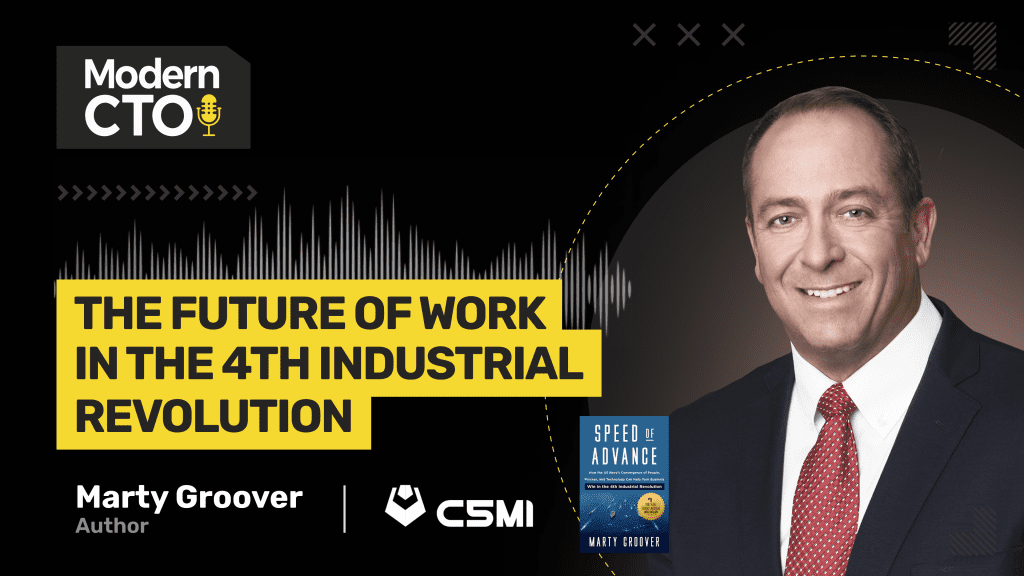
About Marty Groover:
Partner, Chief Technology Officer with more than 20 years of experience leading complex Information Technology (IT) solution delivery and aligning IT with Operational Technology (OT) capabilities for multiple facilities worldwide.
Accomplished leader with an exemplary career history coordinating with corporate partners to develop and execute production planning, lean manufacturing, and Enterprise Resource Planning (ERP) systems. Operational Intelligence strategist with the proven ability to enhance data visualization, maximize value streams, and lead global cross-functional teams.
About C5MI:
We believe in the power of technology to transform, the power of knowledge to guide and our own experience to position your business as a winner.
Who we are
C5MI is a services firm comprised of trusted business practitioners with deep knowledge and first-hand experience managing world-class business processes, and implementing cutting edge technology solutions for manufacturers and supply chains globally.
We will identify where a company has gaps and create a specific plan on how to address those problems. We will save them money first by making their processes more efficient and effective; then we will help them improve their business operations through investments in technology, further increasing efficiencies, always working alongside them throughout their journey.
We see ourselves as allies, not as consultants, that’s why we excel at providing customers long-term value and continuous improvement to create better, stronger, and more efficient companies.
Transcript
(Intro Narrator at 00:00:00) Today, Marty DeMarty, author of Speed of Advance, about the future of work in the midst of the fourth industrial revolution. You're listening to Joel Beasley, Modern CTO.
(Joel Beasley at 00:00:15) I was super excited to get to talk with you today. I've read Steve Case's book about the industrial revolutions, then I saw yours when I was doing research. I was looking at some of the World Economic Forum and the Davos types events where they're talking about it. It's a topic of conversation that I've only grazed the surface of. And so when the opportunity came up to speak with somebody who's written an entire book about it, I was very excited.
(Marty DeMarty at 00:00:44) Yeah, it was one of those things you had to do, and I didn't realize I knew so much about it until I started translating what I did in the Navy. And I started having these moments like, "Wow, here you go. We've already seen the future." That's why I kind of call myself Marty McFly in the book and just had to translate after working at Caterpillar for a while in manufacturing and started to really see the parallelisms between what we did technically with the Aegis weapon system and what really is going to happen in the fourth industrial revolution.
(Joel Beasley at 00:01:14) Tell me about that.
(Marty DeMarty at 00:01:16) So I'll just do a little history. The speed of air warfare got so fast in the Vietnam War. The old radar systems, humans were in the loop, so to speak, if that term makes sense. It took a human to take a designation on a missile, find it with a radar. Once it locked on, it was fine. But when missiles started getting in Mach speeds, it really didn't work too well, and we took a couple of missile hits. The Navy started realizing that, hey, a human can't manage the speed of air warfare anymore. So fast forward, they made the Aegis weapon system, the first weapon system made totally on land. They didn't even have the platform for it. There's a building in Morristown, New Jersey. It looks like a ship out in the middle of a cornfield, in a way. And they developed a system there. Really, what it did, it was the first system to converge air warfare, subsurface warfare, everything into a common display system, CDS, they called it. And you could do math on top of it. You could figure out CPAs. But what it also did is the Aegis radar went from a rotating radar to a phased array, and now it's digitally steered, meaning the computer system managed the radar resources without really a human in the loop. It could go fully automatic and fire missiles and everything without anybody doing anything, which was what we needed when we were in the Cold War. And it really helped us win the Cold War because we got so far technically advanced that the Russians could not make the investments. Now their ships looked a lot more aggressive than ours because they had missile launchers all over them, but they had that because of the reliability. Our systems were so reliable and accurate that they just couldn't compete. And ultimately, in the late eighties, early nineties, they just kind of gave up and put everything in mothball and started over. But fast forward, the speed of retail now with Amazon, very similar situation. The speed of retail is so fast in our supply chains, and the humans, you know, what I know of manufacturing supply chains, logistics really can't keep track of all the data needed to understand lead times and material changes, where the material is, and long supply chains. And so where we're going now at the end of the Silicon revolution, which started in the early eighties with PCs, now sort of the way we overcame the air warfare situation is what's going to happen in the fourth industrial revolution. It's going to have to, to keep up with the speed of retail.
(Joel Beasley at 00:03:42) So the speed of retail and you said it in another way at the beginning. Speed of...
(Marty DeMarty at 00:03:48) Air warfare.
(Joel Beasley at 00:03:49) Speed of air warfare and speed of retail. Where is this concept of speed of something coming from?
(Marty DeMarty at 00:03:56) It's just, humans, at least in my experience, have a certain capacity of how many different things they can handle at the same time before they get saturated, what they can really understand and see. And that speed gets to a point where they can't manage it anymore. And in air warfare, it's very challenging. Looking at a two-D screen, thinking in three-D, same with manufacturing, lead times, and where's my material, and when's it going to be here, and how long is my supply chain, and how much should I order, and all of that. That is just a lot of complicated things that have to work together to converge to make our supply chains and manufacturing work. COVID was a perfect example when they started getting interrupted in how challenging it was and just having the visibility all the way along that supply chain, the digital twin, things. But Amazon, if you look at AWS, it's really a product, but it's also their tool they had to build. They measure everything in their process, and they know exactly how long it takes. And it's all math. And it's no different than the algorithm to track a missile that's coming in at Mach 2 or whatever. You know? It's the same kind of concept, all these algorithms working together to come to manage things automatically where the man or the human doesn't need to be in the loop, if that makes sense. If there's things that humans don't need to do, you could automate them and then let the humans, and the way the Aegis weapon system works, it only, by exception, has the operator do things when they need to.
(Joel Beasley at 00:05:27) And are you still working with weapon systems, or are you working with retail now?
(Marty DeMarty at 00:05:31) Now I'm working more into the warehouse and manufacturing space, more into creating the digital twins, leveraging the data off from condition-based monitoring of whatever, whether it's real-time location tracking, whether it's a transactional ERP system with SAP, whether it's operational technology running manufactured operations management, whether we take the data off from a sensor, current off a motor, data off from a PLC. How do we converge it? And that's really where the convergence of people, process, and technology comes in, and measure that from the shop floor to the top floor, and put it into a common operational picture, which is another term I use in the book that we had in the military.
(Joel Beasley at 00:06:18) And why did you decide to write the book? You're clearly doing well, making money. You're consulting, correct?
(Marty DeMarty at 00:06:24) Consulting, yes.
(Joel Beasley at 00:06:25) Absolutely. What was, why write the book? Was it just to share your knowledge with a large amount of people?
(Marty DeMarty at 00:06:31) I really felt the need for it in our country looking at what happened during COVID. I started writing it during COVID. A little bit before COVID, I decided I was going to write it. I kind of had the chapters written out in my mind. For many years, working in manufacturing, again, light bulb after light bulb being turned on and seeing it and then understanding it. Wow. This really was a great concept of how do you leverage people and then digitize the process and use the technology the right way. A lot of times, people want to go to technology first. And my book's not how to do Industry 4.0 or how to do the next industrial revolution. It's really about strategy. How do you think about things the right way? Because if you just jump into the technology, you're probably going to make mistakes if you don't really understand what are the capabilities I need to have better business outcomes, but also to engage my workforce to manage the reality where we are today. Because when you look at companies trying to hire people and having people come to work is, it's an issue and demographics together, manufacturing. There's millions of jobs in manufacturing that are going unfilled that are going to have to be automated. That autonomy is going to need to be there to overcome those challenges because they're just not, the people just aren't there to do the work.
(Joel Beasley at 00:07:43) I agree. So I live just about an hour outside of Nashville in Tennessee. And, you know, large vacation destination. We've got the music. There's a lot of that type of industry. Right? A lot of the people working the bars and restaurants types jobs, because of the nature of the vacation type town. Now this weekend, we went into the city, into the large mall inside of Nashville.
(Marty DeMarty at 00:08:10) Yep. I've been there.
(Joel Beasley at 00:08:11) And yeah, at Opry Mills Mall or Opry. Yeah. Every place had a two-hour wait for food. And when we walked, what we started to notice was as we were going from Rainforest Cafe to this restaurant to that restaurant, walking up to them, you would imagine that they would say there's no wait because a third, if not slightly more than that, of their tables were just empty. And they all said the same thing, as if they were all singing the same song. Yeah. We just don't have the staff. We just don't have the staff. And I'm looking around, and I'm thinking, what has gone wrong? Because for a while, I had the thought in my mind that, oh, you know, we're giving a lot of economic stimulus. We have extended the unemployment benefits. Maybe people aren't going back to work because they're getting money from the government. But I believe most of that's expired. Correct? Yeah. So what is it?
(Marty DeMarty at 00:09:05) I just think there's so much, I think demographics, I think a lot of people got into, at least what I've seen in the Boomer generation, they just decided to exit the workforce. So there's a lot of people that exited the workforce, and there just weren't the people behind them to fill all those work spots. I mean, really, the demographics. If you look, it takes 2.25 children per couple to maintain your population. And we've been not hitting those numbers in our country for a while. And I think when you look at the demographics, and I love studying them, especially when you look at China and some other industrial countries, Japan, Germany. They're all in the same boat. Their populations are shrinking. In fact, China, they thought they were going to hit peak population in 2030. They hit it this year. I was reading about it. They've already are going down, and they've already had more people die than were born this year. And so they're on the same path of you're going to have to automate these things. Germany's been in trouble for a while. That's why they brought in a lot of the Syrian refugees when that happened. And I was actually working in Germany doing a SAP deployment when I worked at Caterpillar, and we had tent city right outside the Dortmund Soccer Stadium. It was really interesting, and they were bringing people in because they knew that they needed that population to do things. That's why, you know, the automation is going to have to happen in these areas, really.
(Joel Beasley at 00:10:34) Have you heard Mike Rowe talk about this? Yes. Eye opening. Right?
(Marty DeMarty at 00:10:39) Yep. He knows it's true too, and we don't have the trades. You know, I'm building a house right now. It's challenging to get anybody in the trades. Actually, if I had, all my children are graduating from college, but if I had a college age student right now, I'd say, don't go to college. Go learn a trade. Go become an electrician or a plumber or whatever because you're going to be better off financially because you're going to be able to demand a premium for your services because there's not enough people out there to do it.
(Joel Beasley at 00:11:07) Well, there's the story of an electrician driving around in the $80,000 pickup truck crushing it at 21. And then you see their counterpart coming out of college with $100,000 in debt, living at home with their parents. They've already bought their first house, have a car they shouldn't be having if you're following an intelligent financial plan, but they've got the disposable income simply because the price has gone up so great because of the supply and demand.
(Marty DeMarty at 00:11:34) Yeah. Absolutely. And, you know, for our security and, again, why I wrote the book, what I really believe is we globalized, and we used labor arbitrage over in China to overcome inflation and keep the prices where they're at. Now we're feeling that place again. And what happened at the end of the seventies and early eighties, we had another inflationary event, right, at the end of the seventies because of various situations with petroleum and different things that were happening. They raised interest rates just like they're doing now. People would like to think that maybe a political person came in, made some decisions, waved the wand. It's way too complex to do that. You can influence it. You can't have that type of change. But what did happen is the PC. Steve Jobs and the PC people, you know, IBM and all of them together, that PC, Silicon age, really slingshotted our productivity until about 2011. If you look at the Bureau of Labor Statistics' multifactorial productivity, we've gone down. We've got more data than ever, but that's the problem. There is so much that people have data everywhere, but it's not converged properly, and they don't really understand how to create a common operational picture that answers questions instead of creating more questions. Because just because you have a bunch of data visualization or analytics, somebody's still got to put that intelligence to it to say this means this or this equals this failure mode or based off this, do this. This is where, and then you've got to have the right strategy. What do I really need to do? And I don't care what your business is. You know, if you've got to try to survive, I mean, McDonald's has full robots now. They're cooking french fries and making. They didn't go in there to make robots to do it, but they know I need this capability. I've got to be able to keep this restaurant, but I've got to be able to serve this many people a day, just like restaurants. If they don't have enough turns, restaurants have two choices, raise their prices or go out of business. I mean, they need the turns to keep those tables moving. And if they're not seating people at tables and turning them every twenty, thirty, forty minutes, it's a recipe for going out of business.
(Joel Beasley at 00:13:45) So back to the experience I had at the mall, did we come to a conclusion? Do we think that the reason why there was a lack is because of population regeneration or because of economic things happening? Did we come to a conclusion on what we think that is?
(Marty Groover at 00:14:01) I think it's a combination of both. I think it's people leaving the workforce, but also other people, they're just deciding to do without. I mean, some of the younger millennials, I have some friends that have some kids, and they're just happy being around. They don't, they're not looking to buy a house.
(Marty Groover at 00:14:16) They don't care about what kind of car, and they're just not into that. You know, the work like that. They have different experiences in life. And I think the combination of those things, different generations, different experiences, people aren't willing maybe to do that type of work anymore. And because it's a hard job working in, you know, service and things like that, and they just don't see the value in it.
(Joel Beasley at 00:14:39) I was also thinking that part of it might be the labor squeeze in the technology market.
(Marty Groover at 00:14:47) That's true.
(Joel Beasley at 00:14:47) And them paying ridiculous entry fees just to get people out of the restaurants and into some training program where they can learn to do customer support or write some very basic low-level code.
(Marty Groover at 00:14:59) That too. Well, in remote work, absolutely. Somebody would rather go do remote work than work in a restaurant.
(Joel Beasley at 00:15:04) You know? Yeah. I talked to the CTO of Upwork.
(Marty Groover at 00:15:07) Yeah. Upwork.
(Joel Beasley at 00:15:08) And I was asking about trends or things that they see, you know, behind the scenes that are interesting. And he said one of the trends that they were seeing was the rise of hiring outside of major cities. Most people think the talent was in major cities, but it is true. It's not just a small isolated incident where people decided, "Hey, COVID happened, so I can go live outside of a major city and make my money go farther and have a higher quality of experience."
(Joel Beasley at 00:15:38) That's happening across the planet in all the different countries and continents.
(Marty Groover at 00:15:44) That is true too. Because you look at even in China, they built all those cities. And I've been all through China on the bullet trains and seen them. They're ghost cities. Nobody's living in them.
(Marty Groover at 00:15:52) There's few lights. Some of them, you know, people even paid for them and nobody's living in them, and they invested their retirements thinking they're gonna make money on it. And I do see that. And that's kind of the draw for our company. One of our models is, you know, work where you like.
(Marty Groover at 00:16:07) You know, all of our work is remote, which is amazing. We did a project for over two years. We never stepped foot on a customer's worksite, and it was a large contract mining company. And we were using telemetric data from their mining vehicles, and we never stepped foot in Indonesia and delivered these projects remotely. It's just amazing what COVID really drove.
(Joel Beasley at 00:16:31) When I was raising money for this company that we're at today, we've been doing it for about five, six years. They were asking me about how I meet with the customers and make this happen because we're selling, you know, roughly $600,000 to a million dollars a year in sponsorships and leadership training and things of that nature. And I said Zoom. And this was before the pandemic. Right?
(Joel Beasley at 00:16:57) And they're like, "What do you mean?" I said, "We meet all our customers on Zoom." He's like, "Well, why is your travel budget zero?" I was like, "Because we don't leave." And it just took a moment for everybody to realize that I think I was the first company that they had ever seen that was pitching to them that had built an entire business completely remotely.
(Joel Beasley at 00:17:16) And our team today is fully remote as well. So, yeah, I like it. I like that lifestyle.
(Marty Groover at 00:17:22) Yeah. It's definitely, a lot of people are getting pretty addicted to it. And I think companies that are requiring them to come back to work are losing them because they can go someplace else. And it's gotta be challenging. I can't even imagine being a large corporation and owning the real estate that they own and trying to, I know.
(Marty Groover at 00:17:44) You know, manage it because, and even the government, we're doing a large warehouse management system with Defense Logistics Agency. And even the government workers, they're allowing them, you know, they only have to be in the office so many days during the month. They have to hit it. But, you know, they have these huge government monoliths, and nobody's in them. They're all working from home. It's amazing.
(Joel Beasley at 00:18:09) I wanna touch back a little bit to the Mike Rowe thing. So he's been going around. We didn't, we just said, "Do you like Mike Rowe?" Right? Yeah. And I think we left the audience behind us.
(Joel Beasley at 00:18:21) But I do wanna talk about that because he's been going around to different media outlets and discussing about what's happening. To your point, we mentioned a little bit about it, about the trade jobs, but also about men and them exiting the workforce and the rate at which they're exiting the workforce. And the one thing that caught my attention, and I'm by no means well-read or an expert in this area, but I like Mike Rowe, and I tend to trust him. Right?
(Marty Groover at 00:18:48) Yeah. I do too.
(Joel Beasley at 00:18:50) I have been watching this guy for ten-plus years. Yep. You know? And he seems like a genuine person, and I happen to know the guy, Clint, who actually gave Mike his break.
(Marty Groover at 00:18:59) Oh, really?
(Joel Beasley at 00:18:59) I did a project, like, seven years ago with this guy named Clint Stockholm. And now he runs one of the offshoots of Curiosity TV or something like that. Uh-huh. And he was the one that gave Mike his break, so I got to, you know, network through that area. But the interesting thing that I took from Mike Rowe was he was saying that the way that we judge unemployment, like, the unemployment rate is a bad indicator.
(Joel Beasley at 00:19:25) Yep. And it is. Do you know why it's a bad indicator? Can you speak to it better than me?
(Marty Groover at 00:19:30) Well, I know during the Obama administration, they did change the metrics on it after 2007, so it kinda skewed what they were looking at. But it also doesn't account for all these people. Once they're out of the workforce long enough, they don't count as a percentage. So even when you see a low percentage, you really gotta look at the amount of people and the amount of people actually in the workforce. Now, right before COVID, it was the highest it'd been in a long time, the amount of people in the workforce.
(Marty Groover at 00:19:59) I think during, you know, previous administration, regardless what you think about it, the numbers were the highest they'd ever been as far as participation. And that's really what you've gotta look at, who, you know, how many people are in the workforce compared to how many people there are. Right?
(Joel Beasley at 00:20:12) Yeah. I think that was the insight that he had where he would take the number of able-bodied people that could work, and you would imagine that when we're talking about unemployment, that's where your brain goes by default. Yeah. Unemployment should be the number of people that could work and whether or not they're employed, but that's not what the number is. It's a different number.
(Joel Beasley at 00:20:33) I think in order to be considered in unemployment in that rate, you have to be actively searching for a job or applying for unemployment benefits. There's an entire, I think he said north of a million people, maybe several million people. Josh, could you Google and check that out?
(Marty Groover at 00:20:48) I'm sure it's a lot more. It's more than a million.
(Joel Beasley at 00:20:50) Yeah. And it was, he was specifically talking about men, and he was also mentioning that the amount of time that they spend on screens is equal to a full-time job because your next question is, okay, you have all these able-bodied men who are intentionally outside of the workforce. What are they doing with all of their time? They're playing video games.
(Marty Groover at 00:21:14) Yeah. Yeah.
(Joel Beasley at 00:21:15) And watching Netflix.
(Marty Groover at 00:21:16) And some of them are making money on playing video games. There's people, I have friends, their kids actually make money. Other people, this is mind-boggling to me, but other people pay to watch them play in a video game and log into their channel.
(Joel Beasley at 00:21:31) Twitch. I thought it was a joke at first when somebody told me. Because I grew up playing, I grew up arguing with my friends about who got to play next with the controller. Right? And so when I found out that, you know, you didn't want to watch, the thing you wanted to do was to play, and you would have to wait to do that.
(Joel Beasley at 00:21:47) And then I found out that there's this service where there's a billion people and they're getting YouTube-level engagement and all you do is watch other people play their game and provide commentary, I was blown away. Yep. Josh, you wanted to say something. What was the number, Josh?
(Intro Narrator at 00:22:02) Yeah. So I just Googled people not employed in the US. And, apparently, in December 2022, the number was 100,620,000 people.
(Marty Groover at 00:22:11) Yeah. So we're running around bragging about 3.5% unemployment based off what, a two-thirds numerator? The denominator totally skewed there.
(Joel Beasley at 00:22:23) Yeah. I mean, there's under 400 million people in America, I believe. Correct?
(Marty Groover at 00:22:27) Yeah.
(Joel Beasley at 00:22:28) So a hundred million, that's a quarter or so of people that could be working that aren't working. How are they making money? Is it just that their parents have money or the kids are taking care of their parents? I'm curious to know more about this.
(Marty Groover at 00:22:43) The gig economy, the gig economy is out there. And I say that, and I know this is for true because, again, I have friends, and my daughter was one of them. She'd make money just getting on Instagram and holding up a product, and they'd send her free products, and then they'd give her money if people bought it. I mean, if you really, I'm like, "You're kidding me." Right?
(Marty Groover at 00:23:01) She shows me the checks. She'd get, like, $300 from some vendor because she got the most clicks showing something of theirs in the way she demoed it. They liked it, and then she got a bunch of other people to buy stuff based off clicking on her site. So they sent her money. I was like, "This is a different world."
(Joel Beasley at 00:23:19) It makes sense, though. Yeah. Because if you see all the money that was going to TV and then all the attention got dispersed across all the people, rather than all the money just going to the TV stations. Yeah. And the media companies, it now has turned everybody into this media person. Look at me.
(Joel Beasley at 00:23:37) My background, software engineering for seventeen years, building teams of teams and then selling products and things of that nature. And then I started this as a hobby for 200 episodes. It was just an expensive hobby. Just spent savings. I had to do it.
(Joel Beasley at 00:23:51) And by year three, we were making a million dollars a year on advertisements.
(Marty Groover at 00:23:55) Yeah. I need to talk to you offline on how to do this.
(Joel Beasley at 00:23:58) Yeah.
(Marty Groover at 00:23:59) It's a whole new world. You know? In just a few years, it's gonna be totally different. It's gonna be amazing to watch, really.
(Joel Beasley at 00:24:06) So what thoughts do you have for technology entrepreneurs or technology leaders who are in decision-making positions at their business for how to handle or navigate this fourth industrial revolution?
(Marty Groover at 00:24:21) So I think it's very challenging times for these people, and you're starting to see a shift of where those decision makers, again, are moving from the Boomer level down to the Gen X and different levels. And some of them that are making decisions now are digital natives. They have a totally different view on how this stuff works. It is challenging when you go out to try to sell them solutions and sell them, you know, products that are there. And this is really the issue that we have is some of the technology that is more hardcore industrial technology just hasn't stayed up with the personal piece.
(Marty Groover at 00:24:56) You know? I love when Steve Jobs said, you know, in 2007, "You can, we could live without this," but you think about our personal life as a common operational picture on our phone, really. And if you have Macs, it's all across your Macs. But when you go out to a lot of our supply chains and manufacturing and hardcore, you know, things like that, warehousing, it's just not that way yet. And I think it's challenging for them because you have to innovate, and you're gonna have to do something.
(Marty Groover at 00:25:22) A lot of people are choosing to be second, which is fine, and we find this. But a lot of times, we go to customers, like, "We know we need to do something, but we don't know how to go." And you have to create, kind of, you gotta, it's a long-term play, but when you look at corporate people, how long do they really stay in their jobs? And especially now, after all these people retired, there's a lot of people that may have been sucked two levels up into a position, and they don't have that ground experience of, like, you know, like you did developing stuff, like I did, deploying solutions, going out and having to do the hard work. There's no easy day implementing new technology.
(Marty Groover at 00:26:00) There just isn't. It's a shin kick every time because you try to translate a business process into a technical solution. And the convergence of the people, the people gotta accept it. They've gotta see it as a value. They have to be on board with you.
(Marty Groover at 00:26:14) It has to show business value. It's a pretty risk-laden thing to install technology. I don't know if you're familiar with SAP, but I'll tell you, install an SAP and do any, it's not for the faint of heart. I mean, it's really hard. And to get that leap of faith for those people to take on the new technology and adopt it, and then start leveraging that digital core by leveraging other tools that are on top of it, I mean, people just, it's just too much for them.
(Marty Groover at 00:26:44) It's exhausting, and they're afraid to do it. Honestly, a lot of people are very like, "Hey. If I don't touch anything and it's working now, it's still gonna work." But if you look at how many retail companies went bankrupt from 2018 on, the speed of retail, what Amazon has done and definitely accelerated during COVID, they're out of business. Brick and mortar, you know, they're done.
(Marty Groover at 00:27:07) That's what's gonna happen to people that don't make decisions. Sooner or later, they're gonna get so far behind. And to your point, there won't be enough qualified people that know how to do this stuff that can do this technology thing. They integrate it, do the coding, visualize it, and create the algorithms that drive that autonomy that you want at the top of that maturity curve. They're not, there's not gonna be enough of them. I don't care how much money you have.
(Marty Groover at 00:27:35) They will not be there. Now the big four are investing large sums of money. Over at Hyderabad, I got a development team, about 30 people. Deloitte, in the last three years, built this 55,000-seat office over there because they see the future coming. They know cloud and everything's going on.
(Joel Beasley at 00:27:55) What country is this?
(Marty Groover at 00:27:56) In India.
(Joel Beasley at 00:27:56) In India?
(Marty Groover at 00:27:57) So Hyderabad is a city of 10 million people. You can't believe the investments these large, you know, multibillion-dollar companies are making. I call them the big four: Deloitte, Accenture, PWC. These companies, they have huge...
(Joel Beasley at 00:28:17) It's the company store again. I get to interview people all over the world, and when I found out what the culture was like, you're judged. Like, you work at Samsung, you live in Samsung office building.
(Joel Beasley at 00:28:29) You could tell me that it's not the city, but I know that in India somewhere, this is true. But you're part of the company. You live at the Samsung office buildings. You work at Samsung.
(Joel Beasley at 00:28:40) You go to the grocery store in your town, and there's three or four major companies. And I won't forget this: somebody had told me that the quality of the spouse was dependent upon the brand that you worked for. So you would get judged. Like, your in-laws, potential in-laws, would judge you as a mate based off of the brand that you worked for. And you can kind of see that a little bit in America.
(Joel Beasley at 00:29:06) You get judged on, you know, your class or your abilities, but it's not a specific brand. It's not like because you are Samsung, you know? So that's kind of a very distinct difference between our cultures.
(Marty Groover at 00:29:20) Oh, absolutely. But it is amazing to see the shift that's happening. But also, I think continental consumption is going to drive things back. I think COVID, if it's done nothing—again, why did I write the book? I truly believe that the labor arbitrage is over with in China.
(Marty Groover at 00:29:38) We cannot afford now. The environment's going to drive this because of the ESG, if you're familiar with that: environmental, social governance. And really what's going on in Davos this week and all the stuff that the government's doing to drive the environment, these long supply chains will not be allowed because of how much pollutants they put in the air, driving stuff across the ocean and then sitting in a port. And, you know, you just look at the port in Los Angeles or Long Beach in California, those ports, and how much they can see the pollution right there. They just changed, probably in November, December, that you couldn't even have a truck that was over so old going into the port anymore because of that situation. So I really believe small, distributed manufacturing using Industry 4.0, additive manufacturing, is just going to be the day. You're just not going to have a big factory pouring a bunch of foundry parts because you're just going to have, you know, powder-based, laser additive manufacturing.
(Marty Groover at 00:30:35) And it's amazing. The parts they can make these days are just going to be distributed around this spoke and hub sort of distribution center that Amazon's creating. Amazon's buying—Jeff Bezos wants to be net zero, what, I think by 2030 something—but he's buying 100,000 Rivian electric delivery vehicles for Prime. Now we worked with Rivian when they first started. I love their vehicles. In fact, I got one on order.
(Marty Groover at 00:31:00) My buddy's got one. It's an amazing vehicle. But that, it's a change. It's really going to drive a big difference in our country. And continent of consumption and closeness of supply chains are the only way we're going to overcome this inflation and do kind of what we did when we shifted all the capital over to China for low-tech stuff and some high-tech stuff.
(Marty Groover at 00:31:23) And now, because they've had it for 25 years or whatever, now we can make the investments back here. And I think, you know, the chips are the first kind of wave, right? Because we've got to have them. We realized during COVID, oh, we're not—we've got to put chip makers right on our land, right here where we need them.
(Marty Groover at 00:31:42) I think you're going to see that in the next 20 years, and it's just going to be a whole new world. You order a pair of sneakers, they're going to get printed. They're not going to be made. The material, you know, some of the core material will be there, but they're going to be made, you know, when you order it. It's going to be amazing.
(Marty Groover at 00:31:56) Delayed differentiation.
(Joel Beasley at 00:31:58) I was talking with Boeing, and they print some of their airplane parts. And I was just blown away. They're highly specialized parts. They have these massive 3D printers for these turbines, and they'll actually print. It's more cost-effective to be able to print it on demand than any other manufacturing position, and I agree.
(Joel Beasley at 00:32:19) You know, chips, I loved what I got to see, I think with NVIDIA in Texas, their new multibillion-dollar facility for building chips. I'm not a huge fan of the government in general, but I do acknowledge them when they do great things. And getting money to manufacturing to bring things here was a great thing.
(Joel Beasley at 00:32:41) Also, when they did the rural Internet, which helped Musk get his satellites and help the rural areas get broadband, I thought that was a fantastic thing. So not anti-government. I just like small government.
(Marty Groover at 00:32:52) Yeah. I like them not picking my pocket as much. I mean, I spent 21 years in the government and did my service.
(Joel Beasley at 00:32:59) Thank you.
(Marty Groover at 00:33:00) I love it, but I also know that I'd rather have us making decisions where our money goes. And if they're going to invest in manufacturing, at least it's something that's productive. It's not driving the wrong behaviors. It's driving the right behaviors somewhat.
(Joel Beasley at 00:33:15) Yes. There are so many points that you make that I want to respond to. I'm trying to be polite and let you talk as much as possible. But you are just hitting on so many issues, and that's why I like to get to do these episodes with authors, because you've thought about so many of these topics in detail. When you were discussing the supply chain, I had watched on Joe Rogan, this guy named, I think, Siddharth.
(Joel Beasley at 00:33:38) He did a book about cobalt mining in the Congo. And these supply chains were saying, you know, because cobalt's in everything. It's in...
(Marty Groover at 00:33:46) Oh, yeah.
(Joel Beasley at 00:33:46) It's in our phones...
(Marty Groover at 00:33:48) Computers, everything critical.
(Joel Beasley at 00:33:49) Yeah. And they call them artisanal miners. And that's the fancy way to say they're digging it out with their hands. And they said that we don't have any of those in our supply chain. It's all robots and machinery and all of that.
(Joel Beasley at 00:34:03) And then he got in, he back-channeled in and built relationships, and it took him a couple years. And then he got footage and videos of these where ultimately upstream ends up at the largest. And it's not just one brand that's offending because they sell upstream to this giant distributor of the cobalt, and then they distribute to everyone else. So it's not like somebody's, you know, doing that. But he did say that the companies up at the highest levels are turning a blind eye to it, and they just say that this is it, and they know it's not true.
(Joel Beasley at 00:34:33) So when I watched that on Joe Rogan, I said, "Hey," I said, "Josh and Andrea, I was like, can you guys reach out to him and see if he'd come on?" So we're going to have him on the show. So if you come up with any questions for him, let me know, and I'll ask for you.
(Marty Groover at 00:34:47) Interesting. Well, this is one of the things that I'm kind of working on on the side is the full traceability of EV material from raw material into the batteries, into the vehicles, and all the way through the life cycle, because this is going to be an amazing market, a whole new world of a battery market. Like they'll do FTXs on them and everything for second-use batteries. So I'm putting in a Tesla solar power system with the Powerwalls in my new house.
(Marty Groover at 00:35:18) And those Powerwalls will be a second use, you know, for the batteries coming out of vehicles and stuff. It's going to be amazing when you look at how many EVs are coming out. It's only going to exacerbate that core mineral traceability requirement because you're going to need to know where this stuff comes from and how they're getting it out of the ground, and that whole piece of it's just going to explode. Regardless of the way you think of blockchain, blockchain will be a major—like, they're calling it Web 3, right?
(Marty Groover at 00:35:48) Blockchain will be a major software system capability going forward. It's going to trace everything through the whole life cycle of it.
(Joel Beasley at 00:35:57) It makes complete sense. You know, everybody attributes blockchain to cryptocurrency, and a lot of people listen to the show can understand and differentiate between them. Also, I love it how as humans, we make this mistake over and over, Marty. We think that the new technology is just going to be great or it's going to work and it's going to be perfect. And then when there's problems, we all throw our hands up in the air and say, "Oh, this technology sucks," and it does. But then it has that core adoption group and it continues to mature, and then it becomes something. But it's important not to write these things off when they start stumbling through puberty and making their world appearance.
(Marty Groover at 00:36:31) Yeah, exactly. I mean, look at bubble memory. Look at some of these things that when it first came out, you know, it—and now look at the capabilities that we have in these supercomputers. It's mind-boggling when you look at a full, nothing but an NVIDIA computer.
(Marty Groover at 00:36:46) It's nothing but GPUs in the front of it, and it's just jamming unbelievable amounts of computations. I'm kind of a geek on that. I've been out to some of the labs and seen some of the giant supercomputers and what they're doing, and they're doing all AI predictive maintenance on, you know, facilities and infrastructure and stuff like that. It's the stuff I knew in the military was really amazing. Still amazing to this day, but where we're going is just—people just have no idea.
(Joel Beasley at 00:37:18) It's hard because I'm always trying to follow the money because these weird innovations will happen where there's strange large sums of money spent for things. Like for the preventative maintenance, I talked to somebody a few years ago in Australia, and they worked on these giant autonomous vehicles, construction vehicles that were stories tall and they were autonomous. And it was because it's on private land, so they don't have the same regulations. If a part went down, its ability to mine and that the dollars per second that it was out was so great that they would put the part on an aircraft or a helicopter and fly it directly there, and they would spend tens of thousands or hundreds of thousands of dollars to get this part there expedited. And if you can just provide a predictive model to help reduce that, you can have enormous amounts of dollar savings.
(Joel Beasley at 00:38:10) And to me, just to get exposed to that concept, to think out there...
(Marty Groover at 00:38:13) That's what we do.
(Joel Beasley at 00:38:14) Is it?
(Marty Groover at 00:38:15) Drive failure mode analysis and do predictive analytics. That's a project we just did with a company called PetriSea, which is a World Economic Forum Lighthouse Company. And that's exactly what it was: taking telemetric data, taking filter cuts, all these different indicators of problems or reliability, and then converging them into machine learning environment and start driving the health monitor way before it ever fails. So getting out of run-to-fail, getting to preventative, but then getting to predictive.
(Marty Groover at 00:38:46) And then not only that, but then remanufacturing products. So getting maybe 150% of the life cycle out of it that the OEM recommended because you're seeing it so early. You're not having durability issues. So there's a whole Weibull curve on durability. And if you can understand where that curve is and get ahead of it with measurements and, you know, even strain testers that understand the kind of pressures you're putting on things and metal fatigue and things like that.
(Marty Groover at 00:39:17) It's just amazing, the sensors out there now, but you have to understand the failure modes, and then you have to, you know, put them in the right algorithm, and you've got to train that machine learning over and over. And then pretty soon, you get enough data sets, and it works. I mean, we did the first predictive maintenance back in 2015 at Caterpillar on an ASRS machine. And we could see based off the torque of the spindle, the speed, the angle, the temp—those things stack together. One of them by themselves may not tell you something, but when you start stacking harmonics of issues together, all of a sudden, this and this and this—which, again, a human can't see those three things, but a machine can—and you put them together and you start stacking those harmonics of issues together, all of a sudden, you can start seeing them before they happen.
(Marty Groover at 00:40:06) And then now you pick and choose when you want to take the system offline and fix it.
(Joel Beasley at 00:40:11) I love that you mentioned that. Earlier when I talked about that Boeing episode that I had done, one of the topics was about ethical AI, and what they had done other than the 3D printing is they were doing some of this failure mode technology, and they would run it on the engines of the jets. And what they found in their data science team trying to figure this out was that the profile of how the pilot flew the plane, how aggressively they flew it, how much finesse they flew it, directly related to the wear and tear and all of that. And then they had to make this ethical decision of, do we include this information in our pilot review, as far as performance review? Ultimately, they did not.
(Joel Beasley at 00:40:53) They do not connect those things together from the last time I had a conversation with them.
(Marty Groover at 00:40:58) But how about when they just take the pilot out of the loop and say, "Guess what? If you try to do it, you're not going to be able to do it. We'll have something that counters it and won't even let..." See, that's where the mining vehicles that are operated by operators, they're going like, "Nope. You can't hard-shift it," or the brakes will automatically—because a lot of times, they leave the brakes on and, you know, they just forget what they're doing or something.
(Marty Groover at 00:41:20) All these weird human failure modes, you can see it and automate it and then, you know, take the person out of the loop and it won't even happen, you know?
(Joel Beasley at 00:41:30) What do you think will happen with the economy on the basic premise that humans use currency to exchange value with one another? So even if everything were automated, we would find some other thing, some other reason, even if it got down to all of us making art or music or something of that nature.
(Marty DeMarty (also referred to as "Wirtzak and DeMarty" in intro) at 00:41:46) I think humans are ever going to be out of the loop totally. I think that we're going to be ten times more productive because, and this is what I've seen just helping customers and doing these things, now where the people are spending all this time and non-value added and not being able to resolve problems or think about problems or have enough time to even do anything but survive in manufacturing, imagine if you could automate all these things and now the computer goes, I don't know how to solve this one, or I don't know how to make this better. I don't... Now, are you familiar with Six Sigma?
(Joel Beasley at 00:42:19) Yes.
(Marty DeMarty (also referred to as "Wirtzak and DeMarty" in intro) at 00:42:20) So DMAIC, right? So if you can codify, and this is what we always say, design it, measure it, and analyze it so that you take all of that grunge work that you have to do to try to figure out problems, and now you just have to do improve and control. And then you still use automation to improve and control. Okay, that one's done. I've digitally codified that problem. It's not a problem anymore. Pretty soon, now you've got people opened up to, to your point, painting, but they're able to be creative and start thinking about a problem. Because when you're just inundated with nothing but, you get hit with problems all day and you can't get good situation awareness or understand what you're thinking about or not have good decision support because you've got bad information and you make bad decisions. And this is where in the military we just started getting, we were able to fight differently because all these things were being taken care of for us. And actually, the system was sending alerts to us to say, hey, look at this. What's going on with that? Not us having to see it. And I think that's where we've got to go. And a lot of people say, well, the fourth industrial revolution is going to take away everybody's job. No, it's not. They're not going to do it. I don't think so. There's some things will, but I think it'll be replaced by other things that need to be done too.
(Joel Beasley at 00:43:34) Only because that's the entire pattern through all of history. That's the...
(Marty DeMarty (also referred to as "Wirtzak and DeMarty" in intro) at 00:43:37) Horseless carriages. I need an airplane. All these things.
(Joel Beasley at 00:43:41) Mail with the Internet.
(Marty DeMarty (also referred to as "Wirtzak and DeMarty" in intro) at 00:43:42) What are they going to do in the house? They got a washing machine. They've got, you know...
(Joel Beasley at 00:43:47) Oh, man. So what do you think is going to happen as far as, okay, to your point, we make people more productive. I was watching a video earlier today, and they said, and who knows if this is fact-checked, right, 2% of people have this sense of urgency, this sense of get up and go. And when I look around the world and see the entrepreneurs and see, you know, get to work with different people and just hiring people alone, I know it is definitely more rare to have someone with a high work ethic and a sense of urgency. Whether it's 2% or not, maybe it's close. But let's say you make those 2% of people ten times more efficient and effective. Does that allow more people to float on by? What happens to the people who aren't? Are they just living an average life or their desire is to, if they want to make a change to have nicer stuff? Or how does that work?
(Marty DeMarty (also referred to as "Wirtzak and DeMarty" in intro) at 00:44:41) That's interesting. You know, as a person that's highly productive, has a high sense of urgency my whole life, you know, I wake up in the middle of the night like, oh crap, I've got to get this done. You know? And it's hard for me to imagine that, though I would like to. I'm getting to the age where I would like to just be able to say, you know what? I want to read this today. I've got all these books that I buy all the time. I'm like, I want to read them. And I'm too busy creating and doing other things. But I think that some of these things, like millennials get a bad name, but what I've seen is I've seen a lot of young engineers when we give them these tools, they come up with solutions that I could never think of. They're so much better. Like, oh, look at this. I did this, this, this, and this. You're like, that's great. I mean, you're running... So I think what I really believe is if you do this right, and this is what I always try to do when I was factory manager, if I can push the business down to the lowest level, because where does the undercover boss always go? They don't go to middle management. They go down to the shop floor, the lowest level. Imagine if you could empower that workforce. There's a lot of ingenuity down there. They're just not empowered. And I think maybe they feel like, well, I'm not part of the decision. I'm not part of this. I can't... what's the difference? I'll just come here and punch my time. But what I've seen is, and I have a chapter about untapped potential in the book with people, I think if you engage people and you give them the responsibility and if they understand what you want, and, this is what you want, boss? This makes it important for my job? I can feel a sense of empowerment. I have decision rights based off this. The system's telling me... You really can drive your business down to the lower level. And when you have an organization, and I always like to say, guys, we want to set this up where we have boring manufacturing or boring logistics or boring whatever, and everybody's working two levels up because they're empowered because we've given them the tools to be part of ownership of the business and driving it. And if you can get that, the business outcomes are unbelievable because now who knows the job better than the people on the floor? Give them the tools and let and empower them and reward them properly. I used to put out reward posters. Solve this quality problem, and I'll give you, you know, this much money. And one guy, I mean, he made so much money one year off from awards. Like, we got him the chairman's or the general manager's award at the end of the year. He got like $7,000 plus up for tax. He was able to put a new driveway, and he and his wife are crying, like, can't believe, you know, we work for a company that does this for us. It's really cool to see that engagement too and empowerment.
(Joel Beasley at 00:47:20) I learned that from a young age. When I was, I think, about ten years old, my uncle worked at Fujifilm, you know, the film company. And he was, I believe, a plant manager, like a floor manager, and he had some control or way that if you moved the processing equipment, the manufacturing equipment, if you just reorganized it in the same space, you would get a certain amount of efficiency. And he went and he approached his team, their leaders, and he said, hey, I want to be compensated. I have this method that we can adopt that'll give us this more efficiency, and I want compensation based off that. And he worked out some deal with them, and he did it. And to me, just seeing that that's possible, having that around me, that helped shape my way of thinking about business quite a lot.
(Marty DeMarty (also referred to as "Wirtzak and DeMarty" in intro) at 00:48:07) Yeah, it's powerful. And if you engage people better, treat them better, and I always said, look, I work for you. My job is to empower you and give you the most tools. You tell me what you need. What's going to make a difference? Don't make excuses. Don't, you know... let's get those. But I always found that there's three y, three x. I always believe three x people want to do a good job, and if you empower them, they will. The majority of them. There's always exceptions to every rule.
(Joel Beasley at 00:48:37) Yeah. Like, when you were talking about empowering people at the lowest level, I was thinking about, you know, the eighty-twenty rule where 20% of the companies make 80% of the profits, and then you get that culture, and then it's attracting people who like to be in that top 2%, who like to do the work. And so I was thinking, I said, you know, the problem is probably in two places. It can be on the side of the company saying, hey, we don't have these people, so, you know, we're not going to have these systems to help pull them up or empower them. But then at some of the companies, you'll have people who want to be empowered, but they don't have systems to go up. So it's this... when I hear that and think about that and I go and I talk to other professionals, I put a heavy emphasis on the idea of being really self-aware about where you're at in your career and what you want and making sure that it aligns with the company that you're at. Because I've seen developers that throw stuff in meetings, and that works out really great if you're at a company that likes to throw stuff in meetings. It does not work great at my company, though.
(Marty DeMarty (also referred to as "Wirtzak and DeMarty" in intro) at 00:49:39) No, I'm not a fan of that either. I'm a fan of... well, I love our core values at our company. We've worked as, you know, people in the military. We have people that worked at Fortune 100 companies. You know, we started this company, but we really want to challenge the present, you know, to change the future, and change is what we believe we could do better if we could just have these tools. So some of this stuff is pretty selfish that I go in and deliver. It's like, I always wanted this. If I had real-time location tracking, I could tell exactly, you know, how long it took to do this process and where the material was and all that, and these different solutions that are available now and work really well. It is just really amazing if you understand, you know, what turns you on and where you want to go with it and how to do it. But, yeah, working in corporate America is definitely, and I think it's getting harder in corporate America. I think people are really afraid to innovate. It scares me sometimes because some of these companies are so status quo and so risk-averse, and the swings, the pendulum swings are so fast that people get whipped one way and then whipped the other, and they're all just kind of holding on. Like, just let me get my corporate, you know, retirement package.
(Joel Beasley at 00:50:51) I'd rather take a knife, go into the wilderness, and hunt. You know? If people who are interested in the book, they want to learn about the fourth industrial revolution, they're interested to learn more about how you think on this topic, where would they go buy the book?
(Marty DeMarty (also referred to as "Wirtzak and DeMarty" in intro) at 00:51:09) Well, it's on every major... and in fact, just this week, the audiobook is now available. So they told me it was a Wall Street Journal bestseller last May, and then they told me don't do an audiobook until you get that, you know, bona fides. So I did the audiobook and that took a lot longer than I thought, and I didn't read... I had somebody else read it, but it took a while. That just got released. So Amazon, Barnes & Noble, you know, any place like that, it's there. It's available.
(Joel Beasley at 00:51:34) And can you tell me what the title is so people can search for it?
(Marty DeMarty (also referred to as "Wirtzak and DeMarty" in intro) at 00:51:37) Yeah, it's called Speed of Advance: How the US Navy's Convergence of People, Process, and Technology Can Help Your Business Win in a Fourth Industrial Revolution.
(Joel Beasley at 00:51:45) I love it. And if people are interested in reaching out to you, LinkedIn, would that be a good place to go?
(Marty DeMarty (also referred to as "Wirtzak and DeMarty" in intro) at 00:51:50) Or I have a website, www.speedofadvance.com, or they can go on my company's website, www.c5mi.com. And Speed of Advance has meaning to it too. So can I just close with one? Yeah. Speed of Advance is a measurement on a ship. So when you're on the deck of the ship, every day you're driving somewhere on a ship, and that's the speed made good compared to your plan. So that's why I came up with a name for my company and a name for the book, Speed of Advance, because you always have to know what your speed of advance is. You're always measuring it to be the most efficient you can when you're at sea because it's not like you have a lot of gas stations to pull up to. So you're always trying to gain on your speed of advance so you have time to do drills or underway replenishment, or if something breaks, you know, you're never going to have to run faster or burn more fuel than you want to. So that idea to me, once I got in the business, was really like, and that's really about all these tools. How do you measure actual versus plan and live condition-based monitoring and get those answers for you to tell you, hey, run at the speed, or even just automate the speed. Take the man out of the loop. I don't need someone on the console anymore doing that. Just run it.
(Joel Beasley at 00:52:58) I love it. Thank you so much for doing this, Marty. We made a podcast. How do you feel?
(Marty DeMarty (also referred to as "Wirtzak and DeMarty" in intro) at 00:53:03) It's great.
(Joel Beasley at 00:53:04) Thank you so much for listening. And if you found this episode useful, please share it with a friend or colleague who you think would get value from it. And if you have topics that you'd like to hear discussed on the podcast, either add me on LinkedIn or send me an email, [email protected]. Every time I get an email or LinkedIn message, it absolutely makes my day and inspires me to keep going.