
Episode 780 ·
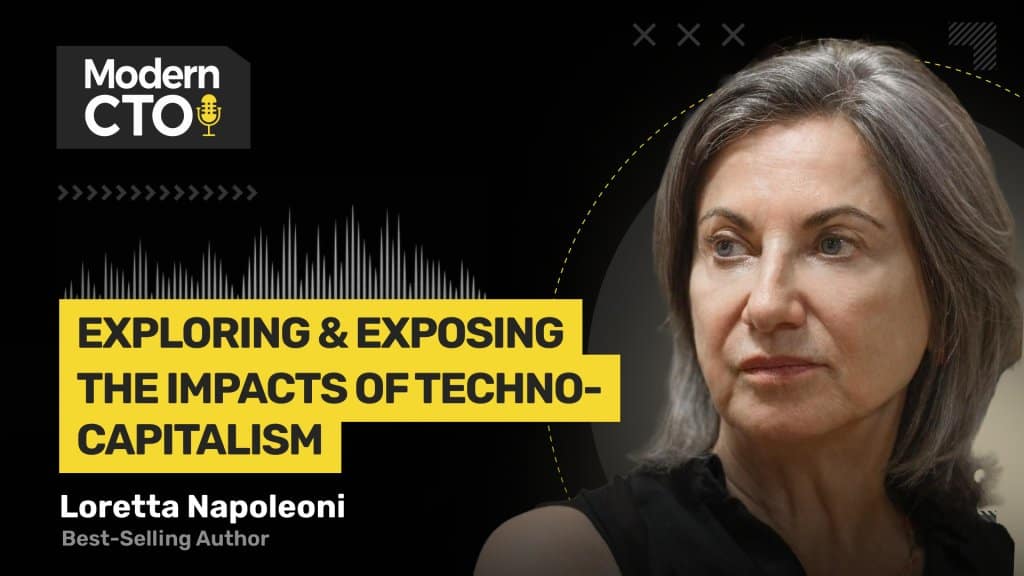
Exploring & Exposing the Impacts of Technocapitalism with Loretta Napoleoni, Best-Selling Author
Today we’re talking to Loretta Napoleoni, best-selling author. We discuss the ways in which technology has given rise to monopolistic superpowers, the impacts that these companies are having on society, and how we can pave the way for a brighter future with technology.
All of this right here, right now, on the Modern CTO Podcast!
To learn more about Technocapitalism: The Rise of the New Robber Barons and the Fight for the Common Good, check it out on Amazon here.
Have feedback about the show? Let us know here.
Produced by ProSeries Media.
For booking inquiries, email [email protected]
About Mike Rubin
Loretta Napoleoni is the bestselling author of Maonomics, Rogue Economics, Terror Incorporated and Insurgent Iraq. She is an expert on terrorist financing and money laundering, and advises several governments and international organizations on counter-terrorism and money laundering. As Chairman of the countering terrorism financing group for the Club de Madrid, Napoleoni brought heads of state from around the world together to create a new strategy for combating the financing of terror networks.
Napoleoni is a regular media commentator for CNN, Sky and the BBC. She is among the few economists who predicted the credit crunch and the recession, and advises several banks on strategies to counter the current ongoing crisis. She lectures regularly around the world on economics, terrorism and money laundering.
Loretta is also a columnist and writes about terrorism, money laundering and the economy for several European financial papers including El Pais, The Guardian and Le Monde. In the 1990s she was among the first journalists to interview the Red Brigades, the Italian Marxist armed group. She subsequently spent three years interviewing members of other terrorist organizations. In 2003 she interviewed followers of al Zarqawi in both Europe and in the Middle East.
Born and raised in Rome, in the mid 1970s she became an active member of the feminist movement and a political activist. She was a Fulbright scholar at Johns Hopkins University’s Paul H. Nitze School of Advanced International Studies in Washington DC and a Rotary Scholar at the London School of Economics. She has a Masters of Philosophy in international relations and one in terrorism at the London School of Economics.
She began her career as an economist, working for several banks and international organizations in Europe and the US. In the early 1980s she spent 2 years in Budapest at the National Bank of Hungary working on a project for the convertibility of the florin that ten years later became the blueprint for the convertibility of the rouble. In he 1980s she worked for a UK registered Russian Bank, Moscow Narodny Bank, which acted as the foreign branch of the Bank of Foreign Trade. This position afforded her a unique insight into the Soviet economy. In 1992 she produced the final documentation for the structure of the International Bank for Reconstruction and Development, IBRD. She teaches a course at Judge Business Schools, Cambridge.
Transcript
(Intro Narrator at 00:00:00) Today, we're talking to best-selling author Loretta Napoleoni about her latest book, Technocapitalism: The Rise of the New Robber Barons and the Fight for the Common Good. You're listening to Joel Beasley, Modern CTO.
(Joel Beasley at 00:00:19) Loretta, hi. We're here.
(Loretta Napoleoni at 00:00:22) We're here. Wow, we made it.
(Joel Beasley at 00:00:26) So the way I got introduced to you was a friend of mine, Christopher, was talking about technocapitalism, and that's where I learned the phrase, maybe about two months ago. And he just kept mentioning it and mentioning it in the context of a decentralized AI project that they were working on. And then I get an email from your PR people saying that you wrote a book, and it's about technocapitalism. And I said, wow, yeah, this is perfect timing.
(Joel Beasley at 00:00:52) This is perfect timing.
(Loretta Napoleoni at 00:00:53) Yeah, that's right.
(Joel Beasley at 00:00:55) Yeah. So tell me a little bit about what was the moment when you were living in life and you said, this needs to be a book. Like, this is something that I need to write into a book.
(Loretta Napoleoni at 00:01:09) I don't know if it was the exact moment. It was not an epiphany. It was more of a process. I just wanted to understand what was going on with technology. You know, we know so little about technology, but we use it every day. I mean, you can't possibly live without your telephone anymore, for example. And then, you know, through, of course, the pandemic, if we didn't have that kind of connectivity, we would not have been able to survive. Although, you know, the idea of writing a book came before the pandemic. So it was very good because all of a sudden I was living the experience of what does it mean to have technology in a moment of major crisis.
(Loretta Napoleoni at 00:01:59) So I thought it was going to be negative in terms of interviewing people because I couldn't move around, but in reality, it was fantastic because I could reach anybody in real time without going anywhere. But it was a difficult book to write because it took me almost three years. Also, things were happening, so you need a little bit of distance in order to write about certain events unless you want to write in terms of news, and I didn't want to do a news book. I wanted to do an analysis book. But, you know, when the Redditors were assaulting Wall Street, GameStop was just, wow. You know, I'm writing about this and it's happening. So it's interesting.
(Joel Beasley at 00:02:52) I had to do some research to look up what the robber barons were because it's become a word that you're like, oh yeah, the robber barons. But you go look at the definition and you're reminded of Carnegie and all of these individuals and Rockefeller. But a core theme in your book is the space barons and the tech titans have hijacked technology, right? And so have they hijacked—what's the argument? Is it that they hijacked it, or they came about because of it?
(Loretta Napoleoni at 00:03:23) Well, I would say that hijacked is the right word because they were the first ones who actually approached technology in commercial terms. So they used it to create something. Think about, you know, Facebook, for example, or even Amazon. So the original idea. But then they made sure that they were the only ones who control technology. So they blocked competition. They created monopolistic positions, oligopolistic positions. And above all, they are preventing us from understanding how technology actually functions, and therefore, you know, to use technology for ourselves, for the common good, which is the main issue of the book. It's okay to be a technocapitalist and make money. I mean, I'm not against capitalism as such. But the moment in which this activity becomes an activity that is working against society, that is actually working not in the interest of the common good, then I think, you know, that should not happen.
(Joel Beasley at 00:04:43) Yeah. When I saw the Twitter Files, I mean, it was both sides of the political—it doesn't matter what side you were on—both sides were using it as their own censorship tool. And it's something that you kind of know is going on. And then when you see it actually happen, you're like, yeah, well, now you know it's real. So, you know, your book read a lot like Russian cinema to me. It was very, very pessimistic. I was like, oh no. Where's the turnaround? Are we too late? Are the tech giants too powerful?
(Loretta Napoleoni at 00:05:18) Well, actually, to be honest, this is one of my most optimistic books because, you know, the others—yeah, the other stories about terrorism. One of my bestsellers, the one on the Islamic State, where they were cutting people's heads. So at least here—no. I think, yeah, to be honest, I think this is an optimistic book because this is a call to arms, basically. You know, you just say to people, hey, you know, look, we invented this technological revolution. This is the product of ourselves. It's the product of humanity. And technological innovation is what can save us from impending catastrophes such as, you know, climate change, for example.
(Loretta Napoleoni at 00:06:07) But we don't know how to use it. We don't know how to reach out. We don't know how to control it. So, I mean, the potential for using technology for our own future are right there. The issue is at a social level, political level, and even economic level. You know, how do you go about it? How do you take back what really belongs to humanity? I mean, you know, these guys, the technocapitalists, the tech titans, they did not invent technology themselves in a vacuum. You know, this is the product of centuries of study, innovation, progress. So it belongs to everybody. It doesn't belong only to them.
(Joel Beasley at 00:07:04) Yeah. And you are right because there are certain things—and I guess we'd have to get more specific to which specific invention and things of that nature—but there is this threshold in which a technology becomes so useful to humanity that you need to make it public or accessible, right?
(Loretta Napoleoni at 00:07:26) Yeah. I mean, I can give you lots of examples, but, you know, the most recent example, I mean, is AI. You know, there's so much controversy about AI. Is it good? Is it bad? It's going to ruin us. It's going to destroy the labor market. I mean, it goes on and on and on. But the truth is that it depends how you're going to use it. So we know that the application of AI, for example, to medicine, to modern medicine, is extremely, extremely beneficial. I mean, there have been, now in the UK, a couple of cases of women with breast cancer that was detected through mammography because of the application of AI.
(Loretta Napoleoni at 00:08:14) So a doctor, a human eye, would not have seen that particular cancer because it was too small. So the implications of that are immense because I'm not only saving two lives, but also saving money for the National Health because, you know, in the UK, there is a National Health System, so the taxpayer funds it. So the longer, you know, an illness progresses, the more expensive it is and also the more expensive it becomes, you know, to get rid of the illness. So you see all these positive implications. And then there is the other side of the coin, which is, you know, the use of AI in modern weapons.
(Loretta Napoleoni at 00:08:59) So we are basically getting rid of all our old weaponry. This has happened in the U.S. This has happened in Europe. We're sending these obsolete weapons to Ukraine so that we can replenish our war chest, so let's say, you know, with AI or intelligent—as well, you know, intelligent weapons. Now in the war in Ukraine and also in Gaza, they are also testing these new weapons. So you see, economically speaking, the investment in the arms industry actually makes more sense than investing in the health sector because, you know, you can make more money. And this is where the common good has to come into the equation.
(Joel Beasley at 00:09:58) So you can make more money killing people than you can saving them?
(Loretta Napoleoni at 00:10:03) Yes. You can make more money killing people than saving. That's the bottom line. But this is not something that is happening today. This is the history of human beings. It's been like this. You know, war has always been economically very convenient because, you know, you win the war, then you loot. I mean, in the old days, you know, that's how they did it. But we are in a democracy. We are in an advanced society. We have a civilization in place. So all of these elements should play a major role in making sure that more money goes towards the application of AI which benefits society than towards the application that actually doesn't benefit society. Because, I mean, yeah, the war in Ukraine does not benefit our society, you know, if you think about the use of these weapons. Yes, you may say, oh yes, they're protecting people from Putin, but that's—
(Joel Beasley at 00:11:06) I'm not a fan of the Ukraine war, by the way.
(Loretta Napoleoni at 00:11:09) Exactly. Neither am I. I'm not a fan of any war. No. So, but even if you want to turn it around and say, oh, but this war was necessary, blah, blah, blah—even so, there is not a direct benefit to my society, which is the society that is producing the weapons. So, is what I mean. So why are we doing it? Why don't we invest more in the health sector where we know for sure that we can save human lives and save money of the taxpayer?
(Joel Beasley at 00:11:41) The reason that I don't like the AI weapons is because, ultimately, without the AI weapons, there's a person responsible for giving the order or for actually pulling the trigger or pressing the button. And so you've got that moral interface there where that individual can object to the order. They could say, I was ordered to do this, but this isn't right, and so I'm not going to do it. And so you have that, and that's—I think that's good, and that's useful. And when you have AI, you get rid of responsibility. So some engineering team in some corner of the country built some algorithm that's deterministic and probabilistic, and that will create the best decision. And so it's like, why did that person or why did that machine kill that person and autonomously decide to execute on that target? There's no human being where you can be like, it was your responsibility. That's a slippery slope. It's very scary for me.
(Loretta Napoleoni at 00:12:42) There is something else also that I think we should take into consideration about the use of AI in warfare, and we're seeing already in Gaza or in Ukraine. So traditional warfare was combatant. So, you know, you have the army, the soldier, whatever, and, you know, the enemy, which is, again, the army, the soldier. So it was combatant against combatant. Now the civil population was hit by the war, but it was not a target, meaning, you know, it so happened that the civil population was living in places where the war was taking place, and there were the consequences. So today, as you see the development of artificial intelligent weaponry, you have less and less involvement of the combatant and more and more involvement of the machine against the civilian population. And a very good example is Gaza, right? But also in Ukraine, it's the same story because, you know, if you see how the Russians or, you know, the Ukrainians are using the drones, at the end of the day, the drones are aiming at civilian population, at areas where the civilian population lives. So we're in a completely, completely different warfare, which is prospecting in the near future.
(Joel Beasley at 00:14:12) You mentioned in your book a concept of sleepwalking towards dystopia. That really stood out to me. When I saw that, it stood out to me because it was a way to put words to something I instinctively feel, and you did that for me. Congratulations. You're an amazing writer.
(Loretta Napoleoni at 00:14:30) Thank you. Thank you very much.
(Joel Beasley at 00:14:31) But this now begs the question, how did we fall asleep and how do we wake back up? How do we not end up in dystopia? Or is dystopia the destination and that's where we're going?
(Loretta Napoleoni at 00:14:42) I think we fell asleep for a series of reasons. I mean, you know, we are so far away from war. You know, we're talking about the Western world. We are—I am the first generation. You're younger than me, but I'm the first generation who never experienced war. I was born in 1955, so basically, you know, ten years. But, you know, my father went to war. My grandfather had two wars, two world wars. So, I mean, there is not a generation in Europe that didn't experience war. So this sense makes us misjudge, I think, the consequences of bad political decisions.
(Loretta Napoleoni at 00:15:29) And then, you know, another reason, I think, is the politics of fear. I think, you know, I do mention it in the book. So the U.S. and, to a certain extent, also all the allies have projected for decades this image of the future, which is, you know, much worse than the present. So there was a tactic for governments to be reelected, for example. You know, you elect me because, you know, I can guarantee that, you know, things will remain the same. But, you know, if you don't do that, you know, the future is very bad. It's very negative. So because of that, our expectations about the future have been quite negative. So it's almost like, you know, we are prepared constantly for the worst. But because this worst never arrives—and then when things start really going badly, which is exactly what is happening today—I would say that in the last ten years, there's been an acceleration of the disintegration of the nation state, but also a real weakness of democracy and a proliferation of war everywhere, and technology is playing, of course, a role in all of that.
(Loretta Napoleoni at 00:16:56) When things really happen, we're not prepared for reality because, you know, we still think it's a projection. It's not going to happen. So we don't see that we're living in dystopia. If you take what is happening today, I mean, again, I think Gaza is a very good example. If what is happening in Gaza had happened ten, fifteen years ago, I mean, we would have stopped it. I mean, for sure, public opinion would not have been able to digest that, and politicians would not have been able to continue along the path because their electorate would have been enraged. But somehow through these ten, fifteen years, this has become an acceptable event, an acceptable daily event. So that's what I mean about walking into dystopia, and that's one example. Then we can talk about the impact of social media upon our kids. We can talk about, you know, the isolation of our kids, because of video games, social media—
(Joel Beasley at 00:18:19) TikTok. I want to interrupt you a little bit because you said something. As you're talking about Gaza and this happening now and it wouldn't have happened fifteen, twenty years ago, public opinion would have stopped that. Do you think it's the loss of our common shared values? Like, America used to all say the same thing, right? And you had the pledge, and you had all of these things where it's like, this is what they stood for morally, and this is what their value system was. And then they were, you know, using that to make decisions. Do we go stop this person or do we go stop this from happening? And then it kind of just—we kind of just felt like it stopped. And then we just started arguing and internally fighting, and then we somehow became—it became popular to say that America is not good inside of America, which is odd. But do you think a lot of the problems that we're facing is because of our loss of shared values as Americans?
(Loretta Napoleoni at 00:19:19) I think, you know, to a certain extent, you're right. But I wouldn't say it's so much about shared values as leadership. I mean, the U.S. was projecting an image since World War II, which was the leader. I mean, the beacon of democracy, the protector of the weak. They were—then, you know, of course, you know, these were just words because in reality, we had the Vietnam War. We had lots of negative things, but it doesn't matter.
(Loretta Napoleoni at 00:19:49) I think, you know, what people saw was the possibility to create a system in their own country, which was a system based upon justice, where anybody could become anybody, anybody could achieve whatever they wanted — opportunities, equality, all of these beautiful things. So, yes, I think the US, at least for us, for people coming from Europe being born in that particular era, so right after the war, was very much like that. So that was really almost a dream to achieve exactly what America had. And then all of this proved to be absolutely wrong. You know, partly, I think, was because of the fall of the Berlin Wall.
(Loretta Napoleoni at 00:20:42) So you didn't have the contraposition anymore of the Cold War between good and evil, you know, that dichotomy, which is always super positive. But also, I do think that technology did play a certain role because technology unveiled aspects of the so-called American dream that we didn't even imagine. I mean, think about the impact of WikiLeaks. So, you know, we always had conspiracy theory. We also had in Europe a very strong socialist communist movement, which was linked to the various parties in Western Europe. But one thing is to say, oh, the Americans are doing this and this and that, which is anti-democratic in certain countries. Another thing is to have documents in front of you which actually proves all of that. So I think WikiLeaks is the beginning of the end of this image of America as being, you know, really the beacon of democracy and the shining example to follow for all the world. And it's interesting that it comes from one of the members of the cypherpunks, which, you know, in the 1980s, was the group that was mostly concerned about the state's attempts to control the internet, the people that actually wanted the internet to be the great equalizer.
(Joel Beasley at 00:22:22) Is there a way to recapture that status for America?
(Loretta Napoleoni at 00:22:29) This is a very, very difficult question to answer. Is there a way? I don't think — look, I don't think it's too late. It's never too late anyway until it is too late. But I think that the US still has amazing potential. So it's a multicultural society. It's a rich country. There is a firmament in the country all the time — arts, music, you name it. It's a great country from that point of view. But I think, you know, the problem is that politics is degenerating where you cannot possibly have two old people — forget about their ideas and what they have done, but you cannot have two people, one is over 70, one is over 80, and one is approaching 80, running for president of the United States. We need youth. We need new ideas.
(Joel Beasley at 00:23:31) I know. Look at the age of our founders.
(Loretta Napoleoni at 00:23:34) Yeah. Exactly. Yeah. It's just — yes, exactly. This is like, it's almost like the Iranian theocracy where everybody's a hundred years old. I mean, no, I think that is the first problem.
(Joel Beasley at 00:23:50) Well, I think — and I got to talk with — and, Josh, if you can remember, please jump in and let me know — but I talked with some sort of psychologist type person. But the idea was you've seen in your lifetime, if you followed American politics, you've seen Congress start to stagnate. So we were getting new people in, and they were of a certain age. Sorry. They were of a certain age, and then they just kind of stuck. And then now we've had these same people, and they've gotten really old. And I think that you can simplify it and say that's not good, and that's fine. Right? Largely, objectively, because they don't have to live with the decisions they make, technically. But you could also say, what's the impact on society? Because the way that — and I'm a dad. I've got three kids. I'm 36 for context. But I noticed that the way I have matured over time, different levels — right? There's always different levels — is by watching the people in the public around me. So I was like, oh, I'm that guy now. That's not acceptable behavior. I have to act this way. And when you prevent Congress from turning over and getting fresh new people, you prevent the 35-year-old from seeing, oh, look at all these 35-year-olds in Congress. Maybe I should stop being childish. Maybe I should stop doing these things because my peers are literally running the country. Well, you've got 50-year-old people that are the young people in Congress. So we're having this sort of mass developmental delay happening in our consciousness, and we're creating these 50-year-old children by not allowing them to take the social cues because we're letting these people stay in Congress. That's just a little thing I've been thinking about.
(Loretta Napoleoni at 00:25:38) No, I think you're right. I think you're absolutely right. But before that, I would say, why don't young people want to go into politics?
(Joel Beasley at 00:25:51) Lies? Yeah.
(Loretta Napoleoni at 00:25:52) Yeah. Well, yeah. Yes. Absolutely. I agree with you. I think politics is not appealing because of the lies, the corruption. But it was always there. You know, when I grew up, it was exactly the same thing, but we were so engaged. We were so incredibly engaged in politics. Activism was part of our life. So you go to school and be a student, and then you would be an activist. And the majority of the people were like this. This was not a minority. So, you know, in my class in high school, I would say the majority of the students were active either on one side or another side. You know? It doesn't matter. It's activism. So we would meet — we had meetings, we had demonstrations, we had discussions, we read books and then discussed the books. It was a completely different life from the life of today. Now, I see my children — my youngest son is 31 years old. He's very bright. I mean, he has a great job, and he's interested. You know, I'm not saying that he's not interested in politics, discusses politics, but not in a million years will he go into politics. He thinks that it's not sexy. It's not exciting. He thinks it's something for the oldest, exactly what you were saying. You know? So it's like almost a self-perpetuating system. And soon the young one in Congress will be in their seventies. And then what? You know? Do you see what I mean? So how much — that's my question when I was doing this research. How much actually has technology impacted this situation? And I would say that one of the main characteristics of when we were active was the fact that we met together. So, you know, we didn't have all this technology to communicate to each other, so we would go to school. And then, you know, after school, you would meet somewhere, anywhere. You know, we met at people's houses. We met — because I was born in Rome, you know, most of the time we went outdoor because the weather was nice. But it was a way to socialize with people. And through that socialization, you grew up. So you had your first love stories, you had, you know, your friends, your first best friendship and all this stuff. So all of this was in the context of being part of society and being politically active. Now, that doesn't happen anymore because how do they communicate? Now mostly, they communicate through a screen, exactly, which is exactly the telephone. So between me and, you know, my group, there is always this thing. And this thing is not real. This thing is a machine. It's not — you know what I mean? So this thing will say whatever I want to say and whatever they want to say, but it still is in the middle. It's still in between. So I think that is one of the main problems also why all of a sudden activities like that — and politics is just one. I'm talking also activity for climate change, anything. I'm thinking that the gay movement of the 1970s today — if it had happened today with this technology, it would have been very, very different from what it was.
(Joel Beasley at 00:29:55) You make an interesting point about growing up in the socialization and being an active participant. I think if we were to chart active participation, it would be crashing. So now I don't have to. I can solve some of my social need by watching content and watching two people discuss it, but I'm not practicing myself. You know how many times I follow people and I really like their content? I consume a lot of it. They have great ideas, and I turn around and try to go say that idea and share it with somebody, and it's just like so clear in my head, comes out like garbage. Right? Yeah. And so it — but the ideas when I'm on stage speaking or I'm socializing with people and, you know, in groups we're all facing each other, it just kind of comes out, and it usually sounds pretty great. And so I agree with your concept of this socialization is incredibly important and helps us understand when we grow up. I tell people all the time, because a lot of the content we do is on technology and leadership and scaling teams, that becoming a parent has been the single greatest lesson in leadership and working with a team that you can ever possibly have. Right? It teaches you so much, and that socialization helps you grow up. So do you think that this technology is preventing us from getting those social experiences because we're just watching and observing versus actively participating? You think that's the problem?
(Loretta Napoleoni at 00:31:23) Yes. I think this is one of the negative consequences of technology. I mean, being a parent, of course, is extremely difficult today. I mean, luckily, I didn't have this kind of problem because my kids grew up — I mean, I think, you know, they got their first telephone when they were 16, 17, so they were ready. But I see today that young kids have iPads and interact with the iPads. The positive things, don't get me wrong. I mean, so two-year-olds know exactly the alphabet because, you know, they have the app on the iPad that says A, B, C, D, and all this stuff. So they may even learn how to read and write earlier than we did. But the real problem is that too much time is absorbed in that interaction. So that interaction is not only an educational interaction, it also becomes an entertainment interaction. It becomes a way to park your kids in that interaction so you can do other things. There are many positive things to say about the fact that kids should be bored and invent games, play inventing things.
(Joel Beasley at 00:33:02) You are a great parent. I can already tell. Yeah. Look. My wife — I've got three kids under the age of seven right now. Okay? And we actually just two weeks ago or so, we got them their first iPads. Okay? So we homeschool them. Yeah. We live on a farm. We're out in nature. Lots of outside time.
(Loretta Napoleoni at 00:33:25) Yeah.
(Joel Beasley at 00:33:26) Yeah. And because of the nature of my job being so heavily dependent with technology, I have to live out in nature so I get it enough.
(Loretta Napoleoni at 00:33:34) Yeah. Sure.
(Joel Beasley at 00:33:34) And so now we're faced with these questions. Now my background is software engineering. To set up the parental controls to be what we wanted, it was an entire Friday night to get version one done. We let them have it for a couple days. We learned the problems. Then we spent another whole afternoon, and I've got — not to say anything great about me, but I've got a master's level education in building technology systems. Right? And so if it's taking this much of my time and this much debate and conversation and testing, okay, did that setting work the way we imagined it to work? There's 5,000 settings. The average parent's probably just handing them the pad and saying, you know, we're trying to restrict to very specific apps. Like, they can't — we even had to make the decision on FaceTime. Like, while we will be the only contacts they have in grandma and grandpa, do we let them have FaceTime yet? We decided no. We decided text is fine. And then it's like, after all the parental controls — and I'm sorry that I'm talking a lot.
(Loretta Napoleoni at 00:34:39) No. But this is good. Yeah.
(Joel Beasley at 00:34:40) After all the parental control configuration, we've ultimately, in the past two weeks, have come to the conclusion that we're only going to hand them the physical iPad when they have to do a school assignment or when we — we created a schedule, like a printout on the homeschool schedule on the fridge.
(Loretta Napoleoni at 00:34:59) Yeah. Yeah.
(Joel Beasley at 00:35:00) Yeah. And they get it two or three times a day for specific reasons. They get it one time a day for — well, some days they do piano, and there's a piano learning app that plugs into the piano, so they get it for that. But it's creating all these rules and structure around it have been hard. And we see other parents — okay, they're parents, but they'll just hand the kids the open unlocked iPad out of the box. And they can go on Google searches and watch YouTubes, whatever they want. It's crazy.
(Loretta Napoleoni at 00:35:28) But this is — well, you see, this is actually super interesting because that shows the complexity of the technological innovation. Because while you were talking — so I remember, you know, with my kids, my kids could not watch TV. Okay? They only were allowed to watch videos, only videos, and the videos, of course, were handed over by us. On a Saturday morning — so Saturday morning, they'd get up, I don't know, 7:30, and they were allowed to put the video in and watch the video, and that was it. They could not watch TV. So the decision was relatively easy because, you know, the only thing that was there was TV. And, of course, we could control the video, so I would get them only specific videos. But you — so what for me was a very relatively easy decision because, you know, there were only two items to choose. Right? You have the iPad. You have the timing of the iPad. You have the iPad for school. So you see how much —
(Joel Beasley at 00:36:47) TVs are all computers now?
(Loretta Napoleoni at 00:36:49) The TVs also. Now, you know, I couldn't be able to prevent them from watching TV because, you know, of course, they would have their iPad and there is internet connection in the house everywhere. So if they want to watch the TV, they can watch the TV through the iPad. But, you know, in our case, the TV could not be switched on. So everything gets so much more complicated as technology, you know, evolves and your decision as a parent becomes more and more complex. So, yeah, I think, you know, it would be of great help if people would be more aware of the consequences of having the kids attached constantly to the internet and to social media. Now, you know, because you have a degree, because you do a certain kind of job, you also made certain kind of choices. Your wife is the same. But you are very much the exception to the rule. You know?
(Joel Beasley at 00:37:51) Yeah. I want to figure out how to make it easier for people. You know, there's got to — there will be eventually some way to make it easier. Right now, we're heavily constrained by the business models of the companies that are the main players, the Netflixes. All of these content providers are heavily incentivized to give you as little control as possible over what you see and maximum control over what their advertisers, what they want to push, and what they think should trend and all of that. And that's like a — we should have the right — I wrote an article a few — a year ago called "My Body, My Pixels." Yeah. Like, these are my pixels on the screen. I should own the pixels, and I should determine what I get to see. I shouldn't let everyone else come in and show me whatever they want to.
(Loretta Napoleoni at 00:38:40) Yeah. But it's good you mentioned that, because the EU actually has introduced the legislation on privacy several years ago, exactly based upon this concept. My data is my data. I do whatever I want with it, and you're not going to harvest my data simply while I watch one of your films on TV online.
(Loretta Napoleoni at 00:39:12) And this is why now, you know, often when you go on a web page, you have to say yes, I accept, and no, I don't accept. But that was the EU. The US didn't do anything, which is interesting because, I mean, this is where technology started. This is where the technological revolution started. And the reason why they didn't do anything is because there was, as I say in the book, a cross-pollination with Wall Street, which, of course, you know, Wall Street is very much linked to the political elite.
(Loretta Napoleoni at 00:39:47) So they were all in cahoots together. And that is why the system is wrong, because we should have had the state, the government, the institutions to protect us as they protect us against other industries, like the tobacco industry, for example.
(Joel Beasley at 00:40:10) Yeah. Well, I think this is why younger people aren't excited about politics, because, you know, like, for me, I'll see something and, look, I'm very pro-small government.
(Loretta Napoleoni at 00:40:23) So am I.
(Joel Beasley at 00:40:23) Yeah. And so I'm very cautious on ideas that I would present to apply to everybody. But I was like, man, this idea of we are not technologically constrained by this. Like, if I wanted to create the most amazing parental control app that I just gave it to you, Loretta, and I said, Loretta, you're going to talk to this AI for like five minutes and share all your values and what you think is right and all of this stuff, and then it's going to impose that rule set on the devices that you've set—that is completely technologically possible right now. Right?
(Joel Beasley at 00:40:57) I could, but we don't have the—on a nerdy level, we don't have the programmatic interfaces to achieve that because the companies aren't doing it. I could go to Congress and try to get a bill passed that forced—just like they do with stealing our information and giving it to them for FISA searches—I could go and force them to do that.
(Joel Beasley at 00:41:22) But like, there's so much corruption and stuff. Like, I don't know. If this were back in the day before I had seen everything, I would probably be bright-eyed and bushy-tailed and say, I'm going to take this policy and I'm going to try to get it passed. But now it just seems like the whole system is just so messed up. It's like, I don't know. It's really demoralizing, to be honest with you.
(Loretta Napoleoni at 00:41:44) Yes. I think it is demoralizing. I agree. But I don't think you should give up, because, you know, giving up means that your children will really live in a dystopia. You know? That's the—I think, you know, that's the leverage that we have. It is with people of your generation, so people who are parents now of young or teenage kids, in order to protect this generation. I mean, your children's generation is the first generation—no, it's not the first, actually, but, you know, it's one of the first that was born in the middle of the technological revolution. So, you know, from zero age, they could have had an iPhone next to them.
(Loretta Napoleoni at 00:42:32) They—yeah. So, no, at least in my case, with my kids, my kids were not aware of it until they were teenagers. So they had a certain period of time, which is the formative years, in which, you know, they were free from that kind of conditioning. But, you know, after them, you know, we have—you know, completely—technology is part of our world. Technology is like, you know, the trees that are outside, you know, your farm. You know? It's here to stay forever, and from what they know, was here forever. They don't know anything different. So in the end, there is a way to control all of this.
(Loretta Napoleoni at 00:43:15) And maybe the word "control" is also the wrong word, because people may think, oh, control is intrinsically negative. But I think "regulate," perhaps, is a better word, so that you still let technology run free, but, you know, it runs free for a specific objective, which is the one to improve the common good. So in the case of the kids, it's going to be to help them develop better skills in terms of learning, not to be conditioned to buy, you know, certain products.
(Loretta Napoleoni at 00:43:57) Do you see what I mean? So there must be a protection of the—there must be a bill that protects the child, you know, against this kind of conditioning. And then from that, you move on, and you can say the same thing for what concerns ourselves. I mean, you are bombarded constantly by messages that compound your weaknesses.
(Loretta Napoleoni at 00:44:24) Because, of course, you know, the algorithm is built in that way, and there is nothing more powerful than weaknesses. It's easier to get you on your weaknesses than on your happiness, because it's easier, you know, to sell you a diet online because you think you're fat than, you know, to sell you a dress if you think you're slim. Yeah. So, yeah.
(Joel Beasley at 00:44:52) I give a lot of credit to the—I don't give a lot of credit to the EU, but I do like, hey, leadership is leadership. And while I don't agree with every policy that occurs over there, specifically hate speech type stuff, but while I don't agree with every policy, I do think they have done an amazing job of leading on the technological policy front. It's almost like every—but they've got it to the point where everybody in the world is sitting around watching the EU, like, what are they going to do next? What type of, you know, GDPR, whatever policy are they going to come up with next? And so I do give them lots of credit for that. At least they're doing something, which is great.
(Loretta Napoleoni at 00:45:34) Yeah. No, they're moving in the right direction. But, you know, I spoke with them—I spoke with the head of the antitrust policy a few weeks ago. It was interesting because, you know, he said books like your book are great because, you know, people actually become aware, but this is an upward struggle because the tech titans, specifically talking about, you know, the head of five, six, you know, top companies in high-tech in the world, they are so powerful that they behave as if they are above even the political leaders.
(Loretta Napoleoni at 00:46:14) Now that is an important sentence, important sentence, because their entitlement doesn't come from the people who have voted for them. The entitlement comes from the money that they have accumulated. You see the difference? So, going back to the original robber barons—they were bad, of course they were bad, but at least Carnegie invested a phenomenal amount of the money made for the arts so that the people could enjoy.
(Loretta Napoleoni at 00:46:52) John Ford created an entire town for its workers, and he said, you know, producing cars for my workers. The Rockefellers, you know, gave money away in charitable initiatives because they realized—actually, the story of Rockefeller is very interesting. Not that Rockefeller was particularly, you know, keen on helping people, but he realized that in order to be liked, he needed to give back some of that wealth. So it was a strategic decision. But these guys are giving back zero, absolutely zero.
(Loretta Napoleoni at 00:47:35) They don't even feel the urge to do it. They're venerated like gods for the simple reason that they're so rich. Do you see how shallow the whole thing is?
(Joel Beasley at 00:47:47) Well, to be completely honest with you, I don't follow them enough to know.
(Loretta Napoleoni at 00:47:55) I had to study them.
(Joel Beasley at 00:47:57) You would know in comparison of what it's like, hey, here's robber barons before—at least they're a little bit nicer. The current robber barons we have right now are like—
(Loretta Napoleoni at 00:48:08) Oh, yeah. But what I'm saying is they're all bad, but you can see the difference, because society mattered more at the time of the robber barons than it matters today. Because otherwise, they would not have done it. And the reason why society doesn't matter so much is because we are so disjointed, because, you know, thanks to all these technological gadgets, we are not anymore activists. We are simple users or, you know, a mind to be exploited, a resource.
(Joel Beasley at 00:48:47) Yeah. A mind to be programmed and shown enough images to where you make a purchase.
(Loretta Napoleoni at 00:48:53) Exactly. Exactly.
(Joel Beasley at 00:48:54) Yeah. And that's honestly where the premium comes into parenting or your self-respect of—you know, one of the things I got to do a few years ago was I interviewed somebody on distraction and how technology distracts us. And from that interview, he gave me a two-week challenge. He said, turn off every notification, every notification bubble, everything so that your phone never bings, beeps, or anything. And he goes, then when you open it up and you want to use it, it's there, and you can go find what you need to find.
(Joel Beasley at 00:49:26) And so he asked me to do a two-week challenge. I did a two-week challenge. It's been three years. I still haven't turned them back on. And the only thing I get notified of is when my wife calls and when I get text messages. I have those two notifications on. Other than that, the 75,000 Slack notifications and 200,000 emails—no. I don't get any of that. When I want to do email, I go into email.
(Joel Beasley at 00:49:51) You know? When I want to do Slack, I go into Slack. And it's really changed. You know? You could just look at the data. I think I would pick up my phone an average of like 215 times a day before the notifications, and now I pick it up like 50 times a day or whatever it may be. But a huge difference in the way you look at it—from your technology using you to you deciding when you're going to engage technology to achieve something you want to achieve.
(Loretta Napoleoni at 00:50:19) Yeah. Yeah. But that's self-discipline. So he told you to do that. You did it. So this is self-discipline. That's what we need. We need—we can change the way technology's affecting us, providing that we know how. But if you don't know how—
(Joel Beasley at 00:50:40) Yeah. Yeah. I hope discipline—I mean, discipline's the answer, but I'll tell you this much: whenever I travel and go to airports, I'm like, this is the general public? Oh, we're not doing good on discipline.
(Loretta Napoleoni at 00:50:55) Yeah. You know, one thing I noticed actually is on the tube in London. So I used to go to work in the eighties in the city, and I took the tube, you know, to go to work and come back. So there were no telephones or anything like that, so people actually read books. So on the way to work in the morning, everybody was reading the newspaper. Right? So you had all these, you know, people reading the newspaper. And on the way back, people were reading books. I mean, real, you know, solid books.
(Loretta Napoleoni at 00:51:30) Now you get on the tube, and every single person is on the telephone.
(Joel Beasley at 00:51:35) They look down like this, everybody.
(Loretta Napoleoni at 00:51:37) Yeah. They're all like this, right? All of them. And on rare occasions—rare occasions—you see somebody reading a book, and often, actually, they are young people. And then you become extremely curious about the title of the book they're reading, because, you know, the title of the book says a lot about the person.
(Loretta Napoleoni at 00:52:00) But it's so interesting to see how things have changed. And in the UK, people actually used to read a lot. I mean, it's not like in Italy, where, you know, very few people read, to be honest. But in the UK, there was a very high percentage of people that read at that time, and I think even now is still, you know, quite good. But nobody reads on the tube anymore because by bringing a book, you can just, you know, look at the phone.
(Joel Beasley at 00:52:32) Well, and so here's some positive to all of this. It is now easier than ever to be successful and build relationships because everybody is so starved for real human interaction. So I'm the annoying person on the plane that when I sit next to someone else, I'll talk to them. I'll ask them—I'll ask some good questions. Right? But I'll talk with them and have a conversation with them. And I've noticed that people are pretty susceptible to having conversations now, to the point where some of them don't know how to do it. It's like if I'll talk to somebody in public, they'll just look at me like, you're—oh, you're not supposed to be talking to me. We're in public. Like, I'm like, it's okay. We can have a conversation. You know?
(Loretta Napoleoni at 00:53:11) Yeah. But they also open up.
(Joel Beasley at 00:53:13) They do.
(Loretta Napoleoni at 00:53:14) They do. I mean, when I came from Seattle to San Diego just a few days ago, there was this woman, young woman—she was 31, she told me—sitting next to me. And our conversation started because she had 1984. She was reading 1984, and she put it in, you know, before takeoff in a little space on the front of the seat. So I asked her, I said, oh, I said, you're reading 1984. Is this the first time? And she said yes.
(Loretta Napoleoni at 00:53:46) And I said, you know, there is a new—there is the Julia, which is the 1984 from Julia's point of view, which came out in November in the UK, and I just read it. And so we started talking. And, oh my gosh, you know, we spoke all the way, and she told me everything about her life. I mean, clearly, she had a difficult upbringing. She manages the family business.
(Loretta Napoleoni at 00:54:12) I mean, she went on and on and on. And at the end, you know, I gave her a few pieces of advice, you know, being the old lady. And then at the end, she said, oh, can I have your phone number? I want to stay in touch with you. I mean, thank you so much for your advice. I was touched. I was absolutely touched. So here we are: the solitude of people—it's incredible that as soon as, you know, somebody offers one door, opens one door to, you know, their soul, they just pour it out because they are lonely. You see, it's just—I was quite surprised, I must say, because generally a young—I mean, a young girl doesn't open so much with somebody, a total stranger, but, oh my gosh, she really needed it.
(Loretta Napoleoni at 00:55:02) And she had her phone in her hand all the time. And with her phone, she showed me all the pictures of the members of the family, her dad, her mom, you know, her former boyfriend, all that stuff.
(Joel Beasley at 00:55:14) So I want to kind of put a bow on the conversation and start to wrap up. I am curious what the answer is. Do we grab our pitchforks and we go to Elon Musk and Bezos and demand something? Do we just focus on our children and raise them? And have children, by the way. It needs to be popular to have kids again. Like, what do we do after this entire book about understanding the fight for the common good and the rise of the new robber barons? What's the outcome? What do we do?
(Loretta Napoleoni at 00:55:47) I think we have to educate ourselves. That's the first thing. So we need to understand the pros and cons of technology. We also have to understand how to manage, how to use it for ourselves and our society. So the moment we learn all of that, then we realize that we don't want an instrument like this to be divisive. We don't want this to be a barrier between our souls. So we actually, you know, want this to be an extra element to connectivity, but the true connectivity. And then at that point, everything will fall into place because, you know, once we become conscious of all of this, we put pressure upon the politicians. I mean, at the end of the day, you know, the politicians do whatever they think we want them to do. So if they perceive the fact that we don't like the way they're handling, you know, the technological revolution, innovation, the way these companies are taxed—because, I mean, we didn't even get into the taxation aspect of all of that—then I think they will start to act upon it.
(Loretta Napoleoni at 00:57:12) So, really, we need a grassroots movement from the bottom up, which is always the best way to approach anything. But technology per se is not negative. It's positive. It's the use that is wrong.
(Joel Beasley at 00:57:30) I love it. Well said. Thank you so much for listening. And if you found this episode useful, please share it with a friend or colleague who you think would get value from it. And if you have topics that you'd like to hear discussed on the podcast, either add me on LinkedIn or send me an email, [email protected]. Every time I get an email or LinkedIn message, it absolutely makes my day and inspires me to keep going.