
Episode 785 ·
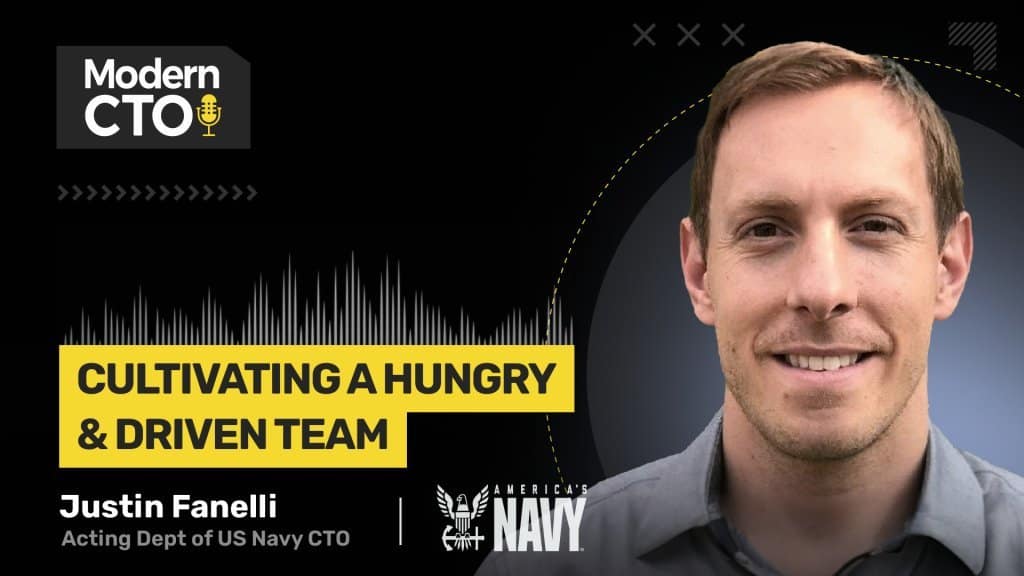
Cultivating a Hungry & Driven Team with Justin Fanelli, Acting Dept of US Navy CTO
Today we’re talking to Justin Fanelli, Acting Dept of US Navy CTO. We discuss the robust relationship between the public and private sector, Justin’s experience leading technical teams for the Navy, and what it means to really get after discipline in life.
All of this right here, right now, on the Modern CTO Podcast!
To learn more about the Navy, check out their website here.
For more on Justin's courses, check out www.h4d.us and https://www.commonmission.us/
Have feedback about the show? Let us know here.
Produced by ProSeries Media.
For booking inquiries, email [email protected]
About Justin Fanelli
Technology at its best is about positive outcomes.
Creativity, education, storytelling, experimentation and partnerships help us all learn together faster and deliver. And if what we're doing matters, so does speed, so does quality, so does value.
About The US Navy
The United States is a maritime nation, and the U.S. Navy protects America at sea. Alongside our allies and partners, we defend freedom, preserve economic prosperity, and keep the seas open and free. Our nation is engaged in long-term competition. To defend American interests around the globe, the U.S. Navy must remain prepared to execute our timeless role, as directed by Congress and the President.
Transcript
Today, we're talking to Justin Fanelli, CTO of the US Navy, about how his team is crushing it in both public and private sectors. You're listening to Joel Beasley, Modern CTO.
Alright, so walk me through this. You guys are hungry, you're driven, but it's government. And you don't usually associate hungry and driven with government. You guys are out there working 14 hours a day. It's crushing it. What are you doing exactly?
Yeah, so I probably can't brag about the actual amount of time we're working because we do time cards. But here's the deal. This is not your granddaddy's government. We're trying to—I think several years ago now, we recognized that most organizations, if they're successful, are digital organizations. That's why I started listening to this podcast. But if you're doing things the old way, you're not just ineffective. Like, you're hurting your user base. You're letting people down. And so the idea of—there are ebbs and flows in cycles of opportunities in the tech space and then overall with what's happening in the world. We want to go smart and fast. And I believe the government can do that, and we've seen that recently. And as long as that's the case, I want to be here serving with people who are doing exactly that. It's more exciting than it was 25 years ago, I'll tell you that.
But when I turn on C-SPAN and stuff, it just looks like a retirement home. But when I'm talking to you, I've got a lot of energy. It sounds like you guys are moving and shaking. You say it's not your granddaddy's government, but when we look at our representatives, isn't it skewed towards our granddaddy's government?
So the executive branch, in general, regardless of administration, you'll find patriots in there. So there are people who have been beaten down by the system that exists, but there are mavericks and getter-dones, and just people like your dad who are in a uniform and joined for the right reason. Early career people who just want to serve and be a part of something bigger—that was our last batch of hires. And they're in there, and they're looking at friends who are doing other things. And when they go back for reunions or catch-ups, they're comparing notes, and we're getting more applications than we used to. So I think there is some of that. On the upper end, an interesting trend is—I mean, there's a lot of people, right? This is the largest, if not employer in the country, spender in the country, across federal government. The idea of doing that efficiently and then seeing the difference you're making—I see more people who are activated on the later end of their careers. We're seeing more people who've crushed it, people who've had success in tech or other places, say, "Hey, how can I help? Are you trying to angle on the government? Are you trying to get over?" No, I'd really just want to give back. Like, I'm at that point in my life. How do I help? And so to that point, I think we have a lot of pockets of goodness.
I 100% agree, and I think this is a good point to emphasize that when I watch the media, I have a depressed view of our armed services—most things in general, but specifically that. And so I live in a military town, actually, an Army town. So I live in Clarksville, Tennessee, which is the 101st, right? And look—
My grandfather's unit. Oh, is it? Yeah, keep going. Keep going.
Keep going. So I've got, I would say, 80% of the people we interact with in this town—when we go to church or grocery store or whatever, all of our social friends—they're all flying the Chinooks or something, right? And we got close with a couple people in SF, the Special Forces. And so they come over—I've got about seven acres out in the middle of nowhere, and we set up a shooting range, and they came over and we were running through some operator drills, and they were giving me this awesome experience that I've never gotten to have. And I asked him—I'll leave his name out of it—but I was like, "Hey, you know, I see this stuff in the news about this woke nonsense and drag queen shows and..." He goes, "Dude, it couldn't be farther from that." He goes, "Those are just these rare little nonsense things that happen." He goes, "All the people, at least in SF stuff that I'm in, we're all just straight assassins. We're exactly what you would expect and, you know, like me." And so that gave me so much hope as a patriot, as a person who loves America. That gave me so much hope. And so I don't know, that's why I figured I'd share that little story.
No, I appreciate that. I mean, in general, if I'm just speaking about myself, I have not found news cycles to be particularly helpful. And so I'd rather read books at this point and then grab info. I mean, quite frankly, it feels like we've been all the way around and we're back—in-person meetings and intersections. I get so much more from those than these constant flows of data. We know how data works. I love my APIs, but if I can get in a room with a handful of people, even if they don't think the same way I do, and we can get contact and we can get collisions on some of that stuff, I'm either going to get smarter or knocked down, or probably both. And that's meaty stuff. That's what we want.
And then do you interact—one of the guys I follow on LinkedIn, his name is Nicolas Chaillan or something like that. He was, I think, the US Air Force software guy. Do you interact with some other heads in other divisions, or are you just focused on Navy?
No, totally. I love that question. So the government is massive. Not all things are created equal, and there are just brilliant people all over, but you don't always know how to find them. And so LinkedIn has been helpful to that point. But in general, if you spend enough time, there's a gravitational pull. And so I—if I spend too much time thinking about one problem or in one place or with one set of people, I find myself anchoring. I don't even realize it. And so the answer to your question is, today I had lunch with Health and Human Services, the FCC, the Army, the Air Force, and a bunch of other people. When the world is at its best, it feels smaller, and we can chunk some of these things off and we can figure out, "Hey, we think these problems are very specific to us," and sometimes they are, and most of the times they aren't, right? And it's just a framing thing. So if you can take this big group of people and this big world and these big, huge problems and chunk them, then they're actually solvable.
And so how did you end up in this role as CTO of the Navy?
Yeah, so I've—two jobs, like all of us, right? So I think the meandering path is I just kept trying things that sounded interesting. The long answer is: electrical engineer, was in Air Force ROTC, wanted to serve, registered for commissioning. I got medical DQ, and I was like, "Oh no, I want to be around and in uniform." I get to choose my own clothes, but I got to sit around people who were in the Navy. And I looked at a bunch of other industry jobs and just wasn't as motivated at that time by those. And then I did a command and control job and then an intelligence community job and then a healthcare job and then a business systems job. And so through all of those, it wasn't intentional. I just—electrical engineering and computer science and kind of riding that wave, and then private sector stuff. I guess the funny story is I think I complained about my computer enough that they asked me to help fix computers across the Department of Navy. And so that was in a long title, but tech director for Program Executive Office Digital. So the short version of that is director, technical director of IT services, along with the executive. And then the CTO for Department of Navy fleeted up to CIO, and so I started doing both.
And so do you have an official rank as that position, or do you hold it as a civilian? How does that work?
I hold it as a civilian. The civilian force and the military force work very integrated. The civil-military fusion—super effective. Talk more about fusions. But my rank is—this is a little bit wonky, but there's the government scale, there's GS, and then there's the executive ranks, and then there's political appointees. So I'm above GS and below appointee. I'm what's called a senior scientific technical manager, but it's of the executive echelon.
Yeah, to that point of that fusion stuff, I'd say half the people I interact with in this town, they're active duty, and the other half are retired, but they're civilians working in the same buildings that they were working in when they were active duty. It's very complicated how all of that works, but it's closely intertwined.
Yeah. Yeah. And to that point, I've listened to the show a bunch. Most of the guests, I think, are private sector guests, and they're making big things happen. I wanted to mention that the intertwining between private sector and public sector is growing also. So that mesh is on the uptick. And we're listening. I mean, back in the day, we used to invent all of our own stuff, and it was government off-the-shelf. The amount that dual-use case and that our private sector relationships are turning into win-wins—night and day from, I don't know, less than 10, 12 years ago.
Well, by the way, I very much appreciate that you're a listener. Thank you so much for listening to the content.
Yeah, man. Yeah, man. The first episode I listened to is the National Instruments CTO, Thomas Benjamin. I was with him, and I'm like, "This dude is brilliant. I just want to hear more." And so I got his card and I thought we'd have a relationship, but yours was the first one I picked up. And I'm like, "Okay, this is for me." The idea of people coming on here and talking about getting after it is something I wanted to be a part of.
Yeah. Well, thank you so much for the feedback. Hey, what is a typical day like for you as the Navy CTO?
That's awesome. So within Department of Navy—so Navy and Marine Corps—I'd say there are no typical days. They're mostly productive and long, but fairly rangy. And so from the IT side of things, meeting with folks who are working on cloud, whether they're internal or external, working with folks who are in the weeds on cyber—and that includes the cloud folks. That includes end-user devices. That includes Cyber Command and some other agencies who are doing nitty-gritty stuff. The short answer is a lot of meetings, but and then maybe work afterwards. But the longer answer is, at the intersections of connecting the dots on the future of zero trust and progressing a handful of positively disruptive pilots day by day. And then looking at policy that's coming from different places and saying, "Hey, can we make use of that? Can we turn that into go-energy within the department?" And then meeting with users or super users to figure out, "Hey, are the problems that we're addressing the same problems that they have now, or have those moved on us?" So I could give you the full list, but it's a lot of contact, correlation, and then adapting our daily plan and then our quarterly campaign plan.
Does your culture have that sort of direct communication feel? Like, in the private sector, you'll find a lot of feelings, for lack of a better term. But people will sidestep, you know. And I noticed that when I interact with my military friends, they're very direct. And I prefer direct communication largely because that's what I got growing up, right? And I was like, "I need clarity. I need it clear so we can execute." And do you find that in your job? Because I mean, you are in the fusion, but do you still have that direct communication?
Yeah. So from a Bayesian perspective, it's never 100%. I'll tell you, first and foremost, I fuel off of that, whether it's good news or bad news, whether it's getting or giving. If it's direct, it's efficient. And we can translate that into data and then translate that into action. So bias towards action—love it. Not every conversation is that. The cool thing is the more context you have—so framing is a superpower within the government, because there's just a lot. There's no shortage of context and opportunity. And so we have—there are direct people, you know who the direct people are, and then where there's a more nuanced message, you can normally calculate. I've gotten better at calculating that and also context switching. So the short answer is I'd say it's probably the best concentration of direct people. And then when you need to figure something out, maybe it's intentionally obfuscated, and maybe it's just that they don't know the answer, and we can dig in. I think my team is really good at that. So what I'll do, I'll just share a personal—like, if I come out of a meeting and I'm like, "I don't know exactly what happened there," I'll bounce that off—we have a daily scrum, just 15 minutes of, "Hey, what do you think about this? What am I missing? Give me some blind spots." And these are people, and this is super interesting from a cross-functional perspective. We have an Army guy, a Navy retired captain, a guy who worked for the FBI, a guy—so they can 360 me really well.
Dude, that is awesome. That is so—you know, one of the things that's been interesting for me since doing this show is the number of people I get to speak to that are Israeli startups. There's a lot of Israeli startups, and this goes all the way back to one of my trips out to a security conference, and they had all the countries for the security conference. It was really cool. And I got to meet a couple of these people. Then I started to pick up on a pattern, and the pattern was that these people that were mandatory service time were better people. They had a clear style of communication. They got exposure to problems at scale from day one. So, you know, I started a Fortune 500 company. I'm a peon.
(Joel Beasley at 00:15:50) I go into the mail room or whatever and I work my way up for twenty years until I can work on the real problems. IDF, you start your service day one. You're taking over some project of someone else, and it's serving billions of requests a day, and you're just the guy now. And so what I found was through my probably fifty-plus interviews with different people that came out of IDF and started a private company is that their experience was so incredibly beneficial by getting to work on problems at scale in the IDF that that supercharged them, and now they're making a bigger impact in the world as a whole. Now, when I was a kid, I would tell you, if you talk to eighteen-year-old Joel, I'd say mandatory service is nonsense, not doing it.
(Joel Beasley at 00:16:29) It's not for me. But if you talk to, you know, thirty-six-year-old Joel with three kids, I'm like, we should make everybody do that in the United States. It would give them discipline, a sense of community, a tie to their country, and it would give them the opportunity to experience commercial problems at scale. What are your—I know you're the CTO of the Navy, but from a, let's take it personal—what are your personal thoughts on mandatory service?
(Justin Fanelli at 00:16:55) The idea of serving—I think, going to your eighteen-year-old self, the idea of serving isn't attractive to everyone until you're doing it. And so when you're in there, it comes down to how we learn. Right? They say the majority of people are visual learners. I think the majority of people are contact learners. Right? I can watch someone learn something and not learn much. I can do it, even if I don't want to do it. And I mean, who liked working out until you got good at it? Right? And so now you're like, oh, I love working out. You didn't start liking working out. You started liking sitting on the couch. And so that activation energy—I mean, I think you can—there's almost no greater honor to me than being in the military.
(Justin Fanelli at 00:17:48) And so I think there is something in the United States to volunteering and saying, like, hey, I am calling into that service. And then in a different way from a civilian perspective, it still feels like service. And so if you're getting after that, and just signing up isn't enough. You have to lean in. I don't know about all the mechanisms for if people are made to do something and they're not leaning in, but I love when people are choosing to do something, because then you're choosing to do it every day and getting after it and getting after it.
(Justin Fanelli at 00:18:23) Do I think everyone would benefit? I mean, this is a ridiculous comment, but I think if everyone even waited tables, if you had any sort of service experiment—my friends who left college and had never had a job got punched in the face in their first job. Right? And so if you're not getting after something that's humbling you on a regular basis, if that feedback cycle isn't coming at you, then we're just not learning as quickly as we should. And to this point, Marines and IDF and just anyone who has that entrepreneurial spirit, they probably got it either from their parents or the cycles to say, oh, you know what? The connection between doing something and getting outcomes just got closer together. That's what winning feels like.
(Joel Beasley at 00:19:16) Well, I like you, Justin. You're my people, man. Like, when I talk to them, I'm like, wow, how many people are like Justin in our military? I want more Justins out there.
(Justin Fanelli at 00:19:26) There are some awesome people. And my team is—you know, we were talking about how much we work. My team, they work so freaking hard that when outside organizations or outside people are like, how are you doing?
(Joel Beasley at 00:19:42) How are you holding up?
(Justin Fanelli at 00:19:42) I'm not holding up. My people have me inspired. I am fired up. Right? I've found that—this is super anecdotal, but whenever I talk to people who are burned out anywhere, it's not because they're working more than other people. I just think they don't feel that—I mean, it happens. Right? There are people who work too much. But if you're not feeling like you're connected to a tribe and you can see the difference you're making, you're more likely to get burned out.
(Justin Fanelli at 00:20:16) There's a correlation to that that I've seen is much stronger than the number of hours. I know sixty-hour-a-week people who are loving life, and I know thirty-hour-a-week people who are burned out. Right? It's not the amount of time. It's like, do you see the difference you're making? And are you part of something that you really care about and making it better?
(Joel Beasley at 00:20:39) Yeah. Have you ever come across Jordan Peterson's content?
(Justin Fanelli at 00:20:42) Yeah. Yeah.
(Joel Beasley at 00:20:43) Yeah. So I got to meet him a couple weeks ago in Nashville, and I went to listen to one of his lectures. And he talked a lot about a little bit to this about your aim, being very, very clear on the thing that you're aiming at and then allowing the world to orient. So this is not just a microphone. This is now an object to achieve the aim I have chosen. And watching how your money and your time and your resources hone in on that one specific point. And after hearing that talk, I got to go with my wife. We got a babysitter for the night, did an overnight Nashville.
(Justin Fanelli at 00:21:18) Yeah.
(Joel Beasley at 00:21:19) And date night. We get one night a year where it's an overnight, and then we do date nights every month. But after hearing that, we both sat up in the hotel room the whole night, and we're like, alright, what's the aim for our family? What's the aim for you, for her, and what's the aim for me? And let's put those on a piece of paper. And we got it designed up and put it on the fridge. And for the past two months now, we've just, every day we wake up and we're just like, that's our aim. That's our aim. And we are crushing it.
(Justin Fanelli at 00:21:48) That's awesome. That's so intentional. Right? You've—there's more data than there's ever been before. Right? And it's the same for intentions. And so if we are aimed on one thing, how else would we filter out everything that doesn't matter as much? So by you prioritizing your life in the form of actions—yeah. And then when something is out of line, you're more likely to notice it, so it increases observability. And that's a technical discussion. Right?
(Justin Fanelli at 00:22:19) Just like on our networks. If we're looking for something, we know how to find it. This is how we look at anomalous threats. This is how we look at anomalous behavior. This is how we look at something that's holding us back from our ultimate objective. So I'm with that, man.
(Joel Beasley at 00:22:36) Well, that was actually the problem is when the podcast got more successful, more business opportunities started to come up. And so people would be like, hey, I want you to be a part of this or a partner in that or be in this fund or start with this startup. And all of these things emerged, and, you know, Peterson and many other psychologists talk a lot about the fact that this depression and anxiety comes from too many potential paths opened up and not being able to decide and reduce that into one. And so the definition gave me the power to say no. So now something that is really good can come along, and I could say, that's amazing, that would work, I would make a ton of money, there's great people in that project, everything's go, go, go. However, it's not in line with my aim, so I have to say no to it. And then I've—that gives me that freedom to say no to things now.
(Justin Fanelli at 00:23:27) Oh, I love that. I mean, it's an alignment game. Right? If life is pretty good, maybe great, but if something's up, you're like, okay, what's in me that's not aligned? And to this point, we can look and see that pretty easily. Same with our portfolios. Whenever I'm teaching and I'm like, hey, this semester, this group doesn't feel like they're as in line as they usually are, and there's data there. Maybe their grades are different, but this doesn't feel right. Those are triggers to reflect and then, hey, let's simplify. Because simplicity scales, to your point.
(Justin Fanelli at 00:24:09) Right? I want seven goals. Do you know the word "priorities" didn't get pluralized until the last fifty or a hundred years? It used to just be "priority." Priority's number one. And you're like, oh, what are your priorities? That's nonsense. What do you mean priorities? So there's one priority, and then everything else is not a priority. And so we've pluralized this. Right? And, you know, we understand why we have to, and there's a couple mechanisms for wrestling with that. But the idea of being able to say yes to what is the biggest positive impact as opposed to trying to be living in the cereal aisle—no one thrives living in the cereal aisle.
(Joel Beasley at 00:24:50) Just all sugar. Get out of there. You're teaching a class titled "Software-Defined Warfare," quite possibly the most badass title for any class in college ever. What is software-defined warfare?
(Justin Fanelli at 00:25:05) That's a good question. So I'm excited about that one. So that one's coming up in the future at Georgetown. I had equally cool, maybe equally cool titled courses. So last one was "Hacking for Defense." And then the one before that was "Cybersecurity Strategy: Public and Private Perspectives." Less cool, but still a great class. Software-Defined Warfare is a wonk meter raised. Um, so this one is the idea of, like, hey. Something that private sector recognized a while ago, and actually the Department of Defense started driving early on, but Silicon and software is a bigger deal today than it was yesterday, and it will be tomorrow.
(Justin Fanelli at 00:25:55) Right? And so what can we do at Ukraine-type cycle speed for adapting? How long does it take to bend metal versus for a digital twin to change the way that we operate? I drive a Tesla, and so when we get those software updates, I kind of get giddy at this point for, okay, my look and feel is going to be different, and so might, to some degree, my steering. But the idea of things as platforms that are inherently updatable just means that we can learn faster.
(Justin Fanelli at 00:26:34) And so software-defined warfare means, let's look at the art of the possible. Let's look at where there are opportunities to use the leverage that we have and increase the leverage that we have across the board to adapt and then learn at scale.
(Joel Beasley at 00:26:51) How long is this class as far as total length? Is it six weeks, eight weeks?
(Justin Fanelli at 00:26:56) Fifteen weeks. It's a full—it's a three-credit grad school course. Yep.
(Joel Beasley at 00:27:00) Okay. So teaching is a large part of your life then?
(Justin Fanelli at 00:27:05) Yeah. I mean, it's something I've been doing for about ten years. I love it. The students end up being lifelong relationships. I'd say mentor-mentee, but it probably goes both ways. Some of them are off doing amazing things now. But yeah, it's at least one day a week, normally a three-hour block, where we'll get together. And then the best classes will do most of the leading. We do some flipped classroom stuff. We do some hands-on stuff, a lot of discussion. Very few of these classes are technical. No one's building code. But when we talk through strategy—Hacking for Defense is a really cool one. It's taught at a bunch of universities. It's out of Stanford. It's Steve Blank and kind of lean startup applied to defense.
(Justin Fanelli at 00:27:57) This is one where they're out doing interviews. They're out getting contact. We were talking about service. Again, very different, but they have to cold or warm contact a hundred people, experts, during the course of the semester. And so fifteen weeks seems like a long time until you have to have a hundred phone calls and then collate that data and get after it. So I was just with the founders of the course. I was with Steve and some others recently. And then last night, I had dinner with the Stanford Hacking for Defense class. I teach it at Georgetown. And they are fired up and ready to go. And then they're in the trenches of this data. So it's a cool set of courses.
(Joel Beasley at 00:28:45) What type of experts are they contacting and why?
(Justin Fanelli at 00:28:48) Yeah. They pick a problem, so it's domain specific. And then, actually, they'll drift a little bit. And so an example would be, one of them—the class last night was, they're looking at documented policy, and they're trying to digitize all of it. And they're saying, okay, based on all of the policies that exist, is there an opportunity to optimize or forecast, or does this present opportunities? Can we figure out how to get things delivered faster? Can we figure out which policies are more useful than others? And so they created a software product, or at least a model around that. We had one that was a team that was looking at space. So commercial space. So mostly proliferated lower orbit. We know those companies. But they were then talking to, here are NASA people, here are Blue Origin people, here are technocrats and policy people. So it takes a lot to get to a hundred. So kind of anyone that they can think of and then do parallels.
(Joel Beasley at 00:30:03) I love that, you know, because that's kind of my job. Right?
(Justin Fanelli at 00:30:06) Yeah. Yeah. That's—I hadn't thought about that. That's super cool. Yeah.
(Joel Beasley at 00:30:09) Yeah. Yeah. Contacting experts and pulling information and insight out of them. And I'll tell you what, my entire life changed after, you know, my first—I'm coming up on, you know, ten years and a thousand interviews. A thousand interviews. Yeah. Yeah. And so after the first hundred or two hundred, this new thing happened where I just started understanding people better. And I was sharing this years ago.
(Justin Fanelli at 00:30:35) That's dope.
(Joel Beasley at 00:30:35) And somebody said that there's a book called, like, A Hundred Conversations, or the theme of the book, whatever it is called, is to go out and have a hundred conversations with different people that are meaningful. Not at the checkout like, hey, how's your day? Go actually discuss a topic with a hundred different people, and these new patterns will emerge. You get it because you've already done it. But these new patterns emerge, and you start to understand different people, how conversations flow, different talking styles, different outcomes, incentive alignment. You start to understand these parts of conversation in a whole new way. So that's amazing. Who's telling them to go contact these hundred people? You said Steve Blank?
Justin Fanelli at 00:31:15
Yeah. So Eric Ries wrote a book, Lean Startup. I think he was a student of Steve's. And it's an awesome book.
Justin Fanelli at 00:31:24
And then Steve and Pete Newell and a handful of others at Stanford were like, hey, what if we get at some of these problems a different way? Like, what if we just, to your point, aim some students at a problem who don't have any context? And we're like, what about context? Well, like, let's just have them go get context, and let's give them a grade for that.
Justin Fanelli at 00:31:45
And to your point, the intersections end up being way interesting. I learned the Space Group is three guys. I had lunch with two of them over the weekend. And I learned so much about space from them. We did the final presentation in congressional buildings, like, just called in a favor, and then we did it from there.
Justin Fanelli at 00:32:11
And so we had like 20 experts come in and they're like, those guys knew space. Like, they've been doing space for five years. No one was working on space. Now they sound like experts. Yeah.
Justin Fanelli at 00:32:21
We're trying to build versatilists. I mean, this is how we want to teach in general. Hey, if you're in grad school, hopefully you're trending towards a specialist. We encourage people to, I don't know, kind of get smarter from a generalist perspective. And then can you turn into a versatilist and get those intersections? Because to your point, if you can grab the hook, the things we're studying right now, school aside, anything aside, the problems are going to keep coming at us and we can't predict what they are.
Justin Fanelli at 00:32:50
But if you learn how to learn through doing, and then you enjoy it, right?
Joel Beasley at 00:32:58
You know where they do this really well? I picked up on it like 10 years ago. My brother went through med school. And I was having lunch with him, and I said, hey, he was telling me about some surgery that he had learned.
Joel Beasley at 00:33:07
And I said, alright, so you know, I grew up with you. I shared a room with you when we were children. You've been saying since age—since my first memory of you—that you're going to be a doctor. You've been, you know, you're on your way to becoming a doctor. You're a doctor now. I was like, and you have all this background knowledge, but at the end of the day, you're walking into that room and you're cutting into someone. I'm like, that's an incredibly detailed moment in someone's life, and that has to be done really well. So tell me, Mitch. I was like, how do they teach you that?
Joel Beasley at 00:33:39
And he goes, oh, it's really easy. Like, watch one, do one, teach one. And I was like, what do you mean? He goes, yeah. When we want to learn a new surgery, doesn't matter what type of surgery it is. He goes, we go in, we watch someone do it, then we do it on the, you know, lifelike simulator or whatever, and then we teach someone to do it. And if we do those three, that's it. He goes, well, we have all this baseline knowledge, but then we just go take a class to learn to do the surgery. And I was like, that's how you teach the most difficult things in life. Right?
Joel Beasley at 00:34:09
The things where everything's on the line, where someone's life is on the line. And so if that's the modality to teach that, why don't we just apply that to other ways of learning things? And so I started doing that in my life where I would just try to reduce the cycle time between seeing someone do it, doing it myself, and then teaching someone to do it.
Justin Fanelli at 00:34:27
Yep. Yep. There's analysis paralysis. Right? It depends on the stakes. But if we're just in the knowing knowledge and we never turn it into action, then what are we? Like, experts of, I don't know—
Joel Beasley at 00:34:39
Theory?
Justin Fanelli at 00:34:41
Yeah. Like, right? From afar. And so the knowing, doing, oscillating between those two, that's super cool. And then you actually mentioned cycle time. The idea of, hey, VCs are making a bet, and then they figure out whether that was a good bet or not in seven years.
Justin Fanelli at 00:34:59
Chefs are making a sandwich and it either is delicious or it sucks in like 15 minutes. Right? The closer we can pull in, especially from a technology perspective, that feedback cycle—hey, let's try this out, let's get that out to a wider set of people. I mean, that beta into feedback, that is so important because, to connect that back to the aim thing, there are 100 things to do.
Justin Fanelli at 00:35:29
And if you're kind of piecemealing your learning along the way as opposed to solidly learning something and then figuring out, okay, I can scale this piece, and it's interdependent, and I can scale this piece, then you can actually get that traction.
Joel Beasley at 00:35:44
Hey. Have you met Ryan Graves? Have you met Ryan Graves?
Justin Fanelli at 00:35:48
Name sounds super familiar.
Joel Beasley at 00:35:50
Yeah. He's fairly popular in the space now. He was on Joe Rogan's show, and he was identifying when he was doing some of his flights, these objects in the sky that he couldn't tell how they were there. There was just—
Justin Fanelli at 00:36:08
Team broadcasting. Interview. Yeah. Yeah. Yeah.
Joel Beasley at 00:36:10
Yeah. And he was mostly—he was not approaching it from like the alien UFO standpoint. He was approaching it very pragmatically as a, hey. We're flying at the speed of sound, and we don't want to run into these things, so let's figure out what they are. Right?
Joel Beasley at 00:36:23
Which I loved that approach because it allowed him to cover it technically without being labeled a crazy person. Anyways, the only reason why I bring him up is if you don't know him, you should. He's got good energy like you. He's a super bright guy, and he's making the transition right now from fighter pilot, you know, whatever, to helping a fund that's investing in detection technologies for detecting things in the airspace. So he ran into this problem on duty where he was flying into restricted spaces, and there were objects there that shouldn't be there.
Joel Beasley at 00:36:58
Period. Let's just leave it at that. And so he's like, we want to detect these things so we don't run into them because we're flying multimillion dollar aircraft at the speed of sound. And so let's just start with that premise, and let's build better technology to detect these things so we don't run into and crash into them. And so he's out there now for the past year or two doing that fund. So if you want to see some cool stuff going on, I'd talk with Ryan. And if you want an introduction, I can make it too.
Justin Fanelli at 00:37:22
Okay. Sweet. I do. Curious solvers light up my life. And the idea of people who, hey, I am in here, in this case, in the government, and then I jump out to solve a problem. They can even expand that company and turn that into dual use case. They can just solve for exactly what they wanted. I mean, that journey ends up being a wild ride. So I spend, I don't know, at least 5% of my time with entrepreneurs who never planned on being entrepreneurs, but have launched something and then caught the bug and are getting after it.
Justin Fanelli at 00:38:03
That's awesome.
Joel Beasley at 00:38:04
Because you're private and you're CTO, does your security clearance—does that still matter, or do you just get only public information? How does that work?
Justin Fanelli at 00:38:12
Oh, you mean because I'm not in uniform?
Joel Beasley at 00:38:17
Correct.
Justin Fanelli at 00:38:17
Oh, yeah. I mean, so I'm still a government employee.
Joel Beasley at 00:38:21
Okay. Yeah. So clearance is still your clearance. It doesn't matter if you hold uniform or private. Okay. Cool. Yeah. I don't know that much about it. I'm just curious.
Justin Fanelli at 00:38:29
Yep.
Joel Beasley at 00:38:31
It's like, as a kid, I wanted to be super secret spy guy. Right?
Justin Fanelli at 00:38:34
Right?
Joel Beasley at 00:38:35
And so I got to see my dad in Air Force, right? Who didn't? And so the fact that I get to talk to really cool people—and we can edit this part out, but I became friends with some of the people that were building those screens inside of your op rooms.
Justin Fanelli at 00:38:49
Mhmm.
Joel Beasley at 00:38:50
And so, like, just some of the stuff—obviously, they didn't share anything classified with me because that would be inappropriate. But just the interesting stuff that goes on, how you can start in private and end up with clearances and end up being in rooms that you never imagined you would ever be in, that to me is fascinating.
Justin Fanelli at 00:39:12
It's the idea—not the looking glass, but the idea of most things are deeper than we realize. If you're around the right people and you approach it with the right mindset, curiosity as opposed to judgment, that's actually where real problems get solved. People who've been looking at the same problem or the same room for 10 years, they may be making incremental progress. But when NASCAR and Southwest or whatever airline met, they figured out, oh, here's how we can do maintenance, and now we fly and get on time more often. Right?
Justin Fanelli at 00:39:48
These connection points and where they lead us, super cool stuff. I talked to a venture capitalist the other day who is now leading a nonprofit for getting elite grads to come do a couple years of service and then go back into industry. Or just people are doing—none of this stuff is static. People are doing interesting things, and we're kind of figuring out what the ecosystem should look like, especially with AI.
Joel Beasley at 00:40:20
So here's a fairly selfish question, because I have you here. I might as well just ask. So I've had the interest a couple times, it's come up. I was like, you know, maybe there's some way I can be useful. Right?
Joel Beasley at 00:40:36
Because I'm not going to go serve in the sense of, like, drop everything and change my career and join or whatever. But maybe there's boards or—and I kind of see it happen in media from here and there where, like, we got together all of these people, and they form this board or whatever. But I get to see all of these technologies, and I get to see stuff that exists publicly, and I get to see the stuff that the private people have behind the scenes that are coming because people show me stuff off cam on the podcast all the time. I get to see all this stuff. And I'm like, man, if there's people solving problems and there's some way for me to be useful, how do you think I would go about doing that?
Justin Fanelli at 00:41:17
Yeah. So let me make sure I fully understand. You've gained all of this experience, and you'd like to put it into service. That doesn't sound selfish at all to me, just for the record. Right? You're like, hey, how can I give back in this way based on something I've assembled that I didn't even plan on assembling? Right? This secondary benefit that may end up being primary. So I think that's super cool. The most basic ways are—so the dual use, I don't know if your whole audience knows what dual use is, but what we consider dual use is someone who's selling a product to the government and private sector. And they have kind of both sets of pipelines. Where that goes back and forth, it ends up being, if it hits the mark in both cases, a pretty good economic deal. And so there are a lot of emerging startups in that dual use space where they need someone with business savvy or someone with contextual information, generalist information where they can say, hey, I'm a specialist.
Justin Fanelli at 00:42:32
You've met the CEO or CTO or technical person who can't tell a story. Well, it's the same for not being able to contextualize this. And so, first and foremost, where startups and new entrants and those vendors—where they have a great idea and they can't convert it into outcomes. They need some steering.
Justin Fanelli at 00:42:55
And we want that. Right? I want this new energy high impact company to crush it. But sometimes they get stuck on something because they don't have the experience, but they have the right idea. And so we actually call it the valley of death when someone has a really good idea, but it can't land into providing some sort of mission outcome on the other side and have a sustainable growth rate.
Justin Fanelli at 00:43:19
And so just the lowest barrier to entry is advising some of these startups to make it through, or someone who is only focused on private sector. Say, hey, what if you expanded to serving and solving a particular government problem at speed? Oh, they would never go for that. That's your granddaddy's government. Not necessarily if you can prove the impact that you have, then there are some people in the government who will grab this new way and then ride that. And that might be usefully disruptive in some cases, or that might mean that we have to divest something to invest something, but drivers wanted and best ideas in terms of outcomes wanted. And so I think a thriving market of high impact items is the most straightforward. On the board side, I'm happy to introduce you to some people on Navy and Marine Corps and Department of Navy. We have an all star science and technology board that just got stood up not that long ago for the secretary.
Justin Fanelli at 00:44:27
It's a fairly small group, and they're doing kind of intense studies right now. These are people who have done awesome things. And they figured, because they have other jobs, it would be on advising, and they are elbow deep. They're in the trenches actually helping us solve problems and investigate. One of them is a former Secretary of the Navy.
Justin Fanelli at 00:44:53
One of them is the dean of a university. Actually, a few of them are deans of universities. And so they're just cool people to kind of meet and get up with. The next time that we grab a meal or beers, if you're in DC, let me know. But there's all kinds of opportunities as the too long answer.
Joel Beasley at 00:45:12
Justin, we did it, man. We made a podcast. How do you feel?
Justin Fanelli at 00:45:15
I feel awesome.
Joel Beasley at 00:45:17
Thank you so much for listening. And if you found this episode useful, please share it with a friend or a colleague who you think would get value from it. And if you have topics that you'd like to hear discussed on the podcast, either add me on LinkedIn or send me an email, [email protected]. Every time I get an email or LinkedIn message, it absolutely makes my day and inspires me to keep going.