
Episode 833 ·
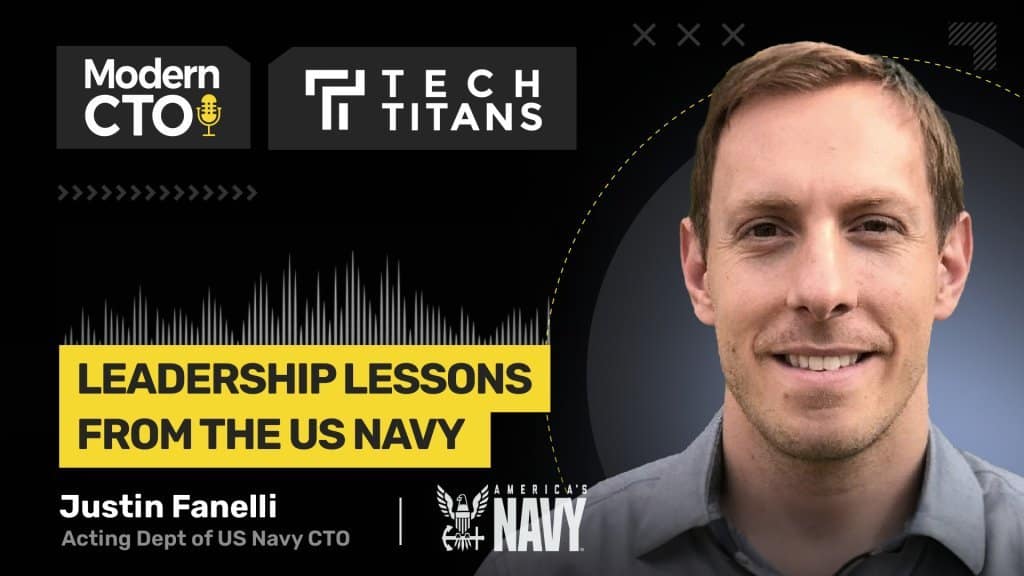
TECH TITANS: Leadership Lessons from the US Navy with Justin Fanelli
Today, we're talking to the CTO of the US Navy, Justin Fanelli. Discover how the modern government is embracing digital transformation, the power of direct communication in military settings, and the unexpected passion driving innovation in public service. Justin shares invaluable insights on leadership, burnout prevention, and the importance of continuous learning.
All of this right here, right now, on the Modern CTO Podcast!
For more on Justin’s courses, check out www.h4d.us and https://www.commonmission.us/
Produced by ProSeries Media: https://proseriesmedia.com/
For booking inquiries, email [email protected]
About Justin Fanelli
Technology at its best is about positive outcomes.
Creativity, education, storytelling, experimentation and partnerships help us all learn together faster and deliver. And if what we’re doing matters, so does speed, so does quality, so does value.
Transcript
(Intro Narrator at 00:00:00) Today, we're talking to tech leader public speaking coach Jeffrey Hock about his best tips for conquering communication as a leader. You're listening to Joel Beasley, Modern CTO.
(Joel Beasley at 00:00:16) Hey, Jeff. How are you, bud?
(Jeffrey Hock at 00:00:18) Hey, I am very good. Thank you. Very excited to be on this podcast.
(Joel Beasley at 00:00:23) No, this is exciting. And it seems like you've dedicated your life to helping technical people communicate, communicate their ideas, improve in their career with communication. Can you tell me a little bit about that?
(Jeffrey Hock at 00:00:35) Oh yeah. It's not a coincidence that I came to do that. I used to work in tech for twelve years as a software engineer, and communication was my biggest struggle. I used to have social anxiety. I was shy. And even just having to talk in front of people was extremely hard for me. So I had good technical skills, but I felt completely blocked because of my lack of communication skills. So once I could develop them and see how many benefits I could get out of it, because once you have great communication skills, that's when I realized that my life started to become meaningful. That was really great, and that's why I decided to help other fellow people in tech who also might struggle with their communication skills to develop them.
(Joel Beasley at 00:01:38) You said you felt blocked. You were good technically. You felt like your communication skills were blocking you from advancement. Give me more. What's an example of a moment that you're like, wow, I need to learn to communicate better?
(Jeffrey Hock at 00:01:53) You know, just making an important call was so draining and so difficult. And the worst is that when you finally get the courage to do it and you somehow lose your intellectual abilities because the pressure is just so high. It's so hard because you know that you know. You know, after the call, you know, why am I so stupid whenever I'm in a high stakes situation? So those were very hard moments, and I didn't know what to do.
(Joel Beasley at 00:02:26) So do you work with people that want to become keynote speakers, or do you work with people who are just trying to become better at communication in their job so that their life is easier when working with other people? Where do most of your clients fit in?
(Jeffrey Hock at 00:02:43) I'd say I have a little bit of everything. I have people who feel anxiety before they speak, and they just want to be able to express themselves clearly in those situations. I have people who used to be able to speak properly, but then something bad happened in their life and they cannot get back to it. They come to me and they say, I used to be confident in those situations, but now it doesn't work anymore. So I had a few people like this recently. And I have other people who are okay when it comes to the emotions, but they're not effective. Typically, they're very technical. They're really experts. But whenever it comes to talking to people who don't share the same expertise, they have a very hard time to do that.
(Joel Beasley at 00:03:37) So if I'm a super technical person, but then I have to approach the board or the executive team, I have to learn the new language.
(Jeffrey Hock at 00:03:47) You need to know what they need to know. Because if you are the CTO of a company, your job is to abstract the technical to the other people who don't understand it. That's literally your job. It's the same concept as abstracting something in a code base. You deal with the technical and you need to know what they need to know in order to take decisions.
(Joel Beasley at 00:04:21) So what's your method for explaining tech to non-technical people?
(Jeffrey Hock at 00:04:27) Most likely you will not explain it. You don't really need to explain how exactly it works and what are the details. If people are interested and they want to know it, usually they ask. What you need to know is what's the impact of this tech? What can you do with the technology? What are the limitations in terms of scalability, number of users, speed? Those are dimensions that affect other people, that affect the business, the cost also, the time it takes to develop something. But how exactly it does it, that's the magical ingredient that you know, but you abstract it.
(Joel Beasley at 00:05:15) How much of your coaching with people is on their body language?
(Jeffrey Hock at 00:05:20) It's funny because it's a question that I'm asked every once in a while. What do I do with my body? That's usually the wrong question to ask. What I found is that if you know and if you use your words and if you really own what you say, body language is very natural and automatic. It's like if you talk to friends, you will have some body language, but you never think about what to do with your hands or what to do with your body. It's automatic. And it's the same when you talk in front of an audience. Most people who have trouble to express this body language, it's because they want to sound like the documentation or they want to talk as they think someone in their position would talk, but not as themselves, as who they are, with their own words.
(Joel Beasley at 00:06:23) When you work with people, I saw on your website, when I first saw you I was like, oh, I wonder if you could coach me on being a better podcast host. And then I read your site and it was like, work with me if, and I was like, I don't really have a lot of the problems that you're promoting on your website. But I believe a lot of people that are on this journey are experiencing those because I experienced those. And so that's why I wanted to bring you on here so if people are trying to improve at communication, they can reach out to you and talk with you. If they want to do that, what's the best way to find you?
(Jeffrey Hock at 00:06:54) LinkedIn is the best. Just add me on LinkedIn. Send me a message. I also have a website. You can contact me directly by email.
(Joel Beasley at 00:07:04) Very cool. And we'll put links to that in the show notes below because people will ask me from time to time if I can help them. And I'm like, yeah, here's an episode where I talked about it or something. But people need more than that. You need to go on this journey and it's not something that happens overnight. I mean, I'm close to a thousand episodes now, right. And so you have this system. You've got month one, month two, month, I think it's like a three month thing that you go through. Can you tell me a little bit about what you do?
(Jeffrey Hock at 00:07:37) What we start with with my customers is to be able to speak, but about very silly topics. The idea is to find your way of expressing yourself that is natural, that is very you. What I found is that if I give tips directly for what to say, they will not own the content. So they will say it in a rather robotic and very kind of automatic voice. They will say what they have to say, but they will not have the spark. They will not feel alive, and they most likely won't enjoy it. So that's why I always start by giving exercises to find their unique voice and their unique style. And once that is done, then it's all the technical: how to include the audience, how to use eye contact, how to use the stage, how to use your voice, going slower, going faster, making pauses, all those things that are technical. And only when they can be confident themselves with owning the body and the space, then we work on the content. Because at that moment they know what it feels like when they talk properly. And so at that moment, adding the content and being effective is the best.
(Joel Beasley at 00:09:19) So what's your exercise to find someone's unique style?
(Jeffrey Hock at 00:09:24) It's trying, trying many things. Trying everything that you can think of. It can be very creative. You can do what you like other speakers to do. So typically, try to do animation, like warming up the room. Try to add questions. Try to add emotions, like very intense emotion: anger, frustration, happiness. Overplay, jump, turn around, run, do whatever comes to your mind. Because every time you do it, of course it will be a little bit scary, but that will give you all the possibilities. And once you are on stage and you know that you can do whatever crosses your mind, of course in order to give power to your message, not just to have fun for yourself. It's always in the direction of the message. And once you have all the possibilities and you know that you can cry, that you can run, that you can scream. You have your style because you tried everything. You know what you like, you know what resonates with you, makes you unique. And you know that you're not driven by fear anymore. Because the big problem on stage is that we would like to shape how people perceive us. And it's only once you really did show vulnerability also, trying to make yourself smaller and see how it feels and see how the people react. And once you can do all of this, you have your style.
(Joel Beasley at 00:11:10) I like to ride the energy of a story, right? So I'm really into storytelling. I've got these storyteller tactics. I read Robert McKee. I like the jump up in the energy of the story than the pull down, you know, what they're doing to you when you're watching movies constantly. And for me that's the fun part. The fun part is that I'm going to go into this situation where, as humans, when we're watching someone speak, we're really delegating our stream of consciousness to them. When you go watch a movie, you're saying, hey director, I trust you. I'm going to get on a conscious roller coaster where you're going to have the ability to manipulate my emotions. And I trust you enough because of your genre and your history that you're going to take me on a ride that I'm going to enjoy. And when I realized that, when I realized that's how I watch movies, that's how I talk. That gave me a different frame to put together my talks. I was like, oh, I can do that intentionally without being weird.
(Jeffrey Hock at 00:12:17) Yeah. Yeah. Telling stories is literally a way to write in the brain of the people we're listening to. Not just write information, but writing emotions. If you do it well, you can make them feel what you want. And that's the reason why it's so effective for selling, because of course, if you can talk about your product and at the same time make them feel excited and great about it, that's the power of it. For the attention also, it's very good to have different emotions, you know, to play with this.
(Joel Beasley at 00:12:54) Yeah. When you want somebody to listen really closely, you just speak a little bit quieter, you know, because they have to lean in. What does he say? You know, there's all these little things. And I would say that for me, I don't know the formula because I've never worked with a coach. But what I did was I just watched people and tried things and watched people and tried things. And sometimes it doesn't work out, but it's just knowing that you've got to be comfortable with the fact that sometimes it won't work out or watching yourself back if you record yourself. You know, most people, Jeff, they don't record themselves. They don't record videos of them speaking. That's the greatest life hack that there is to speaking is recording and watch it back because then you just get disgusted with the little things that you do and your body just kind of stops doing them.
(Jeffrey Hock at 00:13:43) Oh yeah. And pro tip: if you watch a video of yourself and you don't feel cringe, if you feel like, oh, that's okay, it means you're natural because we are overly critical. So you might never like your voice, but if you find that your way of talking is okay, it means you're natural.
(Joel Beasley at 00:14:04) So we talked about month one. You're going to help them learn to speak with enthusiasm and passion. They're going to learn to improvise, how to speak in front of a camera. Big deal in this day and age, right, because most meetings are virtual now. How to craft your appealing story. How do you do that? How do you craft your story?
(Jeffrey Hock at 00:14:24) Pro tip: crafting your own story is extremely hard. I can't do it. I think I'm pretty bad at crafting my own story because we can never know what are the good parts, and we don't know how to express it in a nice way. But whenever you talk to someone and they share their story with you, you try to dig a little bit. What's the obstacles that they face, what's the past, how they overcome their struggles and what they do, what their achievements, why they do all of what they do, what drives them? Once you have all of this, someone else can craft a nice story about you. But doing it yourself, I think that's really hard. So what I do is by really understanding the person and the story and trying to find what's beautiful in the people that I talk to. You know, it's really like, let's be curious because I know there is something beautiful in everyone, but sometimes you need to dig a little bit because they might have their own interpretations. And we are all like that. And so once I can tell them, or once anyone can tell you what's beautiful in you and in your story, yeah, usually you feel better about it and you can tell it yourself.
(Joel Beasley at 00:16:00) That's true. Yeah. When I was crafting my story, I was reading a lot of the Robert McKee and storytelling. So if you look at the people that make movies, if you look at the amount of dialogue in a movie, it's actually much smaller than you imagine, right, because it's not just completely full of words. And how to look back at your life. And one of the things that I found effective was to just make a list of the moments when I felt the greatest amounts of emotion personally. And I was like, alright, here's the five to seven moments that are the, I've experienced the greatest amounts of emotion, whether it's anger, happiness, joy, whatever it is. And then trying to build a story around that. You have to balance that with, it's also your audience too. You have to know your audience, knowing why you're there speaking, right? That's very important. If I come with my personal story about losing my mom and everything to a technical talk about Kubernetes, that's, I mean, if I could fit it in in the first ninety seconds maybe, but you have to find some way. First, the first and foremost important thing is who's the audience and what type of value are you trying to bring them, and then work backwards from that. So for the email signature, I was thinking to myself, how do I get complete strangers to understand what drives me in a paragraph? And I was like, that was the question I asked myself. How do I get complete strangers to understand who I am in a paragraph? And that's what came out from it. And so if people want to see that, you can just email me [email protected] and say, show me that paragraph and I'll reply with it. Yeah, you'll get it.
(Jeffrey Hock at 00:17:49) That's a very powerful question. Yeah. How can I show to people who I am in one paragraph? You know, I believe that the questions that you ask are half of the answers. If you ask the right questions, you will get what you want. But you need to ask the right questions.
(Joel Beasley at 00:18:13) What is the single biggest tip, most impactful tip that you have? When you do this thing, you notice light bulbs click on inside of people and they have revelations. What is that thing that you do when you work with them?
(Jeffrey Hock at 00:18:29) So if I compress it into a paragraph and I remove all the, people don't care that you're smart or not. Don't care if it's you or another person. What they care about is the message and what value, what message, what things that they can take that might change their life. So, well, most of the people, sorry, we're already more than a paragraph here.
(Jeffrey Hock at 00:19:05) The problem most people face with public speaking is because they feel that the spotlight is shining on their face. But when you speak, put the spotlight towards the audience. And this changes your relation to speaking in many ways. Feels better, more efficient. So the spotlight is not shining on you, but it's shining on the people who are here.
(Joel Beasley at 00:19:37) How do you do that tactically?
(Jeffrey Hock at 00:19:39) You watch the audience and you start to ask, "Who are they? Why are they here? What would I like to know if I were sitting where they are now? What do they need? What do they think?"
(Jeffrey Hock at 00:19:58) It's really thinking about them and stopping all the thoughts that are going towards you, which removes all the insecurities. And you have a message that—I mean, people realize it when what you say is directly related to them.
(Joel Beasley at 00:20:23) Now, for people who are interested in working with you as a speaking coach, right? They just want to become better at giving their stand-up update, or maybe they actually want to tour the world stages and speak to tens of thousands of people, or maybe something in between. Maybe they just want to feel comfortable in front of 100 people at their local event venue. How do they reach out to you? What do they do?
(Joel Beasley at 00:20:48) Do they just LinkedIn message you and say, "Hi, Jeff. I need help communicating"? What do they do?
(Jeffrey Hock at 00:20:55) Yeah, that's by far the easiest. On LinkedIn, saying hi, and that's it.
(Joel Beasley at 00:21:02) And then do you jump on like a discovery call with them to see if you could be useful? How does that process work?
(Jeffrey Hock at 00:21:07) Yeah, I like to start with a little coaching session to understand what people want and to give them one or two tips that they can already apply, so that it gives them a taste of what it feels like to work with me. And even if they don't like it, they still get something useful out of it.
(Joel Beasley at 00:21:27) Nice. What's your favorite tip? What's your best tip?
(Jeffrey Hock at 00:21:32) The one I gave you before about putting the spotlight on other people. That's one of my favorites. I would say if I have another one, it's look for fear. And I try to find settings, environments, things to do in which there's some fear, because if you do that many times, that's how you grow the most.
(Jeffrey Hock at 00:22:05) That's how you increase your comfort zone. That's how you get more possibilities. And that's how you become an amazing speaker, by adding a little bit of fear all the time. And if you already feel comfortable in what you're doing, try to add some spices yourself.
(Joel Beasley at 00:22:22) So what? Do I just go outside in the woods and start yelling? Does that work?
(Jeffrey Hock at 00:22:26) Oh, if it's something that you feel some resistance when you do it? Yeah, well, you can.
(Jeffrey Hock at 00:22:35) And of course, if it's aligned with your values. Let's be clear, because, yeah, of course. So then, I mean, using fear as a compass rather than trying to find other ways and avoid it—that can bring you very far.
(Joel Beasley at 00:22:55) You've done it successfully. Congratulations. And now you're helping other people do it. This is fantastic.
(Jeffrey Hock at 00:23:01) Oh, that's where I found the meaning. I mean, once I did it, I realized that all the meaning that I have in my life came from facing those fears.
(Joel Beasley at 00:23:13) So if you want meaning in your life, contact Jeff. You can either take my advice and have kids, or you can contact Jeff. Get some meaning in your life.
(Jeffrey Hock at 00:23:25) Joel, might I share a gift with our listeners?
(Joel Beasley at 00:23:27) Yes. Oh yes, please. Yeah.
(Jeffrey Hock at 00:23:29) So I have made a PDF that explains the methodology that I'm using and that we talked about. You can find it on my website, jeffreyhock.com/podcast.
(Joel Beasley at 00:23:44) Josh will put a link down there. So if you're listening on the podcast, just scroll down and there will be a link to get to that PDF. Do you have a podcast?
(Jeffrey Hock at 00:23:53) /podcast—it's a podcast gift. Actually, I do have a podcast, but it's not out yet. It's starting.
(Joel Beasley at 00:24:02) Nice. When's it coming out?
(Jeffrey Hock at 00:24:04) Hopefully beginning of September. So I'd like to have a few episodes before we start out. I'm doing it with a friend.
(Joel Beasley at 00:24:11) September, like next year, or December?
(Jeffrey Hock at 00:24:14) No, no, no. December.
(Joel Beasley at 00:24:16) Oh, December. Oh, nice. Very cool. Well, yeah, let me know when it comes out. Send me an email so I can check it out.
(Jeffrey Hock at 00:24:23) Yeah, sure.
(Joel Beasley at 00:24:25) What's it called? Do you have a name yet?
(Jeffrey Hock at 00:24:27) Yeah. Casually Pro. So the idea is we find people who have a job that might not be well known to the public, and we try to find people who are inspired by those jobs and who can tell how it is, what they find meaningful, what they find interesting about what they do.
(Jeffrey Hock at 00:24:51) And our hope is that we will help people who are still looking for what they want to do with their life find something, a path, or maybe some inspiration.
(Joel Beasley at 00:25:06) Oh, wow. Very cool. Well, Jeff, thank you so much for doing this, man. We made a podcast. How do you feel?
(Jeffrey Hock at 00:25:11) Oh, yay. Very cool.
(Joel Beasley at 00:25:15) Thank you so much for listening. And if you found this episode useful, please share it with a friend or colleague who you think would get value from it. And if you have topics that you'd like to hear discussed on the podcast, either add me on LinkedIn or send me an email, [email protected]. Every time I get an email or LinkedIn message, it absolutely makes my day and inspires me to keep going.