
Episode 813 ·
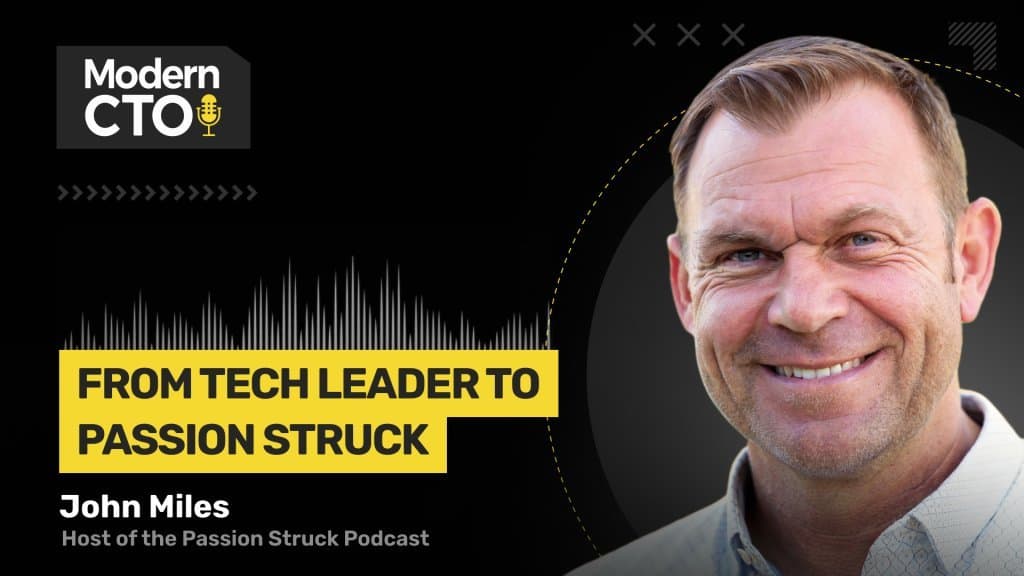
From Tech Leader to Passion Struck with John Miles, Host of the Passion Struck Podcast
Today, we’re talking to John Miles, host of the Passion Struck Podcast. We discuss John’s extraordinary journey from tech executive to international speaker and personal development guru.
All of this right here, right now, on the Modern CTO Podcast!
To learn more about Passion Struck, check out the website here: https://www.passionstruck.com/
Produced by ProSeries Media: https://proseriesmedia.com/
For booking inquiries, email [email protected]
About John Miles
Recipient of Best Business Book and Best E-Book Honors - International Business Awards (the Stevie Award)
John R. Miles is the dynamic force behind Passion Struck®, captivating millions with his globally-renowned podcast and national radio show, making a significant impact as a thought leader in the fields of behavior change, health and wellness, the science of personal mastery, and self-leadership. His journey, from the U.S. Navy to senior executive roles in the Fortune 50 to software CEO, grounds his insights in real-world experience. He's not just a voice on leadership and personal growth; he's lived it, making his guidance and storytelling resonate authentically with his audience.
As an award-winning author, keynote speaker, and entrepreneur, John blends practical wisdom with relatable anecdotes, making complex ideas about health, wellness, and personal mastery both accessible and inspiring. His Podcast, Passion Struck, is one of the world's leading shows and the #1 alternative health podcast, featuring engaging conversations with notable figures like Angela Duckworth, Seth Godin, Susan Cain, Robin Sharma, David Rubenstein, Cass Sunstein, and Dr. Mark Hyman.
His latest work, "Passion Struck: Twelve Powerful Principles to Unlock Your Purpose and Ignite Your Most Intentional Life," delves into the heart of what it means to live a life fueled by passion and purpose. Drawing on insights from luminaries such as Oprah Winfrey and Astronaut Chris Cassidy, the book offers twelve science-based principles designed to awaken the dormant potential within us all. It's a journey through overcoming self-doubt, catalyzing personal growth, and embracing a life lived with unwavering intention. It's been honored as a 2024 must-read by the Next Big Idea Club and The Best Business Minds Book Awards for 2024.
His social media presence, podcast, and YouTube channels annually enrich the lives of tens of millions of individuals, inspiring them to embark on their transformative journeys.
Transcript
Today, we're talking to John Miles, host of the Passion Struck podcast, about his journey from tech leader to international speaker and top podcaster. You're listening to Joel Beasley, Modern CTO.
When I met you, you were previously the head of technology, I think, at Dell or something like that. You had some big C-level technology type roles, and then you were working at a media company, but you weren't a personality. And that's when I met you. And then fast forward, what, seven years, seven plus years it's been. Now you have this top-ranked podcast called Passion Struck. You've written a book about it. It's doing really well. How did you go from tech leader into content creator into personal development?
Well, man, that is quite the journey, I will have to say. Yeah. I think sometimes we realize internally when we're not on the right track. And yet when we get all those indications, it can be so hard to change our course because we've become so accustomed to the life that we're living. Meaning we get used to the paycheck, we get used to the lifestyle, the image of how people see us, the title that we inherit because of where we are in life. And I think that that's something that a lot of people grapple with. And I remember, you know, looking back, you were right. I was at Dell and I hadn't even been there very long, just a very short time. I had transitioned from Lowe's Home Improvement into, at the time, becoming a divisional CIO at Dell for their consumer business. And I remember driving home from work one day, about a thirty-minute commute from Round Rock to where we lived just outside of Austin. And I was in this meditation and I kept hearing these words that you were supposed to serve a different collection of people and your life is supposed to go in a different direction. The people I was told to serve were the beaten, broken, bored, lonely, battered, and helpless of the world. And Joel, I don't know about you, but when you're sitting here, you're a Fortune 50 executive, not only did I not know what that meant, I had no idea who those people were that I was supposed to be helping or how I was supposed to even help them. But what ended up happening is I resisted this calling and it kept coming back as I would meditate, in my dreams, as I would pray. I kept having this surreal experience that what I was doing was not what I intended to do. And I think oftentimes we all face the same situation. It's as if you're standing on one mountainside and you're trying to look across to another mountainside, and on the mountain you're on, you can see the direction where it's going. And then you look across and you see where that other mountain can lead you. But the issue is you don't know necessarily how to cross that chasm. And I think that's what I was feeling, because it's really scary to do something different, especially when you're putting it all on the line and risking everything that you've built up to go after solving a problem that you uniquely feel not only a desire, but a calling to solve and are uniquely positioned to do it. And in essence, that's what becoming Passion Struck is all about. But for me, it really took a meaningful event to finally get me off that ledge to take action. And that event was in November 2017, during the time that you met me. I had started my own business. It was called Ovesto and we were putting fractional executives into different businesses, and I was fulfilling one of those slots for a company called Bold Business. Well, one of the mornings before work, I was going through my normal routine: take my daughter to school, after that go to Orangetheory, come back to the house. Well, this given day, there was a flux in the system. And at Orangetheory, we had some type of electrical fire in the air conditioning system, fire engines come and I go home about forty minutes earlier than I typically would have. Unbeknownst to me, someone has been following me for some period of time, looking at my schedule and when I would be away from the house. And this morning, our paths collided when I came home to not only an intruder robbing me, but holding my own gun against me. And if that wasn't enough, as I'm just trying to come to grips with this, my best friend jumps off the Skyway Bridge. For those of you who live in Tampa, you know what it would be, but imagine a bridge if you're not from this area that's as tall as the Golden Gate Bridge, and ended his life. These two catastrophic events, which I processed over the upcoming weeks and months, really led me to this conclusion that I have been spending so much time making other people's dreams come true, but I haven't made my own. And I'm not using my unique inherent gifts that God has given me in service of the people I'm supposed to serve. And so from that point forward, I really went into a couple years of just deep self-journeying to understand how I was supposed to help those people and what I was supposed to do. And that's a long story for telling you how I got to what I'm doing today.
So you come home from Orangetheory and a robber you don't know, correct?
No. It turns out to be a robber I did know.
You did know?
It turns out that this person worked—I had been going through a divorce. I was renting a house at this particular time, and this person happened to work for the rental company. He had been in the house before, but only a couple times. So in the split second when I initially saw him, I didn't put the two and two together. But after processing it, I realized that it was the same person.
That's crazy. Did he just run when he saw you or did he shoot at you or what?
Well, I came in and was going up the stairs when my stairs has about a 90-degree bend in it. And as I'm jolting up the stairs because I wanted to go up to my room and change so I could go for a bike ride because I was a cyclist at the time and needed to get into biking clothes, as I'm just about ready to turn that curve, I start hearing deep breathing, like fast breathing. And I realized at that moment that I wasn't alone. And so my military training kicked in and I knew at that point that I was going to be facing an intruder. I didn't know what the threat was. So my first instinct was to determine if there was a threat. And then I knew I was going to have a split second decision to either rush them or to try to evade. And as I made that curve, I realized that he was holding a gun. And I made the split second decision to alter my course and I was the one who got the heck out of Dodge and went out the back, and he ended up going out the front. And the cops come and everything else and I'm looking after the person left for how they were able to access the house, and I'll never forget that the police are outside laughing and I couldn't believe they were laughing. I'm like, what is so funny? And they go, look in your door. And in the door was not only a key, but a key that had a tag on it that had my address, my codes for the alarm, my challenge code for the alarm, and my gate code. So this person had all the information they needed to do what they did.
Wow. How did they catch him?
Well, so I can't give details of who this rental company was, but the owner calls me up and says, "My grandfather went to the Naval Academy. We're gonna do everything we can to help catch this person, whoever it might be." A couple weeks later, I'm meeting with the detective and I told her that story and she goes, "Well, he did everything but that. He realized that this was his person, gave him a heads up and told him to get out of town." So this person went out of state for a period of time on the run because he knew the police would be looking at him, then was stupid enough to come back and was caught robbing different sailboats and other boats in one of the local marinas. And when they went back to his house, they found a couple of the items that had been stolen from my house in his bedroom.
Woah. That's crazy.
Yep. Very crazy.
Okay. So these big—and then unfortunately, in that similar time frame, you lost your best friend as well. And so these two events happen. And what was that just enough for you combined to say—and then a divorce is stressful too, right? So you've got these two or three things happening. And is that what gave you the possibility to change? Like, what was it?
Well, I guess it was the last straw that I was facing this existential question: Did I wanna go on with my life permanently regretting that I didn't pursue this chance that I was being given to become my ideal self or to pursue what I've been put on earth to do? And I think—I not think, I ended up stumbling into the career that I had gotten into because, coming out of the military, I was supposed to go in the FBI. My class at Quantico got canceled literally three days before I'm supposed to get there, and that started a whole chain of events taking me down a path into the business world that I never ever contemplated. And then I was really good at it. So I kept doubling down. And even when I was with Arthur Andersen and the company collapsed, I look back and think that that could have been a pivot point where I could have gone back and gotten a doctorate in positive psychology, doing what I'm doing now. But instead I doubled down on the business career and got to a point where I felt completely unfulfilled. I felt like there really wasn't meaning when I got up in the morning as to why I was living out these days, and I was getting completely burnt out. And I look back and that was the impetus of moving away from that and finally taking the chance to do something different.
Have you ever had an interview—I know you've done a lot of interviews, it's a great podcast, people that are listening, they can—it's called Passion Struck, correct?
Yes.
They can go subscribe to it there. But have you ever had anybody who achieved a dream and then got depressed and lost direction after they've achieved the dream?
Well, sure. I mean, I think that happens as well. In fact, I think there are a lot of people who experience what I experienced. Henry David Thoreau even coined it "quiet desperation" decades ago. And I think it's the state that people find themselves in. And I think it's even more prevalent today than it was when he wrote it. That we end up pursuing who we think we should be, our "ought self," self-discrepancy theory if someone wants to look at that, instead of becoming our ideal self, and that's exactly what had happened to me. And that creates a chasm. And it's interesting because there's several bodies of work that have examined this. One is The Five Regrets of the Dying, a book that Bronnie Ware wrote. Another source, if people want to look at it, is work by Tom Gilovich, who I think he's out of Cornell, but he's a psychology professor that's been studying people's biggest regrets and has been examining thousands of people in their third trimesters of life. And both his work and Bronnie's work found that the number one regret that people have is not the what-ifs or the should-haves. It's not pursuing becoming their ideal self. It's not taking the gamble on themselves to be all that they could be. And in Tom's case, that was 76 percent of the respondents. In Bronnie's case, it's the number one regret that she lays out in her book, where she spent years and years working with people in palliative care to hear that this was their same largest regret.
How do you build certainty around your calling? I'm sure there's people that are listening right now and they're thinking, yeah, I've always had in the back of my mind that I wanted to do X, right? I wanted to do that, but it doesn't make sense. It's not practical, so-and-so. How do you know what you're being called to do?
Well, as I said, I was given a message of who I was supposed to serve. I wasn't given any message on how I was supposed to do it nor the problem that I was being called upon to solve. And I think that's the starting point that people need to go on is to figure out what is that big hairy problem that you are uniquely positioned to help people with. And it's interesting now, people come to me for advice on this and I had a woman—I'll just call her Julie—the other day who's 40 years old. She's been in her career now for 15 plus years. And she is trying to go from the business career that she had to an influencer career. And she has made some great leaps already. She has kind of found a lens that people are responding to her message. She's had millions of downloads per month on Instagram. But when I started to probe her deeply on "what is the one word problem that you're trying to solve," she went on describing it for five minutes. And I said, "No. You need to quantify it in one word." And she goes, "Well, I can't do that." And I go, "Well, then you're not ready to pursue it then, because you've got to do that work to understand what the problem is." Meaning, if you're in personal branding, perhaps what you're trying to solve for is obscurity. You've gotta get crystal clear on the problem that you're trying to solve before you can do anything about it. So in my case, I started to go through this exercise. These people I've been told to help, I started looking at the emotions they're feeling. They're feeling indifferent or apathetic. They're feeling lonely. They're feeling helpless. And I thought that those were the one-word problems. But the more I really got into this, for me, it came down to this concept of unmattering. That we don't feel like we hold significance either to ourselves or others. And I think it's an existential crisis for hundreds of millions, if not billions of people across the planet right now. And so then after I figured out that helping people realize that they're significant was what I was trying to solve for, I then had to figure out how am I going to solve for it? Do I wanna do that by being a one-on-one counselor? Sure, I can influence lives, but it's going to be as if I was a psychoanalyst and doing it by the hour and one by one. Or could I do it in mass? And that's kind of what led me to go on the journey that I've gone on with the book and the podcast and the courses and everything I'm doing now is to try to help solve this problem globally.
What type of courses do you have?
So I am working on building out what I call the Passion Struck University and the initial courses are all based off the book that came out in February, also called Passion Struck. So they deep dive into the 12 principles that I discuss in the book. Six of them are mindset shifts, six of them are behavior shifts.
And what's the—so what's the purpose of going to the course? Why would I go buy the course? Do you help people go through the same process you did of listening to who you're supposed to help, figuring out what that is and turning it into something? Like, is that what you're helping people do? Or—
So, Joel, the background on this is as I started going down this journey of self-discovery, I started even when I was at Bold Business, looking at luminaries and what made these luminaries different from the rest of us. And when I say luminaries, these could be business executives, they could be recording artists, they could be actors or actresses, they could be sports stars, they could be college professors. But the ones who really broke out and I considered to be Passion Struck, what made them different? And I started looking at their characteristics. And the initial step of this was me creating something for Bold called the Bold Leader Spotlight, where I started to see a pattern in business executives emerge in how they were leading. Well, then I started to look at, well, how do they live their lives? And I ended up coming up with probably 20 different principles that I then worked down to the 12 that I have in the book. And then I put myself through the process of using them to turn my own life around over a period of two years, found that they worked, and then used my own me-search to then write the book. So it really is this methodology that you can use in many different situations. One, if you're feeling stuck in life and you're looking for how do you become unstuck, you can use it. If you're a high achiever and you've plateaued and you're looking how to get to the next level, you can use it. If you're in university right now and you're looking at how do you carve becoming the ideal self that you want to pursue in life, you can use it.
(John Miles at 00:20:50) There are many different use cases.
(Joel Beasley at 00:20:53) Now do you get messages from your audience about people putting the content from your podcast and books into practice and getting results from it?
(John Miles at 00:21:01) Yeah, I do. And I get a lot of requests to go deeper or to touch on topics in different ways. So for instance, one of my chapters is on the power of perspective, and I talk about zooming out and using the power of that. So someone asked me to do a deeper dive on it.
(John Miles at 00:21:21) So this week, actually, I'm releasing a solo podcast on the concept. It's a behavioral science podcast called Choice Bracketing. And really what it comes down to is it's the individual choices that we make that determine the future life that we live. And so often, we look at the choices we make in isolation instead of as a portfolio of choices that lead to the life that we desire. So what choice bracketing is really about is zooming out and looking at how do you get in the habit of examining your choices in a more holistic manner.
(John Miles at 00:22:06) And in this episode, I go through the example of Jeff Bezos and I go through the example of Warren Buffett. And in the case of Jeff Bezos, he used choice bracketing. He calls it something different. He calls it a minimization regret methodology that he used when he was deciding to come out of Wall Street to start Amazon. But basically, he realized that by making that decision to figure out what role he was going to play in the internet revolution, he wasn't just making a decision that impacted one aspect of his life.
(John Miles at 00:22:47) He realized that by pursuing this path, it was going to impact a decade or more of his life. And it's something that he used throughout his time at Amazon to make choices to build the foundation to what ended up becoming a global marketplace and, of course, what he's done with Amazon services. And in Warren Buffett's case, what you can learn from this is he doesn't make his investing decisions in isolation. He does it in a portfolio and he also uses choice bracketing by looking at this over a longer term horizon and diversifying how he's making his decisions. And we can use the same methodology in our life.
(John Miles at 00:23:32) And an easy way for people to understand this is, let's say you had trouble sleeping like I did last night. For whatever reason, I woke up at 3:00 in the morning.
(Joel Beasley at 00:23:44) You were excited to come on the show.
(John Miles at 00:23:47) I was so excited to come on the show. Couldn't sleep. Sat there for like an hour and a half, two hours. I've been having these eye issues. So I had these substances in my eyes, so I couldn't read because my eyes were still blurry.
(John Miles at 00:24:02) So I'm just sitting there letting the time go by and I end up falling back asleep, waking up late. And my typical routine is to get up at 5:00 to 5:30 a.m. I go to the gym right away. Today, I didn't get up until seven. And so my immediate thought was, it's going to screw up the rest of my day if I go to the gym.
(John Miles at 00:24:22) And it would have been easy for me to make the excuse and not go. But in my case, I did. I went and just did Peloton at my house so I could get some workout in and keep my pattern. But what ends up happening and what I'm discussing here is, we end up making that decision not to go to the gym and then it makes it that much easier for us to make that same decision again and again and again. And before long, we're missing more and more days.
(John Miles at 00:24:50) And what ends up happening is the cumulative effect that that has over months, years and decades to our health and well-being. The same thing goes with the choices that we make every single day, whether that's the meals that we're eating for lunch, the snacks that we're putting into our system, whatever it may be. And so in this episode, I was really going into this power that I talk about of zooming out and how it completely shifts the way that you make choices when you start looking at them as a portfolio. So that would be an example of some of the things I would teach in a course.
(Joel Beasley at 00:25:31) Well, I want to make sure that we tell people about your book. It's called Passion Struck. Can they buy it on Amazon?
(John Miles at 00:25:38) You can buy the book wherever books are available. Amazon is probably the easiest one, but it's on Walmart, Target, Barnes and Noble.
(Joel Beasley at 00:25:47) Very cool.
(John Miles at 00:25:48) Yeah. And I'm surprised you don't want to, since we're talking to a bunch of technology people, you don't want to ask me technology related questions.
(Joel Beasley at 00:25:57) Well, sorry. Well, yeah, let's get it out there. What do you have specific things you would like to say to the tech leadership type audience?
(John Miles at 00:26:07) Maybe I'll just phrase it in this way. In the book, the way that it ended up being published, it's geared more towards personal development. However, the initial draft of the book was aimed more towards business advice and the publisher wanted me to change it. So the principles in it are really universal to whether it's in your career, trying to make your work environment better or to become a better leader, what have you. And I'll just talk about one.
(John Miles at 00:26:39) So one of the things I cover in the book is this topic of becoming a boundary magnifier. And I use this punch phrase of sometimes being right means being alone. And in this chapter, I really go into the life of Steve Jobs, but I also, it's kind of like a memoir, the way I wrote it of my life as well. And as I reflected on this, I first heard these words from my boss when I worked for Lendlease, Jay Skubinski. And he was talking about it because he had recently become the CIO.
(John Miles at 00:27:16) We were getting ready to launch these new initiatives and everyone from around the world came to this meeting. We all sat here in the room and everyone is nodding yes. And he said, just watch what they do after this. And in this case, being right, sometimes being right means being alone. Sometimes you've got an initiative that you see where it can take the company and others can't see it and they're going to desert it the first time that they feel resistance or that it might not be popular.
(John Miles at 00:27:56) And when you're in those positions as a leader, that's when you have to double down on knowing that the strategy you're trying to put into place is the right one. Imagine you're the CEO trying to turn a troubled company around. And I can't imagine trying to be the CEO right now at Boeing and how many decisions they have to make to right that ship. And a lot of them, they're going to feel like they're in isolation when they're making them because these decisions are very unpopular because they're going to change people's behaviors, they're going to change the culture. But sometimes being right means being alone.
(John Miles at 00:28:31) And I remember personally, I was in a situation that had some pretty grave consequences. I was about two years into my position at Dell, maybe a little bit longer. And I was put in charge of the largest initiative that we were doing. It was this global rollout of Oracle quote to cash. And I inherited this thing probably a quarter into the project's evolution, and we were spending somewhere between $150 to $250 million a year on this thing.
(John Miles at 00:29:07) And my predecessor who had been the CIO before, he was now the president of one of the business units, was the one who was the chief architect of this. But upon inheriting it and seeing where the business was going, I saw that there was a clear gap that this platform was never going to be able to do what we needed to do to sell software and some of the services that we were doing. So we were going to end up spending a billion and a half dollars and at the end of the day, the solution wasn't going to work. And one morning, it's before the executive steering committee and I'm trying to decide how do I approach this meeting. I happen to be in what we call the God pod.
(John Miles at 00:29:52) If people have been to Dell, there's this area where Michael and the CFO and a couple of the other leaders sit in, but they have their own cafeteria and Michael was having a coffee. And I got a coffee and I started talking to him about my dilemma. And he said, "John, in my career, I can't tell you how many times," he said, "sometimes being right means being alone." And he said, "You have to make these decisions that you feel align with your values and are in the best interest of the shareholders of the company you're serving."
(John Miles at 00:30:21) And so I went into the room and said that we need to switch direction. I had in the background assembled a small group of 10 to 12 cross-functional leaders who had examined it, came to the same conclusion, and we had an alternate path that we could take that would be far cheaper. I'm talking like 10% of the overall cost and we could get this thing in in 18 months instead of the seven to eight years we were looking at. And unfortunately, I never got to see it implemented. That ended up being the direction that they took.
(John Miles at 00:30:59) But that president did everything in his power to see that I got fired, which ended up happening. Now an interesting thing, Joel, happened about a year later, the CFO happened to be talking to the person who was now the CIO at Dell and said, "Miles was right all along. We should never have been doing that other thing. We should have been doing this project." Now, I could look back on this and say, I regret it because it derailed my career as a CIO.
(John Miles at 00:31:27) But the way I look at it is I can live with myself because if I am not doing what I think is right and what I think is in alignment with my core values, and in that case, what I thought was in best service of Dell shareholders and the leadership of the company, I couldn't have lived with myself. But it's a clear example of how difficult this can be, but how important it is for a leader.
(Joel Beasley at 00:31:58) That's a good story. You have a lot of experience, man. A lot of good stories. You are a storyteller.
(Joel Beasley at 00:32:05) It's funny. When I first met you, I thought you were pretty quiet, right? When I met you at Bold. But when I started looking at your content you were putting out a couple years later, I was like, this guy's got some really good ideas. He's got some really good thoughts.
(John Miles at 00:32:18) Well, I think it's in the position that you're in. And when you saw me at Bold, the person who owned that company was the one who was making the majority of the decisions. I was a consultant working there and giving him advice. But ultimately, you can't lead a horse to water, right?
(John Miles at 00:32:38) So the way I would try to do it is influence behind the scenes and give my advice outside of the meetings on why I thought we should pursue something, but I didn't want to overstep that person in a meeting, if that makes sense.
(Joel Beasley at 00:32:54) Well, we did it. We made a podcast. How do you feel?
(John Miles at 00:33:01) Well, we've been talking about doing this for a long time, Joel. I know. I am just really honored to have been on this journey with you for as long as you've been on it because you were, I won't say you were as far back as Jordan Harbinger or Emily Morse and getting started into podcasting, but you were doing podcasting long before it became cool. And you really had these interesting ideas on how podcasting, similar to me, is a medium to reach people. But underneath it, you have to have things that really take the concepts and make them more applicable to people.
(John Miles at 00:33:39) And I remember when you were first starting, you had this really cool concept of this armband that you wanted people to wear so that as they were bettering their skills, they would get different colored armbands. And it's little things like that that make a difference. People want to see that they're making progress. They want to see that the effort that they're putting in is making a difference. And I really think that you are making a huge difference.
(John Miles at 00:34:06) I look at how you've expanded into the different business lines that you're doing now. And, you know, I just want to say congratulations because it's really awesome for me to see your dream come true and how you took this concept and are Passion Struck yourself and have taken it to this next level.
(Joel Beasley at 00:34:27) Well, this was great, John. I'm so glad we got to do this. Thank you so much for listening. And if you found this episode useful, please share it with a friend or colleague who you think would get value from it. And if you have topics that you'd like to hear discussed on the podcast, either add me on LinkedIn or send me an email, [email protected].
(Joel Beasley at 00:34:48) Every time I get an email or LinkedIn message, it absolutely makes my day and inspires me to keep going.