
Episode 636 ·
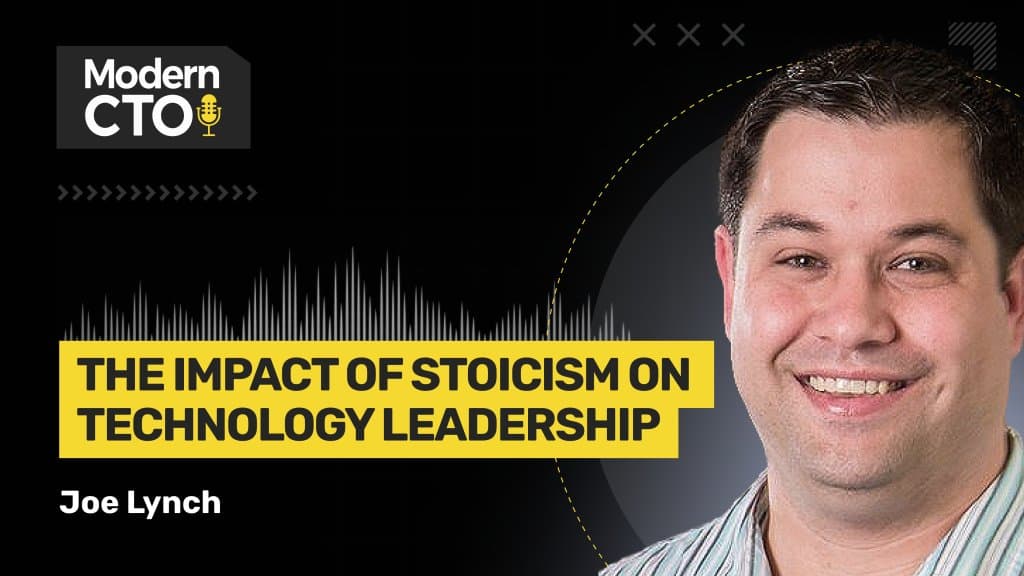
Life, Leadership, and Stoicism with Joe Lynch, former VP Engineering at Twilio and former Googler
Today we’re talking to Joe Lynch, former VP Engineering at Twilio and former Googler. We discuss how to grow your business and relationships at the same time; the impacts of stoicism on technology leadership; and why you have to have rain to appreciate sunshine.
All of this right here, right now, on the Modern CTO Podcast!
For more about Joe, check out his Linkedin: https://www.linkedin.com/in/josephflynch/
Have feedback about the show? Let us know here: https://docs.google.com/forms/d/e/1FAIpQLSdeUa1YYkq0HtgAc5OfCkoAWHwYhjI82n2p-5vjvb2RlPA9Hw/viewform
Produced by ProSeries Media.
About Joe Lynch:
Engineering Leader with comprehensive experience in bringing scalable SaaS products and platforms to market. Proven ability to build, motivate and lead world-class Engineering organizations at scale, with a focus on quality, efficiency, rapid delivery and continuous improvement. Outcome-driven, working in partnership across complex organizations to forge alignment and drive bottom-line results.
Transcript
(Intro Narrator at 00:00:00) Today, we're talking to former VP of Engineering at Twilio and former Googler, Joe Lynch, about life and leadership. You're listening to Joel Beasley, Modern CTO.
(Joe Lynch at 00:00:15) Sam Cooke, Ray Charles, and all them came out of gospel and blues sort of mixed together. Hey, Joel. Hey, buddy. How are you? Good. How are you?
(Joel Beasley at 00:00:23) You're talking about music? Do you play music? Do you make music?
(Joe Lynch at 00:00:27) Yeah, I play the guitar and sing. I mostly like to sing, and so I play the guitar and can fake a little bit on the piano, mostly to accompany my voice.
(Joel Beasley at 00:00:37) Okay. What type of music do you sing?
(Joe Lynch at 00:00:39) I'll play acoustic blues, like blues that goes back to the thirties, forties, fifties, and then just some other soul music, folk tunes, things like that. Mostly stuff that was written well before I was born.
(Joel Beasley at 00:00:53) I saw John Mayer and B.B. King do a set together, and that made me fall in love with blues.
(Joe Lynch at 00:01:00) Yeah. Yeah. I've seen B.B. King probably eight times or something before he passed away. He used to come to a theater that's pretty close to me called the Keswick Theater. I love B.B. King. Yeah. And he used to play with Bobby Bland, who was my favorite blues singer that ever lived. They grew up together, actually, in, I think it was in Memphis where Beale Street is. Beale Street is in Memphis, isn't it?
(Joel Beasley at 00:01:22) We're going to say yes. We'll have fact checkers.
(Joe Lynch at 00:01:24) Let's go for yes. Yeah. Yeah.
(Joel Beasley at 00:01:27) So you were at Google. Tell me a little bit about what you did there.
(Joe Lynch at 00:01:30) Yeah. I went to Google because I was starting to get more and more experience. In my previous role before that, I was the CTO at a tech startup and building systems at a scale that I wasn't used to and I thought was exciting, learning a lot about distributed systems. But I wanted to have that feeling again of having trouble keeping up, which I hadn't had in a while. I remember when I first got started in my career, I felt like I was constantly scribbling, trying to learn about all these things. And while I'm not suggesting I had gotten to the point where I knew everything, I had known enough where I found myself at the whiteboard more often than I found myself asking questions and trying to learn and things like that. And so I said to myself, well, Google would be a place where I would have trouble keeping up. And separately, I wanted to learn about managing systems at scale, knowing more and more about distributed systems, which is the lifeblood of Google, and they've had to push the boundaries on things. So that's why I went there.
I started out in the storage organization way at the bottom where all the bits are stored. So all the information that Google has that you could imagine—like Gmail attachments and emails and search results or search queries and things like that, and photos and cloud data—all that stuff is stored in the same systems way at the bottom. And so I got to manage the storage efficiency organization, which was responsible for coming up with creative engineering approaches, whether from a planning perspective or a technical perspective, that would allow Google to save as much money as possible on their storage spend. And the thing that was great about it is I got to work with some really, really great people that were experts in the space. And storage is a space where a lot of distributed systems knowledge has emerged from NoSQL databases. All those things were pioneered at Google.
So I got to learn about Bigtable, which was the first NoSQL database that basically has ever existed. I got to learn about Spanner, which is Google's strongly consistent inter-region relational database, which basically offers the dream properties that you wish you had in a relational database years ago. I got to learn about their distributed file system. So a lot of technical learnings. And then in addition, I got to work with a lot of the different groups—you know, Cloud, Gmail, all these folks. And then finally, I worked with some individuals whose knowledge and experience was just mind blowing for me. So, yeah, it was a great, great ride.
In that role, I also spun up a team and managed that team to build a system to combat capacity stockouts for Google Cloud. So the stockout, as a metaphor, is if you go to a corner store and you're looking for a bag of Doritos and the Doritos aren't there, they're stocked out, you're pretty disappointed, right? Well, you're even more disappointed if you're a cloud customer and you ask for a VM of a reasonable shape in a certain geography and it's not there. That's something that you're going to be very disappointed about because it can break your business. So these stockouts were hurting Google Cloud, and we spun up a system and worked on a system and got it out there that helped to combat those stockouts and informed their capacity planning.
(Joel Beasley at 00:04:51) Oh, that's pretty cool.
(Joe Lynch at 00:04:52) Yeah. And then finally, I worked on the Cloud Observability platform—logs, metrics, all the things that engineers need in order to run and scale their systems. I was responsible for the data ingestion aspects of that. It was really high impact, a lot of fun. It was interesting to work on products where if you made a good move or a bad move, it would affect hundreds of thousands of customers across most businesses that you can name. Very high impact, a lot of fun, got to work with a lot of great people.
(Joel Beasley at 00:05:27) What makes a good engineering manager?
(Joe Lynch at 00:05:29) That's a good question. I think the first thing is that they have to see themselves in service of the engineers and business outcomes. So when people ask me what my job is as a leader—and I think that's irrespective of whether you're a VP or a director or an engineering manager, all of which I've been at different points—my job is to get the right business outcomes while helping you to do your very best work. And I don't stack rank them. I try to make sure that they go together.
So if I'm getting great results but I'm not growing the engineers or the other leaders on my team—because I think this is a question about leadership and management in general—if I'm getting results but not growing the people on my team, I consider myself to be failing. If I'm growing my people but I'm not getting business results, I consider myself to be failing. And so I have to make sure that I can do both. Now, that said, I've never worked in a nonprofit area, so I think of business results. But for the most part, what that means is I have to be conscious. For example, when I line up projects or programs for people to focus on, ideally, I'm always doing something that will help the business. I'll never encourage doing something that isn't in service of the business. I've never worked at a research university. I don't plan to.
(Joel Beasley at 00:06:53) Me either.
(Joe Lynch at 00:06:54) Yeah. But when I also think about who should work on what, I think about the business needs, a person's strengths, and a person's interests. And the business need alignment has to be there. But a person's strengths and a person's interests, there's hopefully material overlap, but they're not always the same thing. So I might be very strong at writing Java code, but my interest is I want to build world-class machine learning models. Well, if I don't have that need on that team, you know, your interests aren't going to be well served. But ideally, you have other interests that overlap with your strengths. But sometimes you ask people, hey, can you take one for the team here? You're really great at X even though you're not excited about doing it. And then in other cases, if you can accept a little bit of risk on a project, then you'll go out of your way to make sure that somebody gets to learn on that project, they get to learn a new skill set that they're excited about. There are constant trade-offs that you have to make to make sure that you're getting business results and helping people to grow. Those are the things I think about most, anyway.
(Joel Beasley at 00:08:08) Yeah. I mean, those are great things. How do you do both well? Like, how do you do both the business outcomes and making sure that the people have these needs and strengths and interests all aligned? Like, how do you do that really well?
(Joe Lynch at 00:08:25) It's hard. I don't claim to have a magic algorithm. But I think the thing that helps the most is I demonstrate to people that I care about them as individuals. That's usually the thing that comes across most when I leave a place and people say, hey, what was it like to work with Joe? They'll usually say he really cares about people. And it's not like I wake up and focus on that per se, but I think that through the actions I take, I demonstrate that I do care about them. And when you care about somebody, it tends to enable trust. And trust, you know, unlocks a lot of things—you know, accelerating business results, people being willing to go the extra mile.
And then another thing that supports it is I'm very transparent, or I try to be, about decisions. So if I have to make a tough call about something for an organization, whether large or small, if it's a non-trivial decision, not only will I consult with a lot of people, but if it's my decision to make, I'll make the decision. But then I try to spend a decent amount of time explaining the why. And so even if people might not agree with the logic, at least they understand where you're coming from.
(Joel Beasley at 00:09:46) So I want to get your insight on this when you were talking about caring about people and leading them. So I actually had a conversation, I think last week, with one of my directors, and we were discussing this idea of—I was asking about his individual contributors and all of that. And I had asked him something, I think, along the lines of, well, yeah, which person on your team is a morning person? Or, you know, who wakes up early? Or who's the person that's the night owl? And stuff like that. And, you know, he said something along the lines of, what? That doesn't really matter. Like, we just focus on in our one-on-ones, we just focus on their metrics and if they're hitting their goals and things like that. And I said, well, I heard this one speaker in personal development one time say the idea that you can manage or lead somebody without knowing who they are and caring for them is a myth. Like, you have to know who they are and care for them in order to lead them. And so I was just giving them examples and talking with them about this. I felt like I was kind of fishing around because the problem is that it's not a science. Because if I say get to know them, it's not like you can—well, some people might take that as, like, let's have a meeting and all of a sudden start interrogating them. It's this really weird—
(Joe Lynch at 00:10:58) Where were you born? Yeah. Yeah. Yeah. What are your kids' names? Yep.
(Joel Beasley at 00:11:02) Yeah. So how do you—and I know I'm kind of putting you on the spot, but how would you go about explaining to a new leader how to have a personal relationship with the people you're managing but not crossing boundaries?
(Joe Lynch at 00:11:18) Yeah. That's a good one. I'm not sure I've ever had to address this directly, but I suppose one of the things that I do is when people are trying to decide whether they want to go into management, I try to pressure test the why. And so when I went into management, I just fell ass-backwards into it. You know what I mean? When you start out, you know, you write code, you build systems, you do good at that. You get responsibility for a larger system. Before you know it, you're leading others in a technical fashion. Then before you know it, people are like, hey, you want to manage people? And it just seems like, okay, that's the next rung on the ladder. Let me try that. But that's usually not a great recipe for success. But the truth is that a lot of us, that's how we get started. And in hindsight, you look back and you realize, wow, I've made a lot of mistakes, but I'm glad that somebody gave me the opportunity to try that.
But ultimately, when somebody says, oh, I want to be a manager, or I want to lead larger teams, or, you know, whatever the thing may be, I try to tease apart the why. And so if you try to tease apart, what are your motivations? You know? Well, hey, what do you think this is going to look like? Oh, well, you know, I'll get to call the shots. And, obviously, there's elements of being a manager is, you know, generally a manager has to be a leader. A leader does not have to be a manager. But there are parts of being a manager, if you've never done it before, that might seem attractive. Oh, they got to make the call on X, or, oh, they got to, you know, set somebody's performance review rating, and that has a lot of impact.
But the truth is, most of the time, the job of a manager isn't always directly rewarding. There's a lot of hard work that goes into it that's thankless. You've got to approve expense reports and time sheets and deal with all kinds of issues between people in an organization, help deal with them without anybody ever knowing. It's a fairly thankless job a lot of the time. But the thing that makes a difference for me is if I can affect somebody's life positively, if I can, in some sense, be of service, that gives me a personal reward. I find that rewarding. And it doesn't have to be, you know, plastered on a newspaper. The reward is actually, for me, is actually private—the fact that I was able to make a small difference in somebody's life.
And so I try to tease apart the why and find out if there's an element of wanting to be of service in what they want to do. And if I can't find that element of wanting to be of service—that is, enabling other people, helping them to grow, unlocking business results, helping people to overcome their challenges and connect better with others—if I can't find that servant leadership aspect, then I usually call that out in people and say, look, I'm not seeing that. And my experience is that's the foundation of good leadership. So it doesn't mean that I won't support you in becoming a manager, but I think that that's a component that I think is an important part and that you would either need to bring to the table or grow in the direction of wanting to develop that.
(Joel Beasley at 00:14:41) And you can tell so much by how they react to that advice.
(Joe Lynch at 00:14:44) Yeah. Yeah. They're like, whoa, hey. I don't want—it's like, I don't want to fill out TPS reports. There's all kinds of things that come with being a manager that aren't always fun. And so when you paint the picture of what it looks like, I would say half the people walk away from it. You do have to do a little bit of a reverse sell, because I think that it's different than a lot of people realize. Maybe in the command and control days, which I've never lived in, it was more fun because you had, you know, direct power. You could, you know, control all the things. But that's just not real life, at least not in the space of building software. You know, you've got brilliant people, people that are smarter than you, and you're trying to figure out, okay, how can I help them to succeed without getting in their way? And it's a tricky business.
(Joel Beasley at 00:15:30) Story of my life, man. When you talk about wanting to be of service, you've mentioned that a number of times, does this extend—who you are as a person, does this extend outside of your professional career? Like, the people in your life outside of work would probably similarly describe you as the people at work as far as your—
(Joe Lynch at 00:15:50) I think so. I think that I'm an introvert, and so my social life is pretty contained and pretty simple, and it's mostly oriented around my wife and kids. But when I think about my extended family or old friends and things like that, yeah, I think it comes across.
(Joel Beasley at 00:16:08) I've got three kids between ages—a daughter who's five, a son who's four, and a son who is seven months. So when you talk about social life, I'm like, what do you mean? Everyone's an introvert when you—or everyone has a low social life when you have children. It's like, that is—that's my crew. It's my wife and my kids. They are the center of my universe. So—
(Joe Lynch at 00:16:32) Yeah. I have four myself, going from 19 down to 12. And yeah, three kids is around when the discrimination kicks in. That's when the people start looking at you funny.
(Joe Lynch at 00:16:43) Or, you know, if you go to visit somebody, "Hey, I'm gonna pop by." And then you get a pause. And they're like, "You bringing the kids?" Yeah. Where somehow, one is easy, two is cute, three is like, okay.
(Joe Lynch at 00:16:56) Yeah. Make a reservation in advance before you come by.
(Joel Beasley at 00:17:00) Yeah. We have several friends who have five. And my parents, they came from families of seven. You know, they were one of seven. And so it's amazing to me how I go around in life. And I, you know, a lot of the—we got a lot of 20, early thirties people that work at our media company. And I think I'm the only one that has kids. And I go around and I meet, run into different people that don't have kids. And I mean, not to let the conversation go into a negative way, but it seems like a fairly selfish reason is why. Like, and I'm not saying that that's good or bad, but the—I wish I could somehow extend to them the experience of, yeah, you're gonna be giving up your time, and you're gonna be giving up a lot, but I believe you're gonna gain more than you give up through the experience.
(Joe Lynch at 00:17:54) Yeah. And I—a person—I always use having kids as an example of where, like, we really have two systems of thinking: our, you know, figuratively, our head and our heart. Kids are not logical. Having kids is not a logical investment. So for people that are hyper-logical, having kids makes very little sense. But it's the heart thing. It's kind of somehow wanting to—I don't know. It's like once you start to take care of them and they develop their little personalities, yeah, it changes your life in huge ways, in ways that you can't communicate to people who haven't done it before. And it's not all roses. Right?
(Joel Beasley at 00:18:31) Oh, no. No.
(Joe Lynch at 00:18:32) But it's—there's—it's like your whole worldview changes. What's most important to you? And the definition of fun changes. You know?
(Joel Beasley at 00:18:41) For sure. I mean, yeah. I spent money on a fence the other day. Like, where—how did I get here in life? Yeah. And I was excited about the different fence I picked out and all of that. I was like, this is the progression of life. You know? Yeah. What are you reading? You said you like to read a lot. What type of stuff are you reading?
(Joe Lynch at 00:18:58) Oh, yeah. I read a lot of stuff. I have a reading ritual, I guess, where I get up, you know, semi-early, at least for me, given the way that I'm wired. I get up around 6:30, eat breakfast, and then I have my reading ritual in the morning. I read a few spiritual books, a few—but they're like one-pagers, like things that can serve as devotionals. And so I'll flip through a few pages that are of a spiritual nature, a few that are of a business nature, and then some that are of an ethical nature. That takes like a half hour. That's like me—I think it's the equivalent of people doing their meditation or sitting in a bathtub of ice cubes or whatever other people do to start their day. And after that, I usually do a longer, like, technical reading, depending on what I'm interested in, or if I'm in a spot where I have to learn about something at work to be effective, which is most of the time, I find I have to read voraciously to even keep up with the pace of technology change, especially given the type of work that I do. I've been in infrastructure, things like that. So, but the good thing is, like, if I'm excited about what I'm doing, it doesn't feel at all like work. So I don't know. Some of the things that I'm thinking about at the moment, technically, are—you know, I happen to think—are the connectivity story between services in a heterogeneous environment. Like, where if you have Kubernetes and VMs and Google Cloud and AWS, you know, this is like an example of how things were at Twilio. The connectivity story between services is such a mess. It's very, very complicated, and it's getting more and more complicated. So that's an example of something that I've been reading a lot about lately.
(Joel Beasley at 00:20:55) What are you learning in the spiritual content?
(Joe Lynch at 00:20:58) At the moment, I was raised Catholic, but I'm not, you know, a practicing Catholic, but I've drifted into other things over time. Like, I find that Jewish ethics, for example, is a space that I like a lot. And it's not even a religious orientation for me. I don't consider myself to be particularly religious. It's more that it's very methodical and rich in all the history around how the rabbis came to conclusions around the right way to treat one another. And the thing that I like about it is it doesn't just give you the answer. It shows you the debate over time. "Oh, this rabbi said this. This rabbi said that." And then in the end, there isn't a whole lot of, like—there are some agreements on, "This is considered the authoritative ruling," but somebody can come along later and always displace it in theory. So there's a lot of debate around the right way to live, and I find that pretty interesting. And then another thing that I've been reading a lot lately is centered around stoicism. So Marcus Aurelius and Epictetus, for example, are some of the foundational writers in stoicism. And I find that's helping me a bit because stoicism—one of its foundational viewpoints is, "Hey, there's a whole lot of stuff that's going to go on and you can't change it. Get used to feeling it, accepting it, and then having to move on." And when I think about it, like, I think about, like, the serenity prayer, for example.
(Joel Beasley at 00:22:38) That's exactly what I was just thinking about. Yeah. Yeah.
(Joe Lynch at 00:22:41) Even if you put the G word aside, you know, "Grant me the serenity to accept the things I cannot change, the courage to change the things I can, and the wisdom to know the difference." Well, if that's not a description of what you're trying to do all day, every day, I don't know what is, because our unhappiness is rooted in, like, "Things aren't the way that I want." I've never experienced things being the way that I want. There are only degrees of dissatisfaction. And so—but within there, there's—I'm exaggerating. Obviously, there have been times where I've been very happy. But within there, you have to be careful around, "Well, can I change this or not?" And if I can change it, like, what's the risk-return curve? You know, just because I can change it doesn't mean I should. So for example, I've had situations where I've—like in sports, I've thought about, you know, I'm not excited about how my boys are getting along with certain people in sports, but they're getting older. And I can't be like helicopter dad or something like that. They—you know, if I try to get involved with their stock price and how they're perceived by people that can control their play time and things like that, it'll just hurt. So I have to step back and actually let things be. And then other times, I have to have the courage to make a change. Most of the time, that's in my own behavior. So long story short, stoicism is one of the things that I'm reading a lot right now.
(Joel Beasley at 00:24:16) Do you ever struggle with being content?
(Joe Lynch at 00:24:21) Yeah. I'm very introspective. If you're introspective and if you're a realist, sometimes the world doesn't always work the way that you want. And most of the time, it isn't so easy to accept it. That's why I'm reading about it and it's like, "Oh, can I get good at this?" Because I'm definitely not good at it right now.
(Joel Beasley at 00:24:44) Yeah. I was struggling with it a little bit over the past year or two. Things got really, really good, and I got concerned. Yeah. I know. I got concerned because I'm like, "What's going on? Like, I'm always battling. Like, since the day I showed up here on this planet, like, I have been battling, and it's just difficulty after difficulty." And right now, I'm just in this calm sea, and I'm like, "I'm not equipped for that. Like, I'm a wartime general. I'm not equipped for peacetime."
(Joe Lynch at 00:25:11) Yeah.
(Joel Beasley at 00:25:11) And but while you're in war, you justify it through achieving peace. So it's this weird sort of thing that I struggle with. And then I go, "Okay. I'm learning right now. I'm 35, just to give you an example of where I'm at in life. But I'm learning right now this sort of ebb and flow or balance of being content, but also doing some challenging stuff or having some challenge. Like, rather than it just being all chaos all the time trying to, you know, gasp for air. Now I'm like, "All right. I'm gonna kind of be on this lake, but I'm also gonna have some fun." And that is not something that you do at once. It's something that you just constantly work towards.
(Joe Lynch at 00:25:53) Yeah. I know what you mean. You know, that feeling of like, "Woah. I, you know, lightning hasn't struck in a while." You're waiting for the other shoe to drop. Especially if, you know, you've experienced tragedy in your life. I mean, I know—I read about some of the tragedy that you experienced. It was awful. Awful. And I think about, you know, we've all—we all have our experiences. One of my toughest experiences was my youngest sister was killed in a car accident. She was 27 years old. She was months away from her wedding date and was just like that. You know? And there are no—for me, personally, there are no religious things that helped me with that. We had to, you know, I had to work through that and, in some sense, work towards acceptance of like, "This is the reality" and look back at all the great times that we did have. You know? But then, like, you start—if you have enough of those things in your life, you start to tell your story in terms of like, "Well, this was phase one, and phase one was rooted around this tragedy. And then phase two was rooted around this tragedy, and phase three is rooted..." And that's like a not a good way to think about life. And for me, I'm trying to change that. You know?
(Joel Beasley at 00:27:15) And I will disagree with you for myself. So I find it very empowering to do that. I use it all the time. Now that's just, you know, me. But what I have found is things like, you know, holding my mom's hand as she passed away, or getting hit by a car when I was 12 and being in a wheelchair for a year, or, you know, all of these other difficult experiences that I've had, I keep them close to me. Like, I'm not, like, holding on in pain. Right? Like, I've worked through it all, and now I'm just looking at it logically as, you know, they're important lessons to me, and they remind me that no matter how hard—let me give you an example. I run a business. Right? I'm an entrepreneur. Like, obviously, there's a lot of stuff going on in the marketplace right now, hence, you know, your job movement. And so, like, there's a lot of waves going on right now. And then I'll notice myself getting a little bit, like, caught up in that, and then I'll just, you know, be laying down at night. My wife and I pray before we go to bed, and—and that's—how does that actually look? It essentially looks like us just talking about stuff and talking to God. And what happens is I realized that, "Oh, that doesn't matter." Like, that's not nearly as hard as, like, letting your mom pass away in your arms. Like, what? A down quarter? Well, we're actually doing well this quarter, but like, a quarter with turmoil in the marketplace? I'm like—see, so it kind of helps me set things in perspective. Or when I'm going to do something difficult, I was like, "Yeah." I was like, "I've been hit by a car and had to learn how to walk again. Like, this is so easy compared to that." And so that's how I will use it. But I do agree. It—we don't know each other super well. Right? We're meeting each other for the first time. But there is definitely some fine nuance into people holding on with pain and using tragedy, letting tragedy affect their lives versus, like, taking it and owning it and using it as a tool of power.
(Joe Lynch at 00:29:12) Yeah. So all the things that you said, I, A, I agree with and, B, I relate to. What I meant was more like, I don't want to define my life in terms of it.
(Joel Beasley at 00:29:22) Oh, okay.
(Joe Lynch at 00:29:23) And so it's very—and it's very easy, I think, on some level for me to do that. So we're like, "Oh, that was my down period because of X, and that was my down period because of Y." But, yeah, I think that tragedy brings meaning to your life. You know, you have to have a little rain in order to appreciate sunshine. And I look back on the moments that I had with my sister, with other people that I've lost, and they're now profound. I can look back on those positive moments with, like, profound joy, when before they were just things that happened. And, yeah, on a comparative basis, I will occasionally think about those things to derive strength from too. Like, how's the presentation go? Or what do my quarterly results look like? How does this performance review go? Those things pale in comparison to what it's like to lose somebody that you love or what it's like to have some other senseless tragedy hit you. There's a saying that on their deathbed, nobody ever wished that they spent more time at the office. I don't think in the end distributed systems are going to matter much when I go to the grave. It's going to be, you know, "Did I make a difference in somebody's life?"
(Joel Beasley at 00:30:49) I 100% agree. Now, if you don't like using the tragedies to help sort of define the timeline of your life, what do you use in place of that?
(Joe Lynch at 00:31:00) You know, I don't know because I—consciously, it's not as if I've ever told my story end to end, but I suppose that, um, you know, like, when I think about the birth of my kids is an example of something that changed my life in a positive way. When I think about what it was like to learn to play music, what it was like to go to college and, you know, surrounded by people that, you know, were pretty wealthy. And I, you know, came from a more working class background. And to be—I was—I think I was able to appreciate, like, the things that were in front of me because of that. Like, the idea that I could just go study whatever I want and that my dad would be okay with it. Like, you know, my dad was a Philly cop, and I was one of five kids, one of five or eight, depending on how you count. And it blew my mind that he even paid for me to go to school. I went to the University of Pennsylvania, which is not a cheap school, but I had a full scholarship to go to St. Joe's, which is also in the Philadelphia area. And he said, "Pick whichever one you want." He didn't try to twist my arm one way or the other. I'm not sure I would have had the strength to do that. But he did tell me years later, like, "Every now and then when times were tough, I would drive and park next to St. Joe's and think, 'He could have gone there for free.'" And so—but, like, I don't know. Like, those are some of the positive things. And, like, my boys playing lacrosse. Like, I played lacrosse in high school, and I played every—to some degree, mostly informally—every sport that you could imagine. And to me, lacrosse was just like no other sport. I just loved it. And so I taught my boys how to play, and now they love it. You know? And they don't love it because I loved it, but they love it because they've figured it out that it's great for them. To watch them play, to play together on the same team. They're—you know, one of them is on JV, one of them is on varsity, but they're like warriors out there. It's a great thing. You know? So what I guess what I'm getting at is finding, you know, in addition to the valleys, calling out the peaks as well when I think about my life.
(Joel Beasley at 00:33:13) No. That's exactly what I was—I take notes, by the way, if I'm looking down. But that's exactly what I was thinking as you were talking is, you know, I made a little list of the positive: birth of kids, learning to play music, college. And then, you know, you talk about the more difficult moments of losing your sister.
(Joe Lynch at 00:33:30) Marrying my wife.
(Joel Beasley at 00:33:31) And marrying your wife. Yep. Sorry.
(Joe Lynch at 00:33:32) Had a kiss so that I put that in first in case she was. No. Seriously. Seriously, though. Let me make a plug for my wife.
(Joe Lynch at 00:33:40) Really, to have somebody that sees you and really sees you and doesn't feel like you're a project that has potential. It's like, no. She sees me as I am and is okay with me. And in fact, you know, more than tolerates me, actually likes me, actually loves me. I'm like, that's a great feeling.
(Joe Lynch at 00:34:04) That's a great feeling because you don't always get that in life. You know, usually you always get the sense whether it's self-imposed or coming from other people. It's like, well, you do this okay, but you don't really do that. And I don't feel that way with my wife. You know?
(Joe Lynch at 00:34:18) She likes me the way that I am. So, you know, I've managed to fool her, but, hey. I'll take it.
(Joel Beasley at 00:34:22) Yeah. We are at that point now. We've been together for ten years. I'd say dating phase was pretty good. Like, best friends, having kids.
(Joel Beasley at 00:34:30) The first three years of having our first kid was super taxing. I was also starting the business then. But for the past three or four years, I can honestly say without exaggerating that we are best friends. And I actually told her last night, we're gonna do real talk right now, Joe. Okay.
(Joel Beasley at 00:34:48) So yesterday, one of my neighbors was talking about this. We have a chicken coop.
(Joe Lynch at 00:34:52) Don't worry. I fully confidential, and I charge reasonable rates.
(Joel Beasley at 00:34:56) Oh, I love it. Yeah. And I said that we had this chicken coop. We were debating to get rid of it and get a different chicken coop because of x, y, or z, or whatever. And we had had this conversation about five months ago.
(Joel Beasley at 00:35:07) Nothing had happened. And then my neighbor was talking to me. He's like, yeah. You know, we were really interested in that chicken coop, and they had done a favor for me. And I was like, well, yeah.
(Joel Beasley at 00:35:15) You can have it. Because in my head, it was gonna cost us like $5,600 to get a dumpster out there to break it up and destroy it and get rid of it. Right? So I was like, oh, we're so lucky because now I got this person who's gonna take it for free, and it's gonna save us money. And then I go in and I tell her, and she was super frustrated at me for not talking with her about it.
(Joel Beasley at 00:35:34) And so anyways, we're talking at night before we go to bed, and I said, you know what? I go, we're kind of blessed because the biggest problem in our relationship is that I gave away a chicken coop that you wanted to sell on Facebook Marketplace.
(Joe Lynch at 00:35:47) Yeah. Yeah. Yeah. Yeah. I mean, when I step back, it's, you know, it's a gift to have found somebody that sees me.
(Joe Lynch at 00:35:56) And we're, yeah, we're very happy. And like any other marriage, we've had our ups and downs. But, you know, having the kids and spending time one with one another, it's a gift.
(Joel Beasley at 00:36:07) The ups and downs, we talked about the positives and the overcoming the difficulty. Is it possible that those are all different experiences we can draw on and we need different ones at different times? Like, it's not always you—like, for example, if I'm in a really difficult moment, you know, the birth of my kids is great, but a moment where I overcame an incredible amount of difficulty is actually the one I would probably want to pull up to handle with that. Or maybe when I'm feeling like I don't have a lot or that I want too much, maybe then I can connect back to the birth of my kids and remind me the material things don't matter. And so we kind of use these different experiences to help you get through the lows and the highs?
(Joe Lynch at 00:36:48) Yeah. Definitely. They're almost like cards or pictures that you put in your back pocket, and you pull out the right one depending on context. And it is not just personal stuff. It's also professional.
(Joe Lynch at 00:37:01) Because obviously, personally, I think we grow from experiences if we reflect upon them. If we have experiences, but we don't reflect upon them, then we don't tend to learn as much. And you can learn a certain amount from books and blogs and talks and things like that. But in the end, you have to experience your own things. And yeah.
(Joe Lynch at 00:37:24) So it's I can sometimes feel the similarity between something potentially going wrong in a project or a work setting. Say, oh, this feels like when this happened ten years ago in this other project, you know, what did I do then that helped me to succeed? Or what did I do then that caused me to fail that I don't want to repeat? But, yeah, it's like those experiences. They're all sort of like baseball cards or something.
(Joe Lynch at 00:37:49) You have to find the right one and take them out to help you in that context.
(Joel Beasley at 00:37:54) Beautifully said. I'm watching the time here. Is it cool if we do some sort of rapid fire questions from the audience? We've already sourced some questions about trust and commitment and things like that.
(Joe Lynch at 00:38:05) Go for it. Yeah.
(Joel Beasley at 00:38:05) For meeting tech teams. Okay. Cool. Let's say day one as a tech leader, you start fresh new company. What's the first action that you'd take to start building trust with your team?
(Joe Lynch at 00:38:16) Sit down, talk to them one on one, and ask about their life. Ask about their background. Ask about what they're hoping to get out of this job, trying to get a sense of the type of work that they like, that they hate. What do they like or not like about the environment? What are some of the things that they would change?
(Joe Lynch at 00:38:36) So, in some sense, it's like trying to get to know them as people, get a hook on their morale and then how they see their career growth, how they see the company. It's sort of I guess I'm a little bit formulaic about that. That's what I do every single time that I step into a new role is I start with one-on-ones, people on my team.
(Joel Beasley at 00:38:57) What are some effective communication strategies for building trust, and how can leaders ensure that their messages are being received accurately?
(Joe Lynch at 00:39:09) So trust sort of there's a lot of different context for trust. If there's trust between two people, that's one flavor of trust. I think there's also trust between yourself and your higher self that's almost like governing your actions and reflecting. But it sounds to me like this is a question maybe about trust between a leader and their collective organization. I think that some of the things that have helped me is be transparent.
(Joe Lynch at 00:39:38) Like people, we're all big kids. People know when you're saying fluff. Now, there are some times when, as a leader, you can't say certain things. Like for example, in the face of a layoff, there's only so many things that you can say, and none of those things are gonna make people feel good. But when I think of at the first round of layoffs at Twilio, the layoffs hit, they were a big surprise to everybody, including me, and there was just silence, absolute silence.
(Joe Lynch at 00:40:13) I mean, there was, you know, my boss, for example, hadn't said anything, and I think the CEO hadn't said anything. And I put myself in their shoes. And I think that's the first part is put yourself in the other person's shoes and like, what are people feeling right now? It occurred to me that it reminded me of, it felt like grief. It felt to me a little bit like grief and, you know, like the Kübler-Ross five stages of grief.
(Joe Lynch at 00:40:42) And what I did was I pulled everyone together in only fifteen minutes, and I didn't turn it into an ask me anything thing. I just wanted to do a really short conversation with them. And I just tried to call out that like, Hey, this is awful. All I can do is relate to your pain. It's painful for me.
(Joe Lynch at 00:41:08) This is awful. I'm feeling all kinds of things. Like, you know, survivor's guilt in a sense. What? Why them and not me?
(Joe Lynch at 00:41:16) Some people that got laid off were great at their job. I'm bouncing back and forth between shock and acceptance. So these were the kind of the things that I talked about. And that we should, like, the best thing to do, I think, is support those people that were laid off because if you're feeling bad, imagine how they feel. And then also have patience with one another because I think different people are gonna move through the rough phases at different times.
(Joe Lynch at 00:41:45) Within a week, some people are like, hey, let's go. It's all business. And then other people are still having a tough time with it, you know, a month later. And so having patience with your colleagues. So basically, I guess in summary, like trying to communicate from the point of view of empathy that you hear people, that you see people, try and be transparent.
(Joe Lynch at 00:42:08) Those are some of the things that I did.
(Joel Beasley at 00:42:11) I love it. Thank you so much for listening. And if you found this episode useful, please share it with a friend or colleague who you think would get value from it. And if you have topics that you'd like to hear discussed on the podcast, either add me on LinkedIn, or send me an email [email protected].
(Joel Beasley at 00:42:30) Every time I get an email or LinkedIn message, it absolutely makes my day and inspires me to keep going.