
Episode 394 ·
Jim Walsh, CIO of Right Networks - Digital Transformation in Accounting
Today we’re talking to Jim Walsh, the CIO of Right Networks. And we discuss how to make sure your security strategy is always evolving and up to date. How Jim’s company has utilized ITProTV to upskill their workforce, and what digital transformation looks like for accounting functions
All of this, right here, right now, on the Modern CTO Podcast!
To learn more about Right Networks, check them out at https://www.rightnetworks.com
To learn more about ITProTV, check them out at https://www.itpro.tv
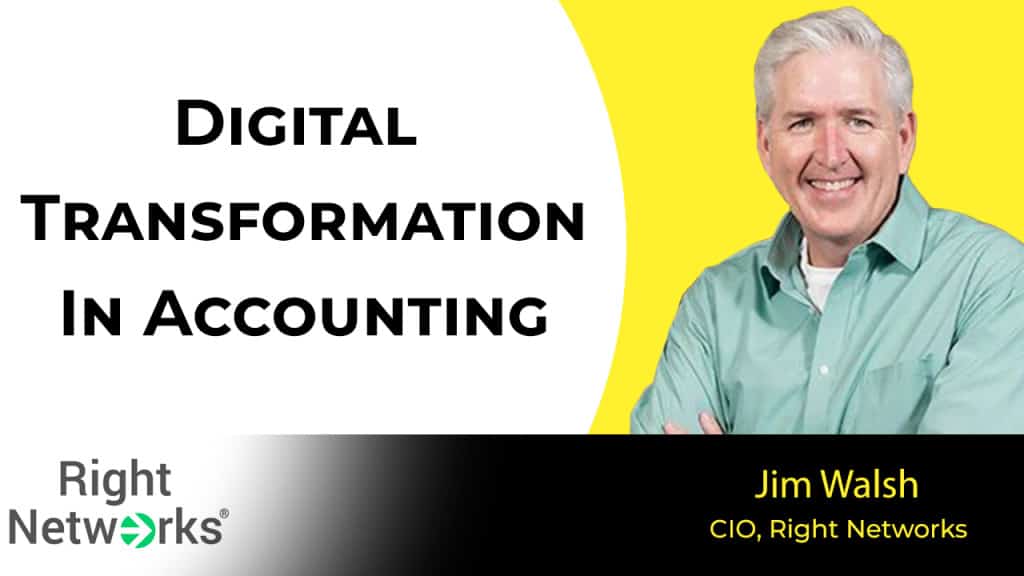
About Jim Walsh:
Technical executive with a mix of business, people, and technical leadership skills. Focus on providing the leadership necessary to put the people, process, and technology in place to drive profitable growth.
About Right Networks:
From the beginning Right Networks has been helping accounting firms and small businesses experience the value of being cloud-connected. We combine unmatched knowledge of accounting and tax applications, world-class cloud technology and a 24/7 US based support organization to dramatically enhance how our clients work.
We currently call more than 6,000 accounting firms, 50,000 small businesses and 210,000 users our clients. We partner with the industry’s most respected software providers and pride ourselves on exceptional customer satisfaction.
We believe accounting can be done so much better in the cloud.
Our team is driven by a desire to help firms of every size, independent accounting professionals, and small & medium sized companies transform their business and step into a connected world where they can be more productive, collaborate more effectively, and scale.
Transcript
(Joel Beasley at 00:00:03) Hello, my friends. Today we're talking to Jim, the CIO of Right Networks, and we discuss how to make sure your security strategy is always evolving and up to date, how Jim's company has utilized ITPro.TV to upskill their workforce, and what digital transformation looks like for accounting functions. All of this right here, right now on the Modern CTO Podcast.
(Joel Beasley at 00:00:20) And what digital transformation looks like for accounting functions. All of this right here, right now on the Modern CTO Podcast.
(Intro Narrator at 00:00:33) This is the Modern CTO Podcast.
(Joel Beasley at 00:00:44) Could you give me a little bit of your background? How did you first get into technology?
(Jim at 00:00:49) Yeah, so good question. I was thinking about this when, you know, knowing we were doing this today and sort of went into the wayback machine and started to think about how I got into it. And, you know, I would say coming out of high school, just, you know, probably like a lot of 18-year-olds, I really had no idea what I wanted to do. I was definitely going to go to college, but I had—I was always strong in math. I took, in my senior year in high school, a FORTRAN programming class, and I think it was the last year they used punch cards. So I bet you've never seen punch cards, Adam, but—
(Joel Beasley at 00:01:26) Not in person.
(Jim at 00:01:27) That was an interesting experience. So, you know, you'd code in all of your code on a teletype that would punch holes in cards, and then you'd load it in with a card reader. And so it was—you know, I thought it was super interesting. I didn't really know what I wanted to major in in college, so I decided to go to computer science and see how that was. And so I ended up liking that, and I got a computer science degree and came out of college and got my first job programming on an IBM mainframe—an IBM Mainframe 370—writing business applications.
(Jim at 00:02:05) And it was interesting because it was so different, you know, back in the mid-'80s, right, where you would—you know, I was part of a larger software development team, of course, just out of college, the youngest person on the team. And there were mid-career, late-career folks on the team. And in that day, you would spend two or three hours in the morning writing your code, submit it to the compiler, and then you would have probably half an hour to wait to get results from the compiler, which seems crazy today, but that's kind of how it worked back then. And they would—you know, most of them were smokers, and they would submit their code to the compiler and they would all go outside and smoke. And so I was not a smoker and was younger.
(Jim at 00:02:48) And so there was one IBM PC in the office. And while my code was compiling, I would always go over and play around with that IBM PC and figure out, you know, how that worked and what that was all about. And it seemed a lot more fun and interesting than coding business applications on an IBM 370 mainframe. And so around that time, I had a friend of mine decided to run for state senate in Massachusetts, and he asked me to work on his campaign and handle all of the technology needs of the campaign.
(Jim at 00:03:28) So I said, "Sure." I was, you know, 23 years old, and it sounded great. I had no idea what that meant, but I decided—Yeah.
(Joel Beasley at 00:03:35) So the technology needs a bit.
(Jim at 00:03:37) Why not? And so it turns out that, you know, he needed a computer. And at that time, an IBM personal computer at that time was probably over $2,000, which was super expensive for a campaign that was, you know, in a state and it was just starting. And we really didn't have a lot of money. So I just figured out what all the components were that went into a personal computer and mail-ordered them and built a computer for him, which turns out only takes a couple of hours to put it all together and test it out, burn it in, load the operating system, and we were off and running.
(Jim at 00:04:19) And I was able to do that for about $300, maybe $350. And so that sort of got me sparked on, you know, personal computing. And so I probably spent the first, you know, 15 years of my career in corporate IT, really in progressive areas of responsibility, specifically around local area networking, software on local area networks in pretty large companies for most of the first 15 years. So I was in—and it was great. I got exposed to, you know, lots of different types of businesses and large global businesses.
(Jim at 00:05:04) So I worked for the City of Boston for a number of years, so I was able to get exposed to, you know, what it takes to run a large municipality. I worked for a financial institution that was a large global financial institution. I worked for a manufacturing company that made robots, Cincinnati Milacron, all in corporate IT. And then finally in a managed healthcare company, which was—you know, when I went to the managed healthcare company, it was much smaller. So I had spent, you know, a dozen years in really large corporate IT.
(Jim at 00:05:45) And, you know, getting exposed to how things are done at scale globally was super good experience early in your career. And I started to cut my teeth on management there, but I wanted to—it felt sort of—you sort of feel disconnected from the business and you feel kind of like a number. So I wanted to get, you know, I wanted an opportunity in a smaller company. And so I took an opportunity at a managed healthcare company that when I joined was not tiny, but probably, call it, $80 million in revenue and a few hundred employees, but, you know, much smaller and earlier stage than I had been in. And I thought I was going to go there and really show them, you know, how to do things because I was coming from these, you know, large, successful Global 500 companies.
(Jim at 00:06:34) And what I quickly realized was I knew how to operate within an established, scalable infrastructure. I had no idea how you put that in place. And that's really what needed to happen for that company to grow from, you know, 70 or 80 million in revenue. We had a target to get to a billion within five years, and we needed, you know, a lot of scalability and technology in order to achieve that goal.
(Jim at 00:07:04) So that was a great learning experience. And we didn't make it to a billion. We made it to about $750 million, and then we ended up selling the company at that point. So it was, you know—but that was really my first experience in, you know, a relatively smaller, high-growth kind of environment, and I loved it. It was so great.
(Jim at 00:07:28) And it was a pretty technology-intensive business, so that was a good fit for me. And, you know, all of those experiences were great. I loved getting exposed and seeing how different businesses ran and, you know, what happens in a bank, what happens in a manufacturing company that makes robots, and that was super cool. But in corporate IT, I always felt disconnected from what the company actually does for business. And so it was around this time that, you know, software companies were starting to talk about offering software as a service, which at the time was called ASP.
(Jim at 00:08:09) And it turns out my background was great for this because software companies knew a ton about how to write software and ship software and knew really nothing about the rest of the IT infrastructure and components needed in order to deliver it as a service. And so I started with a company, relatively small company just outside of Boston, to head up their what they called their ASP service. So it was an enterprise software company that shipped product that had some demand from their marketplace to offer it as a service. So I came in to start the ASP version of that software for that company. So that was sort of a—
(Joel Beasley at 00:08:52) What's ASP?
(Jim at 00:08:53) So application service provider is what they referred to it as. So today, we would probably call it SaaS, software as a service. It was, at that time, they called it ASP. And so that was super interesting because the software was collaboration software, so it delivered content—PowerPoint or, you know, demonstration of software, that type of content—with integrated voice over IP. So corporations would use it—a lot of education departments for global companies would use it so they could train their employees on software or, you know, train their employees on anything really over the Internet and over computers rather than, you know, having to fly people around, and it reduced the cost for them and they could get their employees trained much faster.
(Jim at 00:09:44) So there was a great market need for it, and the marketplace really wanted that delivered as a service. They didn't want to have to build—and, you know, running voice over IP on a network is not that straightforward for your average business to figure out. So we grew that, and at that point, I was hooked because now I'm right in the middle of, you know, actually what the company does for business. Right?
(Jim at 00:10:13) I'm not just corporate IT working in the background—not to minimize that, that's super important too. But now I'm in the middle of what the company is actually selling and delivering and starting to interact with clients and get into negotiations around contracts. And so it was a great, great experience. And I never went back, so I've spent the past 20 years really exclusively working in what was ASP and then became on-demand and now is software as a service or cloud and have, you know, spent the last 20 years really applying my skills and learning in smaller, high-growth type companies that do that.
(Jim at 00:10:58) So it's been a great journey so far.
(Joel Beasley at 00:11:02) Really cool. I'm just curious—when you mentioned you spent some time working for the City of Boston, what was your title there? Just because I didn't know that cities and governments had CTOs until we had the CTO of the United States on the podcast a while ago, and then subsequently had the CTO of New York City a little while after that. But, yeah, I was just curious.
(Joel Beasley at 00:11:30) What were you doing?
(Jim at 00:11:31) So I was, you know, at that time, a relatively entry-level person. So I was a software programmer.
(Joel Beasley at 00:11:38) Oh, cool.
(Jim at 00:11:38) That was my job there. And—
(Joel Beasley at 00:11:41) Was there a CTO at the time?
(Jim at 00:11:43) There was a CIO, which was probably the same role. But yes. And if you think about it, which I, you know, if I hadn't worked there, I never would have thought about it either. But, you know, running a large city is very similar to running a large company.
(Jim at 00:11:59) And there's technology needs from—you know, if you look at every function within what it takes to run a municipality, whether that's—you know, I did work there. I worked with the Boston Police on—you know, they have a position within the Boston Police called a ballistician who's responsible for, one of the things he's responsible for is, you know, all of the guns. And so, you know, anytime there's an arrest and they confiscate a weapon, that's all getting put somewhere in storage, and they have to track all the serial numbers. And, you know, and so there was a—so I wrote a software application to track all of the—and I had no idea any of this existed until the ballistician brought me to the warehouse where the guns were, and it was a massive warehouse with just racks and racks and racks of weapons. And, you know, so it was—yeah.
(Jim at 00:12:59) It was crazy. But, yeah, from that to, you know, the demographics of the population of the city—there was one of the coolest things there was the traffic department. So they had a pretty sophisticated GIS system, you know, the geographical information system, and it controlled all of the traffic lights in the city. And so there was a room with a massive wall with a map of the entire city of Boston with every single traffic light in the city. And you could, you know, you could control, you know, whether it was red, yellow, or green from this room.
(Jim at 00:13:39) And so they would—you know, they had a bunch of guys from MIT that would do analysis of traffic patterns, and they would program, you know, what was the optimal way to program the lights. I mean, it was super cool. And, but then every time I went out in the city, I was stuck in a traffic jam. So I'm not sure, you know, I don't know what it would have been like without that system. But, so there's, you know, just all kinds of things like that—licensing boards, and there's just a ton to run a large municipality.
(Joel Beasley at 00:14:10) Yeah. I had never thought about, um, just like governments in general as the amount of kind of business operations that have to go into it. But I've been, like, listening to some other podcasts about world history recently and just realizing that it's always been that way. For example, when a lot of countries in South America were first becoming independent, they were raising money by selling bonds over in Europe. And in order to sell their bonds and promise that they'd pay them back and everything, they were, like, writing up revenue projections based on their natural resources to prove that it's a good investment for people.
(Joel Beasley at 00:14:54) And so I was like, "Wow, that's like—there's businesses, but countries." And, um, sorry, small digression, but that was just something interesting.
(Jim at 00:15:06) Yeah, no, it's true though. You don't think about it until you, you know, you kind of get inside or get exposed to it. And you're like, "Yeah, that totally makes sense. Of course they need to do that." Right?
(Jim at 00:15:16) Yeah. And I think in some ways more challenging for them because, you know, at least in certainly in a city municipality, right? They have needs like a business would, but I don't know if they necessarily have the funds or the ability to compete for the talent the same way a private business would. So, you know, so I think there's some challenges there for sure.
(Joel Beasley at 00:15:39) But let's get back to—so right now you're at a company called Right Networks. Can you tell me about what you're doing there?
(Jim at 00:15:47) Yeah, sure. So Right Networks is—now it's a really interesting company, right? So we help accounting professionals and accounting firms really with their technology needs.
(Jim at 00:16:00) And so what that means is, you know, there are many core applications that accountants and accounting professionals and firms need and they rely on in order to, you know, run their business. And so many of them—some of them are modern SaaS-type cloud applications natively, and many of them are not. A lot of them tend to be, you know, native Windows-based applications that have evolved over the last 20 years, 30 years, 40 years with a tremendous amount of intellectual property living within these applications that have been developed, and they're core to being able to do the job of an accountant. And so we have technology and services that—one of the things we do is cloud-enable many of these applications, and we optimize them to run in the cloud. And then we provide that to accounting professionals and accounting firms.
(Jim at 00:17:01) And then we have other services that—probably maybe you could think of them maybe in the advisory category of, you know, what are the best technologies to use to run your accounting firm in a modern way? Where are some of the strategies you can use to build and grow your firm, and how do you connect with existing clients and get new clients? And we have technology that helps accountants and accounting firms do that.
(Joel Beasley at 00:17:36) Cool. So it's kind of digital transformation specifically for accounting firms and accounting departments, or do you avoid that buzzword?
(Jim at 00:17:45) No, I don't think we would avoid that buzzword. You know, I think that's a pretty good description. And then I would say the only thing—maybe not unique to us, but where we focus—is on smaller to mid-sized firms.
(Joel Beasley at 00:17:57) So—
(Jim at 00:17:59) You know, maybe firms that wouldn't necessarily have the resources internally to be able to do what we're able to offer or that maybe a larger firm might have on their own.
(Joel Beasley at 00:18:10) Right. Yeah. I mean, it's traditionally prohibitively expensive for the smaller firms to have access to that kind of stuff. So that's cool.
(Jim at 00:18:19) Exactly. And, you know, when you think about it, I never thought about it much until I came to Right Networks. But, you know, accounting is part of every single business. And so there's a massive market out there, and it's super important. It's critical for every single business to have a functioning, solid accounting function. And we've experienced terrific growth every year, certainly since I've been here.
(Jim at 00:18:50) And the company's about twenty years old, but continues to grow at a really fast pace, both organically and as well as through acquisition.
(Joel Beasley at 00:18:58) That's cool. So you and I were originally connected because we had Don Pezet from ITProTV on our podcast a little while ago. And he was an awesome guy, and then you guys use them for some of your training and stuff. And so that's how we heard about you. And I was just curious, what's your involvement been like with ITProTV at Right Networks?
(Jim at 00:19:27) Yeah, they've been a really important partner for us, and we've used their services quite a bit. So it's been great. Obviously, you know, when I describe the business, we're about 500 employees now and growing, and many technology professionals within the company. And that can range from customer support representatives, infrastructure engineers, software engineers, security analysts and engineers.
(Jim at 00:19:58) So it's a pretty broad spectrum of technology needs. And so we've been using ITProTV since 2018, and we have folks, you know, technical professionals within the company that leverage that to get their training and education to continue to build their skill sets. So that's been super important. And we also sponsor the certifications, the technical certifications for our staff that want to do that. So, you know, things like CompTIA A+, Security+, Network+, Microsoft Azure certification, those types of things.
(Jim at 00:20:39) So we leverage it in a number of ways there.
(Joel Beasley at 00:20:42) That's cool.
(Jim at 00:20:43) It's been a really good service for us.
(Joel Beasley at 00:20:46) So how do you encourage your employees to actually use the training? Because I know it can be challenging once you get training to have your employees actually use it. That's a big issue in the training industry. We used to, or we still do, have a leadership training software out for executives that we've built. Since we talk to executives all the time on the podcast, we learn a lot and put some of that content out there for training. But in doing that, we learned just how often training software just sits there and does nothing after the company buys it. So I'm just curious, how do you go about encouraging your employees to use the training that you get for them?
(Jim at 00:21:33) Yeah, I think it's a pretty natural advantage, right? There are always positions that are becoming available that folks are desiring to get to. And one of the ways that they can get there is to make sure that they stay current on training and continue to expand their skill set and learn.
(Jim at 00:22:03) And so we do some incentive-based things that would encourage them to take the training. But I think mostly they're motivated to expand their skills and try to get to that next position that they have their eyes on. And, you know, in some of the groups where the more senior-level technical folks are, I mean, we look at the company as the farm system for bringing people through. And so there's a pretty common upward mobility for folks. And one of the ways, I think people know, that one of the ways they get there is through leveraging not just ITProTV, but expanding their skill sets, getting more training, getting more skills both on the job and through training.
(Jim at 00:22:47) So it's—
(Joel Beasley at 00:22:48) Yeah, that's awesome that you have such an opportunity—
(Jim at 00:22:53) Yeah.
(Joel Beasley at 00:22:53) —to grow your career within the company there. Because I know it's becoming more and more the norm, especially with remote work now, it's so easy to just, if I want a promotion, I'll just start job hunting instead of talk to my boss about that. But that's cool that you've encouraged that kind of culture at your company that, like, hey, if you want to go somewhere else with your career, you can learn things. And here, we have these resources here for you to learn things and then apply them at a new job here for you. That's cool.
(Jim at 00:23:29) Right. And I know that it's the biggest cliche ever, right? Where there's growth, there's opportunity. But it's so true. And we're growing, and that's been a really big advantage for us from being able to retain technical talent and move people up.
(Joel Beasley at 00:23:48) So on the topic of growth, recently we had on a company called WIFM that actually started as a CPA firm. But they just had really close connections with their customers, and they just kept asking, what else can we do for you? What else can we do for you? And as a result, they started adding more and more capabilities and became a pretty tech-heavy company. And I know they even have a cybersecurity product out that they sell. And they, like I said, started as a CPA firm. So I'm curious, you're talking about having a lot of growth. What's the process like of adding more services and capabilities to your portfolio? Is M&A the norm for you, or do you do R&D product development within the company, or a mix of both? And if so, how do you decide between the two?
(Jim at 00:24:42) That's a good question. It's a mix of both is the short answer to the question. I think for us, you know, what we think about is how can we get more value into the hands of our customers as quickly as possible at the most reasonable cost. And I think that's really where it starts. And so we identify, okay, what is a good area for us to add capability? If there's an opportunity to accelerate the roadmap through an acquisition that makes sense from a cost standpoint, as well as functionality and technology, then we're certainly open to both. But sometimes you need to develop it too.
(Jim at 00:25:32) So it's a combination of both, but it's really roadmap-driven, which is driven by what the needs of our market are.
(Joel Beasley at 00:25:43) Makes sense. So I want to talk a little bit about security too, because obviously handling the data involved with accounting is incredibly sensitive. And you're CIO, so I'm sure that's really top of mind for you. So having been in tech for a while, when did you first start thinking about tech from a security-first perspective?
(Jim at 00:26:13) That's a great question. So I actually have been a Chief Security Officer in my past. So I really started thinking about it when I took that job for sure.
(Joel Beasley at 00:26:24) Oh, I bet.
(Jim at 00:26:25) Yeah. That was about ten years ago. So probably in the past ten years it really became front of mind for me. And it's only gotten further to the front and is accelerating, I would say, at this point in time.
(Jim at 00:26:48) And so, you know, it's just a constant race. Certainly, you know, ubiquitous Internet connectivity throughout the world has accelerated that. And it's a race between the good guys and the bad guys. And, you know, we're on the good guys' side and have really, really critical, important data. So it's core to what we do at Right Networks. So it's an area that we invest in and that I think about constantly.
(Joel Beasley at 00:27:22) So you've been there for about four years now, right?
(Jim at 00:27:26) Correct.
(Joel Beasley at 00:27:27) So was the security team and strategy at all different when you started there? And if so, how did it change?
(Jim at 00:27:39) So I think the biggest changes are, one is just the, you know, we're at a different scale now because we've experienced four years of significant growth. So there's that component to it. So there's, you know, as you grow, it's larger scale, it's more complicated, there are more products. So there's a wider portfolio of things, which then bring with them areas of security that you want to think about. And so the team certainly has grown significantly. We've gone from, I don't remember exactly how many people were on the team when I got here, but it's at least doubled in size and maybe even grown more than that. And then I'd say the other thing that's changed significantly, even in the last four years, is the technology and capabilities that are available out there. And so, you know, one of the technology areas that I'm super interested in is not just security, but also AI and machine learning. And there's so much that's happened in the last few years and capabilities that just didn't exist a few years ago that we have today. And we've mostly acquired those technologies and figured out how we apply them to add value to our platforms and to our environment.
(Joel Beasley at 00:29:03) That's cool that you've brought the AI angle into the security conversation. Because recently we had on the CTO of Avast, which, if you don't know of him, he is a fascinating individual. Because he's a professor of AI at a university.
(Jim at 00:29:22) Oh, wow.
(Joel Beasley at 00:29:22) Yeah. He's a professor of AI, does a ton of research in the area, and he's also the CTO of Avast, a huge security company. And one thing that Heath was saying he thinks about a lot is adversarial AI. And that's exactly what it sounds like: the bad guys using AI to scale up their attacks and automate their attacks. And he was saying that the only way to really deploy security against those at such a large scale is to also automate your defenses.
(Joel Beasley at 00:29:58) And that just kind of conjured images in my head of classic robot fights, which I know is not at all what it's like, but I like thinking about it like that. And anyway, I think that that's just such a crazy kind of future application of AI in the security space that wouldn't have even been top of mind ten years ago. And it's just crazy seeing that all develop today. And so how do you think about scaling up your defenses, I guess, and automating your security practices?
(Jim at 00:30:41) Yeah, I think that's an area of focus for us all the time. And so I think we have a couple of ways we approach it, right? One is, we have these large platforms today that are at scale and growing. And, you know, there's a ton of security operations and security capabilities and activities that we're engaged in today in order to secure and run those platforms. And then we have a small team that does nothing but look at what's coming next. And so we call it Architecture and Advanced Technology. And they're looking at, you know, not just security, but just in general, what's coming next and how do we apply that and leverage that for our business. And, you know, like I said, I think—I don't know the CTO of, did you say it was Avast?
(Joel Beasley at 00:31:36) Yeah, Avast, like Avast antivirus.
(Jim at 00:31:39) Yeah, I'll have to look him up. But yeah, I think that's absolutely right. I think you can't battle bad guys with AI with keyboards and mice. We've got to do it with good guy AI.
(Joel Beasley at 00:31:53) Yeah, absolutely. And I—
(Jim at 00:31:54) And I think, you know, our approach to that is to look at what is available in the marketplace, acquire that, and become really, really good at applying that for the advantage of our business.
(Joel Beasley at 00:32:11) So I know I keep referencing other episodes, but that's how I've kind of built up my understanding of the industry. And so anyway, another interview I did recently was with a guy named Biju from a company called Hexaware that they are all about automating everything and helping out companies across industries with digital transformation. And he gave me a really cool walkthrough of the general digital transformation process. And from talking with you today, it sounds like you guys have built up, obviously, from helping move accounting departments to the cloud and building up your security infrastructure, it sounds like you've built up a really solid infrastructure for digital transformation in general. So I'm curious, what's your advantage of sticking with and focusing on accounting firms and accounting departments?
(Jim at 00:33:22) So that's a great question. And it's one that we, at a strategic level, talk about a lot, right? And, you know, I think we're—not to say we would never expand beyond accounting. I just think we believe there's so much more that we can bring to accounting, and there's just a runway of years of continued growth and additional services that we can bring into accounting. And if we were to start to expand or go broader than that, I think it would be distracting and take away from our ability to really continue to deliver additional value to the accounting market. But it's a good question. I mean, we've certainly talked about it a ton.
(Joel Beasley at 00:34:14) Yeah. No. But I mean, it's really a smart strategy to master your niche and be disciplined about not getting distracted by the shiny object. Because, I mean, sometimes the shiny object can become a business model that you try for a while, and then $100,000 later, you decide, well, I guess we learned that that wasn't the thing for us. But that's after a lot of, like I said, $100,000 later. Or it gets much larger scale than that even by large companies. But yeah, it's awesome.
(Jim at 00:34:55) I would say that's true. Never say never, you know?
(Joel Beasley at 00:34:57) Yeah, exactly.
(Jim at 00:34:58) It's something we revisit all the time. But I just think every time we check in on that, it's sort of, there's so much here and there's so much more for us to be able to do here that, you know, this is the place for us to be focused.
(Joel Beasley at 00:35:11) For sure. I mean, like you said at the beginning of the call, or just a little bit earlier, there's no shortage of accounting because every single business needs to do it. So you certainly have a lot of room for growth still.
(Jim at 00:35:29) Yeah, absolutely.
(Joel Beasley at 00:35:31) So I want to talk a little bit about leadership before we wrap up. Is that cool?
(Jim at 00:35:36) Sure.
(Joel Beasley at 00:35:38) So I guess you've been in leadership for a long time, but you did start as an individual contributor. What would you say was the biggest lesson you learned the first time you transitioned from individual contributor to management?
(Jim at 00:35:57) Oh.
(Joel Beasley at 00:36:01) Hitting that wayback machine again.
(Jim at 00:36:03) Yeah. I think I'd say probably the biggest thing is, I mean, you live with yourself for years and years and years, and then you're an individual contributor, and you're used to thinking a certain way and approaching things in a certain way. And to a certain extent, you're doing that because you think that's the right way to do it and the best way to do it. And I think what you learn very quickly is there's a lot of right ways to think about things. There's a lot of best ways to do it, and there are a lot of different approaches.
(Jim at 00:36:38) And so I think, you know, you quickly learn you're not gonna turn everybody into the way you do it and then make that work. It's more, you know, it's understanding what everybody's talents are, how do they think, how do they approach things, and how do you as a leader set them up so that you can get the best work out of them. And, you know, both from an individual perspective and when you look at the makeup of the team and really understanding, you know, what are the different strengths of the folks on the team and, you know, delegating work in a way that is most effective collectively as a team. And it's just probably that's the biggest lesson I think is learning how different and how varied, you know, each person is from individual to individual. And everybody's got gifts and talents, but they're very different.
(Jim at 00:37:38) I'd say that was a learning experience for me.
(Joel Beasley at 00:37:42) Yeah. That makes a lot of sense. I mean, the strongest team is like a group of people that are all extremely talented in different areas so that they can come together and be more than a sum of the parts. Right?
(Jim at 00:37:56) Right. Exactly. Yeah.
(Joel Beasley at 00:37:59) I'd say you just got me thinking about kind of one thing that I've learned as I have transitioned into leading a little bit. And the hardest part for me was letting go of previous responsibilities and having to accept that when you hand them off, they might not execute on it perfectly at first, and you have to let them fail a little bit. And you have to let this thing that you used to work on get accomplished not exactly how you would do it before. And you just have to watch and be okay with that.
(Joel Beasley at 00:38:40) And that's hard. That's really hard to do.
(Jim at 00:38:43) It's super hard.
(Joel Beasley at 00:38:45) Yeah. But I mean, at the end of the day, I mean, I will testify that because most of my job today, I learned on the job, like, just by doing. And I'll say that I'm much better at what I do for that because that just ingrained it so much deeper in you than someone just saying, hey, here's your instructions. So it's important to remember that. Remember that feeling of how much you learned from hard knocks.
(Jim at 00:39:24) Right. Yeah. Yeah. Right. I mean, yeah, you can hear somebody, you know, it's like your parents will tell you something over and over and over, and then, you know, you're gonna go do it the way you're gonna do it anyway, and then you're like, oh, yeah.
(Jim at 00:39:35) I guess they were right, but I had to learn it the hard way. Right?
(Joel Beasley at 00:39:38) Yeah. Definitely. So I wanna wrap up with my favorite question to ask. What are you learning right now, and what's challenging you?
(Jim at 00:39:50) Oh. So I think, you know, we're in the process now of, you know, we've identified some what we think are good additional products and services to add to the portfolio. And, you know, we're at the very early stages of testing and understanding, you know, are those good products and services to add to the portfolio? So going, you know, thinking about that and going through the process of, you know, how do we test that? How do we evaluate how the test is going?
(Jim at 00:40:24) How do we translate that into what it really means longer term for the growth of the business? I'd say that that's probably an area that I'm challenged by right now. And super fun and interesting and a little bit different from what I've done in the past. So—
(Joel Beasley at 00:40:40) If you don't mind talking about it, that sounds really interesting. We don't have to talk about what the products are, but what's your testing process like for testing market pressure and evaluating these new products?
(Jim at 00:40:53) We're figuring that out. And, but it's, yeah. It's actually going out into the market and, you know, going through the process of selling and delivering on a somewhat limited basis these products and services. And then, you know, figuring out, you know, what are the right metrics to be measuring and how are we monitoring and measuring that and making changes and adjusting as we go.
(Joel Beasley at 00:41:23) That's cool. Yeah. I've heard of a strategy for kind of day zero of just figuring out what you want to try to sell. I've heard of businesses or founders that will come up with a couple different product ideas and just make some ads for them without making the product and just run the ads and then see what gets the most clicks. And then they're like, alright.
(Joel Beasley at 00:41:49) I'll figure out how to make that product. And they make it, and then that's how they do the first stage of their product development. And I've heard some pretty wild success stories around that. That it's just such a smart idea. Like, you can test how much people want a product without even making the product.
(Joel Beasley at 00:42:13) Just so interesting.
(Jim at 00:42:15) Yeah. It's interesting too. Not right now, it's been in a previous company. You know, we were doing something similar and, you know, there was a whole—the product team and the delivery team were completely wrapped around the axle on, you know, how it's really complicated to figure out how do you bill and, you know, charge people for this new product and, you know, all of these changes that had to be made to the billing system that were gonna take months to do development on in order to be able to even get out there and test it. And we just said, you know what?
(Jim at 00:42:46) What if we just put it out there? And because all we're trying to do—we're not trying to make money with this yet. We're just trying to understand what the demand looks like. So what if we just put it out there and put a button that says, you know, pay, and then we just never bill them for it. We'll just see how many people actually go through and attempt to acquire the product, and they'll just be in a trial.
(Jim at 00:43:14) And so at some point, we'll figure out how we'll charge for it and bill for it, but let's first find out if there's demand for it.
(Joel Beasley at 00:43:23) Yeah. That's really cool. So I guess before we wrap up, is there anything that we didn't get to touch on that you wanted to touch on today? I know you've mentioned huge growth a couple of times. Are you hiring?
(Joel Beasley at 00:43:36) Do you wanna plug that?
(Jim at 00:43:37) We are constantly hiring. So, yeah, I mean, across the board, all of our different tech positions, and with, you know, remote work, the geography is open. And so we're, yeah, absolutely. It's a terrific company, great growth, great place to work, really cool technology, great people. And, yeah, we're hiring all the time.
(Jim at 00:44:01) So check us out.
(Intro Narrator at 00:44:05) Thank you so much for listening. And if you found this episode useful, please share it with a friend or colleague who you think would get value from it. And if you have topics that you'd like to hear discussed on the podcast, either add me on LinkedIn or send me an email [email protected]. Every time I get an email or LinkedIn message, it absolutely makes my day and inspires me to keep going.