
Episode 468 ·
Underwater Robots Are Cool - with Jeff Smith, VP & GM of Autonomous and Undersea Systems at Saab
Today we’re talking to Jeff Smith, VP and GM of Autonomous & Undersea Systems at Saab; and we discuss how Jeff has built a career in underwater robots, engineering challenges of building machines for use underwater, and Saab’s various unmanned underwater underwater vehicles used in defense, exploration, and more.
All of this right here, right now, on the ModernCTO Podcast!
Check out Saab's undersea systems at https://www.saab.com/products/security/underwater-systems
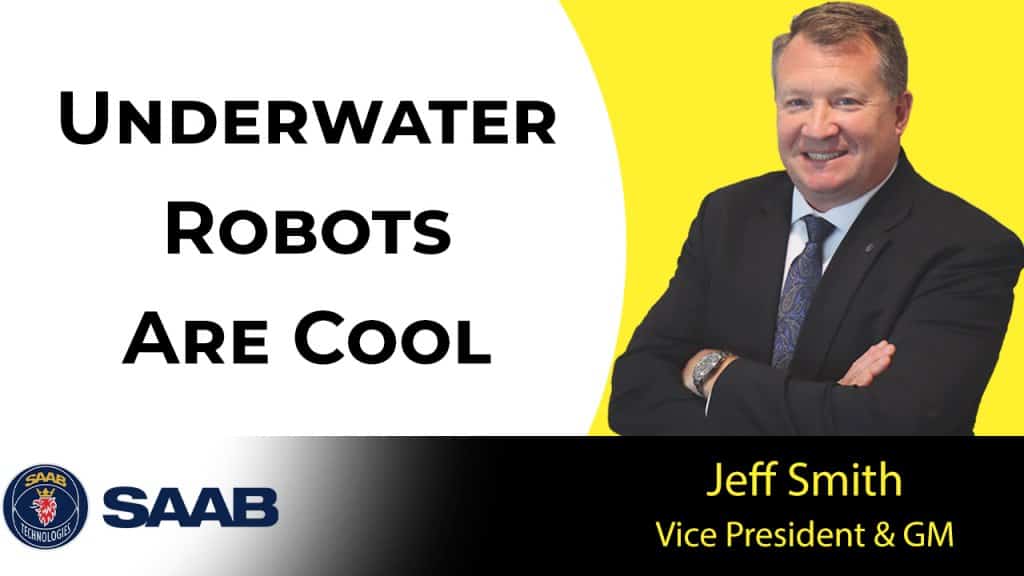
About Jeff Smith:
My experience includes over twenty five years of working in advanced technology industries leading multifunctional teams in concept generation, research, design, product development and new business capture. I have assembled large corporate teams to capture major programs of record for the U.S. Navy, as well as cutting edge R&D projects within DARPA and ONR.
About Saab:
Saab serves the global market with world-leading products, services and solutions from military defence in all domains to civil security. Saab’s market offering is broad and consists of complex systems involving extensive research and development as well as services with a high degree of repetition. With operations on every continent, Saab continuously develops, adapts and improves new technology to meet customers’ changing needs.
Transcript
(Intro Narrator at 00:00:03) Hello, my friends. Today, Joel is talking to Jeff, vice president and general manager of Autonomous and Undersea Systems at Saab, and they discuss how Jeff has built a career in underwater robots, engineering challenges of building machines for use underwater, and Saab's various unmanned underwater vehicles used in defense, exploration, and more. All of this right here, right now, on the Modern CTO podcast.
(Joel Beasley at 00:00:35) Here we go. This is the Modern CTO podcast. You know, looking at these underwater robots, they look so cool, and there's so many different things that they can do, right?
(Joel Beasley at 00:00:55) And then your title, I couldn't tell, like, are you over all of autonomous systems, or are you over, like, the aquatic systems that are autonomous? Or can you explain to me what you do there?
(Jeff at 00:01:07) So at Saab, I'm the vice president general manager for a brand new division called Autonomous and Undersea Systems. So our charter is really unmanned systems in general, but our focus is more on the maritime side. So unmanned undersea vehicles, remotely operated vehicles, unmanned surface vehicles are sort of the three focus areas for platforms that we have.
(Joel Beasley at 00:01:27) That's pretty cool. And then have you been into these underwater robots for a long time, or is this a newer thing?
(Jeff at 00:01:34) Somehow I've gotten about thirty years of my career already, and about half of that was spent at General Dynamics, mostly focused on submarine manned systems. And then about halfway through my career, I started to get more into the robotic side and shifting to autonomous and robotic type systems.
(Joel Beasley at 00:01:54) And then is this the same Saab that makes the cars?
(Jeff at 00:01:58) So the one thing that Saab actually doesn't make these days is cars. They sold the car industry back in, I think, it was the early nineties to General Motors, and then General Motors, I think, ended up going bankrupt with them sometime in the mid two thousands. But in Sweden, Saab is really the defense industrial base, so we make all their jet fighters, their submarines, their surface ships, most of their weapons systems, radars, everything, really.
(Joel Beasley at 00:02:24) Oh, really? They make the ships, weapon systems, Saab is making this? So at some point they didn't get started with cars. What did they get started with?
(Jeff at 00:02:34) They actually got started in the mid to late thirties with airplanes. They decided during World War Two that they really wanted to have an indigenous airplane capability, so they started making their own airplanes. And airplanes is really a big part of the company. It's been really, really interesting. You know, they've developed a lot of very unique and interesting airframes over the years, and they have one of the top fighters in the world right now. And in The US, they actually work closely with Boeing. And jointly, they developed the T-7 trainer jet. It's the next generation trainer jet for the US Air Force. So that's being made largely by Saab under a prime contract with Boeing out of West Lafayette, Indiana.
(Joel Beasley at 00:03:14) Oh, that's amazing. My dad was in the Air Force. They put the GPS systems into the B-2 stealth bombers. That's how he got into technology. Oh, wow.
(Joel Beasley at 00:03:23) Well, that's really cool. So does Saab actually have, like, other than the ones you mentioned, I think the T-7, do they make the frames, or are they making the entire jets?
(Jeff at 00:03:33) In Sweden, and it's sold internationally, they make the Gripen aircraft, the fighter. It's popularly sold globally. I believe they have jets right now in, I think, at least three or four countries and several more coming.
(Joel Beasley at 00:03:48) Oh, that's cool. I'm learning so much. I think, for most people, Saab is just the car company.
(Jeff at 00:03:55) You know, and everybody knows it for that, which is funny because, you know, that's the first question I always get is, you know, we really like those cars. They were nice cars, but they haven't been made in some time. And, you know, Saab, the prime company, hasn't made them in almost thirty years, I guess.
(Joel Beasley at 00:04:13) Oh, man. So have you been there your whole career?
(Jeff at 00:04:15) No. So I've only started with Saab in the last eight months. I've jumped around through several of the large defense primes. I started my own company actually in undersea robotics about six years ago. I sold it to a large defense prime. And then a couple months, about eight months ago, I was actually starting a new company myself when a headhunter, or actually several headhunters from Saab, started to call, and I decided to look at what it was. And when I figured out sort of what they're looking for, it just seemed like a perfect job, and I didn't need to go find a new investor.
(Joel Beasley at 00:04:48) Yes. I know that. I like the entrepreneurial part of you. It teaches you everything really fast.
(Jeff at 00:04:56) It's, you know, it was a big decision not to start my own new thing again because we had success the first time around, but I believe my wife's a lot happier with me having a real, you know, a steady solid job where I don't need to worry about payroll every two weeks.
(Joel Beasley at 00:05:12) Absolutely. And it helps the relationship too, right? She gets more time with you as well.
(Jeff at 00:05:18) I haven't seen her in about three and a half weeks, but—
(Joel Beasley at 00:05:20) Are you on, like, a tour of duty or something? Why not?
(Jeff at 00:05:23) So I just actually spent a couple weeks in between The United Kingdom and Sweden. I was over for business meetings and a conference. I actually ended up getting COVID along the way, so I got stuck over there. But my wife's been traveling herself. So she just recently retired out of another large defense contractor.
(Joel Beasley at 00:05:43) Oh, nice. I spent some time in, like, the South Sweden area close to Copenhagen. There's, like, that bridge, and it's a beautiful area out there.
(Jeff at 00:05:51) I love Sweden. Back in November, I actually had the opportunity to go up to pretty much the northern parts. I think sunset was at 2:30 in the afternoon.
(Joel Beasley at 00:06:02) Yep. Yeah. That was interesting. We got off the plane, and then we were walking around, and then it was, like, 11 PM and it was still bright. And I was like, this is odd.
(Jeff at 00:06:12) So summers, it stays late. Winters, it gets dark very early. So yeah, I was in Stockholm and Linköping this past week.
(Joel Beasley at 00:06:22) So you're on your way back, you're traveling back right now to The States?
(Jeff at 00:06:26) I just came in last night. I passed a negative COVID test yesterday, and I was able to come back into the country.
(Joel Beasley at 00:06:34) Welcome back, my friend. Thanks. So tell me a little bit about what your day to day looks like.
(Jeff at 00:06:42) So what I really like about Saab is they have a really extensive portfolio of undersea systems. So when they chartered me to stand up The US division, the challenge was really not what products we needed to develop, but what products in the portfolio best fit for The US market. And how do we bring those to bear, bring them to production, transition them to The US, really Americanize them in a way so that we can sell them to US defense, to the US Department of Defense, US Navy, stand up production, stand up build team here, transition the technology. You know, it was really kind of a clean slate. How do we start a real business here based on technology we can leverage from Sweden?
(Joel Beasley at 00:07:27) Oh, that's cool. So when I was looking at some of, like, the underwater systems, you had stuff for discovery, you had stuff for defense. So you just picked those out of the existing portfolio to start the division in The United States?
(Jeff at 00:07:41) Yeah. Really, it involves talking to the customer and figuring out what they really want. And, you know, from a portfolio perspective, you know, it was great because we had a huge amount of technology available, and it really comes down to aligning what the customer wants with what we can do and then picking the right products that we can sell sort of the fastest and stand up a company in a new division as, you know, as good as you can and make that impression and impact on the market.
(Joel Beasley at 00:08:07) That's pretty cool. It sounds like a super exciting opportunity because then not only, like, as an entrepreneur, you typically start, you know, well obviously at the bottom, right? And then you have to build it up and everything. But when you can start a division of a company that's like a household name, you can just go really far.
(Jeff at 00:08:26) You know, when I started my prior company, Riptide, we literally started in the kitchen on a credit card, right? And it was, you know, there was all the challenges that came with, you know, I didn't have a really good—I didn't know what I was doing. You know? I had always been with more solid companies throughout my career, so it was really kind of going out on a limb. But when Saab called and sort of laid this out, it was just a whole new challenge because it was an established company. It was, you know, a huge product base. They had really good working technology already, and I didn't, you know, I didn't need to develop anything really new to start with. So it was just a much different challenge. And, you know, what I liked about it was it really opened up everything where I could focus on growing the right team of people, you know, really pull in products that made sense for what we needed based on a, you know, a proven technology capability that was already established. You know, we'll develop our own capabilities and our own products as we go forward, but obviously being able to leverage what's already out there and what they already have is a big advantage for us.
(Joel Beasley at 00:09:27) And was Riptide like exploration? Was it advanced weaponry?
(Jeff at 00:09:32) So Riptide was a micro UUV primarily, a small unmanned undersea vehicle. It was about 25 pounds, right? About three feet long, 25 pounds. You know, I joke that at the time when most unmanned undersea vehicles were about a million bucks, we started selling vehicles for about 10k. And, you know, I joked that, you know, the reason was because I had to get a $10,000 limit on my credit card. And if I could spend 10k to make it, I could probably sell it for that and start making more. So, you know, the price point was, you know, it was somewhat driven by the fact that we had limited dollars to invest, but the other need was we saw a lot of demand for just new lower cost systems. You know, you look at the aerial drone market, obviously, multimillion dollar Predators and things like that that have shrunk down to, you know, people are now making drones in their home, right? You got these little things that cost a couple $100. So the technology has really moved a long way, and we were just really looking to take advantage of where the current market was and, you know, get things out there that were a lot more affordable for, you know, the broader users, schools, universities, research institutions, things like that, and really open up the ocean as much as we could.
(Joel Beasley at 00:10:45) You should talk to the BattleBots people and see if they could do, like, an underwater edition.
(Jeff at 00:10:49) So one of my close friends was actually one of the founders of BattleBots, and I do tend to watch it now and then, especially when he's on.
(Joel Beasley at 00:10:56) Oh, what's his name?
(Jeff at 00:10:58) Christian Carlberg, C2 Robotics. They have the Yeti. It was the big vehicle this season.
(Joel Beasley at 00:11:04) We had on the referee guy. He's like one of the executive producers. I think his name—I don't wanna butcher it, but I can't—I think it's like maybe John or something. But yeah, the BattleBots is, like, I did the interview because my team was like, hey, do you want to talk to BattleBots? I was like, of course. Because I remember, like, the one episode I saw ten years ago, you just kind of remember it in culture. And then afterwards, the interview, he was telling me people watch it, like, with their families a lot, right? And I've got two little kids because it's, you know, it's family safe. So I proceeded to watch after that interview every single episode of BattleBots in existence.
(Jeff at 00:11:41) Good. So Christian, as I understand, had actually started out really working with his daughters. It was a joint family project to get his daughter into robotics. And, yeah, I worked with Christian, too, probably twenty five years ago or so, and he's been a good friend and, uh, done really well with it.
(Joel Beasley at 00:11:57) That is super cool. Now I wanna talk a little bit about the discovery. We mentioned it earlier, but what part of the technology, of Saab's technology, was used to make this discovery? Can you tell me about what the discovery was, what the technology was?
(Jeff at 00:12:13) I think I can talk on some of that. There's, you know, what's available out in the public domain is open, so I can reference a lot of that?
(Joel Beasley at 00:12:20) Okay.
(Jeff at 00:12:20) I do think we have some restrictions still under the prime and how that exploration went. So in general, two Sabertooth vehicles went on that expedition and were involved with searching for and then ultimately locating the Endurance, Ernest Shackleton's Endurance. So they found that ship at 3,000 meters of water. I think reports vary between two thousand nine hundred ninety eight and three thousand and eight meters, but the vehicles themselves were 3,000 meter rated vehicles. So it was right at sort of the hairy edge of where they can get to. Obviously, there's safety factors on the vehicles and that. But the vehicles are, the Sabertooth vehicles are very unique in that they're a hybrid ROV AUV, so they can operate tetherless or they can operate with a tether. And in this case, they were operating under ice, so they had the tether to the vehicle. The vehicle can be fully autonomous or can be remotely controlled via that tether.
(Joel Beasley at 00:13:18) Okay.
(Jeff at 00:13:19) But one of the unique things about that vehicle is because it's set up the way it is, a lot of times your UUVs are typically a—they're a smart torpedo, right? They can go out and they can mow the grass with side scan sonars looking for, you know, imagery and detecting things in that sonar imagery. What's unique about Sabertooth is it's actually capable of hovering. It can go forward. It can go backwards. It can change its orientation. So it's much more controllable, six degree of freedom sort of orientation, that allows it to really get in close to a wreck, inspect it. You know, it can mow the grass as well, but it's really meant for very high maneuverability in inspection type missions, which is what the, you know, some of those imageries we see online of the Endurance with the, you know, the golden lettering across the back of the ship and just the, you know, how well preserved that shipwreck is, is just amazing. And that's all due to the fact that, you know, it's a very stable vehicle that's there taking that imagery.
(Joel Beasley at 00:14:20) What was the Endurance? I mean, I know it's a ship, but can you tell me more about what it was?
(Jeff at 00:14:25) So now I wish I have read a lot more on Shackleton. But back in, you know, a hundred and seven years ago, Shackleton was an Arctic explorer, Antarctic explorer, and the Endurance was an exploration mission to the South Pole, and he got caught in the ice. And I think it was about a year and a half that it took him to basically get off the ice, get to, I think, South Georgia Island or one of the close islands there, to get a rescue party together to go back and rescue his crew. So it was a long, you know, it was, heroes were made from this. I'm not sure ultimately how many people ended up dying, but, you know, his crew basically spent almost a year and a half, I think, on the ice in Antarctica locked in.
(Jeff at 00:15:10) And eventually, the ship that was caught in the ice got broken up and sunk. The shipwreck itself ended up about four miles from where it was reported. So that was one of the reasons they've actually mounted several expeditions to go and find it, and they were successful this time around using the Sabertooth technology, unlike past expeditions. But the ship was sitting upright in pristine condition, really, considering how long it'd been down.
(Jeff at 00:15:35) But it's a wooden ship, you know, from over 100 years ago and just in beautiful, beautiful shape given the cold water, given the depth, given the lack of things that eat wood in that temperature water and at that depth.
(Joel Beasley at 00:15:46) Oh, that's very cool. Yeah. That's plenty of information. You know a lot about it. Okay.
(Joel Beasley at 00:15:54) So the Sabertooth, the one that helped find that—when you're taking the technology from an exploratory piece of technology like the Sabertooth and you're then going to make it so where, like, maybe rockets or somehow weaponize it, are you—do you use existing models and then weaponize them, or do you just build the model specifically for each use case? How does that work?
(Jeff at 00:16:21) So the way that a lot of the platforms work is the platform provides really the core capabilities: basic autonomy, navigation control, depth keeping, altitude above the bottom, propulsion, so speed, vehicle control, what it needs to do. And then we add the payloads to the vehicle to then make it really missionized for what it's gonna do, whether it's, you know, put a high-end sonar on it to look for stuff, put an acoustic package out to potentially run training missions for, you know, the good guys' sonars, or deception missions for the bad guys' acoustic capabilities. They can be weaponized with explosives. In a lot of cases, most of the undersea vehicles that do blow up—I mean, at one extreme, you have torpedoes.
(Jeff at 00:17:08) But at the other end, you have mine countermeasures, mine neutralization systems, where we really go in and where, for instance, mines are put out, they can be used to neutralize and blow up the mines.
(Joel Beasley at 00:17:20) Oh, very cool.
(Jeff at 00:17:21) In some cases, that's a sacrificial mission where the vehicle itself will blow up. In other cases, we can drop or plant a charge, and then the vehicle can go back to a safe distance while the charge then explodes.
(Joel Beasley at 00:17:34) What's the difference between a Sabertooth and a SeaWasp?
(Jeff at 00:17:37) So they both have a high degree of maneuverability. The SeaWasp is really set up specifically for mine neutralization mission, so that'll be able to hold either one or multiple charges for neutralization. So it can inspect things. It's a slightly smaller vehicle than the Sabertooth. So the range typically, as you get smaller, your range goes down.
(Joel Beasley at 00:17:59) And then another question we were talking about during the production meeting, the prep for this, was, you know, GPS doesn't work well underwater. Correct?
(Jeff at 00:18:10) Correct. You only have it when you're on the surface. Or you can—they have some different acoustic capabilities where if you have a surface node, you can sort of extrapolate from that surface node where you are subsea via, you know, ultra-short baseline communications or things like that. But when the vehicle's on the surface, it tends to have GPS. And then once it dives, it's either navigating on its own without GPS, sort of dead reckoning, or via an acoustic update with a surface GPS enhancement.
(Joel Beasley at 00:18:41) So there's a number of different communication methods you can use throughout the journey from where it starts to how it's deployed to where its destination ends?
(Jeff at 00:18:50) Yeah. The challenge really comes down to—I mean, physics underwater is just a lot harder. You know, you don't have radio frequency, so you can't get GPS. You can't get RF comms. When you talk about acoustic modems and typical undersea communications modes that they can use, you're talking like 1970s, early '80s baud rates on, you know, computer modems, bits per second.
(Jeff at 00:19:16) Right? You're not talking—you know, everybody now is used to, you know, 5G, 4G communications. And undersea, it's, you know, it's really like Morse code.
(Joel Beasley at 00:19:25) So is that what these tether—the argument was sometimes in the videos we were watching, it was just the torpedo. Other times, it looked like it had the string attached to it.
(Jeff at 00:19:36) Yeah. So a lot of torpedoes, including Saab's, can operate via a tether. And the benefit of that tether is you just get, you know, you get wideband communications to it. You get full communications because you're in contact with the vehicle, and you don't have to worry about that acoustic link. The downside of that tether is it can limit operations.
(Jeff at 00:19:57) You know, there was a great quote by one of the early founders in this undersea vehicle space, a guy by the name of Jim McFarlane. Jim always had the saying where, you know, the greatest advantage of an ROV is its tether. The greatest disadvantage of an ROV is its tether. So it's just one of these things where if you need that real-time link, you know, it's available. But the problem is it also limits what you can do with the vehicle.
(Jeff at 00:20:21) You know, it really depends on the mission you're trying to go after and what you're trying to do with it. But ultimately, even with tethered vehicles, what we're seeing is a trend toward much smarter, greater autonomous capabilities even on those systems, so that the operator isn't as—you know, doesn't need to be as heavily involved with everything that the vehicle does. Right? He's not controlling every aspect of the vehicle control. The vehicle's really maintaining its own position, and the operator is just giving it sort of indications and desires for what they want to do with the vehicle once it's employed.
(Joel Beasley at 00:20:51) And so how long can these tethers go?
(Jeff at 00:20:55) I've worked ROV tethers in past life, you know, tens of thousands of feet. So, I mean, if you look at ROV capabilities, most commercial ROVs go to—deeper-rated systems—3,000, 4,500 meters. There are systems out there that go to 6,000 meters. So you're looking at, you know, 20,000 feet, almost four miles of tether.
(Joel Beasley at 00:21:16) That's crazy.
(Jeff at 00:21:17) The challenge with particularly tethered systems is you're talking usually a cable that has to have, you know, strength elements to it. So by the time you get down that deep, you know, your tether can be quite substantial. And, you know, the weight of the tether can be, in some cases, way more than the actual vehicle you're putting on the end of it. So in a tethered system, you have to have a lot of power on the vehicle to really be able to fight the tether and help control its position, you know, with all of that drag that's really behind it.
(Joel Beasley at 00:21:49) How long until we have autonomous turrets that just are positioned in the ocean that just scan for enemy ships and take them out based off of their own programmed orders?
(Jeff at 00:22:02) I don't know if I can answer that.
(Joel Beasley at 00:22:04) The answer is we already have it. It's already out there. It's like I want to make sure that I have every RFID chip or whatever identification I need if I'm traveling around in the waters. Because that's how, I mean, they can identify things with vision, but they can also identify things with other—yeah. I wonder, and you don't have to answer this by the way, but I wonder how would you solve that? Like, even on land systems, I mean, vision's pretty easy on land, right, to make decisions, but vision's not as easy in water. Correct?
(Jeff at 00:22:38) I mean, I'm an avid scuba diver, and, you know, I've dove where I can't see it in my hand. Right? You can be in certain water conditions where, you know, you don't have six inches of visibility. It's really that bad. It just really depends where you are in the world. You know, if you're in the Caribbean, you tend to have 100 feet or more visibility. If you're in—you know, I'm looking at Boston Harbor right now and, you know, I'd be surprised if it's more than three feet.
(Jeff at 00:23:01) So, I mean, that's why, you know, sonar is really—you know, it's underwater radar for lack of a better description. It's using sound waves to basically get an idea of the environment. It's, you know, it's how dolphins and whales have spent their lives.
(Joel Beasley at 00:23:16) So with sonar, is there a way for me to have some sort of unique ID? It's like, let's say you have two of the identical ships. One ship's red and one ship's blue. You can't physically see them. With sonar, is there some way to assign some sort of unique identifier to it by responding to the sonar technology or no?
(Jeff at 00:23:36) So, I mean, there's typically two types of sonar. Right? There's active sonar and passive sonar, where you're putting out a signal. And you can put whatever signal you want. You know, you can control that for frequencies, for, you know, width, for, you know, everything that you can possibly put into a signal from low frequency, mid-frequency, high frequency.
(Jeff at 00:23:56) So that's really—and there's different purposes for that. Right? For active, you can use it to see. You can use it to light up a target, you know, that you're looking for. You can use it to generate a reaction of some kind.
(Jeff at 00:24:10) On passive systems, you're, you know, you're really more listening for what others are doing, whether it's a motor in the water. And, you know, every motor sounds different even if it's in the same ship. So from historical, you know, Navy days, you know, the Navy used to track foreign submarines and be able to tell which submarine was which submarine. Granted, they were a lot louder in the early days before they did a lot of quieting work that, you know, now makes it much, much more of a challenge.
(Joel Beasley at 00:24:37) Do you think—I want to talk a little bit about propulsion and energy. I'm assuming these things are powered with battery or some sort of fuel or what?
(Jeff at 00:24:46) So there's a lot of different propulsion technologies out there. Right? If you look at the US Navy submarine force, every ship in the US Navy is nuclear power. You know, there's a huge amount of advantage that that gives you and, you know, you never have to surface.
(Jeff at 00:25:03) A lot of the foreign navies and a lot of the Saab-built submarines that are out there are, you know, diesel electric where they'll, you know, they'll have actually a fuel cell potentially on the vehicle, Stirling engine capability, something like that, but they have to come up occasionally, snorkel, run a generator, you know, recharge batteries, things like that. In most undersea vehicles, you know, if it's a tethered vehicle, we actually have the ability to put power down the tether. So we don't have to necessarily have batteries on the platform. But in a lot of fully autonomous vehicles and if you're gonna cut the tether or have a hybrid vehicle, you need power on the vehicle. And typically, you know, lithium batteries are used pretty extensively.
(Jeff at 00:25:40) There's some older battery technology that's still heavily used because of the safety. You know, lithium, I think everybody's familiar with some of the things that go wrong with, you know, iPads and the Sony laptops and things like that. You know, there's an aphorism: the only difference between a battery and a bomb is the rate of discharge. So, you know, bad things can happen with batteries and seawater, unfortunately.
(Jeff at 00:26:03) And, you know, you're in an environment that's, you know, a lot of pressure, cold temperatures, you know, hazard to electrical if there's a leak, things like that. So—
(Joel Beasley at 00:26:12) Oh, dude, this world is so—this is so big. I heard some crazy stat that we've barely explored, like, a fraction of our ocean floor. Do you think that that's true?
(Jeff at 00:26:23) There's actually some of the best articles I've read in that space are from a guy named Anthony Demarée. Anthony is—he's got a company called Bedrock, Bedrock Systems. He's written a lot of—a couple—three primary articles I'm thinking of that really describe the problem about how, you know, we know more about the moon than we do with the ocean. It's just, you know, we haven't really looked. You know, I go back to when I was with a company called Bluefin.
(Jeff at 00:26:52) We were kind of in the right place at the right time with the vehicle when, you know, tragically, MH370 went down, the missing Malaysian airline flight in the west of Australia. So our vehicle, a couple of our employees were there, you know, days after to start the search. And when they first got on site, you know, everybody from—you know, in looking at the global maps and how deep the water was, the vehicle was rated to 4,500 meters water depth, which is, you know, almost three miles deep. It's pretty deep. But when we got there and the first dive went down, the vehicle aborted when it got to basically its maximum depth, and it still wasn't anywhere near the bottom.
(Jeff at 00:27:30) So when they—the Australian Navy immediately brought in a hydrographic survey ship and did a resurvey of the area, and it was 5,000 meters deep. So it was—you know, they were off by the depth globally kind of thought from all the international charts that were out there was off by greater than 10%. And it's just, you know—and that's, you know, that's today. Right? That's not that long ago. It's, you know, a couple years back. It's—I think the last person that had really, you know, measured the depth of the ocean there was probably Cook with a rope and a rock. You know? It's sad to see that there's, you know—
(Jeff at 00:28:04) And we're getting better. We have a lot more sensors going out. We have a lot more ships that are doing, you know, bathymetric surveys as they transit. There's just there's more and more data coming in, but, you know, it is astounding that, you know, when you look at sort of where ships go, that was one area of the world where just not a lot of ships transit through. So we don't—you know, there was no reason to get the really oceanographic bathymetric data in that area because, you know, people don't really go there.
(Joel Beasley at 00:28:31) Is there areas in the—and you might not know this, but are there areas that are so deep that we don't have technology that can reach them?
(Jeff at 00:28:42) So we have gone to the deepest parts of the ocean. Right? The deepest part is the Mariana Trench. And we sent—the Trieste went there back in the sixties. And then in recent history, James Cameron actually made a manned dive on Challenger Deep with his system.
(Jeff at 00:29:01) And then I think the Chinese actually may have just sent a vehicle down as well. So there's now been, I think, three excursions to the deepest part of the ocean, and it's, I mean, it's deeper than Mount Everest is tall. Right? It's—I think, I'm probably gonna get it wrong—37,000 feet deep, so more than seven miles.
(Joel Beasley at 00:29:23) That's crazy, man. So we do have the technology today to scan the ocean floor if we wanted to.
(Jeff at 00:29:29) We have the technology to scan it, but the problem is it's—I mean, it's like scanning it looking through a straw. Right? Your typical sensor range is pretty limited, and it's a very big ocean. So, you know, your typical sonar, depending on how big and complex it is, you know, it can see tens of meters maybe. And you look at, you know, look at Malaysia Air, they were searching hundreds and hundreds of square miles, and the full search area ended up being, you know, so much more.
(Jeff at 00:29:58) And it's just, you know, to search an area, you know, typical vehicle, standard vehicle in the industry right now can search about 20, 25 square miles a day. And that's not—you know, if you look at, you know, Navy has challenges for, you know, what's in the South China Sea, you know, that's decades of a single vehicle. Right? So you put multiple vehicles in there, it's still years.
(Joel Beasley at 00:30:23) That's crazy. How many—I wonder how many vehicles you would need. I don't know how many square miles of ocean there are, but it'd probably be, like, 10,000 or something, vehicles or more. Right? You'd probably need a lot of vehicles.
(Jeff at 00:30:34) Yeah. It's—you're not gonna get there. Yeah. You know, I hope you do. I'd like to build a lot of those.
(Joel Beasley at 00:30:40) Yeah, I'll put in an order. 1,000,000, please. Can I have 1,000,000 of these vehicles? So what is, I don't know if you guys put your pricing, if it's public knowledge or something, but like, what would a Sabertooth cost? What would a range, a fair range be?
(Jeff at 00:30:54) You know, one, I think I'd get in trouble if I said. Two, I honestly don't know.
(Joel Beasley at 00:30:58) Okay.
(Jeff at 00:30:59) It's, when you look at sort of a lot of the undersea vehicles, you know, most of them are a million bucks or more. It really depends on the depth rating, the sensors that are on them. You know, there's sonars out there that go on these systems that can cost $500,000 just for the sonar. You know, every component, you know, and you need navigation systems, Doppler velocity logs, communication systems. All of those pieces can cost, you know, tens of thousands if not hundreds of thousands of dollars. So by the time you add it up into a full vehicle, you know, you could easily be looking at a couple million dollars for a highly capable vehicle.
(Joel Beasley at 00:31:36) Oh, I know a guy that can build them for like $10 out of his kitchen.
(Jeff at 00:31:42) Plus sensors.
(Joel Beasley at 00:31:43) Plus sensors. That's just for the base. That's for the framework. So dude, that is so cool. I'm learning so much about this technology. What are some of the limitations, other than distance we can see? What type of limitations are we running up against with the technologies today?
(Jeff at 00:32:05) You know, the biggest challenges out there, the US Navy came up with a list about two decades ago, I guess, now. But, you know, the top one for a long time has always been power. You know, you mentioned batteries and how you power these things. You know, the biggest challenge with underwater is, you know, it's overcoming drag. And, you know, you look at an airplane, you know, drag is sort of a result of the density of the medium you're moving through. And, you know, water is 800 times more dense than air. So immediately, your drag goes up so, so much more when you're underwater. So, I mean, that's why, you know, planes are easy to fly at hundreds of miles an hour. But once you go underwater, you know, you're lucky to be able to go a couple knots with a small vehicle. And, you know, you look at torpedoes, they burn a ton of energy going really, really fast, but they can't do it for that long. So they're pretty short range kind of systems. So the, you know, the big challenge is, you know, if you're going to go out persistently and spend a long time with these vehicles, you need to be really, really efficient, and you need a really high energy density battery or power capability or energy storage, basically, on the vehicle. And there's just, you know, you're limited with, you know, your current battery technology. You know, even the state of the art stuff that's going into Teslas and that, it's just, it's still not that good. It's, you know, it's better than we had a couple years ago, but battery technology just hasn't evolved that quickly. You know, there hasn't been really any big steps. You know, nuclear power, there's a reason the US uses nuclear power in all their submarines. Problem is I don't think you're ever going to put a nuclear radiothermal generator or battery or something like that on a UUV just because there are some inherent dangers there.
(Joel Beasley at 00:33:50) Yeah. I also think that it's got a bad rap in society, like culturally, but as far as the technology, it's a brilliant answer. Like, and I'm seeing more and more the stigma sort of fading away, like, as people become more competent and understanding, even the general public, of technology and how it works and how it changes and evolves. I've been following this personally, like the advancement of nuclear technology, simply because the first time I heard it and started looking at the densities of what the technology can do as a fuel source, I saw that this is a no brainer. We should be investing everything into figuring this out, like the waste from it, the amount of energy it can produce. And then instantly when I connected it with the fact that bad things happened in the seventies and the eighties and stuff like that, I was like, oh, that makes sense. Because as humans, we're humans, man. We're emotional. If we see really bad things happen, we're like, stay far away. And I hope that we, I actually have a series of interviews coming up, which I'll let you know what I learned from them, but with people that are advancing nuclear technology right now.
(Jeff at 00:34:58) It's, I mean, it's clean power. Right? You're not talking about carbon. You know, everyone's worried about carbon. And, you know, there's just a lot of benefits to it, and granted, you need to be safe. But there's a lot of capabilities out there, and, you know, the US Navy's been using nuclear reactors for a very long time and very safely the whole time. You know, other countries haven't had that same safety record, and that's unfortunate.
(Joel Beasley at 00:35:22) And then when they're building these, like the navy ships, do you guys get involved with them at all, or is that something separate?
(Jeff at 00:35:28) I worked for General Dynamics for about half my career, so I did, I didn't do any work on reactors. I worked mostly on combat systems and things that go on to submarines from an electronics point of view.
(Joel Beasley at 00:35:41) How do we handle ethics around autonomous systems? Like, not specifically yours or General Dynamics, which I've gotten to talk to them a little bit too. But like, let's say you are at Riptide, right? And Riptide decided to make just something that had an ordinance, something that could explode autonomously or fire a projectile autonomously. How would you handle the ethics of that system and its failure rate and things like that?
(Jeff at 00:36:09) You're really asking about killer robots, right?
(Joel Beasley at 00:36:16) Well, I'm curious. Do you put like a group of people together? Do you find autonomous ethicists? Like, I mean, I'm not skilled to be having that conversation in detail.
(Jeff at 00:36:26) Well, I mean, ultimately, what we tend to build is built to basically a navy requirement and navy specification. So how are they going to use it? And that, to some extent, separates the, you know, a lot of the defense contractors from the challenge. And typically, just to point out, when it comes to actual munitions and the charges and that going on to the system, that's usually done aftermarket by the navy. Right? So they'll put on that weapon payload themselves in their own facilities. So typically, contractors don't handle any explosives, things like that unless they're truly an explosives house. When you look at really the challenges of how those systems are employed, either, you know, with people or are they autonomously doing something, there's a lot of debate there currently in the military. In a lot of cases, even for, like, something as, you know, like mine neutralization, the navy wants to see the mine before they shoot it or put a charge into it. So in a lot of cases, that's where those systems, although they could be autonomous, tend to go back to, you know, man in the loop tethered systems where the navy puts eyeballs on it before a human pulls the trigger. Got it. So that's kind of where they are. And there's an ongoing debate. There's some houses, you know, some parts of the navy that think they're ready to move toward autonomous kill on a neutralization vehicle. There's others that still want the capability for man in the loop.
(Joel Beasley at 00:37:56) So the way that these defense contractors interface with the buyers, which are governments, like militaries of governments, is they're providing some sort of RFP or some sort of spec, and then they respond back to that spec. And that's how it, it's very different when we're doing SaaS software, how we interface with our customers. These are typically like one off projects or they're contracted projects for very specific outcomes and highly detailed specifics like technologies. And is that how it goes?
(Jeff at 00:38:32) Yeah. So typically, the way that programs tend to evolve is, you know, it'll start out with the Navy lab where they'll work demonstration systems. They'll put out some RFPs. And in a lot of cases, they'll do their own development or work with an outside contractor to sort of build a fundamental capability that they can then, you know, really demonstrate and try out. And, you know, this is, you know, people joke about, you know, the $10,000 hammers and things like that. Well, what happens is a lot of things go back to this long, long development chain that just takes time and investment and testing and all the different things that go into these things before they become, you know, sort of a remote possibility for a program. And then the program requirements will then flow into them to build to that, then roll out through a request for proposal. They're typically competitive systems, so everybody's bidding to go after these capabilities. And it's, you know, the Navy really, at the end of the day, they determine what they're buying. So those requirements flow down from the end customers.
(Joel Beasley at 00:39:34) That's very cool. I have a, how do I say this? I have a friend. I'll go with that. I have a friend who his job was actually tracing back the materials for the different parts that came in. So let's say there's a hammer, right? So he would actually follow the chain of where did that metal come from, where did that wooden handle come from by country and stuff like that. So they trace these parts. All that's like a job that the military does.
(Jeff at 00:40:05) Well and, you know, in this day and age now, you look at that, and it goes back to every microchip that's in a vehicle, every, you know, there's huge amounts of concern for cybersecurity. You know, was any code put in anything, you know, before it was under your control? Times have changed. Right? I mean, there's a lot of things that, you know, you don't consider every day and what goes, you know, what goes into, you know, your mouse. Right? Can everything be a listening device? Right? It's crazy. Right? It's a different world.
(Joel Beasley at 00:40:38) Yes. It, I've heard so many stories, people like they'll even attack companies downstream. So they'll find a 3D printer that's printing the result of someone else. So it's like a lower security company, like lower secured company. And then they can steal the blueprints off of those 3D printers. And then they just get the research from these, like, massively secure companies. Just use the third party to actually run the code.
(Jeff at 00:41:05) Yeah. And, I mean, in recent history, then, the military's put a lot of attention on, I'm not going to remember the acronym, unfortunately, but it's controlled unclassified information is what it stands for. It's unclassified, so it's not controlled at a high level, but the conglomeration of it out there is it can become sensitive when you start putting all this together into potentially military systems.
(Joel Beasley at 00:41:30) That's very cool. One thing I want to talk about because I just saw that we're kind of close on time here, is I wanted to know about, let's see, this guy, this underwater robot repair stuff. Tell me about that.
(Jeff at 00:41:45) EROV. So EROV stands for electric work class ROV. So this is our new, largest vehicle that we make through our Saab Seaeye, which is a UK group focused on commercial remotely operated vehicles, ROVs. I actually had the pleasure of being at a trade show two weeks ago in the UK where we had sort of one of the first models there on the floor. And I'll show you a picture of it life size just to give you some.
(Joel Beasley at 00:42:20) Oh, wow. That's way bigger than I thought. Our team was saying that we think it's like the WALL-E of the sea, but that is not WALL-E. That's like a small Transformer.
(Jeff at 00:42:30) It is, oh, the amount of power that that thing takes from the topside and converts for subsea use is incredible. It's a fully electric vehicle. It can handle a great deal of current and a great deal of thrust in any direction. It's a really incredible new capability. The other thing about it that's really unique is when you look at those two manipulator arms on the front, those are now fully electric manipulators. Historically, a vehicle like that would have a lot of hydraulics on it, which can be, you know, reliability or, you know, leaking oil. Just, it's not, you know, this is really the most modern electric vehicle that's ever been made. We just had a large sale to a company called Ocean Infinity that's been publicly addressed now where they're going to put these vehicles on unmanned surface vehicles and run fully autonomous, you know, over the horizon with an operator basically sitting in his home office. But the, you know, the ROV and the USV are out doing remote work, deep ocean exploration operations, maintenance without any people involved at the site.
(Joel Beasley at 00:43:44) If I can send a ship, I can be at my computer in, you know, Tennessee, and I can actually take the ship from port that has this giant device on it, this giant WALL-E thing on it, and take it out deep sea, you know, and then have the WALL-E thing actually deploy into the water and do its job, and then come back, and we can bring it back to port? Like, you can do all of that autonomously?
(Jeff at 00:44:11) Yes. It should be fielded starting in 2023.
(Joel Beasley at 00:44:15) What's the name of that company again?
(Jeff at 00:44:17) Ocean Infinity is the company, and they're calling this the Armada fleet.
(Joel Beasley at 00:44:21) Okay. We need to have them on the show. Let's make sure the production team makes a note of that because that thing is cool. I'm very surprised at the size of that. I'm glad you showed me.
(Jeff at 00:44:32) Ocean Infinity is a very unique company that's really been pushing the balance of technology in the space. So they've really been, you know, they've been a great customer to Saab Seaeye, but they're doing some great things.
(Joel Beasley at 00:44:45) So when I first saw this picture up top, it reminded me of, well, two things. The first thing it reminded me of was the underwater cables that power the Internet that go between countries and the repair that needs to happen on them. And the second thing is, like, potentially an oil spill. Do these machines, are they like overkill for that, or can they maintenance internet lines with them and clean up oil spills?
(Jeff at 00:45:10) Those are typically all operations these do. So on the subsea side, they'll do maintenance, inspection, repair and maintenance of deep sea wellheads, things like that. They'll inspect pipelines, gas oil pipelines that transact the North Sea, things like that, subsea cable installation, you know, changing out repeaters, things like that. That's all within their capabilities.
(Joel Beasley at 00:45:36) That's very cool. Man, you are just a wealth of knowledge on this underwater robot stuff. This has been fantastic. We're coming up on time here. Was there anything that you wanted to get out to the world that we haven't covered yet?
(Jeff at 00:45:51) I hope the message is subsea robots are really cool.
(Joel Beasley at 00:45:54) Yeah. We can make that the title of the episode. Thank you so much for listening. And if you found this episode useful, please share it with a friend or colleague that you think would get value from it. And if you have topics that you'd like to hear discussed on the podcast, either add me on LinkedIn, or send me an email, [email protected]. Every time I get an email or LinkedIn message, it absolutely makes my day and inspires me to keep going.