
Episode 438 ·
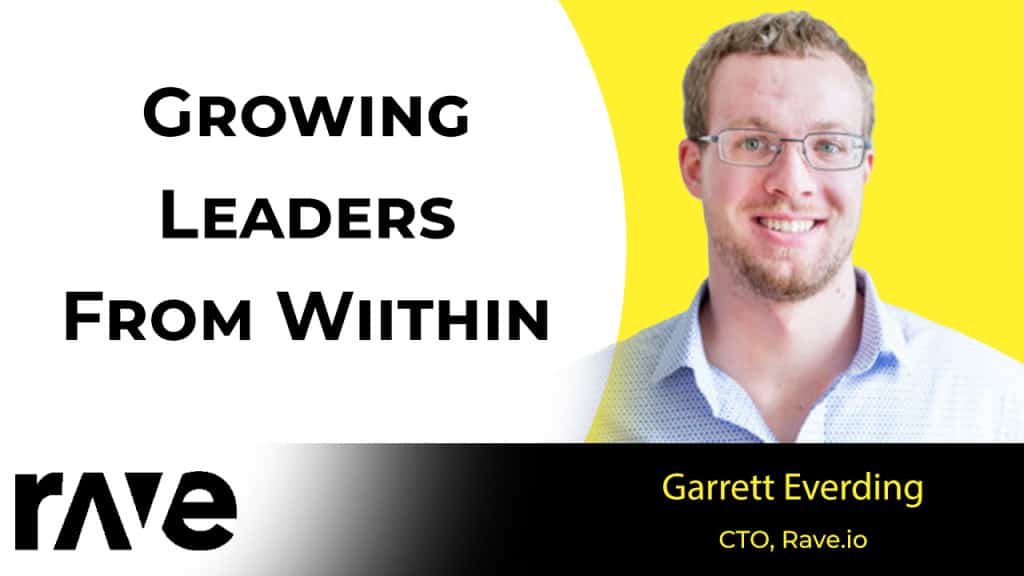
Growing Leaders From Within with Garrett Everding, CTO of Rave.io
Today we’re talking to Garrett Everding, the CTO of Rave.io. And we discuss how Rave has created an AI-powered DJ, and how to grow excellent leaders from within your organization.
All of this right here, right now, on the ModernCTO Podcast!
To learn more about Rave, check them out at https://rave.io
Transcript
(Intro Narrator at 00:00:02) Hello, my friends. Today, Joel is talking to Garrett, the CTO of Rave.io, and they discuss how Rave has created an AI-powered DJ and how to grow excellent leaders from within your organization. All of this right here, right now on the Modern CTO Podcast.
(Joel Beasley at 00:00:24) Here we go. This is the Modern CTO Podcast. So I'm curious to know about Rave. What does Rave do? Tell me about it.
(Garrett at 00:00:41) So Rave is kind of this mix of two things. The first thing we did was we wanted to bring people together to watch media and chat in perfect sync. So it's kind of this idea that when we used to be kids, we used to all come around the TV at 7 p.m. on a Tuesday night, and we'd watch the TV show, whatever that was, and we'd laugh, we'd chat, and we'd kind of talk about it while we're watching it. So we want to kind of recreate that similar experience, but in the generation of the Gen Zs and the millennials.
(Garrett at 00:01:16) So we created this experience where people can come around from around the world on iOS, Android, and VR and watch Netflix together, YouTube, Viki content, and chat and VoIP in this seamless, rich environment. So that's what we first did, and we've been growing that out. At about two years ago, we started down this road to kind of answer this question: can you create or can you make music with artificial intelligence and machine learning? And after about two years of R&D, we kind of got to a place where we're creating really interesting content from YouTube videos like a proper DJ would. So anytime you go to a club, you get this really cool experience where the music's transitioning, you're getting fun drops, you're getting cool transitions.
(Garrett at 00:02:07) We're using technology to create that same experience for your everyday life. So when you're at the gym, when you're working, when you're going for a run, when you're driving, when you're having a party, when you're having a barbecue on the weekend, you can have this really great music experience without having to just put on a Spotify playlist and getting silence every three minutes.
(Joel Beasley at 00:02:31) That's interesting. That's actually really cool. It's like your own little DJ.
(Garrett at 00:02:36) That's exactly what it is. It is your own personal artificial intelligence DJ that just seamlessly mixes music for you.
(Joel Beasley at 00:02:44) So now, if I download Rave right now, I can do this?
(Garrett at 00:02:48) So if you download Rave, you can do the social viewing. You can go to our current AI DJ site and make mashups, which was our first foray into this to kind of prove out the technology and prove out the market. So this new form of technology will mix up to 500 YouTube tracks.
(Joel Beasley at 00:03:07) So I could do artists from—so if I have a Spotify, it'll integrate my Spotify?
(Garrett at 00:03:12) Yeah. If you have a favorite Spotify playlist, like hip hop central or chill lounge or a rock list, you can give it to our system, and it'll go off and it'll do all of its magic to break this song apart, do all the music information retrieval, and then put it back together like an actual DJ would.
(Joel Beasley at 00:03:34) Get out of here.
(Garrett at 00:03:35) No, dude.
(Joel Beasley at 00:03:36) Alright.
(Garrett at 00:03:37) That's what it does.
(Joel Beasley at 00:03:38) How can I invest? Your other thing's cool, right? Like, oh yeah, we're gonna all watch video together. That's okay. But this is what everybody in the world wants for their barbecue.
(Garrett at 00:03:49) Yes. This is what everyone wants for their house party.
(Joel Beasley at 00:03:52) This is what people want when they're running on a treadmill. Yeah, I go to the—my gym clothes are in the other room right there. I go to the gym in the morning and I change into my nice monkey suit.
(Garrett at 00:04:02) So we're at the gym. It's just really frustrating to get this silence every three and a half minutes. So this just keeps the energy going.
(Joel Beasley at 00:04:10) I don't think—for me, it's not that. That's not the selling point for me. I don't care about the silence. I don't have silence. Pandora blends it together perfectly for me from end of song, end of song.
(Joel Beasley at 00:04:20) I don't use—I don't have a lot of Spotify going on right now, but mostly Pandora at the gym, and it has that nice transition between songs. But that's not the same as when you listen to a nice DJ mix stuff. That's a whole different experience. And the only way you can get that now is when the DJs go through and make their mixes. But then you have to listen—then you have to go hunt down that DJ, and then they only have so many songs mixed, and they're always mixed the same way, so it's the same pattern all the time. And I want fresh DJ.
(Joel Beasley at 00:04:58) I want a personal DJ on demand, all the time, just mixing music for Joel. That's what I want.
(Garrett at 00:05:04) Yeah. So this is basically that product for you.
(Joel Beasley at 00:05:08) That's the sell, man. That's the point where I'm like, I would have downloaded it and paid for it right now. Literally. And then I would no longer—I know that there was a big push where Apple Music, Amazon—I think it was Amazon too—but I know it was Apple Music, Pandora, and Spotify all released APIs and they said start mashing stuff up and start doing stuff with this. And that was really interesting to me.
(Garrett at 00:05:34) Yes.
(Joel Beasley at 00:05:34) And so looks like you guys have taken advantage of that.
(Garrett at 00:05:38) Well, we've actually had to do everything from the ground up because even the technology, the tools that Spotify gives access to through their API, isn't rich enough to pull apart music at such a granular level. With not a lot of work, you can generate seven hours of just great DJ-sounding audio.
(Joel Beasley at 00:06:01) Wait. So I have to do work?
(Garrett at 00:06:02) You just have to choose the music. Right now, you choose the music because that's the interesting part. So you choose what you want to listen to, and then we go off and we mix it.
(Joel Beasley at 00:06:13) But I could pick a playlist, though, so I don't have to—
(Garrett at 00:06:15) You can pick a playlist. So if you like an EDM playlist, one of the things I like to do is I'll just go on the site. I'll go to the YouTube search, and I'm like, EDM. And I'll choose a really popular EDM playlist from YouTube, and it produces really good results. I'm happy with it. That's what I want to listen to. It's clean. It's simple. But if I want a rock one, I'll go, okay, give me a rock one.
(Garrett at 00:06:40) Okay. So do you—
(Joel Beasley at 00:06:41) Who else does—do other people do this?
(Garrett at 00:06:43) There's a couple of people who are doing this at a simple level. We're going a little bit further where we're actually cutting up the songs. We're looking for the actual key points that a DJ looks for—looking for the crescendo, for the drop, finding the right place to drop, finding the chorus, finding the verse, looping parts, manipulating it in small and intricate ways that actually works better together. Doing all of these things that actual DJs do, but at a—
(Joel Beasley at 00:07:15) You're AI-ing a DJ here.
(Garrett at 00:07:18) Yeah. That is what we are doing. We're really making it clean and simple for people to create great-sounding music with artificial intelligence.
(Joel Beasley at 00:07:30) Let's see if dj.ai exists as an available domain name. Have you tried to buy that one yet?
(Garrett at 00:07:36) I think it's too short. The other ones seem to be not really friendly.
(Joel Beasley at 00:07:41) Not really friendly?
(Garrett at 00:07:43) Yeah.
(Joel Beasley at 00:07:44) You probably get deejay, yeah, something like that. DJ, djai. Oh, man. I think I'm quitting the podcast, and now dj.ai is my new name, and I'm gonna run around as—
(Garrett at 00:07:58) I might have to see if I can get the name first.
(Joel Beasley at 00:08:02) No. It's my brand, man.
(Garrett at 00:08:04) Sure is now.
(Joel Beasley at 00:08:06) CTO value. Tell me about the size of your team. What are you doing? Do you crack a whip, or do you put out sugar cubes? How do you run your people?
(Garrett at 00:08:14) It's a really interesting question. So we're about 10 people right now spread across both platforms, about half and half right now, with the AI DJ kind of growing a little bit more. I'm kind of a quiet CTO. I don't crack whips. I kind of just lead with working through problems with people and walking them through what their issues are and what their challenges are, and kind of just being the quiet reserve technology person.
(Garrett at 00:08:44) I don't know. That's how I describe it.
(Joel Beasley at 00:08:46) When they come to you with the human problems, right? The he said, she said type deals. How do you deal with that?
(Garrett at 00:08:54) Those are my least favorite problems.
(Joel Beasley at 00:08:56) I know. For the quiet person, they're not engineering problems.
(Garrett at 00:08:59) No, they're not. But you can still kind of approach them as engineering problems if you think about them as questions to work through. Why do you think this? What is the actual problem here?
(Garrett at 00:09:10) To dig down to what is kind of the root cause. There still is a root cause when you're dealing with people. And frankly, honestly, I'm not good at that yet. I'm still figuring it out, and I kind of rely on the founder to also help with that. It's not just me being responsible.
(Garrett at 00:09:30) It's a small enough team where we're both part of that conversation.
(Joel Beasley at 00:09:35) Who do you see as the next—you have your team. You're clearly identifying different people's strengths and weaknesses. Right now, there's someone that you see—if your team grew by 10 or 20, who is that person that you're thinking of that you know would be a leader? Because you have to structure teams of teams. Right now, it's all nice and chill because it's about 10 people, so you haven't had to split off to where you have direct reports necessarily.
(Joel Beasley at 00:10:02) But when that does happen, when you do get that check in San Francisco this week, you have someone on your radar to be a leader of teams, right?
(Garrett at 00:10:11) Yeah. So we have our Android lead right now. He's a really interesting guy. He started out as a junior Android developer, and he just stuck with us and kind of grew into this role. And he really takes passion for the project, and he really knows how to think things through and figure out what are the important things without me having to kind of walk him through, "This is what needs to be done this week."
(Garrett at 00:10:40) He kind of can self-identify, which is really an important trait that I look for in people. Being able to find what is the biggest problem we have this week? And he will just go up and he'll work with—he has one co-op right now because we kind of—we haven't found another person like him, really.
(Joel Beasley at 00:10:59) And they're tough to find.
(Garrett at 00:11:00) They're really tough to find. You can train them. You can train them. He's just naturally fallen into that role, and he's actually starting to take on that role on iOS as well.
(Garrett at 00:11:15) So he's growing into the position.
(Joel Beasley at 00:11:17) Do you know that you can actually train your other people? You have the 10, and there's probably—not all of them—but probably there's two or three that you would identify to train. What's that person's name? Who's the senior Android lead right now?
(Garrett at 00:11:30) Colin.
(Joel Beasley at 00:11:30) Colin. Alright. So if you had four more Colins, would that be beneficial to your company?
(Garrett at 00:11:35) I wouldn't say no to that. You can't. I can't. You can't. I can't say no to that.
(Joel Beasley at 00:11:42) You can't say no to that. Alright. So you can train people to do those things that you like that Colin does. It just takes time. It doesn't come easy.
(Joel Beasley at 00:11:54) You have to identify what makes—just like you're doing with the DJ AI. You identify how a DJ chooses to transition and how all that stuff happens. You do the same thing, but if you understand what makes you really like Colin—the self-identifying and being able to get the priority and then lead others to work on it and accomplish it—you can take, not all your people, but you can take a couple of them and teach them how to do that, and now you have three Colins at your company.
(Garrett at 00:12:22) This falls into kind of a—it's a half PM or product manager job and half a developer job, because being able to identify what the weaknesses are of a product, what are the strengths, where are we kind of falling down, traditionally is a product manager role. So how are you guys kind of identifying those skills and teaching those skills for developers, if I got that right?
(Joel Beasley at 00:12:46) Yeah. So what we're doing is we're taking the skills that make the best people the best, and one of the base skills is self-discipline. Another skill—because I mean if you can make yourself sit down and do something you don't want to do, that's the most useful skill in life. You can do anything you want. Yeah. You can learn anything, you can learn physics and become a rocket scientist, you can do anything you want.
(Joel Beasley at 00:13:05) So that's a fundamental skill. We also found that there are people who are quiet, but they're ready to be leaders. They're hungry. They may be pursuing it outside of work, but then it's like, how do you communicate that to your leader? If you have another individual that's not Colin come up to you and say, "Hey Garrett, I'm ready to be a leader," what do you say back to them? What's your response back to them?
(Garrett at 00:13:31) Because I've never had that happen, I'm kind of working it through in my head.
(Joel Beasley at 00:13:35) Good.
(Garrett at 00:13:37) If that was where they're interested, I would probably take the kind of approach that one of my mentors took with me and the co-chair of the CNIB Youth Council. He really kind of—we put—we were in that role, and he would be there to support, and he pushed us into a couple ideas that were kind of crucial to his mentality for leadership. Servant leadership. What are the books? What are the ideas to start learning and kind of growing as a leader to kind of identify the skills that really matter when it comes to leadership? That's kind of where I would start directing people.
(Garrett at 00:14:18) Because being a leader means a lot of different things. If you're looking at John Maxwell's five levels of leadership, you have everything from positional as kind of the first level of leadership, which really—you have a hard time getting people to do things—to level five leadership, which takes a long time to get, but it's really powerful, and it's all about building relationships. So I'd kind of start pushing people into how to identify the skills that they need to learn to develop as a leader, instead of just a manager. Develop into a leader who can get people to do things that go above and beyond what is required and what is kind of the norm.
(Joel Beasley at 00:15:09) Okay. So you would suggest some leadership content. You would suggest some books. If I said, "Garrett, I want to be a leader," you would say, "Okay. Here are some books," and then I would be expected to go off, learn the books, and then come back to you?
(Garrett at 00:15:24) Learn—not learn the books, but start—because you don't have to be put in a power—a leadership position—to start expressing leadership.
(Joel Beasley at 00:15:34) Yes. Thank you. Alright. You don't—
(Garrett at 00:15:36) have to do that. It's like how developers can become CTOs, but not all developers should become leaders or managers. Not everyone's built for that. But I think the key for when a developer becomes a CTO or a VP or a director is they start being leaders of their own team without having any of the positional power, because positional power is the lowest form of leadership and the easiest form of leadership. But when you don't have that and then you're developing and you're getting people to do things at the same level as you, that's really powerful.
(Garrett at 00:16:15) That's really the thing that I want to look for and I want to see in people who are self-identifying as leaders.
(Joel Beasley at 00:16:22) Yes. So they come to you and they say I have an interest to be leaders. You explain to them that first you have to be able to lead yourself before you can lead others, and you don't necessarily have to be in a position, a title of leadership in order to lead. Right? Often you'll find leaders sometimes happen unintentionally where everyone's just like, oh, he's the leader. He doesn't have the title, but everybody listens to that person. Right?
(Garrett at 00:16:48) Because they're content experts. Maybe they're content experts. Maybe they just have experience. Maybe they're just willing to make a decision. And sometimes it just comes down to simple—they're willing to make the decision and own that decision and move forward. In some projects, that can be enough.
(Joel Beasley at 00:17:12) So then they go back and they read and they start learning about leadership things, leadership skills, what's important, different—maybe making people feel heard, understanding, being decisive like you said, thinking macro and then understanding priorities. All these different concepts that if you were to read a hundred leadership books, the same fifty, sixty lessons would be all the same ideas. They're all the same ideas worded differently, right?
(Garrett at 00:17:38) Yep.
(Joel Beasley at 00:17:39) So then they come back to you and they said, okay, I've read it all. I read ten books. I've got all the ideas. It's been three weeks. I've been just grinding outside of work. I'm ready to be a leader.
(Garrett at 00:17:54) So then I'd probably find—I don't know how well this worked for us. But if you're bigger, if you're in a state where we had a lot of smaller stuff to do that was not, like—I'm talking about a month to two months worth of two people, three people work—I might set them up with those two, those two people. Not really give either anybody leadership, but see if that person takes ownership over the product and can really grow into a role without actually being put into it. I might give them the lead role. I don't know. It's kind of circumstantial whether or not I want—if they can demonstrate to me that they can actually successfully lead people and accomplish the goal that they're being set.
(Joel Beasley at 00:18:48) Nice. So you give them a small leadership task by pairing them with somebody. And then you see how they pair with somebody.
(Garrett at 00:18:54) Even if it's just a co-op, a co-op would be a great experience because you're having to teach. You're having to deal with somebody who might not have as much experience as you. And how you treat that person, work with that person can be really telling sometimes. And how they can figure out—and even prioritize the other person's development. Because an important part of leadership is really being able to develop the people around you, and not just in terms of leadership skills, but also in terms of development skills, interpersonal skills.
(Joel Beasley at 00:19:28) I think everything's leadership.
(Garrett at 00:19:30) Everything's leadership. Yeah. But developing other people's skills.
(Joel Beasley at 00:19:34) Well, you're raising the standards of what is acceptable to you. And if I go in—one of the things I talk about often is like how do you become a leader instantly. Right? If I go in and I'm working with my peers and I set my standards above everybody else's and push myself harder than anybody else pushes—I push myself internally harder than anybody else. I have my highest level of standard, but work's still getting done, obviously. And I'm balancing productivity with perfection, and I am always improving and working. That's going to raise everybody up around me because there's this unspoken thing where everybody knows what is an acceptable amount of productivity on the team. Right? And so if a new entity comes in and raises that, well, they just raised it for the whole entire team. So now you pair this person with another person and you see that, oh, this is pretty good. This is working well. And then so maybe, what do you do next?
(Garrett at 00:20:27) Then I would like to follow along with one-on-ones, see how they're progressing, see what kind of problems they're running into, see if they're identifying where their weaknesses are, and then start moving them into other roles. Figuring out what they're really good at. Like if they're really good at just being dropped into a project and taking control and fixing a product, or they're really good at taking projects from beginning to end, figuring out where they're good, where their leadership style shines and what their—where they're strong.
(Joel Beasley at 00:21:03) Where they're strong.
(Garrett at 00:21:04) Where they're strong. Because not everyone—that's smart. The last 10%. I know I'm atrocious at doing projects and getting the last 10% of a project. I'm really good at the other part of it, but the detail work at the end, the last 10% is always the hardest. The polish. And it's really good to have somebody on your team or a company on your team who are leaders and can really push that last 10% through, which is some arguably the most important part.
(Joel Beasley at 00:21:35) Okay. So I want you to imagine your day as a pie chart. Okay? And you're going to split it into a handful. Just the top ones that come into your mind. What how does that pie chart look? What are some of the biggest sections that you're spending your time on? Like a daily time.
(Garrett at 00:21:53) Daily? Yeah. I'm spending probably about a quarter to a third of my day on still development. I still have to carve out that much on any given day to do all the things I need to do.
(Joel Beasley at 00:22:11) Are you like air traffic controlling?
(Garrett at 00:22:13) Well, I'm also ops and the lead back-end developer.
(Joel Beasley at 00:22:18) Okay. So what's the next slice?
(Garrett at 00:22:21) Next slice, probably, it would be probably product manager, PM for the various teams. That'd be probably a third of my day, if not more on some days. Another part would be networking.
(Joel Beasley at 00:22:38) Maybe that one.
(Garrett at 00:22:39) Networking, kind of biz dev.
(Joel Beasley at 00:22:41) I'll get that one.
(Garrett at 00:22:41) That's probably like 10% of any given day.
(Joel Beasley at 00:22:45) That's 70%. Let's get that last.
(Garrett at 00:22:48) Where do I spend the rest of my day?
(Joel Beasley at 00:22:50) Creativity is—okay, you have to have space between things.
(Garrett at 00:22:54) To be honest, that last 30% I save for forest fires.
(Joel Beasley at 00:23:00) You spend 30% of the day you're a firefighter.
(Garrett at 00:23:02) Yeah. Well, when it comes to just what can be thrown at me on a given day, I can't always predict what's going to happen on any given day.
(Joel Beasley at 00:23:13) Life. We'll say life.
(Garrett at 00:23:14) Yeah. Life when it comes to—there's a crisis on our mobile platform. There's a crisis with, or there's something we need to work through on the audio team that's going to take a lot more of my time. There's a crisis somewhere where there's something that really needs my attention, that I need that space to make sure that I can give enough time for that problem.
(Joel Beasley at 00:23:40) Are you working like eight, ten, twelve? Like, are you working a lot?
(Garrett at 00:23:45) I don't really know how to define that because—
(Joel Beasley at 00:23:47) You just don't always work.
(Garrett at 00:23:49) Or I'm—because it's also, define work. Am I at a computer for all that time? No. Am I listening to mixes? Am I using the app? Am I using our app? Am I listening to mixes just to see what are the things that are good with them, what are the things that are bad with them? It's working. Yeah. You're just always paying attention to what's going on. And when you're testing mixes, you're listening for two, three, four hours for a bunch of different mixes. So QA takes a lot of time.
(Joel Beasley at 00:24:19) So you spend—so we'll say, what, do you do that every day or weekly or—
(Garrett at 00:24:25) Per build. Every couple days. A lot of music to test.
(Joel Beasley at 00:24:31) Yeah. You'll find that some things work really well with the style and yeah. Lots of thinking to happen.
(Garrett at 00:24:37) Yeah. Alright. Where are our weak points?
(Joel Beasley at 00:24:41) Okay. So you have ten people. Colin is really showing a few of these attributes that make your life easier. So if you had two or three more Colins, how would you do that? Would you—you would probably spend more time teaching the other people the skills, the fundamentals of what makes Colin Colin, not not direct way, right? But you would be teaching them skills that would be improving them. And better yet, if you had—I mean, that's what you'd be doing, right? If that's the best way—I mean, by the way, I've never done this with anybody before. I'm just making this one out. Yeah. So I don't need any package. It's fine. Yeah. So, alright. So more Colins. You need more Colins. And then would it make sense—here's a good question—would it make sense to dedicate a small slice, maybe 10 to 15% a day to teaching those people the skills and traits that make Colin so useful? Should you invest in your people?
(Garrett at 00:25:50) I have to. It's been one of the things that's been on my mind lately, but I'm spending enough time development side, spending enough time working through problems, all that normal stuff that you do as a CTO, all those technical problems, working through like what is the best way to do X, and why don't other things work? Like, that's just standard. But it's that side that, honestly, yeah, that's been more on my mind, especially since I've been talking to more people, being part of more CTO groups, and seeing more of that. It's definitely become more aware that that's where I'm lacking.
(Joel Beasley at 00:26:30) So one of the trends I found with talking to a hundred CTOs in the past year and everything from an individual CTO out of a garage to 10,000 employees, the ones that do better, they make the most of what they have. So some people will say, oh, well, I'll invest in my people, or, oh, I'll get better leaders when we get to that stage. And I'm like, hold on a second. Go talk to the people who were at the stage. The only way they got there was by getting ten Colins in their first twenty people. You don't get to that stage without having a really tight consolidated group of people. Money doesn't solve this problem either.
(Garrett at 00:27:11) No. It just makes the problem worse.
(Joel Beasley at 00:27:14) Yeah. It 100% does. If you want a company to go out of business really fast, give them a bunch of money to artificially expand.
(Garrett at 00:27:20) I guess it's also the seeing and talking with other people and going over your problems to see, to have a different perspective too. Right? Because that's another part that it's very hard to get in this position. Having a good relationship with somebody who can be there to bounce ideas off of, that's not just—that actually understands where you've been, understands a little bit deeper of what the problems you've been facing the last six months. It's a deeper relationship with people than other communities I've seen. There's the online CTO forum. I don't know. There's probably a couple thousand people on it, and there's periodic emails that go out with general questions. But you don't get a very good or deep answer for your specific problem and your specific—you don't really get a great answer there. You get alright answers. And if you piece enough of it together, you can get something. But you're not going to get an honest, deep answer for some of the harder questions. Because you've got to open yourself up. Yeah. You've got to open yourself up. And as a technology leader, a lot of people—a lot of people I've seen, a lot of my friends, we're typically more introverted even though we're leading teams. And that's sometimes hard for us. So putting people into a small group like that, it might not be solving the entire problem that you're solving, but it is an important asset in the picture of developing CTOs, I honestly believe it is.
(Joel Beasley at 00:29:00) Oh, 100%. It's very valuable. A mastermind group of your peers is the most valuable thing ever. That doesn't make you more Colins.
(Garrett at 00:29:08) No. But it can help you—it helps identify some of the problems that you might be having when you're developing more Colins.
(Joel Beasley at 00:29:16) Oh, yeah. 100%. Yeah.
(Garrett at 00:29:18) Yeah. It's not going to be the answer, but it might help you develop the confidence to be able to.
(Joel Beasley at 00:29:26) Right.
(Garrett at 00:29:26) Because that's the only thing.
(Joel Beasley at 00:29:29) Here's a question for you. So if you—a company that has business, they have a team with a system and the—I see businesses as collections of systems. Okay? So you have a system process that runs that creates product, which you then have a process that runs that markets and communicates the message to the world, which you then have a process that runs that converts through a sales pipeline, which then generates money, and then that's your overall—you then have this big system, and then you have to have a positive feedback loop where the amount that goes in is greater than—right? So you have to have positive feedback loop. So the system, you have processes at your business and systems that run little programs that run inside your business for each important part.
(Joel Beasley at 00:30:22) So if you want to achieve something, you specifically create a system for it, and then you monitor the output of it. Right? Did this—how many stories did you produce, or how many commits came out, or how many features made it to production? Because you're not paid to write code, you're paid to ship code, right?
(Garrett at 00:30:37) You're paid to make people happy.
(Joel Beasley at 00:30:40) Aw. I got more fuzzy inside. Well, it is true.
(Garrett at 00:30:43) We're paid to bring value. When you're a consumer product, that's who you're really going for. Yeah.
(Joel Beasley at 00:30:51) So having a system to generate more Colins would be a good system to have at your company.
(Garrett at 00:30:55) Yeah. And it's not—I don't—so, yeah, you can distill it down into a pipeline of how to get there, but there's really—I'd be interested to see what your steps are to kind of—I don't want to say what is the equation, but what are kind of the general steps you guys are looking at or you guys think are the ways to develop those people?
(Joel Beasley at 00:31:16) It's pretty simple. So if the question is how do you develop them, a lot of people ask that. There's lots of books. There's lots of stuff. But if you give the people the option, then the people who want to be leaders will exercise the option.
(Joel Beasley at 00:31:29) The people who don't will ignore it. It's pretty simple because right now, there's two scenarios. There's scenario where you don't have a path to leadership at your company where you could say, hey, everybody, if you want to become a leader, learn these skills, exercise these skills, use this system, and this will show me how you progress through leadership, and then we will move you into leadership roles and here is the direct and specific and clear path to leadership within this organization. And if you want more, here is the answer.
(Joel Beasley at 00:31:55) Raise your hand if you want more. Half the people raise their hand. They want more. We're humans. It's how we work.
(Joel Beasley at 00:32:00) And then you—well, if you do train. Funnel.
(Joel Beasley at 00:32:02) And then you let them go down the path and the ones who are consistent and desire more, they will go down that path and you'll be able to instantly filter out everybody and see who wants it. And the people who don't won't and that's perfect. And so you have that system. Now if somebody's quiet, like you're quiet, you're a leader, now you're a CTO, you made it all the way to CTO and you told me that there's this whole group, all these CTOs who are quiet and introverted. You were still you and you still have that leader inside of you when you were a junior engineer somewhere, right?
(Joel Beasley at 00:32:34) Whether that company developed you or not, is there gain or loss? If they don't develop and you see an opportunity to go lead or go up somewhere else, you're going to take that, you have taken it, and now you're the CTO of this company. Correct?
(Garrett at 00:32:47) Correct.
(Joel Beasley at 00:32:47) You have those people inside of your team working for you today. So now the question is, do you develop them and resource them to be great leaders inside of your company and grow your company, or do you just go on and let it be Wednesday, and eventually they'll leave and go become leaders and their CTOs of their own somewhere down the path in the next three to five years. And this is the problem that we set out to solve. Yeah. The thing is I'm getting phone calls from CTOs saying, hey, I keep getting people leaving.
(Joel Beasley at 00:33:12) They're doing startups. They're going off in engineering the next great thing with someone, like how do we get people to stay? Well, what path do you have that says if you want more, you're here? Think about the people in your team right now. You should have a conversation with them and you should come up with some word document or something.
(Joel Beasley at 00:33:29) And then after this call or on your plane ride that says, if you want more at the company, here's the path to more, because right now you don't have that door open. And when you don't have that door open, the clearest path to more is a recruiter tapping them on the shoulder and say, hey, your job title says junior developer. This job title has $40,000 more yet and says senior developer. I think you want more. And they hype them up and they convince them to go from A to B and they profit in between.
(Joel Beasley at 00:33:53) But if they said, oh, no, no, no, no, no. I have a path over here. I'm actually doing something. I'm working towards something. I'm investing in myself and I'm working on these skills and I'm going up inside this organization and me doing that is actually going to make this organization better.
(Joel Beasley at 00:34:06) Plus, I like everybody here. Well now you have a clear path. They have something they're—if you're playing a video game and you don't know that you're going to the next level, you're just running around, playing around in the current level in the lobby or something, right? You don't—you're just messing around. There's no incentive.
(Joel Beasley at 00:34:22) But if you're on a quest, you want to complete that quest. You want to make it to the top. So where's the carrot?
(Garrett at 00:34:28) Yeah. Do you guys take anything into account when it comes to interviewing people for this?
(Joel Beasley at 00:34:34) Oh, I thought you were going to ask if we take cash or check.
(Joel Beasley at 00:34:38) I'm joking.
(Garrett at 00:34:41) No.
(Joel Beasley at 00:34:41) I'm joking. Ask me again?
(Garrett at 00:34:44) Is the new material kind of geared towards also identifying this at the interview process?
(Joel Beasley at 00:34:51) How do you mean?
(Garrett at 00:34:52) So identifying those, being able to look for those skills when or look for those attributes and people during the interview process so that you're being a little bit more deliberate in your hiring process. Growing your leaders inside is really important. As you're growing a team, you want to be also bringing in—you want to stack the deck in your favor, I guess, to bring people into your organization that have those skill—have the attributes for those skills as well. Is that something you guys are looking?
(Joel Beasley at 00:35:25) So that's a good point because your team is like the pie chart again, where you're not going to—not everyone's a leader, so you're going to need the people that are interested in mastering their craft. People interested in being the best at Ruby or the best at whatever platform you're using. And then that would be like more of an individual contributor mastery path. But here's the thing, at different points in your life, you transition back and forth.
(Garrett at 00:35:47) Yeah.
(Joel Beasley at 00:35:47) So there was a point in time where you wanted to be the best programmer in the world on some specific language, you wanted to know everything about the language, how everything worked, and you know that moment when you learn how documentation works and you're like, oh man, this stuff's useful. I can read documentation now.
(Garrett at 00:36:03) Documentation peaked at the man page.
(Joel Beasley at 00:36:08) I'll out wall you about it later. So that's good. So how you balance your teams is actually something that I've been looking a lot at too because, you know, when you have a child, some people want to go more into the mastery of their craft because they want to spend—they just want to be really, really good and concentrated at their nine to five, but then they get hungry when their kid hits two, three, four, five, and now they want to level up to a senior VP or whatever it may be. So being able to watch how your team is balanced and stuff, that's a good one. If it comes up enough, it would definitely—we could probably make a pie chart on it now based on who engages with the leadership content.
(Joel Beasley at 00:36:48) Yeah.
(Garrett at 00:36:49) Yeah. But what about helping actually helping leaders be able to identify those characteristics during the interview process?
(Joel Beasley at 00:37:01) And this is a good—so specifically you mean during an interview process identifying leaders. How would you do that? That's the question?
(Garrett at 00:37:13) That's the question.
(Joel Beasley at 00:37:14) I would go around and talk to 20 CTOs, do research through the past thousand hours of content we have, and really answer that question and boil it down to three or four things. If you seek, you will find. That's how life works. Research a problem, you'll find out the answer. You test it, you refine it.
(Joel Beasley at 00:37:30) And here's the core attribute of a leader that I believe exists in every single great leader. It may exist in—it may not exist in mediocre leaders, but in every great leader, I believe that individual is continuously learning and always striving to be better.
(Garrett at 00:37:43) Yes.
(Joel Beasley at 00:37:44) And if you provide them a repository of useful information to do that, and that you would—they would actually get points for doing it and you would—they would be able to show off their leadership skills and be able to progress down a path, they—that's the person in school that you know is going to do the extra credit. That's the person you want. You don't want the people who are doing just enough to get by. You want the person who's trying to do more.
(Garrett at 00:38:08) But is that an intrinsic or extrinsic motivator? Because rewards of points, that kind of—that can very easily turn into an extrinsic motivator, which is not what you want.
(Joel Beasley at 00:38:21) So the system was structured based on Nir's book Hooked, how to build habit-forming products, and it actually satisfies both the intrinsic and extrinsic reward value system. So the individuals will look at it in an intrinsic way of mastery of their leadership skills, while some will look at it as an extrinsic way as a way to get points, and people will actually flip back and forth based on their mood and what and how their structure of their life is. So not everybody's always intrinsic or always extrinsic, and so we designed the system to satisfy both needs.
(Garrett at 00:38:56) I've been meaning to read that book for a while. It's been—I think it's been on my bookshelf for a while. I just haven't got to it. I've been really enjoying Ben Horowitz's Hard Thing About Hard Things.
(Joel Beasley at 00:39:07) Oh, yeah.
(Garrett at 00:39:08) That is a fun, fun read.
(Joel Beasley at 00:39:11) Step one is just doing them. It's like, what's a one page book?
(Garrett at 00:39:15) No. No. It's a fun story of all the things that kind of went wrong for LoudCloud.
(Joel Beasley at 00:39:24) Oh, cool.
(Garrett at 00:39:25) It was a really interesting kind of war story and all the things that kind of just went wrong and all the ways that you're going to just get through it.
(Joel Beasley at 00:39:34) Push through.
(Garrett at 00:39:35) Push through, and all the just the lessons you saw and all the problems you ran into. Like, just the hard thing about hard things. Like, when you're faced against a do or die situation, where do you turn? Like, how do you know where to turn to go to keep on fighting the next day? Yeah.
(Garrett at 00:39:52) When you're facing bankruptcy in a month, what do you kind of do? Which is an interesting—which is an interesting idea and an interesting kind of lesson, I think. I loved his quotes about, stop shooting silver bullets, start shooting lead. That is one of my old and favorite quotes from the book.
(Joel Beasley at 00:40:10) Okay. And why?
(Garrett at 00:40:11) Because it's like, so in this scenario, like, in the problem they're having, all the engineers were kind of trying to pitch him just silver bullets on how to tweak the product or downsize the product or pivot the product into a different niche market or—and kind of just what is the silver bullet trying to get us out of this problem. And his, I don't remember who he got the quote from, but he got the quote from somebody else.
(Garrett at 00:40:40) And it was, no. We have an amazing product. We're losing in the industry, not because our product sucks or because the market's wrong. It's just our product just isn't there, and we need to really just start shooting lead bullets. We just really need to start hitting it out of the park and just double down on what we're doing, focus on the product, reengineer it, retool it for what we're doing because there's success here.
(Garrett at 00:41:06) We're just failing.
(Joel Beasley at 00:41:08) And so that stuck with you because that resonated true with your experience.
(Garrett at 00:41:12) Yeah. Because it's just—when you're losing in a market or you're losing in a product, sometimes you just have to fight for it. You just have to keep fighting and really feel what—where you're weak, where you're weak in your product, why you're losing out on bids, why you're losing out on customer acquisition, why users are kind of just falling off. Like, don't pivot and just try to put it into a niche market. Kind of focus on just winning this market because this is the market you're in.
(Garrett at 00:41:49) Persistence.
(Joel Beasley at 00:41:51) There's a story of persistence.
(Garrett at 00:41:52) Yeah. That is a better way of saying it. And it's just the story of persistence.
(Joel Beasley at 00:41:57) Yeah. And we want to hear that story a hundred different ways to keep it in front of us.
(Garrett at 00:42:01) Yeah. Well, all the time.
(Garrett at 00:42:02) Hard work. You have to hear something seven times before you believe it's true. Reinforcement is one of the best things.
(Joel Beasley at 00:42:11) Yeah. Watching a child grow up is unbelievable because that's very true with them. They just—you can go surprise them a thousand times. It's like you would say the knee jerk reaction is to say, oh no, I get things first time. It's like, well you've been around here on earth a long time so these things have been really impressed on you.
(Joel Beasley at 00:42:31) So people want to find out more about you, LinkedIn or Twitter, where do you hang out?
(Garrett at 00:42:35) I'm active on both. LinkedIn and Twitter. I'm easy to find. On Twitter, it's GS Everding, and on LinkedIn, it's just Garrett Everding.
(Joel Beasley at 00:42:44) Excellent. And the most the quickest advice other than hiring more Colins or converting your existing people more Colins that you'd give to yourself ten years ago, what would that be? Would it be the silver bullets thing?
(Garrett at 00:42:54) Ten years ago, I think I was just starting from university. Yeah. Silver bullet, persistence, really fighting through or fighting through the hard times. I think that's the best lesson. Sticking with something, hands down the best thing you can do because sometimes it's going to look dark as what it's done.
(Joel Beasley at 00:43:11) You're like a beautiful poet, Garrett.
(Garrett at 00:43:15) People don't say I'm—I don't think of myself good with words, so that way. So yeah. Thank you.
(Joel Beasley at 00:43:23) Thank you so much for listening. And if you found this episode useful, please share it with a friend or colleague who you think would get value from it. And if you have topics that you would like to hear discussed on the podcast, either add me on LinkedIn or send me an email, [email protected]. Every time I get an email or LinkedIn message, it absolutely makes my day and inspires me to keep going.