
Episode 587 ·
Sales Strategies: It’s In The Details with Frank DeGeorge, CTO at Impact Networking
Today we’re talking to Frank DeGeorge, CTO at Impact Networking; and we discuss ways to refine sales strategies; why putting in the proper work to your CRM can have a huge ROI; and how you get huge groups of people on the same cultural page within a company.
All of this right here, right now, on the Modern CTO Podcast!
Check out more of Frank and Impact Networking at https://www.impactmybiz.com/!
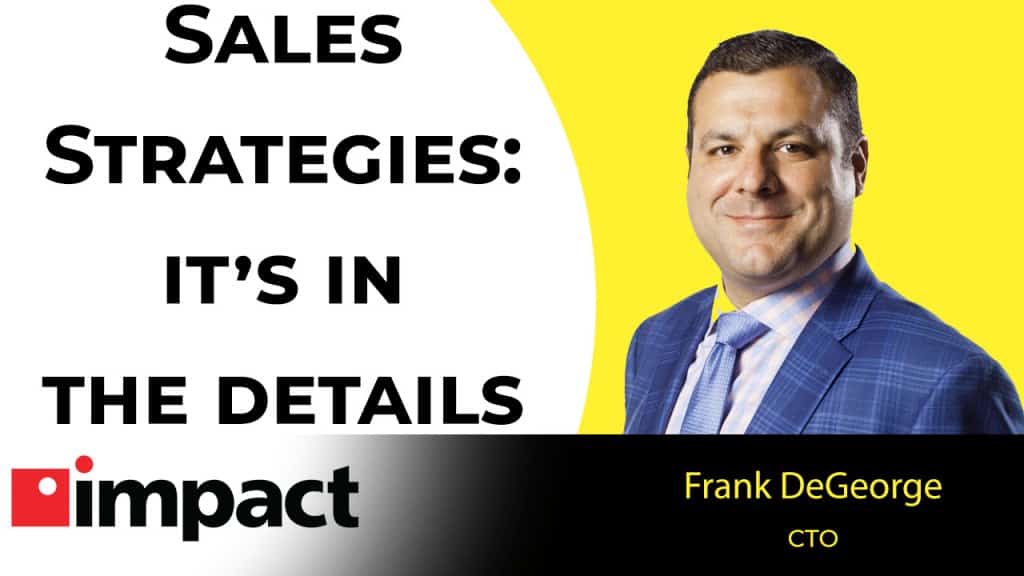
About Frank DeGeorge:
Frank is Chief Technology Officer for Impact Networking. He is responsible for establishing the company’s future technology vision and strategic direction, while building and implementing platforms to support customers, employees, and partners.
Frank joined Impact in 2006 and was named partner in 2014. With more than 16 years of experience in driving innovative change within complex technology environments, he has a proven track record of helping Impact continue to grow while also ensuring its customers have the best-in-class tools and resources necessary to scale and be successful. Today, Impact’s average annual growth rate is 25% with more than 900 full-time employees across the nation and nearly $200 million in revenue.
Frank manages several teams of experts responsible for designing and implementing solutions that automate redundant, inefficient business processes and advancing Impact’s vision for growth and success. From low-code platform for custom applications to business process optimization, he is a true expert at understanding the challenges that Impact and its customers alike face and helping to convert challenges into competitive advantages. In addition to developing his internal team, he maintains partner relationships and regularly vets new solutions to add to the company’s solutions portfolio. Formerly, he managed customer-facing teams from pre-sales to implementation.
Frank earned a bachelor’s degree in management information systems from Bradley University. He is currently enrolled in Kellogg Executive Education’s Chief Digital Officer Program specializing in digital marketing strategies via data, automation, AI & analytics, design thinking, and energizing people for performance. He serves as a board member for DOT Security, a managed cybersecurity provider powered by Impact Networking.
About Impact Networking:
Founded in 1999, Impact is one of the fastest-growing managed services providers in the nation, employing over 900+ industry experts at 23 locations across the US. Beginning as a hardware dealer in an increasingly stagnant industry, Impact expanded into the business process optimization sector, helping businesses to reduce redundant, manual processes with intelligent automation. Today, Impact specializes in the conception, development and execution of customized strategies and solutions that improve technical, financial, operational and creative aspects of a business. The Impact suite of services includes Managed IT & Cloud Services, Cybersecurity, Digital Innovation, Print & Document Management and Branding & Marketing. Recognized for rapid growth, continued innovation and company culture, Impact has been listed as Inc. 5000 “America’s Fastest Growing Private Companies” eleven years in a row, CRN Triple Crown winner and Chicago Tribune “Top Places to Work.” In 2019, Impact celebrated 20 years of successful growth with continued plans for rapid expansion in sales, solutions, employees and locations. For more information, visit www.impactmybiz.com.
We count on our employees to deliver an exceptional and successful experience, which is why fostering a positive employee culture is the final piece to delivering exceptional customer service.
Employees are supported by the most thorough ongoing training, mentorship and resources in the industry. The majority of our branch managers began as entry-level sales reps and worked through the ranks. Promotion from within has maintained employee retention at nearly 100 percent in our senior level positions. Our significant 27% year over year growth creates advancement opportunities for employees, and the outlook is positive for even greater growth in the coming years.
Transcript
(Intro Narrator at 00:00:00) Today, we're talking to Frank from Impact Networking about refocusing sales strategies. You're listening to Joel Beasley, Modern CTO.
(Frank at 00:00:13) Hey, Joel.
(Joel Beasley at 00:00:14) Frank, how are you, buddy?
(Frank at 00:00:15) I am good. How are you?
(Joel Beasley at 00:00:16) Hey, it's been a while.
(Frank at 00:00:18) Yeah, I think they said, what, end of 2019 or mid-2019? Does that sound right?
(Joel Beasley at 00:00:23) I just Googled it, and you were episode 109, and we're at, like, 600 something now. Wow. I know. Yeah, it's crazy.
(Frank at 00:00:33) That is interesting.
(Joel Beasley at 00:00:35) Makes you feel old, right? That's how I feel now.
(Frank at 00:00:37) Yeah, it's been a few years then, for sure.
(Joel Beasley at 00:00:39) I was curious to know, you know, when I got to go visit you and your offices and see your sales team, and I got to meet some different people within your organization. Your organization was heavily driven by, you can correct me if I'm wrong, salespeople that were on the ground salespeople. They would go into businesses. And we haven't spoken since COVID's happened. What happened to your business? How did you handle that?
(Frank at 00:01:06) Yeah, so obviously, we have a pretty non-complacent approach to everything we do at Impact, which is great because it forces us to constantly rethink and reevaluate, invest in what we're doing. So a lot of the investments we made up until that point allowed us to do a pretty seamless pivot. Our owner and I and a few others had a conversation, you know, in middle of March, right, about what we're going to do. And then within a couple hours, we decided that we're going to, you know, send everybody remote.
(Frank at 00:01:33) And we did that for about 100 days. And then the governor of Illinois and our markets allowed us to come back. And so we only did about 100 days full remote, and we were flexible, and we did it right and safe. It's crazy to think about, you know, how long ago that seems. But, you know, we walked all the offices, we invested in masks and sanitizers, and every employee got unlimited access to those things. We were flexible. People needed to be flexible. So to answer your question is, yeah, I mean, you kind of hit us right in the face, but we reacted, and I think everyone did the changes that they needed to do. And we are still very much an in-person sales organization from that aspect. We still go out and see customers on a regular basis, and obviously, especially coming out of the early parts of the pandemic, we're cognizant of what that meant to other organizations. But we tried to be safe and do it right and not change too much of what's made us successful over the years.
(Joel Beasley at 00:02:31) And is managed services the direction of the business?
(Frank at 00:02:33) So that's, it's interesting. And I have a stat that, well, you know, that I could go over. When we were talking in 2019, that was the investment, right? We're trying to grow that business. Well, this year, we finally hit that flip where over 55% of our revenues this year are coming from managed services.
(Frank at 00:02:51) And so we've made the full transition, which is crazy because seven years ago, that business model for us didn't even really hardly exist. And it hasn't really took traction up until the last probably three or four years, and it's grown exponentially. So that's driving a lot of the things I'm sure we'll talk about as we go through this episode, of the changes that we have made that are making and are setting us up to take advantage of that. I would say new business, like I did in 2019, but now it's becoming the majority business of what Impact is offering, which is really IT services and cyber services.
(Joel Beasley at 00:03:25) How are you selling those services with in-person salespeople? Or is it, like, let's say, doctors' offices and things of that nature that are purchasing your services? Who's your customer there?
(Frank at 00:03:37) Yeah, so we have a defined ICP, ideal customer profile. Really, it's mid-sized market. Now we define that probably a little more open-ended. So companies with over 50 employees typically. Obviously, getting more towards that mid versus a small side of the mid-market is becoming our niche.
(Frank at 00:03:56) And really industry agnostic. Nothing, you know, there's some sweet spots for us, but we're not tied to any of those in particular. And, yeah, so we have, I think, let's see, we've opened up in Texas since the last time we talked. So we're in Wisconsin, Illinois, Indiana, Texas, and California. And we define our ICPs around those companies that are headquartered around our offices because I think when you're making these types of decisions where we're, I mean, these are usually multimillion-dollar contracts in a lot of cases where we're becoming essentially that trusted partner to manage their IT and cyber. And you've got to be able to do that with feet on the ground.
(Frank at 00:04:37) You've got to be able to do that remotely as well, but it's a big decision for these companies. And it's something that I think they want to know that they're making the right decision. And coming out, just like you came out to our offices and seeing who we are and what makes us up and then getting a sense for the people that are going to be taking care of you, I think is key.
(Joel Beasley at 00:04:53) Yeah, they were beautiful offices, and everybody was really nice.
(Frank at 00:04:56) Really nice.
(Joel Beasley at 00:04:57) And smart.
(Frank at 00:04:58) Yeah, that's key. Smart people, too, right?
(Joel Beasley at 00:05:01) Yeah. Oh, man. So this part of your business is growing. It's a large part. You're doing security and managed services for all, like, SMB mid-size companies, or it's dependent upon geography.
(Joel Beasley at 00:05:14) Now a lot of the conversation we had earlier this week, or not between you and me, but someone else, is us talking about, like, account-based marketing and how, you know, there's different types of CTOs. Some have a stronger ability at sales than others, and some are better at cutting costs than others, and there's different strengths. But I want to focus on the sales CTO because knowing you, you have a really strong sales background, at least just meeting you and being around you for the past, you know, knowing you for the past couple years. But I was curious, do you take an ABM approach at your organization, or do you do a spray and pray, shotgun? How do you do it?
(Frank at 00:05:53) So this, yeah, so also interesting timing with that question. We've refined that a lot. I would say if you rewind us back to even when we first talked in 2019, our ICP was more not set in stone. It was more of a shotgun approach. And now we are really trying to, you know, to use that term, pull out the rifle versus a shotgun and hone in on our ICPs that are assigned to our accounts. So, yeah, I mean, I have a heavy background in client-facing work and sales development and stuff like that. I've since given up all those responsibilities to focus on our own transformation and the things that we have to do at Impact, handed those client-facing teams off to other members within the organization. From an account standpoint, absolutely. And we've done a number of things and invested over the past couple years and even right now that we're doing to enable our sales team to get the best information to find out who those ideal customer profiles are that are in their territories and how to really hone in on them.
(Joel Beasley at 00:06:51) Why don't I tell you what we're doing, and then you can sort of coach me around it?
(Frank at 00:06:56) Like, CTO to CTO sales type stuff, because I don't really know what I'm doing. I just wake up every day, and it seems to be getting better. So different executives that I would interview kept talking about ABM, ABM, ABM. And I'm like, well, what I'm doing is called shotgun. What's ABM?
(Joel Beasley at 00:06:56) Like, CTO to CTO sales type stuff, because I don't really know what I'm doing. I just wake up every day, and it seems to be getting better. So different executives that I would interview kept talking about ABM, ABM, ABM. And I'm like, well, what I'm doing is called shotgun. What's ABM?
(Joel Beasley at 00:07:13) I'm trying to figure that out because everyone kind of has a different version. And then what I came up with was the difference between ABM in my mind currently is that we'll pick a, like, a set of accounts. We'll say, like, all right, we want these 100 accounts, and we're going to keep bothering people at these 100 accounts until they tell us no, and then we'll replace them with another account. Whereas the spray and pray, everyone picks, like, two contacts. Like, if IBM came across their radar on ZoomInfo, they would pick two contacts from IBM. There's 300 departments in IBM that could do business with us. And then they would move on, and that's working. I mean, it's generating revenue. It's growing the company. What do you think when I tell you all of this?
(Frank at 00:07:51) I mean, our sales cycles are typically long because we have a defined list of accounts that we want people to get access to now or then to get into. I agree that you've got to hit multiple, multiple contacts, and you've got to be able to profile those accounts and know why that account is in your ICP or something that you're going to target and how to approach it. And so we've done a lot of work over the years. Really the last two, two and a half years, we've done a huge, just complete 180 at our marketing and sales tech stack to allow for better account-based marketing, to integrate better with our marketing automation. We've rolled out sales cadencing this year, actually within the last 90 days, to structure that communication that we want using the best content creators we have because we have awesome content creators.
(Frank at 00:08:39) Whether it's coming from marketing, our chief strategy officer, they know how to create content and get it. And it's just making sure it gets out in the right format. And so, yeah, I mean, it sounds like our approach is similar in concept, that you have X amount of ICPs in this given area. You may give or take one or two a year, but it's not like once you go through those 120, there's another 120 right behind it. So, yeah, you've got to get creative. You've got to get to know why. It's in canvassing and profiling, understand those accounts, understand the different contacts, understanding how you're going to get a hold of them and why when you do get a hold of them that you have a message that connects. All those things, we have a lot of effort going into that exact topic. How do we make our sales step more effective?
(Joel Beasley at 00:09:29) So there's not another 100 if the 100 say no. They just have to figure out how to do business with those 100.
(Frank at 00:09:35) I mean, if you go through and say that you've profiled your entire territory, you know, because we're, again, more geo territories with those. You've got to get creative because there's 100 or 200, 300, whatever the number is in that territory that our rep has, those are the ones that they, you know, ideally that they get into. Now there's other accounts, right? There's, what, 98,000 companies headquartered in or on the Chicagoland area, right?
(Frank at 00:10:00) And that's the third largest market, right? Or 95,000. I forget the exact number. So we've looked at, we subscribe to ZoomInfo. That's an expensive platform, but it's, I know.
(Frank at 00:10:10) Always a lot. It's got a lot of good data, but it's not perfect. So bringing in ZoomInfo data, bringing in Duns data, using sales reps to update that information in the CRM appropriately. We've custom, you know, developed what we call the account profile, which is per segment of business that we offer. What are some key questions that you would want to keep track of? And so we've developed that into the CRM as well so they can keep track of that and know.
(Frank at 00:10:39) So, yeah, you have, let's just say, X amount of ideal customer profiles, but we have four or five main services that we can sell that. So really you have five customers within one. So to your point, new customers and expansion of customers is a huge initiative for us. Especially last year, we spun off the cyber division of Impact into its own company called Dot Security.
(Joel Beasley at 00:10:59) Oh, really?
(Frank at 00:10:59) So, that's exciting because it does a little bit of separation of job duties, right? It's like our engineers are managing the environment. We have a whole different team of people that are the ones that are managing the security. So then every IT customer since became a prospect for our security offering.
(Frank at 00:11:18) And we were doing it a little bit then. Obviously, we still take a security-first approach. But by spinning it off, it becomes a better offering, better service to that customer, better separation of what the IT is doing versus what cyber is doing.
(Joel Beasley at 00:11:34) Does it have the Impact branding on it? So it's a company of Impact, or is it completely separate?
(Frank at 00:11:39) It has a little bit of influence of the Impact brand on it, but it's its own entity as far as company and branding and stuff like that.
(Joel Beasley at 00:11:49) Oh, cool. That's so cool. Question about the Duns data. So I'd been using ZoomInfo, and then Duns did a sponsorship with the show. And the reason that's relevant is because usually I'll talk to one person from a company.
(Frank at 00:12:01) Sure.
(Joel Beasley at 00:12:02) When they do sponsorships, we'll come up with different angles and talk to different people in different divisions. This one guy we talked to, well, just like next-level brilliant. But, like, it blew my mind. I'll send you the episode after to listen to him, but this guy was crazy smart. And, you know, sometimes I do these episodes where I feel like I'm a, like, a chimpanzee, like a monkey compared to this. I was like, how is that person a human?
(Joel Beasley at 00:12:24) But I was talking with them, and they told me that they have a new platform called RevUp. And so I didn't know Duns was a competitor with ZoomInfo. So—
(Frank at 00:12:39) They are, but they're also probably mutual customers of each other, right?
(Joel Beasley at 00:12:42) I would imagine so. Yeah. And so they told me about this product. I'm just curious if you use it. It's called RevUp. And what it does, from my understanding, and I haven't used it, but my understanding is that it'll connect into multiple data sources you have and help you figure out which leads to prioritize based off of people visiting your site or email opens, things of that nature. Have you ever used that product?
(Frank at 00:13:05) Not from them. I know there's any number of different companies. Even Zoom is trying to put some of their data cleanup, you know, lead prioritization and all that. There's a lot of those two types of tools out there. We've looked at this just, I think you have to be, you have to be mature in your setup and your CRM cleanliness and stuff like that before you start trying to use a tool like that to prioritize, I think, what leads are going to be one for you to prioritize and focus on.
(Joel Beasley at 00:13:41) Any tools in your sales stack that have just changed everything for you, have blown you out of the water?
(Frank at 00:13:47) Yeah, for sure. Obviously, setting the foundation a couple years ago, we went from a non-standard CRM that was for our old way of doing business into Dynamics CRM. So that's laid the foundation of a lot of things that we've done over the last two years, got us to the point where we can account profile and better identify our ICP, connect tools like ZoomInfo. We use HubSpot for marketing automation. The biggest game changer is something we just launched over the last 90 days, and that is cadencing, and we use SalesLoft for cadencing. So we looked at the two major platforms out there for sales cadencing and sales automation, Outreach and SalesLoft. Cadencing is a set of steps and structure and content and information about how we could target a specific account. And so if it's a cold outreach, we can develop a sales cadence for that with content developed from marketing or from our internal team. They can take snippets and put their own touch on it.
(Frank at 00:14:57) They can personalize it. It could tell them that at this point, we're going to reach out on LinkedIn, then we're going to send an email, then we're going to send a phone call. And the reason why it's a game changer for us is because, obviously, the way that people have found accounts and prospected has changed over the last, especially the last three years, but definitely over the last five years, where phone calls and stuff like that are good, but you have to get way more creative. You have to get way more structured and have a plan on every account. So a lot of what made us successful five or 10 years ago still does.
(Frank at 00:15:34) Right? Any salesperson knows you have to have activities. It's gotta be tracked. You gotta know what your goals are, but it's what activity and what are we moving towards to track? And how can we use the data in the CRM, use the data from ZoomInfo, use the data in our account profile to develop a proper path for trying to get someone to set a first appointment to at least hear us out?
(Joel Beasley at 00:15:56) And how much time would you say you would spend on an account before you reach out to them? You mentioned a couple of times that you developed this reason. There's only so much information that you have about what they're doing publicly before you actually figure out what's going on. And almost inevitably, whatever they're doing publicly is not the current buyer they're working on. So how much time do your salespeople spend before they start outreaching with a good reason?
(Frank at 00:16:23) You know, it depends. I mean, there's because—
(Joel Beasley at 00:16:26) We spend zero. I'll let you off the hook easy. We spend zero. We just spam people. You just go—
(Frank at 00:16:30) And just go at it. Yeah.
(Joel Beasley at 00:16:31) We just go at it, and we only go at it, though, with people that look like our other customers. We just take our customers, look at ZoomInfo, and make those filters, and that's it.
(Frank at 00:16:41) Yeah. I mean, you can use the—what do they call it?—ZoomInfo, the alerts as far as what they think they're researching and stuff like that. You know, here's an example. This year, our largest deal record was broken three times, which is great.
(Frank at 00:16:57) So that means that the things that we're doing are heading towards the right direction. We're constantly breaking that big deal record. In one case, it almost doubled, which is great. So but that deal that we—and then, by the way, we just got one of them two weeks ago, which is awesome too. Close the year off strong.
(Frank at 00:17:15) I mean, we were in that account for two years before we got that deal. Now, that's not always the case, but we have invested a lot in marketing and branding, especially in our physical locations where we have. You can't drive through Chicago without seeing our branding, whether it's on the highway or you went to a Chicago Blackhawks game or a Cubs game. And as this market has matured, we're doing the same thing in other markets like Texas and California where we need that visibility. Tie that with what the sales reps are doing, with what marketing is doing, and the outbound strategy, and the sales cadencing, and using the CRM to bring that data together—that I know that this person was on our website looking at these pages.
(Frank at 00:17:58) I popped the alert up in Dynamics. I'm now gonna put them into a sales cadence with what they were looking towards. That's when you really start to hit the ground running. And I guess if you get to that point and where that does happen and you have no information in the CRM about that account and haven't done that account-based profiling or marketing, then that's a shame because you could have a lot more information to use to engage a customer or a prospect, I mean, who is interested in what we're doing and looked at the information on our website at these specific pages. We should have information that should allow that conversation to be a lot easier to get that first appointment.
(Joel Beasley at 00:18:38) I love that. Yeah. The first—I think one of the times I was in town, I was driving to your office or doing another meeting, whatever I was doing around there, and I just remember being in an Uber and driving by a stadium and seeing the Impact logo on the stadium, and I was like, is that Frank's company?
(Frank at 00:18:58) What's that?
(Joel Beasley at 00:18:59) Yeah. Like, that is awesome. Because I have no idea. You know, I get to meet so many people, and—
(Frank at 00:19:03) Right.
(Joel Beasley at 00:19:04) And I go off of personality, if I like the person or not. I don't go off of company size and things of that nature. So when I was getting to meet you, I was like, oh, cool. I get to meet Frank. We had an awesome conversation. I just didn't realize how big Impact was. It's huge there.
(Frank at 00:19:16) It, you know, again, it helps because we get a lot of people saying, I know I've seen your logo. Now, you know, it makes sense. So they come in our offices and see it. They're like, where am I seeing that? You know, it just helps connect the brand that we're a brand that's been around. People are making serious investments in their infrastructure and counting on us to deliver. They gotta know that we're gonna be here tomorrow, and we have the people to support them for the long-term periods of time that we're engaging with.
(Frank at 00:19:45) Most of our contracts are about five-year contracts. And so there's a lot of things that we gotta do upfront, but then we also gotta manage the environment properly over the years.
(Joel Beasley at 00:19:55) One of the things I really liked about your company and you was that you started out selling printers.
(Frank at 00:20:02) Yes.
(Joel Beasley at 00:20:02) And you managed to adapt with the times, and I feel similarly. Right? We started out with leadership training and licensing content. We adapted and went into sponsorship and content creation. Did you have to make a big change when COVID happened, or did the security stuff just was already in the pipeline and already going?
(Frank at 00:20:23) Yeah. You know, if we haven't been making the changes we made leading up to COVID, we would have been put out of business. I mean, that really is—there's the—that is gonna have, or still isn't gonna have, such a drastic effect on our traditional business, our original business, that we're still gonna go through and deal with. Our, you know, it's funny because actually our print business still grew this year. Year over year, it grew, but it's coming from our customers that we're managing their whole IT environment with, and there's just something that they don't wanna deal with. There's good business out there for print and copy.
(Frank at 00:20:57) There's, you know, I still talk to a lot of the other companies across the country and there's companies that are doing really well. It's not an easy business for the last few years between supply chain shortages, people not in offices, remote work. There's just a number of different challenges that make that hard, especially for the small companies. But our transition began well before that. Even when Impact opened its doors, we were always focused on other things besides print.
(Frank at 00:21:26) And we knew eventually, I think we knew eventually, that that wouldn't be the majority of our business at some point. But it got us to nearly $100 million where it was the majority of our business. And this year, we're gonna grow over $40 million organically, and that growth is coming from our IT operation, which is led by a close friend of mine here, obviously. And you've met Patrick Leighton at our Optimize event. And that's where that growth is coming from.
(Frank at 00:21:53) It's bringing other business along with it. We'll be roughly $180 million in revenue this year. So when we talked in 2019, I'd have to go back and think, but we're probably $40 to $60 million larger than we were in 2019. In 2020, we grew. In 2021, we're a little bit of growth, but this year is a huge growth year for us.
(Frank at 00:22:15) And it's all led by the IT business and our cyber business, which is forcing again a lot of the transformations that we need to make at on the back end of Impact or the core systems, because what started out as workarounds to support a growing business has now become the majority business, which is obviously the strategy to enable and run that business has to shift along with it.
(Joel Beasley at 00:22:37) Did any of your experiments flop along the way? Obviously, the cybersecurity worked and shifting from printers to print and all of that worked. Did you ever try anything that just completely did not work?
(Frank at 00:22:48) You know, that's an interesting question. We've—I would say we've revamped a few things, you know, once or twice to get it right. And IT is a good example. When we opened Impact up, it was time and material.
(Frank at 00:23:00) And that means I only make money when your stuff doesn't work and you're frustrated and calling me. And we revamped that business to be a managed approach, and that's when we brought in Patrick Leighton to revamp that. And that obviously is the right call for the market because that has exploded exponentially since we've made that shift. So there's lots of examples of that too. We'll try and we'll learn and keep pushing forward.
(Joel Beasley at 00:23:25) What's Patrick's core competency? What's his role?
(Frank at 00:23:28) So he's our VP of Managed IT. So he runs our Managed IT division, which is, again, you know, half the revenue of the company at this point. So he's got a pretty big responsibility for the business development team that supports our sales team, our unified service and call center. We call it not call center, but it's a service operations, our service delivery. And he also is—I don't know if he's chairman of the board or a—Fort Dodd.
(Frank at 00:23:59) He's also involved in making sure that that gets off the ground running properly just like he has for the IT division.
(Joel Beasley at 00:24:05) What was it about Patrick that caused you and your executive peers to say, yeah, let's give him more responsibility?
(Frank at 00:24:12) So there's an interesting story there, but we met him through a mutual customer of ours and got to know him and tried to find a way to partner or work with his old company, and that kind of fell through. And then he decided to kind of entertain the opportunity with us to say, listen, we're not gonna get in your way. My owner, Frank, a different Frank, is good about getting the right people with the right mindset and enabling them. And so for the first year, he just had to develop his program.
(Frank at 00:24:49) We didn't wanna sell anything. We wanna develop a sound program with best practices and really make sure that we get that foundation right. So him and I have worked close together even before he was here, and we were close together when he is here. And just find ways to make sure he has what he needs and that he builds his own business and keep going. And we all try to enable and work with each other on it. But he's talented.
(Frank at 00:25:14) He knew how to talk through or he knew how to manage and run an IT MSP from previous life and using that with kind of the Impact backing and the partner's backing and the owner's saying this is gonna be a home run. Let's all try to change the company. But at that time 90% of our revenue came from print and he came on board and IT was $500,000 in revenue. Now it's, I don't know, lower 80 million, let's say, in revenue. So, it takes a team effort, but he definitely knows this stuff.
(Joel Beasley at 00:25:50) What are the big conversations that are happening with you and your team? What are you guys thinking about? Data storage, scaling, sales? Where is your mind at most of the time?
(Frank at 00:26:00) We've done a few things this year. So a new ERP is on our road map. And so luckily for us, we have a playground company, Dot Security, that isn't that risky because it's a start-up. So we're kind of engineering and using that as a testing ground for an ERP change. Data warehousing and using that to hold our data from multiple different sources before we do the ERP changes as a big priority. So we have kind of a more of a balance point.
(Frank at 00:26:31) But we've replaced two legacy systems over the last 18 months with ones that we've developed ourselves. The marketing and sales tech stack has been a huge initiative for us and ongoing. So I have one agile team really just on that alone that is tasked with our Dynamics integration with our SalesLoft, modifying that, and improving our rep experience and some things that are still cumbersome for sales reps. So constantly evaluating how do we make their lives easier. We rolled out a new commission portal for our reps that'll get a revamp in Q1 from an interface standpoint to make it easier for reps to see where a deal is at, what the status is, and all those things.
(Frank at 00:27:13) Because when you write one contract that can be $100,000 a month, there's a lot of little pieces that make up that deal. How do we provide visibility to that across our company? And any number of other different things. We launched an updated customer portal this year for our customers, for our IT customers. We have another tool that we use that allows our customers that we're co-managing with where we don't take over all their IT.
(Frank at 00:27:39) They have resources on-site, so we have an application that allows them to escalate tickets back and forth between us. So that's something that we've revamped this year. So, yeah, we got a few things going on.
(Joel Beasley at 00:27:48) Yeah. A lot going on over there, man. And you got 900-something people. Right?
(Frank at 00:27:53) About 900 employees. Yeah.
(Joel Beasley at 00:27:55) Yeah. Wow. Are you publicly traded or private?
(Frank at 00:27:57) We're all private. Yep.
(Joel Beasley at 00:28:00) Well, I wanna talk about some leadership stuff if that's cool with you.
(Frank at 00:28:03) Sure.
(Joel Beasley at 00:28:04) With all of these changes, I mean, we're 15 people. Right? And focus is important for us. So I can only imagine at 900 people what's going on over there. How do you get everybody focused on the same page and achieving these new initiatives that you have going on?
(Frank at 00:28:20) Communication. I've learned that the kind of, I would say, the good way, the bad way. Communication definitely helps. Culture. I mean, we still spend a lot of time and effort and money on culture.
(Frank at 00:28:32) We still do one or two in-person events a year. So we bring all 900 people to one spot. So we're actually going to Houston for the first time in—is it March or April next year? But we had our Optimize event the day after. We had our whole company meeting in the same venue.
(Frank at 00:28:53) Right? So they got to see some of the cool things that we're able to do and we're able to accomplish. I know it sounds cliche, but that really seems to be the best way to do it. With 900 people, it gets harder. Right?
(Frank at 00:29:03) It gets hard. And it's up to all the partners and our executives and our managers that were to carry that culture torch and to have their mini versions of it within their local offices. And each team, you know, I think has an adaptation of it. But, you know, we try and get people excited with what we've done, where we've been. Yes.
(Frank at 00:29:27) We're 900 employees today, but, you know, five years ago, we weren't. Ten years ago, we were nowhere near that. And then 20 years ago, we were three employees. You know? So making sure that story stays alive of who Impact is and what we're about and why we grow.
(Frank at 00:29:42) We grow for the sake of the employees to give them opportunity to have a career that they could be proud of and work with a company that is able to provide that.
(Joel Beasley at 00:29:51) And how many years into it did you join?
(Frank at 00:29:54) I've been here almost 16 and a half years, I think. So the company was founded in '99. I started in June of '06. We were about 45 employees when I started, about $13 million in revenue.
(Frank at 00:30:08) And there's a number of people like me that started in that time that are now VPs and partners in the company. We named Patrick a partner last year, so there's still opportunity for new employees that do well within the organization. But, yeah, I can't believe I've been here 16 and a half years. That to me is crazy.
(Joel Beasley at 00:30:25) Let's go back 16 and a half years on the topic of communication.
(Frank at 00:30:30) Uh-huh.
(Joel Beasley at 00:30:31) What were you doing then that you cringe at now as far as your communication habits?
(Frank at 00:30:37) As a company or me personally?
(Joel Beasley at 00:30:38) You personally.
(Frank at 00:30:39) Me personally. I didn't know what—I mean, I was—this is my first job out of school. I didn't know what I was doing. I started Impact entry level. So, I mean, what I did is I shut up, and I listened to everyone else, so I wouldn't say something stupid.
(Joel Beasley at 00:30:56) That's my strategy, man.
(Frank at 00:30:57) Yeah. That's it. I was trying to learn and absorb. I think, yeah. I mean, obviously, you learn a lot over 16, 17 years.
(Frank at 00:31:07) You know, being a first-time manager, you learn what to do, what not to do. And now I get the chance to talk to other first-time managers and hopefully coach them about avoiding the same mistakes. But, you know, it's the same thing. You don't want them to avoid the same mistakes because you've got to make mistakes in order to improve. So it's kind of a double-edged sword.
(Frank at 00:31:27) It's about reflection and working with them and making them understand that that's okay, but here's how we would want to improve on that type of thing. So I don't know. You know, that's a hard question. I think, obviously, people grow and develop over the years. But I don't know if I would cringe or change anything that got me to where I'm at because, obviously, it got me to where I'm at, and I think that that's part of just who you are.
(Joel Beasley at 00:31:51) I fully agree. It's a tough balance between reading and learning about an area and actually gaining real experience there because you can read about leadership books all day. You can read every single leadership book. You can know every single thing. But there's something about experiencing the situation.
(Joel Beasley at 00:32:09) For me, I mean, I don't know if it's true for you, but I remember all the most painful things. Like, I remember the most painful mistakes, and there are some things that I let my team do. Like, if I think it's, oh, that's like a little bit of pain, you know, that's—yeah. No. So you let that happen.
(Joel Beasley at 00:32:25) But if the kid's putting the fork into the light socket, you stop them. Right? You're like, no. We don't need to run this experiment. We know how that turns out.
(Frank at 00:32:32) We've done this before, other than work.
(Joel Beasley at 00:32:36) Yeah. Yeah. Communication. I want to even go deeper into that. So when you're communicating with such a large group of people, how are you doing that? Are you just talking with your direct reports, and they're talking with their direct reports, and it's this cascading thing? Do you have a communications person that you work with that helps you put out content to your teams? How is your communication done currently?
(Frank at 00:33:00) You know, you've got to pick and choose because too much communication, no one reads anything. I break it up. There's things that I want to make sure that the message gets out the way I want it to get out and not play the game of telephone. And so I'll send emails to the entire company. I'll send emails to groups of the company. We do videos. So we'll have, like, if I'm communicating with the sales team, I'll put my email together, but then I have someone who's been in sales for ten years or now works on my sales ops team. If I ever make a video, that's thirty to sixty seconds of the highlights. You have the detail there. You get the communication now.
(Frank at 00:33:34) I have a very close relationship, or at least I think I do. I try to maintain that with all of our sales managers and general managers and VPs and even a lot of the sales reps. I don't ever want to lose that connection to the ground with any of the people I support, whether you're in sales or not. So I think it's important to know that I'm approachable with challenges or things that are working right or not working right. And so that communication can be directed to me, and then it can also be outbound.
(Frank at 00:34:02) So I can make sure that if I hear something that doesn't sound right, that we can correct it. I've learned a lot about that over the last couple years as we've gotten bigger, as we've made significant changes. And I don't think I'm done learning that. I think we're still fine-tuning what level, how much, what format, what voice. And you have to get people excited about those types of changes because we need them to be on board with it.
(Frank at 00:34:30) We need them to want to keep pushing Impact forward for the sake of not just them, but for everybody. But the shift in revenues in a relatively quick amount of time, like I said, about four years of balance went like this from this. There's pain. There's challenges. There's things that were designed perfectly and ran perfectly that now all of a sudden don't even fit the majority of the use cases. So those are the challenges that we're faced with.
(Joel Beasley at 00:34:56) And then as we go into 2023, we're at the new year mark right now. People are discussing goals, objectives, things of that nature. For us as a business, I'd say this is the first year that we are stable, like, really stable. It's, you know, first, we're in year five.
(Frank at 00:35:15) Right.
(Joel Beasley at 00:35:15) And it's been up and down. We think we've got something going. It's looking great, then it crashes. And then we got the sponsorship going real well, but then it's not recurring. So every month, you start at zero and have to sell $100,000 or whatnot. And then we got the recurring stuff in there now, and that's growing. And so I'm finally at the point where I can actually come up with, you know, here's quarter one, what I want to get done. Here's quarter two. I found myself not being able to plan after quarter two. Like, I could very easily come up with, here's what I want done in quarter one, the three big things, and here's what I want done. But I couldn't plan the whole year. I don't know why. Are you guys able to do that, or do you just do a few quarters at a time?
(Frank at 00:35:58) We plan for the year. So as the company has matured, obviously, so has our finance team, and so has our data. Right? Our data has matured. But it's funny you mentioned the transition from one-time to monthly recurring revenue, and that's a transition we made from the product sales to the managed services sales. So there's pros and cons, right? When I ship product, I can ship it, I can invoice it, I can collect it within a relatively short period of time. With monthly recurring revenue, yes, it's monthly recurring, but we have a lot more effort upfront in onboarding new customers than we do, you know, eighteen months in or two or three years into that contract. So the growth of the MRR requires a lot more upfront resources, but we're spreading out how we collect that money to the customer and it becomes challenging to figure out what is that balance of resources. So we do.
(Frank at 00:36:56) We get better every year. And, you know, from a sales forecasting standpoint, like I said, the largest deal record has broken three times. You can't plan for that.
(Joel Beasley at 00:37:08) You want to.
(Frank at 00:37:08) We want to plan for that. We want to do a lot of things to do that. Hopefully, it's six times next year. So, yeah, I mean, we review where we've been, what the budgets are. We get, you know, the sales VPs and GMs on board. And luckily, I'm not involved in the sales budgeting conversations. There's enough people involved in that that they don't need my input, which is great. But, yeah, we all have to work towards understanding what those budgets are. And as our business model on the MRR, like I said, it's in that sweet spot about four years ago. So those customers that were five-year customers four years ago, five years ago, are now something that we can review and plan on. How are they renewing? If they are renewing, what that looks like, and then that becomes part of our budget conversations.
(Joel Beasley at 00:37:56) Are you doing the renewals at Impact over into—for the security ones—over into the new security company? Or are you just keeping them at Impact?
(Frank at 00:38:04) So the security company is a little different than Impact, where it is a channel company, which means it is reselling of services to Impact as a reseller, which is going to allow us to also sell those services in markets that we're physically not, um, and work with other managed service providers that don't have the capability or the appetite for investment to create a managed cybersecurity company. Because there's a lot of cybersecurity out there, right? There's a lot of tools and it's like, oh, yeah. You install this tool set and then it just works. But really, you've got to have that personal touch, that connection. You've got to be able to increase your security posture over time. You've got to be able to benchmark and have it managed. And that's where we think the niche is at for DOT security. And I think you can only do that if you have a connection to your managed service provider, but it's still got to be separate. So that's how that is. So, yes, there's a few—our customers that have advanced security protection at Impact, those have already been made the transition to using DOT employees and stuff to service those accounts seamless to the customer. But, yeah, those changes had to be put in place.
(Joel Beasley at 00:39:17) That's interesting. I only understood about 50% of that because I—
(Frank at 00:39:23) There's a lot of cybersecurity tools out there. It's never-ending, but it's got to have a full touch. It's got to be managed. A managed program is really what helps you increase your ability to keep threats away, to be guarded when threats happen, and to detect it when something does get through.
(Joel Beasley at 00:39:41) So I'm good with that. What I wasn't—where I got lost—was how they resell your—like, I don't know managed service providers specific, like, I know what they do. I understand the concept. They sponsor the show, things like that. But I don't understand what you were saying as far as they're reselling your services to the open market and to an area like, physical territories that you don't currently occupy. Is that what it is?
(Frank at 00:40:07) Right.
(Joel Beasley at 00:40:07) Is that what it is?
(Frank at 00:40:08) Right now, it's just Impact. The plan sometime in summer is to open up DOT to a channel program to other MSPs, managed service providers like Impact, that are already providing managed services around IT to their customers.
(Joel Beasley at 00:40:24) So you're providing managed IT services, which is things from licensing, softwares, you know, supporting things—
(Frank at 00:40:31) Maintain environment. Yep.
(Joel Beasley at 00:40:32) Maintain environment. But the specific act of cybersecurity is being pushed out into this so that—because, like, no one would want to—none of your competitors want to work with Impact directly. That doesn't even make sense. Right? But if you have DOT security over there, then it's—and if it's a separate company, as you said, and, uh, then that totally makes sense. Yeah.
(Frank at 00:40:51) And we think there's a huge niche and a gap of what—there's a lot of bigger companies that have the cyber arm that have, you know, thousand-person SOCs across the country, but we've worked with them even before we created DOT security. We looked at a couple to kind of give them a chance to see what, you know, what does a competitive landscape look like. And we thought we'd be pretty much their ideal customer profile. Alright. We're a growing company. We invest a lot in IT and security, and we weren't happy with the results we got. And so Patrick and Frank got together and said, Patrick, we can do this ourselves. We can do it better, and we can definitely hit the mark where the mid-market needs us to be. And in the middle of pandemic, you know, DOT security was born. And we have an awesome facility that if you think our other facilities were impressive, we built a SOC behind our headquarters, which is actually right behind me back here, that has a 2,000-square-foot command center screen in front of it.
(Joel Beasley at 00:41:56) Oh, that's so cool.
(Frank at 00:41:57) It is one of the largest, um, private use, non-stadium or public venue screens in the country, and that is our command center. And so we—
(Joel Beasley at 00:42:07) Can you text me a picture after that? I said whenever. Alright.
(Frank at 00:42:10) Before we opened the facility, we had a nice little Super Bowl party in there, but, you know, now it's a secure facility.
(Joel Beasley at 00:42:19) In the theme of sales because we usually don't talk about sales, but this week, for some reason, we've had a lot of great people who are knowledgeable here. The channel partner go-to-market, is that different than how you currently acquire customers? Is there a different way to be a channel partner than just selling directly services?
(Frank at 00:42:38) I think there is. Patrick certainly does too. You know, you need your ideal partner profiles, that ideal customer profile. You know, it's still something I know that he's just spent a lot of time figuring out with whoever we put in place to kind of run that channel program. But, you know, think of all the good partners you've had and the bad partners over time. Like, I've dealt a lot with channel, with other software companies, things we've resold, so has Patrick. We know what makes a good partner, what makes a bad partner.
(Joel Beasley at 00:43:10) What makes a good partner? What makes a bad partner?
(Frank at 00:43:12) You've got to enable your partners. You've got to not have channel conflicts. You've got to not have them question your credibility when you're talking to potentially other companies that overlap in the same territories. You've got to make it easy to do business. You've got to reduce the friction and make it easy for them to quote and process orders and get that data. All these things have to happen in order to be a preferred channel partner. Eventually, you've got to be able to allow automation. Right? As we're working with other managed service providers, we've got to be able to potentially integrate with their systems. So all those things are things that we're talking about. How do we have a partner portal that is easy to use? How do we provide training and content and deliver education about why DOT security and what those services are? So there's a lot of work left to do on that for sure.
(Joel Beasley at 00:44:01) That is really interesting. So will that be the sole go-to-market strategy currently for DOT security, just partner channel partners?
(Frank at 00:44:10) Yeah. And, obviously, we're putting a lot of effort into making sure that our Impact accounts that don't have DOT security, or advanced cybersecurity services through us, that we go to market with them first. And then as that business scales, put together a channel program. And, honestly, we don't want everybody recently. We want to be selective too because we've got to be able to provide—there's still a, you know, a human touch to delivering that service.
(Frank at 00:44:39) Otherwise, go work with one of the tools that provide the SOC as part of the platform and whatnot. So that's the stuff that we'll be selective with who we partner with for sure to make sure that not only do we give ourselves a good name, but also that that managed service provider can know that they're getting something that is differentiated and not just something that's the same out there in the market.
(Joel Beasley at 00:45:00) That was one of the big factors when we decided to even do this. We met, like, five separate times, and I met with different executives at different parts of the org. And we found that our cultures were very similar between the two organizations. And that built a lot of trust, like, seeing how they operate over two or three months of conversation and all of that. So I get what you mean because we wouldn't want a fly-by-night type company reselling our services or sending us stuff because we want the customers that are going to be a customer for ten years, not one year. You know?
(Frank at 00:45:31) Yeah. Yeah. For sure. You know, those—and that's why as we refine the process and we work through it with what Impact is doing and we've—there's already potential partners that have reached out to us that when we're ready and they're ready would make a good, you know, a good go at it. And, again, I think Patrick with his network that he has across the country just doing this as long as he has, we're expecting big things. We just got to make sure we set it up right and set it up for success.
(Joel Beasley at 00:46:00) Well, I have no doubt. You got a smart team. You're a great person. Frank, we made a podcast. How do you feel?
(Frank at 00:46:06) I feel good. This was fun.
(Joel Beasley at 00:46:08) Thank you so much for listening. And if you found this episode useful, please share it with a friend or colleague who you think would get value from it. And if you have topics that you'd like to hear discussed on the podcast, either add me on LinkedIn, or send me an email [email protected]. Every time I get an email or LinkedIn message, it absolutely makes my day and inspires me to keep going.