
Episode 452 ·
Impacting The World Through Community with Etienne de Bruin, Founder of 7CTOs & Co-Founder of Elevate150
Today we’re talking to Etienne de Bruin, Founder of the 7CTOs Community, and Co-founder of the Elevate150 Community; and we discuss the impact you can have on the world by working through communities, how to use the ontological method to coach others, and tips for taking care of yourself so you can best serve others.
All of this right here, right now, on the ModernCTO Podcast!
To learn more about Elevate150, check out the community at https://elevate150.com
To learn more about 7CTOs, check out the community at https://7ctos.com
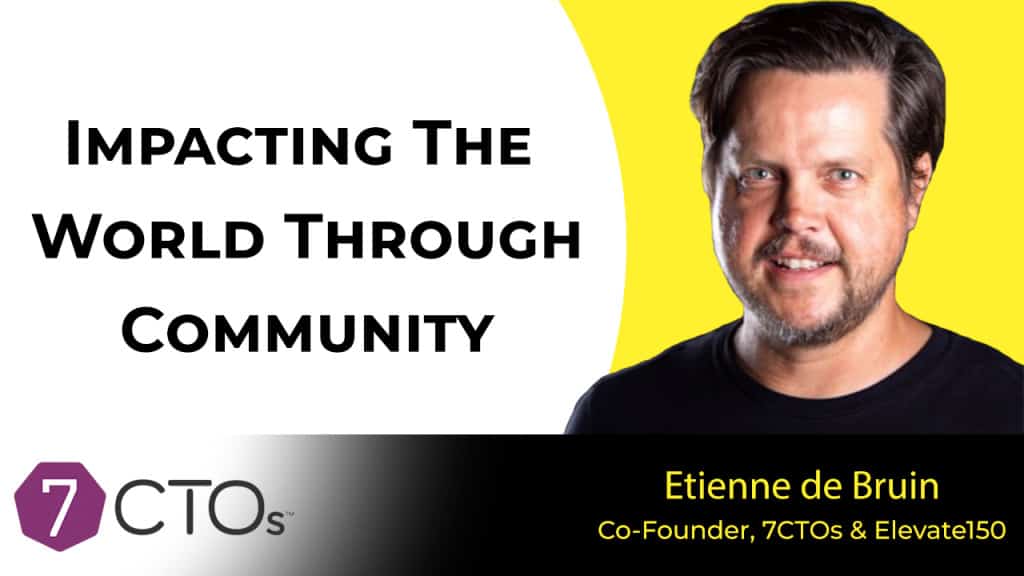
About Etienne de Bruin:
Etienne de Bruin is co-founder and Executive Chairman of the Board of 7CTOs, Inc.
A native of South Africa, Etienne graduated from Stellenbosch University and, worked in the private sector in South Africa before moving to Aachen, Germany in 1997. In 2000 he and his wife moved to San Diego, where they currently live with their three young children.
About 7CTOs:
What happens when a fully engaged CTO combines with the seasoned experience of an Executive Coach?
This is exactly what happened in 2013 when 7CTOs was formed by Etienne de Bruin and Michael Saul. After more than two years spent meeting 300+ CTOs in four cities across the United States, it was clear there was an urgent need for CTO leadership training in technology strategy and execution to transcend their silos, and form close-knit communities of their peers and mentors.
Our singular focus is to build the world’s best Chief Technology Officers. We do this through building close-knit communities of CTOs in cities across the USA.
We’ve all been there, needing help, searching online trying to talk to people who don’t understand. It’s painful.
We wanted a place where we could build meaningful relationships with peers to celebrate success, work through difficult problems and build a vision for the future.
Our community is built on solid principles and a mission to Elevate the next generation of technology leaders.
We invite you to apply to Elevate, experience what we are all about during the application process and get plugged in today!
Transcript
(Intro Narrator at 00:00:02) Hello, my friends. Today, Joel is talking to Etienne, founder of the 7CTOs community and co-founder of the Elevate150 community. And they discuss the impact that you can have on the world by working through communities, how to use the ontological method to coach professionals, and tips for taking care of yourself so you can best serve others.
(Joel Beasley at 00:00:45) I think most of the audience already knows who you are because I've talked about you quite a bit, but I was hoping you could give the 30,000-foot origin story of who Etienne de Bruin is.
(Etienne de Bruin at 00:00:56) Well, thanks for having me, Joel. It's been a while since our RVs collided. So, yeah, my name is Etienne de Bruin, born and raised in South Africa. Known since a very early age that I would be coding and working with computers.
(Etienne de Bruin at 00:01:16) Ataris and Commodores made it down to South Africa. And so then I decided to get my computer science degrees at Stellenbosch University, and then I joined the early stage of the banking sector and the internet. So we built SSL relays so we could re-encrypt traffic between consumers and banks. Being outside of the U.S., we had the export restrictions in the size of the keys that we were allowed to encrypt data with with U.S.-based browsers. And that created a whole industry for us in VPNing and in firewalling and in tunneling, and that got me involved in those category of startups.
(Etienne de Bruin at 00:02:07) And I then got an opportunity to move to Germany with an acquisition in the late nineties, and then my wife and I—and then in 2000, we moved to the United States, and I joined a biotech company. It was a massive step backwards for me. It's the immigrant story. Do what you can to sort of get into the country.
(Etienne de Bruin at 00:02:34) I was reconfiguring RAID drives and upgrading Solaris systems and sitting in the dungeon till three in the morning. So I was super damn embarrassed about what I was doing compared to all this cutting-edge work I was doing. But, anyways, that led me to my entrepreneurial journey. So I decided to, once we got our green cards, start my own company with a friend of mine. And we built a company that—I basically, you know, beautiful story of first line of code all the way through to selling it off.
(Etienne de Bruin at 00:03:11) And during that time, I started the 7CTOs, and I was, very—still am—very passionate about connecting tech geeky types who also understand that that needs to create business and livelihood. And I like to get those people talking to each other in a very sort of intentional, intimate way, and that is how 7CTOs was born. And so after that exit, I decided to just go all in on building out 7CTOs, and that's how our paths crossed.
(Joel Beasley at 00:03:49) Yes. Yeah. That's awesome. Why did you get really attracted to this community concept?
(Etienne de Bruin at 00:03:57) Well, I was—you know, it's interesting. I think it was fueled from my, this is gonna sound interesting, but I think it was fueled from our isolation in South Africa. When I—I grew up in a time where we were boycotted left, right, and center. I mean, you couldn't see a show. You couldn't get a record.
(Etienne de Bruin at 00:04:18) You couldn't—artists weren't coming out. We were isolated at the southern tip of Africa. And when I went to university, I discovered UNIX in the early nineties, and I discovered IRC. And IRC became my lifeline to the world where I could suddenly—I could talk to people without any inhibitions, any restrictions, you know, and it was an unbelievable sense that I was part of a larger community. Through those tools, I think I started learning how to create communities.
(Etienne de Bruin at 00:04:57) I created an IRC channel in South Africa that started meeting up in person around the country, and so I was sort of the godfather of this IRC channel. And it was a very strange feeling to see what can be done and how people's lives can change through opportunities, through growth. And so in my early twenties, I think I saw this—this what community building can do for humans, and I was very attracted to the science and the sort of the methodology of getting that in place. And that led me to creating a musician's website in the early two thousands. Again, as a musician, I was trying to find a band.
(Etienne de Bruin at 00:05:42) I created a PHP website that was like Craigslist for musicians. And I just saw that our website was creating bands around the world. And every step of those sort of startups led me towards this idea that if we can get the right people in the same room at the same time, we can actually have that massive multiplication effect on what people could actually achieve. And that's what I saw for CTOs. I was a lone CTO in a startup with hundreds of other startups with CTOs all trying to do their own thing, reinvent the wheel.
(Etienne de Bruin at 00:06:26) And that's where I started applying this idea that what if I could get everybody to chitchat? And geek coder, but I'm also a raging extrovert. And so I don't know if I'm trapped in the wrong body or the right mind is downloaded into the wrong body. But—
(Joel Beasley at 00:06:52) I wouldn't rule out anything at this point. I think all options are on the table.
(Etienne de Bruin at 00:06:57) Yes. I think the simulation piped the wrong shell script into my brain. But anyway, so I've always been drawn to the community aspect. And because CTOs—this may have changed over the last many, how many years, but initially, at least—CTOs were more introverted, skeptical, evidence-based, guilty until proven innocent humans in the C-suite. And I've really enjoyed corralling them all together.
(Joel Beasley at 00:07:30) And so explain to me what the experience is like in one of the 7CTOs groups.
(Etienne de Bruin at 00:07:35) It was birthed from a frustration I had. So I thought that if I could get everybody together with meals and drinks and high-end experiences, I used to say, you're not gonna get pizza in a cardboard box at a 7CTOs event. It's gonna be nice cutlery, nice experience. So after having many of these experiences, dinner experiences, I thought that I would get everybody into a room and we could have a chitchat. At that time, it was the virtualization of hardware and services.
(Etienne de Bruin at 00:08:10) So everyone was debating, should you have your own bare metal servers or should you be in the cloud? This was in the, I think, in the two thousand tens and elevens. So having sort of put together this group of CTOs that were meeting regularly and communing and sharing and enjoying each other's company, we all got together in a room, and, honestly, all hell broke loose. It was supposed to be a civil discourse between friends. And I tell you what, Joel, it was—it was—talk about panic city for me because people were so offended, so upset, so opinionated.
(Etienne de Bruin at 00:08:57) And I think all those insecurity clichés came out in every form of aggressive communication that could exist. And so that's when I realized just—and it, you know, it was a passionate topic because I think a lot of CTOs were being challenged. Hey. What are you doing about your architecture and your infrastructure growth? And there were some people who genuinely thought that leasing computing power was the wrong thing to do.
(Etienne de Bruin at 00:09:28) If you're going to drive your car until it dies, why are you going to lease it? Just buy it and then drive it till it works no more. Other people were like, no. Well, infrastructure is gonna keep growing, so we need to lease it because we wanna keep getting the new goodies. So that was a very strange time for us.
(Etienne de Bruin at 00:09:46) I'm sure you were there.
(Joel Beasley at 00:09:48) I was not in that specific room.
(Etienne de Bruin at 00:09:50) You were in that specific room.
(Joel Beasley at 00:09:52) I will tell you the first time I heard that there's meetings that get really aggressive. I was interviewing someone on the show. I can't remember who it was, but it was probably about two years ago. And they said as the most calm passing comment, they're like, yeah, it's one of those meetings where people throw things. I was like, I was like, what type of meetings do you have? I've never been in a meeting.
(Etienne de Bruin at 00:10:17) I don't know what happens. I feel like we are amenable, compliant people until the anarchist comes out, and that's crazy. So I decided I was disappointed because I really thought I had a model. I wasn't looking to start a business. I was looking at creating community and I hadn't created a monetized community up until that point other than my music thing, but that was really just placing ads.
(Etienne de Bruin at 00:10:48) So I was very disappointed when I realized that in order for us to have a good discourse that actually moves the ball forward in education, transformation—you know, it's gonna take something out of you. I always tell people growth is hard, so you need to put in that effort because it's not gonna be fun while it's happening. So that's when I decided to flip to a paid membership model in order to attract CTOs who were at a stage in their company where they wanted to invest the time and the money to really be there for each other. And that's what the forum experience is, is seven or eight-ish people get together for a half a day. It's usually four hours before work or after work.
(Etienne de Bruin at 00:11:40) 7CTOs provides a coach, so we have a staff of coaches, and we will lead those groups into a four-hour discussion. And so that forum structure is generally shared learning in the beginning, something that you might not be thinking about or some thought-provoking exercise or something that can help you sort of think orthogonally about stuff. And then we go into a challenge processing framework that we've designed at 7CTOs after many years of people throwing stuff. We've come up with a method that I'm very proud of and really brings the best out in people. And then at the end, we will have someone do a deep dive or a presentation on, maybe their architecture.
(Etienne de Bruin at 00:12:31) Maybe it's a problem that people really wanna dig into and need a bit of extra time to share that with their group. And so month in and month out, these forums are growing closer and closer together. And so the trust and the safety factor goes up, and the sharing gets more intentional and sometimes more personal. And I've seen—I've seen the eyeballs tear up with a liquidy substance sometimes that—
(Joel Beasley at 00:13:02) No idea what that would be.
(Etienne de Bruin at 00:13:04) Yeah. It's—it's—Yeah. Comes out of nowhere, and it rolls down your cheeks. Yeah. Malfunction.
(Etienne de Bruin at 00:13:09) Yes. Eyeball malfunction. And vision malfunction.
(Joel Beasley at 00:13:15) Alright. So that's actually a pretty good explanation of what they are. Tell me a little bit about—well, I mean, I got to go to one of the events. How do you describe the events where everybody sort of gets together?
(Etienne de Bruin at 00:13:28) Our events—so while the forums are, like I said, the hard work happens in the forum. Closed group, confidential. I don't even know what happens in those groups. The confidentiality factor is pretty high. And so what I've noticed is the human avoids change and the human embraces its creature comforts. And in many ways, it avoids the unknown and therefore the realm of possibility.
(Etienne de Bruin at 00:14:04) And so it is our job at 7CTOs to really bring those forums out and to say, hey, forums, let's all meet up. We call them colloquiums. Our most popular event that we host is called a colloquium, and it is sort of a meet-up meets an evening of talks meets group processing. And so we've designed a format where, in a colloquium style, you have an expert come in and present on a specific topic.
(Etienne de Bruin at 00:14:38) And but then you have the groups disseminate that information, and it's not this delayed Q&A that happens between the audience and the speaker. And so we have a very successful and almost an instant integration of people who are able to have group discussions on specific topics. And so those are our colloquiums. We do those around the country. We fly out to cities, and we do those.
(Etienne de Bruin at 00:15:06) Of course, this was pre-pandemic. Post-pandemic, we've been doing them online. Hasn't had the same effect for me, but we are planning them again for this year. And then what we did was at Salt Lick, we all got together for a dinner, and it was a little bit of a homecoming because we hadn't been out there for a while. And so it was just a fun way to see the clan again and to hang out with everybody.
(Etienne de Bruin at 00:15:37) And also there were quite a few members who had signed up for 7CTOs who I hadn't actually met in person. And so for me, I like to get to know everybody personally. So it was a fun thing. So we do the events and we do the retreats. We have an annual retreat.
(Etienne de Bruin at 00:15:55) Everyone comes out to San Diego in November where we do more talks and group exercises to keep this whole collective engaged and learning from each other.
(Joel Beasley at 00:16:10) And isn't that how the basis of Elevate formed through the 0111 conference not happening because of the pandemic?
(Etienne de Bruin at 00:16:17) Yes. So what happened was—and I heard you tell this story, which I loved. I listened to it on repeat for about two months.
(Joel Beasley at 00:16:25) Is it your ringtone when I call you? Yeah.
(Etienne de Bruin at 00:16:27) It's only twelve seconds, but I enjoy it. The—yeah. So when the pandemic hit, I felt moved, and our community felt moved to host, uh, COVID—like, the crisis of the pandemic. There was the work from home thing. There was the equipment and the protocols and all that.
(Etienne de Bruin at 00:16:51) So we started hosting weekly Zoom calls. Then we had the George Floyd incident that, again, was another crisis that raised awareness around inequality. And there was a great conversation, you know, against sort of racism and all that. And so we just went week in and week out for a couple months there. It seemed like we were—there was just another thing to talk about, another thing to talk about.
(Etienne de Bruin at 00:17:24) And there was a bit of a sub-community forming around being on those Wednesday calls. And so I think I even spoke with the founder of EO. There were a couple people that I had on sort of on those calls to help guide and lead our CTOs through these difficult conversations. And when it became clear to me that something was happening, I think I emailed you and I said, hey. I think there's something that we can do together, and I wasn't actually sure what that was.
(Etienne de Bruin at 00:17:58) I just felt a need to reach out to you. Maybe that's what people feel around you.
(Joel Beasley at 00:18:05) Yeah. And then at the same time, I was thinking about you because we were getting a lot of people asking, you know, hey. Do we have a group that we can do through Modern CTO Collect? And I knew nothing about communities. I just know how to do a product like, have a production team and write questions that I'm interested in knowing the answers to and finding cool people that are really smart to help answer them.
(Joel Beasley at 00:18:31) And so that's where my strength is. And so when you approached me and I was like, hey, this is what we're doing, I was like, maybe we should just be partners on this.
(Etienne de Bruin at 00:18:41) I loved it. It was really one of those stars aligning the universe moments. Because, you know, I felt like 7CTOs inherently is a forum community. So everybody who's in—everybody who's in a situation where they want to invest time and money into growth because their startup is scaling or because, you know, it's usually in the—I would say, when you start hitting the $5,000,000 mark and upwards, you know, we start—Series A or B, we start attracting those types of CTOs. With Elevate and with the community product I had at that point, we had many CTOs who didn't wanna do that, but they still wanted to feel part of the community.
(Etienne de Bruin at 00:19:34) And then that's where I think you and I felt there's something we can offer them that is just more of the Wednesday calls. We do a lot of breakouts in those calls. So we have a nice taste of what happens on those calls on Wednesdays for our community. And we've had people, honestly—I mean, I think you've seen this, but we've had people that have not skipped a beat since we did those first calls.
(Joel Beasley at 00:20:02) There's a handful of people that are there every single time. And sometimes they're on their bicycle doing a workout. Sometimes, you know, they're in their arcade or whatever it may be. But yeah, there's definitely some really great personalities that hang around frequently. So I did want to talk to you.
(Joel Beasley at 00:20:21) You were just discussing, you know, the point at which people go or have a need for 7CTOs or sort of realize they had a need for 7CTOs. And for me, when you were talking about that, what was running through my head was those first times when your company starts to grow, and now, you know, it was you and your founder or you and whoever your small team. But now there's new people in the company, and they're sort of speaking a new language, and there's new problems, and you sort of feel like fish out of water. That to me is when I hear people at that stage, that's typically when I recommend them to go to 7CTOs over Elevate. And that's because with the 7CTOs, well, first of all, most of them, I think most of them are in person, right?
(Joel Beasley at 00:21:06) Like...
(Etienne de Bruin at 00:21:07) It's about fifty-fifty. That's fifty-fifty. Our fastest growing format is actually the remote, the Zoom calls.
(Joel Beasley at 00:21:14) So they get together, and they get together consistently, and they're matched pretty well as far as levels of where they're currently at in their process. And then there's just an extremely tight group of these seven or so people, and they share unfiltered with each other. And, you know, when I showed up in Austin, you can feel that bond between them, between the group that's been together. It's pretty cool.
(Etienne de Bruin at 00:21:43) I love it. I love that you saw that. I think there's a sweet spot for that where they start getting to the vulnerable shares. The intimacy in the group is pretty high. And yes, you definitely saw that, and I felt that not having been with them for almost two years. It seemed like they had been through a lot together as the group.
(Etienne de Bruin at 00:22:09) And this is what I love about this type of organization. And I've been to retreats and organizations where if the members of the community are really investing in themselves and working really hard at their own EQ, their own issues are coming up, and they work through that. Well, if you put all of those people into a room together, there's just a completely different vibe. There's an openness. There's a curiosity. There's a willingness to converse. There's a willingness to help. I can't tell you how shocked I was about three or four years ago when I realized that people were just doing their own calls. I just assumed that I was the center of everyone's activity and attraction. But in 7CTOs, because we're all in Slack and we share the Slack with Elevate so we can increase the pool of knowledge.
(Etienne de Bruin at 00:23:11) But it's really incredible to see how people are setting up their own calls, doing their own consults. Sometimes there are some deals that go down, which has been hard for me to know what to do in those situations. 7CTOs has a hands-off approach as long as there's not a conflict of interest. But it just occurred to me that if you're spending all this time with people and you get to know them, well, why wouldn't you work together and do stuff together? So I've learned to deal with that. But to my point earlier, it's been incredible to see how people set up their own calls and quickly jump on a phone call for some clarification and help. It's really a beautiful thing.
(Joel Beasley at 00:24:05) And so I want to get into some... I want to pick your brain as I think you're an expert in a number of areas. That's one of the reasons why I continue to hang out with you. It's very beneficial. So I'm curious to know...
(Etienne de Bruin at 00:24:20) You have a thousand close friends, Joel. You've done an amazing job with bringing this community together. It's been really amazing to watch your work, man. So I'm fortunate to be part of this.
(Joel Beasley at 00:24:34) Thank you so much, man. The hard conversations. We're talking about racism. There's obviously, you know, several points throughout the past couple years where there's very divisive... I think everyone would agree that it's gotten fairly more divisive as far as topics go and in the public. Not, you know, picking a specific one. But when I was going through that, I was asking questions like, how do you address this? Is this my place to address it? You know, whether you're the founder or you're just a manager of a team, not even necessarily a CTO. It's tough. And I did a couple interviews asking people how they're handling it. And there was a couple different strategies.
(Joel Beasley at 00:25:19) But I know you're a certified coach, you run these communities, you're very, very well versed in this stuff. How do you handle difficult public conversations with your team?
(Etienne de Bruin at 00:25:32) The word that comes to mind for me is courage. And as CTOs, it's the courage to not know, the courage to not solve, the courage to say we can speak it, we don't step over it. And while I'm afraid on the inside and my heart is racing and I'm concerned for fallout, I'm concerned for saying the wrong things, I think that there is so much value in saying the thing that you're feeling before saying it. So for instance, you know, I'm a white dude from South Africa, so I am from the oppressors. You know? I'm generationally one of the, you know, I've one of the bad guys from South Africa. I'm at the lowest of the totem pole in South Africa. And so it's with all those thoughts, who am I to speak to racism? Who am I to speak to gender discrimination?
(Etienne de Bruin at 00:26:46) Who am I to want to make a difference? And I've had so many calls in the early days of 7CTOs with women CTOs who I could just hear that they weren't buying a single thing that I was saying. And I just listened to myself say these words, and I just realized if it were me, I would also not believe a single word I'm saying. And so with the difficult conversations, it has just been the word courage to admit that I don't know what the answers are. We may not get to a conclusion at the end of this conversation, and I am going to be vulnerable and honest with how I see things.
(Etienne de Bruin at 00:27:32) And let that be something that can hang in the room. And I think people... I have found that people really appreciate that. Now does it mean that people aren't having side-channel conversations, people aren't getting offended by other people? No. I mean, people are still having emotional responses to the content, to what's being said.
(Etienne de Bruin at 00:28:02) But the question is, can I be with that? And I think what we'll find is that we can't. We struggle to be with someone else's unhappiness, anger, disappointment. You have a natural predisposition to want to fix it, to want to reassure, to want to make it go away. And this is where I think the courage comes in, which is to say, I don't know what to say right now. Or I can see that you're angry. I see that what I just said... I get the sense that you are offended by what I just said, or you look angry. And to be able to have the courage to just say those things, I think that gets you 51% of the way towards having these conversations. Again, it could be a total shit show, and it could go out of control, and we've certainly seen multiple examples of that. But I think it is when we are able to say, I'm going to sit with this right now.
(Etienne de Bruin at 00:29:09) Let's be together around this. We don't have the answers. We can't solve it. That has been the approach that I think has worked, especially for us as we manage this community.
(Joel Beasley at 00:29:22) Thank you. Now I was just... I'm thinking about, you know, the difference that we have in interacting with CTOs, right? Because you interact with a ton of them because of the groups. And for a long time, you know, you were the person doing all the onboarding calls and all of that before your company grew a lot. And so you get to meet a lot of these CTOs. I think a big difference is, you know, 80% of the people I'm talking to tend to be more like victory lap. Like, they've, you know, they've had a career or they've learned a lot and they're coming on to share the lesson. So the pain is typically over, right?
(Joel Beasley at 00:30:02) They've experienced the pain, they're coming on to share, and we're helping amplify, you know, their experiences to help out the next generation of tech leaders. But you are constantly meeting people. Like 80% of your people are people that are in this crisis transition moment, saying, like, help, I need to be plugged into a community, you know, A, B, and C is happening. I think they might pick another CTO because we just raised $192 million. And they don't, you know, there's questions on if I'm qualified and all of these different things.
(Joel Beasley at 00:30:34) And so I'm curious if you had to sit back and sort of take inventory and identify some trends, what are a couple, or what's at least one trend that you see when people are coming to you?
(Etienne de Bruin at 00:30:48) There's a couple things. Probably the number one thing I see is the word like-minded people. So somehow there's a revelation for the person that, well, I can't be the only person facing this. I need to talk to other people. Now I am generally sad at how long it takes people to get to that point. Sometimes, and like you said, sometimes they're under fire. They can see blood in the water. They are starting to plan their exit. Now those aren't people that are great for 7CTOs. And in fact, we basically just send them out to career coaches or, you know, we aren't taking those people.
(Etienne de Bruin at 00:31:35) A lot of them want to start a fractional CTO career or a consulting career, and that's also not great for 7CTOs. Our specific portfolio of client isn't great for them because we want to make sure they get into a forum where they're all actively struggling with the same things. So there's usually a moment. I talk about the middle management problem in our case. It's people who either feel like they have to put a middle management in place. In other words, their own fingertips can't get the work done anymore. They've got to start relying on other people. So that's pretty early. Then there are people who land, like you said, they land the exorbitant funding.
(Etienne de Bruin at 00:32:09) And I talk about this from the scarcity mentality to the abundance mentality, which is as a CTO, and I know you have this experience, we are really well trained in doing as much as we can with as little as possible. How can we get as much out for as little investment possible, either because we're early stage or because we just feel like we can do things ourselves, or our natural disposition is not I'm going to go hire more people. Our natural disposition is I can find more tools to solve these problems myself, you know? And that goes throughout your engineering teams. So the real problem comes in when your C-suite starts looking at you and saying, hey, we need 50 recs filled in the next twelve months, and you suddenly have to spend money. So I think that, you know, I think the eyeballs always go... You can see the whites around the eyes where it's like, hey, I have to go from doing as much as I can with a $5 million budget to now spend a $10 million budget faster than I can. I don't know where to go. I don't know what to spend it on.
(Etienne de Bruin at 00:33:39) And my whole C-suite is looking at me to make that investment so that we can blow up. And so that's when I see people start calling us. They're like, listen, we need to talk to other CTOs who have been through this before, or we've just reached unicorn status. We need to talk to other unicorn companies. And when I say talk, people at that point are generally aware that this is not a quick networking or an advisory conversation, but that this is going to take several months of growing with people. So that like-minded vibe is what we see a lot. And that's what I see a lot of CTOs struggle with. And then they come in needing that sort of help.
(Etienne de Bruin at 00:34:26) Nice. As I was talking to you, I was just mesmerized by your background. It's working.
(Joel Beasley at 00:34:32) Thank you. That's its intended design purpose. Okay. So I want to get to some tangible stuff for people, for at various skill levels, tech leaders, managers, whoever it may be. I know you're a great coach. I know people see you as a great coach. I know you've done your certifications and all of that type of stuff. But if you had to, you know, teach somebody how to be a great coach in like five minutes over a podcast, other than telling them to join Elevate or 7CTOs, what would you tell them? Where would you tell them to focus?
(Etienne de Bruin at 00:35:18) Well, I subscribe to the ontological coaching modality. So what I love about the ontological way, in other words, coaching towards someone's whole being, understanding that there are breakdowns and that they are on the precipice of breakthroughs and that we are governed by our own perception of possibility. And that if we truly work on ourselves, there's a whole realm of potential for us to embrace. And that the converse is true that if I don't work on myself, I am just stuck in the same rut and a super predictable future.
(Etienne de Bruin at 00:36:05) The ontological coaching way really sits with someone and says, well, I'm hearing this. So I'm noticing you said this. So I keep hearing you come back to this. Or how is what you're struggling with at work showing up in other parts of your life? And to just be with that person in conversation, I have seen honestly, Joel, I have seen radical breakthroughs. For instance, someone might come to me and say, I have a real problem with my recruiting strategy. And so they would come to me with a sense of, well, I have this recruiter, or I have to do these job descriptions, or I have to finish this onboarding process. And then when you sit with them in the ontological way, you realize that they have certain beliefs about what their value is to the organization that is causing them to feel stress and anxiety over this completely different part of the process. And I've seen CTOs, when they're able to face that and be with that, show up completely differently to where the hiring challenge in this example fades into a secondary or tertiary issue. And that the real issue at hand is what is the value that I'm bringing to my C-suite, and what does my C-suite view me as?
(Etienne de Bruin at 00:37:31) These are all conversations that you need to be able to sit with somebody and have without trying to solve the problem. Again, having the courage to call them out on the things that you're hearing. I've had some really tough moments where I coach some CTOs who I am like, wow, this person is the bee's knees. Who am I? And then I have to scratch my courage together and say, well, I'm not hearing the thing that you're saying. I'm hearing this other thing. And then boom, see them have this epiphany because someone had the courage to raise their awareness on something that they never thought of. So if I was to... So I'm just going to plug accomplishment coaching. I'd love to just honor that organization. They're based in San Diego, but they take students from all over the country.
(Etienne de Bruin at 00:38:29) Accomplishment coaching, they really... Their intensive program is what I did, and it was a game changer for me. So I'd love if your people can just link out to them, and they can get some signups from this. But marrying for me the CTO expertise, I have a good twenty, thirty years of building technologies, leading companies in some shape or form. That's cool. I mean, that's my path.
(Etienne de Bruin at 00:39:00) But then to marry that with this ontological coaching, you're able to go in and truly listen to what CTOs are saying. Of course, you understand the colloquialism of what the different things are that they're talking about because you're a CTO, but you're actually listening for where are they coming from, what are they perceiving about the world around them, how are they describing relationships. And if you can listen for that, you can really get to the heart of some of the issues they're struggling with. And so that has been quite profound in helping me coach CTOs. I will say for a CTO listening, if they wanted to just have the "do this, do this, and don't do that," I would say number one is be curious.
(Etienne de Bruin at 00:39:58) Okay? You can ring the cliche bell there, but be curious. Not do curiosity, but be curious. What is truly happening for this person as they're saying these things? I mean, I'm really curious about where you're coming from, why you're saying what you're saying.
(Etienne de Bruin at 00:40:18) The second thing I would talk about is relationships, is to understand that everything we do and say is inside of this container called a relationship. Now, unfortunately, in organizational design and in hierarchies, we have this construct. I am the boss. You are the employee. We have a relationship where you do what I say.
(Etienne de Bruin at 00:40:44) And more and more, we know in this globalized workforce that that's not working. We need to understand that I, as CTO, am bringing a relationship to my direct reports, to their direct reports, to my C-suite, and am I intentional about that relationship? The third thing is something I like to think of as being, and that is the ability to say that I look at you, and whenever you and I meet, you are being a certain way. Do I have the skill to perceive that? Am I looking for, "How is Joel showing up right now?"
(Etienne de Bruin at 00:41:26) And I think a lot of times we think, "Well, I am curious. I have a relationship. We've gotta get some work done," boom, boom, boom. But you may show up to that day's work in a very different state of being than you have been.
(Etienne de Bruin at 00:41:43) And so with the coaching mindset to say, "Well, hang on, Joel. I'm noticing a flatness about you today," or, "Hey, Joel. I'm noticing you're super excited about something." To be able to just say, "Hey, I can speak to that. I can notice it, and I can say something about that." And then you get the opportunity to actually share with me what's going on for you. And because I'm curious and because we have a container of a trust relationship, I actually have the opportunity to coach you through what's going on for you. And then the fourth thing is something we've worked on quite a bit at 7CTOs, which we call the essence.
(Etienne de Bruin at 00:42:24) And that is, there's a belief that I have—and you may believe this or not—but that you were born onto this planet with a certain characteristic about you that is wonderfully unique about you. So when you're in that natural state, you bring an essence. When you walk through that door, you bring that thing with you consistently, and people can get to know you for that. And if we, as CTOs, in this esoteric mindset can say, "Well, my lead engineer brings this. Whenever Sally is on a call, she brings this." We have given ourselves so much tooling to be there for each other and coach each other through whatever content is in front of us—missed deadline, unhappiness, bad performance review.
(Etienne de Bruin at 00:43:25) These things are all content, but we can look at the context in which people are showing up and then help them through that. So I would tell CTOs to focus on those four things.
(Joel Beasley at 00:43:38) So to do that though, because by the way, you are very much like that. You are soul piercing. So every time you walk up to Etienne, know that he's read you on your gait. Right? But it's great because it's easy to be around you because of that.
(Joel Beasley at 00:43:55) You can show up around Etienne, and if you're having a bad day, he's gonna pick up on it and want to talk about it and work through it. So I find comfort in the consistency of that part of your personality. But I do want to address something that was really hard for me as I started to try to become a better leader, and that was—and I'm not perfect at this still. I work at it. It was to do those things, to be curious and to care about these people and that new word, ontological, or making sure that, how do you say it?
(Joel Beasley at 00:44:32) Ontological? Yeah.
(Etienne de Bruin at 00:44:35) O-N.
(Joel Beasley at 00:44:36) Ontological.
(Etienne de Bruin at 00:44:38) Ontological, alright.
(Joel Beasley at 00:44:41) Well, I'm not South African, so. But you have to take care of yourself. I mean, you have to make sure your gas tank is full, because if you're irritable, how are you gonna take time to be passionately curious about someone else's life? And how are you gonna be able to be relaxed and genuine and care for them if you're sitting there, worked to death and you're on empty? So how do you do that? How do you take care of yourself?
(Etienne de Bruin at 00:45:10) I appreciate that. You know, I will share that I was very sick recently. I picked up something in the beginning of December. And long story short, it was called labyrinthitis, which throws my balance off. At the time, as I told you, Joel, I thought I was gonna die because I was dizzy and I was throwing up, and I thought, "Maybe, is this what a stroke is?"
(Etienne de Bruin at 00:45:39) And I had a—I'm 49—and so I had a moment, and this is gonna sound a little dramatic, but I had a moment like, "If I die, are my kids gonna find me in the bathroom, or are they gonna find me nicely tucked in my bed? What is the most dignified way I can live?" And, and that, just to be honest, that is how bad it was for me. And it has put me on this mindfulness journey where you ask the existential questions. "Why are we here? What are we doing?"
(Etienne de Bruin at 00:46:10) And one of the tools that has very much served me in answer to your question is the power to notice how you're feeling, to notice what's going on. I think a lot of times we don't realize what's going on. We don't realize that we are overloaded, stressed out, or we—so can I take the ten seconds and just admit to myself that I am freaking out right now? Or I, like yesterday afternoon, I was working, and I realized I am not doing well. I'm not able to get this paragraph finished. And instead of bulldozing and bulldozing and bulldozing, I took a step back and I realized, "Okay. I can't do this work."
(Etienne de Bruin at 00:46:52) So noticing that I am operating at a certain level, to me, is a very important skill for us as entrepreneurs, as CTOs, as family people as well. And then it's just the regenerative question. What do I do to regenerate and to source myself? The list of things that I know that if I do this, I am going to feel better. But if you don't even notice what's going on, you never get to do that, and all you end up is having a crappy evening with your family because, you know, daddy's in a bad mood or daddy's had a tough day. And that's what my 11-year-old does now. She looks at me the moment I walk out of this office, and she says, "Daddy, did you have a bad day?" or "Daddy, how was your day?"
(Etienne de Bruin at 00:47:59) And so from that child's mind, my face carries it. My disposition carries it. And so the ability to notice and then to source yourself, I think, are two things that are pretty simple. So I've got myself a sleep mask. What I do is I sit on my couch, I put that thing on, and I spend five minutes, even if it's listening to a podcast or—I don't try to rest, I just block my eyes. I just say, I put that over my head. And I mean, if I want to walk around and walk into stuff, I'm free to do so, but I'm better to just sit down and think. And sometimes I put my alarm on so I have the security that this isn't gonna take forever. So I set the alarm for five minutes or ten minutes.
(Etienne de Bruin at 00:48:56) I shut my eyes and I listen to a podcast. And as I've gotten better, I've been able to just listen to the silence and enjoy the images in my brain. But the idea of just going with the flow while also peeling your senses has helped me sort of reset in the middle of the day.
(Joel Beasley at 00:49:16) I like it.
(Etienne de Bruin at 00:49:17) What do you do?
(Joel Beasley at 00:49:19) What do I do?
(Etienne de Bruin at 00:49:21) You're gonna be milking some goats soon.
(Joel Beasley at 00:49:25) Yeah. I'm brutally honest with myself. So I try to—I know my strength is self-awareness, but I don't get egotistical or too excited about it because if I do, I won't focus on it. And the reason why I'm good at it is because I focus on it. So with my self-awareness, I'll realize, over the years, I've gotten—I play a game where I reduce the distance between the time it's happening and the time I realize it.
(Joel Beasley at 00:49:55) So that's my game. It's not trying to eliminate burnout. It's not trying to eliminate these feelings of stress or whatnot. It's having the—reducing the window of time from having it to having awareness of it to then taking action on it. So I'll do everything. You know, I'd say nine times out of ten, it's because I'm doing something that I don't want to be doing. So that's very common, right? For us entrepreneurs, we pick up the task because it just has to be done. And then we realize that we're living with it too long, and then we need to hand it off or hire somebody.
(Joel Beasley at 00:50:30) And typically for me, I say historically, the hardest parts for me were the times where I had these tasks that I wasn't enjoying, but I had to do them with excellence anyway until I found the right person for it, because you don't want to rush that because then you have turnover and whatnot. But at the same time, there was some joy there knowing that the end is coming for that specific thing. And I got that advice from Andy Hofer, who actually owns Dynamic Communities. They do the conferences for Dynamics 365 for Microsoft. He was also an investor in the business, so I met with him several times.
(Joel Beasley at 00:51:14) I met with him once when I was super stressed out. And we're at this Starbucks. I drove an hour to go see him. I was like, "Man, I just need to talk to you. I've got a ton of stress right now. I'm going to miss payroll." That's what was coming up. And I'm sitting there and he's just throwing down the best advice ever, right? And then the 16-year-old that was sweeping up could tell he was listening, and he came up after Andy finished talking. He goes, "That's really good advice. That's the stuff you see on Instagram. That's really good." And I'm sitting here having the worst day of my life, and I'm just like, "Shut up. Go away. I'm trying to have a moment here."
(Etienne de Bruin at 00:52:01) That's hilarious.
(Joel Beasley at 00:52:02) It was funny. It was funny. But yeah, it was good advice. So for me, that's what I do. I try to reduce the time, and then typically, it's giving up a task or sometimes it's because I'm not spending enough time with my wife or investing hard enough in my wife or my kids. And maybe there's nothing wrong at work, but I'm not as good at work because I'm not taking care of my personal relationships well. And then that'll be a sign where I'm like, "Okay, now I just need to put work aside. I look at my calendar, determine my essentials, make sure those get done, and then show up for my family as best I can." So.
(Etienne de Bruin at 00:52:41) I love what you said about that realization that you had to go talk to Andy. To go get out of your head and actually say it to people. And I agree with that. I think the tendency to say, "I'm going through this, and it's just me, and I've gotta fix myself," versus "I am now gonna call someone up, and I'm gonna spill the beans."
(Etienne de Bruin at 00:53:09) So I think a lot of times, there's that self-judgment of, "Oh my goodness. I shouldn't have let this happen, or only terrible people let this happen to themselves." So the first thing I have to do when I talk to somebody is admit those things. And I'll never forget, I was in a very, very stressful CTO situation, very stressful. And everything inside of me was, "You're a terrible person. Great CTOs would have nailed this situation. You let this deadline slip. You didn't run these certain tests." And I felt horrible. And at the time, 7CTOs was prominent. So I was like, "Oh my goodness. The founder of 7CTOs screwing up as a CTO."
(Etienne de Bruin at 00:53:49) And I'll never forget, I called up two or three people in 7CTOs, and I said, "Hey. I need to tell you something right now, but I screwed up." And I started spilling the beans about how I was struggling. And I can't tell you the compassion and the love, and I'm sure you experienced this from Andy as well, is that innate need we have to just be there for each other and say, "You know what? It's okay. It's wonderful that you said it." And that was what I got.
(Etienne de Bruin at 00:54:30) And, actually, the fact that I did that gave me the courage to make certain decisions, which ultimately led to me leaving that organization. But I got coached on what my resignation letter should look like, how to set it up in a way that is good for succession, and how to do it in the best possible way for the teams that I had built up over there. And that—I don't know how I would have come up with that by reading a book or writing a blog post. That help we get from our fellow people, fellow human beings, there's nothing that beats that.
(Joel Beasley at 00:55:12) Absolutely. Some things are just meant to be done between humans.
(Etienne de Bruin at 00:55:18) And so that ability to say, "I am in trouble. I need help." Boy, I think CTOs really struggle with that.
(Joel Beasley at 00:55:30) Yeah. And just to be clear, my story was three years ago. So if my team's listening, we are not missing payroll. Everything's okay.
(Etienne de Bruin at 00:55:39) I went to a friend yesterday, and I was really struggling with our payroll.
(Joel Beasley at 00:55:44) No. They're editing the podcast, and the editor's like, "Do I send this to other people in Slack?"
(Etienne de Bruin at 00:55:52) No. You've done an amazing job, Joel. I remember when Modern CTO just started. And even in our community, we have a few people who refer to your book. And this guy, Modern CTO, said that at this stage, you should be this and at that stage. And I just—you know, I'm like, "Hey. That's my friend right there, man. That guy's amazing." So I get the benefit of talking to the people who benefit from my organization. I think someone like you who has a far wider reach, you don't even know who you're impacting by—and I really just want to encourage you, man. From our side of the fence, you're doing some really incredible work. So, and I know you've also navigated your own stuff, and it's been amazing to see you empower your team to do the interviews. You know, so it's really—you're doing some good stuff, man.
(Joel Beasley at 00:56:57) Thank you so much for listening. And if you found this episode useful, please share it with a friend or colleague who you think would get value from it. And if you have topics that you'd like to hear discussed on the podcast, either add me on LinkedIn or send me an email, [email protected]. Every time I get an email or LinkedIn message, it absolutely makes my day and inspires me to keep going.