
Episode 797 ·
How to Stop Being a Jerk with Edward Marx, CEO at Marx Advisory
Today we’re talking to Edward Marx, CEO at Marx Advisory. We discuss Ed’s realization that he was a jerk, how he turned his attitude around, and how he deals with the haters we all run into in life.
All of this right here, right now, on the Modern CTO Podcast!
To learn more about Marx Advisory, check out their website here: https://www.marxadvisory.com/
Produced by ProSeries Media: https://proseriesmedia.com/
For booking inquiries, email [email protected]
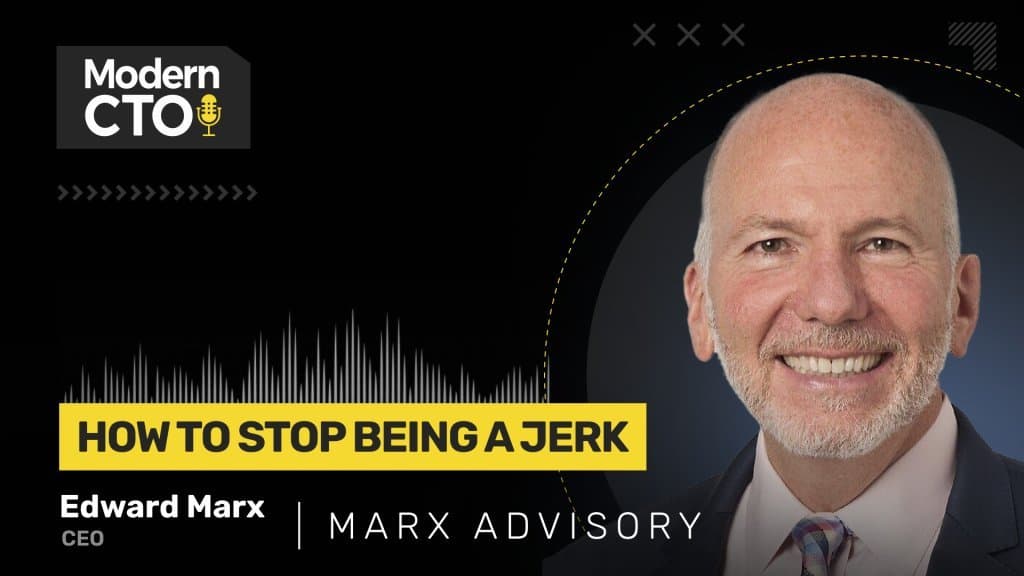
About Edward Marx
I am Edward Marx, a healthcare innovator and leader with over two decades of experience in digital transformation, strategy, and execution. I am the CEO of Marx Advisory, a company that helps healthcare executives and organizations achieve objectives and key results. I will help you succeed.
My mission is to leverage my clinical, business, and technical expertise to enable better healthcare delivery through digital products and services. I speak globally on all things healthcare, innovation, leadership, transformation, and life. I serve on a few select boards, write healthcare bestsellers, and pursue my passions in alpinism, tango, and TeamUSA. I am also a veteran, an author, and a founder.
Transcript
(Intro Narrator at 00:00:00) Today, we're talking to Edward Marx, CEO at Marx Advisory and host of Digital Voices with Ed Marx, about how he learned to shape up as a leader. You're listening to Joel Beasley, Modern CTO.
(Joel Beasley at 00:00:18) So you hated yourself for being an ass at work, and then you changed. And so I want you to tell me a little bit about the realization, about how that came to be that you had this realization, and then what path you pursued to make this change.
(Edward Marx at 00:00:34) Well, I think you have to take reflection of yourself on a regular basis. Like, man, how can I improve? What are things that are issues with me? So I would ask people. I'd ask my direct reports. Kind of hard, right, when your boss says, hey, tell me something. You know, are you gonna get the truth out of them? But I developed a decent enough relationship where I could get the truth. I had some, I was surrounded by some what I call truth tellers, and then also other people in my life and my personal life. And so the other trigger point, and then I'll get more to the focus of the question, the other trigger point is when you start seeing a lot of assholes, you gotta ask yourself, is it you that's the asshole, or is it really surrounded by a bunch? And so it was really a combination of things like that where I was like, dang, I'm kind of an ass, and I need to do something about it. And so as I went through this discovery thing, I talked to my wife and talked to my kids. It's like, hey, what do you think? Some people think I'm an ass. You come across that way? And the general consensus, some were more gentle about it, others were more brash, but the general consensus was, yeah, you're kind of an ass. So I was like, alright, I need to change and not be like that and allow for more grace and understanding and patience and give people an opportunity to be themselves and not have this sort of expectation if they don't answer the way I would or if they don't do things the way I would that I'm gonna just trash them or whatever. So it's like, over time, it's just like, alright, I'm gonna stop being that way. So it wasn't like an instant change, but it happened over time. And then I realized that, all that said, having been an ass, it's easy to recognize asses. And so it was like, I'm gonna talk about that a little bit on my mentoring channel.
(Joel Beasley at 00:02:16) Yeah. So what was some of the actual, like, specific detailed feedback people gave you?
(Edward Marx at 00:02:23) That I'm too harsh. So I didn't have patience. So if I was, like, had this expectation that something was gonna be delivered on July 1st, and it was, you know, the end of June, and they were saying, oh, we need another two weeks. You know, instead of saying, well, tell me about it, help me understand why it's late, is there something that I could do, I was like, oh, just, you know, get out of here. Like, I need someone who can deliver on time. So I was, like, really brash. I wasn't, again, graceful. I wasn't giving grace. Even though other people had given me grace, I wasn't extending that same grace to others. And so that was some of the feedback. Like, too brash, too in your face, and just not gentle enough. You know? And not that you have to treat people and let people get away with things or anything like that, but there's a way of delivering. And I think it was in my delivery that I kind of went off the tracks a little bit. And over time, you know, it kind of gets reinforced. And maybe you work for an ass or have other asses around you, then you tend to become like them if you spend too much time with them. So over time, I think that's kind of what was happening as well. So some people were pointing that out. It's like, man, you're spending your time with these type of people over here, and they're all like that, so you're becoming like that. So, again, lack of patience, lack of grace, kind of brash, unreasonable expectations, things like that.
(Joel Beasley at 00:03:49) What about being too direct? You get that?
(Edward Marx at 00:03:54) Well, that's where I was saying a little bit about, you know, being more inquisitive in the approach. Yeah. So instead of directness to say, well, how come it wasn't done July 1st, it's like, hey, tell me why you couldn't make the deadline. Because maybe there really is a good reason. And if you were suddenly an ass about it, you may never find out the reason. And you may lose good people, and I think I probably did as well, right? Because no one wants to work for an asshole. So I probably lost some good people along the way. So I then went back. I've gone back to people who I no longer have a working relationship with, like, because maybe they did leave. And also on the personal side, I've gone back to a couple people, and I said, you know what? I know I've been an ass, and I'm sorry. And I recognize this. It took me a while to get there. I know it impacted you. I feel really bad about it. That's why I'm here, and I just ask for your forgiveness. And so I've done that to about three or four people.
(Joel Beasley at 00:04:51) Oh, wow. That's interesting. Well, now what's the argument for, like, some people are just really weak?
(Edward Marx at 00:04:58) Yeah. Well, you know, you don't want to tolerate that as well. And that's what I say. It's a very careful balance. So, but it's really up to you and how you go around the approach. So you could still find out if they're really weak. So if they didn't make the deadline, this fictitious example about the deadline of July 1st, and you're like, hey, tell me why it was a struggle to get there. So maybe you give them grace. Maybe they give you a reason, seems reasonable, you give them grace. Then August 1st shows up. And it's like, if you're having the same conversation, then you know you've done all you can as a good leader. Give everyone a shot, extend a little bit of grace. But at the end of the day, you gotta realize this person just doesn't have the ability, the capability to deliver, and therefore, probably not the best person to be on your team. You don't have to be an ass, right? In that situation, you weren't an ass. You gave the person a chance. You extended grace. You were inquisitive. You asked questions, and then you're like, you know, I know it's a struggle, it's probably not a good fit, and so it's probably best that we part ways.
(Joel Beasley at 00:05:58) So the reason why I'm interested in this topic is I had this problem as well and have worked on it quite a bit. Josh is like, it's not good enough yet. But one of the tricks that I found is that I tend to be, like, incredibly, like, I'll just say the one thing in the most succinct way that'll make somebody feel, like, bad even though if you just wrote the sentence down, you're like, oh, that's factual. So delivery, right? That's what you're talking about. But also, I found if, what I do now is that statement forms in my head, and I'll take a deep breath, I'll back up, and then I'll search for the question to ask them that will lead them to that conclusion. Like, what, so that's what I ask myself. What question can I ask this person right now that's going to lead them to the same conclusion I so abruptly arrived at? And that tends to work well in certain situations.
(Edward Marx at 00:06:49) Yeah. That's a good, yeah. And that's why we often use the phrase, well, tell me why. Tell me what the struggle was. And then sometimes, as they explain it, they're realizing themselves, well, I guess that's my issue. I should have handled it. Yep. And if they say that out loud, you're like, this is great. This is awesome. You coached them, and they're not gonna do it again. But, yeah, if, like, it's what I'm saying. If it's a repeatable pattern, that's not good, and it's probably wrong fit.
(Joel Beasley at 00:07:18) Oh. So how do you, I'm just gonna ask you directly. How do you make money? Because you got this podcast. You're working with Team USA at the Olympics. You climb mountains. You do a wide many things. Where do you make money?
(Edward Marx at 00:07:36) Yeah. So I've been very blessed and very fortunate. I found this niche where I'm helping vendors, you know, companies you would know the names of. Not all of them are Fortune 100 companies. Some of them are, but others are, you know, much smaller niche companies in health care tech generally. And I help them to connect better in the marketplace, and that's how I make my money. And so I do a retainer. I have a retained advisory because I was like, I'm only gonna be one person. It's my brand. It's who people know in health care tech, and so I really can't scale that. The only way I can scale it is to do retained advisory. So I don't charge an hourly rate or anything like that because that would limit me, but I leverage my brand. And so I have these retainer arrangements, and that's how I develop, you know, how I monetize who I am in my influencer sort of role. And then I do all these other things, like I have a podcast and a very popular YouTube channel. I just, a very popular X, just started IG and TikTok, you know, and reuse a lot of the content in different formats in each of those particular models. And, you know, I don't do advertising. I don't do ads. I don't have sponsors, but it does help with the brand, you know, and write books and speak. It all helps with the brand. So everyone knows who I am or reinforces who I am, right? So the, so GE is proud to be associated with me because they see me in all these different modalities, and they know that I'm reaching a big part of the audience that they're trying to reach. But the buyers, you know, in our case, like, these would be hospitals or insurance companies, so the tech teams, you know, the CTOs, the CIOs, the CDOs, the buyers, you know, when they get an ad, when they see an ad from, again, I don't wanna name companies, but just think of the big companies that, you know, you know and happen to be also in health care, they shun those, right? It's noise. They don't, but when they have someone that they know and trust and they're like, oh, Ed's working with them, and so that should be interesting. I wonder what's going on. So that's how I make my money, retained advisory, but I do all the other things to help with the brand. And truly, from my heart, I believe that as people poured into me and helped develop who I am and helped the success that I have happen, I have to pour back out to others. And so a lot of the stuff I put out there, all that content, is really just doing that, pouring myself back out and hopefully helping people. And based on the feedback I get, and the number of people that are engaged, I think it is helping people.
(Joel Beasley at 00:10:16) What type of content are you doing on your YouTube?
(Edward Marx at 00:10:19) So I have probably 12 different subchannels on my YouTube channel. So one is called Lessons from My Mentor. So I get called all the time or emailed. People want me to mentor them. Again, it's scale. It's like, man, I can only mentor one person a year and that's what I do. I am mentored myself by a different person every other year and I mentor someone. But all the requests that come in, I can't do it all. So I just thought, wow, I should just do a YouTube series called Lessons from My Mentors. So these are real lessons. Like I said, I have a formal mentor every other year for 20 some years now. So these are real lessons I learned, and I just share those with the audience. Like, you know, how to deal with an asshole, the one that you were referencing to, or how to build your brand, or how to become a speaker, or how to become an executive. You know, different things that might be interesting to people. That's one. I have another one that I just started on. It's called Executive Life Practical Hacks. Right? So it's hard to be an executive, a successful executive, and a family and hobbies. How do you do it? So my guests come on and they talk about, oh, I've got, I'm married, I've got three kids, I've got a husband, and I'm the head of sales for this big company, and these are my three things that I've learned how to do. And so it's just practical. So I just try to put out practical information. I do have one on Team USA because people are always like, what's it like being on Team USA? So every week, I drop kind of like the Road to the Olympics and the Road to the World Championships. So I try to do things of human interest. I do some that are tech. So I have one called Ed Talks. So typically, my guests are more techie from the industry talking about, you know, sustainability with IT or whatever the topic, you know, virtual care, whatever the topic of interest might be. So I have multiple channels, and I have one other one that I'll just mention, has to do, it's kind of my favorite, and it's called CXO Bach, like Bach as in the musician.
(Joel Beasley at 00:12:23) Bach as in that guy.
(Edward Marx at 00:12:25) Got it. And so it makes fun of salespeople. And I learned that all these things I'm sharing with you, by the way, come from my kids, Joel. So my kids are all super successful, and several of them are exclusive to social media. So they built their living around social media. So they teach me all these different things. And my wife's good at it because for her clinic, she has a med spa. So they're all into it, and so they teach me. So I'm like, everything I do, just about everything I do, actually, I learned from my kids.
(Joel Beasley at 00:12:58) That's amazing.
(Edward Marx at 00:12:59) Yeah. So they're quite fantastic. They're very creative bunch, all of them.
(Joel Beasley at 00:13:05) Whoa. That is so interesting. Alright. I think we just became friends, Ed.
(Edward Marx at 00:13:10) Yeah. Yeah. Yeah. You should meet my kids.
(Joel Beasley at 00:13:13) Okay. So we've got a little bit of time left here. I did wanna get into, there was two videos that I saw that I wanted you to talk about. They're completely separate topics. But let's start with, how to deal with haters, right? So tell me a little bit about how to deal with haters.
(Edward Marx at 00:13:35) Yeah. So I learned this quite a long time ago, but I was reminded of it. I made that video, like, the next day. I was reminded of it because I got some hate mail, and I got some hate mail from another industry luminary or at least they think they are, and they were like, you know, the way you talk about your wife is derogatory to women like me. And so I went back to Twitter, and I was like, gosh, how many times did I do something like that this year? It was like three times where I'll post a picture of my wife. I'm like the luckiest guy in the world. I married, like, this Indian princess. She's just stunningly beautiful. And so we go out dancing and all that kind of stuff, and I'm like, man, this is my wife. Yeah. I'm so proud of her. You know? And she's also a, must a weight, what do you call it, body builder, which she was, won her first competition. And so I'll post a picture of her, like, doing the pose, and it's like, I'm proud of her. And at the same time, I talk about she's a clinician. She's Doctor Simran Marx. I'm so proud of her. She started her med spa. She came from nothing. She's another amazing story. I mentioned, you know, from the foothills of the Himalayas, the youngest of 17, lives in a three room shack, suddenly somehow makes it to United States, gets her doctorate, treating patients, you know, assimilating into the western culture. And I'm so proud of her. And the 90% of what I talk about is like, man, I'm so proud of her. What a story. And then every once in a while, I'll be like, man, she's hot. Like, I think the word, this is the words I use, it's actually from the lyrics of a Beach Boys song. I said, hey, we're out dancing. And I said, those shorts sure do fit you fine. It's literally a lyric from the 1960s Beach Boys song.
(Edward Marx at 00:15:27) And this I got this hate mail. And it was funny. I thought to myself, this person I've known of in the industry for twenty plus years, not once, not once, did she ever say anything to me like, "Hey, Ed, I think you're doing a great job as a CIO. Hey, Ed, thanks for leading this. Hey, Ed, thanks for all your contributions. Ed, I'm sorry you got cancer. Ed, I'm sorry that you had this divorce." Ed, nothing, right? And but they'll hate on you. So I'm like, man, that's a sign of a hater is when the only time they ever reach out to you is to hate on you. And so when I got that, I was just reminded about all the haters and what I was told, because as you become more successful, you will draw more haters.
(Edward Marx at 00:16:11) Right? People don't like success. You've heard the story or the allegory about lobsters. Like, if you go lobster fishing, which I've never done, so I only know this through someone else's story. But if you have, like, a basket and you throw in a lobster, they're gonna crawl their way out. But if you have two lobsters in there or more, you can keep the top open because every time someone gets close to the top, they drag each other down. And that's what a lot of people are like. They have trouble with other people's success, whether it's how you look, whether it's how much money you make, whether it's the type of car you drive. You know, it could be a lot of different things. So you have these haters, and the haters, unfortunately, are there. And as I said, the more popular you get in your particular industry, the more haters you'll attract. So how do you deal with them? So that's what I talk about, right? So it's like, if you can, separate yourself from them. Don't interact with them. You can't always do that because sometimes you might work with them and have to work with them. But to the extent that you can physically separate yourself, emotionally separate yourself. You know, if they're hating on you on social media, block them, you know, stuff like that. So that's what you need to do with haters. Don't engage with haters because they'll only be reinforced in their mission.
(Edward Marx at 00:17:22) So you just gotta move on. And at the same time, Joel, you know, kind of like in that earlier question about assholes, you have to do some self-reflection, and I did. And so I did ask around. I said, "Hey, I got some hater, and they hate the fact that whenever I say something about Simran and my wife, you know, and talk about how good she looks or whatever. What do you think?" And the feedback, I asked two or three people who were like, "That person needs to get over it. You know, there's nothing wrong with being proud of your wife and the fact that how she takes care of herself." So anyways, that's how the hater thing came about.
(Joel Beasley at 00:17:57) That's interesting. So I didn't get a lot of hate content until I started making broader content, right? And then we started getting some hate content. But I noticed something interesting about myself. So like I said, I was kind of rude. I learned the day I learned that I was rude, this was a while, probably ten years ago. The day I learned this, somebody said that I was flippant, and I had to dictionary the word. And I was like, "Oh, man, that's not good."
(Edward Marx at 00:18:33) Yeah, didn't sound good.
(Joel Beasley at 00:18:35) Yeah, it was, like, the third time I had heard it in, like, a month, and I was like, "Oh, I gotta look this word up now."
(Edward Marx at 00:18:41) Yeah.
(Joel Beasley at 00:18:41) And then I was like, "All right, maybe I gotta make a change." But what I learned was the times when I would be the most critical or the most harsh towards other people were the times when I was the least happy for my own personal reasons, whatever they may be, right? So things weren't going right in a relationship or whatever it was. When I was frustrated, when I was upset, when I was mad about something completely unrelated, then this thing came up in front of me on my magic distraction device, right? I would just, like, throw something out there or the cold email that came through that just, like, was messed up and I'd, like, respond something terse or whatever. And so what I realized from being a bit of a hater was that haters are just people that are unhappy with themselves, and you happen to be putting content in front of them at that moment.
(Edward Marx at 00:19:32) Yeah, that's a great thing to point out. And I do talk about that as well in terms of, "Hey, the first thing you should do is forgive them." So they don't know you. They're probably coming from a place of hurt or anger or frustration. So you gotta kind of feel bad for them and just forgive them. Doesn't mean that you allow them more access into your life and to hate on you, but you definitely want to be understanding. So yeah, thank you for that reminder.
(Joel Beasley at 00:19:57) Yeah. Yeah. And then if somebody had, like, a moral problem with it and they actually just wanted to help change or get you to think differently, they would pull you aside in a nice way and be like, "Hey, how do you," you know? And then they would walk you through their view of it, and they wouldn't just, like, write you hate mail. Like, who does that?
(Edward Marx at 00:20:14) Yeah. Who does that?
(Joel Beasley at 00:20:16) Who does that?
(Edward Marx at 00:20:17) Yeah. Or if someone really bothered you, then just stop following or looking at it. Like I mentioned, like, I have that choice. I could decide, "Hey, I don't like that particular commentator or whatever, and so I'm not gonna follow them." And everyone's happy.
(Joel Beasley at 00:20:30) And I like X. Have you been using X for a long time? Because I just started, like, three weeks ago.
(Edward Marx at 00:20:36) Yeah. Yeah. For a good ten plus years, I think.
(Joel Beasley at 00:20:39) The interface now is so awesome. I can just click on something and say, like, "Yeah, I don't want to see more," like, "see less of that" or whatever. It's really good at learning what I don't want to see.
(Edward Marx at 00:20:52) Yeah. Like, I know a lot of people are, speaking of hating, you know, hate on Elon Musk, but he's added a lot of feature function that didn't exist before and give you a lot more capability.
(Joel Beasley at 00:21:02) Yeah. And he reduced, you know, the whole government thing going on on both sides. Forget, it's not a particular thing. That was the interesting thing for me about the Twitter leaks, is that it was bipartisan. It was both sides of government officials getting this content removed, and I was blown away by, well, I mean, I don't know. How blown away can you, are we getting desensitized, Ed, to reality? Because things are getting weird right now, aren't they?
(Edward Marx at 00:21:30) Yeah.
(Joel Beasley at 00:21:31) In life. Yeah.
(Edward Marx at 00:21:31) Yeah. It's pretty weird. That's why it's important to have your own, you know, your own moral code, your values, you know, your family, the people that are life givers instead of life takers.
(Joel Beasley at 00:21:42) Yes. I was listening to some Tony Robbins clip this morning of him on a podcast, and he said if you focus on what you can't control, right, like the news and political stuff, we focus on that, it's a great recipe for stress, right? Focus on things you can't control. And then the other one was, like, focusing on things you don't have. He's, like, "It's okay to focus on things you don't have for growth reasons. But if you're focusing on things you don't have while also focusing on things you can't control, you'll just have a massive stress in your life." And I was, like, "Oh, I guess that's true. I gotta stop, get some of the political stuff out of my X feed and get more science."
(Edward Marx at 00:22:23) Yeah. I'm glad with the Tour de France going on right now. You know, that is consuming my X feed, which is great because it was a great thing that happened with Cavendish today, you know, having the rider with the most stage wins ever in the Tour de France. And so my feed's been full of that instead of all the, yeah, political garbage.
(Joel Beasley at 00:22:43) Nice. And so what type of content are you posting on X? Same stuff that you post on YouTube?
(Edward Marx at 00:22:50) It's a mix. So I do intermix my personal life and my professional life. And I'm one of those believing in integrated life. I don't keep the two separate. So, yeah, on my X, you'll see some retweets of things that I'm reading, like, maybe from Wall Street Journal, something interesting, usually tech-oriented. I'll definitely retweet. I'm big time into the Olympics, into sports in general. So it's like when the gymnast team was announced, like, they did some amazing things. And so talked about that. And then, like I said, every once in a while, I'll post pictures of my family. I work out a lot. So lately, I'm not a dog person or someone who tweets their dog and stuff like that. But my dog, I do most of my riding indoors, and one of my dogs has just become this loyal puppy dog. So he'll just lay there, look up at me longingly while I'm on the bike for two hours. I've been posting some pictures of him, which actually get more likes than anything else that I tend to post. So it's just a wide variety of things, some work things, but yeah, I'll repost my content. So if I post a new YouTube video, I'll definitely X that out and stuff like that.
(Joel Beasley at 00:23:59) But that's why I like what you're talking about, how you integrate your personal and work stuff, and I think that's gonna work well for you long-term. What's with the Olympic thing? What's your deal there?
(Edward Marx at 00:24:10) Yeah. It's a little bit strange and different. I'm fortunate. So one of my hobbies is triathlon. And Team USA, the governing body, right, for the Olympics, Team USA Triathlon, so it's Team USA in whatever sport. Team USA Triathlon is actually open, whereas the other sports are closed, right? I couldn't show up to the track and field. They just did the track and field or the gymnasts. They just did their big thing, and the top, you know, gymnasts go on to Olympics. I couldn't show up there and try to compete with Simone Biles, you know, or anything like that. They'd be like, "Who the heck are you?" But in USA Triathlon, it's open. So they do have these competitions that are open. And, obviously, there's the elite pros and those who are gonna go to the Olympics, and they're typically gonna be, although they've been in some of my races, they're gonna be in races around the world with other pros where there's money. And so but it's still the same association and governance structure. So you got that going, and I happen to do pretty well. We just had the national championships, and I happen to do pretty well. I was, you know, top, I've been top 100 in the world across all ages, even though I'm a little bit older. Top 100 in the world in long distance.
(Edward Marx at 00:25:26) And then I've switched over to some other sport like duathlon, which is run, bike, run. You know, triathlon is swim, bike, run. And then they do age group things specifically, and I did pretty well in my age group. At the same time, Team USA Triathlon had this opportunity for a select athletes to go over and be part of Team USA with the triathlon team, and then sort of hang out, do some workouts, hang out at the Team USA house. There's Olympic Village, but then outside of Olympic Village, there's a house for Team USA. So the athletes, their families, stuff like that, sort of like a more chill environment. And in that way, yeah, you can interact, whereas Olympic Village, you gotta be badged, you know, a certain type of badge. So we were offered an invite to go and be part of that, and we said, "Yes, of course. Oh my gosh, are you kidding me?" So I'm not racing in the Olympics, but I'm going to be with the Olympic team. So thrilled to have, and I'll obviously have great, I'll have great seats at the venue and all that kind of stuff. But I'm really thrilled to support the team. Been doing this for a long time. I was captain Team USA last year. So all those sort of reasons is why I got the invite.
(Joel Beasley at 00:26:49) That's amazing. And it makes for great content too.
(Edward Marx at 00:26:53) Yeah. I'm going to definitely have them on one of my shows, you know, after the race. And if they do okay. I would have them even if they got last place, but I'm saying sometimes the mentality or, you know, the mental state, they may all be like, "The last thing I want to do is be on my program." But yeah, they'll be super, super interesting. I love the sport. I love sport in general, and I'm really looking forward to going.
(Joel Beasley at 00:27:19) So as we wrap up, I want you to share, like, one of your most epic stories from the trenches of leadership to show what it's all about.
(Edward Marx at 00:27:29) Yeah. Well, let me combine it then with a triathlon story. So probably the most epic, and it does tie back to leadership in a big way. So I was in the 2018 Team USA national championship, and I was in the last segment, swim, bike, run. So I was in the last two miles of the run and realized I was an executive at Cleveland Clinic, which, for the audience that may not know, you know, is, like, number two in the world for hospitals, Mayo Clinic being number one typically. And so when I was there, of course, I get the executive physical, and I climb high mountains. I do all sorts of crazy stuff. So my wife's always, "Make sure I get my executive physical." You know, it's a all-day-long physical where they test everything. And I had it done, like, in March 2018, and they're like, "Ed, you're the top 1% of all males, just, you know, all the markers for health." And so I was like, "See?" Told my wife, you know, "See, I'm fine." So I go race, and in the last two miles, I get this heaviness on my chest. I'm like, "Oh my gosh, what's this heaviness on my chest?" And, you know, "I gotta make the tea." You know? And so I'm running along, and then I was like, "This is the telltale sign of a heart attack." But I can't be having a heart attack because I'm top 1% in the world according to Cleveland Clinic in terms of my health markers, and I'm still running. I usually run around a six-minute pace at that time, and I slowed down to about six and a half. I got passed up by a teammate of mine that usually doesn't pass me. And so I knew there was something wrong, and he was like, "Follow me. Follow me." Like, trying to draft off him a little bit in the run. And I couldn't keep up. But I didn't have any of the other symptoms, but I just started to reason. Like, there's something called door-to-balloon time. So when your heart stops receiving blood, after about sixty minutes, the heart muscle dies. So if you're not dead already, your muscle, you're not gonna recover. So I'm looking at my watch, and I'm triangulating. I was like, "If I tell someone, if I stop," well, if I stop, so the vain part of me is like, "Oh my gosh, I'm not gonna make Team USA." And then the other part of me is like, "If I tell the race official or volunteer, by the time they radio everyone, the ambulance is at the finish line where the medical tent is. By the time they get here, it's gonna be, like, twenty-five minutes. And it's, like, two miles to go. I can do this in twelve or thirteen minutes." So I decided to keep running. So I ran, and so I was like, "Okay, now I gotta check myself in because, you know, I crossed the finish line. I sprinted." And I was like, "I better check myself in." So I went to the medical tent, and they weren't quite sure what was going on. They did some basic stuff. The doctor's there. And so I said, "One second." You know? Because at the Cleveland Clinic, I'm in charge of virtual care stuff. And so I went to my bag. So a friend got it out of my car, and I have this little device.
(Edward Marx at 00:30:04) It was like the size of a credit card that does an EKG. So they hooked it up to their iPhone and sent it over to the race hospital. This is in Selma in South Carolina. And they're like, oh my gosh, he's having a widowmaker.
(Edward Marx at 00:30:14) So widowmaker, typically, you die right away. You've got like one last breath and you're dead. And they're like, he's got a widowmaker. And so they stick me in the ambulance. So they take me over to the hospital.
(Edward Marx at 00:30:24) It's like Saturday morning at 8:30. And the doctor's there ready to receive me. He goes, Mr. Marx, I'm sorry this has happened to you. It shouldn't happen to someone like yourself, but I want you to know you're gonna get the best care possible. I was just talking to Dr. Nissen. He's a famous cardiologist, the father of all cardiology at the Cleveland Clinic in Cleveland, and we've already shared your images. So by the time I was en route for ten minutes, so I'm counting the time, right? So about twenty-some minutes now. They already shared all the images of my heart and what was going on with the world's foremost expert in Cleveland, and they have already consulted each other.
(Edward Marx at 00:30:55) So when I get wheeled in, they're like, alright, you ready to go? We've got an extra big monitor for you so you can watch it all. I said, rock and roll. Let's do this.
(Edward Marx at 00:31:02) So within thirty minutes, I'm getting my procedure. And sure enough, I can see my heart. Only 10% of it's moving. So 90% of my heart is just like sitting there, and 10% is like, boom, boom, boom. And then I could see them. They take the cath through my wrist, comes up into my heart, and sure enough, there's a blockage, which was a spontaneous thing. And so I'll explain this another day. And they busted through it. Immediately, my heart filled with blood, started dancing around. All the pressure was off my chest, and I was healed.
(Edward Marx at 00:31:31) And I made Team USA. I was number 10. You got top 10? I was number 10. And that was the first question I asked my wife. It's like, did I make the team? She came with my medal. So the reason this is important and the reason I tie it back to your leadership question is, like, whatever it is that you do, for me, it's healthcare tech. Whatever it is you do, you gotta do it really well because you never know. One day, it could save your life.
(Edward Marx at 00:31:57) Especially from a healthcare point of view. It's like, this is the stuff I was in charge of. And I'm glad that I had the team that I had, that I'm glad that we did whatever we needed to do for interoperability to make sure that these images could be shared with different health systems in real time via the cloud in a secure manner. I'm glad we had this little technology stuff that we innovated with that helped save my life. If not saved my life, it at least for sure improved the quality of care of my life because I was able to get diagnosed quicker, beat that sixty-minute mark, and I had a healthy heart as possible.
(Edward Marx at 00:32:32) And ninety days later to the day, so this happened on 04/07/2018 in South Carolina where I had the widowmaker, and I made the team. And ninety days later, which was July 17 in Odense, Denmark, I'm crossing the line, the world championship for Team USA. And if it wasn't for the leadership, not just on myself, my team, other people, we wouldn't have technology like that, and it's gonna save people's lives. It could be your own life. It could be your parents' life, but it's gonna save someone's life.
(Edward Marx at 00:33:03) So it's important that we take everything we do, you know, have fun, all that kind of stuff, of course, but take everything serious because it makes a difference. And so that's my epic story.
(Joel Beasley at 00:33:15) I love it. That was a great story. I love that you actually qualified, and then you got to race ninety days later. That's great.
(Edward Marx at 00:33:23) Yeah. I didn't go super fast because they were still monitoring my heart and everything, and I had strict instructions from my wife being the most badass clinician out there. So I wanted to make sure, you know, I didn't violate anything of hers. But yeah, I did the entire race and crossed the finish line.
(Joel Beasley at 00:33:42) That is amazing. You are a great person, Ed. I've enjoyed talking with you immensely.
(Edward Marx at 00:33:48) No. Likewise. I appreciate you having me on. And yeah, you know, anything good, it comes from two sources, right? And all the people that poured into me, like I said, and the way we all have to pour out, and there's definitely grace and mercy that I've received in my life and from my faith, and I have to give all credit to that.
(Joel Beasley at 00:34:05) Absolutely. Well, thank you so much for doing this. We made a podcast, Ed.
(Edward Marx at 00:34:11) Alright. Awesome. Yeah. So good to connect with you all.
(Joel Beasley at 00:34:14) Thank you so much for listening. And if you found this episode useful, please share it with a friend or colleague who you think would get value from it. And if you have topics that you'd like to hear discussed on the podcast, either add me on LinkedIn or send me an email [email protected]. Every time I get an email or LinkedIn message, it absolutely makes my day and inspires me to keep going.