
Episode 372 ·
Edith Harbaugh, CEO at LaunchDarkly - Deploying More Often With Less Stress
Today we’re talking to Edith Harbaugh, the Co-Founder and CEO at LaunchDarkly. And we discuss how utilizing feature flags enables developers to deploy more often and with less stress. How LaunchDarkly can drop the mean time to remediate bugs down to seconds, and how to establish a culture of autonomy.
All of this, right here, right now, on the Modern CTO Podcast!
To learn more about LaunchDarkly, check them out at https://launchdarkly.com
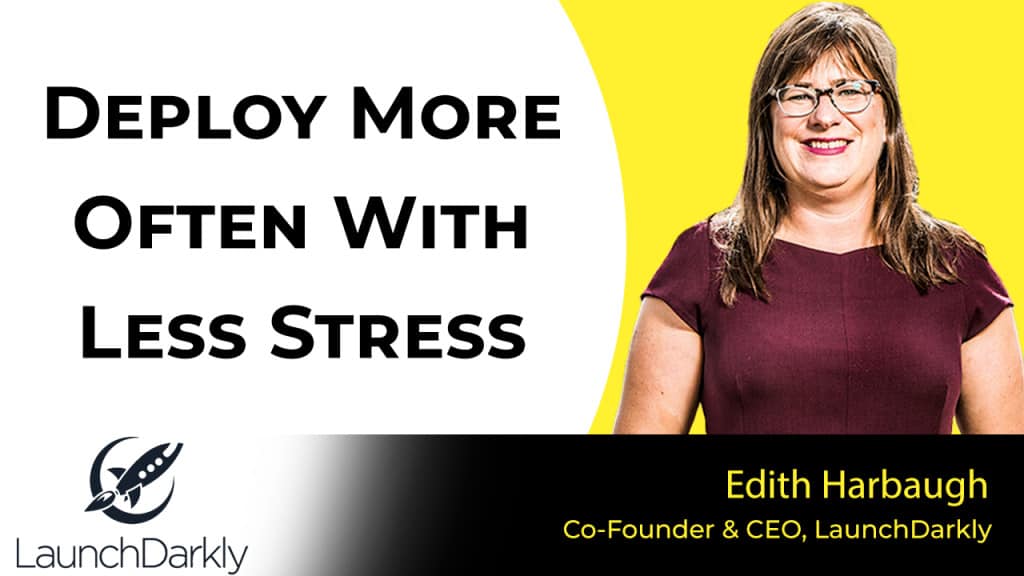
About Edith Harbaugh:
Edith Harbaugh is CEO & Co-Founder of LaunchDarkly, the leading feature management platform. LaunchDarkly serves over 1600 global customers like IBM, Atlassian, and Intuit. She has more than 16 years of experience in engineering, product, and marketing with both consumer and enterprise startups, including TripIt and Concur. She is co-host of "To Be Continuous," a podcast on software trends. She holds two patents in deployment. Edith earned a B.S. in Engineering from Harvey Mudd College.
About LaunchDarkly:
LaunchDarkly is a Feature Management Platform that serves over 100 billion feature flags daily to help software teams build better software, faster. Feature flagging is an industry best practice of wrapping a new or risky section of code or infrastructure change with a flag. Each flag can easily be turned off independent of code deployment (aka ”dark launching”).
Our vision is to eliminate risk for developers and operations teams from the software development cycle. As companies transition to a world built on software, there is an increasing requirement to move quickly, balanced with the desire to maintain control. LaunchDarkly is the feature management platform to control the whole feature lifecycle from Concept → Launch → Value.
LaunchDarkly has SDKs for all major web and mobile platforms. We are building a diverse team so that we can offer robust products and services. Our team culture is fast-paced, friendly, and supportive.
Transcript
(Joel Beasley at 00:00:03) Hello, my friends. Today we're talking to Edith, the cofounder and CEO at LaunchDarkly. And we discuss how utilizing feature flags enables developers to deploy more often and with less stress, how LaunchDarkly can drop the mean time to remediate bugs down to the seconds, and how to establish a culture of autonomy. All of this right here, right now on the Modern CTO Podcast.
(Joel Beasley at 00:00:33) Here we go. This is the Modern CTO Podcast.
(Edith Harbaugh at 00:00:46) I started programming when I was nine or 10. It was back when our library had a computer. And when I finished all my classes and all my work, I would just be sitting there bored, so they would shoo me out of the classroom and say, you know, go hang out in the library at the computer.
(Joel Beasley at 00:01:03) Nice.
(Edith Harbaugh at 00:01:03) So I completely aced Where in the World is Carmen Sandiego, like top-level geography. And then also I taught myself how to program some BASIC just because there's only so much Carmen Sandiego you can play. Yeah, so I could play a lot. I programmed in high school, and then my summer job when I graduated high school was actually really fun. I taught little kids how to program.
(Joel Beasley at 00:01:29) Oh, awesome.
(Edith Harbaugh at 00:01:30) So I taught little kids how to program Logo and BASIC, and that was super fun because a really fun way to learn something even better is to teach it.
(Joel Beasley at 00:01:40) Absolutely.
(Edith Harbaugh at 00:01:41) If you have to explain the concepts or watch an eight or nine-year-old struggle with the language, you really understand it. Got an engineering degree, and then, so that's all the backstory. Got an engineering degree and then designed big systems. So designed portal management systems, site management systems, got a couple patents on that and how to deploy big sites. And then became a product manager because I was tired of building stuff that nobody wanted. It's really frustrating to be an engineer and spend a lot of time building something and have nobody like it.
(Joel Beasley at 00:02:21) Yeah, I can imagine.
(Edith Harbaugh at 00:02:24) So most recently, I was a product director at TripIt, which is an app for travelers.
(Joel Beasley at 00:02:31) Oh, that's cool. So how did you come up with the idea for LaunchDarkly and meet your cofounders and do it?
(Edith Harbaugh at 00:02:38) Yeah, so the first one is easier. I met my cofounder in college. John Kodumal, I think, was on an earlier podcast. He's a cofounder CTO.
(Joel Beasley at 00:02:50) Yeah.
(Edith Harbaugh at 00:02:52) We both loved software. So he got his PhD from Berkeley. I was working as a software analyst and then a product manager. And whenever we hung out, we would just end up talking about software, like design patterns we saw, how waterfall was broken, patterns we saw about what made a good product manager versus bad product manager. And then we kept seeing the same pattern that there was a need for a feature management system. Like, I had one we built internally at TripIt. John, my cofounder, had one. He'd used it at Atlassian. But it was something that we thought should be its own product. That way it would have more robustness and more functionality instead of being something that you relied on, but that wasn't sometimes very well maintained.
(Joel Beasley at 00:03:46) Yeah, because it seems like something that would be so critical to your company, but at the same time, not your core competency. So why would you spend a ton of time on it?
(Edith Harbaugh at 00:03:57) Yeah. So to back up for a second, LaunchDarkly, the company we cofounded, is a feature management system. We help thousands of customers all over the world, like Intuit, Atlassian, IBM, push out features to their own customers and then manage who gets access to them.
(Joel Beasley at 00:04:14) That's really cool. I saw from John Kodumal's episode with us, he was talking a lot about your feature flags that you put in. And so my understanding of feature flags is somewhat limited. I just know that it allows you to deploy some of your features to a subset of your user base and also to activate and deactivate features that you're deploying. But I'm just not really sure on how that works or what it really looks like. Can you give me an overview of feature flags?
(Edith Harbaugh at 00:04:45) Yeah, that's a great description, by the way.
(Joel Beasley at 00:04:48) Oh, thank you.
(Edith Harbaugh at 00:04:50) So the old way of building software, which I grew up with, was that you had a version, basically. So I'm old enough to remember you actually had to print stuff on the disc that would get installed. So when you had a release, everybody got the same features at the same time. And if there was a mistake, it was actually extremely expensive because you had to literally reprint discs or try to get people. One of the big benefits of moving everything to the cloud is that you don't have to print discs anymore, which is better for the environment and also you can constantly update software. So that's the first way that you can get an advantage with feature flags. It has to be online. Where feature flags then fit in is that if you can wrap functionality with a feature flag, you can have it pushed out and live, but turned off for different people or turned on. So for example, if you're a banking customer and you have a new feature that is performing really poorly out of the field, instead of having to run a release and push out new code, you can just turn the feature off.
(Joel Beasley at 00:06:04) That's really cool. It sounds kind of like how a lot of social media platforms are iterating their changes by just pushing out different features to subsets of the audience. Some people get this button, some people don't, and then they see how those perform.
(Edith Harbaugh at 00:06:21) Yeah, absolutely. So we didn't invent feature flagging. It's been a concept that's been around for decades. What we try to do with feature management is make it easier to use. We have support for over 20 languages and then make it something that you have a really nice UI where you can control them easily and then also have workflow and audits about who has turned what on when.
(Joel Beasley at 00:06:46) Oh, one thing that John was talking about in the episode, because we also recently had Dylan Etkin, the founder of Sleuth on the show. And he was talking about how John really helped him start his company and how you, LaunchDarkly and Sleuth, really integrate together. And I was just curious, like, have you worked much with Sleuth and do you know Dylan?
(Edith Harbaugh at 00:07:10) Yeah. I laugh because I am a very small investor in Sleuth.
(Joel Beasley at 00:07:17) Oh, cool. Nice.
(Edith Harbaugh at 00:07:19) A very small investor because Atlassian was one of LaunchDarkly's very early customers, and they gave us a lot of great feedback. So I got to know Dylan through that.
(Joel Beasley at 00:07:30) Oh, cool. So I'm curious. It sounds like both you and your cofounder have really technical backgrounds. How did you decide between who's CEO and CTO at the start of the company?
(Edith Harbaugh at 00:07:41) Oh, John is a much better coder than me. I mean, you know, I was talking about how I coded when I was a teenager, but when I became a product manager, I started focusing much more on talking to customers, figuring out what customers wanted, and going down that path. And then even when I was at Concur, I realized that you could build something really cool, but if nobody knew that it existed, you needed marketing.
(Joel Beasley at 00:08:10) Right.
(Edith Harbaugh at 00:08:11) Which, when I was an engineer, I just completely ignored marketing. And I was like, well, the thing is so cool, it'll sell itself.
(Joel Beasley at 00:08:18) That's what everyone wants to think. Yeah.
(Edith Harbaugh at 00:08:20) Which is absolutely not true. You can have the best thing on the planet that's technically sound, but you still need—like, that's because you have a good product manager and a good engineering team—but you still need to have marketing just to tell people about it.
(Joel Beasley at 00:08:36) Absolutely. So what was it like? Do you have a third cofounder that was the marketing person, or how did you find that at the start of the company?
(Edith Harbaugh at 00:08:46) It was me. So I'd done marketing at my prior startups. I'd worked at a company called Edyn, which was a plant sensor, and I'd gotten them from zero to a million dollars after launch.
(Joel Beasley at 00:09:01) Wow. Yeah, that's amazing. What is a plant sensor?
(Edith Harbaugh at 00:09:08) It is pretty much what it is. So this is back in 2007. I joined this eight-person company as their product manager, and that's why I said that you could build something but not know how to market it. So they built this device where you would plug it into the soil, and then it had a thing on top that would measure sunlight. And then you would unhook it, and you'd shove it into your USB dock, and it would tell you the temperature, the light, and the humidity of that area and what you should be doing with your plant.
(Joel Beasley at 00:09:45) Nice.
(Edith Harbaugh at 00:09:46) Like, whether you're underwatering it or overwatering it. So I joined when they pretty much had gone through the beta as their first product manager, and they were about to launch it. And I think they were just exhausted from having built the thing. So when they launched it, we had all these expectations that we were going to get around 10,000 units the first month. Instead, I think we sold around 20 or 30.
(Joel Beasley at 00:10:10) Oh, wow.
(Edith Harbaugh at 00:10:10) Oh, like, not 10,000. Not 20,000.
(Joel Beasley at 00:10:15) Oh, oh, oh, I thought you meant thousand.
(Edith Harbaugh at 00:10:21) No. We sold 20 to 30 units total. It was this huge, huge, huge flop. And I was like, well, why don't we try to do some marketing? And they're like—and the nice thing about having it flopped so badly at launch that whatever I tried, it couldn't get much worse.
(Joel Beasley at 00:10:42) Right. Yeah.
(Edith Harbaugh at 00:10:42) Like, freedom. Yeah. So I bought Google Ads, which was super fun. Because I'd worked with marketing teams before, but I wasn't allowed to do them, if that makes sense.
(Joel Beasley at 00:10:52) Yeah. Yeah.
(Edith Harbaugh at 00:10:53) Like, I worked at a company before where we spent a million dollars a month on Google Ads, so they don't let you touch them. But at that point of the company, the CEO is like, here's the corporate credit card, buy some ads. And the ads did well, so I bought some more. And then I cornered several key keywords for us. And I figured out that people—I call them the two personas. There was a gadget guy who had some plants that really wanted to nerd out, gadget guy or gadget gal.
(Joel Beasley at 00:11:26) Yeah. Yeah.
(Edith Harbaugh at 00:11:27) And so I would buy a lot of keywords around, like, best gadget for plant. And then the other thing that did really well was people have gardening mothers. They don't know what to buy for them or gardening fathers.
(Joel Beasley at 00:11:39) Right. Yeah.
(Edith Harbaugh at 00:11:40) So around Mother's Day or Father's Day, I'd buy a lot of campaigns around, like, what to get your mom. Anyway, so got that company from zero to a million from a combo of Google Ads, Facebook Ads. It was super fun.
(Joel Beasley at 00:11:53) Yeah. That's crazy. I don't think I've heard a story that drastic surrounding just going from zero to 100 like that.
(Edith Harbaugh at 00:12:04) It was fun. It was also the absolute worst time to launch a gardening product. For another reason, we launched it in November when nobody's—
(Joel Beasley at 00:12:11) Oh, yeah.
(Edith Harbaugh at 00:12:12) Nobody's growing anything.
(Joel Beasley at 00:12:14) Yeah. Well, I mean, it would be a good time to launch it today. Well, now that everyone's just inside growing plants, making their homes into jungles.
(Edith Harbaugh at 00:12:25) Yeah. That company—there's other companies now that are doing similar things.
(Joel Beasley at 00:12:31) That makes sense. Well, I want to circle back to LaunchDarkly because I saw that you guys recently actually published an O'Reilly book on effective feature management. And so I know you talked about how the whole company is feature management. What's that keyword "effective" do to that descriptor there?
(Edith Harbaugh at 00:12:51) So I think feature flags are incredibly powerful. I've given talks all over the world espousing their virtues. They help you with kill switches so that if something is going bad, you don't have to run a new release. They help you with graduated rollouts so that you can get stuff—if something is going bad, you could find it out with only 10% of your customers instead of 100. You could also do long-term segmentations. Like, we have customers in Australia where if there's different territories, there's different legal requirements, and you don't want to branch your code base and have eight different code bases. You want to have one code base and then segment it with feature flags. So I think feature flags are wonderful. There's also the dark side of feature flags, that if used poorly, they could cause a lot of issues.
(Joel Beasley at 00:13:40) How so?
(Edith Harbaugh at 00:13:41) So, for example, if you—like any other bit of code, if you put in a feature flag and you don't document what it does. So if you have a feature flag that you, for good intentions, put in, like, six months ago, now you don't know what it does.
(Joel Beasley at 00:13:59) Yeah.
(Edith Harbaugh at 00:14:00) And then even worse, somebody else doesn't know what it does either, so they just turn it on or off.
(Joel Beasley at 00:14:06) Right. And then you have a whole bunch of people out there with an app that might be broken now.
(Edith Harbaugh at 00:14:12) Yeah. Like, a true horror story I heard was a B2B SaaS app where suddenly nobody could upload a document anymore.
(Joel Beasley at 00:14:22) Oh, yeah. That sounds pretty important.
(Edith Harbaugh at 00:14:25) And then people were frantically calling customer support. People started calling the CEO. And then about four hours in, they figured out they had this old feature flag on a console that somebody had flipped, not knowing that it was the feature flag that turned off uploading documents.
(Joel Beasley at 00:14:46) Wow. Yeah. That's pretty extreme. So the O'Reilly book you guys published is an educational way to help people use them more effectively?
(Edith Harbaugh at 00:14:55) Yeah. I mean, if you don't want to buy the book, I'll just drill it down to: treat feature flags like a first-class object. Have a good naming convention. Don't name them something cutesy like user_setting_17.
(Joel Beasley at 00:15:10) Yeah.
(Edith Harbaugh at 00:15:11) Don't name them something cutesy like fast food, like chicken nuggets. I think that's real silly. Have a good convention about what is on and off. Like, if your default is that stuff is always off by default, make sure everybody knows that.
(Joel Beasley at 00:15:27) Yeah. That makes sense.
(Edith Harbaugh at 00:15:28) And then a really big one is manage the life cycle. Like, if you don't need a flag anymore, you should clean it up out of your code.
(Joel Beasley at 00:15:37) I mean, I think all of that seems like it should be obvious to just have strong conventions in place that everyone's on the same page about, but it's just crazy seeing how many companies just kind of don't have that kind of architecture in place. Like, my brother is a software developer and his company had their founder just had an idea for a company and he wasn't really a software developer, so he just kind of put it together with the coding knowledge that he had. And that's just been their code base for years. And whenever they hire someone new, it's like, all right, you've got to spend three or four weeks just digging through this and understanding this monolith of what it looks like. And when you're dealing with a tool as powerful as a feature flag, it seems like you really can't have that hodgepodge together. You have to have a plan there.
(Edith Harbaugh at 00:16:32) Yeah, which is good. I mean, so one critique I hear about feature flags is, so best practice is to think carefully about the feature, its boundaries, then wrap it cleanly. And then people say, "Well, that seems like a lot of work that I have to do this clean wrap." It's like, well, what's the alternative? That you have spaghetti code that you don't understand?
(Joel Beasley at 00:16:54) Yeah. I mean, I don't know why anyone would want that. But like I said, it just seems like best practices that would just be getting implemented without you having to tell people. But it's hard to remember. You do have to tell people to implement those kinds of best practices.
(Edith Harbaugh at 00:17:14) Yeah. But we've seen such incredible success with our customers. We started seven years ago, and now we have long-time customers who've been using this for two, three, four, five-plus years. And to them, it's just habit. They're like, every time we think about a new feature, a new sprint, we also think about how we're going to wrap it and how we're going to roll it out. It's just ingrained in our process of this is the way we build functionality.
(Joel Beasley at 00:17:40) That's awesome.
(Edith Harbaugh at 00:17:41) Yeah. And they say whenever they slip and they don't do that, they're like, "Why did we not do that from the start?"
(Joel Beasley at 00:17:47) Right. So what's it like when a client buys LaunchDarkly? How do they measure the ROI on it, and how long does it take to see an ROI?
(Edith Harbaugh at 00:17:58) Yeah. So there's different dimensions of ROI. A big—so we actually look a lot at DORA metrics in terms of what our customers find useful. So just one is just iterations. How often do you push software?
(Joel Beasley at 00:18:18) Right.
(Edith Harbaugh at 00:18:19) And if the answer is something like every three months, that's a bad answer right now.
(Joel Beasley at 00:18:25) Yeah. You might as well be printing discs.
(Joel Beasley at 00:18:27) Yeah. Yeah.
(Edith Harbaugh at 00:18:30) So people look at how many iterations can they do. Mean time to remediate is one that Atlassian looks at.
(Joel Beasley at 00:18:37) I don't really know what that means. Can you explain that?
(Edith Harbaugh at 00:18:39) Yeah. So mean time to remediate means if there is a defect in the field, how long does it take to remediate it?
(Joel Beasley at 00:18:47) Okay. Yeah. Yeah.
(Edith Harbaugh at 00:18:49) So the way Atlassian looks at it is the reason why they like feature flags so much is because if there is an issue in the field, you could just turn it off with a kill switch. And then, you know, at your leisure, figure out what went wrong. The old way of doing it, back when I was an engineering manager, is if there was an issue in the field, you had to simultaneously figure out what the issue was and the fix for it and push out that fix.
(Joel Beasley at 00:19:11) That's pretty crazy. Then you're talking, I don't know, that could be a couple weeks if it takes a long time to find the bug.
(Edith Harbaugh at 00:19:19) Or you try to do a hot fix or a hot patch.
(Joel Beasley at 00:19:23) Oh, yeah. Then you can end up creating more problems than solutions there.
(Edith Harbaugh at 00:19:28) Yeah. I saw that over and over when I was an engineering manager. You know, because you're just in this stressful place in your head of, "I need to find a fix. I need to find a fix for this issue." And that's sometimes when you make the worst decisions.
(Joel Beasley at 00:19:41) Right. Right. So I want to put some numbers to this. How drastically do you see mean times to remediate drop?
(Edith Harbaugh at 00:19:49) Oh, down to minutes, if not seconds.
(Joel Beasley at 00:19:52) Wow.
(Edith Harbaugh at 00:19:53) Because if you're like, "Okay, this part of the front end is misbehaving. Let's just turn that off and figure out what's happening."
(Joel Beasley at 00:19:59) Yeah. That makes sense.
(Edith Harbaugh at 00:20:00) Another real one is something that happens a lot in banking is that you could be interacting with the back end and flood it with queries. Banks still have a lot of mainframes.
(Joel Beasley at 00:20:11) Yeah.
(Edith Harbaugh at 00:20:12) So we had a banking customer where they'd tested something before release, but they hadn't tested it with all of their users. So when all of their users started checking their balance, it started flooding this back end system. It was about to bring down everything. Well, they just said, "Hey, let's just turn this feature off and figure out what's happening in a slow, controlled way instead of having it just crash."
(Joel Beasley at 00:20:37) That's crazy. Sounds like a huge catastrophe avoided.
(Edith Harbaugh at 00:20:40) Yeah. And so that's another metric our customers really look at: developer happiness.
(Joel Beasley at 00:20:47) Yeah. Yeah. That makes a lot of sense. I mean, they'll work better, and you can actually quantify that because they'll end up pushing out better products faster if they're having a good time and not frustrated trying to come up with hot fixes and stuff.
(Edith Harbaugh at 00:21:03) Or also the opposite is what happens is that companies become more and more risk averse. So you get in this pattern of there's a bad release. It's like, "Well, let's test everything before release."
(Joel Beasley at 00:21:14) Yeah.
(Edith Harbaugh at 00:21:15) And then the issue there is that the more you test, sometimes the less you find. So if you're testing a lot with datasets that aren't in the real world, you could test to get this false sense of security. And then when you push it out to the real world with real—a big example—real banking back ends, real external systems, that's when all the real issues happen.
(Joel Beasley at 00:21:35) Right. Yeah. There's always something unexpected. So a while ago on the podcast, we had on this guy named Barak, who's the CTO of a company called Bridgecrew. They're a developer tool that shifts cloud security left in the development process.
(Joel Beasley at 00:21:51) And one thing that he mentioned that was super powerful to me is that the further right it is, the much larger team is required to manage the security. Worst case scenario, there's a breach, and then the entire company is all hands on with the security. Whereas if you have the security built into the code and the developer is doing just the best practices right then and there and are able to update it quickly, then it's just one person that's responsible rather than an entire organization. And it just kind of seems like LaunchDarkly is, in a way, shifting control over deployment left so that it's just giving more power to the developers to have that control. Is that an accurate comparison?
(Edith Harbaugh at 00:22:43) It's not just the developers, though. It's also other people in the org. So for the example I gave before about some sort of issue or bug that's starting to bring down a system, the old way of doing it would be to have to call developers at whatever time it was, maybe 3 a.m., and say, "Fix the problem."
(Joel Beasley at 00:23:00) Yeah.
(Edith Harbaugh at 00:23:01) By the way, nobody makes good decisions at 3 a.m.
(Joel Beasley at 00:23:03) Right.
(Edith Harbaugh at 00:23:06) But with feature flags and feature management, you can have somebody in support turn it off.
(Joel Beasley at 00:23:12) That's really cool. So they don't have to have a huge knowledge of the code base in order to operate the feature flags?
(Joel Beasley at 00:23:19) Correct.
(Joel Beasley at 00:23:20) Man, that's awesome. That's really smart.
(Edith Harbaugh at 00:23:23) Yeah. Or you could even, what our customers are doing is linking it into external systems like a Datadog or a New Relic. And if you start seeing a lot of errors, you just auto rollback items. And a developer still has to go in and find the root cause and fix it.
(Joel Beasley at 00:23:40) Yeah.
(Edith Harbaugh at 00:23:40) But you're decoupling the stress of finding the root cause while this thing is also going poorly. You're saying, "Okay, this is going poorly. Turn it off, then we'll figure out what's wrong."
(Joel Beasley at 00:23:51) Yeah. I mean, it makes a lot of sense. I want to talk a little bit about just continuous delivery in general because I know you have a continuous delivery podcast. So I know something that I've seen on the LaunchDarkly website is companies going from delivering once or twice a week—I mean, deploying once or twice a week—to deploying a hundred times a day. What does that journey look like?
(Edith Harbaugh at 00:24:14) Yeah. Well, I'll state up front, not everybody wants to deploy a hundred times a day. I think to some of our customers, that seems absolutely terrifying. They're like, "I don't actually want to deploy a hundred times a day."
(Edith Harbaugh at 00:24:27) What I want to have is the ability to do that, the ability to move that quickly and then also to bundle up everything into a set of features and push those out to customers. So I think a vision people have of continuous delivery is just everything goes from the developer's fingers right out to the customers, which is kind of terrifying at times.
(Joel Beasley at 00:24:52) Yeah.
(Edith Harbaugh at 00:24:52) If you're, for example, an airline, you want to be able to train people in new software. So we love both. We allow the developers to push a thousand times an hour if they want, and then gate it with the feature flag and then get it to the right person when that person is ready for it.
(Joel Beasley at 00:25:08) That's cool. So while the developer is pushing fifty, a hundred times an hour, is that generally the developer's job to decide, like, "Okay, it looks like it's going well. I'll flip this feature on for more people"? Or is that the product manager that's doing that?
(Edith Harbaugh at 00:25:24) It depends on the org. You know, sometimes the developer likes doing it. Sometimes the developer says, "Hey, my—what I like doing is building. It's on the product manager to monitor and get feedback, and I will give the controls to them."
(Joel Beasley at 00:25:38) That makes sense. Would deploying a hundred times a day even be possible without feature flags?
(Edith Harbaugh at 00:25:45) I mean, sure. I mean, anything is possible. It's just very risky because that means that all of those changes are out there, and you don't have a way to control them.
(Joel Beasley at 00:25:56) Yeah. Yeah. I mean, that makes sense. I don't see why anyone would want to do that.
(Edith Harbaugh at 00:26:02) I think it makes sense if you're a really early-stage startup. If you don't have any customers yet.
(Joel Beasley at 00:26:10) Right. Right. Then you're constantly wanting to push it so you can test it yourself and see if it works.
(Edith Harbaugh at 00:26:16) Yeah. You know, if you're at the three- or four-person very early stage and you don't have any customers, you don't really have much risk.
(Joel Beasley at 00:26:25) Exactly. Yeah. But I want to hear a little bit more about your podcast. It's called To Be Continuous, right?
(Edith Harbaugh at 00:26:32) That's right.
(Joel Beasley at 00:26:33) Cool. How did that get started?
(Edith Harbaugh at 00:26:35) So I am friends with Paul Biggar, who's the founder of CircleCI, which is a continuous integration platform. And we would just hang out and talk about software. And finally, I was like, "Hey, we should record this."
(Edith Harbaugh at 00:26:54) So it's fun. Sometimes it's just the two of us talking about software. Sometimes we get guests. I got on Jocelyn Goldfein, who had worked at Facebook, and so she talked about Facebook and their engineering practices. We got in Sam Stokes, worked at LinkedIn, and he talked about some of LinkedIn's practices.
(Edith Harbaugh at 00:27:16) One of my favorites was with a guy named Sam Guggenheimer, who recently retired from Microsoft. And he just had so many stories about life before agile, life after agile. Another favorite guest was Jeffrey Snover, also at Microsoft, where he just talked about how Microsoft moved from monolithic releases of three to five years to being a lot more nimble and that journey. So it's really fun. I look at it probably like you as a chance to talk with cool people about software.
(Joel Beasley at 00:27:49) Yeah. So what have been some of the coolest things or most impactful things that you've learned doing that?
(Edith Harbaugh at 00:27:55) Oh, just—well, that surprises me. I think one of the most radical ones we had was with a guy named Chris Gale who'd been at Yammer, and he talked about how they didn't believe in having a backlog. They just basically burned their backlog and said, "We will come up with new ideas every month. There's no point having a backlog," which I found pretty radical.
(Joel Beasley at 00:28:20) Yeah. That's pretty crazy. I mean, I'll share one of the more interesting ones that we had on, that was storing data in DNA, this company called Catalog. And their whole thing is, because right now their reading and writing process is really slow, their industry that they work in is backlogs and storing long-term data.
(Joel Beasley at 00:28:45) And they're kind of not replacing, but working in the same place as tape backups because DNA can stay and keep the information soundly for thousands of years. So it makes total sense as a long-term storage platform, and they're just working on making it quicker to read and write. But another thing that was super interesting about that was DNA actually has some advantages for computing. You can do searches much faster in a DNA dataset than any computing dataset because basically you can just put tracers and some enzymes that—mix that into your DNA storage batch and they'll start glowing at the point where they're reacting with the exact data point that you're looking for. And then you can extract that, decode it, and so for massively massive datasets, it's a really cool, innovative way to do that.
(Edith Harbaugh at 00:29:50) That's super cool.
(Joel Beasley at 00:29:52) Yeah. They call it, um—so there's hardware, software, and now wetware with biological computing devices. But I mean, they are printing the DNA. It's synthetic. It's not like they're extracting DNA from anything and then changing it.
(Joel Beasley at 00:30:10) Yeah. That was really cool. And then so another thing I was curious about your podcast is, how would you say it's changed since the start? Because I know ours has just evolved so much in the past four years.
(Edith Harbaugh at 00:30:23) How has it changed? It's funny. So I started doing it six years ago, and we had the idea that we were talking about continuous delivery because LaunchDarkly is continuous delivery, CircleCI—Paul's company—is continuous integration. And so we started recording our first episode and we asked, "What is continuous delivery?" And it was just this dreadful hour of just us trying to be very erudite, and it was just really dry.
(Edith Harbaugh at 00:30:56) And I was like, "I didn't like that at all." And Paul's like, "That was really boring." And it's like, "Why don't we start it?" And it's like, you know what? It's like the first pancake.
(Joel Beasley at 00:31:08) Yes. The first pancake is always a trial run.
(Edith Harbaugh at 00:31:11) Yeah. It's like, okay, we got the stilted—another way, why don't we just talk like we're friends again?
(Joel Beasley at 00:31:17) Yeah. Exactly.
(Edith Harbaugh at 00:31:19) And so we started, like, "Hey, what do you like about continuous delivery? What do you dislike?" And suddenly, it was a conversation, and it was fun again instead of just trying to define something. And then we started every episode like that. When we had a guest, we would ask them, "What do you like most about continuous delivery?" And it was just really fun. We got Kevin Henrikson, who's now at Instacart. He'd been the CTO at a company called Accompli, which got bought by Microsoft. And they were just all about continuous delivery.
(Edith Harbaugh at 00:31:52) They're like, the more iterations we get, the faster we'll move. Basically, because they're a startup. So they wanted to ship to the App Store every week, which is fast.
(Joel Beasley at 00:32:03) Yeah.
(Edith Harbaugh at 00:32:04) So they just had their process nailed. Every week, we ship on Fridays, and here's all the things we do to make it wind up that way. And what I really liked about it is that he talked about how he tried to bring that same process into Microsoft.
(Joel Beasley at 00:32:22) Might be more challenging.
(Edith Harbaugh at 00:32:24) Well, the two things he said were really interesting. He said when they got acquired by Microsoft, they said, we're Microsoft now. They said, we're the Microsoft Outlook team. We're not a company. And so that way, it made them part of the company then.
(Joel Beasley at 00:32:37) Yeah. That's cool.
(Edith Harbaugh at 00:32:38) And then whenever somebody pushed back on one of the constraints back then, for tax reasons, they had to put the software through Puerto Rico. Puerto Rico had a tax rate that's lower. He's like, well, can we just automate that and zip it down there and zip it back? That shouldn't take two days. And it was just everything he just said, this lens of, do we have to do that? And if we have to do it, can we automate it? That was his mantra. Automate. Automate. Automate. And that really stuck with me in terms of something that I learned when you're doing a startup. You can build up a lot of craft.
(Joel Beasley at 00:33:13) Yeah.
(Edith Harbaugh at 00:33:14) We have to do it this way? Can we do it faster?
(Joel Beasley at 00:33:17) Absolutely. I think that's just the modern way of looking at things. And if you're not looking at things through that lens, you're gonna fall behind. I saw that your cohost works on a programming language called Darklang. Can you tell me a little bit about that?
(Edith Harbaugh at 00:33:32) I have told him that I think building your own programming language is one of the hardest things you could do. But he's really passionate about it. It is basically a programming language that allows you to kind of deploy and control at the same time. It is cool. And in full disclosure, I'm also a very small investor in his company. It's really hard to get a programming language going.
(Joel Beasley at 00:33:59) Yeah. I mean, I think you're right. That does seem like one of the hardest things you can do.
(Edith Harbaugh at 00:34:05) I mean, Google managed to get it going with Go. LaunchDarkly, I think Paul told you is—no. Sorry. LaunchDarkly, John, my cofounder, built on Go, the programming language.
(Joel Beasley at 00:34:15) Oh, cool. Nice. Well, before we get to wrap up here, I wanna ask you a couple questions about leadership and your approach to leading LaunchDarkly. So if you could design the perfect leadership training program for your direct reports, what would be the most important concept or two?
(Edith Harbaugh at 00:34:34) Oh, gosh. So we're a pretty big company now. We're 300 people. So my direct reports are EVPs who run a department of 50 to 100 people.
(Joel Beasley at 00:34:46) Right.
(Edith Harbaugh at 00:34:47) So they're not first time managers. They're experienced. Something that was really helpful for me though when we were smaller was I took a course called General Management. A guy named Mike Deering here in the Bay Area offers it. It's basically, like the title says, to teach you how to be a better general manager. He has coursework, you know, books to read in terms of what it was like to run a railroad in the 1800s, what it's like to run a factory in the 1700s, and lessons learned from that to apply now in terms of flexibility and optimization. And the book that stuck with me the most, though, was Andy Grove wrote a book basically around system thinking. And as an engineer, I love that. He said, your job as a manager is to build a system that works. And you should not have to be there every day to make sure that things happen. Your job is to build a system, and then if things go wrong, to change the system or to optimize the system. So for example, a real example is our recruiting function. We have an experienced head of HR who is a director of recruiting who runs the recruiting function. Great. That's no longer something that I need to get involved in the day to day of. You know, in the early days when there were eight people, I was the recruiter. I actually emailed out all the job offers.
(Joel Beasley at 00:36:23) Yeah.
(Edith Harbaugh at 00:36:24) You can't do that when you're 300 people.
(Joel Beasley at 00:36:26) Oh, no. Yeah. Yeah. At our company, we're 15 people, and it's just pretty much everyone who's heading up a department. I head production. We have a VP of sales that heads up sales. If you're just in charge of that thing, you hire the people for that thing. We don't have an HR yet, but that would be a really cool thing to have to automate that part of the business. Like you're saying earlier, if we have to do something, can we automate it?
(Edith Harbaugh at 00:36:57) We have people, recruiters who are incredibly talented and better than ever I was at recruiting.
(Joel Beasley at 00:37:03) Yeah. That's awesome. So what would you say has been the most impactful leadership lesson you've learned along the way founding LaunchDarkly?
(Edith Harbaugh at 00:37:13) Well, I think many. I think something I think about a lot is I might have done something in the past, but that doesn't mean I need to keep doing it. To go back to recruiting, now we have full time recruiters who are honestly better than I ever was. Your job as you scale is to hire people better than you are.
(Joel Beasley at 00:37:32) Exactly. Yeah. That's we hear that over and over again. That is just the way to do it. Surround yourself with people smarter than you and keep your ego small so that it's not a problem when they're smarter than you. It's a good thing. What I hear over and over again is the A player managers are so excited when other people are better at their jobs than them because it's just the best thing in the world to be able to just let go of stuff and step back.
(Edith Harbaugh at 00:38:04) Yeah. And the way I did it three or five years ago, the company has changed and grown. The world has changed and grown. There are a lot better ways to do that stuff now.
(Joel Beasley at 00:38:13) For sure. So how do you encourage a culture at your company where people can work autonomously and take ownership over what they're doing?
(Edith Harbaugh at 00:38:24) Yeah. So one of our core values is learn and grow. It's explicit. The whole value is we're building a place where you can learn and grow. And the way I usually phrase that is we'll give you objectives and key results, and it's up to you how you achieve these. And then we also tell people, it's okay if you make mistakes as long as you learn from them. It's fine to make a mistake. If you try something new and it doesn't work, that's how you learn.
(Joel Beasley at 00:38:54) Exactly. So what does that look like in practice, implementing and making people feel comfortable making those mistakes? Do you guys do open postmortems? Or how do you talk about it?
(Edith Harbaugh at 00:39:07) Yeah. Every depending on the department, but every department we try to meet monthly or quarterly about what did we learn, what new things did we try, what worked, what didn't. You know, because if you don't try new stuff, you're never going to learn anything. However, not all that new stuff is going to work. I want other people to say, hey, I tried this and it didn't work. Then have a culture where nobody ever tries anything because they're afraid.
(Joel Beasley at 00:39:36) Absolutely. All right. Well, so I have one more question for you. What are you learning right now as a leader? What's challenging you?
(Edith Harbaugh at 00:39:45) I've learned over the past 18 months how to operate in a remote world. It's hard because a lot of the advice you get about running a remote company involves some sort of gathering together.
(Joel Beasley at 00:39:56) Yeah.
(Edith Harbaugh at 00:39:57) Like, even if you're all remote, fly everybody in. And it's like, well, that hasn't been possible. So learning on the fly how to run an all remote company, and there's still, I think, lessons I'm iterating on. You can't recreate real life over Zoom, but how do you still build solid teams? One thing that we've noticed at our own company is the number of meetings have crept up. And I think that's because if you have a physical office, there's a cost to meeting. Sometimes it's physically how many people can fit in that room.
(Joel Beasley at 00:40:30) Yeah.
(Edith Harbaugh at 00:40:30) I also have Harbaugh's Law of Meetings, which is the number of meetings you have swells to the number of conference rooms and no bigger.
(Joel Beasley at 00:40:37) Yes. Yeah.
(Edith Harbaugh at 00:40:38) Because literally, if you have to book a room, you're like, oh, I can't get a room. Never mind. Let's just chat at our desks or maybe we don't need a meeting. With Zoom, you basically have this explosion of meetings because there's infinite rooms.
(Joel Beasley at 00:40:50) Exactly. And that's a good thing and a bad thing.
(Edith Harbaugh at 00:40:54) Yeah. So now we're trying to kind of get back down to, okay, what needs to be a meeting? What could be an email?
(Joel Beasley at 00:41:00) For sure. So what does the future hold for LaunchDarkly? What are you really excited about?
(Edith Harbaugh at 00:41:07) Oh, gosh. So much. So we have thousands of customers worldwide. I love hearing their stories about how their lives are getting better. I think, however, that we should have tens of thousands of customers. I think everybody in the world who builds software should be using LaunchDarkly. So that makes me super excited about all the customers that we could still reach. I have literally seen how it changes developers' lives for the better. You know, they say they're happier. They get better sleep, their weekends are back because they don't have to worry about bug fixes, and that makes them more productive. So for LaunchDarkly, I'm excited about getting more customers, continuing to grow within an org of helping not just developers, but also product managers, marketers, sales, finance, just making everybody's lives better. So our mission statement is, software powers the world. LaunchDarkly powers all teams to deliver and control their software. I truly believe that, that all teams should be using this.
(Joel Beasley at 00:42:08) Thank you so much for listening. And if you found this episode useful, please share it with a friend or colleague who you think would get value from it. And if you have topics that you'd like to hear discussed on the podcast, either add me on LinkedIn or send me an email [email protected]. Every time I get an email or LinkedIn message, it absolutely makes my day and inspires me to keep going.