
Episode 801 ·
TECH TITANS: The Modern World of Payments & Mastering Work Life Balance with Ed McLaughlin, President & CTO at Mastercard
Today, we’re bringing you an episode of Tech Titans with Ed McLaughlin, President & CTO at Mastercard. We discuss what it’s like to lead in payments, and how Ed masterfully crafts his work life balance.
All of this right here, right now, on the Modern CTO Podcast!
To learn more about MasterCard, check out their website here: https://www.mastercard.us/
Produced by ProSeries Media: https://proseriesmedia.com/
For booking inquiries, email [email protected]
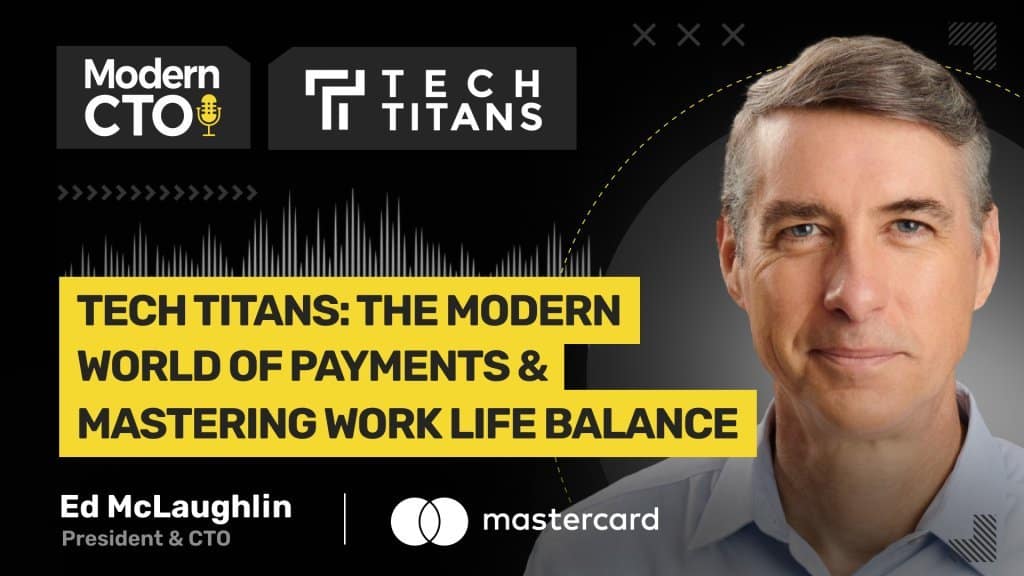
About Ed McLaughlin
I am President & CTO of Mastercard Technology and a member of the company’s management committee. In this role, I oversee all the company’s technology functions. This includes the global payments network, enterprise platforms, technology infrastructure and operations, information security and our global technology hubs.
Prior to this role, I served as Chief Information Officer, directing the development of Mastercard products and services.
In 2010, I was named chief emerging payments officer, leading the development and launch of the company’s digital strategy, partnerships and platforms, including Mastercard Send and Mastercard Digital Enablement System (MDES), the digital token program. I joined Mastercard in 2005 as head of Bill Pay and Healthcare, and was Chief Franchise Officer between 2008 and 2010, where I was responsible for the Mastercard global rules, licensing, brand standards and compliance programs.
Prior to joining Mastercard, I was group Vice President, products and strategy at Metavante (now FIS), a global Fintech that supports issuing and acquiring processing services, prepaid program management, the NYCE debit network, ACH processing and other services.
I joined Metavante in 2002 through their acquisition of Paytrust, an online payments company for which he was co-founder and CEO. Prior to co-founding Paytrust, I was the executive Vice President of product and marketing at LogicWorks, Inc., a data modeling company.
I am a graduate of the University of Pennsylvania, Wharton School of Business and in 2018 completed the AI: Implications for Business Strategy Executive Program at Massachusetts Institute of Technology (MIT). I am also a member of the Harvard Kennedy Business School’s Council on the Responsible Use of Artificial. In 2019, I was awarded the Forbes CIO Innovation Award.
About Mastercard
Mastercard is a global technology company in the payments industry. Our mission is to connect and power an inclusive, digital economy that benefits everyone, everywhere by making transactions safe, simple, smart and accessible. Using secure data and networks, partnerships and passion, our innovations and solutions help individuals, financial institutions, governments and businesses realize their greatest potential. Our decency quotient, or DQ, drives our culture and everything we do inside and outside of our company. With connections across more than 210 countries and territories, we are building a sustainable world that unlocks priceless possibilities for all.
Transcript
(Intro Narrator at 00:00:00) Today, we're bringing you an episode of Tech Titans, featuring our most valuable leadership insights from Mastercard's President and CTO, Ed McLaughlin. You're listening to Joel Beasley, Modern CTO.
(Joel Beasley at 00:00:17) I wanted to start with just helping me have an understanding of where payments are and what's happening in the payments world right now.
(Ed McLaughlin at 00:00:27) Yeah. And payments are one of the most dynamic parts, I think, of technology. If you've seen the rise of fintech, if you see the expansions that are going on. So I always say one of the great things about being at Mastercard is it's one of those anchored human activities. Like, we entertain ourselves, we chat with each other, we buy stuff.
(Ed McLaughlin at 00:00:46) If you think of how e-commerce and the Internet has evolved. So we provide the mechanisms that let people do what they want to do. Now, no one actually wants to do a payment. You're trying to do something else, and this is how we make it happen. So I see it moving in a couple of directions, the digitization of everything.
(Ed McLaughlin at 00:01:03) You know, we've all seen that. And I remember a few years ago where people thought what we did was that iconic plastic card. For me, that's just a token we used to have to give you to get you onto the network. So we're now seeing cars as embedded payment platforms. We're seeing everything we're doing through mobile applications, everything we're doing through digital applications.
(Ed McLaughlin at 00:01:22) As gaming gets more and more immersive, we're weaving payments into that experience. So your ability to buy stuff, to engage in commerce, to have access to everything on the Mastercard network, wherever you happen to be, that's been an amazing, amazing shift for us. The other big thing that's happening in payments though, which is probably even more exciting because these are things we can do for you and me. We're also using this new connectivity to reach and serve people we never could before. So quite a few years ago, it was 2014 at Mobile World Congress.
(Ed McLaughlin at 00:01:56) We said the Internet of Everything must lead to the inclusion of everyone. And we made a commitment to bring over a half a billion people into the formal financial system. Because if we can connect you digitally, but you're not connected financially, you're still cut off. So all of the options that we enjoy online, you don't have access to. Well, we did that.
(Ed McLaughlin at 00:02:20) We brought a half a billion people in, and we're working to bring the next half a billion people in. So it's new partners, working with government organizations, and just expanding the reach of the benefit that we can bring out to people. So it's an amazing time to be in payments.
(Joel Beasley at 00:02:34) Yeah. I was having a conversation with Sri from PayPal a couple months ago.
(Ed McLaughlin at 00:02:38) Yeah.
(Joel Beasley at 00:02:39) Yeah. He's a great guy. And Sri, I love you, but you need a better microphone. We'll send him a microphone.
(Joel Beasley at 00:02:46) That's one of the cool things about being the head of such a massive organization is you can run AirPods and get away with it because everybody wants to talk to you. But so I was talking with him, and he made a good example to me about future of payments. And he said that they're going to become sort of like in the background. So I forget the exact phrase, but he said when you go when you do an Uber, what's the exact moment that you pay?
(Joel Beasley at 00:03:12) And I was stunned. I was like, I don't know. It kind of happens in the atmosphere. Right? And like, background payments. And so I was curious, are we going to see more of that?
(Ed McLaughlin at 00:03:21) Yeah. The phrase we usually use for that is contextual commerce, where it used to be payment was a distinct thing. You know, maybe there's like a gray box terminal sitting there that you would interact with to do the ceremonial payment thing. What we're seeing more and more, and this is what happens with everything digital, that those APIs, that experience is woven into everything else you're doing. So if you're in a deeply immersive gaming environment, right, you want to be able to level up or do the next thing without it breaking the flow.
(Ed McLaughlin at 00:03:52) If you're in your car and you want to drive up to the parking gate and the toll to the parking garage and the gate opens for you and you go through, you just did a payment. So a lot of it is exactly that, is we're figuring out all the different contexts of what people are trying to do. And we share our roles to make that happen seamlessly and as securely as possible, because that only works if you have the right security, if you have the right parameters set up around it. But then we can bring all sorts of new and incredibly rich experiences.
(Joel Beasley at 00:04:22) Yeah. And I think about that because it becomes easier to live your life, but it also becomes easier to spend money. So I could see how there could be some negative side of that. But at the same time, you know, look, I'm an optimist, and I'm a technologist. And if you put a bunch of really smart people on making life really easy, that's just going to come along with it.
(Ed McLaughlin at 00:04:41) That's exactly right. And you're not deciding the payment. You're deciding what it is you want to do. And then we just make that safe, secure, simple, and really, really fast.
(Joel Beasley at 00:04:51) Are there any interesting ways people are doing sort of confirmation of these payments? Like, for example, in the Amazon store, you pick the different items and then you have this moment of checkout. But if you were talking about let's use your example of driving into the parking garage. Is there any sort of interaction or feedback that I'm getting from the system that's like, hey, if you continue to go, you're going to get this payment, or is it just completely seamless?
(Ed McLaughlin at 00:05:17) Well, I think there's two things for that. Right? And let's go engineering. Right? There's binding and telemetry, which always has to be involved on these things.
(Ed McLaughlin at 00:05:24) So the first of is very much when you say to do this thing. I want to use this Mastercard. I want to use it in this way. Sometimes we have limits you can set on it. And then there's also alerts and notification.
(Ed McLaughlin at 00:05:36) So you can get actually more feedback and more information about what you're doing, and you can subscribe to that. So it's essential that people feel like they're in control and know exactly what's going on, but you make it as easy as possible to use. So I think about first just how you set that up. This is the instrument I want to use. Here's how I want to use it.
(Ed McLaughlin at 00:05:55) Here's where I want to go. I'm going to have my car be able to talk to the parking garage. Great. And then how do you get that notification of the information so at your fingertips at all time, you can see exactly what's going on. You can turn it off.
(Ed McLaughlin at 00:06:08) You can turn it back on. And one of the critical factors, I think, for all of us to see that adoption of these new experiences is people want to feel like they're not losing any control, but they're getting all sorts of new convenience.
(Joel Beasley at 00:06:22) So most people think of Mastercard as a credit card or maybe a payment processor. Is that what it is, or are you in other services? Have you gotten into banking and other things?
(Ed McLaughlin at 00:06:33) So what we do, we're a technology services provider. Right? We don't issue the credit. We don't have the bank accounts. We don't do anything like that.
(Ed McLaughlin at 00:06:42) We run a network that we connect together, you know, billions of merchants, tens of thousands of banks, and bring all that together to enable the commerce around it. What we've been doing a lot over particularly over the last five to ten years has expanded the services we can do around that. So things like incredibly sophisticated fraud scoring that we can do, the information like the spending pulse that we talked about earlier. We have digital identity services. We have open banking service that we can provide, but it all gets back to that core value of how are we enabling commerce?
(Ed McLaughlin at 00:07:16) How are we leveraging the data information? How are we building on the technologies we have to really create new value, not only for the traditional banking and business or merchant customers that we have, but for governments, for the financial inclusion really across the system.
(Joel Beasley at 00:07:32) So when I apply for a Mastercard—
(Ed McLaughlin at 00:07:35) Mhmm.
(Joel Beasley at 00:07:35) That's being underwritten by a bank. So it's not Mastercard themselves doing that.
(Ed McLaughlin at 00:07:40) Yeah. From literally from our founding, what we are is a network that was designed to bring together even you know our iconic logo, the interlocking circles? It's really bringing together everywhere you want to shop, all the stores and retailers and everything else with your financial institution, whether it's a line of credit or your debit account or a prepaid account.
(Ed McLaughlin at 00:08:07) We're working with governments on CBDCs, central bank digital currencies around that. We have a big effort in account to account payments or sort of real time ACH payments around that. But the heart has always been enabling commerce and bringing together what you want to do, where you want to shop, where you want to go, what you want to buy with where your accounts are. So any institution that you want to work with will give you a Mastercard. That means we're the network that's going to handle the transactions for you.
(Joel Beasley at 00:08:38) And so when you look at your role on a day to day basis of running this or representing at least this side of the organization, where are the two, maybe three areas where you spend most of your time?
(Ed McLaughlin at 00:08:51) Sure. It's in a job like this, and I'm sure a lot of people listening to this podcast have a similar job. It's almost split brain. Because I always say the experience is the operation. It's keeping our promises every day.
(Ed McLaughlin at 00:09:05) It's making sure that every transaction counts, that we're focused on that. And so we really, really are obsessed with the run. But at the same time, you've got to build your future and what we're doing for modernization. And that's both the core modernization of the underlying network and what we're doing to anticipate what's going to happen next. Like we talked about earlier to apply research and incorporate new technologies like we've done with AI and the fraud engines to always make it smarter and always make it better.
(Ed McLaughlin at 00:09:34) And then probably what's most exciting for me is how can you solve problems you've never solved before? So just like a decade ago, we were working with the mobile majors to make their smartphones platforms for commerce. You know, we're working with automotive companies now because your car is just a computer on wheels. So what's the contextual commerce from there? And so all the ways we can make people's lives easier, bring in new capabilities.
(Ed McLaughlin at 00:10:01) We talked a lot about the services we build, you know, what are new services that naturally fit in with what we're doing. So it really is saying as society and consumer behavior changes, how are we constantly adapting and incorporating through that? And, you know, over and over, what we're designing today will determine the future. So I think for everyone, it's how do you have that kind of split brain of making sure everything's working and always being ready for what's next. I had great advice years ago to do a job like this.
(Ed McLaughlin at 00:10:34) And it was, you know, you've got to know when to be on the dance floor and when to be on the balcony. And you can't spend all your time in either place, and you've got to know contextually when you should be where. And that's kind of what the job's like.
(Joel Beasley at 00:10:48) Yes. It's definitely part art. The quantum storm, quantum computing, that's been a word that's thrown out a lot. You know, breaking encryption was an interesting one. I talked with a couple people. They had said that we have quantum safe encryptions. This was about a year ago, and they said that the only difference between the quantum safe and the non quantum safe is that the quantum safe took longer, and this was in specifically in relation to blockchain technology. How are you thinking about quantum computing?
(Ed McLaughlin at 00:11:24) Well, the first thing I'm not sure who you're talking to. I would correct them. I wouldn't say it's safe. I would say it's resistant because, you know, the so at a minimum, I think a lot of people look at the current technology we use for public key encryption is really based on something that's really hard to calculate.
(Ed McLaughlin at 00:11:42) So if you had a computer that could calculate that in a substantially better way, then there's real risks there. If there's something called Shor's algorithm, which is how you can factor large primes and, you know, from a risk standpoint, therefore, you say, look, in a indeterminate time frame, there's something that could have a massive negative impact. So that puts you pretty high on your risk radar. So we're doing a couple of things for that. Moving away from straight RSA, we've incorporated things like elliptical curve cryptography.
(Ed McLaughlin at 00:12:11) The NSA has just put out a set of recommendations for what I would call quantum resistant techniques that we already and have already incorporated into some of the work we're doing on the network. There's national and global standard boards that we participate heavily in. Because a lot of times everyone's got to make it work for it to work for everyone. So there's a group called EMV, which does the, remember the old chips that you would glue to a plastic card. They defined all the standards around that. We're working with them as a standards body for how do you make sure it will have quantum resistant encryption on that.
(Ed McLaughlin at 00:12:46) And then the other thing is the technology which could be a problem could also be the solution for it. So, in fact, I just won an award on this one. I'm kind of proud about it. We've already tested quantum key distribution, QKD, where you use actually entanglement to secretly move, in essence, not a field that could be calculated, but a one-time key, which is incredibly secure, a truly randomized key to all points in the network. So, therefore, you don't have to worry about a quantum computer breaking the encryption because there's nothing to break.
(Ed McLaughlin at 00:13:19) There's no problem to solve. So we already tested that out. We worked with some great partners, Arista, Cisco, Verizon, but we were able to demonstrate using fiber. So you have about a 100 kilometer, I think, distance for this, but we could show that the network we're putting in place, our backbone would be ready for quantum key encryption. So that's the sort of forward looking handicapping you do.
(Ed McLaughlin at 00:13:37) I don't know if we're ever going to need it. I don't know when we're going to need it, but, you know, our baseline systems are ready for it. And then last one on quantum, you get to the business driver side, which is, you know, are there incredibly hard problems that we need to solve that this could solve in a new way? So we've seen a lot in things like drug research. It looks like there's really potentially interesting things there.
(Ed McLaughlin at 00:14:01) Well, if you think about it, we have all of that information that's coming from the transaction flow. And the ability to distill new information from it by applying powerful new analytical techniques is something we've been working on. We did a deal with D-Wave a while ago to do some primary research on that. So I think there's always a question of clarity versus proximity. I think some of the impacts of quantum computing are quite clear.
(Ed McLaughlin at 00:14:26) The question is how far away is it, and our view there is just something you plan for and get ready for.
(Joel Beasley at 00:14:32) I want to talk a little bit about leadership. I'm watching the time too. We will get you out of here on your hard stop. Everybody's going to be happy.
(Ed McLaughlin at 00:14:38) Thank you.
(Joel Beasley at 00:14:39) But I did, I saw empathy written a lot in your bios and then in different descriptions. I was like, alright, this guy likes the word empathy. There's got to be a story there. Can you explain your experience with empathy?
(Ed McLaughlin at 00:14:51) So many things. When we were, I was just doing a tech strategy for our board. And one of the things I always say is in the end, any tech strategy is just a people and talent strategy. Technology doesn't do anything. It's who we are and what we do with it. So I think our primary role as technology leaders is to create environments, to create a space where people can do their best work.
(Ed McLaughlin at 00:15:21) And if you want that, you've really gotta understand and honor the work that they're doing. And so I think a lot of times we get so fascinated with the how it works, and we don't quite spend enough time on who does it and what it means to them. And we ask, all of us, ask tremendous things out of our people. When you asked earlier about Mastercard and knowing what we do is important. And when things go wrong, when things break, because they always do, it's just amazing to be at our facility here and see people come in with, like, bunk rolls because they will not rest until those problems are under the ground.
(Ed McLaughlin at 00:15:59) And at that point, you can just only be grateful for that. And the other thing I'd say is my early career, most of my early career, I had three startups. And, you know, fortunately, they all made it. Right? They're all successful there.
(Ed McLaughlin at 00:16:13) But what you realize is when you have no brand, you have no customers, you have no revenue, barely have a product yet, the whole company is just the product of the people who show up every day to make it happen. And I think in many companies, and it's something I don't wanna miss at Mastercard. You know, we're standing on the shoulders of giants who helped build the organization, incredibly successful for over fifty years. But you gotta realize all of that is just a product of the dedication, will, and skill of the people who came in every day to make it happen. And so that's where I start.
(Joel Beasley at 00:16:48) I've been seeing that in, well, as you just described it in your company and Tesla, SpaceX. There are these certain companies that they'll get this core group of people who really genuinely wake up every day because they understand that this is their contribution in life and into society. And to me, I am so grateful for those people because my life depends on all these amazing things working really well and working together. So I like getting to, you know, I do a lot of these conversations.
(Joel Beasley at 00:17:22) I think we're, like, north of 700 now. So the culture there, the way you describe it, I don't think I've ever gotten that answer before. I've gotten the answer a lot when hiring about curious people. We like curious people. We like problem solving. But I don't think I've ever gotten that answer that you gave me where you said the people that really truly care about this specific problem. I think a lot of people are almost scared to say that because they don't wanna alienate people or lower their recruiting numbers or anything like that. But when you find greatness, and I can tell that there's greatness within Mastercard. When you find that, I wanna study it. You know? How are they doing that?
(Ed McLaughlin at 00:17:59) Yeah. And, you know, maybe it's a little bit about myself, but my wife in the past referred to me as binary boy. Like, you gotta be all in. Like, what we do, either I'm done or I'm all in. Because what we do, it just takes so much out of people, and there should be a passion there. And, you know, I've always felt whether it's the smallest startup, like, literally two guys and a blank piece of paper to what we're seeing at Mastercard, just get people who are really smart, absolutely committed to the cause, and not being a jerk about it. And that's where magic happens.
(Joel Beasley at 00:18:32) From a leadership perspective, you mentioned your wife, your family. How have you been able to have such a notable career and do well and solve these problems, but also be able to lead your family?
(Ed McLaughlin at 00:18:46) Yeah. That's, um, and this is something I talk to people a lot about. You have to find what works for you. And I'll tell you what I learned doesn't work for me. I do not timeshare well. Right? So what I try to do is when I'm home with my family, I try to be all the way there with them. And I remember years ago when, like, the Blackberry was the Crackberry, and I never wanted my kid to think, like, this was more important than them. So I had, like, a secret room in my house that I would leave it. So if I had to go, I would do that.
(Ed McLaughlin at 00:19:19) But I see that all the time. It breaks my heart where, like, someone's holding a device, they're literally pushing their kid away. Right?
(Ed McLaughlin at 00:19:27) So what I try to do is, task switching is incredibly expensive, right, just from a processing standpoint. So when I'm working, and I also travel a lot, which in an odd way helps, I'm sort of twenty-four-five. But when I'm home with my family, I wanna bring an equal commitment to that. And I want them to know that they are the most important thing in the world, that I'm gonna have to go away and do other stuff.
(Ed McLaughlin at 00:19:51) So I know people and they're fantastic at it, and they can be on the sidelines at their kid's game and just knock off a couple of emails, and they do that. My brain doesn't work that way.
(Ed McLaughlin at 00:20:01) So the first thing I tell everyone is find what works for you. But just like we talked about, if the work's important to you, your family's gotta know that they are the most important thing. And the other thing I'll say as a leader, you gotta live that. If somebody's got something with their family that is more important than what we're doing, and that's where the team is the strength, let them know you'll cover for it. Let them know that, look, all this will be here for you when you get back, and we need you to take care of your business so you can be all here to help us with our business. So I really, like we talked about earlier, I'm binary about that, where I really try to say this is my context now, and then I'll switch into the other context. In fact, my daughter used to catch me. I have a tell. When I start really thinking about work, my right hand floats up, and she would catch me and, like, grab it and pull it down.
(Ed McLaughlin at 00:20:54) And so then I'd switch back to the right context. So that's what I tell people, figure out what works. Some people are great at time slips and interleaving, and they can do that. I'm just really bad at it, so I play it differently.
(Joel Beasley at 00:21:06) Yeah. I'm exact, I'm like you. I can't, if I'm in the email, I'm in the email. I'm not even at the game. And to your point of leading your family, the better job I do at home, the more stable of a foundation and supportive of a foundation I have, the better my performance. They're entangled with certainty.
(Ed McLaughlin at 00:21:27) Yeah. Yeah. And there's probably a third piece of that. I assume you have the same too, but it's also giving yourself time to think because it is really easy, and there's always the next thing happening and the next thing to go after and all that. So I intentionally carve out, I'm a pretty passionate runner and I don't do music. I don't do anything. And I just use that to, like, grind on problems. It was a joke I have, you know, how many miles is this one? But it gives you that time. And I think people sometimes also don't give them that space and they think it's a luxury, not a necessity. And you really do have to find a way where you can just think about the stuff you're trying to untangle. And particularly if you have an operational-focused job, there's always the next ticket coming in, next thing happening on the stack, next thing like that. So I think that's an equally important part of the algorithm.
(Joel Beasley at 00:22:23) Have you gotten to mastery of that? Meaning, when you know you need to go on the run, you go on the run, like, right away. Because when I started, my first experience, when I was engineering, when I was younger, writing a program, I would have this problem, and I knew I need to take a break. But, like, I wouldn't wanna take a break because I wanna solve. But I knew I needed to, and that would be the answer. And so as I got older and further along in my career, I got better at that, but I'm by no means, like, a master. It still gets at me, and I still have, or have you mastered it? Is that possible?
(Ed McLaughlin at 00:22:58) Well, particularly with scheduling, it's not usually a run, but I do find, I always say the longer you go without going outside, the dimmer you get. So I will force myself to break context. I will say I'm just churning here. And get up, take a walk. Like, you don't lose the problem, but you force yourself to look at it differently. I think that that is a key.
(Joel Beasley at 00:23:22) Well, Ed, you are a brilliant human being. I love the culture over at Mastercard and our time together today. We made a podcast, man. How do you feel?
(Ed McLaughlin at 00:23:31) All right. Well, it's great talking to you.
(Ed McLaughlin at 00:23:34) And I'd love to do it some more, man. Let me give it back to you. I think very insightful in the questions you had there. And these are big topics. These are really important topics, and I think really what's happening is these are societal topics that are just sort of expressing themselves through technology, and we really do have to take the time to think about it.
(Joel Beasley at 00:23:51) Thank you so much for listening. And if you found this episode useful, please share it with a friend or colleague who you think would get value from it. And if you have topics that you'd like to hear discussed on the podcast, either add me on LinkedIn, or send me an email, [email protected]. Every time I get an email or LinkedIn message, it absolutely makes my day and inspires me to keep going.